China cherry blossoms: choose a corridor, not a promised peak day
China's cherry season is not one pink wave moving neatly north. Early cultivars can flower in Shanghai, Wuhan and Wuxi while the best-known pale canopies are still closed. Main-season trees can then open quickly after warm days, and later double-flowered cultivars may continue after the famous avenues have turned green.
That makes a “national peak date” almost useless. The practical decision is which city remains worth visiting if the blossoms are early, late or damaged by weather. Build one movable blossom day into a larger city or rail route, watch current official updates, then use dated photographs to choose the exact park.
Every window in this guide is a historical planning range, not a forecast or bloom promise. Temperature controls development; rain and wind late in full bloom can strip flowers quickly. The China Weather Network's phenology explainer documents a Wuhan season in which heavy rain removed much of a full display almost overnight. A warm February can advance early cultivars without moving every later cultivar by the same amount.
The decision in 30 seconds
| If you want… | Choose | Minimum useful stay | Why it works | Main risk |
|---|---|---|---|---|
| The strongest dedicated blossom trip | Wuhan | 3–4 nights | East Lake has scale and many cultivars; Wuhan University adds architecture if you secure entry | Severe approach congestion and annual campus reservation rules |
| A flexible multi-city flower route | Shanghai–Wuxi–Nanjing | 6–8 nights | Frequent rail, several cultivar stages, strong non-flower city days | Each park can peak on a different date |
| A half-day historic-city blossom walk | Nanjing | 2–3 nights | Jiming Temple Road, city wall and Xuanwu Lake connect naturally | The famous road is short and extremely crowded at peak |
| A large planted grove while already in Shanghai | Gucun Park | Half or full day | Many cultivars and a long programmed festival season | Peripheral location; weak reason for a special Shanghai trip without live bloom proof |
| A spring add-on to a Beijing trip | Yuyuantan Park | Half day | Broad cultivar sequence and easy city backup | Event dates are much longer than any one cultivar's peak |
If blossoms are the primary purpose, choose Wuhan or the lower-Yangtze rail corridor. If China history, food and neighbourhoods are the primary purpose, treat Beijing, Nanjing or Shanghai blossoms as one adjustable block.
A planning calendar, from early to late
| Historical planning window | Places to investigate first | What may be flowering | How to use the window |
|---|---|---|---|
| Late February–early March | Gucun Park, East Lake, Yuantouzhu | Scattered early pink cultivars | Good for travellers already nearby; too early to promise a mass pale canopy |
| Early–mid March | Shanghai and Wuxi early zones; Wuhan early cultivars | Early trees plus the beginning of broader succession | Check official daily updates and current wide-angle photos before travelling outward |
| Mid–late March | Wuhan, Nanjing, Shanghai, Wuxi | The most likely period for famous single-flowered avenues in central/eastern cities | Highest visual upside and highest weekend crowd risk |
| Late March–early April | Wuxi, Shanghai later zones, Beijing beginning or building | Main and later cultivars overlap in different parks | Strongest corridor flexibility; move the park day after checking conditions |
| Early–mid April | Beijing later cultivars; selected northern cities | Later double flowers and northern displays | Better as part of a northern city trip than a cross-country flower chase |
The table deliberately uses overlapping ranges. In 2026, Shanghai reported several early cultivars already at a strong stage in the first week of March, Wuhan's city garden experts forecast the main mid-season cultivars later in March, and Beijing's large Yuyuantan program opened on March 18. Those are records from one year. They illustrate sequence; they do not establish next year's dates.
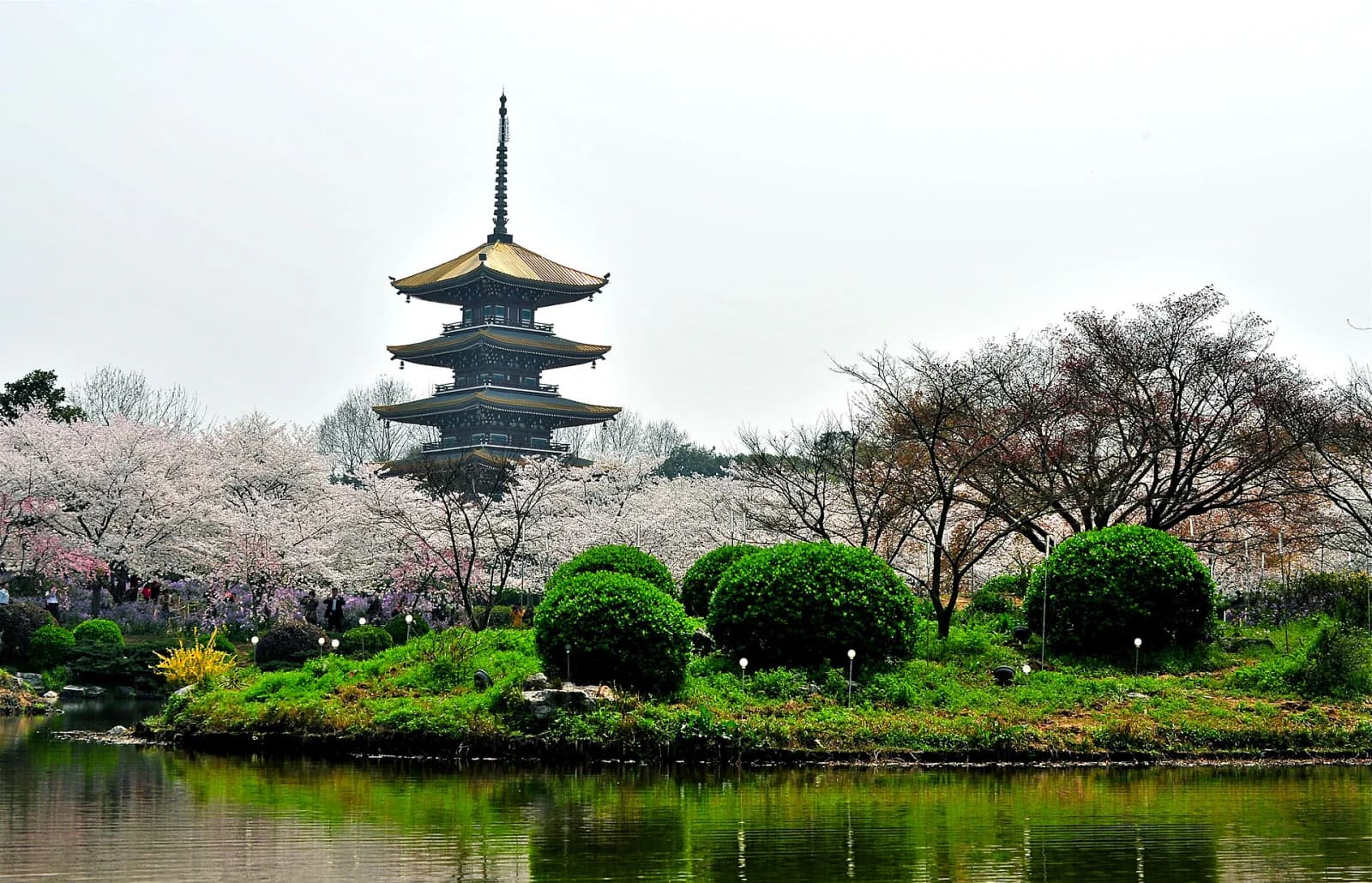
East Lake's large garden and landmark compositions make Wuhan the clearest blossom-first city. The photograph documents the place, not current flower conditions. Photo by Wuchernchau, resized from the original, CC BY-SA 4.0.
1. Wuhan: the best city for a blossom-first trip
Wuhan earns a dedicated trip because it offers two different experiences. East Lake Cherry Blossom Garden is the large, managed flower destination. Wuhan University is a working campus where blossoms sit among historic buildings and Luojia Hill. They are not substitutes reached through the same gate, and trying to force both into one peak-weekend morning often produces more queuing than viewing.
Choose East Lake for scale and a wider date range
The official 2026 East Lake season had more than 100 cherry cultivars, with early, main and later groups opening in succession. The garden opened on March 1 that year, and official reporting described the main period as roughly mid-March into early April. Its 2026 hours, night program and ¥60 ticket belonged to that specific season; do not carry them into a future booking without checking the current Wuhan government announcement or the scenic area's official channel.
Choose East Lake if you want broad lawns, dense groves, water and pagoda compositions, or if your dates sit outside the narrow strongest week for Wuhan University's best-known avenue. Many cultivars improve the odds of seeing something, but they do not mean every part of the garden will be equally full.
The hard part is arrival. During the 2026 season, Wuhan introduced temporary traffic restrictions and seasonal public-transport links around the scenic area. Visitor reports repeatedly described short road distances taking an hour at weekend peaks. Treat any seasonal shuttle, boat or gate recommendation as year-specific. For a future trip:
- check the current official traffic notice 48 hours before the visit;
- use metro plus an official seasonal connection when offered;
- avoid putting the garden after a timed museum or before a flight;
- arrive near opening on a weekday, or choose night viewing only after confirming that year's illuminated zone and last entry;
- carry little luggage even when a season offers storage, because the approach and return queue remain tiring.
Choose Wuhan University for architecture, only with official entry
Wuhan University and Luojia Hill are more intimate. The draw is the relationship between blossoms, the old library and dormitory buildings, stairs and campus terrain. It is also a university, not a public garden.
The university's official English policy example described real-name reservations, daily visitor limits, designated gates and ID checks. It accepted valid travel documents, barred visitor vehicles and kept teaching buildings, dormitories and student dining closed. Dates and quotas change. Use the current Wuhan University website or its verified official WeChat account; ignore anyone selling a “guaranteed” unofficial entrance.
If you fail to reserve, do not wait outside hoping the rule will disappear. Go to East Lake, East Lake Greenway or another open park. If you do enter, plan a respectful two-to-three-hour campus walk rather than treating every doorway and dormitory stair as a photo set.
A resilient three-night Wuhan plan
- Arrival day: stay in a metro-connected Wuchang area; walk the riverfront or Tanhualin.
- Movable blossom day: use the clearest, calmest weekday for East Lake. Do not pre-book a hard evening connection.
- Second full day: use a successful official university reservation, or visit the Hubei Provincial Museum and East Lake Greenway.
- Departure margin: keep Yellow Crane Tower or the Yangtze ferry and riverfront as the no-flower anchor.
This structure still works if rain damages the main canopy. Wuhan remains a worthwhile city; the blossom is the seasonal layer, not the only product.
2. Wuxi Yuantouzhu: the strongest lakeside choice
Yuantouzhu Scenic Area combines Taihu Lake, the Changchun Bridge area, Sakura Valley and garden architecture. Its value is the blossom-and-water composition. The trade is that the scenic area is not beside the main railway station, and the final approach becomes the day's planning problem.
Wuxi's government scheduled the 2026 Yuantouzhu festival from March 1 to April 15 and described early, middle and late cultivars, including new later-flowering trees. That is a festival program and one season's horticultural sequence, not proof that every week offered the same canopy. A traveller arriving in late February could see vivid early pink trees but miss the broad pale “snow” effect; someone arriving in mid-April might see later double flowers rather than the classic Changchun Bridge scene.
Gate and transport choices matter
Recent visitor reports split between Chongshan Gate, the large formal entrance, and Dushan Gate, a smaller approach that can be useful when the year's transport service supports it. Wuxi's 2026 transport notice explicitly asked visitors to prioritise public transport and listed seasonal metro-to-gate shuttles. Routes and operating times are temporary. Confirm the exact gate printed on your ticket or shuttle notice instead of copying an old social post.
For a blossom-focused day:
- Sleep in Wuxi the night before or arrive very early on a flexible rail ticket.
- Follow the current official public-transport plan to a named gate.
- Put Sakura Valley and the Changchun Bridge/lakeside area before optional boat travel.
- Skip the Taihu island excursion if queues are long and the flower landscape is your priority.
- Leave before the final outbound surge, especially if connecting to an evening train.
Yuantouzhu is worth a dedicated Wuxi day when current images confirm a useful stage. Without flowers, the lake and gardens remain pleasant, but they do not automatically justify cutting a day from Shanghai or Nanjing. Huishan Ancient Town is a better second-day anchor than repeating another uncertain blossom park.
3. Nanjing: the best short historic walk
Nanjing's famous blossom experience is compact: Jiming Temple Road, Ancient Jiming Temple, the Taicheng section of the city wall and Xuanwu Lake fit into one continuous half-day. The flowers frame yellow temple walls, gates, lake water and a modern skyline; the city context matters more than the number of trees.
In 2026, Nanjing police reported only scattered opening on March 23 and expected the following weekend to become the popular viewing period. The same notice warned that parking was extremely limited, recommended Metro Lines 3 or 4 to Jiming Temple station and allowed for temporary traffic controls. This is a useful model for planning: a viral “Nanjing is blooming” post can precede the busiest display by several days, while the crowd response can become intense almost immediately.
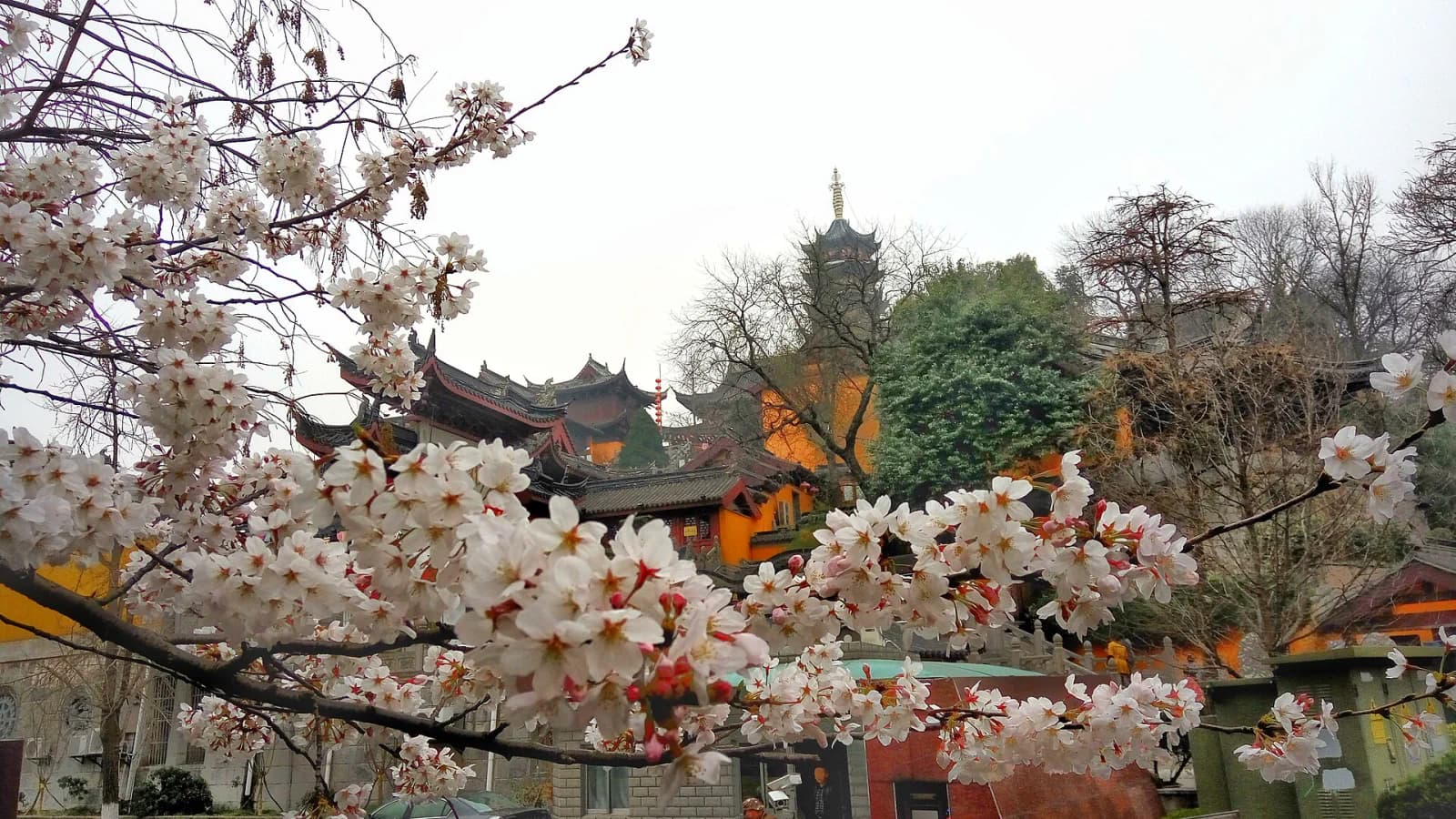
Jiming Temple works because blossoms and historic architecture share one frame. The photograph is a place reference, not a live bloom report. Photo by Haha169, resized from the original, CC BY-SA 4.0.
Start shortly after daylight on a weekday. Walk the public road first, then enter the temple only if you want the religious and architectural visit. Continue through the city-wall/park side and finish at Xuanwu Lake. Do not block traffic for a portrait, fly a drone near the temple or wall, or expect a quiet tripod setup at peak.
Nanjing is still worth visiting after wind or rain. The temple, wall, lake, Nanjing Museum and Purple Mountain preserve the trip. That resilience is why Nanjing belongs in a flower route even though its iconic blossom road is short.
4. Shanghai Gucun Park: go for the grove, not the city centre
Gucun Park sits in northern Shanghai, away from the Bund and the plane-tree neighbourhoods most first-time visitors imagine. It makes sense when you want a large planted grove and current conditions are strong, or when the annual festival's night program is part of the goal. It is not a quick sunrise stop before the Bund.
The 2026 Shanghai Cherry Blossom Festival ran from March 9 to April 9. The official city notice counted more than 16,000 trees across 120 cultivars and separated early-season and middle/late-season night-viewing zones. Early cultivars were already reported at a strong stage before the opening. This shows why one “Shanghai peak” label is misleading: the best gate and area changed with the cultivar sequence.
The current annual notice should answer four questions before you go:
- Which gate is closest to today's strongest area?
- Does the date require advance booking, including for reduced or free admission categories?
- Is night viewing operating, and which zone remains open?
- Has the park issued a crowd or transport notice?
In 2026, Gate 2 connected directly with Gucun Park station on Metro Lines 7 and 15, while official tickets were sold through park channels. Recheck both details for your year. A weekday opening-time visit provides more usable paths than a weekend afternoon. Night viewing spreads arrivals but creates its own last-metro and exit surge.
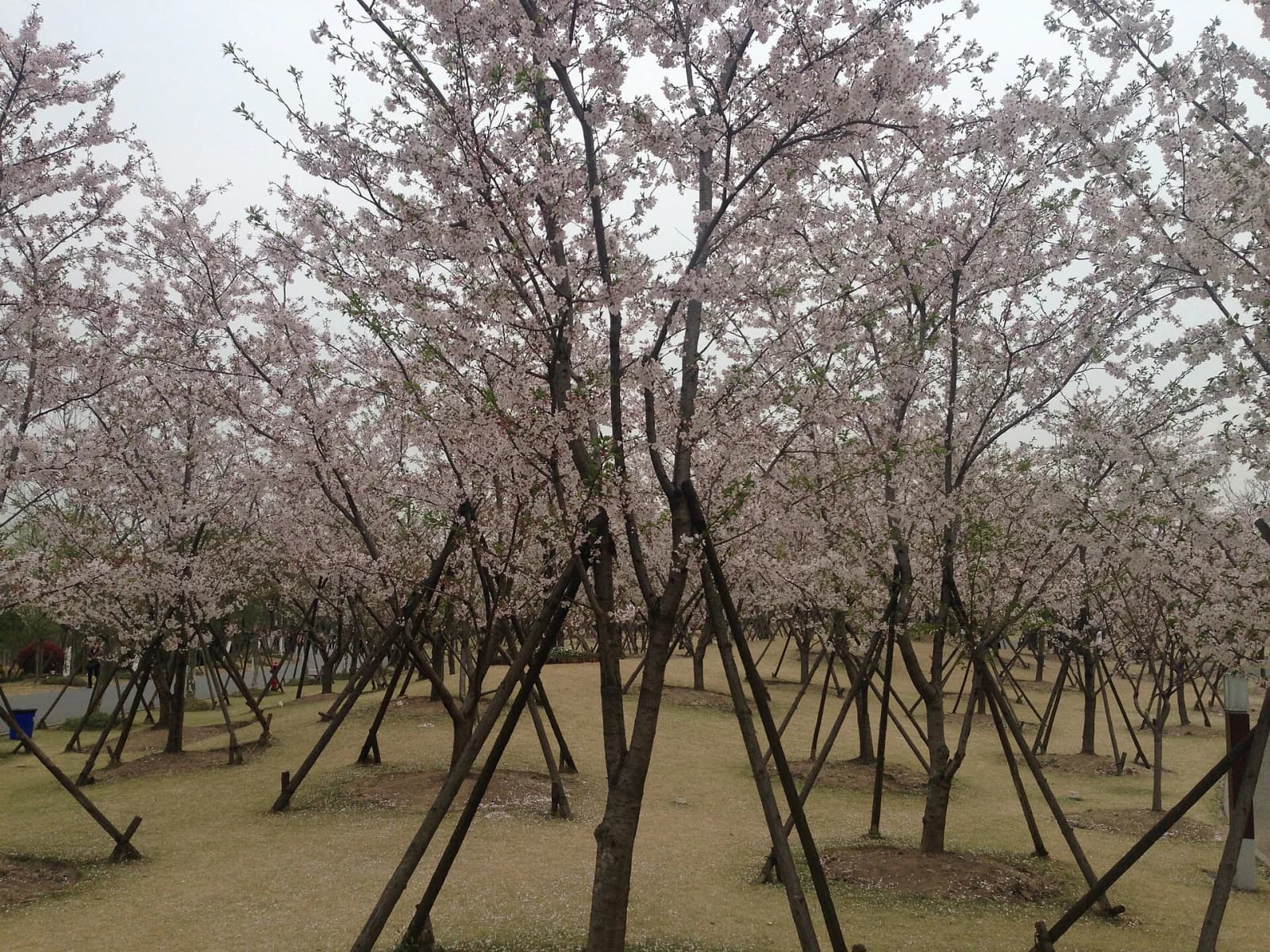
Gucun's appeal is the scale of its planted groves. The photograph documents the park in 2016, not the current stage. Photo by SSYoung, resized from the original, CC BY-SA 4.0.
Without convincing current bloom, skip the cross-city ride. Use Shanghai Natural History Museum, M50 and Suzhou Creek or the Wukang Road area instead. Shanghai does not need cherry blossoms to justify the stay.
5. Beijing Yuyuantan: an add-on, not a national chase
Yuyuantan Park is Beijing's headline cherry collection. The park's official 2026 spring program opened on March 18 and described more than 3,300 trees across more than 50 cultivars. The program continued far longer than one peak because different trees, forced indoor displays and other spring flowers were involved. Do not read an event end date as “cherries peak until then.”
Choose Yuyuantan when Beijing is already on the itinerary. Keep half a day movable, check the official park channel for current flowering areas and ticket rules, then visit on a weekday morning. An early cultivar photographed in late March and a double-flowered tree photographed in mid-April are both truthful Yuyuantan images, but they describe different experiences.
Yuyuantan is a weak reason to fly to Beijing alone. If flowers are late, spend the day on the Beijing Central Axis, at the Forbidden City or in the Summer Palace. A full Beijing trip absorbs bloom uncertainty better than a one-day park mission.
Three routes that remain useful when timing shifts
Route A: six to eight nights, Shanghai–Wuxi–Nanjing
This is the strongest first choice for travellers who want blossoms but cannot change international flights around a three-day forecast.
- Nights 1–3: Shanghai. Keep one half or full day movable for Gucun. Use the city centre on weak-bloom or wet days.
- Nights 4–5: Wuxi. Give Yuantouzhu a full day and sleep before the visit. Use Huishan Ancient Town if current blossoms disappoint.
- Nights 6–8: Nanjing. Take the Jiming–wall–Xuanwu route at the quietest workable time and retain museums/history as backup.
The corridor is served by frequent trains, but “Shanghai,” “Wuxi” and “Nanjing” each have multiple stations. Choose the station by the next hotel and attraction, not by the shortest advertised ride. Read the China high-speed rail planning guide, then compare an exact date and station pair on Trip.com trains. Keep park tickets, festival reservations and train tickets as separate checks.
If live conditions show one city clearly stronger, add a night there and cut a weaker flower day. Do not commute Shanghai–Wuxi–Nanjing in both directions merely to preserve every hotel reservation.
Route B: three or four nights in Wuhan
Use one East Lake day, one cultural/campus day and one flexible city day. This is the best choice when the flower landscape is the main reason to travel. It also has the highest consequence for arriving on a peak weekend without a transport plan.
Book a metro-connected base, not a hotel whose English name simply includes “East Lake.” The lake is large, and a pin on the wrong shore can create a long morning ride. Check the exact map location and current approach before reserving on Trip.com hotels.
Route C: five or six nights in Beijing, with one movable spring day
Use Yuyuantan as one half-day within a history-focused Beijing trip. This is the safest structure for early April or for travellers whose international flights already use Beijing. It is not the right structure for someone whose only acceptable outcome is a dense cherry tunnel.
If the park report is weak, move directly to an imperial site or a neighbourhood day. If conditions are strong, go early and keep the afternoon indoors or nearby rather than stacking another distant timed attraction.
Crowd strategy that changes the experience
“Go early” is useful only when it becomes a complete plan:
- Sleep on the correct side of the city. A 06:30 alarm does not help if the park is a 90-minute cross-city trip.
- Choose a weekday. Peak-weekend roads and metro exits can erase the advantage of a beautiful canopy.
- Know the gate. This matters most at Yuantouzhu and Gucun, where seasonal routes can point to different entrances.
- Carry breakfast and water, not a picnic setup. Food queues consume the quietest hour; large equipment is awkward in dense crowds.
- Leave one direction open. Walk deeper into a large garden before stopping at the first crowded tree. At Nanjing, keep moving toward the wall and lake.
- Set a turnaround time. Return transport can become harder than entry. Do not risk a same-evening flight on a peak blossom day.
A tripod, costume shoot or long portrait session needs more space than a normal visit. Choose a less famous grove or a weekday later-cultivar area. Do not use branches as props or step into protected planting beds for a clear background.
How to check bloom three times
Two to three weeks before
Read the official festival or park notice. Confirm whether the site uses reservations, real-name ID, dated tickets, capacity limits or seasonal gates. For Wuhan University, use only university-controlled channels. For parks, prefer the municipal government, park or scenic-area account over a reseller summary.
Three to five days before
Compare dated, wide-angle images from the exact park. Close-ups prove only that one branch opened. Look for the canopy, ground petals and leaf development. Check the weather after the image date: several warm days can accelerate opening, while strong wind or heavy rain after full bloom can shorten the useful display.
The night before
Check transport restrictions, opening hours, entry gate, last admission and severe-weather notices. Move the flower day when conditions improve. A flexible itinerary is more valuable than a confident month-old forecast.
Rain, wind and the “petal carpet” trade
Light rain before full bloom can produce soft light and fewer visitors. Persistent rain makes paths slippery and photography harder. Wind late in bloom can turn a full canopy into a petal-covered ground within hours.
A petal carpet is not a failed visit if the park still has later cultivars and a strong landscape. It is a failed premise if you booked a distant place only for dense overhead flowers. Judge the whole scene rather than the percentage printed in an app.
After a damaging weather event, use this order:
- check another cultivar zone in the same park;
- check another nearby city within the same corridor;
- keep the city and replace the flower day;
- do not buy an expensive last-minute cross-country ticket for another unverified forecast.
When each place is worth a special trip
East Lake: yes, when current official and dated visual evidence show a useful stage. The garden has enough scale for a flower-first day.
Wuhan University: no as the sole reason. Entry is limited and the campus's value comes from architecture and atmosphere. Pair it with East Lake and Wuhan culture.
Yuantouzhu: yes for a lakeside blossom composition, provided you give Wuxi a night and solve the current gate/transport plan.
Jiming Temple Road: no as a stand-alone city transfer. Yes inside a two- or three-night Nanjing stay.
Gucun Park: usually no as the sole reason for Shanghai. Yes when a current mass display or confirmed night program fits an existing Shanghai stay.
Yuyuantan: no as a national blossom chase. Yes as the movable spring half-day in Beijing.
What to do when the flowers are absent
A robust trip has a replacement that does not feel like consolation.
- Wuhan: Hubei Provincial Museum, Yellow Crane Tower, the Yangtze ferry and East Lake Greenway.
- Wuxi: Huishan Ancient Town or a broader Taihu garden day; keep Yuantouzhu only if you also value the lake.
- Nanjing: Jiming Temple, city wall and Xuanwu Lake still form a coherent route; add Nanjing Museum or Purple Mountain.
- Shanghai: return to central neighbourhoods, museums and the river. Skip Gucun if the long ride no longer has a seasonal payoff.
- Beijing: use the city's imperial and neighbourhood itinerary. Yuyuantan is easy to remove without weakening the trip.
This is the central rule of cherry-blossom travel in China: book a good region, then choose the flower day late. The best trip survives green branches, rain and a missed peak. The blossoms improve it; they do not hold it hostage.