Summer Palace Beijing
The Summer Palace (颐和园, Yíhéyuán) is an expansive royal masterpiece of court halls, painted corridors, Longevity Hill, and the sweeping waters of Kunming Lake. Far from a single palace building, it is one of the world's greatest imperial garden landscapes. A rewarding first visit can be either a focused 3–4 hour highlights route or a comprehensive 5–6 hour full-landscape day. Trying to circumnavigate every shoreline and enter every ticketed interior in one go usually leads to exhaustion rather than appreciation.
Your most important planning decision is choosing your entry and exit gates. East Palace Gate (东宫门) introduces the imperial court sequence in logical historical order. North Palace Gate (北宫门) offers direct access to Metro Line 4 and begins with Longevity Hill, though it starts with steeper stairs. New Palace Gate (新建宫门) is ideal for accessing the Seventeen-Arch Bridge and the open lakefront, but bypasses the classic introductory court halls.
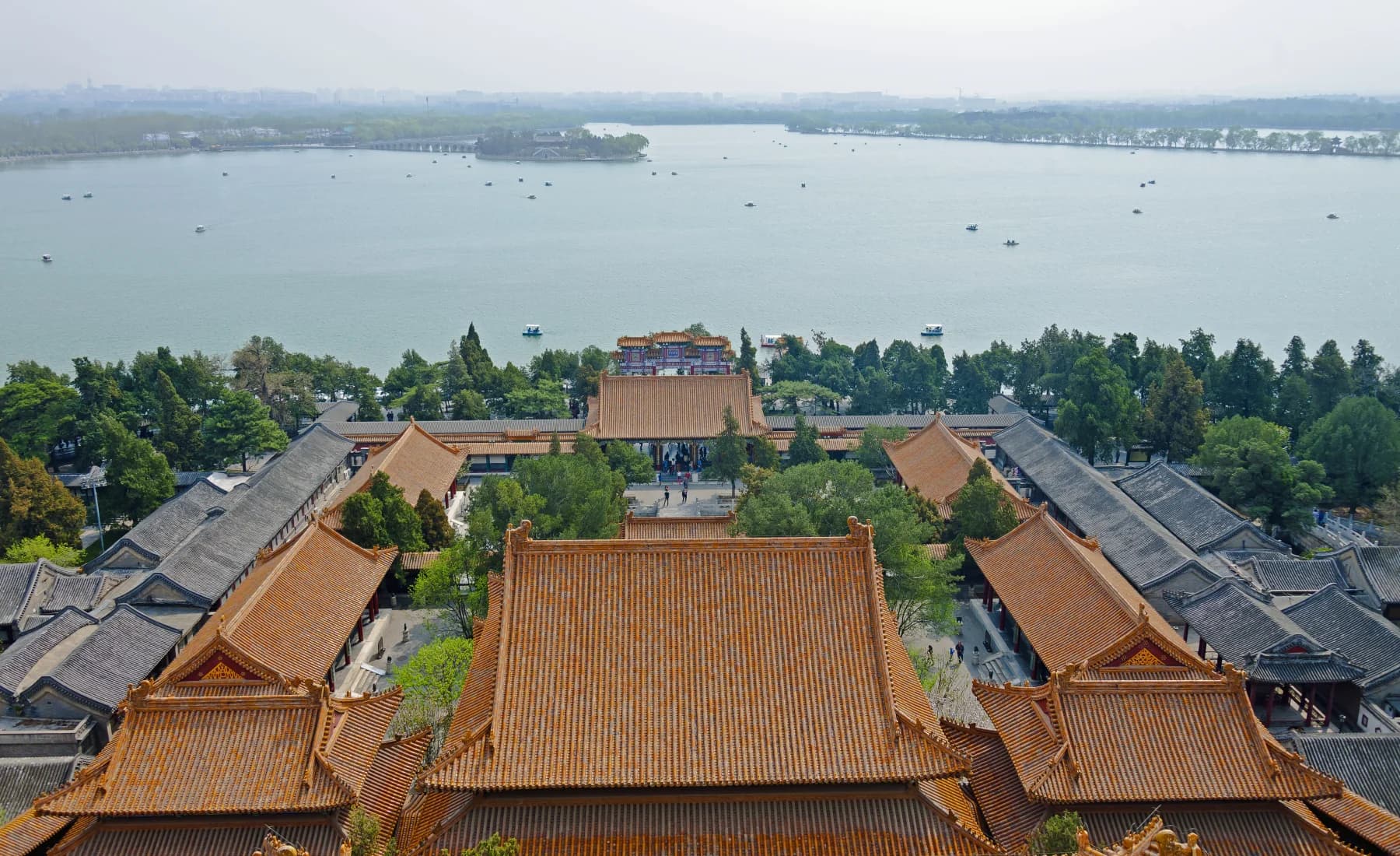
Photo: Daniel Case · Source · CC BY-SA 3.0
Tickets and Passports
Official Beijing park regulations distinguish between standard park admission and an all-inclusive combined ticket covering separately charged interior attractions. Published rates are:
| Product | Peak season, Apr 1–Oct 31 | Off-season, Nov 1–Mar 31 |
|---|---|---|
| Park admission | CNY 30 | CNY 20 |
| Combined ticket | CNY 60 | CNY 50 |
The combined ticket is not necessarily the best choice for everyone. Purchase it only if the included heritage sites are open and you have the time and energy to explore them. Climbing the Tower of Buddhist Incense involves numerous steep stone steps, while Suzhou Street and other side attractions can distract from a smooth, coherent first-time route.
International visitors can purchase tickets using their passport. When the official online flow requires a mainland Chinese mobile number, take the original physical passport to a staffed comprehensive service window for assistance. On-site inventory is still subject to daily quotas and crowd controls, so do not treat walk-up help as a guaranteed ticket during holidays or peak periods.
Check the current Summer Palace product on Trip.com, then compare it with the official Beijing ticketing guidance and the official foreign-phone FAQ. A commercial listing is useful for checking inventory; official announcements and same-day park notices always govern admission.
Seasonal Hours and Monday Closures
The main park operates under the following seasonal hours:
- Peak season: Gates open 06:00–19:00; park closes at 20:00.
- Off-season: Gates open 06:30–18:00; park closes at 19:00.
- Separately charged interior sites maintain shorter hours. In the off-season, several interior attractions are closed on Mondays (except on statutory national holidays).
Last admission to interior attractions is earlier than the main park gates. Recheck the current official park guide before structuring your itinerary around the Tower of Buddhist Incense, the Grand Theatre, museum halls, or Suzhou Street.
Choose the Short or Full Route
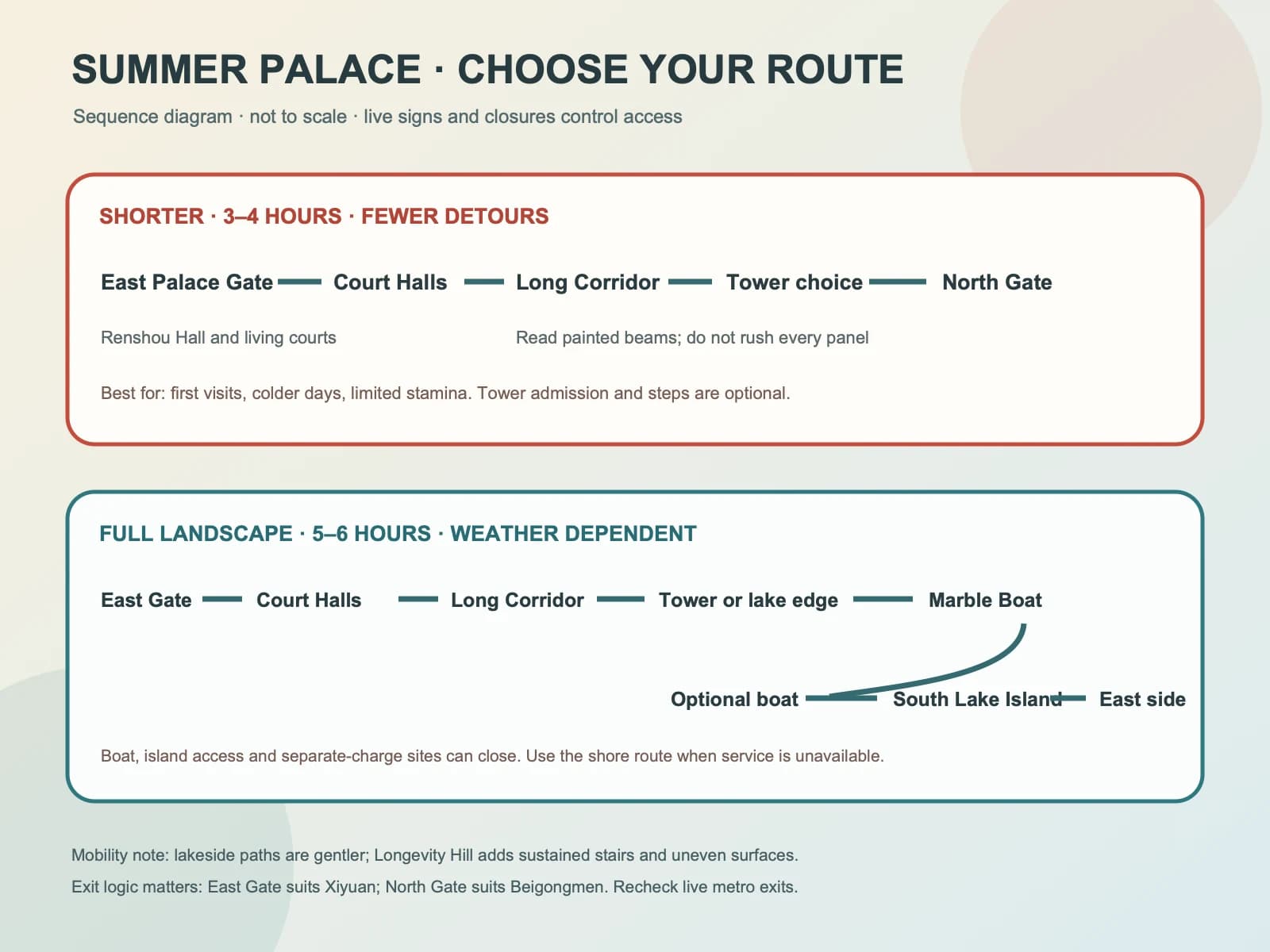
Shorter east-to-north route: 3–4 hours
Follow East Palace Gate → Hall of Benevolence and Longevity → Imperial Living Quarters → Long Corridor → optional Tower of Buddhist Incense → Marble Boat or North Palace Gate.
This itinerary offers the clearest transition from imperial governance and domestic life to leisure garden scenery. Skip the Tower climb when stairs, summer heat, winter ice, or hazy visibility make it less rewarding, continuing along the lake edge to exit through North Palace Gate instead.
Full landscape route: 5–6 hours
Follow the core court-and-corridor route, then select one scenic extension:
- Continue west to the Marble Boat and circle back along the shoreline;
- Take a currently operating ferry boat to South Lake Island and walk back across the Seventeen-Arch Bridge;
- Stay on foot and explore the eastern lake perimeter when boat services or island access are suspended.
Boat services are weather-dependent transport options rather than permanent park fixtures. High winds, winter ice, water conditions, routine maintenance, and seasonal schedules can pause operations without advance warning. Use on-site signage for active paths and accessible detours.
Read the Garden Instead of Collecting Buildings
Court first, scenery later
Near East Palace Gate, formal halls and interconnected courtyards establish a grand political and residential rhythm. Moving west, that structured order dissolves into framed lake vistas, covered walkways, and shifting relationships between hill and water. This deliberate progression is the real highlight—take time to experience the transition rather than rushing straight to the most photographed tower.
The Long Corridor is an image system
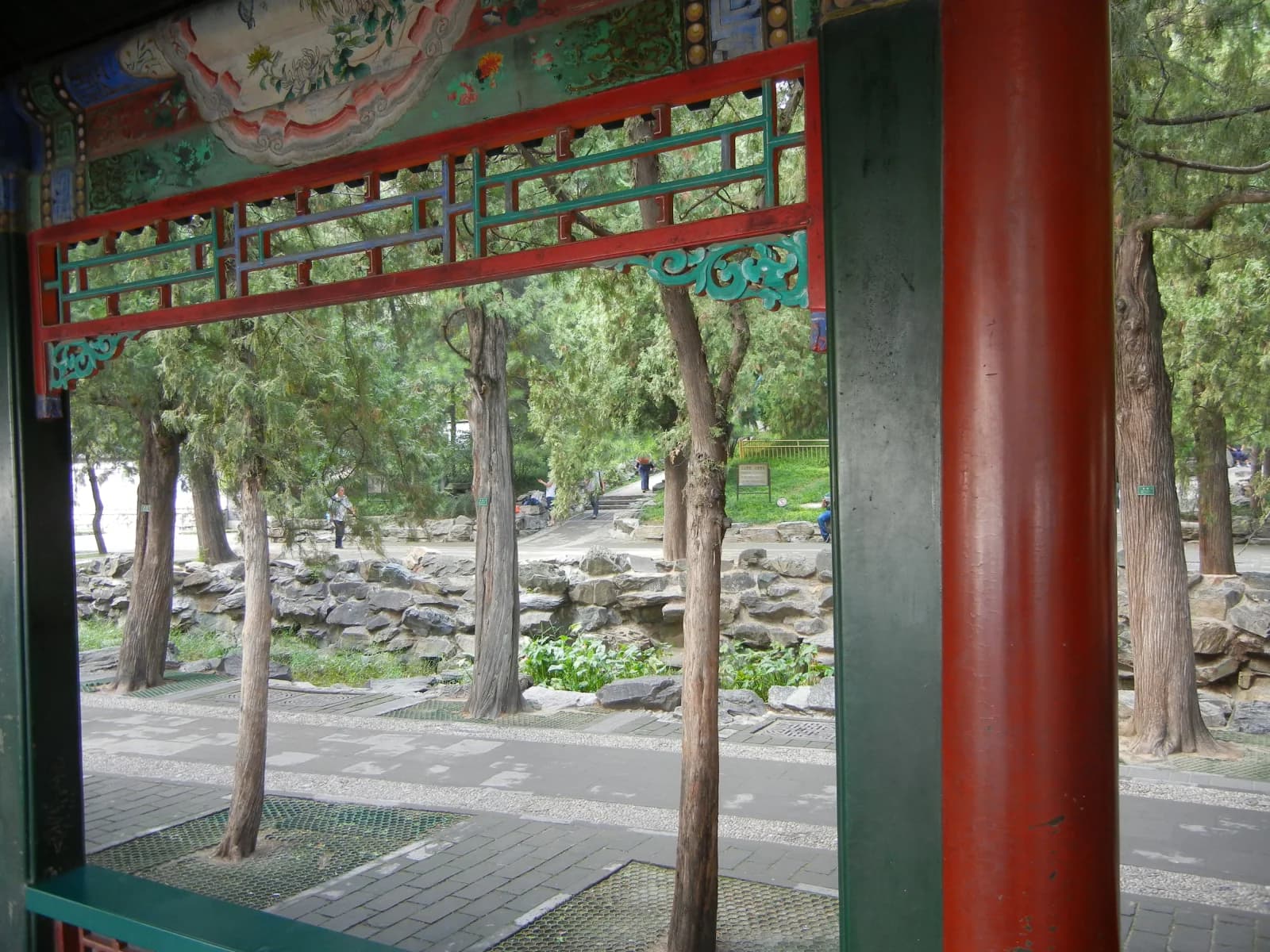
The Long Corridor serves as both a sheltered promenade and an ingenious viewing device. Its rhythmic pillars repeatedly frame shifting views of the lake, rockeries, and willow trees, while thousands of painted crossbeams turn the overhead woodwork into a gallery of classical Chinese legends and landscapes. Pause to examine a few panels closely and compare their themes, pigments, and craftsmanship—looking thoughtfully at five paintings reveals far more than trying to count thousands.
Hill and lake make each other legible
The earth excavated to create Kunming Lake was used to build and sculpt Longevity Hill. Viewed from the hill above, the palace halls form an orderly foreground to the shimmering water; from the lakeside, the Tower of Buddhist Incense acts as an imposing vertical anchor. Experiencing both perspectives reveals the genius of classical Chinese garden design far better than any checklist.
Look twice at the Marble Boat
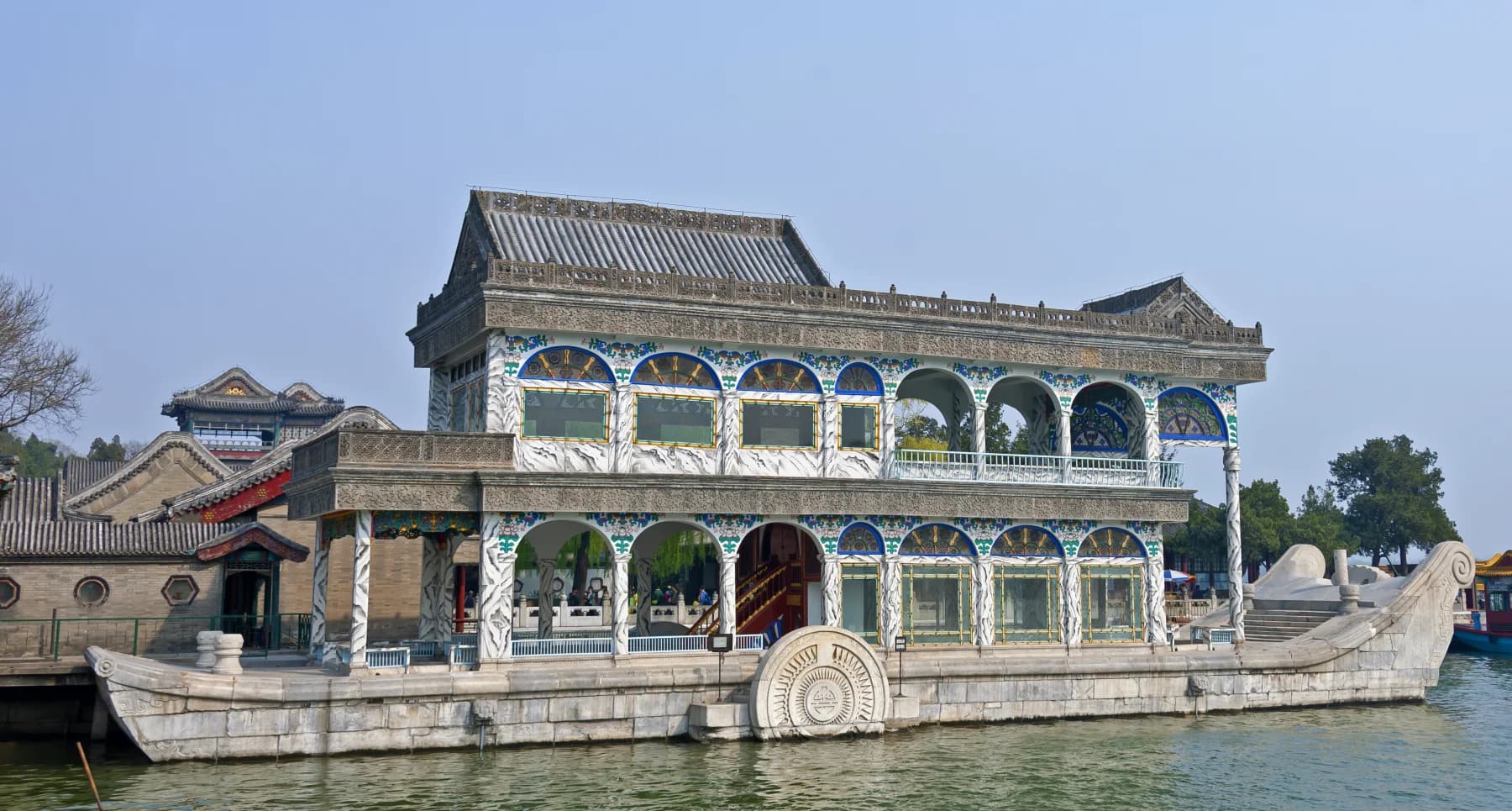
Photo: Daniel Case · Source · CC BY-SA 3.0
The Marble Boat (Stone Boat) is a permanent waterside pavilion designed to resemble a ceremonial vessel. Take note of its massive stone base, intricately painted wooden superstructure, decorative paddle wheels, and Western-influenced stained-glass windows. While popular lore often reduces it to an anecdote about diverted naval funds, the deeper artistic intrigue lies in the playful tension between stone permanence, theatrical illusion, and a vessel that can never set sail.
Heat, Winter and Mobility
- The lakeside pathway is significantly flatter and gentler than climbing Longevity Hill, though the distances remain substantial.
- In summer, start your visit early in the morning, utilize the Long Corridor for shade, and take seated rest breaks before tackling uphill sections.
- In winter, exposed bridges and stone stairways can become slippery with ice; an open park does not guarantee that every interior pavilion, high walkway, or ferry route is accessible.
- Visitors using wheelchairs or strollers should check the designated barrier-free routes at the entrance rather than relying solely on overview diagrams.
- Carry drinking water and sun protection, and avoid bringing bulky luggage; check current baggage storage availability at main gates prior to arrival.
What to Eat Nearby
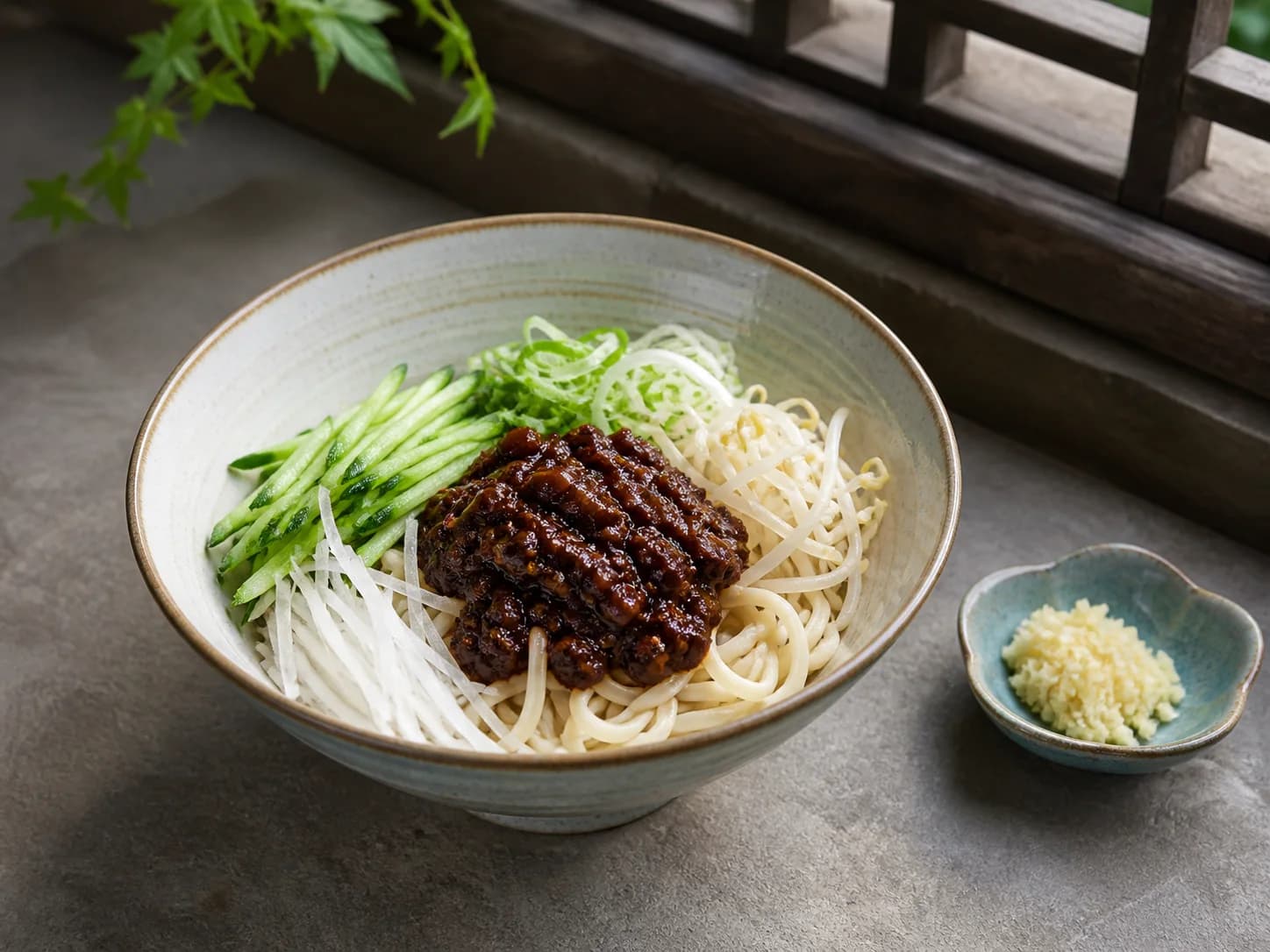
For a quick, satisfying meal near Xiyuan or Haidian, zhajiangmian (Beijing fried sauce noodles) is a great choice: chewy hand-pulled wheat noodles topped with rich fermented-soybean pork sauce and crunchy julienned vegetables. Look for spots where the sauce is rich and savory rather than overly sweet, and stir the sauce in gradually to suit your taste.
Other great local options include freshly made dumplings, Lanzhou beef noodles, or a classic northern Chinese set lunch. Check live map apps for nearby restaurant ratings, opening hours, and queue status. Save elaborate meals like Peking duck for the evening when you can sit down and share a full spread at your leisure.
Pairings and Where to Stay
- Old Summer Palace (Yuanmingyuan): A vast, reflective park centered on historic ruins and national memory—best visited on a separate day rather than tacked onto a long Summer Palace visit.
- Peking University & Tsinghua University: Campus visits require separate visitor reservations that are often restricted during term time; do not assume walk-up entry is possible.
- Fragrant Hills (Xiangshan): Highly seasonal and weather-dependent; combining it with the Summer Palace on the same day is generally too strenuous for a first visit.
- Haidian / Xiyuan: Convenient for an early start at the Summer Palace and university-area dining, but less central for first-time Beijing exploring.
- Wangfujing / Dongdan: The most versatile base for visiting the Forbidden City and central Beijing sights, with direct metro connections west.
- Xidan: A practical midway base between central landmarks and western Beijing attractions, offering excellent transit and shopping.
Compare Beijing hotels on Trip.com by specific metro line and station. Note that a hotel listed "near the Summer Palace" can still involve a long walk to the actual visitor gates.
Final Checklist
- Decide between the 3–4 hour core route or the extended 5–6 hour lake loop before arriving.
- Bring the original physical passport used for your booking.
- Confirm Monday closures and early afternoon cut-offs for interior heritage sites.
- Keep the Tower climb and lake ferry optional based on weather and energy levels.
- Save an offline map or screenshot of the park layout and your chosen exit gate.
- Check morning weather, air quality, and boat operation notices before setting out.