Xuanwu Lake Nanjing
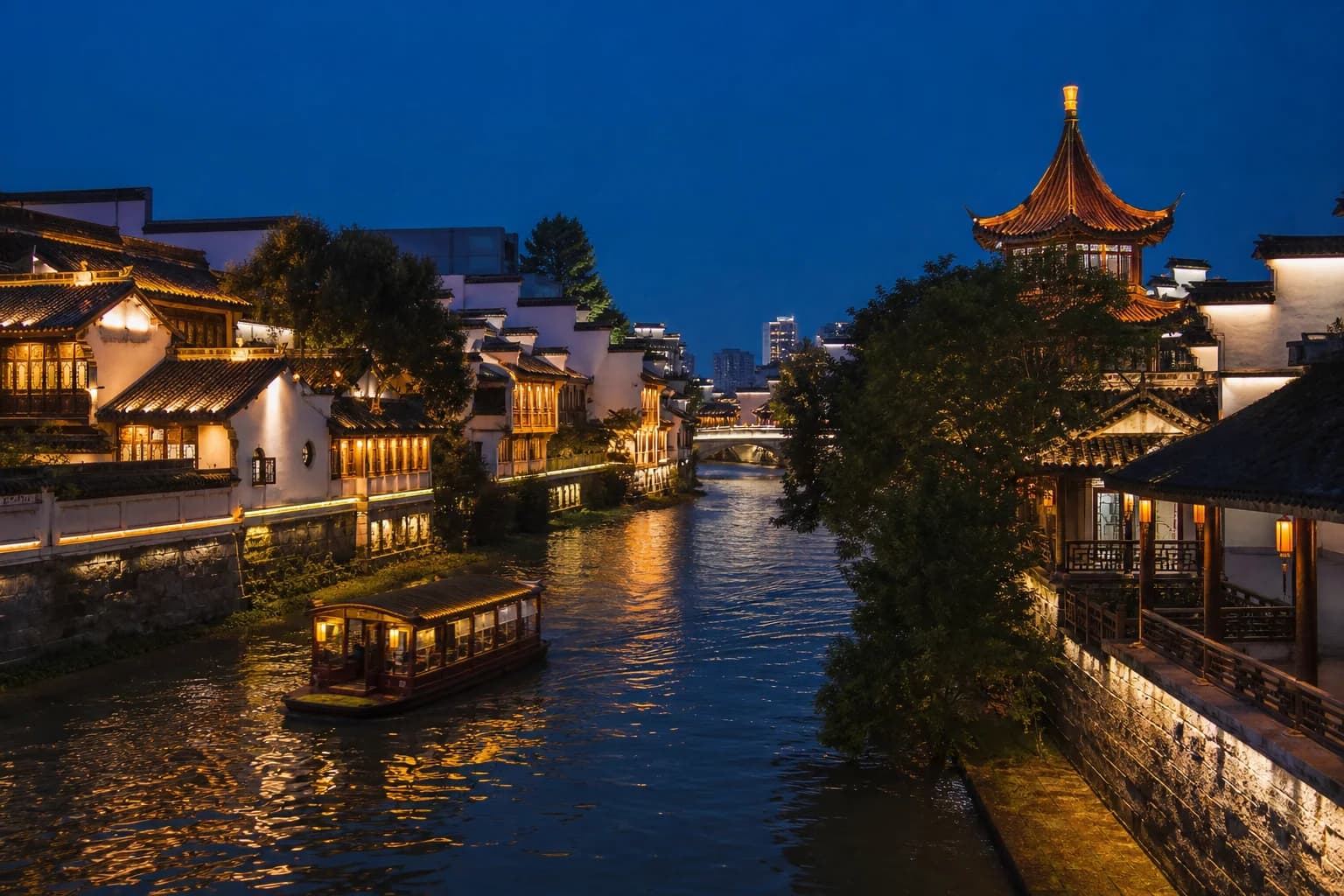
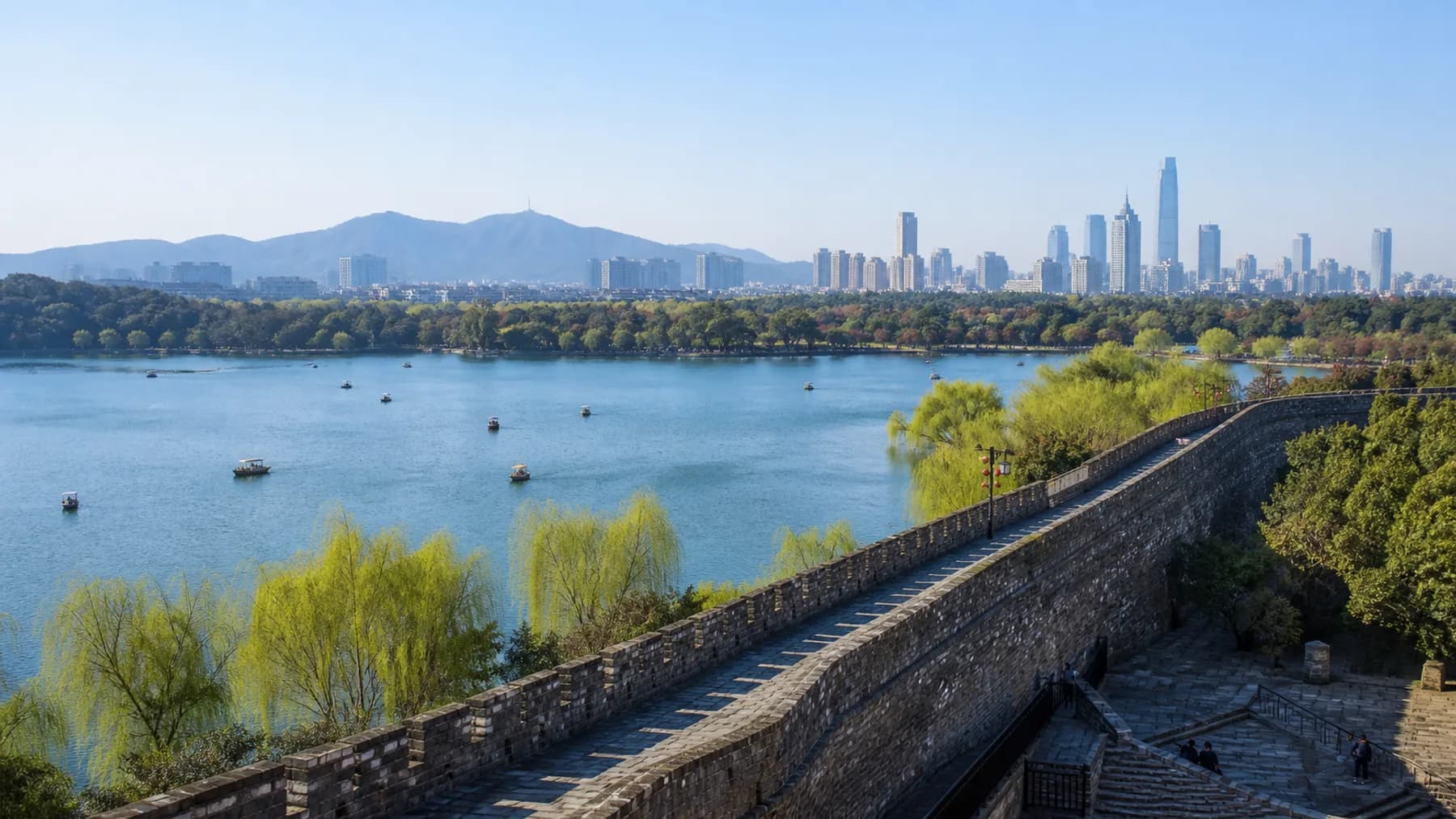
Xuanwu Lake (玄武湖, Xuánwǔ Hú) is where Nanjing's three visual identities meet: Ming city wall, broad urban water and Purple Mountain. The park covers 5.13 square kilometres and includes five linked islands, a garden and an almost 10 km lakeside circuit. Trying to “finish” it produces unnecessary walking. A first visit is better as a 2.5–3.5 hour one-way route between Xuanwu Gate and Jiefang Gate.
Start at Xuanwu Gate if the lake is your main activity and Metro Line 1 is convenient. Start at Jiefang Gate if you are coming from Jiming Temple or want to add the city wall. Choose one seasonal island or one history stop; do not collect all five names.
Xuanwu Lake essentials
| Plan | Current practical answer |
|---|---|
| Admission | Free; no general park ticket |
| Lakeside circuit | Open 24 hours year-round |
| Five islands and Lovers' Garden | April–October 06:00–22:00; November–March 06:00–21:00 |
| First-visit time | 2.5–3.5 hours |
| Full circuit | Nearly 10 km; reserve at least half a day if walking it intentionally |
| Best metro entry | Xuanwumen Station, Line 1; about 5 minutes / 312 m to the gate |
| Best paired entry | Jiefang Gate, about 3 minutes / 168 m from Jiming Temple |
| Boat operating baseline | Usually 08:30–17:00, adjusted for weather and lake conditions |
The old requirement to present a health code or make a general park reservation is obsolete. The park is free, but exhibitions, events and boat products can have separate arrangements. Check the official Xuanwu Lake website and current notices on the day, especially after high wind, thunderstorms or heavy rain.
Which gate should you use?
Xuanwu Gate: simplest for a standalone visit
Use Xuanwu Gate (玄武门) when you want the most straightforward arrival. Metro Line 1 reaches Xuanwumen Station, and AMap verifies a roughly 312 m, 5-minute walk from the station to the park gate. This side gives you a strong first reveal across the water and drops naturally into Huanzhou and the island network.
It is also the better finish if you want food around Hunan Road or an easy metro ride back to Xinjiekou.
Jiefang Gate: best with Jiming Temple and the city wall
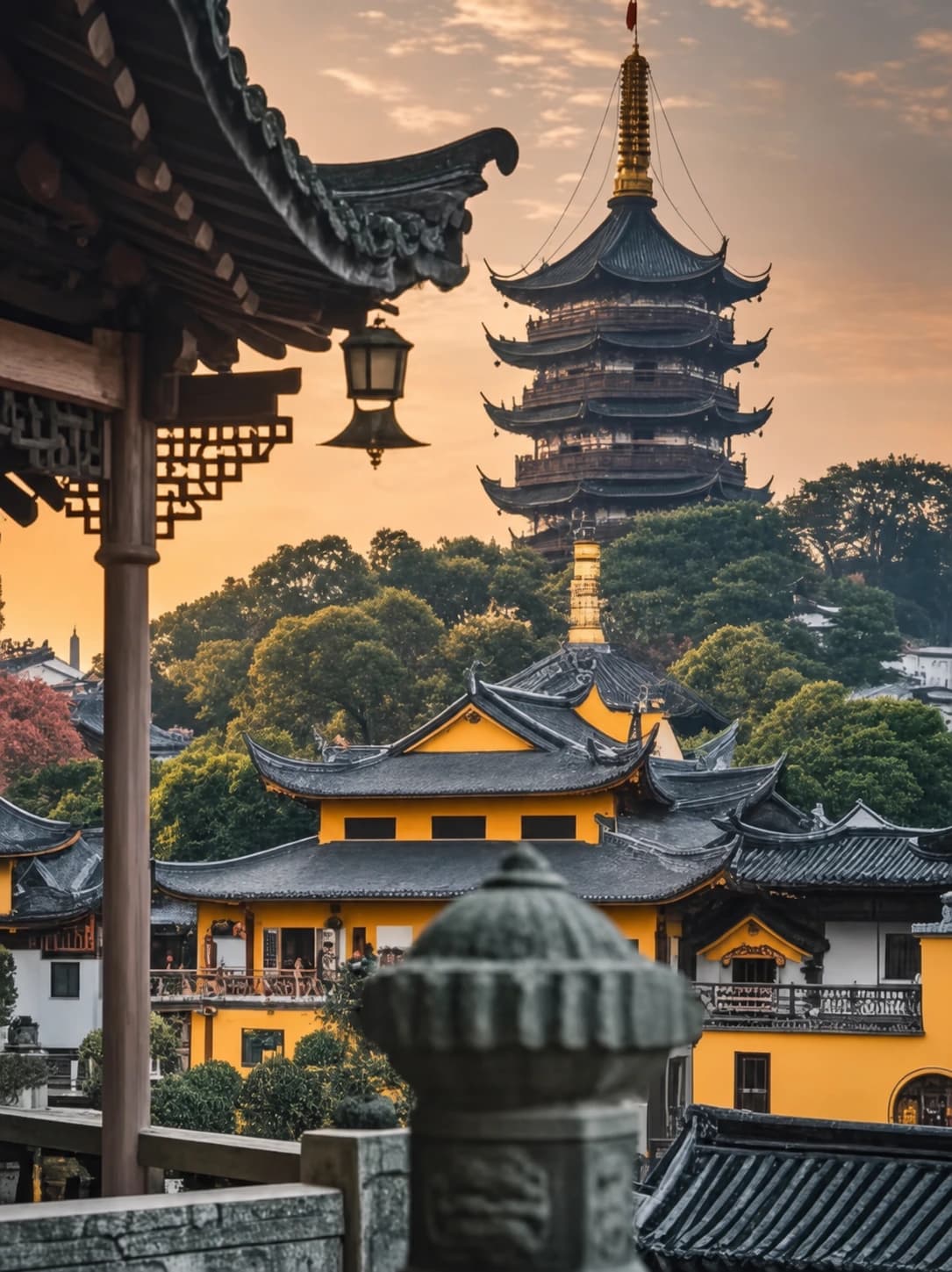
Use Jiefang Gate (解放门) when the lake is one part of a heritage sequence. AMap verifies about 168 m, or 3 minutes, from Ancient Jiming Temple to the Jiefang Gate visitor point. The adjacent wall section gives the clearest relationship between lake and old city.
The city-wall ticket is separate from the free park. Confirm its current admission and last-entry rules before making it the final stop.
Lovers' Garden / east side: use for a specific purpose
The eastern and northern entrances are useful for nearby hotels, Nanjing Station, Lovers' Garden or a full circuit. They are weaker first choices for a short classic visit because they place you farther from the Jiming Temple–city wall pairing.
Three routes that do not waste distance
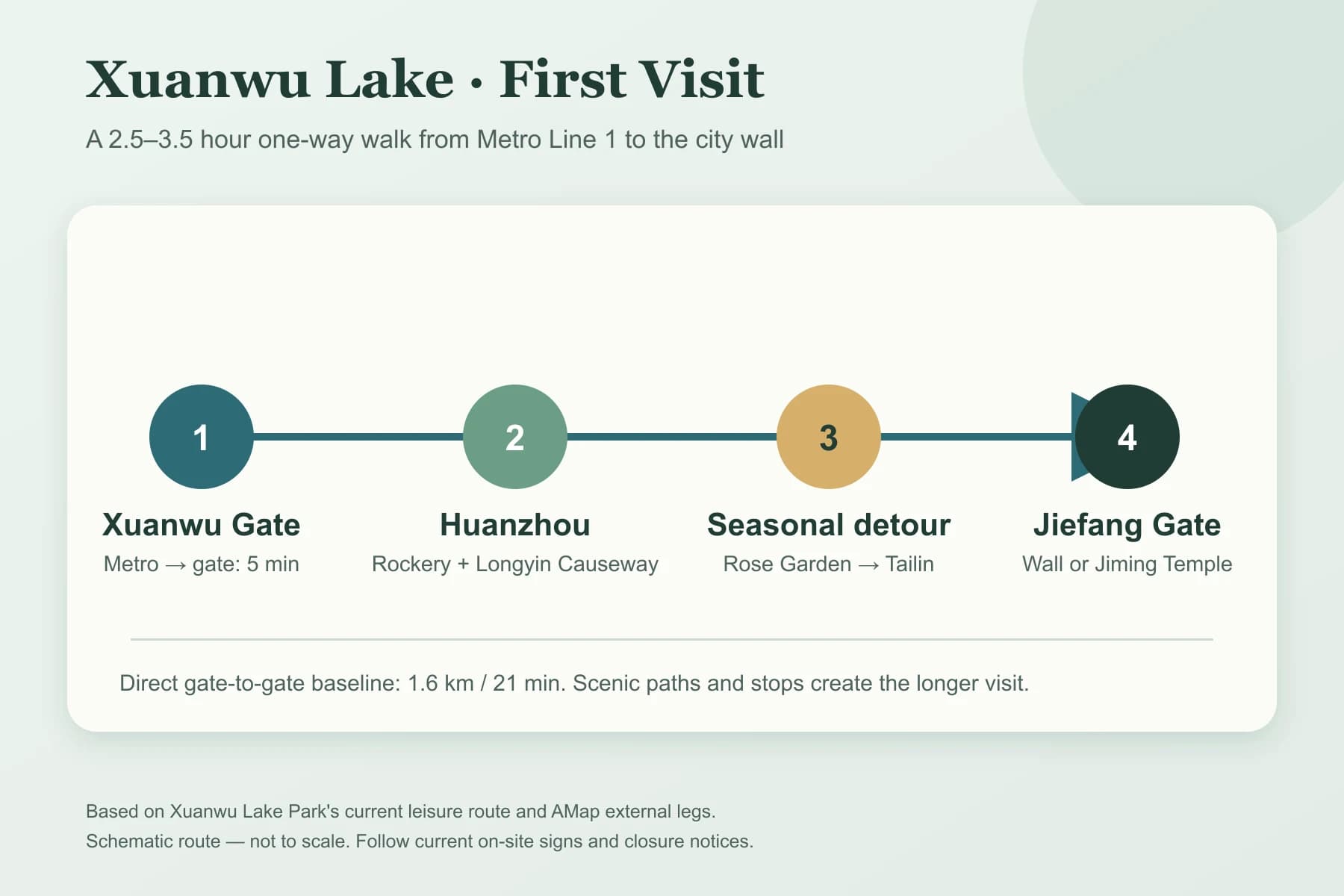
Route 1: first-time lake route — 2.5–3.5 hours
Follow the park's current leisure-line logic:
- Xuanwu Gate: pause after entering rather than immediately turning toward the closest snack kiosk.
- Rockery waterfall and Huanzhou's Longyin Causeway: this is the transition from city-scale lake view to the wooded five-island landscape.
- Rose Garden and seasonal detour: keep it only when something is genuinely flowering. Otherwise, move on.
- Tailin Causeway: the official route identifies this as a possible boat point. Decide here whether a boat replaces more walking; do not add it automatically.
- Jiefang Gate: finish with the Ming wall view, then continue to Jiming Temple only if its opening hours still work.
AMap gives approximately 1.6 km and 21 minutes for a direct gate-to-gate walk. Your scenic route takes much longer because it bends through park paths and includes stops; that is why 2.5–3.5 hours is realistic.
Route 2: Jiming Temple pairing — reverse the route
Visit Jiming Temple first, walk about 3 minutes to Jiefang Gate, then reverse the lake sequence and finish at Xuanwu Gate beside Metro Line 1. This is the cleanest geography for a morning temple visit followed by a relaxed lake afternoon.
Do not combine a full city-wall walk, all five islands, a boat and Jiming Temple in the same half-day. Choose the wall or a deeper island detour.
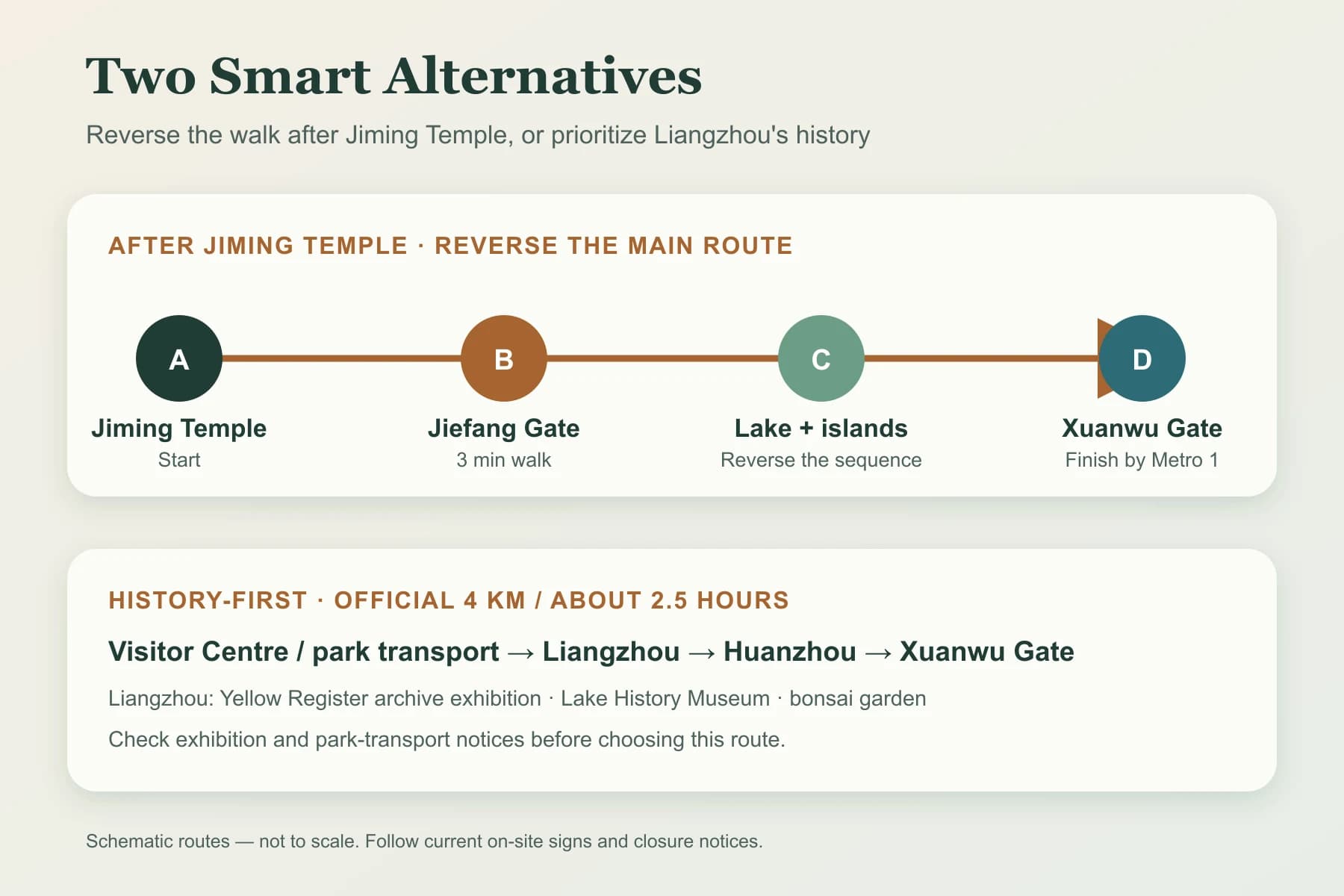
Route 3: history-first official highlights — about 4 km / 2.5 hours
The park's current “highlights line” uses park transport from the visitor centre, then prioritizes Liangzhou, Huanzhou and Xuanwu Gate. On Liangzhou, focus on the Ming Yellow Register archive exhibition, Lake History Museum, Xuanwu Square and bonsai garden. The official estimate is about 2.5 hours.
This is the better route for history-minded visitors, but check exhibition notices before committing. The Yellow Register archive exhibition is normally listed as 09:00–16:30; temporary internal-venue closures occur even when the outdoor park remains open.
The five islands: what each one is actually for
You do not need to walk every island. Give each a job, then select one or two.
- Huanzhou (环洲): orientation and classic scenery. Closest to Xuanwu Gate, with curving paths, rockery, waterfall and the Guo Pu mound. It belongs in most first visits.
- Liangzhou (梁洲): history. The oldest-developed island carries the strongest interpretation of the lake as a Ming national archive site. Add it for museums, bonsai and autumn chrysanthemum displays.
- Yingzhou (樱洲): spring atmosphere. The name is often translated as Cherry Isle, but exact bloom timing changes yearly. Treat flowers as seasonal, not guaranteed.
- Cuizhou (翠洲): shade and rest. A greener, quieter choice when you want trees and breathing room rather than another checklist monument.
- Lingzhou (菱洲): family and activity facilities. More useful for children's activities and eastern-side access than for a compact heritage route.
If you have only 90 minutes, keep Huanzhou plus one broad lake viewpoint. A hurried five-island circuit adds names without adding understanding.
Choose the season, then choose the detour
- Late winter to early spring: plum and early blossoms can make Liangzhou worthwhile before the main spring crowds.
- Spring: prioritize Yingzhou and flower-focused paths, but check the park's current bloom update rather than planning from an old social-media date.
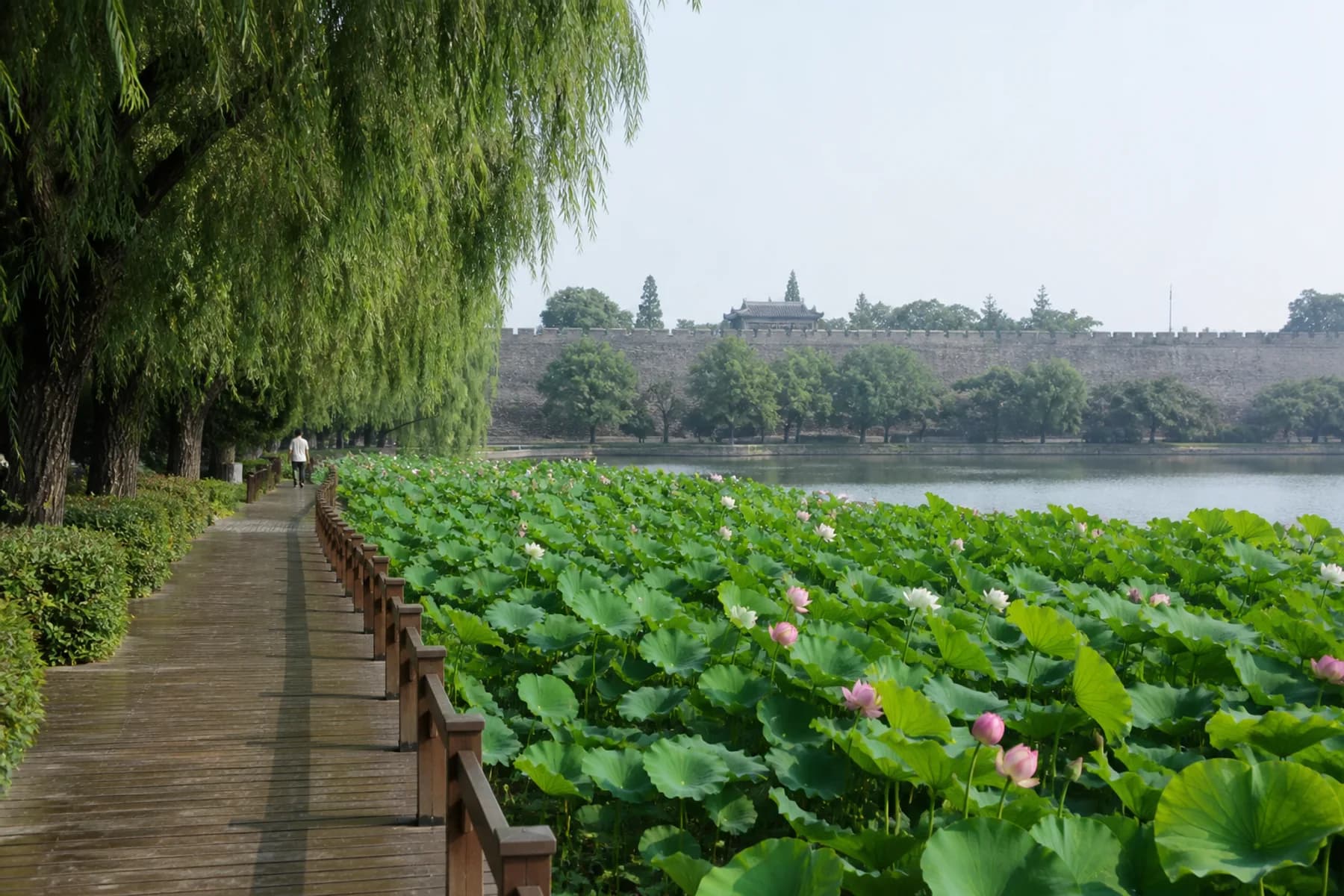
- Summer: lotus is the defining layer. Go soon after opening for lower heat, better light and less crowded boardwalks. Thunderstorms and heat can make a full circuit unpleasant.
- Autumn: Liangzhou's chrysanthemum tradition and clearer walking weather favor the history route.
- Winter: the lake-city-wall composition is still strong. Shorten exposed waterside sections in wind and use the islands' trees as shelter.
The park's own current news feed is more useful for flower timing than a fixed annual calendar.
Boats and sightseeing cars: use them to solve a problem
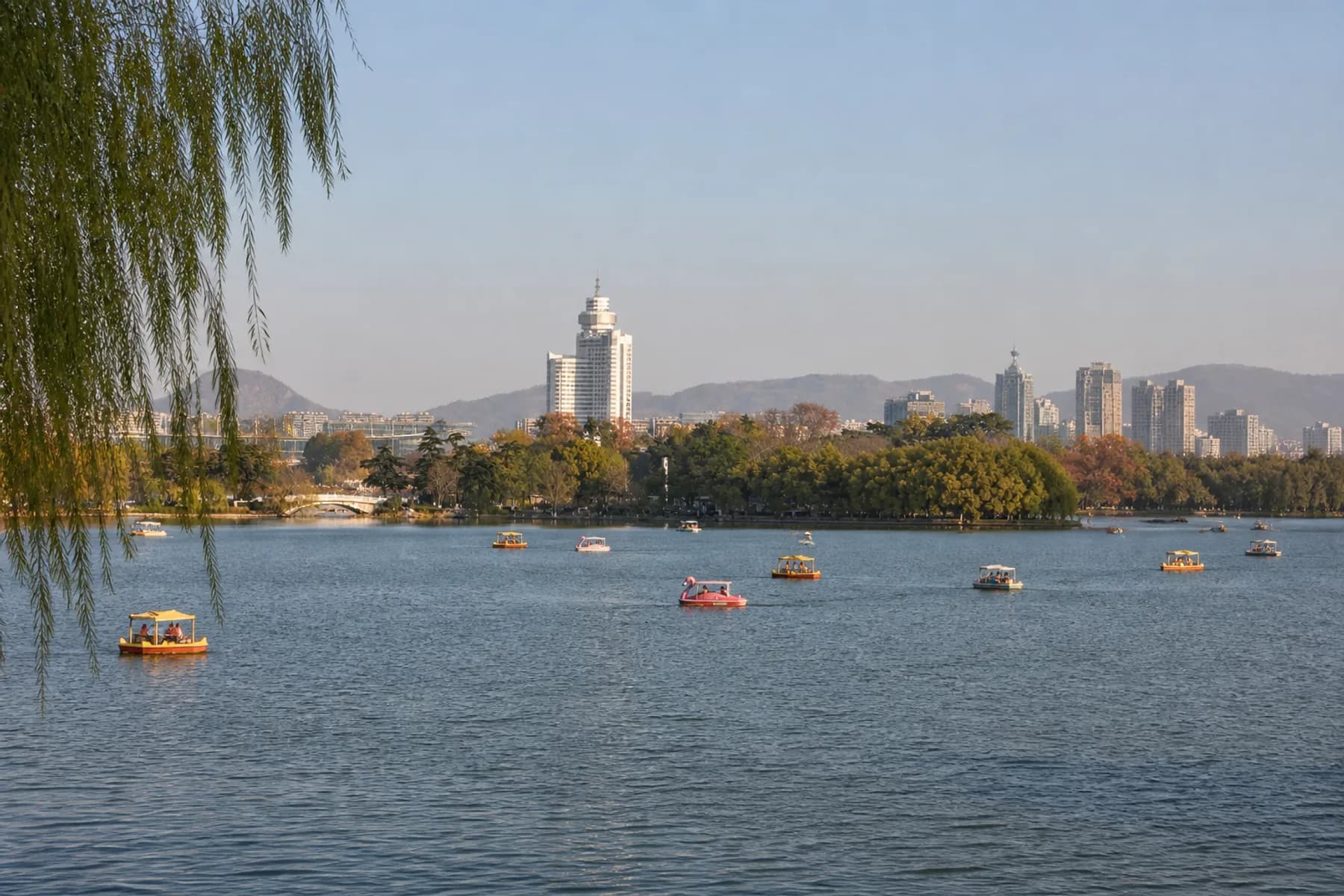
Small leisure boats are worthwhile when the weather is calm and you want a water-level view, not because they are mandatory. The park lists normal dock operation around 08:30–17:00 but explicitly adjusts for weather. Current safety notices confirm that service can pause when wind reaches the marine-operation threshold.
Avoid publishing or relying on old per-hour prices: boat type, capacity, route and deposit conditions change. Compare the board at the operating dock, photograph the return time, and confirm whether you must return to the same dock.
Sightseeing vehicles are useful for limited mobility or the 4 km history route. The official baseline lists different lines roughly between 08:30 and 17:00, again subject to operational adjustment. Ask which line reaches your intended exit; a loop that returns to its starting point can undo a one-way itinerary.
Food after the park: pick the exit first
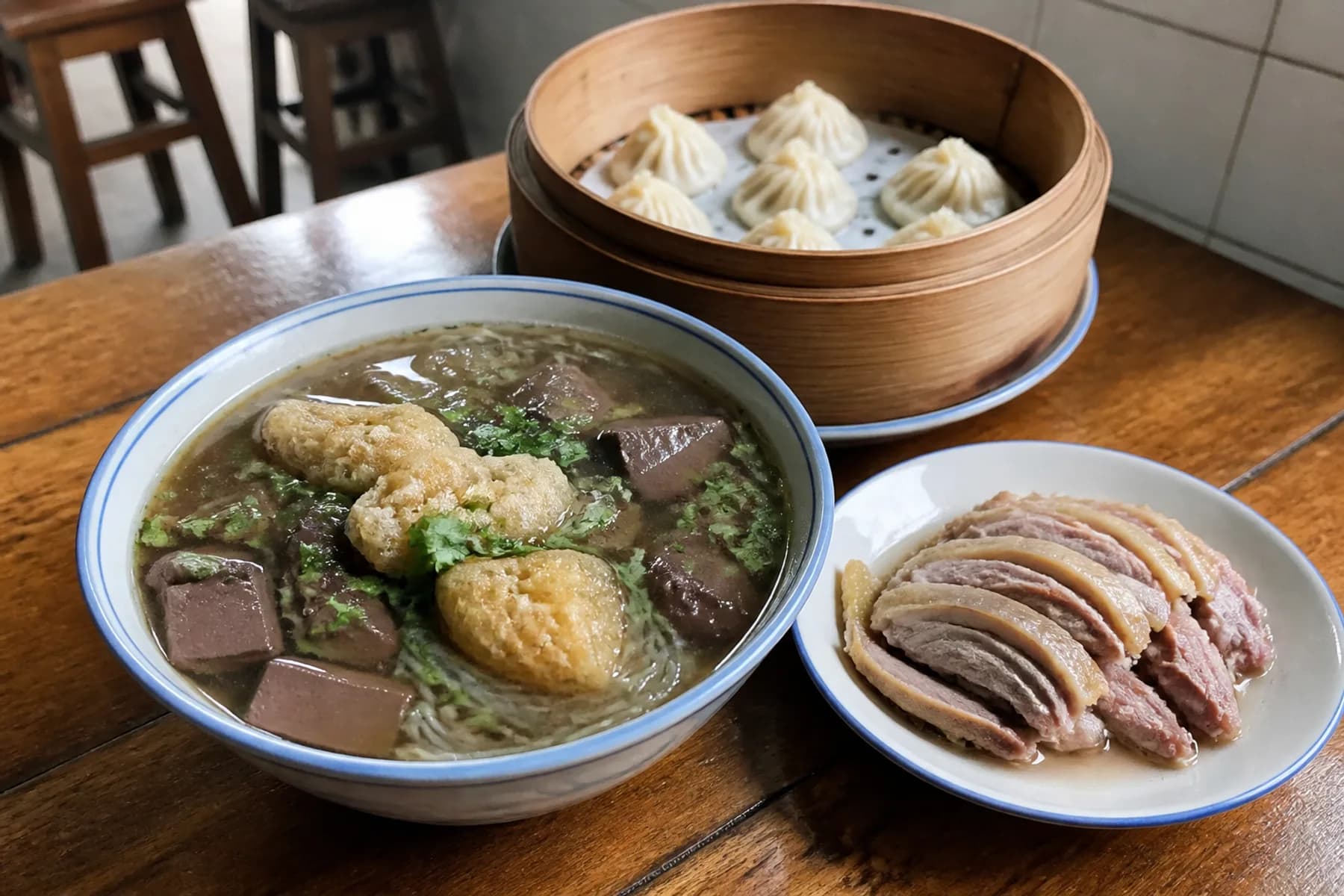
Food inside the park is mainly a convenience layer. Save a real Nanjing meal for after you know which gate you will exit.
- After Xuanwu Gate: continue toward Hunan Road and the surrounding commercial streets for the broadest choice. Duck-blood vermicelli soup is a fast meal; confirm whether you are comfortable with blood and offal before ordering.
- After Jiefang Gate: the immediate Jiming Temple area works for a drink, vegetarian food or a light snack. For a larger local meal, continue toward Gulou rather than crossing back through the park for one viral shop.
- Durable dishes: Nanjing salted duck, duck-blood vermicelli soup, soup dumplings and sesame-scented cold noodles. Choose a busy, clean kitchen with good turnover instead of building the day around a changing online queue.
Vegetarians should ask whether noodles, greens or dumplings use meat broth or lard; a dish that looks plant-based may not be.
Where to stay for Xuanwu Lake
- Gulou / Xuanwu Gate: best if early lakeside walks, Jiming Temple and Metro Line 1 matter. Check the exact station exit and street crossing rather than trusting “lake view” in a hotel name.
- Xinjiekou: best all-round base for a first Nanjing trip. Lines 1 and 2 simplify the lake, museums and south-city sights without forcing you to stay beside one attraction.
- Fuzimiao / Qinhuai: choose this for evening atmosphere and the Qinhuai River, accepting a longer ride to the lake.
Compare Nanjing hotels on Trip.com after choosing the area. Check recent reviews for metro walking distance, construction noise, smoking policy and whether a promised lake view is guaranteed by room category.
Practical mistakes to avoid
- Do not use the old health-code instructions. They are a pandemic-era artifact, not current entry policy.
- Do not assume the five islands share the 24-hour lakeside schedule. Internal island and garden hours are shorter.
- Do not bring a pet. The park's current visitor service says pets should not enter.
- Do not count on a musical-fountain timetable. The current official service page describes paid song requests, not a dependable free public-show schedule.
- Do not force a full circuit in peak heat. Nearly 10 km of exposed waterfront is a real walk, not a short sightseeing loop.
- Do not treat boat operation as guaranteed. Wind and storms can stop service while the land route remains open.
Is Xuanwu Lake worth it?
Yes—especially as the landscape connection between Jiming Temple, the Ming wall and modern Nanjing. The lake itself is not rare enough to justify a five-island checklist. Its value comes from seeing mountain, water, wall and skyline in one sequence.
For a first trip, spend 2.5–3.5 hours and walk gate to gate. Choose Liangzhou for history, Yingzhou for spring, or the lotus paths in summer. That gives the park a distinctive role in your Nanjing itinerary instead of turning it into an exhausting green gap between bigger monuments.