Vegetarian and vegan travel in China: make every meal a short verification
Vegetarian and vegan travel in China becomes much easier when you stop looking for one magic word and use a repeatable check instead. Say exactly what you do not eat. Ask about the broth, sauce and cooking fat. Choose a dish whose preparation you can understand. Keep one sealed backup for the days when a station, late arrival or language gap defeats the plan.
China has deep traditions of tofu, vegetables, grains, mushrooms, noodles and Buddhist vegetarian cooking. It also has meat stock in vegetable soups, pork fat in pastry, oyster sauce on greens, dried shrimp in side dishes and beef tallow in hotpot. A dish can look completely plant-based while its flavor comes from an animal ingredient that never appears on the plate.
The good news is that you do not need fluent Mandarin. You need a precise Chinese card, a few follow-up questions and the confidence to leave when the answer is unclear. This guide is designed to work across cities without depending on one restaurant remaining open forever.
Start by naming your diet precisely
The English word “vegetarian” covers several diets. Chinese restaurant vocabulary is also inconsistent, especially outside specialist venues. Treat these expressions as the beginning of a conversation:
| What you mean | Useful Chinese | What it communicates | What still needs checking |
|---|---|---|---|
| Vegetarian, broadly | 素食 sùshí / 我吃素 wǒ chī sù | You eat vegetarian food | Egg, dairy, honey, stock, lard and seafood seasonings |
| Ovo-lacto vegetarian | 蛋奶素 dàn nǎi sù | Egg and dairy are acceptable; meat and seafood are not | Broth, lard, oyster sauce, fish sauce, dried shrimp and chicken powder |
| Vegan | 全素 quán sù or 纯素 chún sù | No animal-derived foods is the intended meaning | Confirm egg, dairy, honey, stock, sauces and cooking fat individually |
| Buddhist-style vegetarian | 素斋 sùzhāi, 斋饭 zhāifàn, sometimes 净素 jìngsù | A temple or Buddhist vegetarian context | Whether the meal is currently available; egg/dairy policy; five pungents; packaged mock-meat ingredients |
| No pungent alliums | 不吃五辛 bù chī wǔ xīn | You avoid the Buddhist “five pungents” | Name each ingredient too, because lists and kitchen usage vary |
Do not assume that 素 printed beside a dish certifies every sauce and seasoning. In ordinary restaurant speech, it can mean “a vegetable dish,” “meatless,” or simply the non-meat side of a menu. 全素 and 纯素 are more specific, but neither removes the need to ask when the consequence matters.
Temple food deserves the same care. Chinese Buddhist vegetarian traditions commonly avoid animal foods and pungent alliums, but a historic tradition is not a guarantee that every temple-adjacent restaurant, public canteen, pastry or packaged imitation meat follows one formula. The public meal may also have limited service hours, sell out or not operate every day. In Shanghai, for example, Longhua Temple and Jade Buddha Temple are useful places to understand the tradition, but current service and the exact dish still need confirmation.
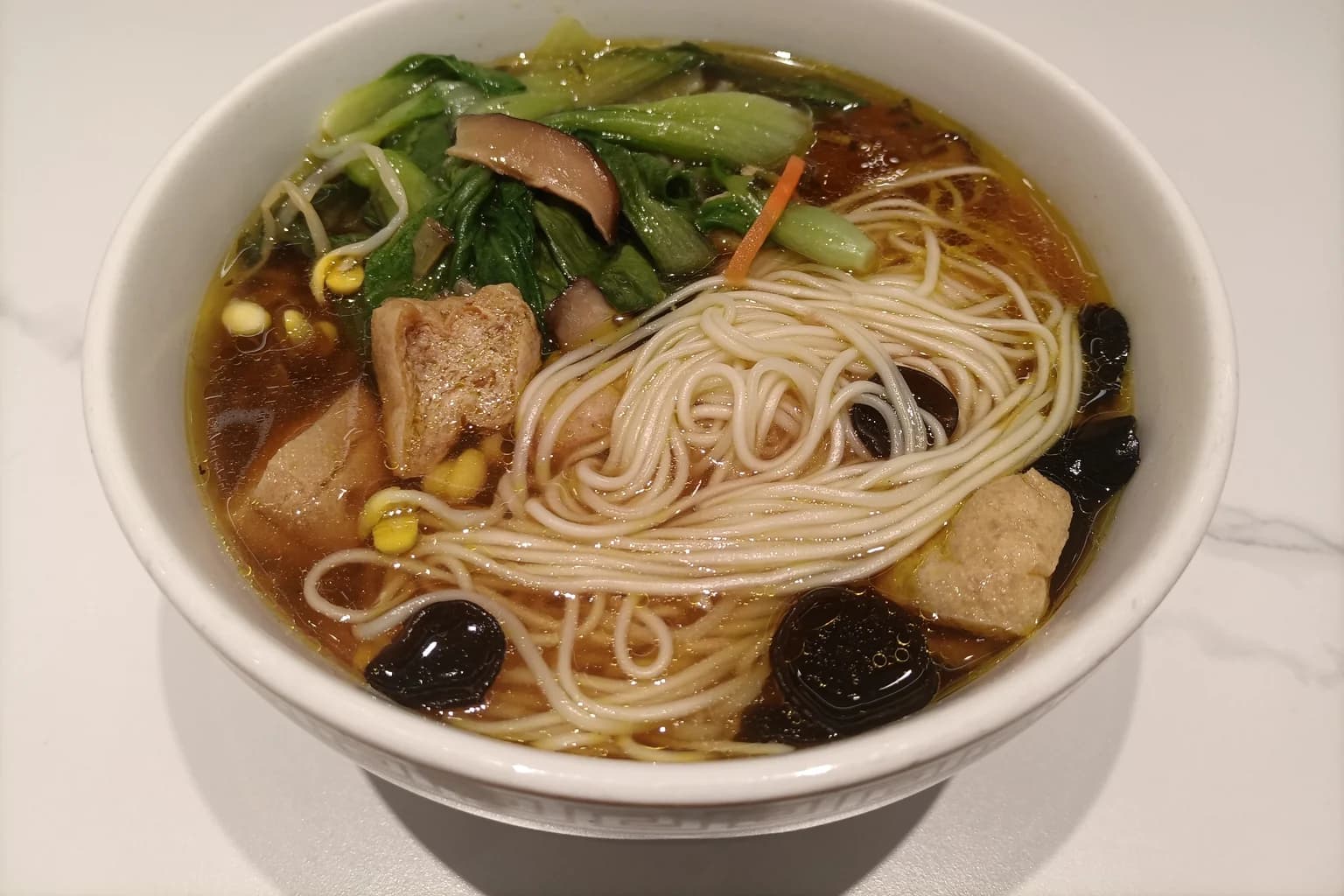
A temple noodle bowl shows how satisfying a simple plant-based meal can be. The image still cannot confirm the broth, seasoning or current recipe: ask before ordering. Photo by Fumikas Sagisavas, CC0.
Save one of these Chinese order cards
Put the version that matches your diet in a full-screen phone note and keep an offline screenshot. Show it before ordering, then ask the shorter dish-specific questions below. Staff may understand a concrete list faster than a translated paragraph about ethics or lifestyle.
Vegan card
我是纯素食者。我不吃任何肉、禽类、鱼、海鲜、蛋、奶制品或蜂蜜。请不要用猪油、动物油、肉汤、骨头汤、鸡汤、蚝油、鱼露、虾皮或鸡精。可以用植物油和清水单独做吗?如果不能确定,请直接告诉我。
I am vegan. I do not eat meat, poultry, fish, seafood, eggs, dairy products or honey. Please do not use lard, animal fat, meat stock, bone broth, chicken stock, oyster sauce, fish sauce, dried shrimp or chicken seasoning. Can it be cooked separately with vegetable oil and water? Please tell me directly if you cannot be sure.
Ovo-lacto vegetarian card
我吃蛋奶素。鸡蛋和奶制品可以,但我不吃肉、禽类、鱼或海鲜。请不要用猪油、动物油、肉汤、骨头汤、鸡汤、蚝油、鱼露、虾皮或鸡精。
I am ovo-lacto vegetarian. Eggs and dairy are acceptable, but I do not eat meat, poultry, fish or seafood. Please do not use lard, animal fat, meat stock, bone broth, chicken stock, oyster sauce, fish sauce, dried shrimp or chicken seasoning.
Add this for no onion, garlic or other pungent alliums
我也不吃葱、洋葱、蒜、蒜苗、韭菜或其他五辛。
I also do not eat scallion, onion, garlic, garlic shoots, Chinese chives or other pungent alliums.
Naming the ingredients matters more than debating the exact historical list of 五辛. A kitchen may understand the religious term but still use a different everyday classification. If leek or shallot also matters to you, add 韭葱 and 红葱头.
Three follow-up questions that solve most ambiguity
- 这道菜的汤、酱和油里有动物成分吗? — Are there animal ingredients in the broth, sauce or oil?
- 可以不用鸡精、蚝油,用植物油单独做吗? — Can you make it separately with vegetable oil, without chicken seasoning or oyster sauce?
- 如果不能完全确定,请直接告诉我。 — If you cannot be completely sure, please tell me directly.
Use the final sentence generously. It gives a busy server permission to say “I don't know” instead of trying to satisfy you with a confident but incomplete answer.
For hotel room service or delivery, paste a shorter version into the order note: 纯素,不吃肉、鱼、海鲜、蛋、奶、蜂蜜,也不要猪油、肉汤、蚝油和鸡精. Written detail reduces the ambiguity of a phone call, but an unchecked note field is not confirmation. Use in-app chat, a call or hotel staff to obtain an answer when the meal matters.
The hidden-ingredient check
Ask about the part of the dish that carries flavor. For soup, that is the stock. For stir-fried greens, it is the sauce and fat. For a steamed bun, it is both filling and dough. For hotpot, it is the base, dipping sauce and shared tools.
| Chinese to look or listen for | Meaning | Why it matters |
|---|---|---|
| 高汤 / 肉汤 / 骨头汤 / 鸡汤 | stock, meat broth, bone broth, chicken stock | A vegetable or noodle soup may use it as the base |
| 猪油 / 动物油 / 牛油 | lard, animal fat, beef tallow | Can appear in pastry, noodles, rice, hotpot base and stir-fries; in Sichuan hotpot, 牛油 usually means beef tallow |
| 蚝油 | oyster sauce | Common on greens and mushrooms; 素蚝油 is a different product, often mushroom-based, but vegans should still read its ingredients |
| 鱼露 | fish sauce | Can season sauces, salads and regional dishes |
| 虾皮 / 虾米 / 海米 | tiny dried shrimp / dried shrimp | Easy to miss in greens, tofu, dumplings, soups and savory pancakes |
| 鸡精 / 鸡粉 | chicken seasoning / chicken powder | Formulas vary; do not assume it is compatible because the quantity is small |
| 蛋 / 蛋液 / 蛋清 / 蛋黄 | egg, liquid egg, white, yolk | Can appear in noodles, wrappers, batter, buns, pastries and fried rice |
| 奶 / 奶粉 / 乳清 / 乳糖 / 黄油 / 奶油 / 芝士 | milk, milk powder, whey, lactose, butter, cream, cheese | Common in bakery food, drinks, instant products and some mock meats |
| 蜂蜜 | honey | Can appear in drinks, glazes, snacks and bakery food |
| 明胶 / 吉利丁 | gelatin | Check desserts, gummies, jelly products and capsules |
| 肉松 / 肉馅 | meat floss / meat filling | Can hide under toppings or inside buns and pastries |
Mock meat also needs a label check. Names such as 素鸡 (“vegetarian chicken”) and 素鸭 (“vegetarian duck”) refer to plant-based imitation foods, often made from soy or wheat gluten, but a packaged or restaurant version may still contain egg, milk, honey or a non-vegan flavoring. Wheat gluten and soy also matter for allergies.
For a stir-fry, ask 不用蚝油、鸡精和猪油,可以吗? (“Can you make it without oyster sauce, chicken seasoning and lard?”). For noodles, ask 汤底是清水还是肉汤? (“Is the soup base water or meat broth?”). For hotpot, ask 锅底有没有牛油、骨汤、鸡汤或海鲜? (“Does the base contain beef tallow, bone broth, chicken stock or seafood?”).
How to choose a restaurant without trusting a directory blindly
Use HappyCow, map apps, hotel staff and social recommendations as lead generators. Then verify the current venue. Search the Chinese name, recent opening status and latest menu. Message or call if the meal is important. On arrival, check whether the kitchen is fully vegetarian or merely offers a vegetarian category.
The most useful hierarchy is:
- Dedicated vegan venue: lowest explanation burden for animal ingredients, though allergies and five-pungents still need checking.
- Dedicated vegetarian restaurant: usually easier for stock, sauce and cooking-fat questions; vegans must ask about egg, dairy and honey.
- Currently operating temple or temple-adjacent meal service: culturally distinctive and often suitable, but verify public access, service time and exact practice that day.
- Ordinary restaurant willing to make a simple dish separately: workable when staff can describe the base, oil and seasoning.
- Buffet or mixed self-service counter: visually convenient, but shared utensils, mislabeled trays and ingredient ambiguity increase risk.
Do not let an old review decide a high-stakes meal. Restaurants move, change ownership, revise menus and stop serving between meal periods. A current map listing still does not prove the kitchen can meet your exact definition.
At a vegetarian buffet, make one lap before filling the plate. Find the cashier or floor staff, show the card, and ask whether egg or dairy appears in any section. If you avoid five pungents, ask whether the venue is 净素 and then name the alliums. If you have an allergy, a buffet's shared tongs and spills may make it unsuitable even when every recipe is vegetarian.
Meal-by-meal tactics
Breakfast: build from components
A Chinese breakfast counter can look promising because soy milk, fried dough, porridge and steamed bread sit beside one another. Treat each item separately.
- 豆浆 dòujiāng is soy milk; ask whether it is plain or sweetened and check packaged versions for added dairy.
- 白粥 báizhōu is plain rice porridge when genuinely cooked with water, but savory congee and toppings may contain meat, egg or seafood.
- 馒头 mántou is plain steamed bread in principle; recipes vary, so vegans should ask about milk, egg and lard.
- 油条 yóutiáo is fried dough, but batter formulas and shared frying oil vary.
- 包子 bāozi and 饺子 jiǎozi must be checked by filling, wrapper and seasoning. A “vegetable” filling may contain egg, dried shrimp, oyster sauce or lard.
When the answer is unclear, a sealed soy drink with a readable ingredient list, fruit and a packaged grain product is a better start than gambling on a complex filled bun.
At a hotel buffet, ask one staff member who can check with the kitchen rather than collecting guesses at each counter. Build the plate from separately understood components. A traveler who accepts egg and dairy can use a wider set of backups than a vegan traveler, so do not copy another person's “vegetarian breakfast” without checking which category they follow.
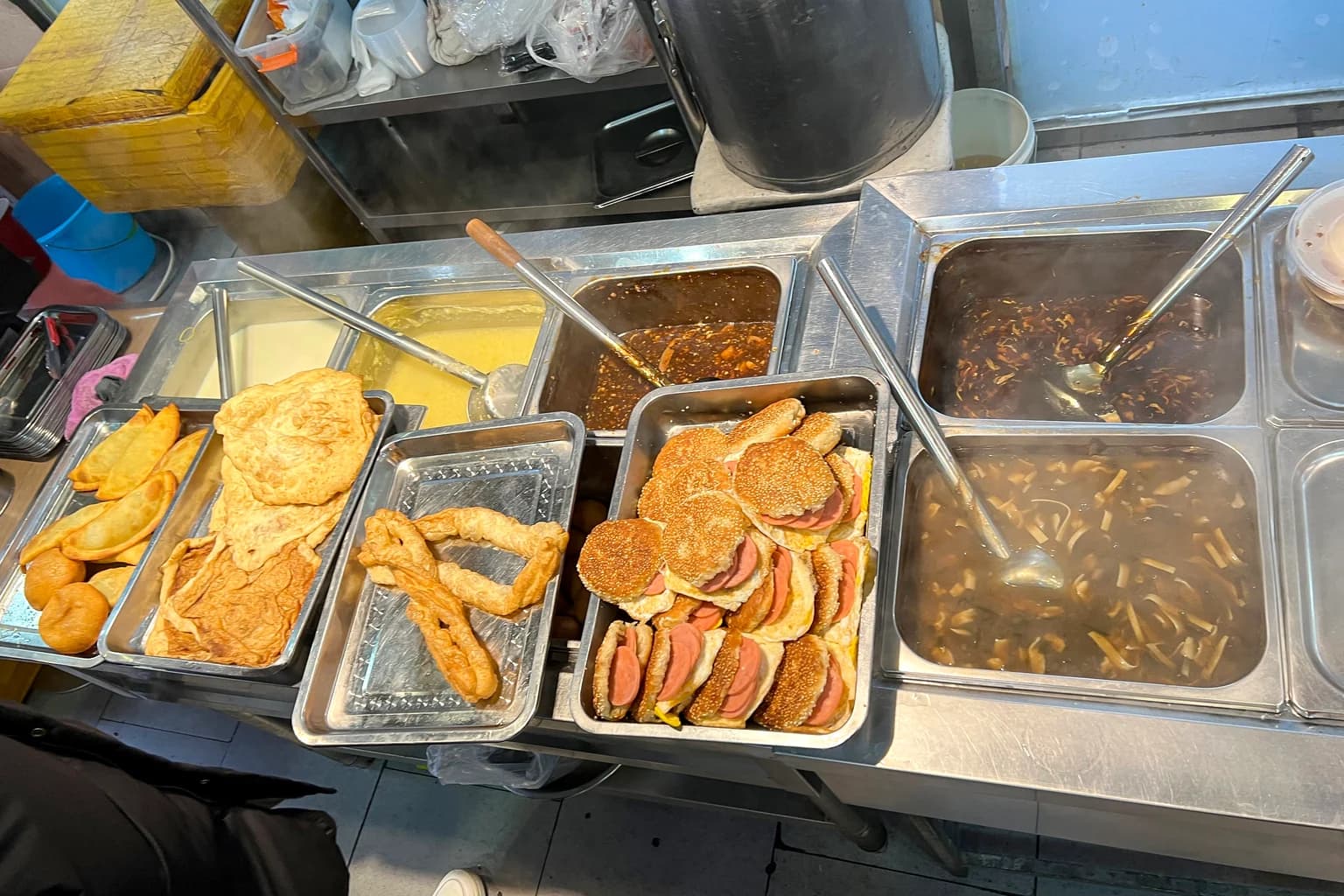
Breakfast counters mix simple staples with egg, meat and prepared soups. Pointing at one tray does not answer what is in its batter, filling, broth or frying oil. Photo by N509FZ, CC BY-SA 4.0.
Noodles: dry and custom-cooked is easier than mystery broth
Soup noodles are a classic trap because the visible ingredients can all be plants while the stock is pork, beef, chicken or bone broth. Start with a dedicated vegetarian shop or choose a dry-mixed noodle whose sauce can be explained. Ask whether the noodles themselves contain egg, then confirm the sauce, lard and chicken powder.
A useful request is: 清水煮面,加青菜和豆腐,不要肉汤、猪油、鸡精和蚝油。 This asks for noodles boiled in water with greens and tofu, without meat stock, lard, chicken seasoning or oyster sauce. It is a request, not a guarantee; accept a refusal if the kitchen uses one shared stock or premixed sauce.
Hotpot and malatang: the base is only the first question
In Chengdu and Chongqing-style hotpot, red color and vegetables do not imply a plant-based base. Traditional spicy bases often use beef tallow. Tomato, mushroom and clear bases can also contain chicken, bone or seafood stock.
Choose a pot that staff can identify as plant-based. If eating with meat-eaters, request a separate small pot rather than assuming a divider prevents all mixing. Use separate ladles, tongs and sauce bowls. Check premixed dipping sauces for oyster sauce, fish sauce and animal stock. At 麻辣烫 málàtàng, ask whether the selected ingredients are cooked in a shared broth and whether the final seasoning contains lard or chicken powder.
Dim sum, dumplings and bakery food: vegetables do not settle the recipe
A vegetable dumpling can contain egg, dried shrimp or oyster sauce. A mushroom bun can use lard in the dough or filling. A glossy pastry may contain butter, milk, egg or gelatin. Ask about both the filling and wrapper or dough.
For vegans, a freshly steamed plain bun with a confirmed recipe is easier to verify than an elaborate “vegetable” pastry. In Cantonese restaurants, even plain-looking greens often arrive with oyster sauce, and soups commonly use animal stock. Request blanched or stir-fried vegetables with vegetable oil and salt only if the kitchen can actually prepare them that way.
Tofu and greens: strong building blocks, incomplete proof
Tofu, mushrooms, bamboo shoots, lotus root, aubergine and leafy greens make a good meal structure. They do not prove the sauce is vegetarian. Mapo tofu usually contains minced meat unless explicitly made vegetarian. Braised tofu may use stock or oyster sauce. Aubergine can arrive with minced pork. Greens may use lard or dried shrimp.
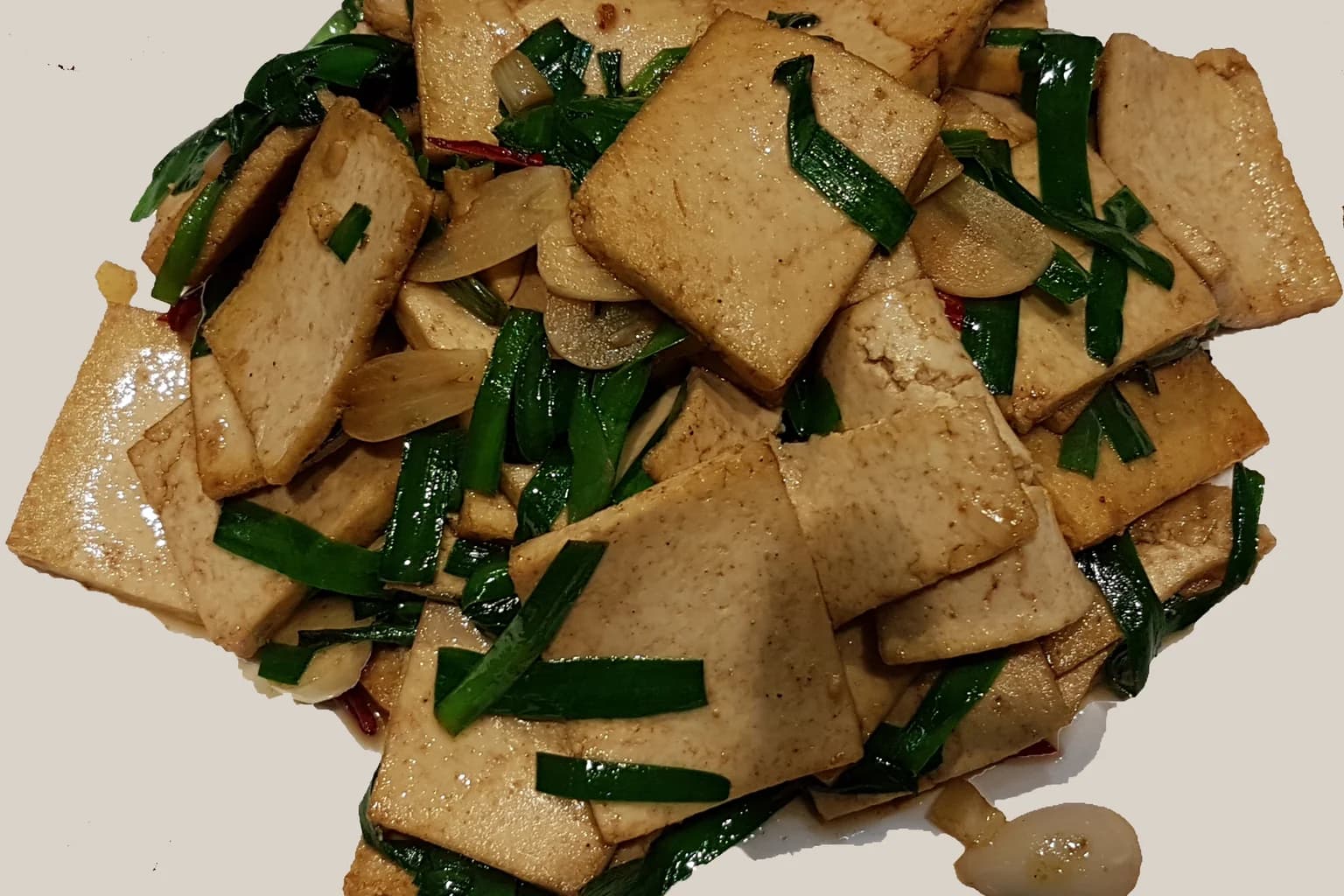
Tofu can anchor a filling meal, while the visible garlic and chives make this dish unsuitable for travelers avoiding pungent alliums. Sauce, fat and shared cookware still need a separate check. Photo by Anagoria, CC BY 3.0.
Convenience stores and supermarkets: read the full ingredient list
Look for 配料表 pèiliàobiǎo, the ingredient list. Scan for the Chinese terms in the hidden-ingredient table rather than relying on a green package, a vegetable photograph or one 素 character on the front. Check flavored soy drinks, crackers, instant noodles, snack bars and imitation meats for milk powder, whey, egg, honey, gelatin and seasoning blends.
As of October 2026, China's new food-label measure has been published but is scheduled to take effect on March 16, 2027. It does not apply to food prepared and sold on site in restaurants. The practical result is simple: read the full current ingredient list, and do not treat the absence of a prominent allergen banner as proof. The State Administration for Market Regulation's published measure gives the exact implementation boundary.
Reliable backup categories include whole fruit, plain rice products, clearly labeled nuts or seeds, sealed soy drinks and simple crackers—but only after your own ingredient and allergen check. “Plant flavor,” “vegetable,” “healthy” and “meat-free looking” are marketing impressions, not a dietary specification.
Trains: board with a real meal
Do not make the onboard cart your only plan. China Railway's current dining FAQ says some ordinary trains have no dining car and tells travelers with special dietary habits to ask train staff; it does not promise vegetarian or vegan meals. The 12306 system offers meal preordering on some journeys, but available merchants and dishes depend on the train and delivery station.
Check the live inventory after booking, and order only when the ingredient information is adequate. Otherwise buy a verified meal before entering the station and carry one sealed backup. Avoid self-heating rice or hotpot products onboard: the railway asks passengers not to use self-heating meals because steam and hot water can create burn risk in the enclosed carriage.
The high-speed rail planning guide covers station choice and transfer timing. Add food acquisition to that timeline. A station may be large and well supplied, but reaching the platform after security is the wrong moment to discover that every suitable shop is behind you.
Choose cities by food friction, not by a promise of perfection
No city can guarantee that every kitchen understands veganism. Bigger cities usually offer more specialist venues and easier delivery searches; regional cuisine determines the questions you need to ask.
Shanghai: the easiest first base for range and recovery
Shanghai combines dedicated vegetarian dining, temple food traditions, international grocery options and many ordinary restaurants familiar with specific requests. It is a strong arrival base because a failed meal plan can be replaced without changing the day's sightseeing.
Use temple meals as one cultural option rather than your only supply line. Service at Longhua Temple or the vegetarian hall associated with Jade Buddha Temple can vary by time and current operation. Keep a second specialist venue saved near the hotel.
Beijing: broad choice, long sightseeing days
Beijing has enough specialist restaurants to support vegan and vegetarian travelers, but distances make location planning important. Save one dinner option near the hotel and one near each long sightseeing zone. On a Great Wall day, take a complete meal or confirm the exact lunch arrangement before departure.
Ordinary Beijing noodles, dumplings and filled breads often need stock, lard, egg and filling checks. A plain-looking noodle is not automatically easier than a clearly described vegetarian set meal.
Guangzhou and Shenzhen: excellent variety, Cantonese seasoning checks
Guangzhou and Shenzhen offer broad dining ecosystems and useful specialist leads. Cantonese cooking rewards careful questions: vegetable dishes may use oyster sauce, broth or dried seafood; dim sum can hide lard, egg and shrimp.
These cities work well when you select one dedicated vegetarian meal each day and use simpler ordinary dishes around it. At dim sum, ordering by appearance creates more work than choosing a venue that can explain its vegetarian menu as a system.
Chengdu: exciting ingredients, high hidden-animal risk
Chengdu offers tofu, mushrooms, vegetables and bold flavors, but ordinary Sichuan cooking often uses lard, chicken seasoning, meat stock or beef-tallow hotpot. A dedicated vegetarian kitchen provides much more confidence than asking a busy mixed hotpot restaurant to improvise.
Wenshu Monastery is a logical place to understand Buddhist food culture, but do not build the day around an unverified report that a public meal will be operating. For hotpot, verify the base and request separate utensils; for noodles, ask about both broth and chili oil ingredients.
Xi'an: grains help, fillings and broths complicate
Xi'an has flatbreads, noodles, cold dishes and vegetable sides that can support a vegetarian meal. The challenge is preparation: bread can be paired with meat broth, dumplings hide fillings, noodles may use egg, and apparently simple dishes can use lard or meat stock.
Choose a dedicated vegetarian lunch on the longest heritage day. For an ordinary dinner, order rice or noodles plus two separately confirmed tofu/vegetable dishes rather than trying to decode a large mixed menu while tired.
Xiamen and Hangzhou: temple traditions plus a normal backup plan
Xiamen and Hangzhou can fit travelers who want a slower food rhythm and Buddhist cultural context. At Xiamen's South Putuo Temple, treat a vegetarian meal or pastry as an option to verify that day, not a guaranteed reservation. Seafood-heavy local menus elsewhere still require exact questions about fish sauce, dried shrimp and stock.
Severe allergy: use a different standard
A preference-level vegan card cannot certify an ordinary kitchen for a severe allergy. Cross-contact can be invisible: a knife, chopping board, wok, ladle, fryer or sauce container can transfer enough allergen to matter. If staff cannot explain the process and equipment, do not eat the dish.
Prepare with your clinician before travel. Carry prescribed emergency medicines, including epinephrine/adrenaline if prescribed, on your person rather than in checked luggage. Keep them in original packaging, bring copies of prescriptions and your action plan, teach companions how to respond, and identify appropriate medical care along the route. The CDC Yellow Book guidance for severely allergic travelers is a useful planning baseline.
Use a card that states 严重过敏 (“severe allergy”), the exact allergen and cross-contact restriction. Replace the blank before travel:
我对___严重过敏,一点也不能吃。接触过___的锅、刀、砧板、餐具和炸油也不能用。如果无法完全避免,请告诉我,我不能吃。
I have a severe allergy to ___. I cannot eat any amount. Woks, knives, chopping boards, utensils and frying oil that have touched ___ also cannot be used. If you cannot completely avoid it, please tell me; I cannot eat the food.
Machine translation is a communication aid, not an allergy protocol. Have the final wording checked by a fluent speaker who understands the allergen. Bring enough safe sealed food to survive a missed connection or unsuitable meal. Do not use a buffet, shared hotpot or mixed fryer when your action plan requires strict cross-contact control.
A seven-day meal architecture you can actually repeat
This is a framework, not a restaurant list. Move the specialist meal to the part of each day when the sightseeing geography makes sense.
Day 1: remove uncertainty after arrival
- Breakfast or arrival snack: sealed soy drink, fruit and a labeled grain product.
- Main meal: dedicated vegan or vegetarian restaurant near the hotel; use this low-pressure meal to test your Chinese card.
- Backup: rice, plain tofu and two simply cooked vegetables from a kitchen that can answer the sauce-and-oil questions.
Day 2: practice an ordinary restaurant order
- Breakfast: plain congee or soy milk plus a confirmed steamed bread.
- Lunch: dry-mixed noodles or rice with tofu and greens; verify noodles, sauce, oil and seasoning.
- Dinner: return to a specialist venue if lunch required too much negotiation.
Day 3: temple-food day, only after current confirmation
- Morning: carry a backup snack before visiting the temple.
- Lunch: public temple or temple-adjacent meal if service is operating and your requirements are confirmed.
- Dinner: simple grain, tofu and vegetable dishes; do not assume the temple meal's terminology applies elsewhere.
Day 4: hotpot with controlled variables
- Breakfast: packaged, labeled components.
- Lunch: specialist vegetarian set meal with soy, mushrooms and vegetables.
- Dinner: separate plant-based hotpot base, separate utensils and verified sauces. If the restaurant cannot separate them, switch to another meal rather than negotiating at a boiling shared pot.
Day 5: long sightseeing or excursion day
- Before departure: eat a substantial breakfast and pack a complete lunch.
- During the day: use fruit, sealed nuts or seeds if safe for you, crackers and a verified protein item.
- Evening: choose a saved specialist venue near the hotel, not an unresearched place beside the final attraction.
Theme parks, remote scenic areas and ticketed compounds can have many food counters while still offering few dishes that staff can explain precisely. Treat them like a transport day: enter with enough food to cover the visit, within the venue's current outside-food rules.
Day 6: regional dish with a controlled adaptation
- Choose one local format—noodles, dumplings, tofu, hotpot or dim sum—and research the usual hidden ingredients.
- Ask for one adaptation that the kitchen can execute, such as water-boiled noodles with greens and tofu or blanched vegetables without oyster sauce.
- Add rice and a second confirmed dish so the meal does not depend on one modified item being filling.
Day 7: transfer day
- Buy the main meal before leaving the hotel district or at a known shop.
- Carry one extra sealed meal beyond the planned journey time.
- Inspect 12306 preorder inventory only as a bonus; do not depend on a vegan option appearing.
- Keep the backup accessible at your seat, not buried under luggage.
Across the week, rotate grains, tofu and other soy foods, vegetables, fruit, nuts or seeds, and other protein sources that fit your diet and allergies. China's public dietary guidance for vegetarian adults emphasizes variety rather than living on plain noodles. Travelers with nutritional or medical needs should make their plan with a qualified clinician or dietitian before departure.
The compact pre-trip setup
Before flying, do these seven things:
- Save the correct Chinese card as an offline screenshot and print one copy.
- Highlight your non-negotiable hidden ingredients in Chinese.
- Save two current specialist-restaurant leads near each hotel, then recheck them shortly before the meal.
- Put one suitable breakfast and one transfer-day backup on the first grocery stop list.
- Mark the meal that must happen before each long excursion or railway journey.
- If allergies are involved, complete a clinician-reviewed emergency and medication plan.
- Accept that a clear “we cannot do this” is useful information and have the next option ready.
A successful vegetarian or vegan trip is not one where every meal is spontaneous. It is one where most meals are easy, the difficult categories are anticipated, and a failed check costs ten minutes rather than the entire day.