China's most scenic train routes: choose daylight before a train name
Only one route on this list justifies designing a trip around the train itself: the Qinghai–Tibet Railway between Xining and Lhasa. The others are valuable because they connect places already worth visiting while adding a strong window experience. That distinction prevents the most common scenic-rail mistake—spending an extra day on a train whose best section passes in darkness, cloud or a tunnel.
A train marketed online as “China's most beautiful” can still depart after sunset. A fast daytime service may show more than a branded tourist sleeper. An A or F seat may be beside a window, but it does not permanently mean mountain side or river side. Train sets reverse, carriage layouts change, seats can be reassigned, and the line itself may cross the landscape several times.
This guide decides which corridors deserve daylight and whether the view is worth changing the itinerary. Use the China high-speed rail planning guide for passports, ticket release, luggage, station procedure, changes and missed trains; use the overnight sleeper guide when a berth, sleep quality and night-station transfer matter more than the window. Use the 10-, 14- and 21-day itinerary guide to choose city order and night counts.
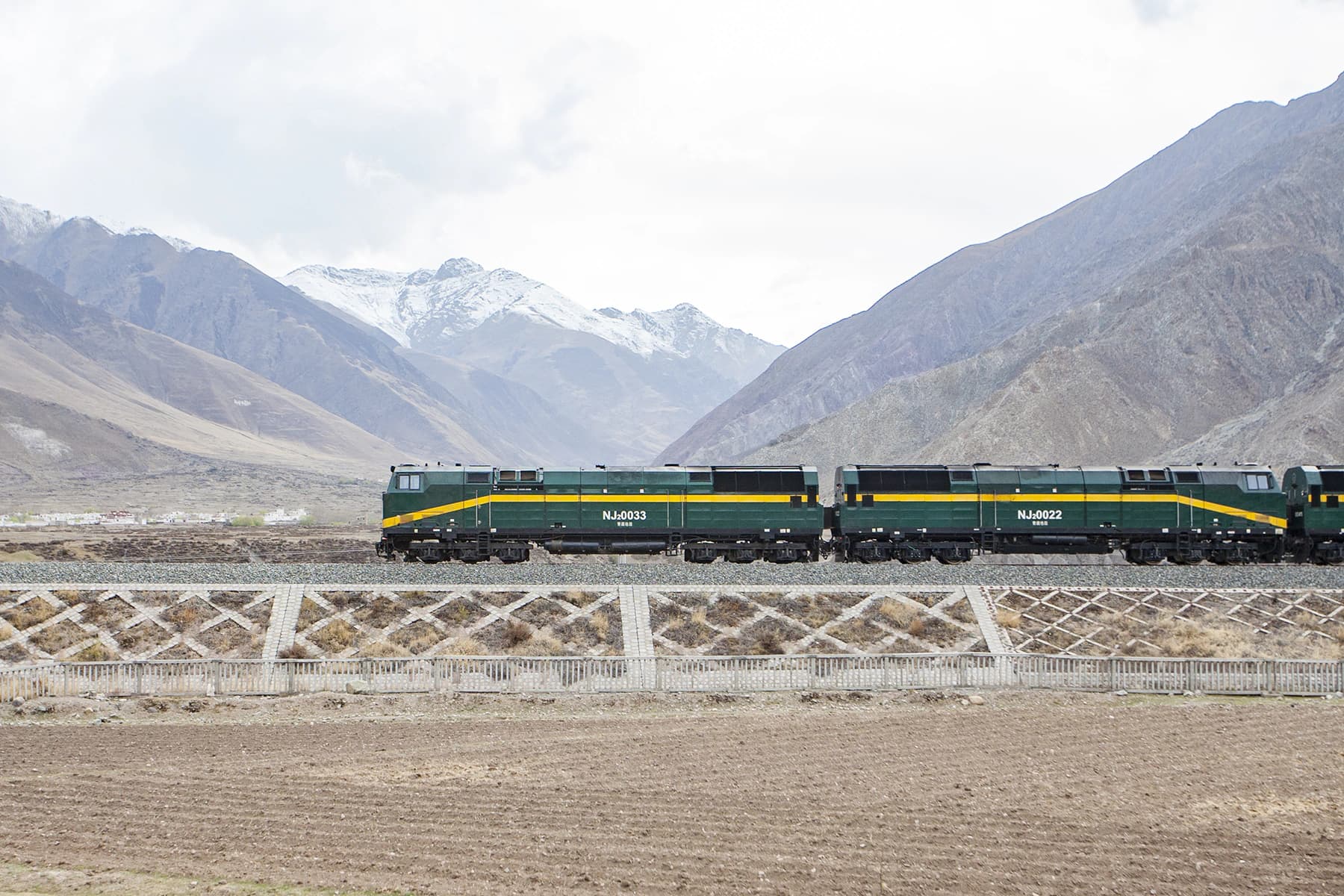
The Qinghai–Tibet Railway is the rare Chinese rail journey where the landscape can be the main purpose. Weather, daylight and the actual timetable still control what appears outside. Photo by Windmemories, CC BY-SA 4.0.
The quick route chooser
| Route | Current useful rail time | What the window can add | Is a detour justified? |
|---|---|---|---|
| Xining → Lhasa | Ordinary services average about 20–21 hours | High plateau, broad grassland, salt-lake country, mountain passes and the Lhasa approach | Yes, if Tibet is already the destination and the relevant plateau section is in daylight |
| Lanzhou/Xining → Zhangye → Jiayuguan → Dunhuang | Roughly 2.5–3 hours Lanzhou West–Zhangye West on faster daytime services; later legs vary | Qilian foothills, dry basins, fields, Gobi scale and Silk Road geography | Yes as a multi-stop route, not as one continuous window marathon |
| Lijiang → Shangri-La | Fastest current services about 1 hour 10 minutes; others are longer | Short canyon, river and highland-meadow glimpses between tunnels | Yes, because it is also the practical destination transfer |
| Dali → Lijiang | Fastest current services about 1 hour 36 minutes | Cangshan–Erhai context, fields and mountain approach | Only if already visiting both cities |
| Nankou → Badaling on Beijing S2 | A short suburban segment, but the city-to-Nankou transfer makes the whole outing longer | Curving mountain railway, Great Wall country and a brief spring blossom window | Yes for rail enthusiasts or a slow Badaling day, not for the fastest Great Wall access |
| Guiyang → Guilin | Common direct services range roughly 1 hour 45 minutes to 3 hours by station and train | Repeated karst glimpses between long tunnel sections | Scenic bonus only; never add the corridor without wanting both regions |
Times above were checked against current official or live inventory on October 3, 2026. They are planning ranges, not promises for a future date. China Railway periodically changes the operating diagram, adds peak services, suspends sales while it loads a new timetable and substitutes equipment. Search the exact date and complete station pair before using any number in a day plan.
Use the scenic-rail test before changing your route
A rail segment earns a place in the itinerary when it passes four tests:
- The exact service crosses the scenic section in daylight. Sunrise at the departure city is insufficient; identify where the train will be several hours later.
- The origin and destination are places you genuinely want. A pretty two-hour window rarely justifies two hotel changes.
- The open sections are long enough to matter. Mountain railways often achieve their speed through tunnels. A famous gorge may appear for minutes, not an hour.
- The slower or less convenient train does not destroy the next day. Compare hotel checkout, station access, train time, station exit and the destination hotel—not only the view.
Give the scenery a simple value: trip-defining, route-enhancing or incidental. Qinghai–Tibet can be trip-defining. Hexi and northwest Yunnan are route-enhancing. Guiyang–Guilin is incidental scenery on an already sensible transfer.
Do not buy a service because its nickname contains “scenic,” “tourist,” “snow mountain” or “most beautiful.” Some tourism trains are overnight accommodation products. One currently discussed Yunnan service is praised for private compartments while running through its supposed landscape at night. The compartment may still be useful; the window claim is not.
1. Xining to Lhasa: the one journey worth planning around
Best for: travelers already taking an authorized Tibet trip who accept a long sleeper journey and want the railway itself to be part of the experience.
Station pair: Xining railway station → Lhasa railway station. Starting farther east adds many hours but does not improve the core high-plateau section. Xining is the cleanest place to board when the purpose is the Qinghai–Tibet line rather than collecting train mileage.
Current ordinary Xining–Lhasa journeys average roughly 20 hours 40 minutes, but the decisive number is the time through Golmud–Nagqu–Lhasa. That is where the train climbs onto the high plateau and crosses the railway's defining landscape. A westbound service can hide part of this section overnight; an eastbound service can produce a different daylight distribution. Compare two or three exact trains on the intended date and write their approximate Golmud and Nagqu times beside sunrise and sunset.
Special organized tourism trains sometimes deliberately protect daylight over the plateau. A March 2026 tourism train left Xining in the evening and took about 21 hours 40 minutes to Lhasa, with the operator promoting daytime high-plateau viewing and onboard support. That does not mean an ordinary Z train, a different seasonal charter or next year's service follows the same timing. A tourism package and a normal railway ticket are different products.
What you may see—and what cannot be promised
The durable sequence is more useful than a landmark checklist: dry Qinghai basin, Kunlun approaches, broad high-altitude plain, permafrost engineering, lakes and wetlands, then the long descent toward Lhasa. Snow cover, green grass, frozen water, wildlife, blue sky and distant peaks all vary with month and weather. A photograph of Tibetan antelope does not make wildlife a timetable feature.
Cloud can flatten the mountains. Dust or condensation can soften the glass. A winter trip can deliver extraordinary clarity and frozen landscapes but fewer daylight hours; summer gives greener grassland and longer light but more cloud. The landscape remains vast even when the named peak does not appear.
Plateau health is separate from scenic value
China Railway's plateau guidance says the Golmud–Lhasa section provides both diffused and individual oxygen service and warns that high-altitude travel places demands on health. Oxygen equipment reduces one operational risk; it does not guarantee immunity from altitude illness. The train also does not create slow acclimatization simply because the total journey is long: much of the elevation gain occurs after Golmud.
Discuss relevant heart, lung, pregnancy or altitude concerns with a qualified clinician before booking. On board, keep activity gentle, hydrate normally, avoid alcohol, and tell staff promptly about severe headache, confusion, breathlessness at rest, loss of coordination or worsening symptoms. Plan the first Lhasa days lightly even if the ride felt easy.
Non-mainland-Chinese travelers must settle Tibet entry and tour arrangements before treating the train ticket as usable. The current published local guidance says foreign visitors and Taiwan residents require an authorized travel agency to arrange the group and Tibet entry letter; categories and rules can change. Verify the requirement for your passport directly with a qualified operator and current official channel before buying non-refundable connecting travel.
2. The Hexi Corridor: build four stops instead of one heroic ride
Best for: a Silk Road trip linking Gansu's major historic and desert destinations.
Useful station chain: Lanzhou West or Xining → Zhangye West → Jiayuguan South (or the exact Jiayuguan station shown on the ticket) → Dunhuang. The scenic logic is a sequence of travel days, not an instruction to remain aboard from dawn to night.
Current 2026 tourism and live train information puts faster Lanzhou West–Zhangye West daytime D services at roughly 2 hours 40 minutes to just over 3 hours. Zhangye–Jiayuguan is commonly planned around 1.5 hours, while a current fast Jiayuguan–Dunhuang connection can be around 2.5 hours. Each date can offer slower trains and different station combinations, so search the actual pair rather than typing only the city names.
This corridor explains Gansu better than one postcard view. Irrigated fields sit against dry land. The Qilian range holds the southern horizon when visibility cooperates. Towns, wind and solar infrastructure, gravel plain and long empty-looking distances show why the historic corridor was a route rather than a single attraction.
The strongest structure is:
- Lanzhou or Xining → Zhangye: choose a daylight service and stay for Zhangye, not only the train. The line from Xining adds a more direct Qilian-mountain context; the line from Lanzhou is easier in a classic Gansu itinerary.
- Zhangye → Jiayuguan: a short enough transfer to preserve a half-day. Sleep in Jiayuguan if the fortress and frontier landscape matter.
- Jiayuguan → Dunhuang: protect the destination time. Dunhuang needs reservations and full days; do not choose a slower train merely to remain in the Gobi longer.
Do not promise “the left side for snow mountains.” The Qilian range lies generally south of much of the corridor, but the railway curves, seats face both ways, and booking channels do not sell a permanent compass side. A/F can indicate window positions on many 3+2 second-class layouts, yet the carriage's orientation determines which landscape each window receives. The honest tactic is a daylight train, a window preference and realistic expectations on both sides.
Spring wind can reduce visibility. Summer can make the basins harsh and bright. Autumn often gives clear contrast between field and dry mountain. Winter can be beautifully spare while shortening usable light. Construction and timetable changes are especially relevant west of Lanzhou: verify the current station pair and do not copy an old train number into a future trip.
3. Lijiang to Shangri-La: a short, useful scenic transfer
Best for: travelers already linking Lijiang and Shangri-La who want to replace a longer road transfer with rail.
The Lijiang–Shangri-La Railway is 139.7 km long. Current operator-sourced reporting puts the fastest journey at about 1 hour 10 minutes, with peak-period service reaching up to 11 pairs and the operating plan adjusted dynamically. Live inventory commonly shows direct daytime choices lasting around 1 hour 10 minutes to 1 hour 50 minutes.
This is a good train because the transport decision works even without the view. It connects two strong destinations, avoids a long road journey, and can show flashes of the Jinsha River system, steep canyon terrain, forest and the higher grassland around Xiaozhongdian. It is not a glass-roof panorama. Much of the engineering lies in tunnels and on bridges; the dramatic open view can arrive and disappear quickly.
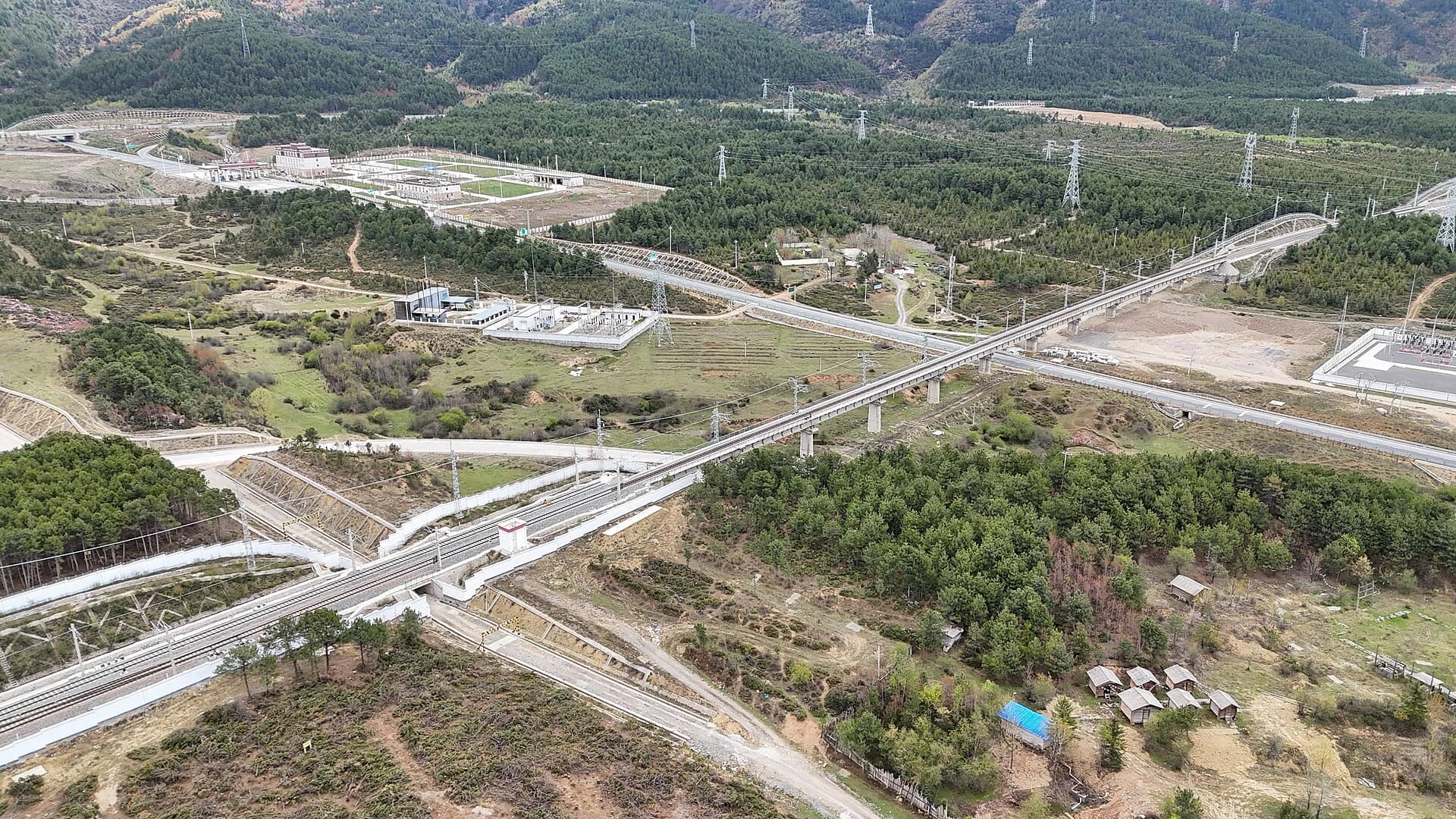
Near Xiaozhongdian, the railway alternates between exposed viaducts and engineered mountain sections. A route photograph shows the setting without promising the view from one carriage. Photo by 瑞丽江的河水, CC BY-SA 4.0.
Do not copy a fixed “Tiger Leaping Gorge side” rule
Recent riders publish conflicting A-seat and F-seat advice for the same direction. That is not necessarily dishonesty: a different train number, carriage orientation, operating adjustment or exact photo location can reverse the useful side. Even on the right side, another passenger, window pillar, reflection or tunnel portal can block the moment.
Request a window, then treat side as luck. Keep the camera ready soon after departure, reduce screen brightness and do not press a large lens against the glass. Never leave the assigned carriage, occupy a doorway or displace another passenger for a viral shot. Seeing the gorge properly still requires a separate Tiger Leaping Gorge route, with road/trail planning and current access checks.
Shangri-La station is not Dukezong Old Town. Lijiang station is south of the old city. A 70-minute train therefore remains a half-day hotel move after packing, station transfers, security and check-in. Choose a departure that preserves either a calm Lijiang morning or a usable Shangri-La afternoon; do not sacrifice both for one online seat claim.
4. Dali to Lijiang: an Erhai window bonus
Best for: a normal northwest-Yunnan route connecting Dali and Lijiang.
Current live inventory shows multiple daily services, with the fastest around 1 hour 36 minutes. The line can give useful Cangshan–Erhai orientation, agricultural landscape and a mountain approach, especially in clear daylight. It should not replace a proper Erhai east-shore day or a Cangshan outing.
Choose the train by destination timing first. An early departure can erase the best part of a Dali morning; a late departure can turn Lijiang arrival into a dark station-to-hotel transfer. Daylight matters, but an extra 45 minutes on a slower service rarely creates 45 additional minutes of lake view.
Read the product details rather than assuming every train uses a standard high-speed 3+2 carriage. Current services can include different train types and classes. Travelers have reported unexpected sleeper-style cars sold for seated use, with berth space handled differently from a normal sleeper journey. The booking's actual class and carriage control; a photograph from another train does not.
Dali station is in Xiaguan, not inside Dali Old Town. Lijiang station is not at the old-town gate. If the hotel is around Erhai's northern or eastern shore, a road transfer may be more direct than returning to Dali station solely for scenery. The rail view is a benefit after the route geometry works.
5. Beijing S2 to Badaling: understand the 2026 starting point
Best for: a rail enthusiast, a slow spring outing or a traveler who prefers the historic mountain line to the fastest possible Great Wall transfer.
As of the Beijing Municipal Transport Commission's July 2026 update, the S2 no longer starts at Huangtudian. Construction associated with the northeast suburban railway moved the operating section to Nankou → Badaling → Yanqing/Kangzhuang/Shacheng. The base plan is only two pairs Tuesday–Thursday and three pairs Friday–Monday and short holidays. Blossom periods can receive temporary extra trains, and weather can cancel service.
That change is decisive. Reaching Nankou from central Beijing adds a city/suburban transfer. For an efficient Badaling Great Wall day, a Beijing North or Qinghe high-speed service to Badaling Great Wall Station (八达岭长城站) can be more practical. The S2 uses Badaling Station (八达岭站), a different station on a different service pattern.
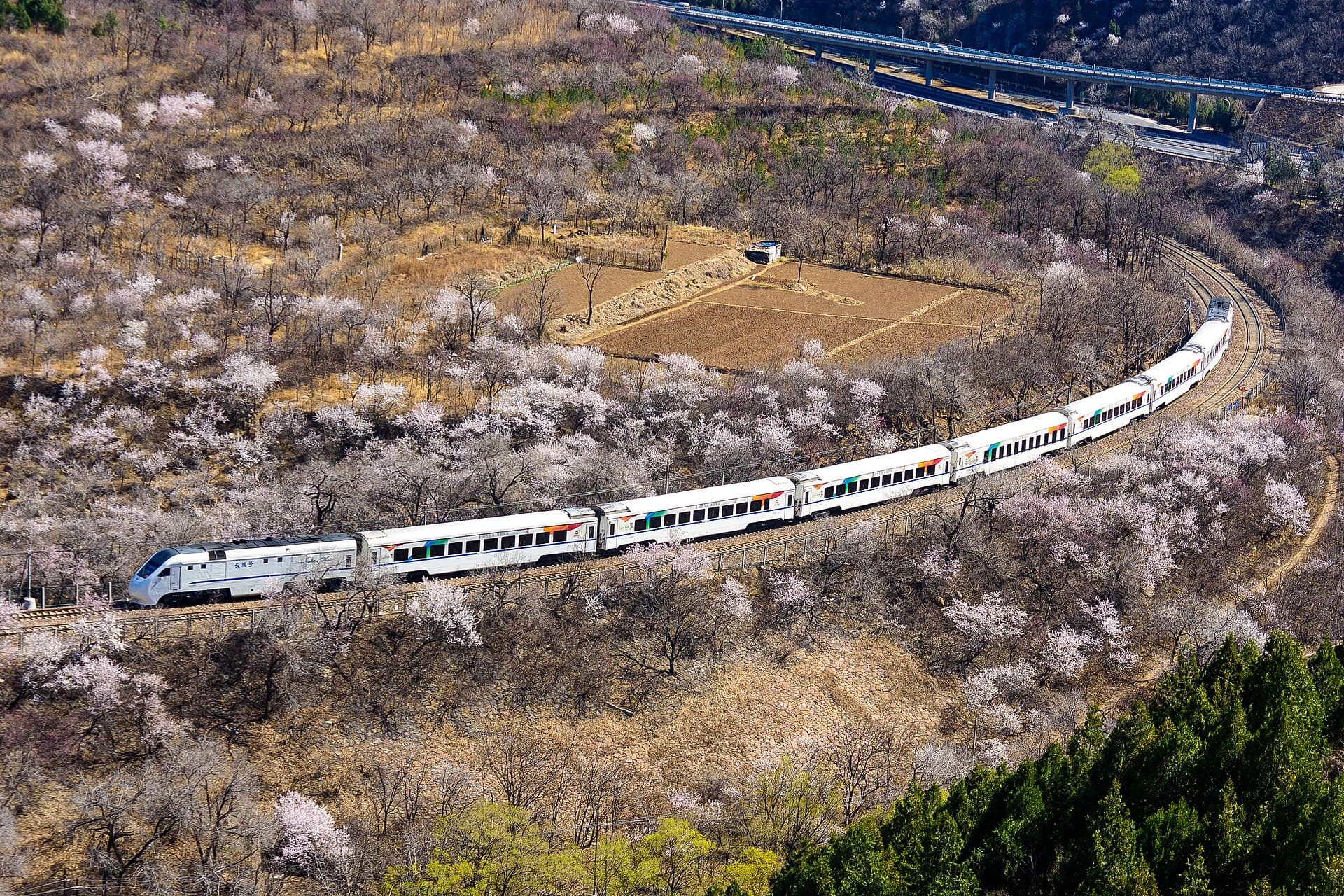
Many famous “spring train” photographs are made from a hillside outside the train. The onboard experience is a moving valley view, not this elevated composition. Photo by N509FZ, CC BY-SA 4.0.
The onboard appeal is the curving old mountain alignment, orchards and brief Great Wall country. The celebrated blossom period is short and weather-dependent. A photograph of the entire train curling through flowers is normally made from outside; passengers do not see their own train from that angle. Choose whether you want to ride the S2 or photograph it from an authorized public viewpoint. Trying to do both on a sparse timetable can consume the day.
Check the current “北京市郊铁路” notice immediately before travel. Rain warnings caused multi-day S2 cancellations in July 2026, and spring service was temporarily increased on specific dates. An evergreen article cannot replace the dated operating notice.
6. Guiyang to Guilin: good scenery, wrong reason for a detour
Best for: travelers already combining Guiyang, Qiandongnan or another Guizhou stop with Guilin.
Current direct services use combinations such as Guiyang North or Guiyang East → Guilin West, with many journeys around 1 hour 45 minutes to 3 hours. Write the suffixes into the plan. Guilin West sits on the city's northern edge and is different from Guilin North and central Guilin station; the fastest rail time may create a longer hotel transfer.
The view is a rhythm of karst towers, valleys, viaducts and tunnels. High speed makes individual scenes brief, while long underground sections interrupt them. This is an excellent “look up from the phone” transfer and a weak reason to insert a new city. If the route already includes Zhaoxing Dong Village, Congjiang can create a more coherent stopover than sitting from Guiyang to Guilin solely for windows.
Low cloud can give the karst depth and atmosphere; it can also obscure the farther formations. Heavy rain and construction or operating changes can affect the journey. The enduring recommendation is the corridor, not a particular train number or side.
Seat direction: what can and cannot be controlled
On many G/D/C second-class trains, A and F are window positions. That is useful, but it is the end of the guarantee. It does not say which side faces north, a lake, the mountain or the gorge. The same numbered train can use different equipment. Seats face both directions, and the train set can enter the route in another orientation.
Use this priority order:
- Correct date, station pair and daylight. These create the view.
- Direct train and useful arrival. These protect the itinerary.
- Window preference. Choose A or F when the layout clearly shows a 3+2 carriage.
- Side preference only as a request. Treat any online letter recommendation as unconfirmed until you see the actual carriage.
First class can provide wider seats and fewer people, but it does not guarantee cleaner glass or the desired side. Business class may recline so far that the view angle is worse. A sleeper gives more journey comfort on a long route, yet the berth and corridor alternate which side is accessible. Choose the class for the total trip rather than buying an expensive seat to solve an uncertain compass problem.
If your issued place disappoints, ask politely whether an unoccupied seat may be used and return immediately when its passenger boards. Do not turn a photo preference into a dispute. Keep bags out of aisles and do not gather around carriage ends.
Weather, season and timetable changes
Scenic rail is unusually sensitive to conditions that no booking platform controls:
- Spring: northern blossom windows can shift by weeks. Hexi wind and dust may reduce contrast. Yunnan's dry-season grasslands can look brown rather than green.
- Summer: long daylight helps plateau and Gansu routes, while cloud can hide mountains. Yunnan rain brings vivid green and lower visibility. Holiday trains sell quickly.
- Autumn: often the most reliable balance of daylight, dry air and field color in the northwest, but early snow and temperature changes are possible.
- Winter: clear air, snow and frozen lakes can be extraordinary. Short daylight makes train selection harder, and disruption has larger consequences on a sparse route.
Construction can move an origin, as Beijing S2 demonstrates. A national timetable change can make future dates appear unavailable before new trains are loaded. Weather inspection, flooding, landslide risk or wind can delay, reroute or cancel a service. Keep the scenic claim subordinate to live railway information.
A booking workflow that protects the view
- Put the desired cities and nights on the route first.
- Write the complete station pair for each scenic leg.
- List every direct service in the current railway sale window.
- Mark sunrise and sunset at two or three points along the line, not only at the endpoints.
- Remove trains that place the defining section in darkness.
- Compare arrival usefulness and total hotel-to-hotel time.
- Request a window only after the train passes the first six tests.
- Keep one acceptable backup in case the preferred service sells out or the operating diagram changes.
The normal China Railway sale period is currently 15 days including the travel date, although the operator can adjust it. A third-party reservation before inventory release is a request, not an issued seat. When the exact dated service is ready, compare live train inventory on Trip.com or use China Railway 12306. The same underlying railway inventory and passport details control the journey.
Three route combinations that work
Seven to nine days: the Hexi Corridor
Start in Lanzhou or Xining, then give Zhangye, Jiayuguan and Dunhuang real nights. Use daylight rail for each forward move and attractions after check-in only when the arrival leaves a robust half-day. This structure makes the scenery cumulative: mountain edge, irrigated corridor, fortress country and desert destination. Flying directly to Dunhuang is faster; rail is better when the intermediate places matter.
Six to eight days: Dali, Lijiang and Shangri-La
Use Dali → Lijiang → Shangri-La. Treat Dali–Lijiang as an Erhai bonus and Lijiang–Shangri-La as the stronger short scenic ride. Give Shangri-La a light arrival day because the destination altitude matters more than the 70-minute train. Do not add a same-day Tiger Leaping Gorge excursion between checkout and rail.
One day from Beijing: S2 only when the operating day works
First solve central Beijing → Nankou. Match one outbound S2 with a verified return or use another mode in one direction. If the sparse times reduce the Badaling visit too far, take the faster high-speed option. A scenic local train should enrich the Great Wall day, not remove the time needed to climb it.
Routes that are often oversold
- Hainan's ring railway: useful for moving between cities and resorts, but much of the line is inland. It is not a continuous ocean-window train.
- Chengdu to Jiuzhaigou/Huanglongjiuzhai: a major access improvement, yet the railway uses extensive tunnels and still requires a mountain-road transfer. Choose it for access, then use the Jiuzhaigou–Huanglong route chooser.
- Very long eastern-origin trains to Lhasa: they add conventional rail hours before the defining plateau. Board at Xining unless the sleeper logistics or city of origin independently make sense.
- Any “scenic sleeper” whose best section is overnight: judge it as accommodation and transport. Darkness does not become scenery because the product has a romantic name.
Final rule
Book the corridor, daylight and station pair. Treat seat side as a preference and weather as uncertainty. The best scenic train is usually the one that advances an already coherent trip while giving you a reason to keep the phone down.
Choose Xining–Lhasa when the railway itself is part of the purpose. Split the Hexi Corridor into meaningful stops. Use Lijiang–Shangri-La because it solves the transfer and adds a memorable window. Ride Beijing S2 only after confirming its current Nankou origin and sparse schedule. Enjoy Dali–Lijiang and Guiyang–Guilin as bonuses rather than restructuring the holiday around them.
Operational baseline checked October 3, 2026. Exact train numbers, rolling stock, station use, daylight, seasonal scenery, Tibet formalities, construction and weather disruption must be verified for the actual travel date.