China overnight sleeper trains: save a useful day, not only a hotel bill
An overnight train is a good choice only when it turns an otherwise wasted travel day into a usable evening, a tolerable night and a workable morning. The word sleeper does not guarantee a private room, a particular mattress, a lower berth, a shower, silence or even the carriage layout shown in a booking-site photograph.
Use this test before buying:
- The train is direct. A 02:00 transfer defeats the purpose.
- Departure is late enough to preserve the day but early enough to board calmly. Roughly 20:00–23:00 is often the useful window; it is a planning preference, not a railway rule.
- Arrival is late enough for local transport and hotel access. A 04:45 arrival can create two hours of waiting with luggage.
- A real sleeper berth is available on your exact date. Do not infer the product from a D, Z, T or K train prefix.
- The berth suits your body and mobility. An upper berth is a poor saving if climbing it is difficult.
- You can accept an imperfect night's sleep. If the next morning contains a timed palace entry, mountain transfer or business meeting, a day train plus hotel may be the better purchase.
For national route geometry, daytime high-speed rail and missed-train procedure, start with the China high-speed rail itinerary guide. For routes chosen because of the view, use the scenic train guide. This page has a narrower job: deciding whether to sleep on the train and making that night work.
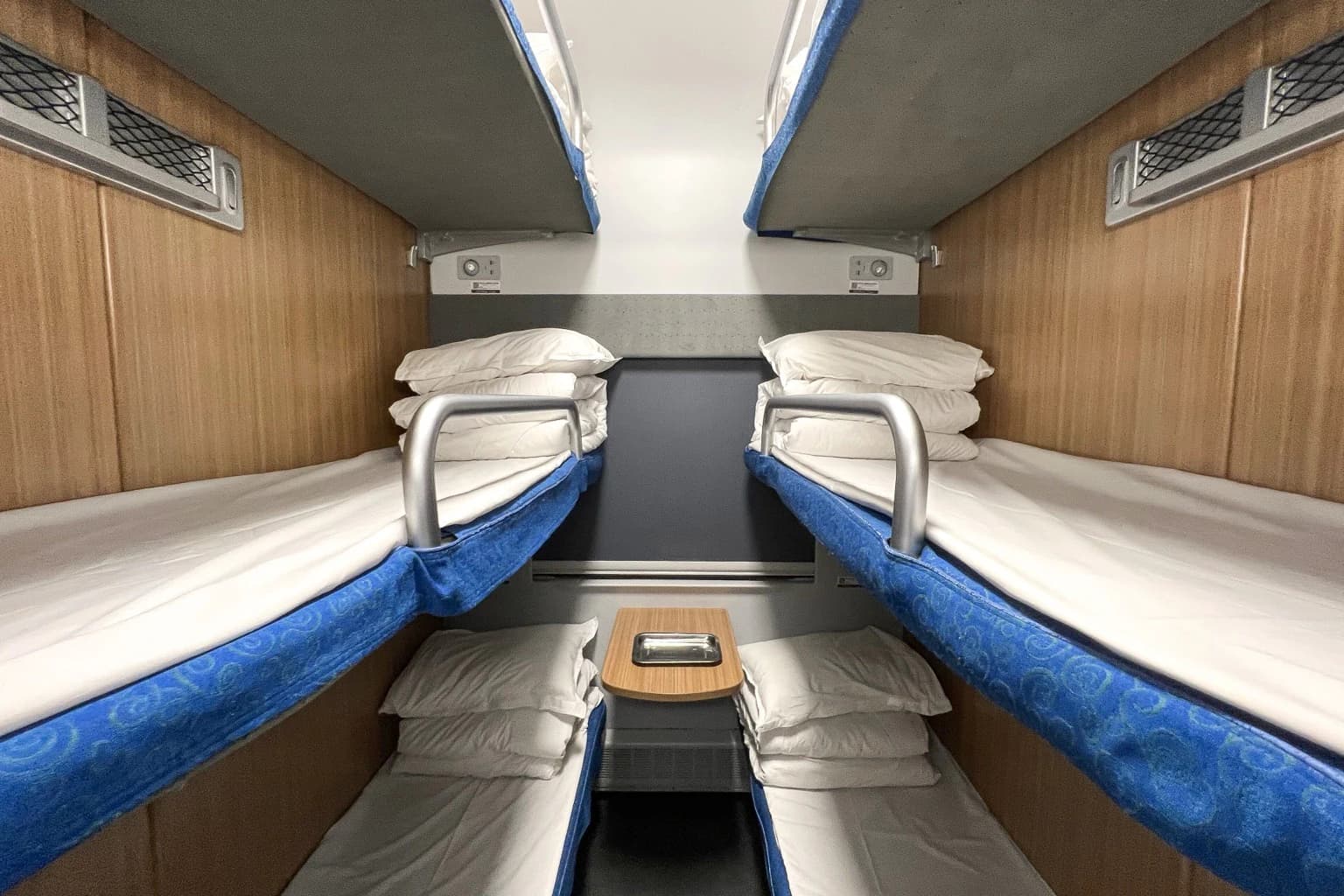
The fast answer: who should take a sleeper?
Choose a night train when the departure and arrival times fit your hotel days, the journey is long enough to replace a substantial waking transfer, and your preferred berth is actually on sale. It is especially attractive for a direct city pair where daytime rail would consume most of a sightseeing day but flying would require two long airport transfers.
Choose a daytime high-speed train when the ride is short, frequent or scenic, when a lower berth is essential but unavailable, or when the night train reaches the wrong station before public transport starts. Choose a flight when the sleeper takes well into the next day, when the rail route is indirect, or when one good night's sleep protects an expensive next-day plan.
The saving is not simply one hotel night. Calculate:
evening hotel use lost + departure-station transfer + station waiting + sleeper fare + sleep cost + arrival transfer + time before the next room is ready
A couple may discover that two soft-sleeper berths cost more than a discounted flight plus a modest hotel. A solo traveler may value arriving in the city center and avoiding airport baggage limits. A family may prefer one enclosed compartment if all four berths can be secured, but scattered berths or ladder access can make the same train unattractive. Compare the complete journey rather than the headline fare.
Know what the booking labels actually mean
China Railway's live search can show several sleeper products. The English translation and photograph used by a reseller can simplify what is really on the train. These are the labels worth recognizing:
| Booking label | Chinese | Typical planning meaning | What still needs checking |
|---|---|---|---|
| EMU sleeper / sleeper | 动卧 dòngwò | A sleeper product on a D-series or other EMU service offered on selected routes and dates | Four-berth compartment, longitudinal pods and other layouts exist; the train prefix alone proves nothing |
| Soft sleeper | 软卧 ruǎnwò | Commonly four berths in an enclosed compartment, arranged as two upper and two lower | Door, socket, storage, washroom, carriage age and price vary |
| Hard sleeper | 硬卧 yìngwò | Commonly open bays with six berths: upper, middle and lower on both sides | Less privacy, more aisle traffic and different storage geometry |
| Superior or deluxe soft sleeper | 高级软卧 gāojí ruǎnwò | Limited premium inventory, sometimes with two berths or extra fittings | The name does not guarantee a private toilet, shower or one standard layout |
| Seat overnight | 硬座 / 软座 | A seat on a night service | It does not replace a bed or a hotel for most travelers |
“Hard” and “soft” are class names. They are not a reliable mattress-firmness review. A soft-sleeper passenger can still hear snoring, corridor noise, station announcements and coupling movement. A hard-sleeper passenger who tolerates an open bay may sleep better than expected. Pay for the privacy, space and access you can verify, rather than assuming a higher class guarantees rest.
As checked on 3 October 2026, the official 12306 ticket-class search lists EMU sleeper, hard sleeper, soft sleeper and superior soft sleeper separately. It also warns that a displayed sleeper price can be an upper-berth reference; the payment screen controls the actual berth and fare. Inventory, equipment and sale status can change when China Railway adjusts the operating plan.
Lower, middle or upper: choose by what happens after lights-out
Hard sleeper normally creates three decisions; soft sleeper usually creates two.
Lower berth — easiest access, least private
A lower berth is usually best for an older traveler, a parent managing a child, someone who needs the toilet frequently or anyone who cannot climb a narrow ladder safely. It provides the easiest place to sit upright and manage shoes or a small bag.
The trade-off is visibility and daytime pressure. In an open hard-sleeper bay, people may stand or sit nearby, and the lower berth is closest to feet, aisle traffic and luggage movement. Do not assume the berth is a private sofa during every waking hour. In an enclosed soft-sleeper compartment, it remains the most accessible position, but companions still need shared floor and table space.
Middle berth — a compromise only in hard sleeper
The middle berth reduces passing contact and is easier to reach than the top, but headroom is limited and the ladder is still required. It can work for a physically confident traveler who values some separation without climbing to the highest level. You will usually dress, pack and sit elsewhere rather than upright on the mattress.
Upper berth — more separation, hardest access
The upper berth is often quieter and less exposed to people moving through the aisle. For a solo traveler, that separation can feel useful. It also has the least headroom, the longest climb and the most awkward path with a phone, water bottle or night bag. Getting down half-awake in a moving carriage is the real test.
An upper berth is not a universal recommendation for women traveling alone. It offers distance from the aisle but makes a quick exit and luggage access harder. A lower berth improves movement and staff access but is more visible. Choose for your body, privacy preference and ability to climb. If a particular level is essential, do not finish payment until the booking flow shows that level or clearly explains how allocation works. A request is not a guarantee.
Useful booking terms:
- 上铺 shàngpù — upper berth
- 中铺 zhōngpù — middle berth
- 下铺 xiàpù — lower berth
- 铺位 pùwèi — berth
- 车厢 chēxiāng — carriage
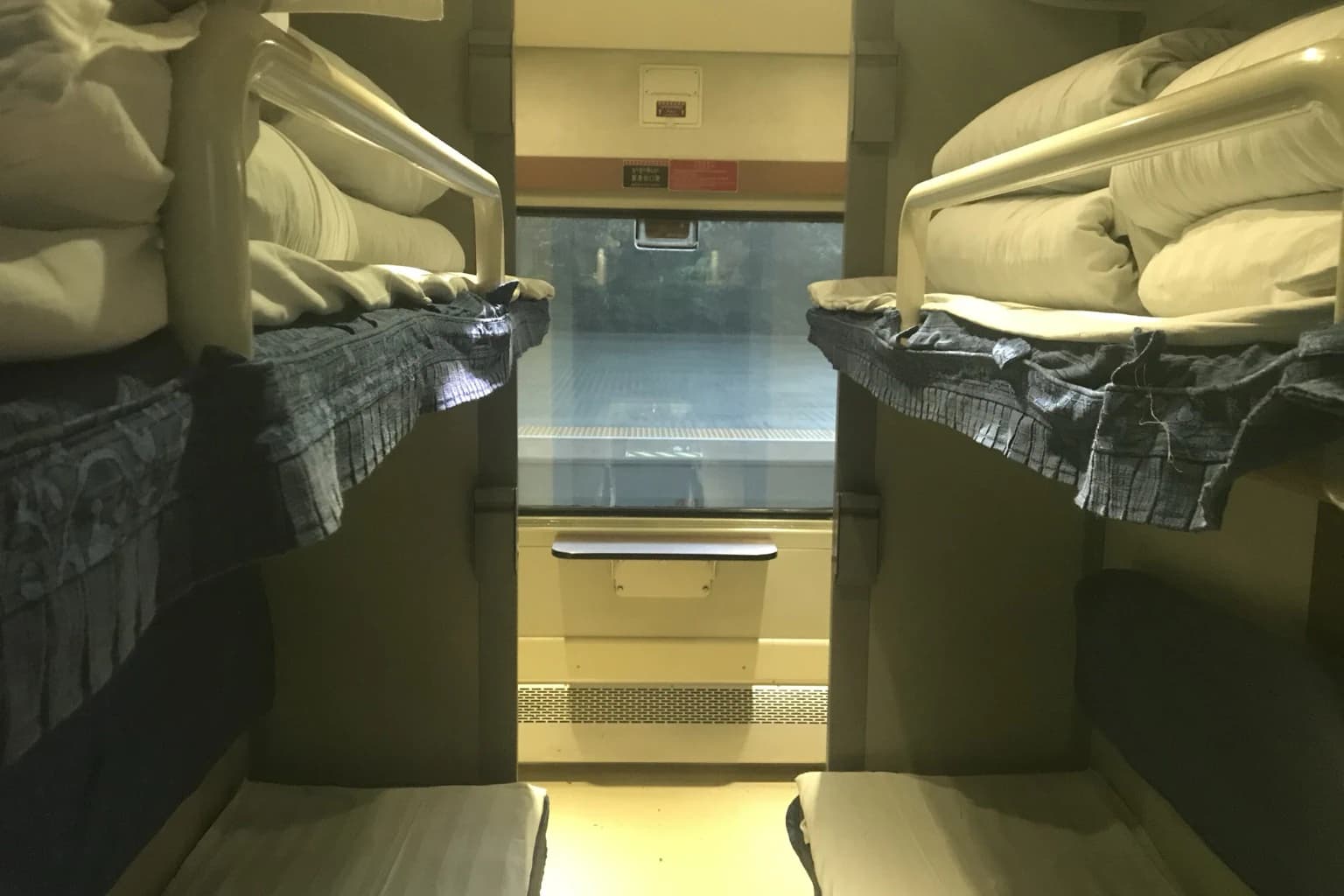
One YW25T hard-sleeper carriage makes the six-berth geometry visible. Storage, sockets, linen and fittings differ on other trains. Photo by MNXANL, cropped and resized, CC BY-SA 4.0.
Book the exact date, station pair, class and berth
The official platform is China Railway 12306. Its normal advance-sale period checked for this guide was 15 days including the travel date, although the operator can announce adjustments. A third-party request placed months ahead does not make railway inventory exist before release.
Use this sequence:
- Search the complete station pair, not only city names. Beijing, Shanghai, Guangzhou and Shenzhen each have several stations.
- Search your exact travel date and inspect both evening departure and morning arrival.
- Open the class inventory. Confirm that the result says 动卧, 软卧, 硬卧 or the premium class you intend to buy.
- Read the berth allocation and price at checkout. A class-page image or reference price is insufficient.
- Enter the passenger's name and passport number exactly as required from the passport that will be carried.
- Save the train number, date, complete station names, carriage and berth in English and Chinese.
- Recheck the booking before leaving the hotel. Schedule adjustments and station changes matter more at night.
If you want a multilingual interface and third-party support, compare live China train inventory on Trip.com. Trip.com is a ticket agent, not the railway operator. The same real-name passenger information and underlying railway inventory still control the journey.
Do not choose a service because an old article calls it “the Beijing–Shanghai sleeper” or because a video shows a desirable cabin on the same train number. The operator can change the timetable, consist or sale pattern. The only dependable product is the one displayed for your date at checkout.
Passport checks: keep the original document in your sleep pouch
China uses real-name train tickets. According to the current China Railway English FAQ, a foreign passenger may buy with an accepted valid passport and should use the same document to enter, board and exit. The itinerary sheet or reimbursement receipt is not the ticket.
Carry the original passport in a small zipped pouch that stays on your body or immediately beside you while sleeping. Do not bury it under a large suitcase: you may need it at station gates, on the train or at the arrival exit. A passport that does not scan may require a staffed/manual channel, so allow more time than a local commuter using a national ID card.
At the departure station, the practical sequence is entrance identity check, baggage security, waiting hall, ticket gate, platform, carriage and berth. China Railway does not publish one universal “arrive by” minute for every station and service. For a first overnight journey, 45–60 minutes before departure is a reasonable personal target, with more time during public holidays, at a huge terminal, with children or when passport verification is unresolved. This is planning advice, not a guaranteed railway cutoff.
Useful sentence:
我带的是护照,需要走人工通道吗?
Wǒ dài de shì hùzhào, xūyào zǒu réngōng tōngdào ma?
I am using a passport. Do I need the staffed channel?
Pack for one controlled night, not a moving hotel room
The best sleeper luggage system has two layers:
- Night bag: passport, phone, charger or power bank allowed under current rail rules, earplugs, eye mask, water, tissue, toothbrush, medication, a light layer and valuables. It stays with you.
- Main bag: clothes and items you will not use until morning. It is closed before boarding and placed where crew direct without blocking a door, aisle or ladder.
China Railway's English FAQ currently gives an ordinary adult passenger a 20 kg free cabin-baggage allowance. Each item should not exceed 20 kg; the outside-dimension total is stated as no more than 160 cm on conventional trains and 130 cm on EMU trains, with a separate 200 cm limit for rod-shaped items on conventional trains. Check the current baggage rules before travel because restricted-item and size rules can change.
Those numbers do not promise that a 20 kg suitcase will fit under your berth. Storage varies by carriage. Some bags go under a lower berth, some on an overhead or end-of-car rack, and some in a space that is awkward once everyone boards. One medium case is easier than a huge hard-shell case. Keep valuables out of a remote rack, close every zip and never create an obstruction to gain extra floor space.
Ask crew rather than copying a social-media luggage arrangement:
这个行李可以放在哪里?
Zhège xíngli kěyǐ fàng zài nǎlǐ?
Where may I put this luggage?
Washing, toilets, food and sockets: assume less, then be pleasantly surprised
Treat the train as a bed plus shared basic facilities. Wash properly at the hotel before departure. On board, expect a shared toilet and washbasin rather than a shower. Bring tissue, wet wipes, toothbrush, a compact towel and slip-on shoes. Keep the wash kit together so that a station stop or queue does not leave your berth unattended for long.
Water, catering and hot-water equipment vary by train. Bring a simple dinner or eat before security, plus enough drinking water for the night. Avoid a strong-smelling meal in a shared sleeping space. If you rely on boiling water, a dining car, a vending machine or a specific breakfast, verify the particular service instead of treating it as standard.
The same rule applies to charging. A photograph showing USB ports does not prove your berth has one. Sockets may be shared, distant, occupied or inoperative. Charge before boarding and carry a compliant power bank under the current railway rules. Never run a cable across a passage or ladder.
Linen may be placed on the berth or issued in another way depending on the product. Keep shoes off bedding, return any issued items as instructed and ask staff if something is missing. Avoid adhesive sheets, straps or improvised structures that could damage fittings or interfere with another passenger.
Noise is the default variable, not a service failure
Night trains move, stop and receive passengers. Even an enclosed compartment may contain snoring, conversation, door movement, phone light, ventilation noise and station activity. In an open hard-sleeper carriage, expect more aisle movement. A train boarding at 23:30 can be particularly awkward: existing passengers may be asleep while you locate the berth and stow luggage, yet you still need to settle quietly in the dark.
Pack an eye mask and earplugs. Download audio before boarding instead of depending on signal. Set a vibration alarm, but do not rely on one phone at low battery. Ask staff how arrival is handled on that service and begin packing before the stop rather than at the platform.
If you are a very light sleeper, compare the cost of a flight or day train plus hotel. Soft sleeper reduces some exposure but cannot remove motion, strangers or stops. The honest promise is a horizontal berth and a chance to rest, not eight uninterrupted hours.
Solo women: make privacy and movement explicit choices
Sleeper compartments and open bays may be mixed gender. Do not assume the booking system guarantees a women-only room, that other passengers will accept a swap, or that a compartment door creates hotel-room privacy. Crew need access, strangers share the space and carriage procedures vary.
A practical solo setup is:
- passport, phone, money and keys in a small sleep pouch attached to the body;
- main luggage fully closed, placed in the designated space, with nothing valuable visible;
- shoes positioned for a quick, safe exit without blocking another passenger;
- hotel name and arrival address saved in Chinese;
- family or a trusted contact holding the train number and expected arrival;
- one polite request to staff if the assigned space creates a genuine concern.
You may ask whether a lower berth or different space is available, but treat it as a request:
如果有空位,可以帮我换到下铺吗?没有也没关系。
Rúguǒ yǒu kòngwèi, kěyǐ bāng wǒ huàn dào xiàpù ma? Méiyǒu yě méi guānxi.
If one is available, could you help me change to a lower berth? It is okay if there is none.
For wider risk planning, accommodation choices and emergency contacts, read the solo female travel guide. A sleeper guide cannot promise personal safety; it can help you avoid preventable exposure and plan an exit.
Families, older travelers and limited mobility
The decisive question is not whether children find trains exciting. It is whether every traveler can board, climb, sleep and use the toilet safely in a moving carriage.
For a family, try to secure berths in the same bay or compartment before payment. Do not expect other passengers to exchange berths after boarding. A young child on an upper berth creates a fall and nighttime-toilet problem; a lower berth is usually easier, but availability controls. Keep bedtime items in one small bag and explain quiet hours before boarding.
For an older adult, anyone with joint pain or a traveler with limited mobility, make a lower berth a booking condition. Narrow corridors, steps into the carriage, ladders and moving toilets can be harder than the journey duration suggests. If the lower berth cannot be secured, a daytime train with an accessible seat and a hotel is usually a better plan. The China family travel guide covers the wider pace and station-day decisions.
The arrival station decides whether the sleeper worked
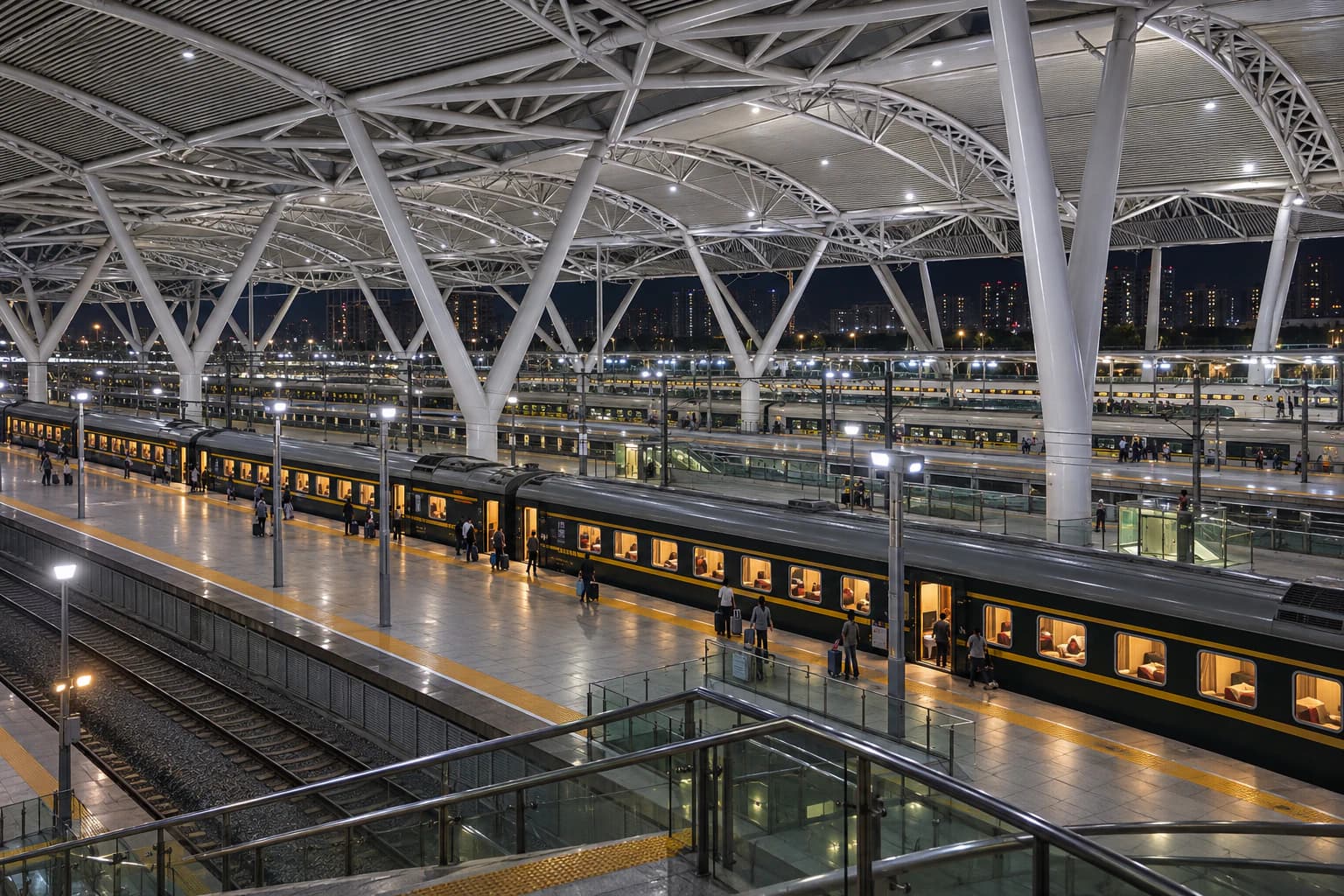
This planning scene illustrates the scale and timing of night boarding. It does not document a specific station, train number, platform or current service.
An arrival at 07:30 near a metro line can be excellent. An arrival at 04:20 at a distant terminal can turn the “saved night” into a taxi problem and several hours in a lobby. Before booking, answer all six questions:
- Which exact station does the train reach?
- When does that station permit exit, and when does local public transport begin on the travel date?
- Where is the legal taxi or ride-hailing pickup point?
- Will the hotel store luggage before check-in?
- Is the reception open when you arrive?
- What will you do if the train is late or the first metro is not running?
Save the hotel name, address and phone number in Chinese. If using a taxi or ride-hailing app, wait in the designated pickup area rather than following an unsolicited driver. Book the previous hotel through the departure evening only when you genuinely need the room; otherwise arrange luggage storage and wash before heading to the station. At the destination, do not assume early check-in. A shower and breakfast plan is part of sleeper logistics.
Also confirm the station suffix. Beijing West and Beijing South, Shanghai Station and Shanghai Hongqiao, or Guangzhou Station and Guangzhou South produce different hotel transfers. A train with a slightly less attractive onboard product may still win if it arrives at the useful station.
Route chooser: search these corridors, then let the date decide
These are candidate comparisons, not permanent train recommendations. China Railway can change services, rolling stock and sale patterns. Search the exact date in 12306 and reject any option that fails the time-and-berth test.
Beijing ↔ Shanghai
This is the clearest comparison between very frequent daytime high-speed rail and selected overnight sleeper inventory. A night service can preserve a day in Beijing or Shanghai, but daytime HSR is faster, easier to recover if plans change and often better before a demanding morning. Choose the sleeper only when the live listing offers a suitable berth, evening departure, useful arrival station and price that beats the complete alternative.
Beijing ↔ Guangzhou or Shenzhen
The distance is long enough for a sleeper to protect substantial waking time. On dates with useful overnight D-sleeper inventory, it can connect north and south without an airport day. The weaknesses are fare, limited berth supply and a very early or inconvenient terminal. Compare the exact arrival with the hotel zones in Guangzhou or Shenzhen, and compare a nonstop flight after adding both airport transfers.
Shanghai ↔ Guangzhou or Shenzhen
This corridor can suit travelers linking China's east-coast commercial centers without sightseeing between them. It is poor when the departure consumes the final Shanghai evening, the chosen service reaches the Pearl River Delta too early, or only an upper berth remains for a traveler who cannot climb. Check flights and daytime HSR on the same date; the sleeper wins through schedule geometry, not romance.
Beijing ↔ Xi'an
A conventional Z/T/K sleeper may appear for some dates and can save a hotel change, but daytime high-speed rail makes this a close decision. Choose overnight only if it delivers a full preceding day, a sensible arrival and a berth you can use. Do not place a timed Terracotta Warriors transfer immediately after uncertain sleep. The Xi'an guide helps decide whether the arrival station supports your hotel base.
Shanghai ↔ Xi'an
This longer diagonal is a stronger sleeper candidate than a short regional hop. Compare directness, arrival station, berth class and total duration with a flight. A service that reaches Xi'an well after breakfast may no longer save the useful day, while a dawn arrival can leave you waiting for the metro or hotel.
Beijing ↔ Harbin
An overnight option can protect a winter sightseeing day, but cold-weather luggage, snow delays and the exact Harbin station matter. Never step off a night train and begin a long outdoor ice itinerary without a warm indoor reset. Use the Harbin destination guide to place the hotel and plan the first morning conservatively.
Routes that usually do not need a sleeper
Short, frequent high-speed corridors such as Shanghai–Hangzhou, Chengdu–Chongqing and Xi'an–Chengdu generally work better in daylight. A sleeper adds waiting, poor timings or an indirect service to a transfer that daytime HSR handles cleanly. Use the sleeper only for an exceptional date-specific reason, not because an overnight train happens to appear in search.
Qinghai–Tibet and very long Xinjiang journeys are different products
A multi-day or high-altitude rail journey is not simply a hotel night on wheels. Daylight, acclimatization, permit requirements, food, washing and endurance become central. If the landscape is the reason to travel, use the China scenic train guide and protect daylight through the best section. An overnight schedule that hides the view may be comfortable transport but a poor scenic purchase.
A realistic evening-to-morning plan
Before 17:00
Confirm the service in the booking app, complete any hotel checkout or late-luggage arrangement, charge devices, download tickets and maps, and save both station names in Chinese. Eat a proper meal unless you have verified onboard catering.
About 60–90 minutes before departure
Travel to the exact station with extra holiday or passport buffer. Pass identity and baggage checks, find the gate and use the station toilet. Buy water before boarding without creating more luggage than you can manage.
On boarding
Match carriage and berth. Place the large bag only in an allowed space, keep the night bag with you and introduce yourself with a quiet greeting. Confirm the approximate arrival and any wake-up procedure with staff. Change into modest, comfortable layers in the appropriate private space; a shared compartment is not a hotel room.
Before sleep
Brush teeth, use the toilet, secure valuables, set alarms and prepare shoes. Silence notifications and use headphones. Keep nothing loose where braking could send it into the aisle.
30–45 minutes before arrival
Wake, wash, pack bedding as instructed, check the berth and charging area, put on shoes and retrieve luggage without blocking the passage. Confirm the station on the screen or with staff; some routes have several city stations.
Useful sentence:
我在下一站下车,请提前提醒我,谢谢。
Wǒ zài xià yí zhàn xiàchē, qǐng tíqián tíxǐng wǒ, xièxie.
I get off at the next stop. Please remind me in advance, thank you.
Final booking checklist
Do not pay until every answer is clear:
- Exact travel date and complete station pair are correct.
- The listing shows a real sleeper class, not an overnight seat.
- The berth level works for the passenger; a request is not being treated as guaranteed allocation.
- Departure preserves the evening without requiring a midnight scramble.
- Arrival fits metro, taxi, luggage storage and hotel-reception hours.
- The original passport details match the booking.
- Main luggage fits current railway limits and can be managed without assistance.
- Passport, phone, medicine and valuables fit in one sleep pouch.
- Eye mask, earplugs, tissue, wash kit, water and charged power are packed.
- The next morning is flexible enough to absorb poor sleep or delay.
- A daytime train and a flight have been compared door to door.
If the train fails two or more items, it is probably not saving a day. It is moving inconvenience into the hours when you are tired. The best China sleeper is not the most famous train or the most photogenic compartment; it is the date-specific service whose berth, stations and timing let you wake ready to use the destination.