China's futuristic cities: choose a real trip, not a technology checklist
China's most convincing “future city” trip does not consist of four skylines and a robot café. Each city in this route explains a different part of urban change:
- Shanghai makes metropolitan planning and vertical scale legible across a river, a planning museum and a high-capacity transport system.
- Hangzhou is the digital-economy context stop, where everyday app-mediated services sit beside West Lake and a newer Qiantang River civic district.
- Shenzhen has the strongest public-facing hardware and science chapter: component markets, an urban-planning museum and a large science-and-technology museum.
- Chongqing shows engineering as an answer to terrain: elevated rail, vertical pedestrian links, cableways, bridges and several street levels compressed into one view.
The important limit is access. An AI industrial park, private research lab, autonomous-vehicle test zone or company headquarters may matter economically without being a tourist attraction. A press release about future industries does not grant a visitor access. This route prioritizes public streets, operating transit, maintained museums and bookable public experiences; everything else needs a current official visitor program.
Use 7 days for two cities, 10 days for a compact four-city route, or 14 days for the balanced version. The cleanest open-jaw order is Shanghai → Hangzhou → Chongqing → Shenzhen, then exit through Shenzhen, Guangzhou or Hong Kong according to the actual international ticket. Reverse the whole route when the airfare works better in the other direction.
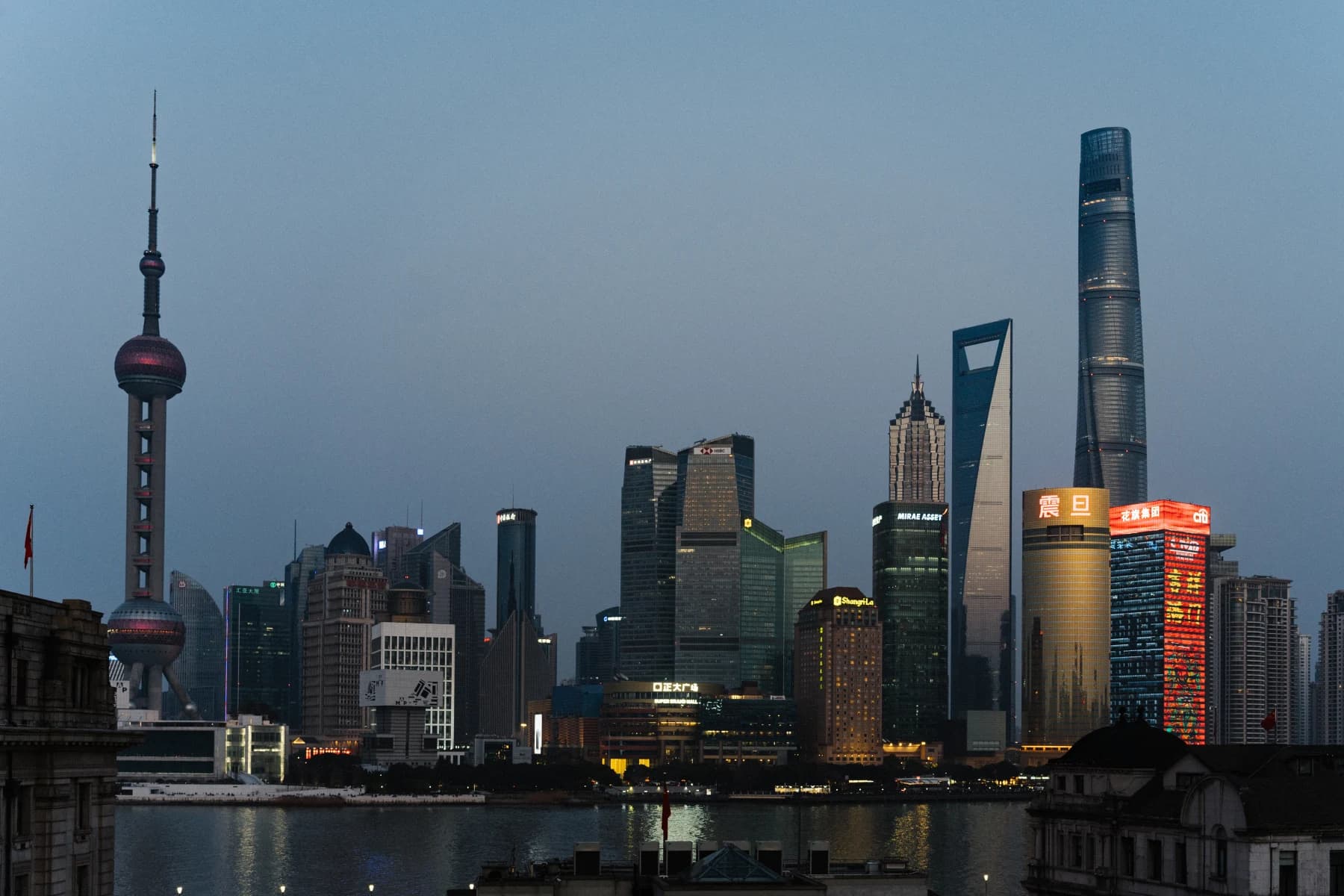
Shanghai makes the route's central question visible: how do transit, historic waterfronts, finance towers and public space occupy one metropolis? Visibility and façade lighting vary by weather, maintenance and event controls. Photo by Lloyd Tudor, CC BY-SA 4.0.
The quick city chooser
| City | Strongest public-facing chapter | What is genuinely visitable | What not to expect | Minimum useful stay |
|---|---|---|---|---|
| Shanghai | Urban planning, skyline, mass transit and river crossings | Planning exhibition hall, public ferry, Lujiazui, Bund and optional observation deck | An “AI district” tour or guaranteed clear skyline | 3 nights |
| Hangzhou | Digital-economy context and old/new urban contrast | West Lake, metro, Qianjiang New City and City Balcony; current public exhibitions | Access to private AI labs, corporate campuses or pilot zones | 2 nights |
| Shenzhen | Hardware, robotics/science interpretation and rapid urban growth | Huaqiangbei, Futian planning museum, Civic Center axis and Guangming science museum | Factory access, daily robot demos or guaranteed autonomous rides | 3 nights |
| Chongqing | Terrain-responsive transport and layered night city | Line 2/Liziba, public escalator/elevator, cableway when operating, riverfronts | A single flat walking route or a city that is “futuristic” only after dark | 3 nights |
If AI is the headline interest, combine Hangzhou for economic context with Shenzhen for the more concrete public science experience. If robots, electronics or prototyping matter, prioritize Shenzhen and read the market as an ecosystem rather than a shopping stunt. If transport engineering is the goal, Chongqing is the strongest stop. If urban planning and skyline form matter, Shanghai and Shenzhen make the cleanest pair. If you mainly want night photography, Shanghai and Chongqing provide the most contrast, but use the local photo pages rather than turning this guide into another pin list.
Define “futuristic” before planning
This route uses four evidence levels:
- Public system: metro, rail, ferry, public space, street design and ticketed attractions that a visitor can use today.
- Public interpretation: an urban-planning or science museum that explains how the system was built.
- Public commercial interface: retail electronics, a current product showroom or a temporary exhibition with clear opening and photography rules.
- Industry context: companies, laboratories and pilot zones that explain the city's economy but may have no public access.
Build the itinerary from the first two levels. Add the third only after checking the exact date. Treat the fourth as context unless a maintained official page offers public registration.
This distinction prevents several common disappointments. A viral robot video may come from a trade fair that has ended. A delivery vehicle may operate only inside a controlled campus. A showroom can close for a launch or serve buyers by appointment. A night light sequence can change for energy policy, weather, a holiday or a major event. None belongs in a fixed route until its current public terms are visible.
Seven days: choose a pair, not all four
Seven days means six nights and includes arrival and departure. Use one of these structures.
Shanghai 3 → Hangzhou 3: easiest first trip
Choose this for urban planning, a major skyline and digital-city context with only one short intercity rail move. It also leaves room for ordinary Shanghai and West Lake instead of reducing both cities to technology branding.
Use Days 1–3 in Shanghai, transfer on Day 4, use Days 5–6 in Hangzhou and depart on Day 7. If the international flight leaves Shanghai, use Shanghai 2 → Hangzhou 2 → Shanghai 2 or extend the trip; the final Shanghai buffer is more important than an extra Hangzhou light-show gamble. The Shanghai–Suzhou–Hangzhou route guide gives the station and luggage logic. Omit Suzhou here because its gardens and canal urbanism deserve a different thematic route.
Shenzhen 3 → Chongqing 3: strongest technology-and-transport contrast
Choose this for hardware, public science and topographical transport. Fly between the cities unless a dated rail service, station pair and departure time make the long train useful. Days 1–3 cover Shenzhen; Day 4 is the move; Days 5–6 cover Chongqing; Day 7 departs.
This pair has more weather risk. Shenzhen's thunderstorms or tropical-cyclone warnings can interrupt exposed plans, while Chongqing's heat, rain, fog or cableway controls can rearrange a day. Keep one indoor museum in each city and do not attach a separate-ticket international flight immediately after the domestic transfer.
Shanghai 3 → Chongqing 3: skyline and night-city pair
Choose this when the visual city is the subject. Shanghai is horizontal and river-defined from the Bund; Chongqing is vertical, topographical and difficult to understand from one elevation. The route needs one flight and gives much less technology interpretation than the Shenzhen pairing.
Do not force a fourth city into six nights. Four check-ins, two domestic diagonals and venue reservations would turn the trip into terminals and luggage.
Ten days: the compact four-city version
Ten days means nine nights: Shanghai 3 → Hangzhou 2 → Chongqing 2 → Shenzhen 2.
Days 1–3: Shanghai
Day 1 absorbs arrival. Use Day 2 for the planning-hall-to-river sequence and Day 3 for a second Shanghai chapter or weather swap. Keep the observation deck optional because low cloud and haze can erase its value.
Days 4–5: Hangzhou
Take a morning or midday train to Hangzhou. The move consumes checkout, station access, security, the train and the new hotel even when the ride itself is short. Use the remaining afternoon for a lake or neighborhood contrast, then give Day 5 to a deliberate old/new city sequence ending at the Qiantang River if the live night notice supports it.
Days 6–7: Chongqing
Fly from Hangzhou when the dated flight saves a useful day after airport access and baggage are counted. Day 6 is mostly a transfer and one untimed evening. Use Day 7 for the 8D transport core. Two nights do not support every riverbank photo route, museum and outward excursion.
Days 8–10: Shenzhen
Compare a nonstop flight with the dated high-speed rail. A long train can be comfortable but still removes most of a day; a flight includes airport access and baggage. Day 8 is the move, Day 9 is one focused hardware/civic or Guangming science day, and Day 10 departs.
This version demonstrates all four roles, but it has only one full day in Hangzhou, Chongqing and Shenzhen. Choose it when the comparison itself matters more than depth.
Fourteen days: the balanced route
Fourteen days means thirteen nights: Shanghai 4 → Hangzhou 3 → Chongqing 3 → Shenzhen 3.
- Days 1–4, Shanghai: arrival plus three usable days. Keep one classic neighborhood or museum day so the city is not reduced to towers.
- Days 5–7, Hangzhou: rail from Shanghai, one old-city/West Lake day and one newer-city/digital-context day.
- Day 8, Hangzhou to Chongqing: a deliberate domestic move. An evening walk is a bonus, not a booking anchor.
- Days 9–10, Chongqing: one transport-and-terrain day and one riverbank, museum or recovery day.
- Day 11, Chongqing to Shenzhen: rail or flight according to the actual date, luggage and station/airport geometry.
- Days 12–13, Shenzhen: one central hardware-and-planning day and one Guangming science or Nanshan/Shekou alternative.
- Day 14: depart from the protected southern gateway.
Fourteen days still does not justify adding Beijing, Chengdu, Suzhou and Hong Kong automatically. Hong Kong can be the international exit, but crossing the boundary, changing rail systems and reaching the airport are a transport chapter, not a free extension.
Shanghai: read the city before buying a tower ticket
Start at the Shanghai Urban Planning Exhibition Hall (上海城市规划展示馆). The municipal visitor listing describes it as a public showcase for the city's planning and development. Check its current calendar, admission and closure day before going; a maintained venue page should override an old blog schedule.
Then move toward the Huangpu. Cross by public ferry if the current route fits, or use the metro. The useful comparison is not “old versus new” as a slogan: look at river setbacks, ferry landings, pedestrian access, tower podiums, flood edges and how many transport modes meet around Lujiazui.
Choose one observation deck only when visibility is worth paying for. Shanghai Tower (上海中心大厦) gives vertical scale, but the public Bund, North Bund and river crossings show how the skyline works without a ticket. If a high view is the priority, check the exact dated Shanghai Tower product after reviewing weather and cancellation terms.
Use the Shanghai guide to add a western neighborhood, museum or ordinary meal. The city's future is less persuasive when every hour is spent inside a tower or staring across the river.
Hangzhou: digital context without inventing a tech attraction
Hangzhou's government identifies AI, low-altitude systems, humanoid robots and other emerging fields in its future-industry program. That establishes economic context. It does not mean the named pilot areas, companies or laboratories accept walk-in tourists.
Build a public day instead. Start with West Lake or a historic core to see the landscape and street system that newer Hangzhou is layered around. Move later to Qianjiang New City and the City Balcony (城市阳台). The newer civic district is useful even without a show: broad riverfront space, towers and transit make a deliberate contrast with the lake.
With only two nights, choose one older-landscape cluster and one Qianjiang modern-city cluster. Do not copy a compressed checklist that combines West Lake, Lingyin, Longjing, Xixi, the Grand Canal and the Qiantang waterfront in one day. Those places sit in different parts of the city, and several are substantial visits on their own. Keep West Lake with its nearby neighborhood or temple chapter, then use a separate half-day or evening for Qianjiang New City.
Hangzhou publishes dated and seasonal lighting notices. A March 2026 visitor notice identified City Balcony as a close viewing point for a special Lantern Festival program. It proves the viewpoint, not a nightly schedule for another month. Check the latest municipal notice on the day and treat any show as a bonus.
Everyday digital services can be part of the observation: app-based payments, delivery pickup shelves, metro gates and online reservations shape the visitor experience. They can also exclude a traveler whose foreign card, phone number or identity document does not fit a workflow. Prepare Alipay and WeChat Pay, keep a physical bank card and some cash, and ask staff for a manual alternative instead of treating friction as user error.
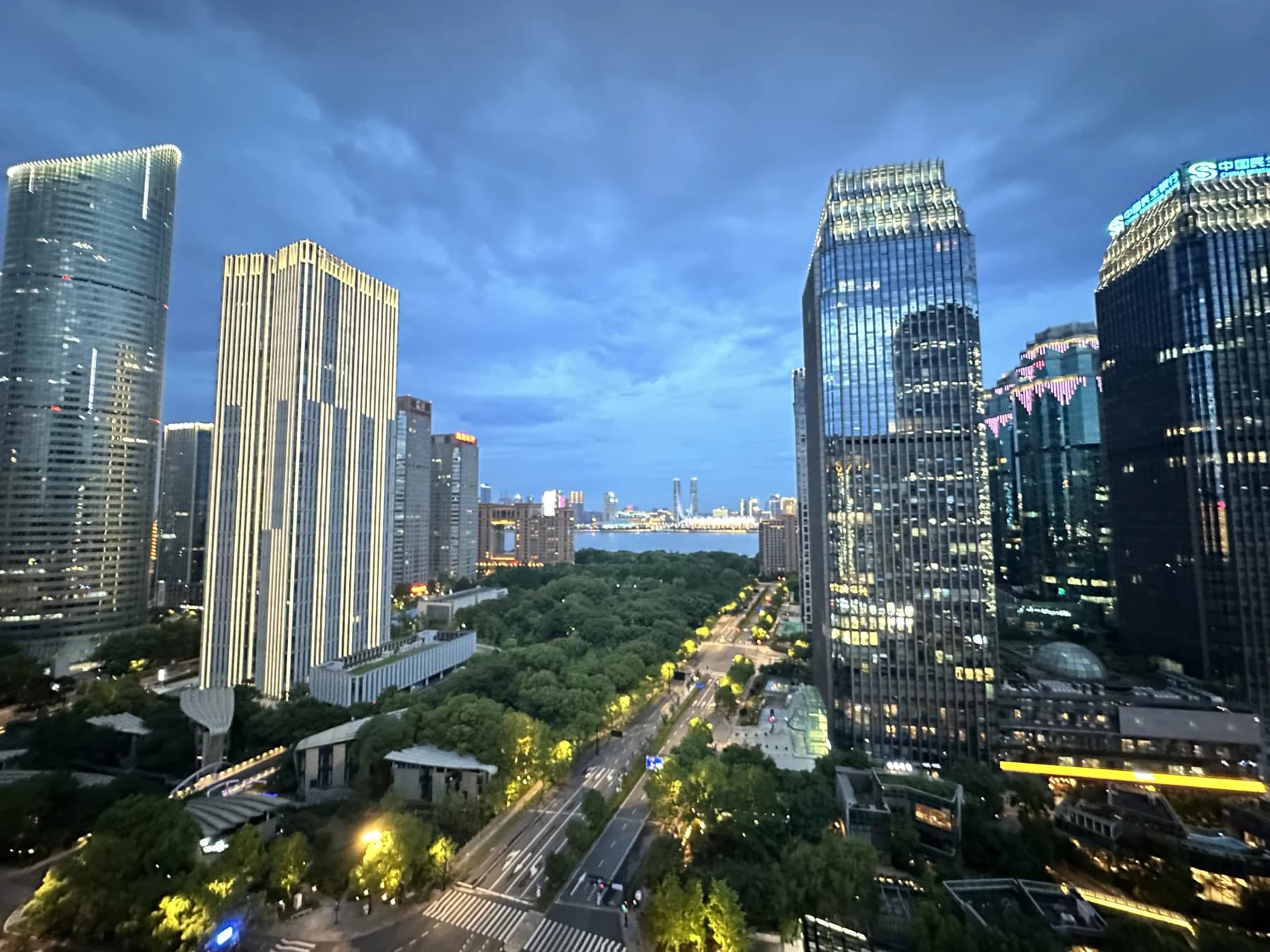
Qianjiang New City is useful for comparing a planned civic district with older Hangzhou. Building illumination and river shows are date-dependent, so the urban form should justify the visit on its own. Photo by Nat4Eben, CC BY-SA 4.0.
Shenzhen: choose central urban systems or one distant science day
Shenzhen offers the most concrete technology chapter, but its useful stops sit far apart.
Central day: hardware to civic planning
Begin at Huaqiangbei Pedestrian Street (华强北步行街). The point is not to hunt for a miracle bargain. Study the connection among components, repair, accessories and finished products. Ask before photographing counters, screens or workers. Use the Huaqiangbei buying guide if you intend to purchase; exact-unit tests, regional compatibility, receipts and warranty terms matter more than the first quote.
Continue to the Shenzhen Museum of Contemporary Art and Urban Planning (深圳市当代艺术与城市规划馆). Municipal material describes its planning galleries as an account of the city's development and 2035 vision. Check the current exhibition, reservation and entry-document notice; temporary art shows and extended opening periods do not establish a permanent calendar.
Finish across the Civic Center–Lianhuashan axis. The public outdoor relationship among the civic roof, cultural buildings, park and Futian skyline is the stable experience. A façade light show, drone event or special performance is not guaranteed. Do not block commuters or fly a drone from the civic district.
Guangming day: public science, not a quick add-on
The Shenzhen Science & Technology Museum (深圳科学技术馆) is in Guangming. Do not confuse it with the older Shenzhen Science Museum (深圳科学馆) in Futian; the first AMap result for a broad search can be the wrong institution.
A Shenzhen government public Q&A describes advance online ticketing and exhibits on computing, communications, drones, low-altitude mobility and autonomous-driving concepts. Those details make it the strongest public science stop on this route, but the ticket-release time, passport support, hall access and program change. Use the museum's official mini-program or contact before reserving the day.
Give Guangming most of a day. It does not combine efficiently with a full Huaqiangbei comparison, a central planning museum and a Shenzhen Bay sunset. If the live booking system allows a choice, a weekday or early entry gives more room to adapt; pick two priority halls before arrival, come by metro, and do not assume on-site parking will be easy. Families may find the museum the better choice; specialist electronics buyers may prefer Huaqiangbei and Futian.
The dedicated Shenzhen robots, EVs and AI guide adds the current public-access distinctions, reservation checks and realistic combinations for Guangming, Bantian and Nanshan. Use it when Shenzhen is a destination rather than a two-night comparison stop.
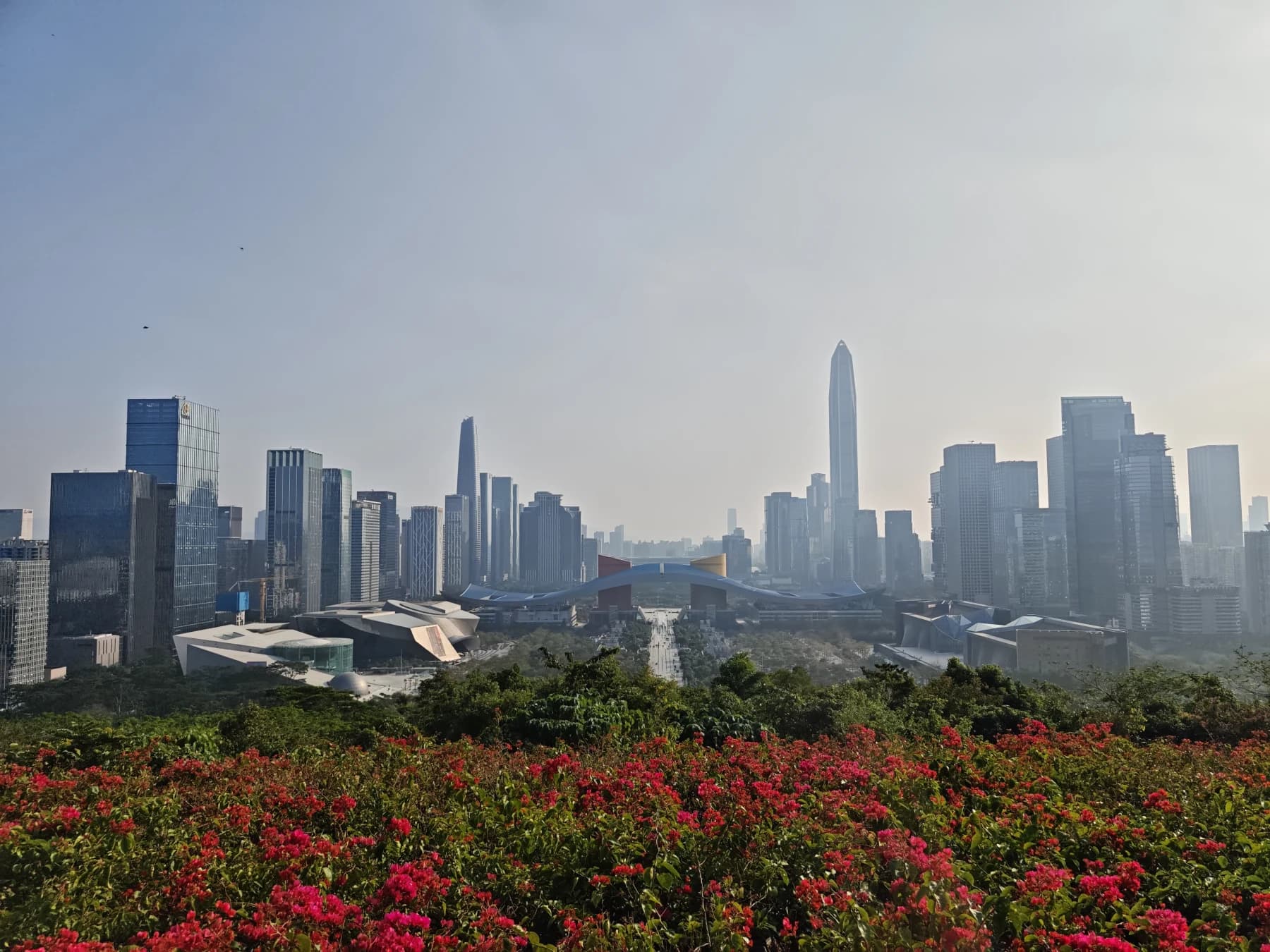
The Futian civic axis shows planning at city scale. Haze, heat and rain change the view, while special lighting remains operational rather than guaranteed. Photo by Pathfinbird, CC BY-SA 4.0.
Chongqing: engineering is the attraction
Chongqing does not need an AI showroom to earn its place. Its “future city” quality comes from the way transport responds to steep slopes, rivers and compressed development.
Ride Line 2 through Liziba, then use the official viewing platform rather than standing in traffic. Liziba Monorail Viewing Platform (李子坝单轨穿楼观景平台) makes the exterior relationship clear; the train ride makes the approach and riverbank legible. These are two actions, not one photograph.
The Chongqing 8D transport route links Line 2, Crown Escalator, Kaixuan Road Elevator, cableway and a conditional ferry with live-status rules. Use that page for exact execution. This guide's decision is simpler: give Chongqing one complete transport day instead of scattering five pins across two transfer afternoons.
If the Yangtze River Cableway is operating and the queue fits, a one-way crossing connects the topographical story. Check the operator notice first, then compare the exact dated cableway product. Metro preserves the route when weather, maintenance or crowding suspends the ride.
At night, use one riverbank. The South Bank photo route gives a daylight-to-night sequence, while the cyberpunk photo guide separates public viewpoints from misleading viral frames. Do not copy all of those stops into this four-city route.
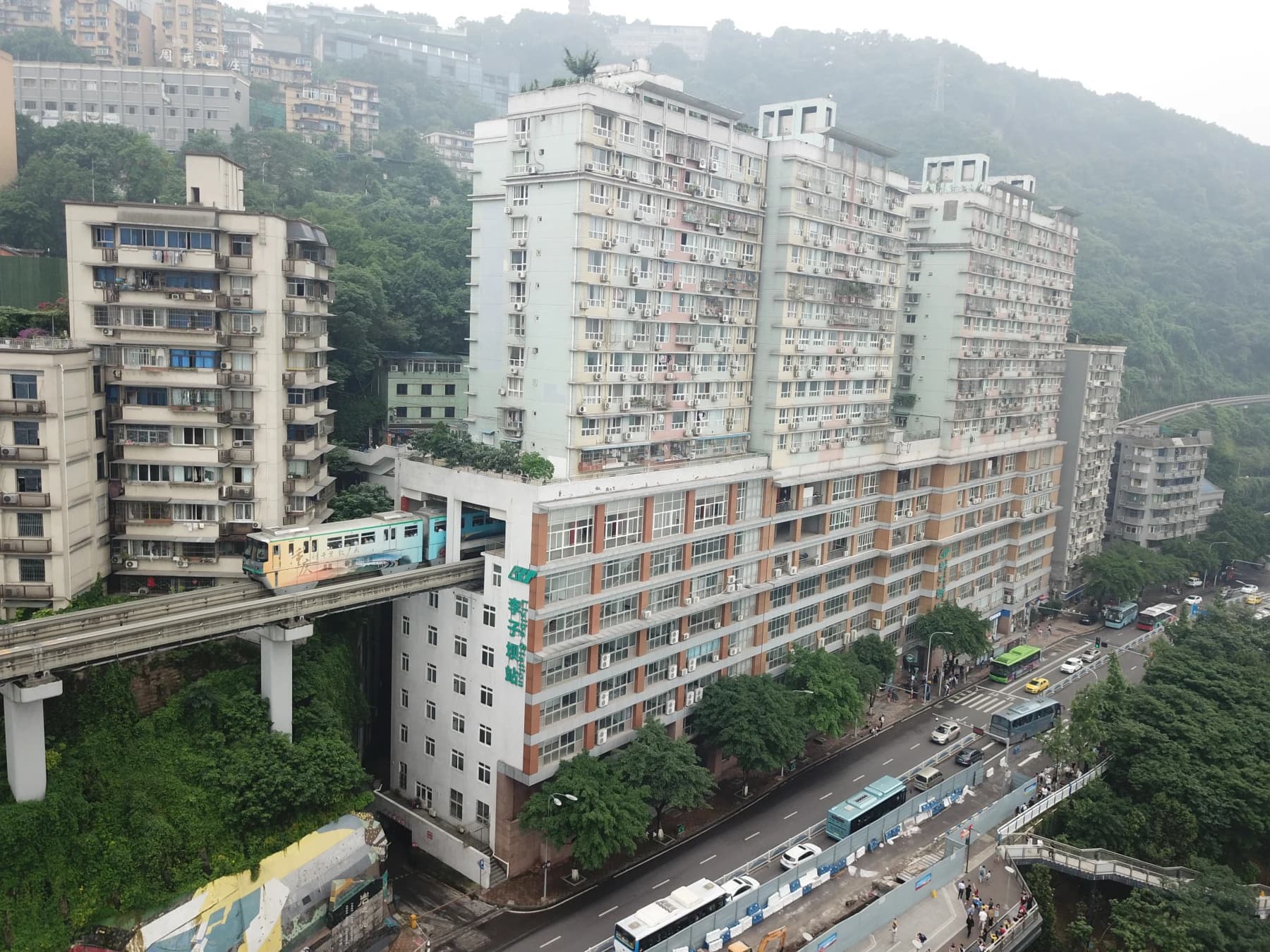
Liziba is compelling because rail, housing, road and steep terrain share one section of the city. Use the train and the official viewing area as public transport and public space, with current construction signs taking priority. Photo by David290, CC BY-SA 4.0.
The transfer geometry
Shanghai to Hangzhou: rail is the default
Use high-speed rail, but search exact stations. Shanghai Hongqiao is not Shanghai Station, and Hangzhou East is not Hangzhou West. Hangzhou East Railway Station (杭州东站) is useful for many east-China services, but the correct arrival is the one that matches the dated train and hotel.
Count hotel checkout, station access, identity/security checks, waiting, the ride, station exit and the next hotel. The rail itinerary guide explains why a short headline ride still consumes a substantial part of a day.
Hangzhou to Chongqing: compare a flight with a long rail day
The cities are too far apart for a casual morning train plus full sightseeing afternoon. A flight often protects more time, but airport access, baggage and delay risk remain. A long train may suit travelers who prefer rail, carry more luggage or want to avoid another flight. Compare both on the exact date after the night pattern is fixed.
Chongqing to Shenzhen: choose by the actual departure
Both rail and air can be plausible. The useful comparison is hotel door to hotel door: Chongqing has multiple major stations, Shenzhen North is not every Shenzhen district, and airport transfers can erase a short flight advantage. Protect the final Shenzhen night if an international ticket follows.
Use Trip.com trains and flights to compare live inventory, then verify the station or airport, passenger document, baggage, change terms and operating carrier before payment.
What to book, what to keep flexible
Book the intercity legs and high-demand museum reservations first. Keep free public skylines, parks and riverfronts movable around weather.
For every museum or public science venue, check:
- current opening and closure day;
- foreign-passport reservation support;
- whether the original passport must be carried;
- temporary exhibition or hall closures;
- bag, tripod and photography rules;
- whether an English interpretation layer exists; and
- cancellation or refund terms for paid special programs.
For every light show, drone show or façade display, check a dated municipal or operator notice. A recurring schedule can pause for weather, energy management, national mourning, a major event or maintenance. Never travel across a city based only on a short-video caption.
Weather and energy management
Shanghai and Hangzhou can be humid, rainy and affected by typhoon-season transport changes. Shenzhen adds stronger heat, thunderstorms and tropical-cyclone risk. Chongqing can be extremely hot and humid, with steep paving becoming slippery in rain and fog removing long views.
Use museums during the hottest or wettest part of the day. Move parks, riverfronts and observation decks to the best forecast. During lightning, severe rain, a tropical-cyclone warning or official crowd control, leave exposed waterfronts, hilltops and bridges. A technology-themed trip still obeys ordinary weather.
Groups with children or older travelers should shorten the day before removing the transport buffer. Shanghai and Shenzhen museums can provide indoor recovery. Hangzhou's riverfront and lake days involve more walking than the skyline suggests. Chongqing requires the strictest energy budget: use metro and short uphill cars, then walk downhill only when paving and knees are comfortable.
Cut-first rules
- Seven days: choose one city pair; cut the other two.
- Ten days with a delay: cut the paid observation deck or light-show wait, not the intercity buffer.
- Low visibility: keep planning museums and street-level transit; cut high viewpoints.
- No public corporate access: do not replace it with trespassing at a campus gate. Use the city's public museum or district.
- Shenzhen science museum unavailable: keep the central Huaqiangbei–planning museum–civic axis day.
- Chongqing cableway suspended: use metro and preserve the South Bank or Line 2 sequence.
- Severe weather: consume the flexible museum day or move early; do not chase a skyline through a warning.
- International departure at risk: remove the final attraction and sleep in the departure gateway.
Final test: is this a real route?
The trip is ready when every city has one distinct job, every company visit has a current public invitation, every museum has a live admission path, and every long transfer has a protected night around it. It is not ready when the plan depends on a robot appearing, an unannounced drone show, a corporate campus letting you in, or four clear evenings in a row.
The most persuasive result is not a claim that one city “looks like 2050.” It is the contrast among four systems: Shanghai's planned metropolitan scale, Hangzhou's digital-economy context, Shenzhen's hardware and public science, and Chongqing's terrain-driven transport. Give each enough time to work in daylight as well as at night, and the route becomes a study of how cities function rather than a collection of neon backgrounds.