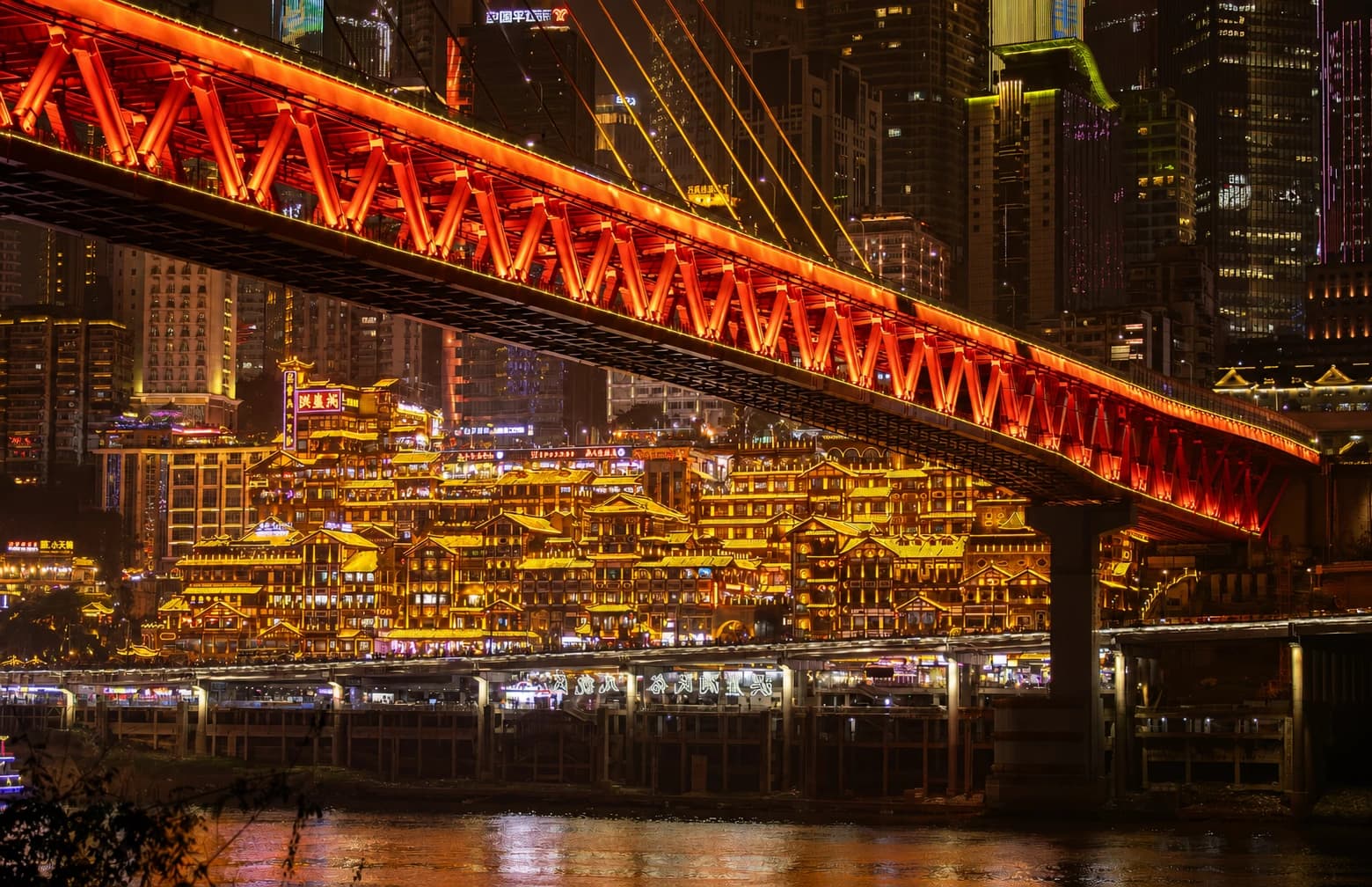
Chongqing photo spots: exact pins, routes and shot plans
Chongqing looks dramatic because streets, bridges, trains and towers occupy different levels of the same frame. The useful way to photograph it is to choose a spatial idea before choosing a filter: train versus tower, stair versus skyline, or old hillside versus new riverfront. Neon alone does not explain the city.
This guide uses eight public places that can be found on AMap. It avoids residential corridors, office floors and rooftops whose access depends on a guard, a purchase or an old social-media post. Some famous long-lens pictures are still possible only from commercial or private buildings; they are excluded from the core route.
Do one route per half-day. The pins may look close on a flat map, but a short straight line can hide stairs, an elevated road and a 20-storey change in height.
At a glance: which shot do you want?
Route A: vertical city
- Liziba Monorail Viewing Platform — Visit around 07:00–09:00. Use 24–35mm to keep the train, station opening and building in one explanatory frame.
- Shancheng Lane Traditional Area — Continue in late morning. Use 24–50mm for stairs, roofs and several street levels.
- Shibati Traditional Area — Use the midday building shade. A 24–35mm view can connect the steep old-city street with the skyline above.
- Kuixinglou — Finish in the afternoon. Use 16–24mm to show the pedestrian bridge and the vertical drop in the same frame.
Route B: river to night
- Longmenhao Old Street — Begin before sunset. Use 24–50mm to frame Dongshuimen Bridge and Yuzhong with the old hillside architecture.
- Chaotianmen Square — Continue through blue hour. Use 24–50mm for the river junction, Raffles City and passing boats.
- Hongya Cave — After dark, use 24–50mm for close layers of cliff buildings, road and Qiansimen Bridge.
- Chongqing Grand Theatre Square — Finish across the river. Use 50–135mm for the full Hongya Cave, bridge and Yuzhong skyline.
These pins are starting points, not instructions to stand on one paving stone. Crowd barriers, construction and riverfront controls can move the safe camera line. Stay in signed public space and adjust the composition from there.
Route A: the vertical-city sequence
- Best for: a first visit, architecture and the “8D city” idea.
- Timing: early morning to late afternoon.
- Order: Liziba → metro or taxi transfer → Shancheng Lane → Shibati → Kuixinglou.
1. Liziba: show why the train is surprising
Navigate to Liziba Monorail Viewing Platform (李子坝单轨穿楼观景平台), not only “Liziba Station.” The lower public platform and the station entrances sit at different heights. The classic mistake is to zoom so tightly that the train could be entering any tunnel. Start at 24–35mm, keep the full opening and several floors of the building, and press the shutter as the front of the train clears the wall.
For a person-in-frame version, place the subject well behind the barrier and move them left or right until their hand, mouth or silhouette aligns with the train path. Use burst mode or Live Photo. Move the subject and phone; never step into the road for alignment. The dedicated Liziba guide has three detailed setups, the separate Line 2 ride and current access diversions.
Target result: a frame that immediately reads as “train through a building,” rather than a red train cropped against concrete.
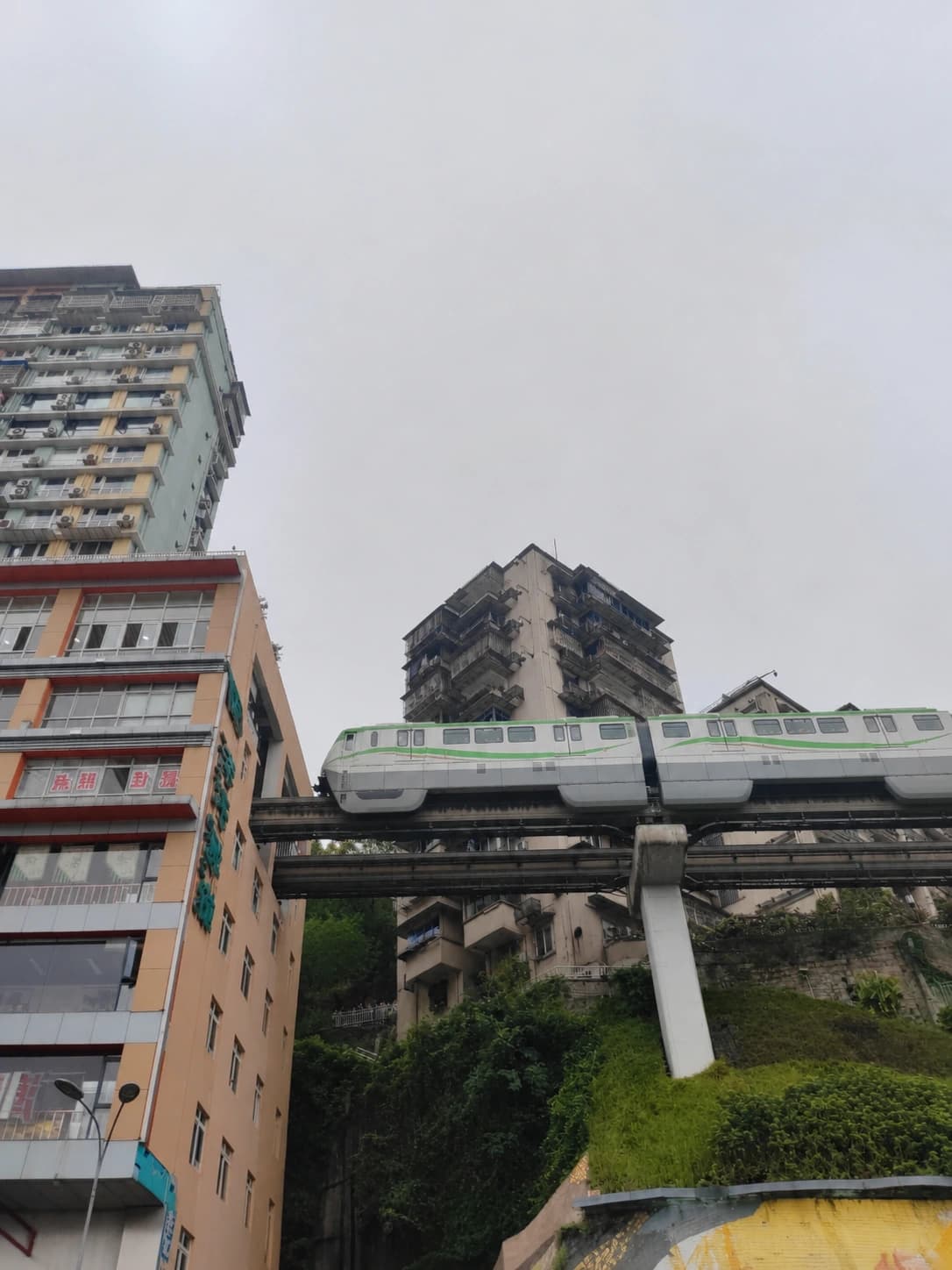
This real Liziba view shows why a vertical frame works well on a phone: the train occupies the middle of the image while the hillside buildings explain the unusual height. From the public viewing area, keep more of the station building in your own frame when the train-through-building moment is the main subject.
2. Shancheng Lane: build the frame from foreground to skyline
Use the AMap pin for Shancheng Lane Historic District (山城巷传统风貌区) as the public entrance. The visual subject is the change in level: stair rail or tiled roof in front, a descending lane in the middle, and newer towers beyond. A phone's 1× lens is usually enough. Use 2× only after finding a clean stack of layers.
Walk downhill when possible, pause on wide landings, and shoot across the staircase instead of standing in the centre of it. After rain, wet stone reflects light but also becomes slippery. Do not ask a companion to pose on a blind corner where residents, staff or other visitors need to pass.
Target result: three readable depths in one image. If the photograph contains only an old wall, it does not yet explain Chongqing's vertical city.
3. Shibati: use the slope, not only the storefronts
Navigate to Shibati Historic District (重庆十八梯传统风貌区) beside Jiaochangkou. The strongest wide shot looks along an uphill or downhill line so the steps lead toward towers above. Keep the phone level to prevent buildings from leaning; include people at a distance for scale, then wait for a gap rather than trying to clear the whole street.
Midday can work here because building shade breaks up harsh light. At night, decorative lighting adds colour, but busy signs can dominate. A quieter daytime frame usually shows the rebuilt street structure more clearly.
Target result: an old-city incline with a modern upper skyline, rather than a close portrait that could have been made on any themed street.
4. Kuixinglou: make the height change visible
Search Kuixinglou (魁星楼) or use the linked AMap POI. The famous effect comes from a pedestrian bridge that feels close to street level at one end while the open side reveals the drop below. Use an ultra-wide lens only when the foreground edge and lower city both remain legible; extreme 0.5× distortion can make the bridge look dramatic but spatially confusing.
Shoot from a stationary position away from the walking flow. A companion can stand on the bridge as scale, but should not sit on a barrier or lean over an edge. If the drop is hidden by a crowd, wait for a gap or change angle—the entire reason for this stop is the vertical reveal.
Target result: a normal pedestrian crossing that turns into a high bridge within the same frame.
Route B: river, old street and night skyline
- Best for: golden hour, blue hour and the illuminated riverfront.
- Timing: begin 90 minutes before sunset and finish after dark.
- Order: Longmenhao → metro to Chaotianmen → Hongya Cave street level → cross to the Grand Theatre side.
5. Longmenhao: use architecture as a natural frame
Navigate to Longmenhao Old Street (龙门浩老街) from Shangxinjie. Look for signed public terraces and openings that place Dongshuimen Bridge or the Yuzhong skyline inside a doorway-like frame. A 24–50mm field of view keeps both the old street edge and distant city readable.
Arrive before golden hour so you can find the composition in daylight. Expose for the skyline, then let the foreground sit slightly darker. Avoid turning a narrow passage into a private portrait set; make the frame quickly and let others pass.
Target result: old hillside masonry around a bright modern city, with the frame itself showing the change of era and elevation.
If you want to stay on the South Bank rather than crossing to Chaotianmen, use the dedicated South Bank day-to-night photo route. It continues through Xiahaoli, Nanbin Road and Changjiahui with light timing and verified transfer lengths.
6. Chaotianmen: photograph the meeting of the rivers
Use Chaotianmen Square (重庆朝天门广场) as the stable pin and follow current public access signs toward the open river view. The subject is larger than Raffles City: include water, river traffic and enough opposite bank to explain the confluence. A polarising filter can help in daylight but should come off at blue hour, when it costs light.
For a clean architectural image, use 1× and keep the verticals straight. For a more dynamic city frame, wait for a boat to cross the lower third. Do not descend to closed operational edges or copy an old waterfront route through construction fencing.
Target result: Raffles City as part of a working river junction, not a close façade with no Chongqing context.
7. Hongya Cave: choose close layers or the full façade
At Hongya Cave, Level 11 meets Cangbai Road and Level 1 meets Jiabin Road. Use the road name when arranging a pickup. From the Yuzhong side, make a close layered image: cliff buildings, elevated road, pedestrians and Qiansimen Bridge. A 24–50mm lens is more useful than a long telephoto because the space is tight.
Do not spend the entire evening trying to fit the complete façade from directly beneath it. The closer you stand, the more the building tilts and disappears above you. Make the close city-layer frame here, then use the opposite bank for the full landmark.
Target result: dense, illuminated levels at close range. Save the postcard-wide Hongya image for stop 8.
8. Grand Theatre riverbank: the wide Hongya skyline
Navigate to Chongqing Grand Theatre Square (重庆大剧院广场), then follow open public paths toward the signed riverfront rather than searching for a “secret platform.” Across the Jialing River, Hongya Cave, Qiansimen Bridge and the Yuzhong towers separate into a clear skyline.
Start around 50–85mm for Hongya Cave with bridge context. A 100–135mm lens compresses the towers and bridge into a denser “cyberpunk” frame, but it also magnifies haze and camera shake. Brace your elbows, use a stable public surface without attaching equipment to it, and underexpose slightly to protect bright signs. A small tripod is useful only where it does not narrow the promenade.
Target result: the complete cliff façade and bridge in one frame, or a long-lens compression that still contains a recognisable river edge.
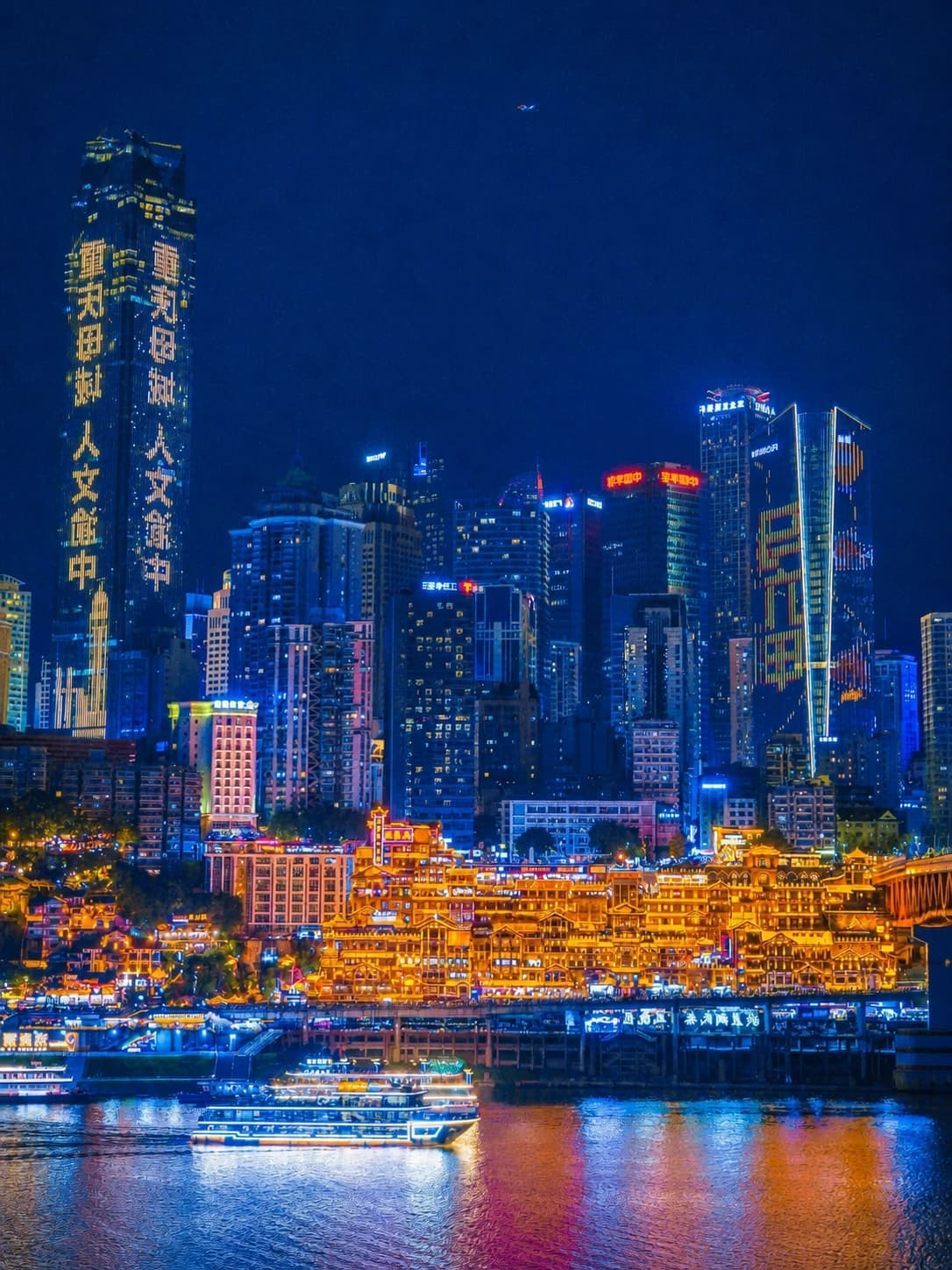
This real opposite-bank result uses the river as a clean lower layer, Hongya Cave as the warm middle layer and the towers as the cool upper layer. Try the same order before adding more elements. Wait for a boat only if it remains separated from the bright façade; otherwise the simpler three-layer frame is stronger.
The lens strategy: phone first, telephoto second
A phone with 0.5×, 1× and 2× can complete both routes. Use 1× as the default, 0.5× only for Kuixinglou or a very tight street, and 2× for clean skyline layers. Keep the phone level and crop later instead of pointing it steeply upward.
A camera kit benefits from a 24–70mm zoom. Add a 70–200mm only if compressed skyline images are one of your main goals. Long lenses turn separate hills, towers, trains and bridges into one dense plane—the style behind many viral Chongqing photographs—but they also require distance. They are most useful at the Grand Theatre riverbank and elevated public viewpoints, not inside narrow old streets.
For night scenes:
- expose for illuminated signs and windows, then lift shadows gently;
- use a shutter fast enough for people and trains unless you intentionally want motion;
- take one clean architectural frame before experimenting with reflections or silhouettes;
- wipe rain or river mist from the lens frequently;
- avoid laser pointers, rail-mounted equipment and flash aimed at train operators or traffic.
Places deliberately left out
Some widely shared compositions use a hotel roof, a restaurant terrace, a residential corridor or an office floor. They can produce striking images, but access may depend on a purchase, a current tenant or explicit permission. A map pin does not create a right to enter.
White Elephant Residence and Haitangxi Tongzilou are also lived-in buildings. If you visit the surrounding public street, keep voices low, do not enter residential passageways for a recreation, and do not photograph residents closely. The eight core stops above already show the city's visual structure without making housing part of a scavenger hunt.
When the drone show changes the route
If your evening matches an announced Chongqing drone-show date, choose the viewing bank first. Crowd controls can close the exact riverfront angle you planned, and crossing the river just before the show can consume the best light. The annual schedule page separates confirmed dates from months that remain unannounced.
For a larger city plan, combine only one of these photo routes with the two-day Chongqing itinerary. Photography improves when the schedule leaves time to wait for a train, a boat, a break in the crowd or ten minutes of better light.