Muslim-friendly China: build a reliable daily system
China can be a deeply rewarding Muslim travel destination. The practical advantage is not one national directory of permanently certified restaurants. It is the ability to recognize 清真 (qīngzhēn), choose cities with established Muslim communities, ask precise questions, and keep a food-and-prayer backup for the days when sightseeing takes you far from those communities.
The easiest trip combines one or two lower-friction food cities—such as Xi'an, Lanzhou, Yinchuan or a well-planned stop in Xinjiang—with major hubs such as Beijing, Shanghai or Guangzhou. The harder version moves hotels every night, assumes every beef or Xinjiang-style dish is halal, and leaves all food decisions until the train has departed.
Use this guide to set your own threshold before the trip. Some travelers accept a restaurant displaying a current local halal sign. Others need to ask about meat sourcing, alcohol and shared equipment. A traveler with a severe food allergy needs a separate medical cross-contact conversation. Those are different decisions, and a useful guide should not flatten them into one label.
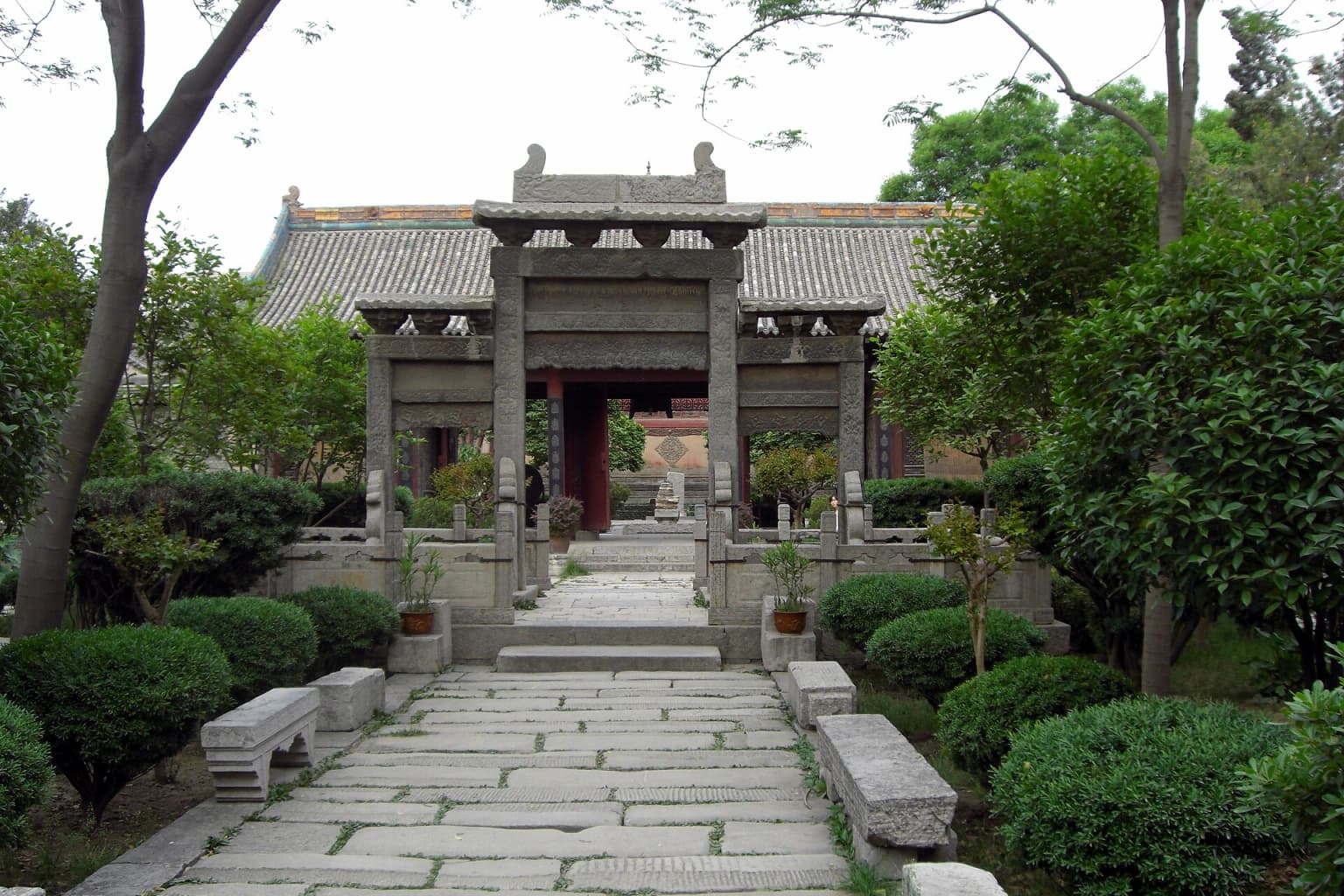
The Great Mosque of Xi'an shows how Islamic life and Chinese architecture meet. It is an active religious site, so current visitor boundaries and prayer-hall access still take priority. Photo by Larry Koester, CC BY 2.0.
Start with the decision that changes the whole trip
Choose one of these working standards before saving restaurant pins:
| Your practical standard | Minimum check at each place | Best trip design |
|---|---|---|
| Current local halal sign is sufficient | Look for 清真, confirm it applies to this branch, and check that the menu and premises do not contradict the claim | Major cities are workable with a verified food cluster and a backup snack kit |
| You also avoid cooking alcohol and shared equipment | Ask about meat, broth, lard, cooking wine, frying oil, pots, knives and boards | Prioritize dedicated halal restaurants; stay near an established Muslim neighborhood or mosque |
| You need a specific scholarly or certification standard | Carry a written checklist and ask the manager, not only the server; decline when the process cannot be explained | Give each city more nights and research current local channels before arrival |
| You have a severe allergy as well | Use a separate allergy card; ask about traces, shared oil and utensils; keep emergency medicine accessible | Prefer packaged food with readable labels and simple kitchens that can explain cross-contact |
Local halal-food regulation exists in several Chinese jurisdictions, but the exact sign, permit and supervisory system is not identical nationwide. A green sign, crescent motif, Arabic-looking decoration, Muslim-sounding owner name, lamb dish or 新疆菜 (“Xinjiang cuisine”) label does not by itself answer every question. Even a genuine sign is attached to a particular operator and premises; an old photograph does not prove the branch's current status.
This is why “I do not eat pork” is only the first sentence. It says nothing about how the animal was sourced, what made the stock, whether a stir-fry used cooking wine, or whether the same fryer handled another product.
What to look for, and what it does not prove
The useful word: 清真
清真 (qīngzhēn) is the main Chinese word used for halal food and Muslim premises. You may see it on a restaurant fascia, a plaque near the entrance, a packaged product or a mosque name such as 清真寺 (qīngzhēnsì). Treat it as the start of verification.
At a dedicated restaurant, check the whole scene. Does the current storefront display 清真 clearly? Does the menu avoid obvious contradictions? Can staff answer where the meat and stock come from? If your standard is stricter, ask whether the kitchen is dedicated and whether any alcohol enters cooking. If the answer shifts between staff members, the practical response is to choose a simpler dish or leave.
Do not rely on color. Green signs are common, but green is not certification. Arabic script can be decorative. “Muslim-owned,” “Hui food,” “Xinjiang barbecue,” “Lanzhou noodles,” 牛肉面 (beef noodles), 羊肉串 (lamb skewers) and “vegetarian” are useful clues, not complete evidence.
The ingredients hidden behind an easy English answer
When staff say “no pork,” work through the components that matter to you:
- Lard —
猪油(zhūyóu): may be used for pastry, fried snacks, noodles or stir-fries even when no pork pieces are visible. - Pork-bone broth —
猪骨汤(zhūgǔ tāng): can sit behind a vegetable, seafood or noodle dish. - Cooking wine —
料酒(liàojiǔ): common in marinades and stir-fries. Also ask about黄酒(huángjiǔ, yellow rice wine) and绍兴酒(Shàoxīng jiǔ). - Gelatin —
明胶(míngjiāo): the source may matter in desserts, yogurt-like products, sweets, capsules and processed meat. - Shared frying oil —
共用油(gòngyòng yóu): a vegetable or seafood item can share oil with non-halal meat. - Shared pot, knife or cutting board: relevant to travelers who avoid kitchen cross-contact.
- Meat source and slaughter: “beef” identifies the animal, not the supply process.
Vegetarian food can solve a meat-source problem, but 素食 (sùshí) does not automatically solve alcohol, gelatin, animal stock or shared-kitchen questions. A Buddhist vegetarian restaurant may be meat-free yet use ingredients or kitchen practices that do not match your halal standard. Ask about the specific boundary rather than forcing staff to interpret a broad English label.
Chinese phrases that produce useful answers
Save these as a screenshot and show the full sentence. Short machine-translated fragments can make a server think you are expressing a preference rather than a requirement.
| Chinese | Pinyin | Meaning |
|---|---|---|
| 请问这是清真的吗? | Qǐngwèn zhè shì qīngzhēn de ma? | Is this halal? |
| 请问店里有清真标志或相关证明吗? | Qǐngwèn diànli yǒu qīngzhēn biāozhì huò xiāngguān zhèngmíng ma? | Does this branch display a halal sign or related documentation? |
| 我不吃猪肉,也不能吃猪油或猪骨汤。 | Wǒ bù chī zhūròu, yě bù néng chī zhūyóu huò zhūgǔ tāng. | I do not eat pork, lard or pork-bone stock. |
| 请不要放料酒、黄酒、绍兴酒或其他酒。 | Qǐng bú yào fàng liàojiǔ, huángjiǔ, Shàoxīng jiǔ huò qítā jiǔ. | Please do not add cooking wine, yellow rice wine, Shaoxing wine or other alcohol. |
| 这个汤是用什么熬的? | Zhège tāng shì yòng shénme áo de? | What is this broth made from? |
| 这个菜会和猪肉共用锅、油、刀或砧板吗? | Zhège cài huì hé zhūròu gòngyòng guō, yóu, dāo huò zhēnbǎn ma? | Does this dish share a pot, oil, knife or cutting board with pork? |
| 里面有明胶吗?如果有,是什么来源? | Lǐmiàn yǒu míngjiāo ma? Rúguǒ yǒu, shì shénme láiyuán? | Does it contain gelatin; if so, what is its source? |
| 我不是过敏,是宗教饮食要求。 | Wǒ bú shì guòmǐn, shì zōngjiào yǐnshí yāoqiú. | This is a religious dietary requirement, not an allergy. |
| 我有严重过敏,少量或共用厨具也不行。 | Wǒ yǒu yánzhòng guòmǐn, shǎoliàng huò gòngyòng chújù yě bù xíng. | I have a severe allergy; traces or shared utensils are also unacceptable. |
| 请问附近有清真餐厅吗? | Qǐngwèn fùjìn yǒu qīngzhēn cāntīng ma? | Is there a halal restaurant nearby? |
| 请问清真寺现在对访客开放吗? | Qǐngwèn qīngzhēnsì xiànzài duì fǎngkè kāifàng ma? | Is the mosque open to visitors now? |
Ask one or two questions at a time. At a busy counter, show the non-negotiable sentence first. If the employee does not know, ask whether a manager can confirm: 可以请经理确认一下吗? (Kěyǐ qǐng jīnglǐ quèrèn yíxià ma?). “Probably” is not useful when the boundary is important.
Choose the city for the kind of certainty you need
Xi'an: the strongest first cultural introduction
Xi'an gives a first-time visitor a visible Muslim community, distinctive Hui food traditions and the Great Mosque within the historic core. It works well when your trip also includes major heritage sights and you want halal meals to be part of the city story rather than a separate logistics task.
The Muslim Quarter is a living neighborhood and worship landscape, not one uniform food court. The most photographed main lanes can be crowded and commercially intense. Walk beyond the first illuminated snack strip, compare several dedicated premises, and verify the individual stall or restaurant. Do not carry outside non-halal food into a dedicated halal establishment.
Stay inside or near the old-city wall if this is your first visit. That keeps the mosque/food area, city-center sights and metro connections within a manageable radius. A room directly above the busiest lanes can be noisy; one or two metro stops away often gives a calmer night without losing food access.
Lanzhou: best for a food-led northwest stop
Lanzhou is the clearest specialist choice for a traveler who wants beef noodles, Hui food culture and a useful rail bridge into northwest China. In Lanzhou, the local breakfast is usually called beef noodles—牛肉面—rather than sold as an exotic “ramen experience.” Choose noodle thickness at the counter, then confirm the branch's current halal status if the sign or operation is unclear.
The city reduces food-search friction, but it does not remove the need to verify every kitchen. A bowl name cannot establish another branch's meat source or handling. Use breakfast near the hotel, keep the river corridor for sightseeing, and avoid crossing the city only for a viral shop when a well-run dedicated place nearby can explain its ingredients.
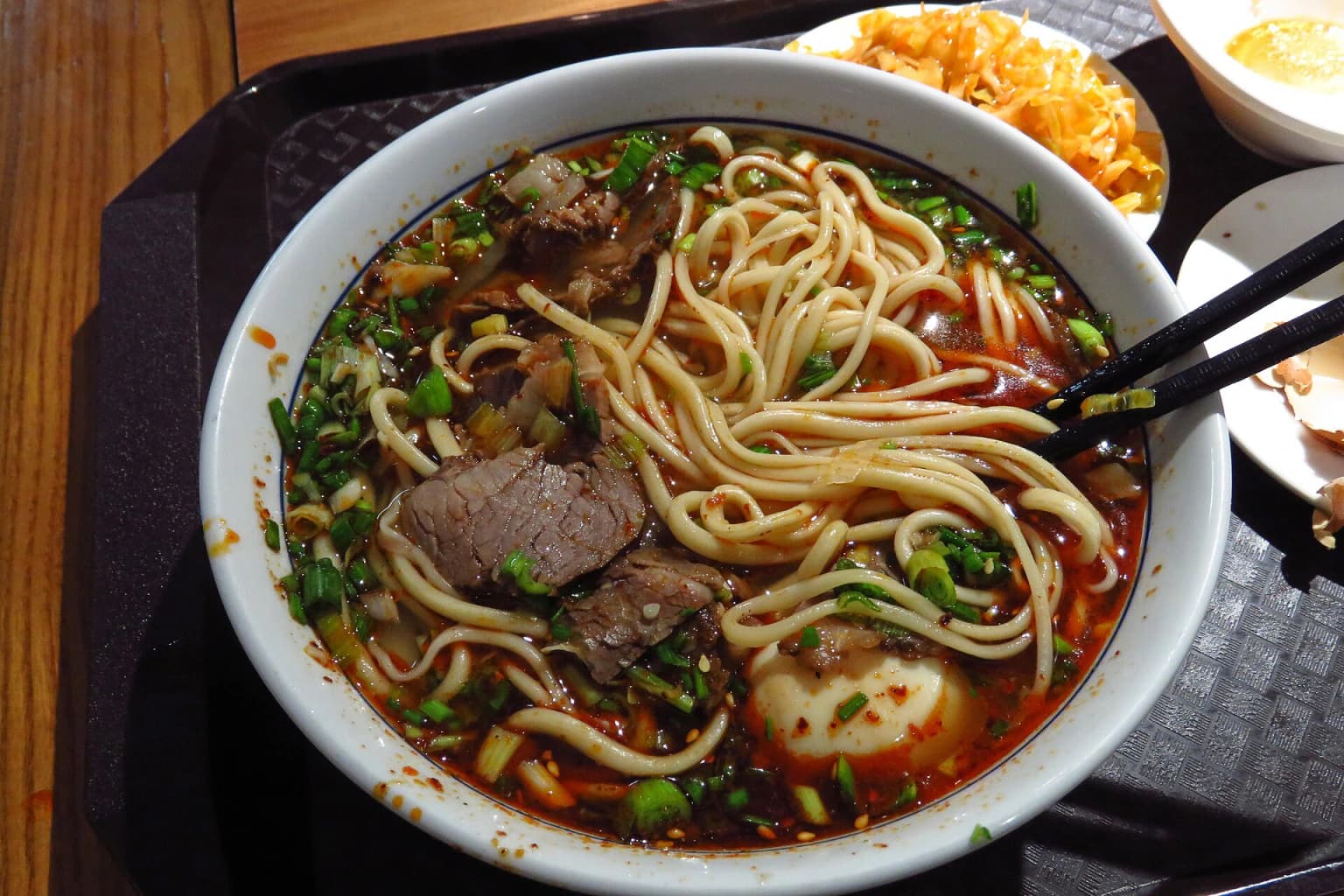
A Lanzhou beef-noodle breakfast makes the regional food tradition concrete. The photograph does not verify another restaurant, branch or kitchen. Photo by N509FZ, CC BY-SA 4.0.
Yinchuan: a slower Hui cultural base
Yinchuan suits travelers who want Hui food traditions, regional museums and a less compressed city pace. Lamb, hand-held mutton, noodles, breads, tea and morning markets can make food exploration a major part of the trip. It is also a useful base for Ningxia landscapes when you can return to the city for dinner.
Do not assume the entire destination operates under one standard. The local authorities still enforce misuse of halal signage, which is a reason to look for the current sign at the actual premises. Stay where evening food is walkable or a short ride away; a scenic-edge resort may create more dinner uncertainty than it solves.
Xinjiang: exceptional food and distance, with city-by-city planning
Xinjiang offers Uyghur, Hui, Kazakh and other regional food traditions, but it is not one compact “halal destination.” Kashgar, Urumqi and Turpan differ in scale, transport and visitor rhythm. Distances between cities can consume a full day, so the food plan must follow the route rather than a generic list.
Never accept the online shortcut that “all Xinjiang restaurants are halal.” 新疆菜, lamb skewers, pilaf or naan do not prove the individual kitchen's status. Look for 清真, ask the same questions you would elsewhere, and avoid treating ethnic identity as a certification shortcut.
In Kashgar, the Id Kah Mosque is both an important religious site and a city landmark. Worship controls the space. Confirm current visitor access, do not assume the prayer hall is part of a tourist ticket, and keep sightseeing photography separate from people's worship.
Beijing: easiest major-hub combination
Beijing is the best major gateway when you want world-famous sights and a durable halal-food anchor. Niujie (牛街) is the practical center: a Muslim community area with the Niujie Mosque, food shops and long-established halal dining. One current Muslim-family travel pattern is to use Niujie for meals while scheduling major sights elsewhere, instead of expecting every attraction district to provide an equivalent choice.
Choose accommodation by your daily priority. Staying near Niujie lowers dinner friction; staying near a central metro interchange shortens sightseeing transfers. A sensible compromise is a direct metro ride or short taxi journey between the two. The Beijing hutong routes can add neighborhood context, but do not schedule a mosque as a casual photo stop during Friday congregational prayer.
Shanghai: workable with a cluster-and-backup strategy
Shanghai has halal restaurants, Xinjiang and northwest cuisines, mosques and a large transport network, but useful options are dispersed across a very large city. The weak plan is to save ten pins without checking which branch is near that day's route. The stronger plan assigns one verified meal area to each sightseeing zone, then keeps sealed food for the gap.
Stay near a metro interchange and within practical reach of one currently verified halal cluster. Before a late arrival, confirm that a restaurant will still be serving; do not assume a mall listing or delivery-app page proves the branch is open. At a Xinjiang-style restaurant, verify the actual premises rather than relying on the cuisine label.
Guangzhou: strong communities, more ingredient questions
Guangzhou is valuable for international trade, historic Muslim heritage and food cultures connected to migrant communities. Areas around Xiaobei are useful research anchors, while the Huaisheng Mosque gives important historical context. Current access and worship boundaries still need confirmation.
Cantonese cooking makes precise questions important. Pork stock, lard, cooking wine and shared equipment may appear in dishes that look seafood- or vegetable-led. If you want Cantonese formats such as dim sum, search for a dedicated halal operator and verify the branch; do not order from an ordinary dim sum kitchen merely because the visible filling is shrimp or vegetables.
Prayer planning without assuming a prayer room
Prayer times change by date and exact city. Set a trusted prayer-time source to the city you are physically in, then recheck when a long train or flight crosses a large distance. China's transport timetables use the official time printed on the ticket; do not adjust a departure based on a cultural or informal local-time expression.
For most sightseeing days, carry a compact kit:
- a thin clean prayer mat or cloth;
- tissues and a small towel;
- a small water bottle when practical;
- a prayer-time and qibla tool that works offline;
- the Chinese request below, saved as text;
- a simple food buffer for a delayed return.
Ask a hotel: 我需要做礼拜,请问有安静、干净、不会妨碍别人的地方吗? This means, “I need to pray; is there a quiet, clean place where I will not obstruct anyone?” Ask rather than assuming a meeting room, gym corner or luggage area is available. If the answer is no, reorganize around your room or a verified mosque.
For wudu, use an appropriate wash area, keep the floor dry and avoid creating a slip hazard or using a public basin in a way that inconveniences others. Facilities vary widely. A mosque may have suitable ablution space, but a tourist attraction or rail station may not. If the available conditions raise a religious question, follow your own trusted religious guidance; a travel guide should not invent a ruling.
On a train, do not block aisles, doors, vestibules or emergency equipment. The most reliable arrangement is to pray before boarding or after arrival when the schedule allows. For an overnight or very long journey, choose a berth or room arrangement with more privacy if it fits your budget, and plan the issue before the train departs.
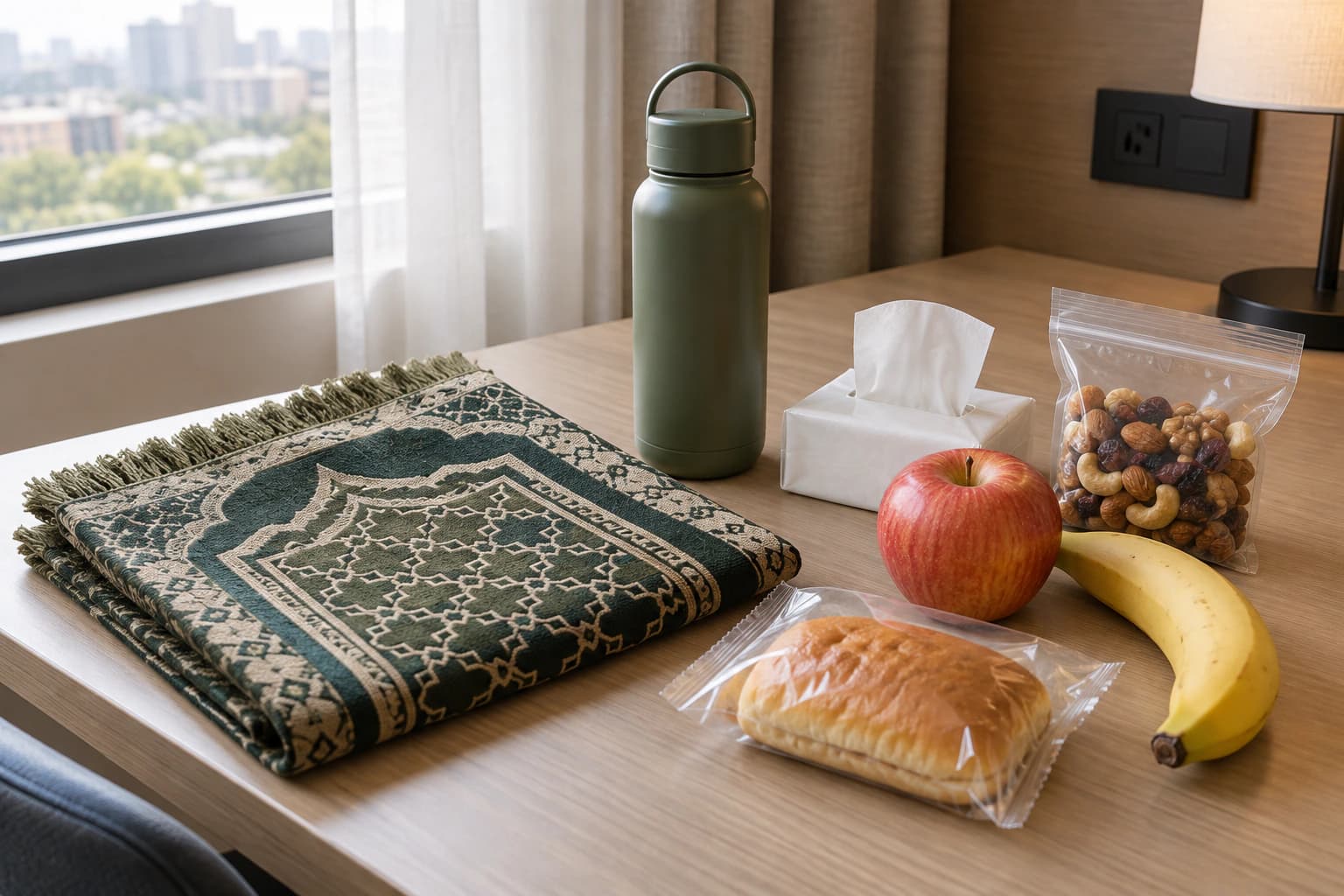
A small prayer-and-food kit protects a long day from timetable changes. Verify every packaged product's ingredients; the scene does not certify a particular snack or hotel facility.
Mosque visits: worship first, architecture second
A Chinese mosque may resemble a traditional courtyard, a modern community building or an architecture style familiar from another country. Do not infer visitor rules from the facade.
At each mosque:
- confirm whether non-worship visitors are currently admitted;
- avoid treating the beginning or end of congregational prayer as a sightseeing slot;
- dress modestly and follow posted or spoken guidance;
- remove shoes where instructed;
- silence the phone and keep conversation low;
- do not walk across prayer rows or enter a prayer hall simply because a door is open;
- ask before photographing any interior;
- never photograph an identifiable worshipper without clear permission.
Women and men may be directed to different worship spaces. Visitor and worshipper access may also differ. A ticket desk, heritage status or appearance in a tourism guide does not cancel the mosque's religious function. If staff say an area is closed, use the courtyard or exterior that they indicate.
Build food security into train, scenic-area and transfer days
Railway food service must meet ordinary food-safety rules, but that does not establish halal status. The trolley may sell a beef meal without explaining the stock, cooking wine or kitchen. A station with halal food on one visit may have different tenants or opening hours on another.
Before a long departure, buy enough for the journey plus one delay:
- sealed nuts or seeds with a readable ingredient list;
- whole fruit that travels well;
- plain bread or crackers from a source you accept;
- a factory-sealed halal-marked meal or snack whose actual label you have checked;
- an instant product only after reading the seasoning and stock ingredients;
- water purchased after any security restriction that prevents carrying it through.
Chinese prepackaged foods should carry a Chinese ingredient list. Use camera translation, then inspect suspicious terms rather than trusting a front-of-pack picture. 猪肉, 猪油, 猪骨, 明胶, 料酒, 黄酒, 食用酒精 and animal-derived flavorings deserve attention. A halal logo on the front does not replace checking the manufacturer and current package when your standard requires more.
For a mountain, desert or large scenic area, eat a reliable breakfast and take your own lunch buffer. Do not count on the last cable-car station or visitor center to stock a suitable meal. Keep food sealed, pack out waste, and follow attraction rules about where eating is allowed.
Ramadan and Eid: plan for changed rhythms, not guessed events
Ramadan and Eid dates follow the lunar calendar and community observation. Local meal times, mosque programs and public access arrangements can be announced close to the date. Do not plan around an old social-media calendar or assume last year's city event will repeat.
If your trip overlaps Ramadan:
- set fasting and prayer times for each city rather than one China-wide schedule;
- confirm whether a halal restaurant serves lunch, closes in the afternoon or becomes busiest near iftar;
- reserve or arrive early for an important iftar meal, but keep a simple backup;
- avoid eating or drinking conspicuously at the threshold of a dedicated community worship space;
- expect mosque visitor access to tighten around congregational prayer;
- keep sunset timing in mind before booking a performance or long transfer.
In cities where many restaurants serve a mixed clientele, some halal premises may continue ordinary daytime hours. In a community-centered neighborhood, the rhythm may shift more noticeably. Neither pattern should be assumed at every branch.
For Eid, wait for the mosque or local community's current announcement before treating a gathering as a visitor event. Larger worship attendance can change traffic and access around a mosque. A respectful traveler gives the congregation space and does not turn prayer arrivals into a photography opportunity.
Hotel and route choices that reduce daily friction
The right hotel is not the one that claims to be “Muslim-friendly” in an undated review. It is the one that solves your actual days.
Before paying, map:
- one current dedicated halal restaurant for arrival night;
- one breakfast or early-opening option;
- the nearest mosque or quiet prayer fallback you can verify;
- the metro or taxi connection to your main sights;
- a shop selling packaged food for departure day.
Message the hotel with narrow questions: Will it accept a food delivery under your reservation name? Is a refrigerator available in the room? Can staff help call a currently operating halal restaurant? Is there a clean, quiet space only if your room is unavailable? A vague “special requests accepted” checkbox proves none of these.
For a first trip, spend at least two nights per base. Moving daily makes you repeat restaurant verification, lose food buffers during checkout and squeeze prayer around station transfers. The China 10-, 14- and 21-day itinerary chooser helps reduce unnecessary city changes. Use the accommodation guide, transport guide and essential apps guide for the booking layer.
Severe allergy and halal are separate conversations
A restaurant may satisfy your religious standard and still be unsafe for a severe peanut, sesame, shellfish, dairy, egg or wheat allergy. Conversely, an allergy-aware kitchen may not meet your halal requirement. Say which issue you mean.
For an allergy, do not rely on 清真, a vegetarian menu or the absence of an ingredient in the dish name. Ask about shared oil, stock, sauces, utensils and surfaces. Show the Chinese name of the allergen and the sentence 少量或共用厨具也不行—“traces or shared utensils are also unacceptable.” If staff cannot explain the process, choose a sealed packaged alternative or leave.
China has published a newer prepackaged-food label standard with clearer allergen rules, but it takes effect on March 16, 2027. Packages during the transition may follow the older standard, and restaurant or freshly prepared food is outside this retail-label system. Always read the package in front of you. Carry prescribed medication in your day bag and follow your clinician's emergency plan; this guide cannot determine whether a kitchen is medically safe.
Respect communities without turning identity into a travel product
China's Muslim communities are not interchangeable. Hui, Uyghur, Kazakh, Dongxiang, Salar and other communities have distinct histories, languages, cuisines and local lives. Ask what a dish is called rather than announcing what it “must” be. Learn a neighborhood's story, buy food at a fair price, and avoid photographing people as ethnic scenery.
Do not enter back-of-house areas, point cameras into worship, or pressure someone to explain personal belief. A market is still a workplace. A mosque is still a religious institution. A family restaurant is not responsible for representing every Muslim in China.
The most reliable Muslim-friendly trip is therefore modest in its claims and strong in its routine: recognize 清真, verify the current premises, ask about the ingredients that matter to you, carry food and prayer backups, and let active communities set the boundaries of their own spaces.