Beijing hutong routes: choose the right old-city walk
Beijing's hutongs are not one attraction. They are a network of residential lanes, temple approaches, market streets, lakeside paths and renewed commercial blocks spread across the old city. The best walk therefore depends on what you want from the day: the Bell and Drum Towers above grey roofs, active religious spaces, early twentieth-century architecture, the White Dagoba behind courtyard houses, or a meal in the city's historic Muslim quarter.
This guide gives you five independent half-day walks. Each has a different visual result, pace and reason to go. Walking distances below measure only the direct legs between the linked map anchors. Your real total will be longer after lane detours, museum interiors, meals and photography.
Choose one route for a half-day. Do not attempt all five as a checklist, and do not enter a courtyard simply because its gate is open. Many of the most photogenic doors still belong to private homes.
Choose your route in one minute
- First visit: Bell and Drum Towers to Shichahai — Choose this for the clearest old-Beijing skyline, a compact route and a blue-hour lake finish. Allow 2.5–4 hours.
- Temples and learning: Lama Temple to Wudaoying — Choose this when interiors, worship and intellectual history matter more than covering many streets. Allow 3–5 hours.
- Architecture and street photography: Dongjiaominxiang to Yangmeizhu Xiejie — Choose this for the strongest contrast between formal historic facades, a restored water lane and the Qianmen creative quarter. Allow 3–4 hours.
- Quiet west-city history: Lu Xun Museum to the White Dagoba — Choose this for literature, a monumental stupa and lower-pressure lanes. Allow 2.5–4 hours.
- Halal food and community history: Niujie to Daji Xiang — Choose this when food culture, religion and a lived neighbourhood are the purpose. Allow 3–5 hours, including queues and a meal.
If you have only one free afternoon, take Route 1. If you already have the Forbidden City and central-axis monuments elsewhere in your trip, Route 3 or Route 4 will show a less familiar side of the old city. If you are still choosing between old lanes, the monumental axis and a modern shopping-led walk, use the Beijing Citywalk chooser first.
Route 1: Bell and Drum Towers to Shichahai
- Best for: a first visit, roofline photographs and an evening finish.
- Order: Beiluoguxiang → Bell Tower → Drum Tower → Yandai Xiejie → Shichahai.
- Base walking: about 1.7 km / 24 minutes between anchors.
- Realistic duration: 2.5–4 hours, longer if you enter both towers or add dinner.
- Start: mid-afternoon; start earlier in winter.
- Finish: Shichahai at golden hour, blue hour or early evening.
1. Begin in Beiluoguxiang
Start at Beiluoguxiang (北锣鼓巷), the quieter northern counterpart to commercial Nanluoguxiang. The useful subject is the lane itself: one-storey grey-brick walls, trees, bicycles and small openings toward side alleys. Walk slowly and keep shop stops optional. Tenants change more quickly than the street pattern.
Use a phone's 1× camera and hold it level. Let the converging rooflines carry the eye into the frame. A doorway can provide scale, but photograph it from the public lane and avoid aiming into a home. Morning gives quieter streets; afternoon makes the north-to-south sequence work better with Shichahai at the end.
From Beiluoguxiang, the planned walk to the Bell Tower (钟楼) is about 0.9 km / 13 minutes.
2. Use the square to understand the two towers
The Bell Tower and Drum Tower (鼓楼) face each other across Zhonglouwan Square. Make the wide outside view before deciding whether to enter. A tower interior adds stairs, historical interpretation and an elevated look over the old city, but it also changes a short street walk into a ticketed visit.
As checked in September 2026, the Bell Tower operates 09:30–17:30 from March 26 to October 25 and 09:30–16:30 from October 26 to March 25. A Bell and Drum Towers joint ticket is CNY 30; separate tickets are CNY 10 for the Bell Tower and CNY 20 for the Drum Tower. Tickets are handled through the official WeChat account “Beijing Bell and Drum Towers (北京钟鼓楼).” Holiday arrangements can override the normal schedule, so check the live channel on the day.
The Bell Tower to Drum Tower transfer is only about 100 metres / 2 minutes. Stand to one side of the square rather than in the centre of bicycle or pedestrian traffic. A 35–50mm field of view can align one tower with the other; a wider lens is useful only when you keep the camera level.
3. Continue through Yandai Xiejie
Walk about 300 metres / 4 minutes from the Drum Tower to Yandai Xiejie (烟袋斜街). This diagonal commercial lane is narrow and often crowded. Treat it as a connector between the tower district and the water, not a shopping obligation.
The entrance arch is the obvious frame, but the better sequence shows how the lane changes: a tight commercial foreground, then a glimpse of sky and finally the opening at Yinding Bridge. If the centre is congested, keep moving instead of waiting for an empty-street photograph that may never happen.
4. Finish at Shichahai
The walk from Yandai Xiejie to the Shichahai anchor is about 300 metres / 5 minutes. Choose one shore rather than attempting a full loop. Qianhai gives an easy finish near Lotus Market; Houhai provides longer water views; Xihai is quieter but adds distance.
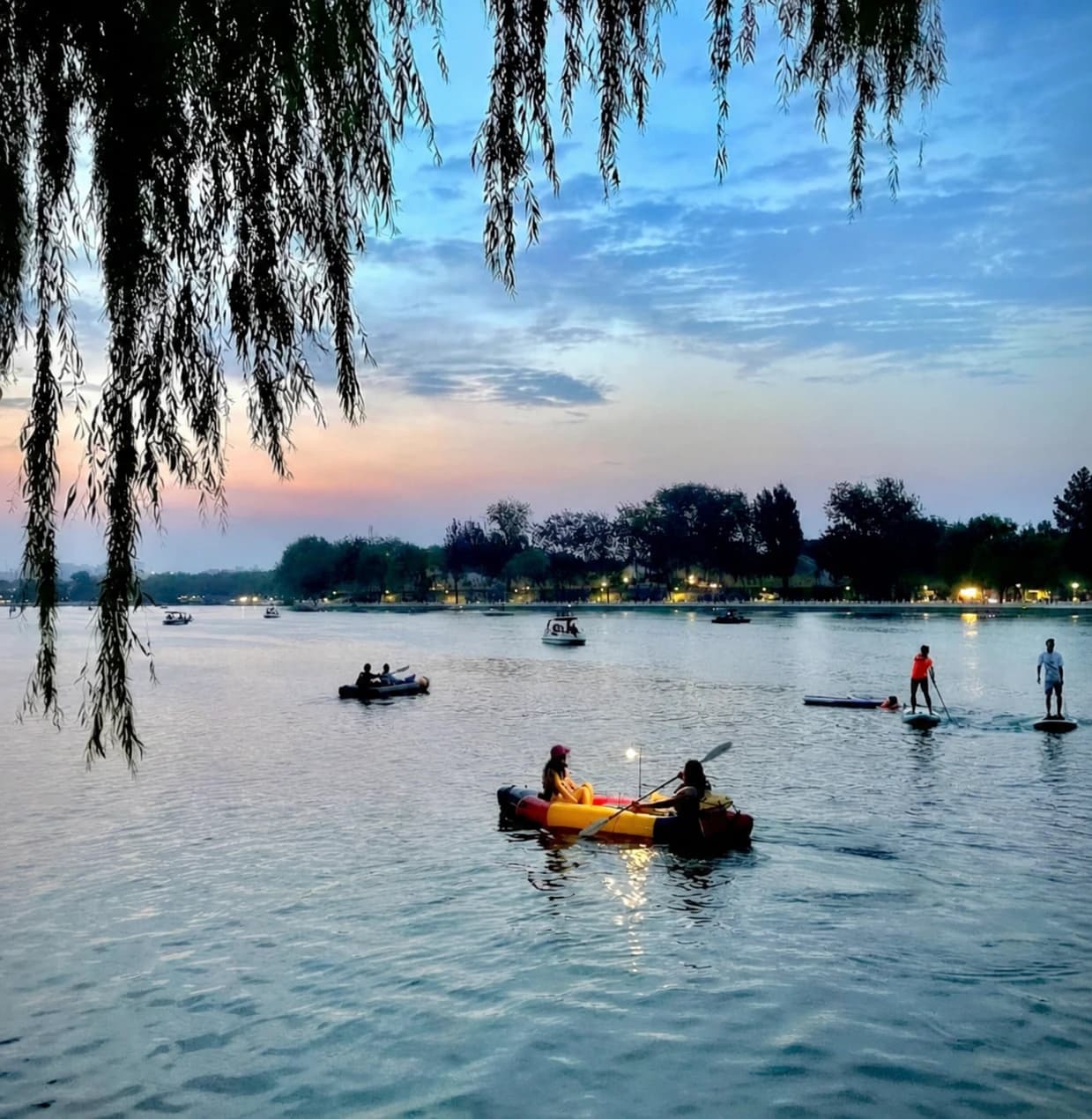
This is the result to plan for at the end of Route 1: dark rooflines and boats below a sky that still holds blue. Arrive before the sky turns black. Use the detailed Shichahai guide if you want a boat, Prince Gong's Mansion or the complete three-lake walk.
Optional extension: Nanluoguxiang is nearby, but its central street is a dense shopping corridor. Add it only if you want that energy. Beiluoguxiang and the lanes around the towers already provide the quieter street scale many first-time visitors expect.
Route 2: Lama Temple, Imperial Academy and Wudaoying
- Best for: living religion, timber architecture and Chinese educational history.
- Order: Lama Temple → Guozijian Street and Confucius Temple → Wudaoying Hutong.
- Base walking: about 0.7 km / 10 minutes between anchors.
- Realistic duration: 3–5 hours with interiors.
- Start: at opening time for a calmer Lama Temple visit.
- Finish: lunch, coffee or an early evening walk in Wudaoying.
This route is geographically short but content-heavy. The mistake is to read “700 metres” and treat three substantial places as a quick neighbourhood loop. Give the two ticketed complexes most of the day and let Wudaoying absorb whatever time remains.
1. Put the Lama Temple first
Begin at Lama Temple (雍和宫). The complex remains an active Tibetan Buddhist site, so the main experience is its south-to-north hall sequence and worship atmosphere. Dress for outdoor courtyards, keep voices low, and follow the on-site photography rules around interiors and sacred objects.
Current seasonal hours are 09:00–17:00 from April through October, with ticket sales closing at 16:30, and 09:00–16:30 from November through March, with ticket sales closing at 16:00. Admission is CNY 25. Book through the official real-name channel and carry the original passport used for the booking. The full Lama Temple guide explains the hall order and current ticket workflow.
2. Cross to Guozijian Street
Walk about 400 metres / 6 minutes to Guozijian Street (国子监街). The pailou gates, mature trees and lower red walls make this more than a transfer. Photograph along the street axis while leaving the entrances clear.
The Confucius Temple and Imperial College Museum opens 09:00–17:00, with last entry at 16:30, Tuesday through Sunday; it normally closes on Mondays except public holidays. Tickets can be purchased online or at the museum, and the normal adult price is CNY 30. Allow 90 minutes if you want the stone classics, courtyards and academy history to make sense. Use the Confucius Temple and Imperial College guide for the internal sequence.
3. Finish in Wudaoying without chasing a shop list
From Guozijian Street, walk about 300 metres / 4 minutes to Wudaoying Hutong (五道营胡同). This is the route's flexible section. Choose a currently open cafe or simple meal only after seeing the queue and menu. The lane still works if a saved business has closed.
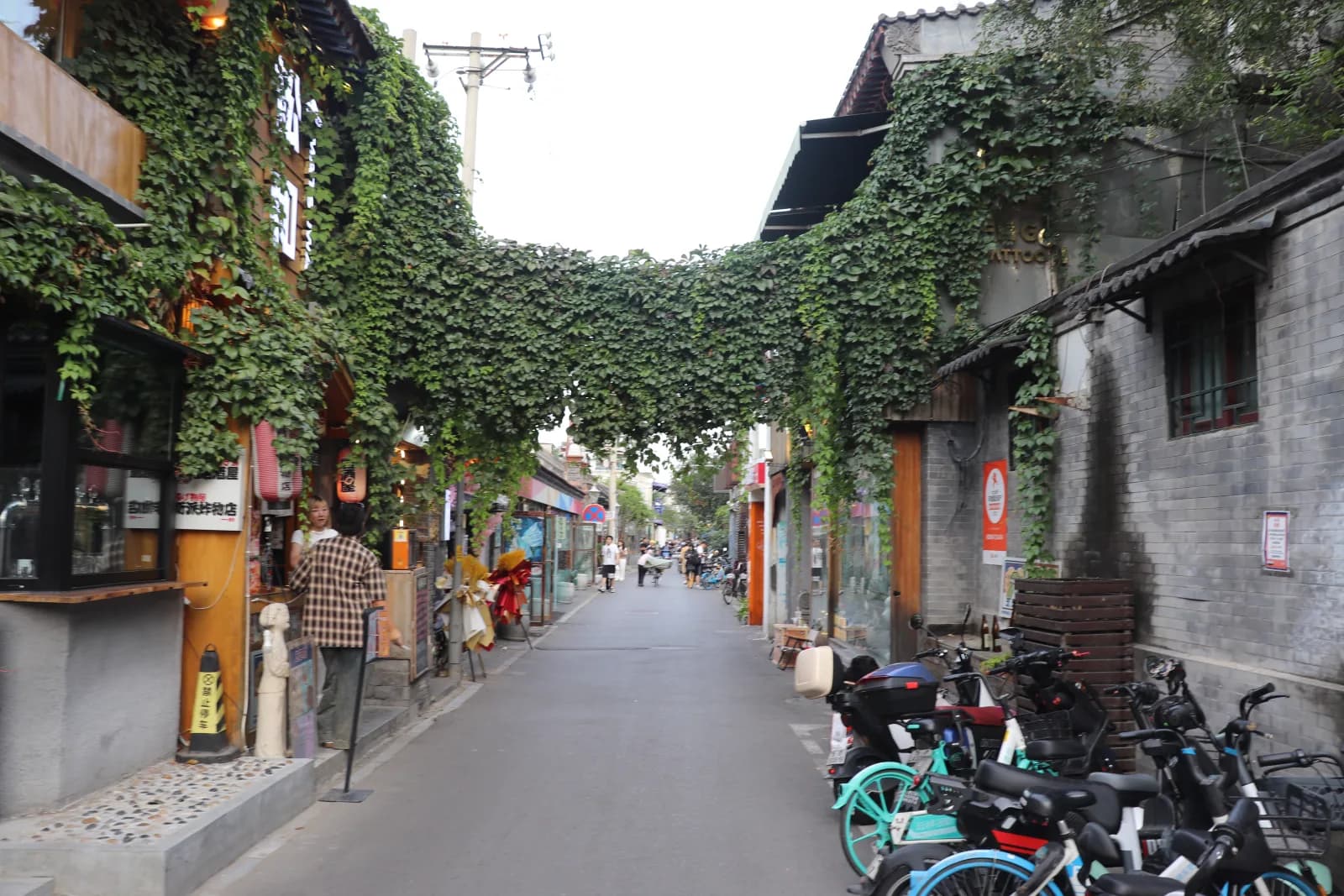
Photo: Andrzej Otrębski · Source · CC BY-SA 4.0
The photograph shows the right expectation: a lived street with shade, bicycles and small businesses rather than an untouched historic set. Keep moving around delivery bikes and residents. For a ready-made full day, use the Beijing Temples and Learning itinerary.
Route 3: Dongjiaominxiang to Yangmeizhu Xiejie
- Best for: architecture, street photography and a route that changes character several times.
- Order: Dongjiaominxiang → Xixinglong Street → Sanlihe Park → Beijing Fun → Yangmeizhu Xiejie.
- Base walking: about 2.8 km / 39 minutes between anchors.
- Realistic duration: 3–4 hours.
- Start: late morning for architecture, or mid-afternoon for a Qianmen evening finish.
- Finish: Yangmeizhu Xiejie, with optional Dashilan or Qianmen night lights.
This route avoids visual repetition. Formal early twentieth-century facades give way to a narrow waterway, renewed public space and finally the angled lanes west of Qianmen. It is a street-level route: many historic institutions along Dongjiaominxiang are exterior views rather than visitor attractions.
1. Read Dongjiaominxiang from public space
Start at Dongjiaominxiang (东交民巷). Walk slowly enough to notice facade materials, setbacks and the difference between former diplomatic buildings and traditional lanes, but do not point a long lens toward guarded entrances. Current police instructions, temporary barriers and photography restrictions take priority over any saved route.
Use 35–50mm for architectural details and 24–35mm for a facade in its street setting. Keep verticals straight. A photograph of one doorway without the surrounding street loses the contrast that makes the route distinctive.
2. Move from formal facades to the old-city water line
The planned walk to Xixinglong Street (西兴隆街) is about 800 metres / 11 minutes. Continue another 500 metres / 7 minutes to Sanlihe Park (三里河公园).
Sanlihe is the route's rest point. The restored watercourse, small bridges and low buildings create an intimate scale after Dongjiaominxiang. Use the stream as a leading line, but do not turn a bridge into a long portrait set. The space is narrow and shared.
For food or coffee, choose by current operation rather than an old viral storefront. A suitable stop should sit directly on the route, display a clear price, provide a real rest and still leave enough daylight for Yangmeizhu. Skip a long queue; Qianmen offers many alternatives later.
3. Cross Beijing Fun and finish at Yangmeizhu
From Sanlihe, the checked walk to Beijing Fun (北京坊) is about 1.0 km / 14 minutes. This renewed block provides a broad transition rather than the emotional centre of the route. Photograph the relationship between retained facades and contemporary public space, then continue.
Walk about 500 metres / 7 minutes to Yangmeizhu Xiejie (杨梅竹斜街). The angled lane carries publishing, craft and neighbourhood history without requiring a fixed shop itinerary. Look for changes in street width, door details and glimpses toward the Qianmen commercial area.
If you want a guide rather than navigating alone, Trip.com currently lists an English 3-hour Qianmen, Dashilan and Sanlihe walking tour. It follows the closest commercial match to this route. Check the exact walking-tour package, confirming the selected date, 09:30 meeting option, minimum booking size and cancellation terms before payment. The public streets remain free and the tour is optional.
Evening extension: walk toward Dashilan or Qianmen after Yangmeizhu. Add only one commercial street. Continuing through every lane turns a coherent architecture walk into an unfocused shopping circuit.
Route 4: Lu Xun Museum, White Dagoba and imperial ritual
- Best for: literature, monumental architecture and a quieter west-city pace.
- Order: Lu Xun Museum → White Dagoba Temple and surrounding lanes → Temple of Ancient Monarchs.
- Base walking: about 1.0 km / 14 minutes between anchors.
- Realistic duration: 2.5–4 hours with interiors.
- Start: 09:00–09:30, or early afternoon with the White Dagoba before last entry.
- Finish: Fuchengmen Inner Street.
1. Start with Lu Xun rather than a cafe viewpoint
Begin at the Beijing Lu Xun Museum (北京鲁迅博物馆). The museum and former residence give the route a human scale before the monumental stupa. Current hours are 09:00–16:00, with Monday closure except statutory holidays. Entry is free; recent official guidance says foreign passport holders can complete identity verification on site without an advance reservation. Carry the physical passport and allow about 60–90 minutes.
Walk about 600 metres / 9 minutes toward Miaoying Temple, commonly called White Dagoba Temple (妙应寺白塔寺). The connecting lanes matter: the stupa appears and disappears above roofs, giving a more useful sense of its scale than a single frontal view.
2. Separate the neighbourhood view from temple entry
You can appreciate the White Dagoba from public lanes without buying a drink or entering a private rooftop. If you want the temple interior, current September 2026 hours are 09:00–17:00, with last ticket sale and entry at 16:30; it normally closes on Mondays. Extended Friday and Saturday evening admission ended in late August 2026, so do not rely on older posts that show a night visit inside the temple.
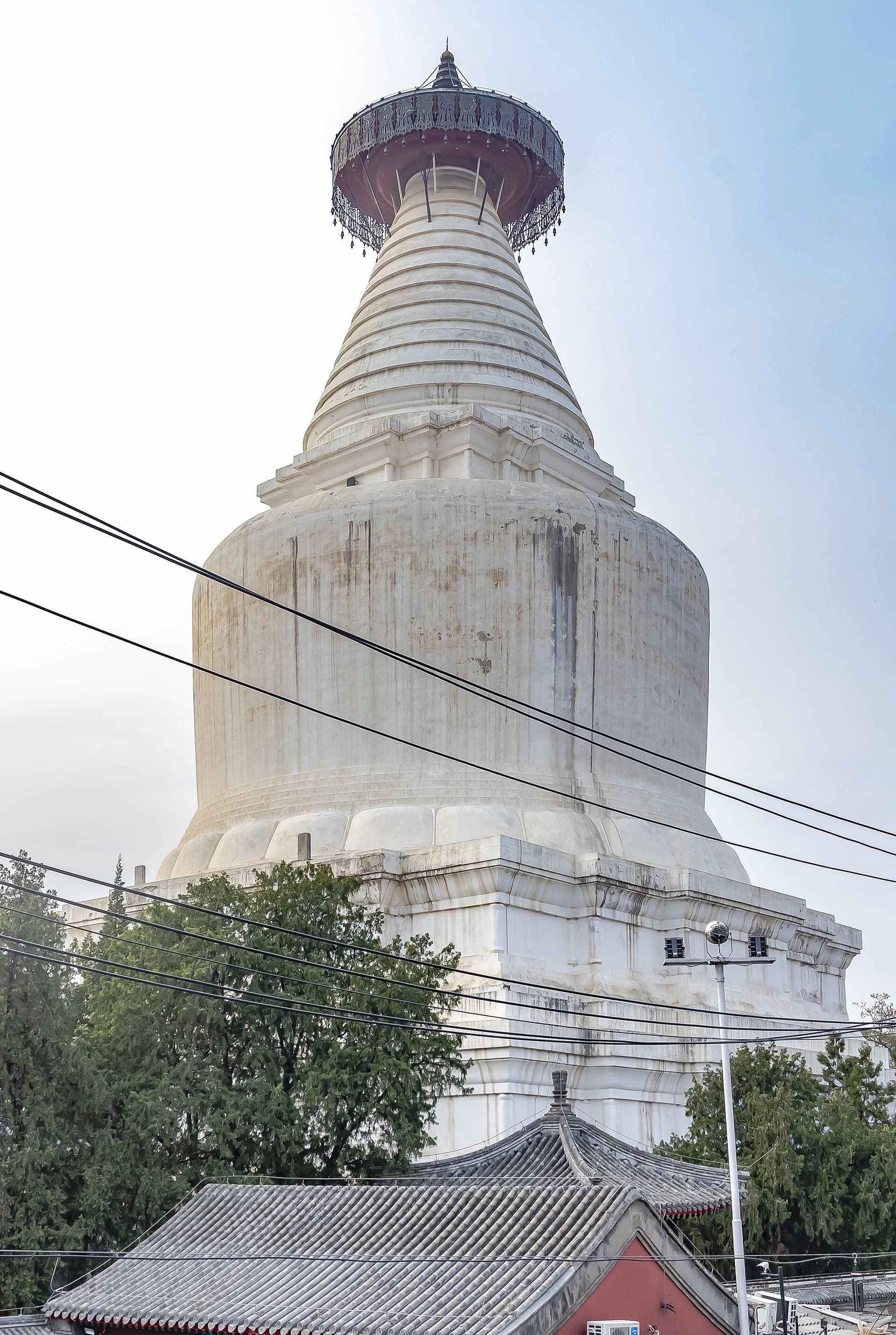
The close documentary view shows the stupa's real weathered surface and roof relationship. From the surrounding lanes, use a longer focal length to place a grey roof or tree at the bottom of the frame, then expose for the white structure. Do not enter a residential staircase or reserve a cafe table solely to reproduce an old rooftop angle.
Photograph by ScareCriterion12, adapted from Wikimedia Commons under CC BY-SA 4.0.3. End at the Temple of Ancient Monarchs
Walk about 400 metres / 5 minutes from the White Dagoba to the Temple of Ancient Monarchs (历代帝王庙). Built as an imperial ritual complex, it shifts the route from a Buddhist monument and modern literary history to the way Ming and Qing rulers represented political succession.
Treat the site as an optional interior. Check the current ticket and opening notice before entering; if it is closed or you have reached museum fatigue, the route still succeeds as a compact Lu Xun–White Dagoba walk. This cut-first rule protects the two most distinctive experiences.
Route 5: Niujie, Fayuan Temple and the southern lanes
- Best for: halal food, Islamic heritage, Buddhist history and community streets.
- Order: Niujie → Fayuan Temple → Lanman Hutong → Daji Xiang.
- Base walking: about 1.9 km / 27 minutes between anchors.
- Realistic duration: 3–5 hours with food queues.
- Start: mid-morning before lunch, avoiding the main congregational-prayer period if you are sightseeing.
- Finish: Daji Xiang or the nearest practical metro/taxi pickup shown live in AMap.
Niujie appears frequently in saved food routes, but visitor reactions are divided. Some travellers value the concentration of halal snacks and layered religious history; others find the queues long and the streets less visually dramatic than expected. Choose it because you want its food and community context, not because a ranking calls it a hidden attraction.
1. Decide whether you are here to eat, worship or observe
Start at the Niujie area anchor (牛街). Niujie Mosque is an active religious site. Visitor access can change around prayers, religious festivals and community activities. Dress modestly, follow staff instructions, avoid photographing worshippers, and accept that some spaces may not be open for casual sightseeing.
For food, use a selection method instead of a fragile list of “must-eat” shops:
- choose a specialist selling one or two visible products rather than the longest possible menu;
- read the posted price and portion before joining a queue;
- order one shared item first, because dense snacks and breads make over-ordering easy;
- keep doorways and the pavement moving while you decide;
- ask before photographing preparation at close range.
Halal beef and mutton pastries, sticky-rice sweets, sesame-based snacks and northern wheat foods all make sense here. You do not need to collect every famous item for the route to work.
2. Give Fayuan Temple its own quiet interval
Walk about 600 metres / 8 minutes to Fayuan Temple (法源寺). The Buddhist complex is a different experience from Niujie's market energy. Current public guidance lists 08:30–16:00, free entry and no reservation, but religious use and special events can affect access. Keep food packed away, lower your voice and follow signs around worship areas.
In spring, Fayuan Temple is associated with lilacs, but bloom timing changes with weather. Visit for the temple and old trees; treat flowers as a seasonal bonus rather than the promise of the day.
3. Continue through Lanman Hutong to Daji Xiang
The walk to Lanman Hutong (烂缦胡同) is about 400 metres / 6 minutes. The lane's value is its community scale and connection to the wider Xuannan cultural area. Photograph surfaces and street depth, not residents through windows.
Continue about 900 metres / 13 minutes to Daji Xiang (大吉巷). Renewal and construction can alter the comfortable walking line, so follow current barriers and live navigation. If queues at Niujie have consumed the afternoon, cut Daji Xiang first. Fayuan Temple and Lanman Hutong form the more coherent cultural finish.
How to combine routes without ruining them
One full old-city day
Combine Route 2 in the morning with Route 1 in the afternoon only if you are comfortable with 6–7 km of total walking and 5–7 hours outside. Finish Wudaoying, move toward Beiluoguxiang, then continue to the towers and Shichahai. Cut tower interiors if the temples ran late. This is the same broad north-city pattern repeatedly seen in current visitor itineraries, but it is a full day rather than an easy stroll.
A photography-focused day
Use Route 3 in the morning or early afternoon, rest near Qianmen, then travel to Route 4 on another day. The two routes both reward architecture photography, but they sit in different parts of the city and their interiors close too early to combine well.
A rainy or very hot day
Choose Route 2 or Route 4 because the museums and temple halls provide structured stops. Route 1 and Route 3 have more exposed walking. Stone paving becomes slippery in rain, while summer sun and humidity make even a short distance feel longer. Carry water, but do not plan toilet access around a saved cafe; use metro stations, museums and signed public facilities.
Walking, cycling and rickshaws
Walking is the default because each route contains short changes in street texture that a vehicle skips. Shared bikes can help between districts, but narrow lanes, crowds, parking controls and central security zones make them unreliable for the core sequences. Park only in marked areas and never leave a bike across a residential entrance.
Rickshaw rides around Shichahai are optional commercial experiences, not required transport. Confirm the route, duration and complete price before boarding, and do not assume that a ride includes courtyard access. For these five routes, your own feet plus a live metro or taxi transfer provide clearer control.
Photography without turning a neighbourhood into a set
The strongest hutong images depend on street relationships rather than a single “secret spot”:
- North route: align a tower above grey roofs, then contrast it with the open water at blue hour.
- Temple route: use gates and tree shade outside; respect interior photography bans.
- Southeast route: keep enough street around a facade to explain why the architecture differs.
- White Dagoba route: compress the stupa behind rooflines from a public lane.
- Niujie route: photograph food details and public streets only after checking that vendors and worshippers are comfortable.
A phone with 1× and 2× cameras is enough. Use 1× for lane context and 2× for a tower or pagoda beyond roofs. Avoid 0.5× close to doors and faces; it stretches both architecture and people. Do not set up a tripod in a narrow passage, use a resident's threshold as a seat, or ask someone to block a gate for a portrait.
Resident and religious-space etiquette
- A closed or curtained courtyard gate is not a sightseeing entrance.
- Do not photograph through windows, over walls or into a home from an elevated position.
- Keep groups compact and voices low in residential lanes.
- Move away from doors before checking your phone or reorganising a bag.
- Ask before making a close photograph of a worker, vendor or identifiable resident.
- At temples and the mosque, dress modestly and follow current rules on incense, worship lines and interior photography.
- Treat laundry, parked bicycles, deliveries and family life as signs of a functioning neighbourhood, not clutter to rearrange.
Where these walks fit in a Beijing trip
Use the main Beijing travel guide to reserve fixed-date attractions before assigning a hutong half-day. Route 2 already forms the core of the one-day temples and learning itinerary. Route 1 fits naturally after the mansion-and-lake day in the two-day imperial gardens itinerary. Route 3 can replace a short Qianmen stop in the three-day Beijing itinerary when street architecture matters more than another headline sight. Choose the Beijing Central Axis heritage and photo route instead when towers, gates, formal symmetry and the Jingshan panorama matter more than neighbourhood lanes. The four-day Beijing itinerary leaves enough space to choose one quieter hutong route or split the Central Axis across two half-days without sacrificing the main imperial sights.
The five walks are alternatives, not a ranking. Pick the one whose purpose matches your day, protect the opening hours of any interior, and let the public lanes between the anchors provide the experience.