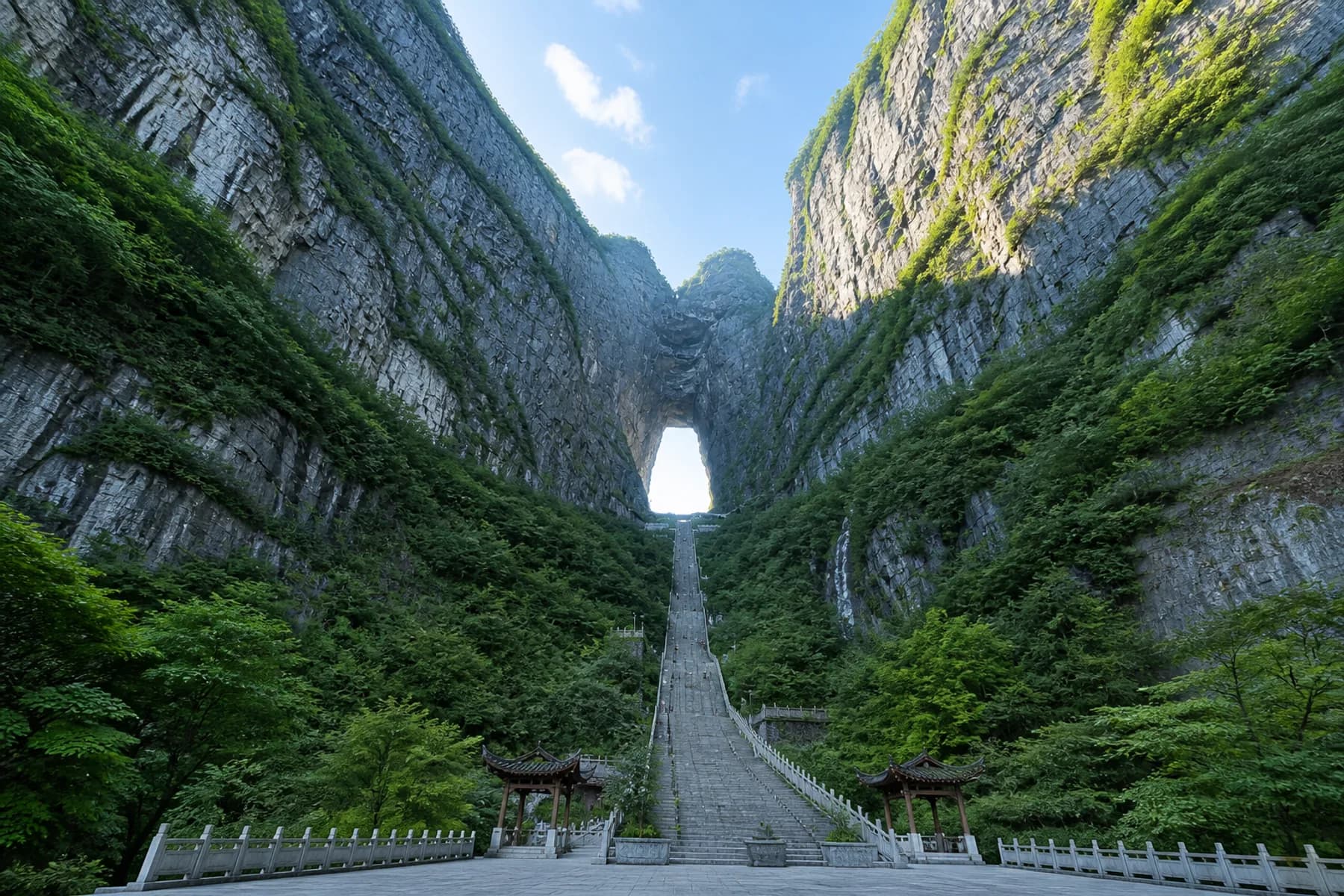
Zhangjiajie
Zhangjiajie is not one compact scenic area. A first trip usually combines three different travel zones: Tianmen Mountain (天门山) beside Zhangjiajie city, the vast Wulingyuan (武陵源) core reached through several gates, and—only if time allows—an onward Xiangxi town such as Furong (芙蓉镇). Most failed itineraries treat these as neighboring urban sights.
The most reliable plan is therefore route-first: book the scarce or route-specific products, assign one hotel base to each cluster, and let current weather and operating notices control the final mountain sequence.
Choose Your Route
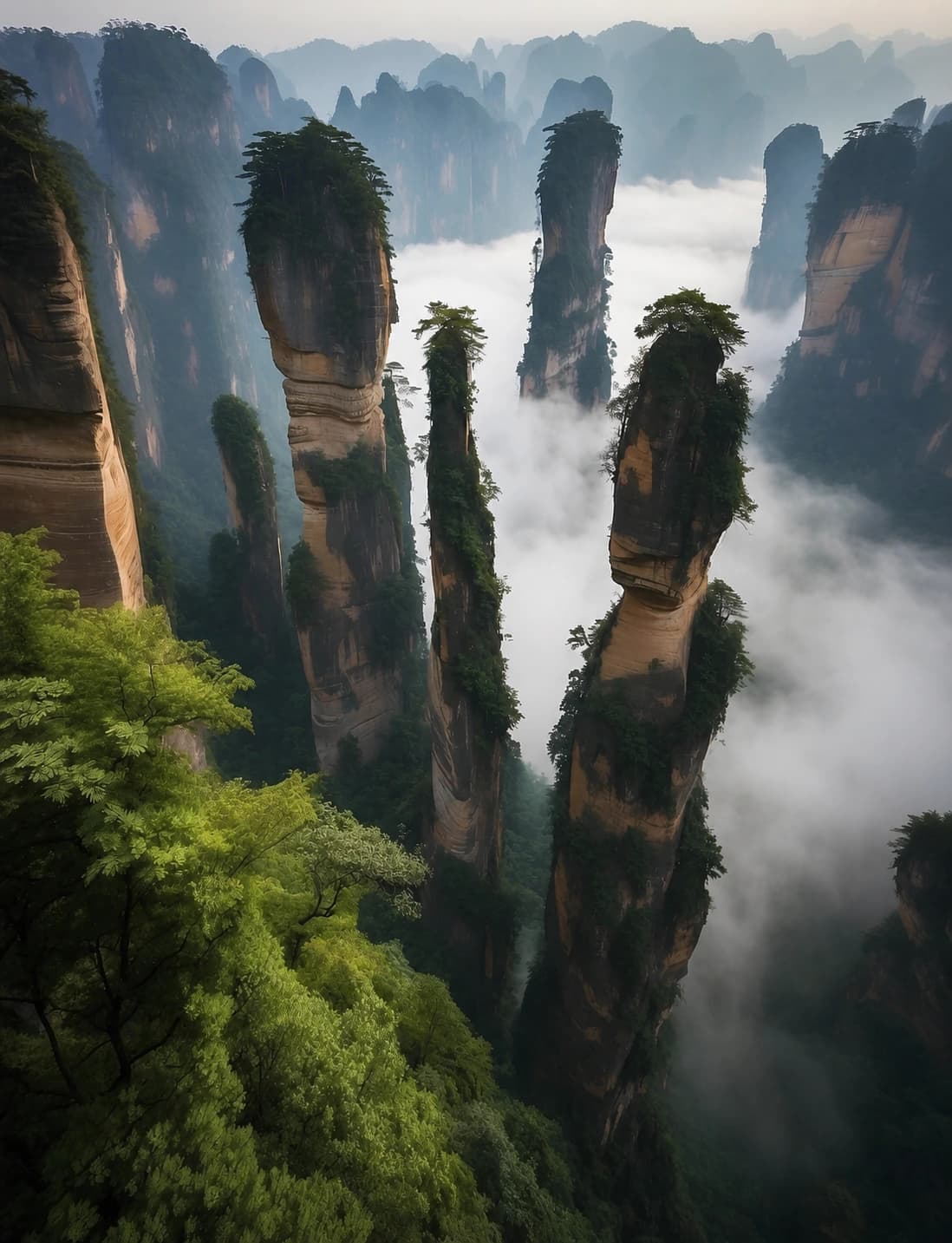
- Choose the three-day route for the complete mountain core: an East Gate upper-to-lower day, a South Gate forest-and-stream day, and a separate Tianmen day.
- Choose the four-day route if you also want Furong Town. The fourth day is an independent transfer and walking circuit—not an extra stop squeezed into Wulingyuan.
- With only two days, choose one full Wulingyuan route plus Tianmen. Trying to sample every famous viewpoint usually creates more queues and transfers than actual walking.
The Gate Logic That Prevents Backtracking
Wulingyuan East Gate: the practical multi-day base
Use Wulingyuan East Gate (武陵源东门) for the upper plateau sequence. A coherent first day runs from the Tianzi cableway and He Long Park toward Yuanjiajie, then uses the Bailong Elevator to descend before a valley finish such as Ten-Mile Gallery. Current scenic shuttles, queues and closures decide how much of the final section remains realistic.
South Gate: forest and stream rather than another plateau race
The South Gate, often labeled Zhangjiajie National Forest Park, is the cleaner start for Huangshi Village and Golden Whip Stream. Do not tell a driver only “National Forest Park”: show the Chinese gate name or an exact map pin. The stream can be shortened to an out-and-back when heat, rain or the last-shuttle window makes a through-walk unwise.
Tianmen: a separate city day and ticket system
Tianmen Mountain begins at its cableway base in Yongding District, not inside Wulingyuan. Its products can use different route letters and directions. Book the correct live product, then follow the route printed on the ticket and the day's weather instructions.
The current geopark route notice supports the East Gate upper-to-lower logic, while official closure notices remain more important than any saved itinerary.
Four Days With Furong Town
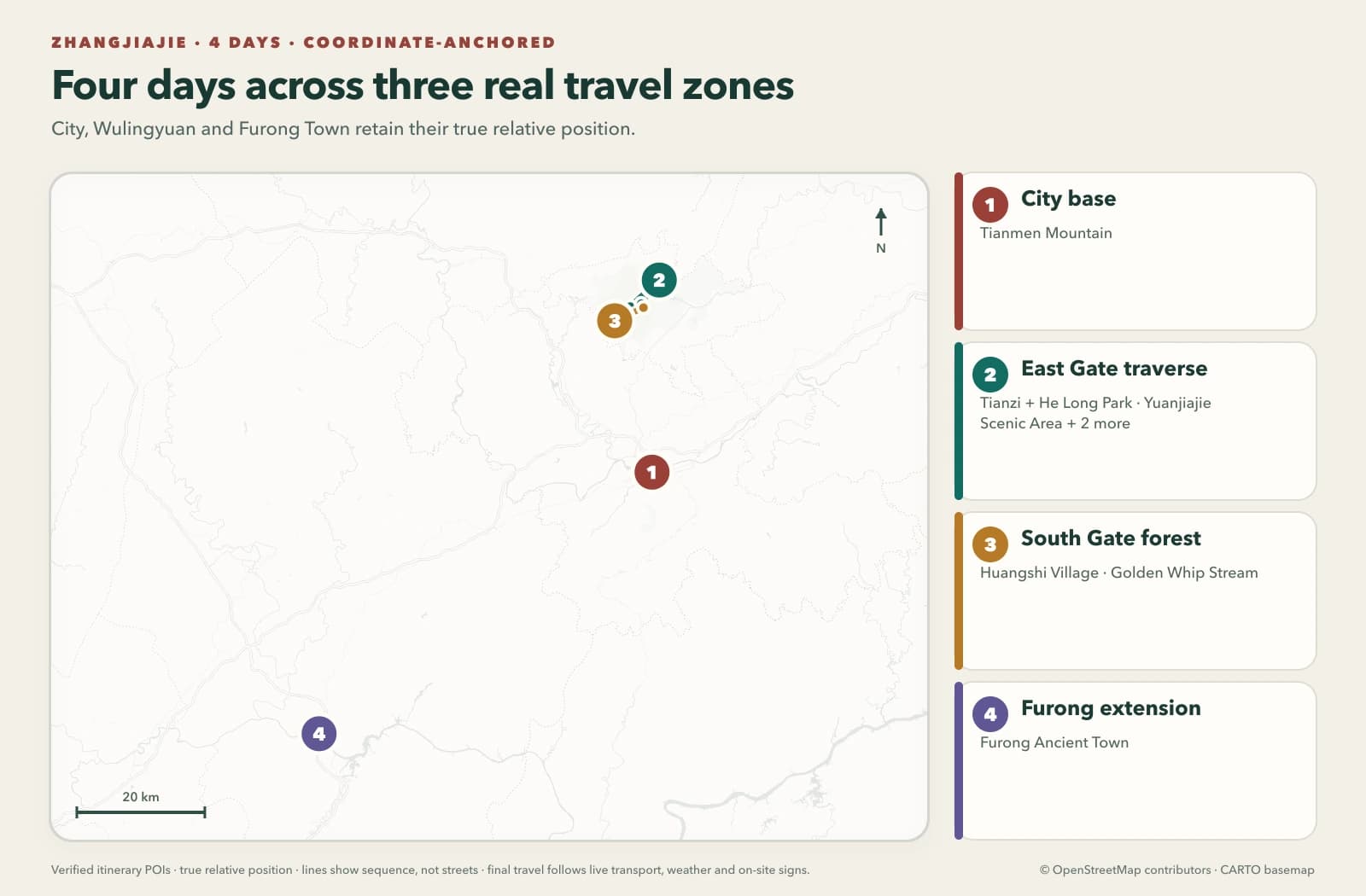
This overview preserves the real relative position of the verified itinerary map locations. Its straight lines show suggested visit order rather than streets or scenic shuttle geometry; current tickets, official notices and on-site signs still control the actual path.
- Day 1 — Tianmen from the city: keep your first night near the cableway or transport hub, complete the booked mountain route, then move to Wulingyuan if your energy and arrival time allow.
- Day 2 — East Gate upper-to-lower: Tianzi/He Long → Yuanjiajie → Bailong down → Ten-Mile Gallery.
- Day 3 — South Gate forest day: Huangshi Village → Golden Whip Stream, shortened when conditions require.
- Day 4 — Furong extension: a direct road-planning estimate from East Gate to the Furong ticket area is about 106.5 km / 1 hr 41 min. If using a live train connection, Furongzhen Railway Station is about 6 km / 14 min by car from the ticket area. These are Amap planning estimates, not promised transfer times.
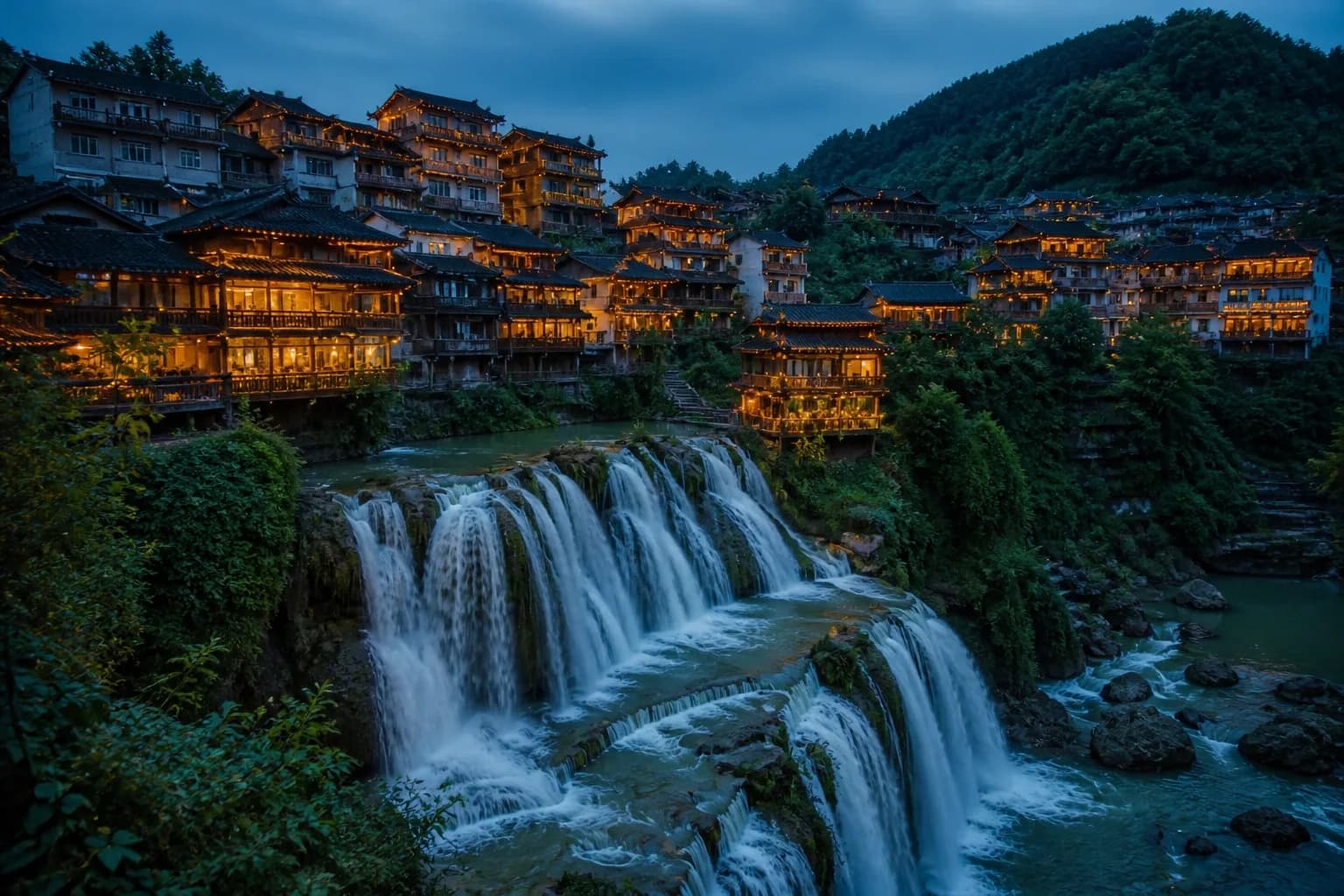
At Furong Ancient Town, allow a generous daylight circuit for the waterfall, wet stone lanes and stilt-house viewpoints. Staying overnight earns a slower evening and early morning; a day visit works when onward train inventory is better. Do not hard-code the light-up time or last departure.
What Makes Zhangjiajie More Than an “Avatar” Photo Stop
Read the stone columns
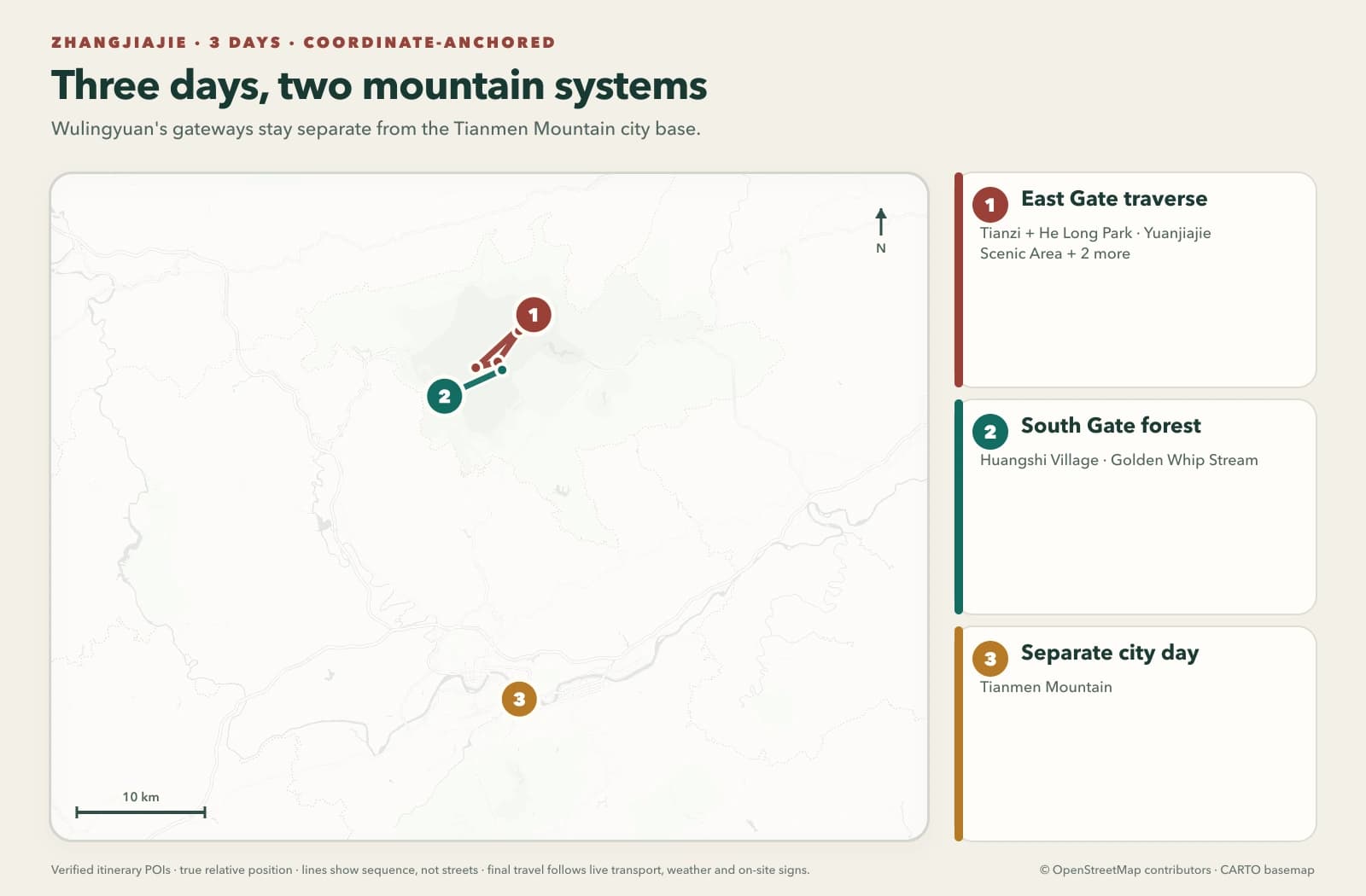
Wulingyuan's visual identity comes from tall quartz-sandstone pillars cut apart by erosion, fractures, water and long-term weathering. Fog can make the columns feel suspended, but it can also erase distant views. Treat clear panoramas as a weather bonus, not a guaranteed product.
Notice how elevation changes the day
The memorable contrast is not only between famous viewpoints. It is between exposed plateau edges, vertical transport, forested valley floors and the sound of water along Golden Whip Stream. A one-way upper-to-lower day reveals that change better than repeatedly returning to the same gateway.
Approach Tujia culture specifically
Look for building structure, food preservation, weaving and ordinary town life instead of treating every staged costume or souvenir as proof of one fixed “minority culture.” Ask before photographing people, and judge craft by the maker, material and process—not by a generic ethnic label.
Food: What to Try and How to Choose It
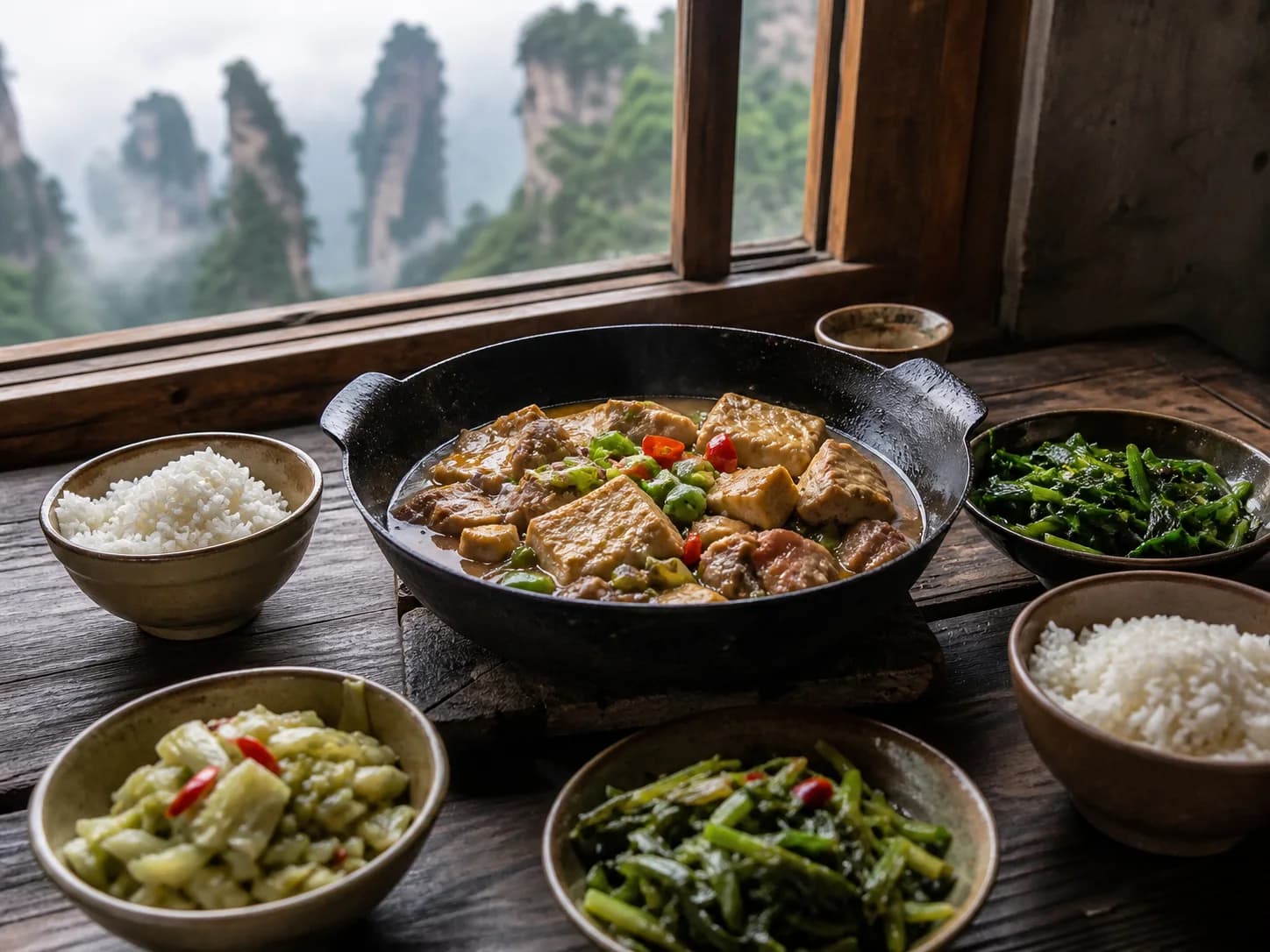
Sanxiaguo (三下锅) is a Zhangjiajie/Tujia-style mixed braise whose ingredients and format vary. Before ordering, ask whether the pot is dry or soupy, how spicy it is, which main ingredients are included and whether the quoted price is for the whole pot. That simple check is more useful than chasing one viral branch.
Also consider:
- Tujia smoked pork (土家腊肉): ask how salty and fatty the chosen cut is, and balance it with greens.
- Rock-ear dishes (岩耳): treat the fungus as one local ingredient, not a guarantee that every expensive version is rare or wild.
- Furong rice tofu (米豆腐): compare texture, chili and sourness; choose a busy, clean counter over a shop name preserved in an old post.
Eat your substantial dinner in Wulingyuan after the park rather than relying on limited in-park choice. Carry sealed snacks, but never expose food near macaques and never feed them.
Where to Stay
Yongding city / Tianmen cableway area
Best for a late arrival, early departure or Tianmen day. It gives easier access to the airport and urban rail stations, but creates a repeated transfer if both park days are in Wulingyuan.
Wulingyuan East Gate
The default base for two national-park days. Prioritize a hotel whose actual entrance is walkable to the gate or a dependable pickup point—not a listing that merely uses “Zhangjiajie National Forest Park” in its name.
South Gate
Good for a quieter forest-focused stay and an early Golden Whip/Huangshi start. Dining and onward transport are less flexible than in Wulingyuan town, so confirm the hotel's real access and transfer plan.
Furong Town
Worth one night when waterfall views after day-trippers leave matter more than a fast onward connection. Ask whether the property requires stairs, where a car can actually stop and whether luggage assistance is available; old-town lanes can be wet and stepped.
Compare live inventory on Trip.com hotels, giving preference to the base that removes the next morning's transfer.
Booking Order
- Reserve the correct live Zhangjiajie National Forest Park / Wulingyuan product, then confirm which scenic transport is included.
- Book the specific Tianmen Mountain product and check its route letter, direction and passport instructions.
- If adding Day 4, compare the exact Furong Town listing with your live train and transfer plan.
- Use Trip.com trains for live inventory rather than copying a timetable into the itinerary.
Tickets, cableways, elevators, scenic shuttles and weather closures change. Preserve queue slack and accept that the final viewpoint is the first thing to cut.
Getting There and Moving Between Bases
- Zhangjiajie Hehua Airport: most useful for the city/Tianmen base; check the live road transfer to your exact hotel.
- Zhangjiajie West Railway Station: the principal high-speed-rail decision point. A hotel labeled “Zhangjiajie” may still be far from Wulingyuan, so compare the final transfer before booking.
- City to Wulingyuan: treat this as a base transfer, not a quick hop between attractions. Confirm the current bus terminal, hotel transfer or legal ride-hailing pickup on arrival.
- Inside the park: public-road taxis do not replace the scenic shuttle, cableway and elevator network. Never create an itinerary that drives directly between upper plateau stops.
Weather, Mobility and Safety
- Check the forecast and official notices each morning. Rain, ice, wind or maintenance can change the workable route.
- Use shoes with wet-stone grip and carry a compact rain layer. Mountain temperatures and exposure can differ from the city.
- Cableways and elevators save elevation, not all stairs. Travelers with limited mobility should choose fewer nodes and confirm current step-free access directly.
- Do not feed macaques or carry exposed food. Keep distance, secure loose belongings and follow staff instructions.
- Never cross a barrier for a photograph. Fog makes edges and wet surfaces harder to judge.
Major Sights to Compare
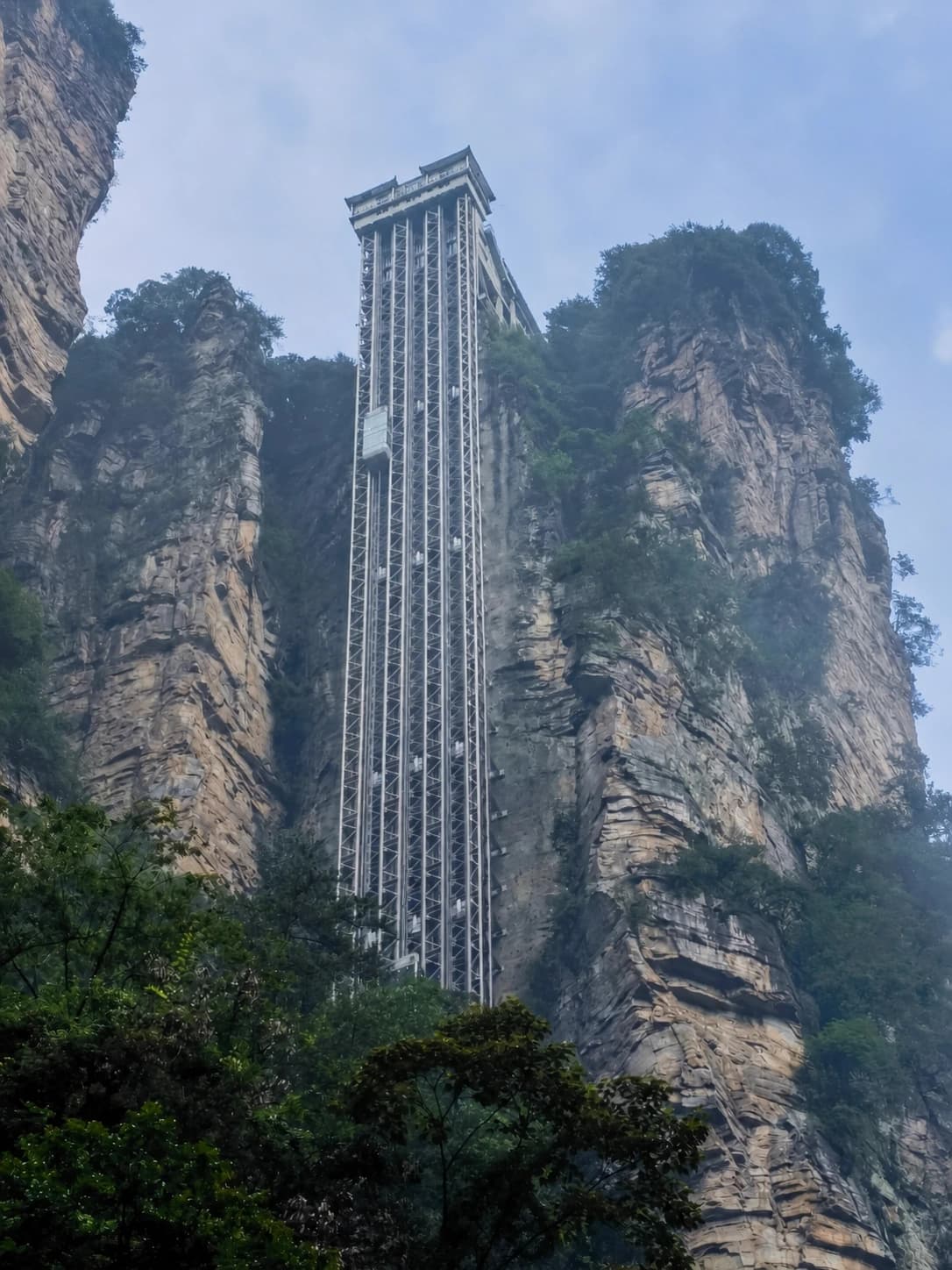
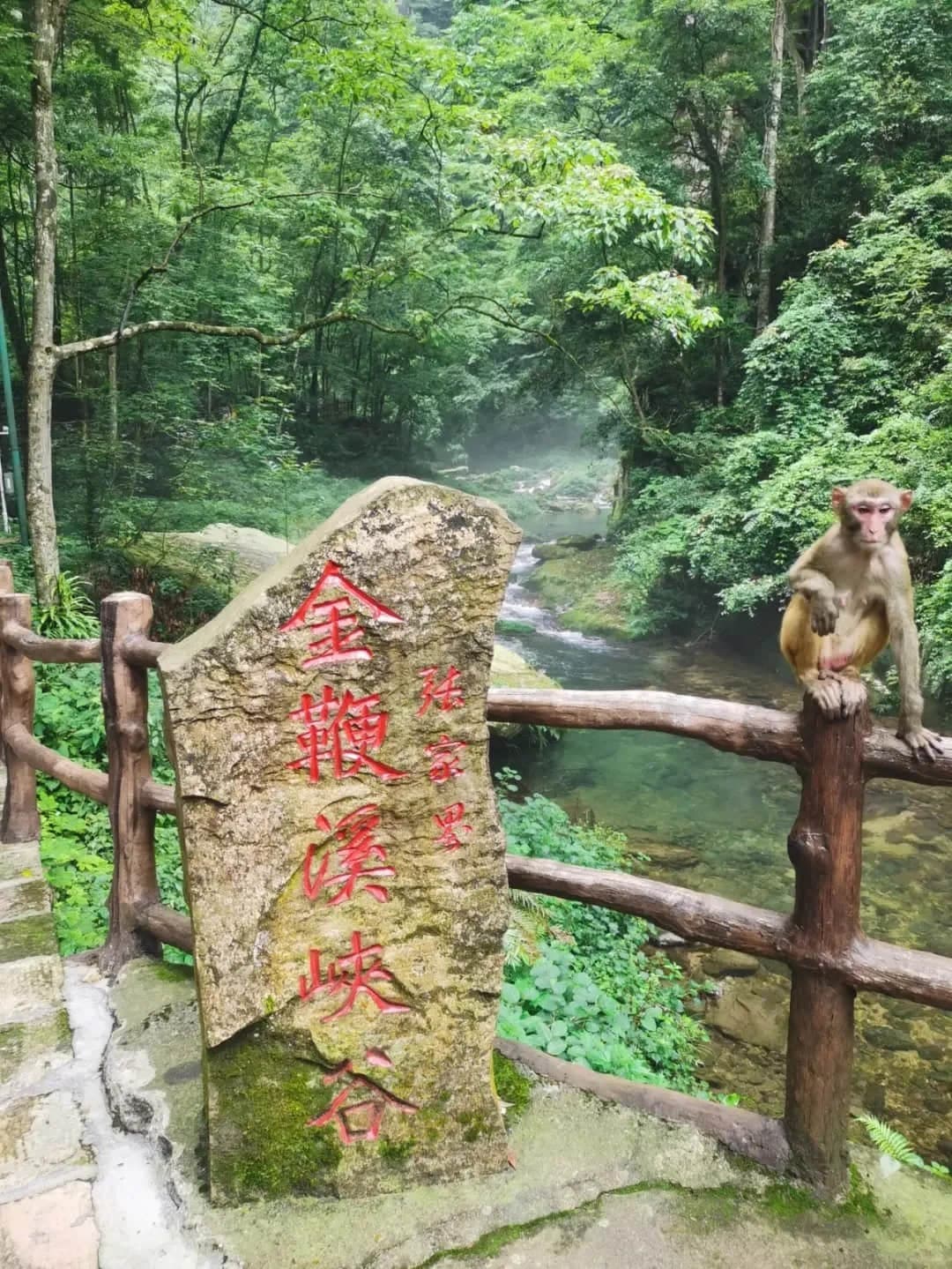
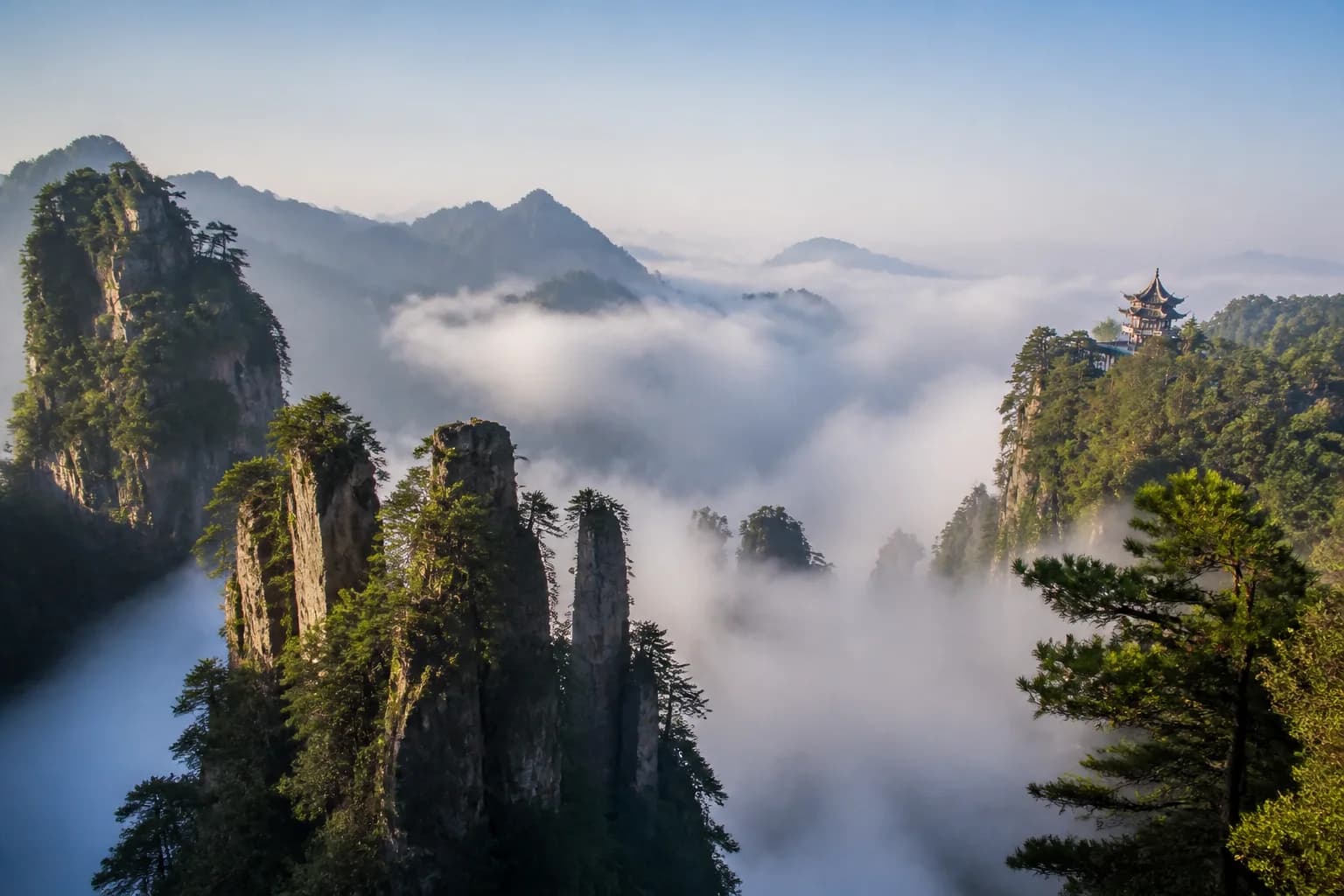
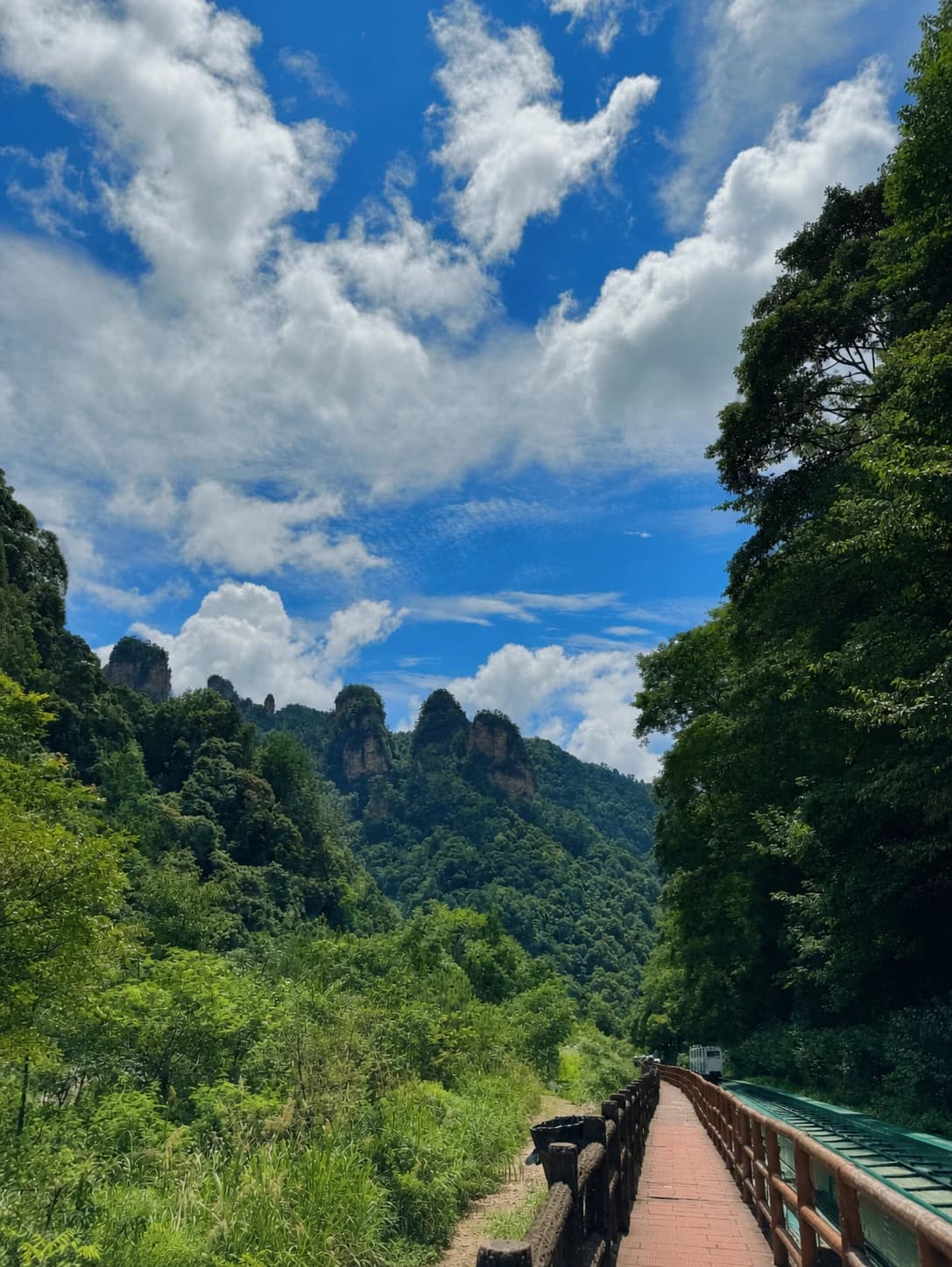
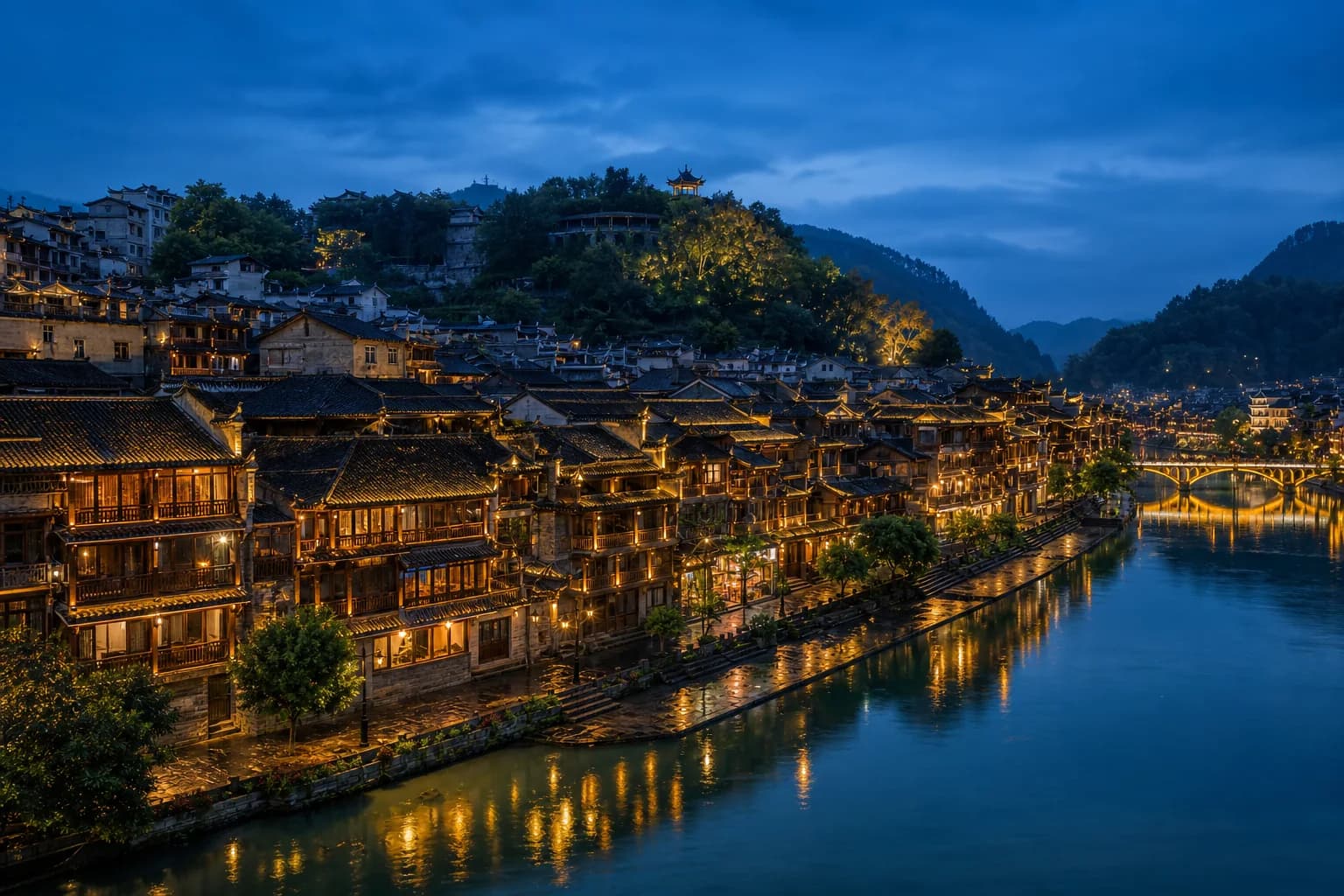
Choose by route role rather than fame: Tianmen is a city-based mountain day; Yuanjiajie and Bailong form an upper-to-lower connection; Huangshi and Golden Whip create a forest day; Furong and Fenghuang are onward Xiangxi extensions.