Huangshan or Zhangjiajie?
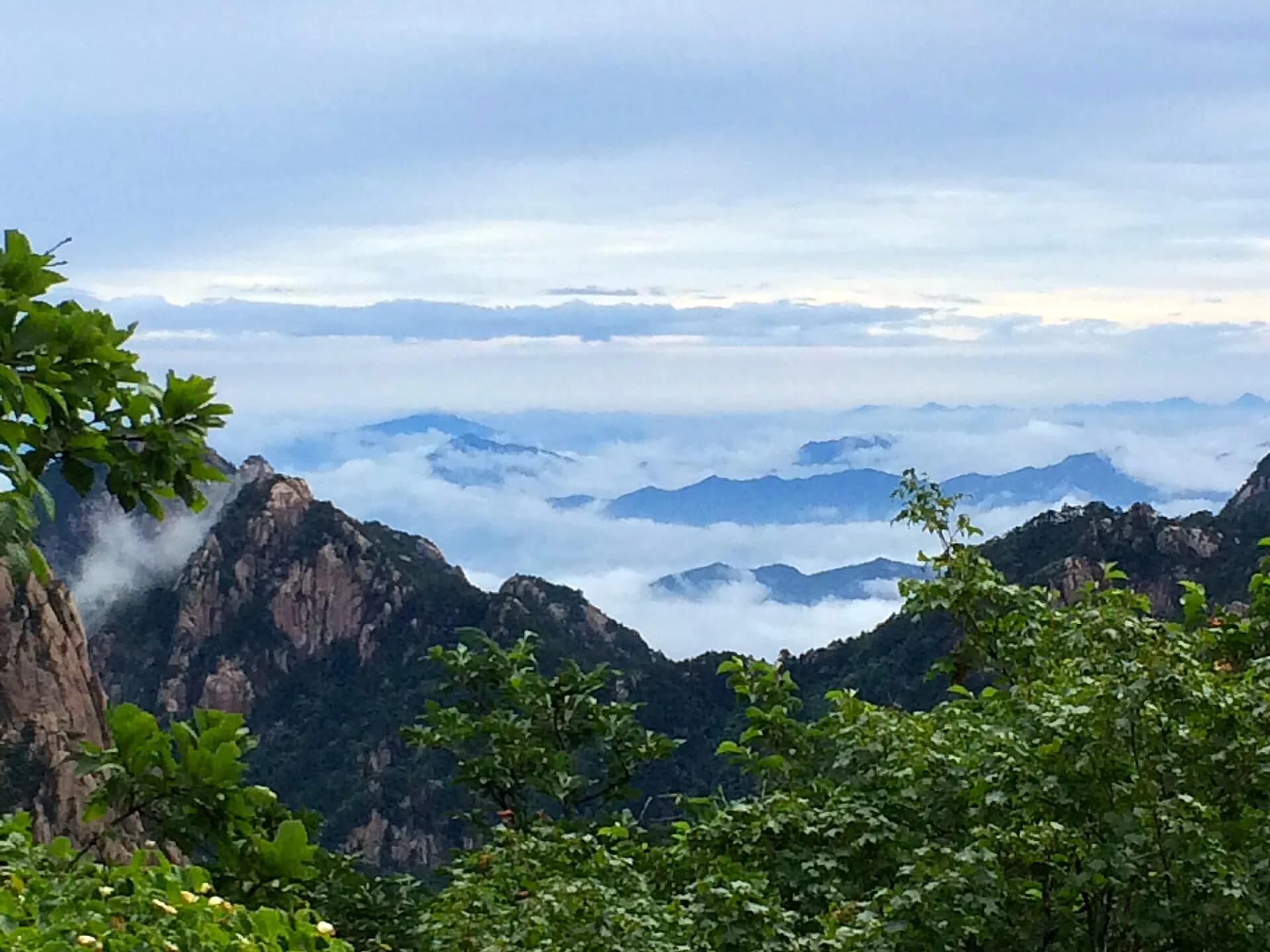
Choose Mount Huangshan for granite peaks, sculptural pines, sunrise/cloud-sea culture and a true stair-mountain experience. Choose Zhangjiajie for vertical sandstone pillars, elevators, cableways and several large scenic systems that can be divided across days.
Decision table
| Priority | Mount Huangshan | Zhangjiajie |
|---|---|---|
| Visual language | granite, pine, cloud sea, ridge compositions | pillar forests, ravines, cliff paths |
| Ideal stay | 2 mountain days + arrival/departure buffer | 3 scenic days |
| Effort | relentless stone steps even with cableway | long walks/transfers; route-dependent steps |
| Overnight | summit night adds sunrise and pace | Wulingyuan base; city base for Tianmen |
| Weather risk | cloud can create or erase views | dense fog can hide pillar scenery |
| Best fit | hikers, landscape tradition, sunrise seekers | spectacle, families with route cuts, regional touring |
Huangshan is the harder continuous climb
Cableways remove the full ascent, not the summit stairs. Recent low-fitness travelers report that published walking times can expand dramatically and that a summit night makes the route more humane. Choose one direction, skip optional canyon/peak detours when tired and protect the knees on descent.
Stay on the mountain only when sunrise, sunset or pacing justifies the cost. Otherwise use Tangkou and take an early cableway day, accepting that a full summit loop is still strenuous.
Zhangjiajie is more modular, not effortless
Wulingyuan's elevators, shuttles and cableways allow route cuts, but transfers, queues and walking between viewpoints accumulate. Yuanjiajie is a concentrated pillar-view chapter; Yangjiajie can be much harder; Golden Whip Stream can be shortened as an out-and-back. Tianmen Mountain is a separate city-side day.
This modularity makes Zhangjiajie easier for mixed groups, but only if the group deliberately drops sections. A “see everything” itinerary can exceed Huangshan in total fatigue.
Huangshan in practice: the two classic plans
One day, about eight hours on the mountain
Recent hikers strongly favor going up by the Yuping cableway (front mountain) and down by the Yungu cableway (back mountain):
| Time | Stage |
|---|---|
| 07:00 | Yuping cableway up |
| 07:20 | Welcoming Guest Pine, before the crowds |
| 07:50–10:00 | Yuping Tower → Hundred-Step Cloud Ladder → Aoyu Peak, the hardest stretch |
| 10:00–11:00 | Tianhai → Bright Summit (光明顶) |
| 11:00–13:30 | Flying Rock and Paiyun Pavilion |
| 13:30 | Beihai and Monkey Watching the Sea |
| 14:30 | Black Tiger Pine → Shixin Peak → Baie Ridge |
| About 15:40 | Yungu cableway down; usually little queue |
Why this direction works.
- Best scenery while you are fresh: the front-mountain section has the most dramatic scenery and the narrowest paths, so you tackle it with fresh legs and before tour groups fill it.
- Safer on the steep steps: the steepest steps are safer climbed than descended.
- Easier finish: the back mountain is gentler and makes a quick walking finish.
Hikers who went the other way said the climb from Yungu Temple uses up the morning on ordinary scenery. They then had to rush the highlights.
Checkpoints. Use these to decide when to cut the route:
- Bright Summit by about 10:30
- Beihai by 13:30
- Baie Ridge by 16:00
The last cableways run around 17:00.
Costs. One hiker's day:
| Item | Cost |
|---|---|
| Admission | ¥190 (¥150 in winter) |
| Cableway | About ¥80–90 each way |
| Shuttle bus | ¥19 each way |
| Mountain transport subtotal | About ¥390 |
| Whole day, including food and the night before | Roughly ¥600–800 |
Sleep in Tangkou the night before, close to the transfer center.
Two days with a summit night
This adds sunrise, sunset, the West Sea Grand Canyon (西海大峡谷) and Tiandu Peak.
- Tiandu Peak: visits must be reserved about two days ahead, and Lotus and Tiandu peaks close in rotation for rest periods.
- West Sea sightseeing tram: it stops around 17:00, so plan the canyon loop early or face a long climb out.
- Summit hotels: basic and very expensive at peak times. A view room at Guangmingding hotel cost over ¥2,000 in September 2026.
- Bags and food: leave luggage in Tangkou and carry snacks, because summit food is limited and costly.
How tiring it is. One family logged about 40,000 steps over the two days. A relative in their late fifties managed the West Sea canyon on day one but could not climb Tiandu on day two.
Zhangjiajie in practice
The national forest park ticket allows re-entry over several days. Split the scenic area:
- Golden Whip Stream: an easier valley walk.
- Elevator and viewpoint day: Bailong Elevator to Yuanjiajie, then Tianzi Mountain.
- Tianmen Mountain: a separate day from the city.
See the Guilin or Zhangjiajie comparison for the full three-day plan.
Weather and timing
Both require a forecast and fallback. Huangshan's changing cloud can produce excellent layers, while rain makes stone steps slick and cold. Zhangjiajie fog can reduce a viewpoint to white space. Add a flexible morning, avoid non-refundable promises of sunrise/cloud sea and check current cableway or trail closures.
Route connections
Huangshan pairs with Hongcun, Huizhou villages, Hangzhou or Shanghai. Zhangjiajie pairs with Furong, Fenghuang, Changsha or Chongqing. Do not select the mountain independently from the onward route when time is short.
Final verdict
Pick Huangshan for a compact, demanding mountain pilgrimage. Pick Zhangjiajie for a multi-day scenic system with more mechanical route choices. Travelers who dislike stairs should not interpret “cableway available” as “minimal walking” at either destination.