Chongqing to Zhangjiajie, Furong and Fenghuang: a realistic 7-day rail route
The sensible order is Chongqing → Zhangjiajie → Furong Town → Fenghuang. It follows the rail corridor, keeps the two ancient towns after the mountain days, and avoids returning to Zhangjiajie with luggage. The route needs 7 days and 6 nights after you leave Chongqing if you want Tianmen Mountain, two proper Wulingyuan days, Furong after dark and a quiet Fenghuang morning.
If Chengdu is your western starting point, add two full Chengdu days plus one Chengdu–Chongqing rail day. The complete 10-day Chengdu–Chongqing–Zhangjiajie–Fenghuang itinerary keeps that extension visible instead of pretending the fast train is a sightseeing day.
The six nights are not all in one place:
- One night in Zhangjiajie city for Tianmen Mountain.
- Three nights in Wulingyuan for two full national-park days and an unhurried departure.
- One night in Furong Town for late-afternoon light and the waterfall after dark.
- One night in Fenghuang for the illuminated river and an early-morning walk.
The minimum route worth doing is 6 days and 5 nights. Cut Tianmen Mountain, go directly from Zhangjiajie West station to Wulingyuan on Day 1, and preserve the two park days. Do not remove a park day simply to keep both mountain areas. An 8-day, 7-night version adds either a rain buffer in Zhangjiajie or a second Fenghuang night.
This is a transport-and-base guide. Use the Zhangjiajie destination guide for the mountain-and-gate system and the Xiangxi destination guide to compare Furong, Fenghuang and other regional bases. Zhangjiajie National Forest Park is a large gate-and-shuttle system, Furong is a compact waterfall town, and Fenghuang is a living river town. Their map icons may look close; their useful visiting patterns are not.
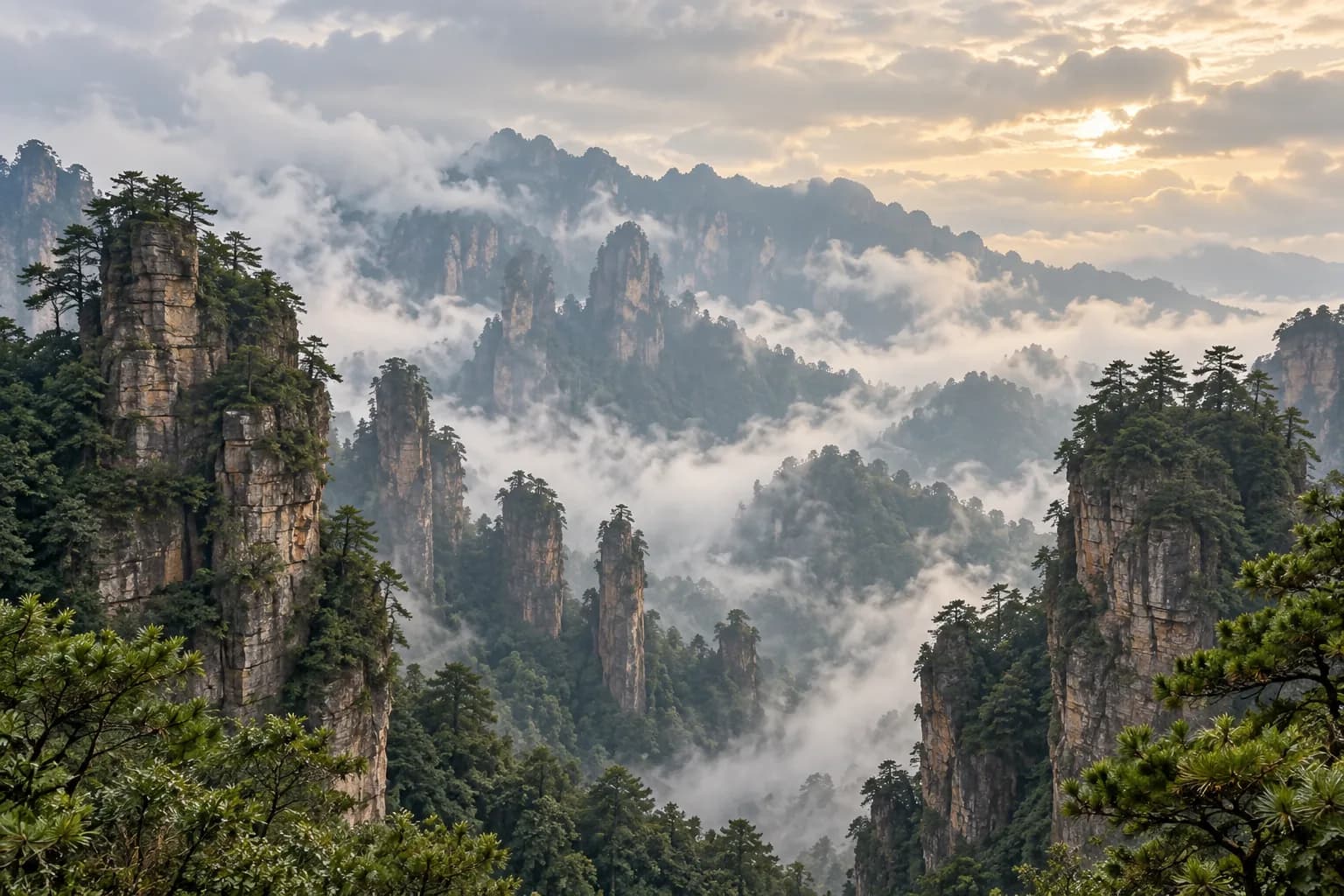
Cloud can conceal an entire viewpoint and reveal it again within minutes. The itinerary therefore gives Zhangjiajie's mountains full days rather than treating one forecast icon as a reason to rush or cancel.
Decide whether this route fits before booking it
Choose this route when all four statements are true:
- Chongqing is already on your trip, or you can reach Chongqing East without losing most of the departure day.
- Zhangjiajie's mountains matter enough to receive three full sightseeing days: Tianmen plus two in Wulingyuan.
- You are willing to change hotels between Zhangjiajie city and Wulingyuan instead of commuting twice.
- You want Furong and Fenghuang at the times when they are most rewarding—late afternoon, evening and early morning—not only during a midday transfer.
Choose a shorter route when the old towns are secondary. Zhangjiajie plus one town is much stronger than Zhangjiajie plus two rushed towns. Keep Furong for a compact waterfall-and-stilt-house stop directly on the rail line. Keep Fenghuang for a larger old-town stay, riverside atmosphere and more time wandering beyond one scenic circuit.
Reverse the route—Fenghuang → Furong → Zhangjiajie → Chongqing—when you enter western Hunan through Huaihua or continue to Chongqing afterward. The daily logic remains the same. The route is directional because the stations form a useful sequence, not because the scenery only works one way.
The 7-day, 6-night plan
Day 1: Chongqing East to Zhangjiajie West, then stay in Zhangjiajie city
Use the morning to cross the regional distance, not to attempt a mountain attraction. The 2025 Chongqing East–Qianjiang opening shortened the fastest Chongqing–Zhangjiajie rail journey to about 2 hours 02 minutes, according to the National Railway Administration. Current inventory still varies by date and departure station, so a useful planning range is about 2–4 hours.
Most convenient fast services use Chongqing East (重庆东) and Zhangjiajie West (张家界西). Do not book by city name alone. Chongqing has several major stations, and a transfer across the city can erase the benefit of a fast train. Match the station printed on the issued ticket, arrive with the original passport used for booking and leave a wide first-day margin.
Compare live China train inventory on Trip.com after choosing the exact station pair. A listed departure time is not a permanent timetable; recheck it in the booking app and on the ticket before travel.
At Zhangjiajie West, go to a city hotel near the Tianmen Mountain lower cableway or central Zhangjiajie, not automatically to Wulingyuan. The city base protects Day 2 from a long early transfer. Keep Day 1 light: check in, eat, collect any mountain-ticket confirmation and sleep.
If the train arrives late, do not convert the evening into a speculative Tianmen visit. Tianmen products have route letters, timed access and operating constraints. A rushed late entry can leave you with the least useful direction and no weather margin.
Day 2: Tianmen Mountain, then move once to Wulingyuan
Tianmen Mountain rises immediately south of the city but is separate from Zhangjiajie National Forest Park. Give it a day from its city cableway base. Buy the exact route and direction shown for your date, then follow current cableway, shuttle, escalator and weather notices.
Start early enough to absorb ticket checks and queues. On a clear day, prioritize exposed cliff and summit sections while visibility holds. In fog, slow down rather than trying to chase every viewpoint. Cloud is part of the mountain; wind, lightning or operating suspensions are reasons to change the plan.
After descending, retrieve your stored luggage and move to Wulingyuan near the East Gate. This is the one intentional hotel move inside Zhangjiajie. A late-evening arrival is acceptable because Days 3 and 4 begin from the park base.
If you are booking through an international platform, check the live Trip.com Tianmen Mountain product for the named route, direction, entry time, passport fields and cancellation terms. A generic “Tianmen ticket” label is not enough.
Day 3: Wulingyuan plateau day—Tianzi Mountain, Yuanjiajie and one descent
Enter through the correct Wulingyuan East Gate / Sign Gate (标志门). A coherent first park day is East Gate → scenic shuttle → Tianzi Mountain cableway → upper viewpoints → plateau shuttle → Yuanjiajie → Bailong Elevator down → valley shuttle back toward the East Gate.
The sequence matters more than the number of stops. Cableway and elevator rides are short, but their queues are not. Keep at least one hour of slack before the final useful shuttle window and cut the last viewpoint before you risk being stranded on the wrong side of the park.
Do not add Golden Whip Stream as a full walk after a long plateau loop. The valley deserves separate time. The four-day Zhangjiajie itinerary explains the gate-specific order in more detail.
For advance purchase, inspect the Trip.com Zhangjiajie National Forest Park listing, but confirm whether the selected product includes only admission or also a cableway, elevator, sightseeing vehicle or timed component. The live operator rule controls.
Day 4: South Gate, Huangshi Village and Golden Whip Stream
Use a different park entrance to avoid repeating the same transfer. A practical second day begins at the National Forest Park South Gate, climbs Huangshi Village by cableway for a summit loop, then returns to the valley for Golden Whip Stream.
Choose the stream length according to the final shuttle, heat and energy. A shorter out-and-back is legitimate. The full valley walk is not a tiny add-on. Keep food sealed, never feed macaques, and give them space; a loose snack bag is more likely to create trouble than a missed photo.
Return to the same Wulingyuan hotel. This third Wulingyuan night prevents a tired evening race to Zhangjiajie West and keeps the next morning flexible. If weather ruined Day 3, use Day 4 for the better-visibility plateau circuit and shorten the valley section. If both days have low cloud, accept that the park will be atmospheric rather than panoramic.
Day 5: Wulingyuan to Furong Town by station transfer and short train
This day contains three separate movements:
- Wulingyuan hotel → Zhangjiajie West station.
- Zhangjiajie West → Furongzhen station (芙蓉镇站) by train.
- Furongzhen station → the scenic town and your hotel.
The names “Zhangjiajie” and “Furong” hide the road transfers. AMap's dated road model puts Wulingyuan East Gate about 26.3 km / 28 minutes by car from Zhangjiajie West, with an estimated taxi cost around CNY 74 before traffic, waiting or platform-specific charges. Allow 60–90 minutes hotel door to station door, more on holidays or in rain.
Current direct trains from Zhangjiajie West to Furongzhen can take only about 23–35 minutes, but do not build a tight connection around that short ride. AMap places Furongzhen station about 5.9 km / 14 minutes by car from the scenic area, with a modelled taxi estimate around CNY 14. Recent travellers also report hotel pickups and low-cost local shuttles. Ask your hotel for the current pickup point, price and waiting policy before arrival; do not assume every room includes a free transfer.
Arrive by mid-afternoon, leave the suitcase at the hotel and enter the Furong Ancient Town guide circuit with a small bag. Start above the falls, descend through stone lanes, view the waterfall and stilt houses from multiple levels, and return after the lights come on if conditions are safe.
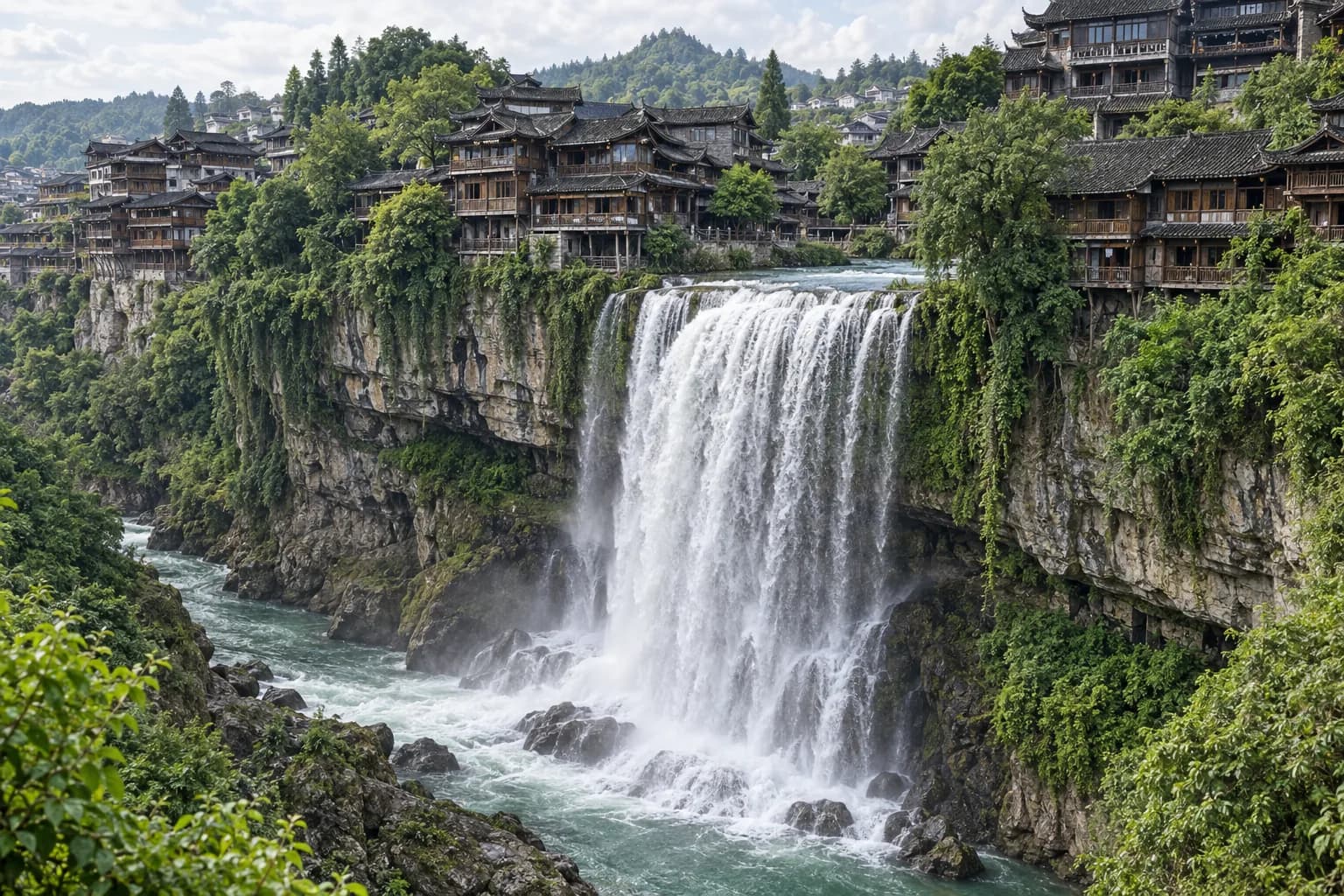
The scene explains why Furong is placed after the mountain days: it is compact enough for an afternoon arrival, but its waterfall, steep lanes and evening light deserve more than a station stop. Water volume and colour change with rainfall, and lower paths can become slippery or close. Treat the photograph as atmosphere, not a promise of identical flow or access.
Check the current Furong Town product on Trip.com for the exact date, admission components, re-entry terms and cancellation rule. Do not rely on an old screenshot of a ticket price.
Day 6: slow Furong morning, then rail to Fenghuang
Use the first hour after breakfast for the viewpoints you could not enjoy in the evening. The town is easier to read before day groups fill the narrow steps. Do not attempt a second complete waterfall circuit with luggage; return to the hotel, collect bags and leave a station buffer.
Current Furongzhen–Fenghuanggucheng trains commonly take about 27–40 minutes. The rail ride is shorter than the total hotel-to-hotel transfer. At the destination, confirm that the ticket says Fenghuanggucheng (凤凰古城), then choose between the official high-speed rail shuttle and a legal taxi.
AMap's dated model puts Fenghuanggucheng station about 10.7 km / 18 minutes by car from the central old-town POI, with an estimated taxi cost around CNY 27 before traffic or drop-off restrictions. Its current transit model finds high-speed rail shuttle Line 2 toward Nanhuali, about 53 minutes including walking and a CNY 7 fare. Current stops, last service and the best line for your hotel can change, so show the driver or shuttle staff the hotel's Chinese name and exact pin.
Spend late afternoon on the Fenghuang Ancient Town guide. The historic streets and riverside public realm are free to enter; individual compounds, museums, cruises and performances may charge separately. Walk one bank before dark, cross a legal bridge, then return along the opposite bank as lights reflect on the Tuojiang.
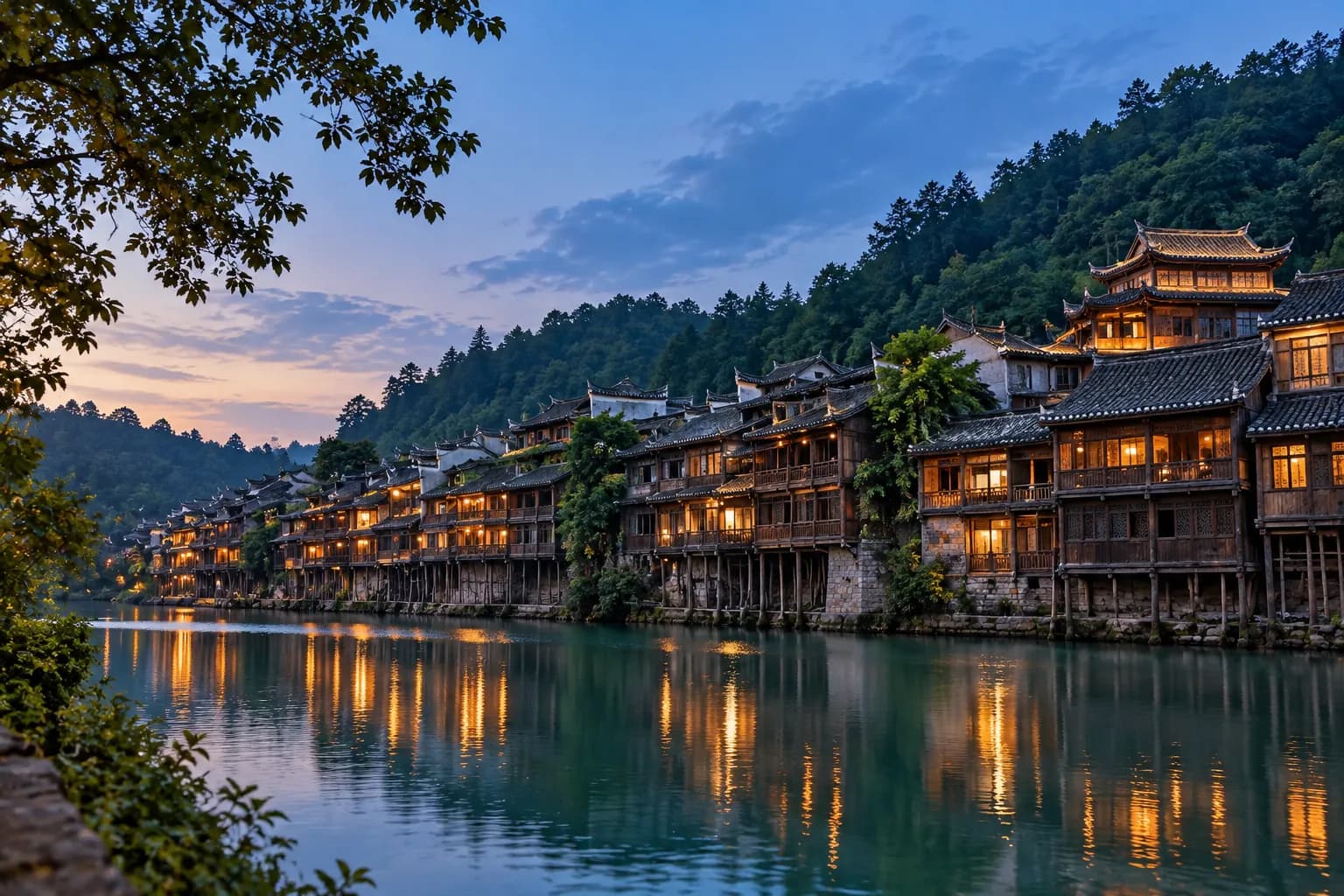
Do not make the night walk your only Fenghuang experience. Evening lighting can be vivid and crowded; the quieter morning shows timber structures, lanes, residents and the river without the same commercial intensity.
Day 7: Fenghuang before breakfast, then continue onward
Walk between roughly first light and breakfast rather than racing to every named bridge. Choose one compact loop near your hotel, keep voices low in residential lanes and avoid using doorways as portrait sets. Return for luggage and continue to your next city through Fenghuanggucheng station or Huaihua South, depending on the live itinerary.
If Fenghuang is your trip's emotional endpoint, stay a second night. Use the extra day for slower neighbourhoods, an optional museum or a properly selected Tuojiang cruise. If considering the Trip.com Tuojiang cruise listing, verify the wharf, route, day or night slot, included items, document fields and cancellation conditions. The cruise is optional; the town does not require it to be worthwhile.
Station transfers you must budget separately
| Transfer | Planning evidence | What to do |
|---|---|---|
| Chongqing hotel → Chongqing East | Depends on your district and operating metro route | Map it from the actual hotel. A morning taxi across Chongqing can take far longer than the rail ride suggests. |
| Zhangjiajie West → city/Tianmen base | Separate urban transfer | Use the hotel's Chinese address; do not ask for “Zhangjiajie mountain.” |
| Wulingyuan East Gate → Zhangjiajie West | AMap road model: 26.3 km / 28 min, taxi estimate about CNY 74 | Budget 60–90 min door to door and add holiday/weather margin. |
| Furongzhen station → Furong scenic area | AMap road model: 5.9 km / 14 min, taxi estimate about CNY 14 | Arrange hotel pickup or use the official local queue; confirm whether waiting to fill is involved. |
| Fenghuanggucheng station → old town | AMap road model: 10.7 km / 18 min, taxi estimate about CNY 27; Line 2 model about 53 min / CNY 7 including walking | Choose by luggage, arrival time and hotel pin. Narrow one-way streets can lengthen the final approach. |
These are planning estimates recorded in September 2026, not fare guarantees. Weather, road controls, holiday demand and the exact hotel entrance can change them. The linked AMap pins are useful for showing the intended endpoint:
- Zhangjiajie West station
- Wulingyuan East Gate
- Furongzhen station
- Furong Town scenic area
- Fenghuanggucheng station
- Fenghuang Ancient Town
Where to sleep, and why the exact pin matters
Zhangjiajie city: one night near the Tianmen lower station
Choose a property that accepts your passport, stores luggage after checkout and can explain the walk or taxi to the lower cableway. “Near Zhangjiajie” is too broad. A hotel convenient for Tianmen may be inconvenient for Wulingyuan, and vice versa.
Wulingyuan: three nights within an easy East Gate transfer
The goal is to reach the East Gate without negotiating a long morning taxi, then keep the same room after both park days. Confirm the walking route, not only the straight-line distance. Wide roads, barriers and a hotel on the wrong side of the river can turn a nearby pin into a tiring approach.
Furong: one night near a usable entrance, with pickup confirmed
The prettiest “inside scenic area” room may require steep stone steps. Ask four questions before paying:
- Where exactly does the station pickup meet?
- Is pickup included, paid or conditional on arrival time?
- Can staff carry luggage from the vehicle drop-off?
- Is the room beside nightlife, a waterfall-facing public path or a quiet rear lane?
Compare Furong Town hotels on Trip.com by exact map pin, pickup terms, passport acceptance, room access and recent noise reviews—not by the hero photo alone.
Fenghuang: one night at the edge of the core for sleep and luggage
A direct river view is attractive, but a room beside the busiest bar section may stay loud deep into the night. Wooden buildings also transmit footsteps easily. For most travellers carrying suitcases, the best compromise is near the old-town edge or a vehicle-accessible lane, within an easy walk of the river.
Compare Fenghuang hotels on Trip.com after checking the actual entrance, stairs, vehicle drop-off, river-noise comments and whether the property accepts international guests. A hotel marker in the centre of the old town does not prove a taxi can reach its door.
The luggage strategy that keeps the route workable
Use a rolling suitcase only if you are prepared to leave it at hotels and stations. Furong and Fenghuang have stone paving, stairs, narrow bridges and vehicle restrictions. A suitcase that is easy in a station concourse becomes difficult during a 15-minute old-town walk.
Pack the route around four rules:
- Carry a small mountain daypack with water, rain layer, passport, power bank and sealed food.
- Keep the large bag at the hotel on mountain days; never drag it through Wulingyuan.
- Confirm storage and pickup in writing with the Furong and Fenghuang hotels before arrival.
- Put medicines, passport and one change of clothes in the daypack in case the large bag is stored out of reach during a transfer.
Do not plan a Furong “station layover” unless you have a confirmed luggage solution. The station is outside the scenic town, and the visit requires two road transfers plus admission and stairs. A three-hour gap between trains is not three hours at the waterfall.
Weather and crowd fallbacks
If Zhangjiajie is foggy
Low cloud can improve close views while erasing long panoramas. Keep the park day, but favour forest, stream and near-field rock detail. Use Golden Whip Stream or a shorter valley route when the upper plateau is fully closed in. If the next day is clearer, move Yuanjiajie and Tianzi Mountain to it.
Do not promise that fog will lift at a particular hour. Recent visitors report rapid changes, but a personal pattern is not a forecast. Follow live visibility, lightning, wind and cableway notices.
If rain is heavy in Furong
Expect slippery stone, spray and potentially muddy water. Use shoes with grip, protect electronics and obey any closure around the lower waterfall path. The town still has roofed lanes and elevated views, but do not descend simply because a saved video showed the path open.
If Fenghuang is crowded
Keep the evening short and use the early morning. Walk away from the most illuminated central bridge, cross at a legal public bridge and follow the opposite bank. A second night is more useful than trying to force empty photographs during the busiest hour.
During national holidays
Book trains and timed mountain products as soon as their official sales windows open, choose refundable accommodation where possible and add a full transfer buffer. The route's weak points are not the train running time; they are taxi queues, scenic-entry checks, cableway lines and narrow old-town lanes.
What cannot be treated as a day trip
Chongqing to Zhangjiajie National Forest Park and back
Do not do it. Even the fastest rail journey still leaves urban transfers at both ends, and Zhangjiajie West is not at the park gate. The mountain needs a full operating day, not the hours left between two trains.
Tianmen Mountain and a full Wulingyuan circuit on the same day
They are separate mountain systems with separate entry logic. Combining them produces transport, queue and closure risk without giving either place a coherent visit.
Zhangjiajie, Furong and Fenghuang in one sightseeing day
The short intercity train times make this look possible on a booking screen. Hotel checkout, station security, train buffers and station-to-town transfers make it a luggage relay. You may pass through all three names; you will not meaningfully visit all three.
Furong and Fenghuang as two equal day stops
This is technically possible only when you accept Furong as a compact three- or four-hour stop, have confirmed luggage handling and give up its evening. It is a useful emergency compression, not the recommended trip.
How to cut or extend the route intelligently
For 6 days / 5 nights, cut Tianmen Mountain and take Day 1 directly from Zhangjiajie West to Wulingyuan. Keep two park days, one Furong night and one Fenghuang night.
For 5 days / 4 nights, keep Zhangjiajie plus only one old town. Use three nights around Zhangjiajie and one in Furong or Fenghuang. If this is your first visit, protect two Wulingyuan days before preserving every town.
For 8 days / 7 nights, add one night where uncertainty is highest:
- Add it in Zhangjiajie during wet or shoulder-season travel so one poor-visibility day does not control the whole mountain experience.
- Add it in Fenghuang when slow streets, museums, food and early-morning photography matter more than another mountain circuit.
- Add it in Chongqing before departure if an international arrival, late flight or separate railway-station transfer would otherwise make Day 1 fragile. Use the Chongqing destination guide to plan that city as its own stay.
Booking order
Book in this sequence:
- Fix the direction and total nights.
- Check Chongqing East → Zhangjiajie West and the two short Xiangxi train legs with exact station names.
- Secure the time-sensitive Zhangjiajie mountain products.
- Reserve one city hotel and one Wulingyuan hotel; do not confuse their roles.
- Reserve Furong and Fenghuang hotels only after checking pickup, stairs, noise and passport acceptance.
- Ask each old-town hotel for the current station-transfer instructions in Chinese and save the reply offline.
- Recheck weather and operating notices 48–72 hours before the mountains, then change daily order rather than deleting the whole route.
The route works because each move has a purpose: fast rail crosses the long distances, one hotel change puts you beside the correct Zhangjiajie entrance, and the two old towns receive the evening and morning periods that a day-tour schedule loses. Keep those decisions intact and the four-stop journey remains ambitious without becoming a race.