Huangshi Village
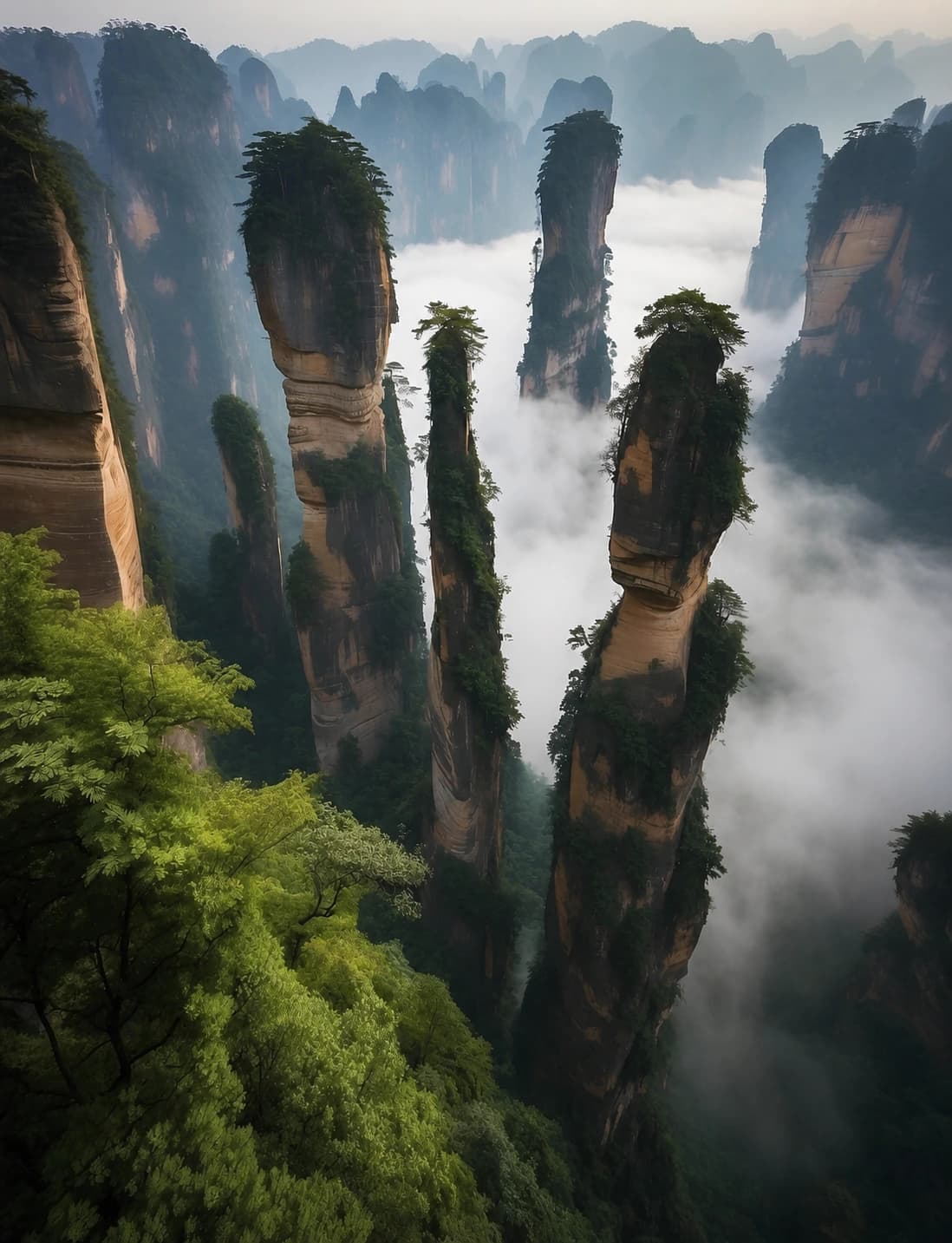
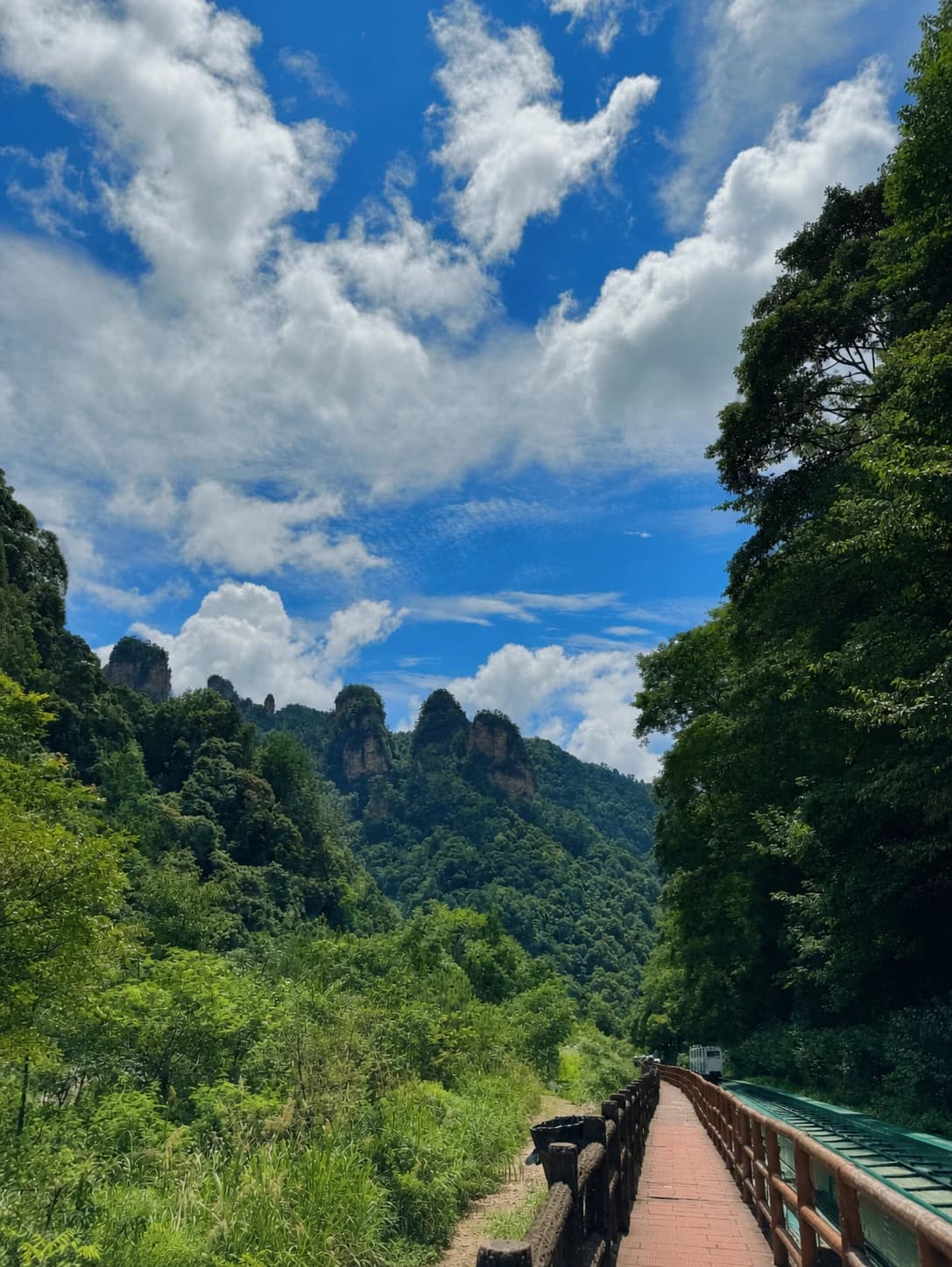
Huangshi Village (黄石寨, also written Huangshizhai or Huangshi Fort) is a high, broad viewing platform above the South Gate of Zhangjiajie National Forest Park. Despite the English name, it is not a lived-in village, not Huangshi city in Hubei and not Yellowstone National Park. Think of it as a forested summit circuit surrounded by quartz-sandstone pillars.
Its advantage over the more famous Yuanjiajie is route clarity. You enter through one gate, choose cableway or hiking for the vertical section, walk a signed summit loop and return toward the same lower area. Its weakness is duplication: if your itinerary already contains several plateau circuits, Huangshi can feel like another variation on distant pillars. Visit it for a quieter South Gate day, the cableway-and-forest combination or a pairing with Golden Whip Stream—not merely to collect another attraction name.
The short answer
- Correct entrance: South Gate / Forest Park Gate (南门 / 森林公园门票站).
- Minimum sensible visit: cableway return plus a reduced summit loop, around half a day once queues and transfers are included.
- Balanced first visit: cableway up, summit loop, signed hike down.
- Strong-hiker option: hike up, summit loop, cableway down before the operating cutoff.
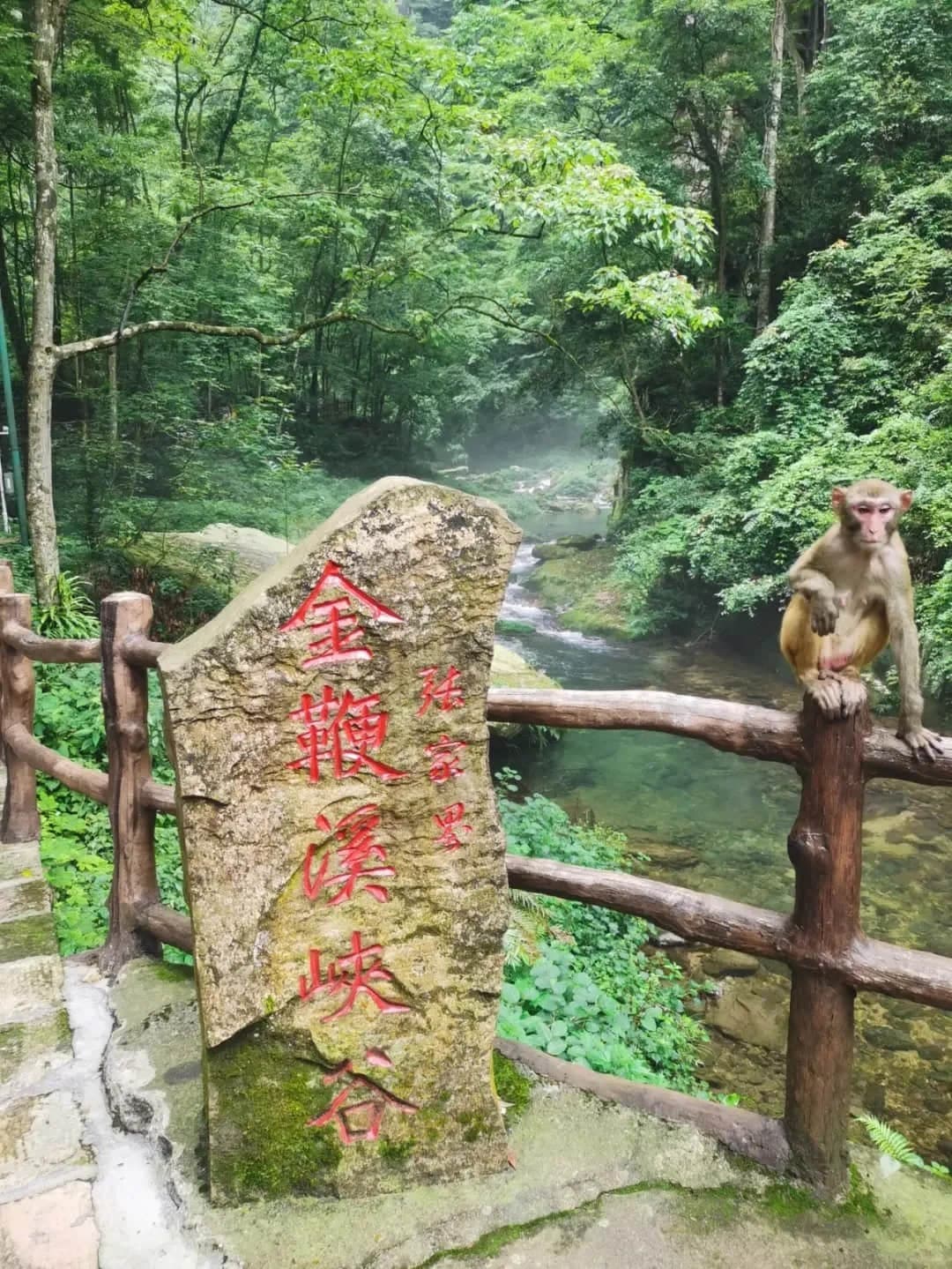
- Best pairing: a flexible section of Golden Whip Stream after descending—not an automatic full traverse.
- Main decision: how much vertical effort to spend before the summit loop.
Choose one of three route patterns
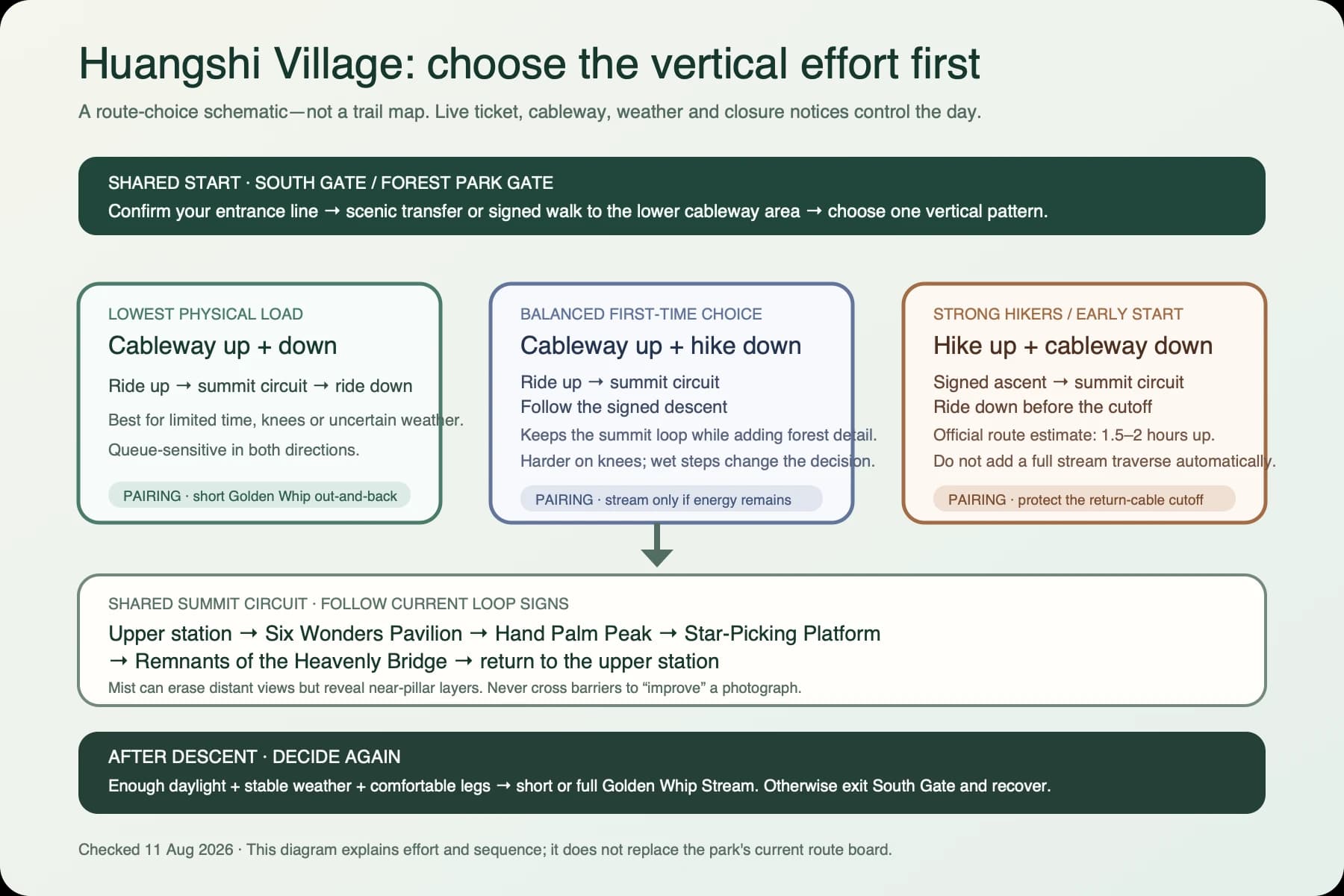
The park's March 2026 three-day recommendation places Huangshi on Day 1 from the South Gate. It gives two ascent choices: a 1.5–2-hour hike or the cableway, followed by Six Wonders Pavilion, Hand Palm Peak, Star-Picking Platform and the Remnants of the Heavenly Bridge. Treat that as the route skeleton; current signs, maintenance and your ticketed entrance still control the actual path.
Option 1: cableway up and down
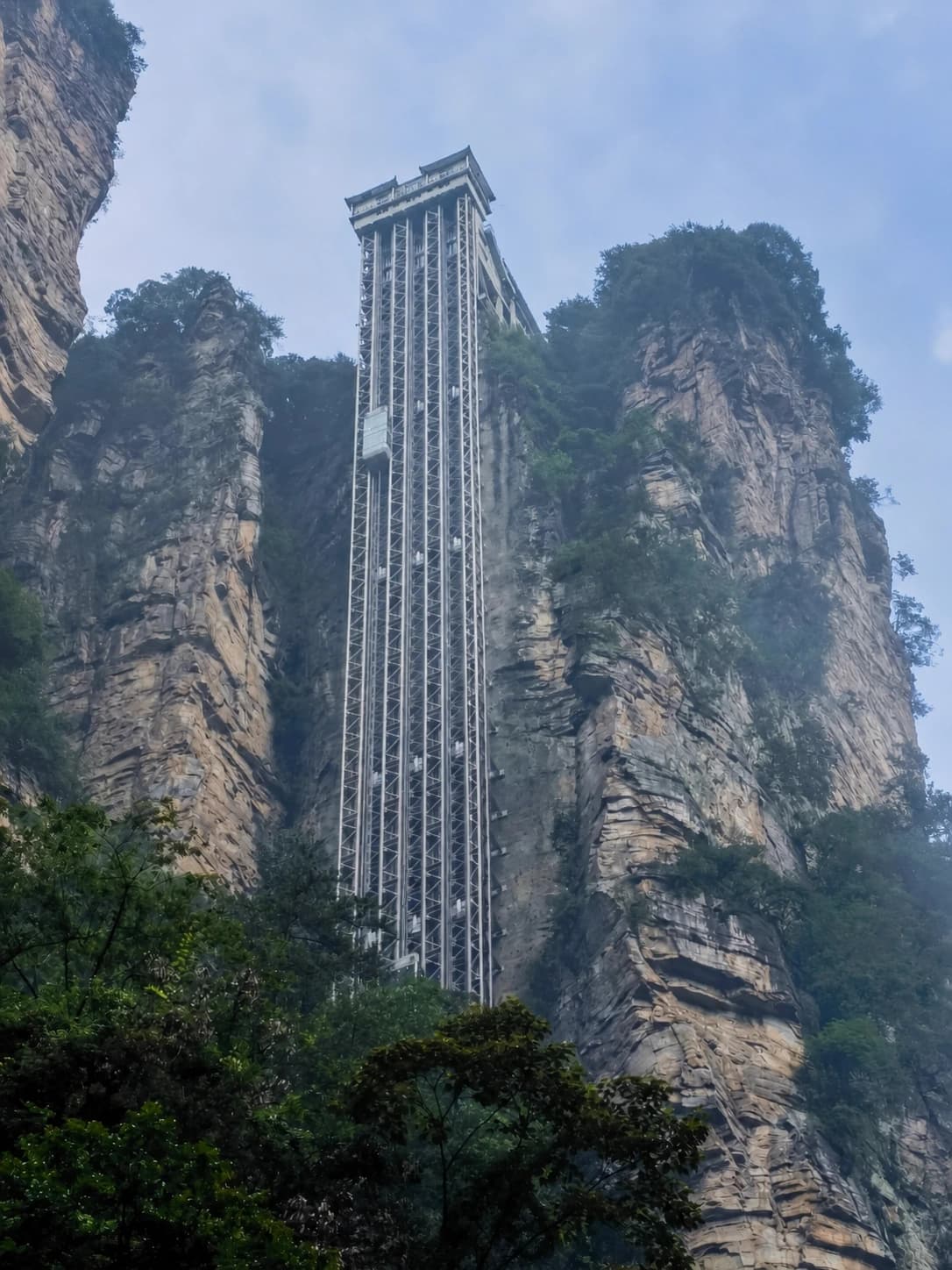
Choose this for limited time, uncertain weather, younger children or knees that dislike long stone descents. Ride up, walk the current summit circuit and return by cableway. The physical load is lowest, but the plan is queue-sensitive twice.
Do not reduce the visit to one pavilion photo. Even with a return ticket, allow time for several directions around the summit. Near pillars can appear when mist hides the wider panorama.
Option 2: cableway up, hike down
This is the most balanced first-time pattern. The cableway gains height efficiently, the summit loop supplies the main viewpoints, and the descent adds forest, rock texture and a changing sense of scale.
The tradeoff is knee load. Wet stone, fallen leaves and humid heat can turn a nominal descent into the hardest part of the day. If rain strengthens or legs feel unstable, use the cableway down instead of defending a plan made at breakfast.
Option 3: hike up, cableway down
Choose this only with an early South Gate arrival, strong uphill fitness and a confirmed return-cable operating window. The official route estimate of 1.5–2 hours is for the ascent itself, not city transport, ticket checks, rest stops or the summit circuit.
Protect the cableway cutoff. If queues, mist or a slow ascent consume the margin, shorten the summit loop rather than racing near exposed viewpoints.
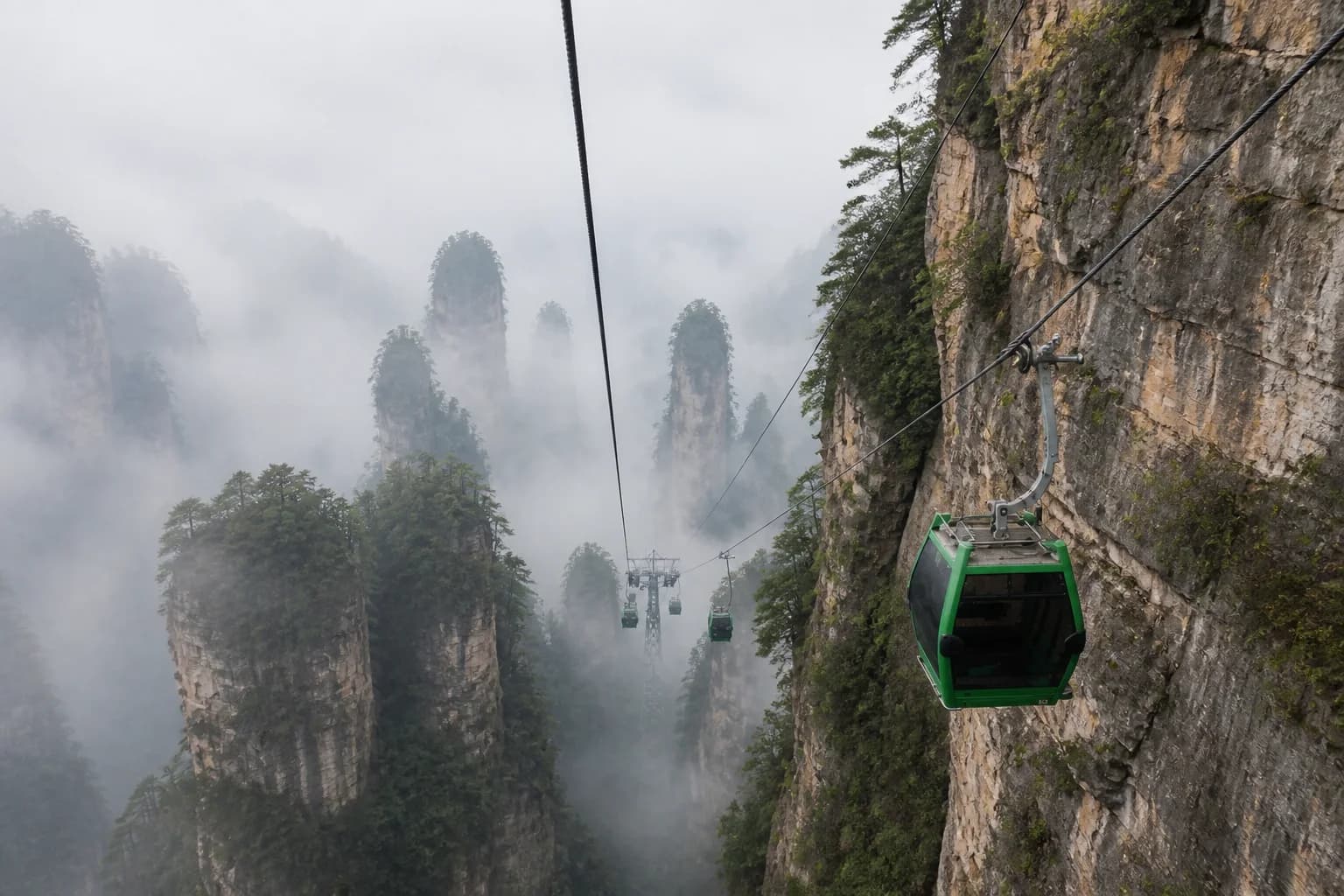
How to read the summit circuit
Huangshi is described by the geopark as a quartz-sandstone fangshan, a table-like high platform with a relatively open top and steep surrounding cliffs. More than 500 metres of quartz-sandstone thickness in the Huangshi–Golden Whip area helped provide the material and vertical space for the surrounding pillar landscape.
Six Wonders Pavilion
Six Wonders Pavilion (六奇阁) is the orientation point rather than the whole destination. Its name refers to the area's often-listed combinations of mountains, water, stone, cloud, plants and animals. Use the pavilion to understand which side of the plateau you are viewing, then continue around the loop.
Five-Finger Peak and Hand Palm Peak
Current official material uses both Five-Finger Peak (五指峰) and Hand Palm Peak (手掌峰) among Huangshi references. English sign translations can vary, so match the Chinese characters on the live board rather than assuming every “finger” label identifies the same rock. The useful visual question is how separated pillars align briefly into a hand-like silhouette from one angle and dissolve from another.
Star-Picking Platform
Star-Picking Platform (摘星台) is a projecting viewpoint with a stronger feeling of exposure than its modest walking distance suggests. A 2026 accessibility project added a roughly 29-metre connecting accessible path and improved the approach, but that does not make every adjoining trail step-free. In wind, rain or crowding, wait for space rather than leaning around another visitor.
Remnants of the Heavenly Bridge
The Remnants of the Heavenly Bridge (天桥遗墩) is best read as a group of separated stone masses suggesting an interrupted bridge. Do not confuse it with First Bridge Under Heaven at Yuanjiajie, which is a different formation and a different park route.
Huangshi is not the Avatar pillar
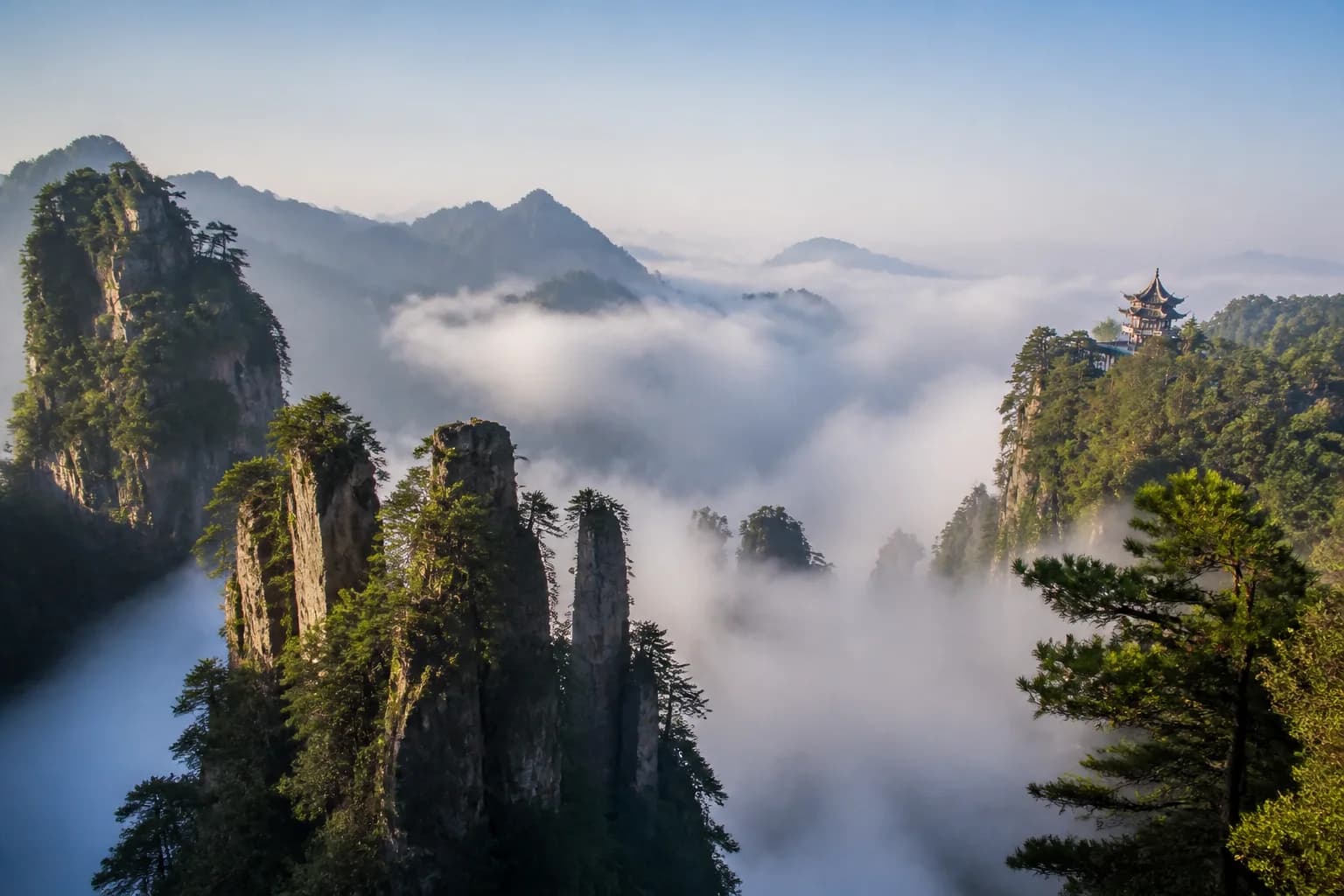
The often-repeated claim that a Huangshi formation inspired the “Hallelujah Mountains” is misleading. Current geopark material identifies Yuanjiajie's Qiankun Pillar as the Avatar-associated site. Huangshi deserves its own identity: a broad summit, pines, cloud seas and multiple directions across the peak forest.
Weather changes what is worth seeing
Clear weather reveals depth and far ridgelines. Broken mist can be more dramatic, separating near pillars into layers while hiding the distance. Solid whiteout is different: if every viewpoint has no depth and the weather is worsening, shorten the circuit rather than waiting indefinitely.
Spring adds a quieter feature. Official April 2026 reporting documented pink and rose rhododendrons around Huangshi and Yuanjiajie. Blossoming dates move with temperature and elevation, so do not book a specific week on the assumption that one photograph represents every year.
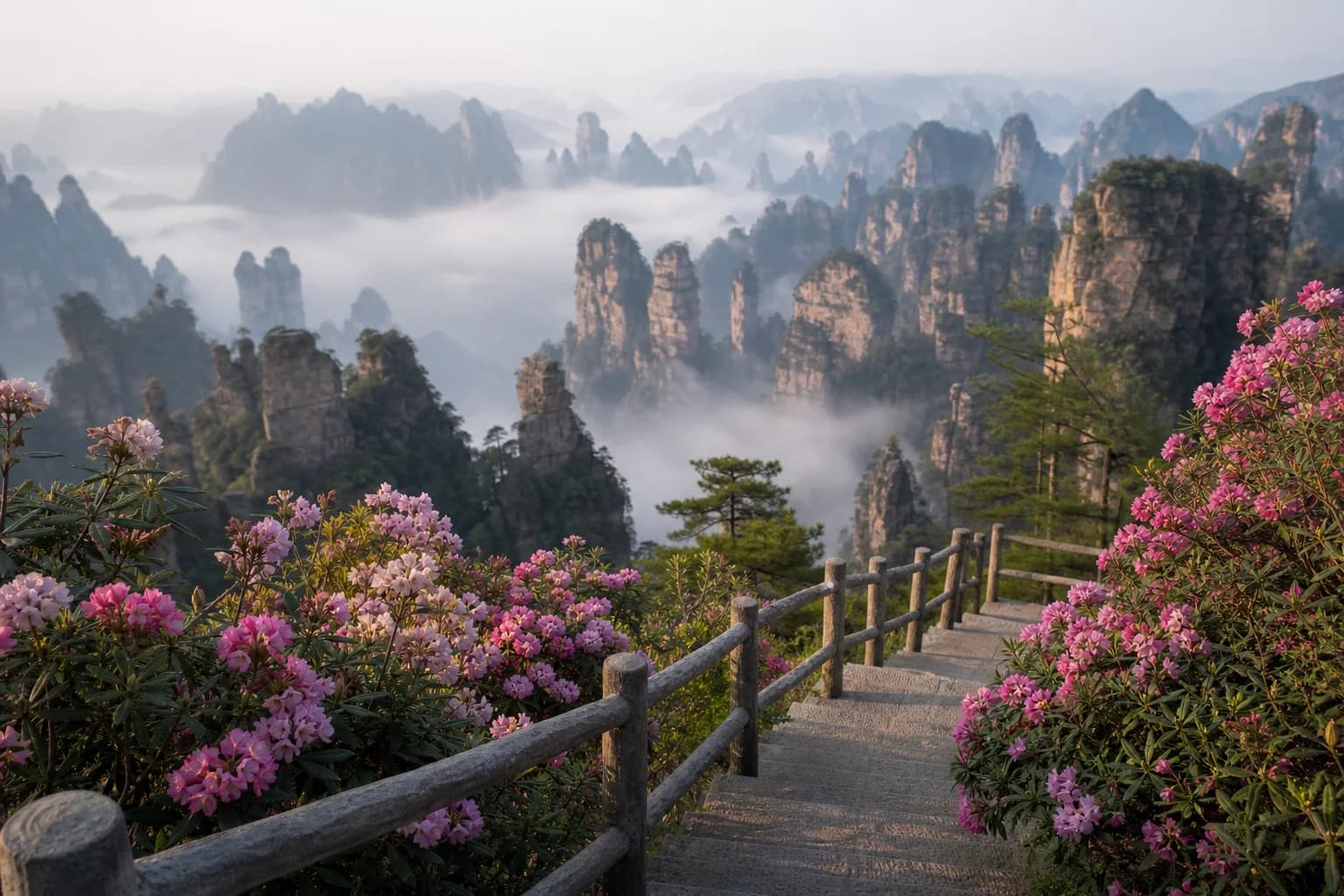
- March to May: flowers, fresh green and frequent visibility changes; carry rain protection.
- June to August: dense greenery and cooler summit air, but humid climbs, storms and heavy demand.
- September to early November: often the cleanest balance of walking comfort and visibility.
- Late November to February: possible frost or snow, shorter daylight and a higher chance of icy closures.
Tickets, cableway and current operations
Huangshi sits inside the Zhangjiajie National Forest Park / Wulingyuan ticket system. The cableway is a separate transport product or package component. Old pages still repeat fixed ¥65 and ¥118 prices; do not build a budget or route from those screenshots.
Before buying, confirm:
- that your ticket line permits the South Gate Huangshi route;
- one-way versus return cableway inclusion;
- passport or booking-document requirements;
- the day's last ride and weather policy;
- refund or rerouting rules during maintenance.
Compare the current Trip.com Zhangjiajie National Forest Park listing, then let the live park notice and ticketed line override marketplace summaries. The same rule applies after heavy rain: a park reopening can still use route-specific lines and restrictions.
Getting to the correct gate
Show a driver 森林公园门票站 / 南门, not only “Zhangjiajie National Forest Park.” The park has several widely separated gates, and East Gate is not the efficient start for Huangshi.
Save the Zhangjiajie National Forest Park South Gate ticket office (张家界国家森林公园南门售票处) before leaving your hotel. This is the arrival point for this route, not a generic marker in the middle of the park.
From Zhangjiajie city, official transport sources direct visitors to tourist coaches from the central bus station toward the forest-park gates. Historical prices and frequencies should not be treated as current; ask specifically for 森林公园门票站 and confirm the destination before boarding.
Since June 2025, an official ring bus has also linked Wulingyuan bus station near East Gate with the Forest Park South Gate. This is especially useful when a Golden Whip through-walk ends at a different gate, but same-day operating times still need confirmation.
Pairing Huangshi with Golden Whip Stream
The official three-day route pairs morning Huangshi with afternoon Golden Whip Stream. That does not mean every traveler should complete both full routes.
- Cableway return: the strongest candidate for a longer Golden Whip walk.
- Cableway up, hike down: add the stream only if legs, daylight and weather remain comfortable.
- Hike up, cableway down: prefer a short stream out-and-back unless you trained for a long combined day.
If you intend to exit at East Gate after a through-walk, verify the current internal shuttle and external ring-bus plan before committing. A car left at South Gate creates a retrieval problem if you emerge elsewhere.
Food: summit fuel versus a regional meal
Official route guidance mentions summit fast food or carrying a simple lunch. Treat mountaintop outlets as fuel: compare posted prices, carry water and keep snacks inside a closed bag around macaques.
After the park, a more distinctive regional meal is rock-ear mushroom chicken soup (岩耳炖土鸡). Rock ear is a dark fungus associated with cliff environments and is usually simmered with chicken into a clear, earthy broth. Ask whether the restaurant uses dried or rehydrated fungus, how large the chicken portion is and how long preparation takes. Sanxiaguo, Tujia steamed pork, smoked pork and Sangzhi salted tofu are other documented Zhangjiajie choices.
Where to stay
- South Gate / Luoguta area: best for the earliest Huangshi start and the least morning transfer. Dining and hotel inventory are thinner; confirm evening transport.
- Wulingyuan East Gate: best overall park base, with more restaurants and hotels plus the ring-bus option to South Gate. Leave enough time for the cross-gate ride.
- Zhangjiajie city: best before Tianmen Mountain, a late arrival or an early railway/airport connection, but weakest for a relaxed Huangshi morning.
Use Trip.com hotels in map view and measure against the exact gate—not the broad “Zhangjiajie” label.
Accessibility, safety and macaques
The park's 2025–2026 accessibility program includes the Forest Park Gate–Huangshi line and improvements around Five-Finger Peak and Star-Picking Platform. Cableway access and upgraded paths can make a reduced visit possible, but the complete summit and hiking network still includes gradients, steps and weather-exposed surfaces. Ask staff which loop is currently suitable for your mobility device.
Do not show food to macaques, make eye contact at close range or pull an item back from an animal. Step away and seek staff assistance. On viewpoints, keep bags compact, wait for rail space and never cross a barrier for an unobstructed photograph.
Final recommendation
Choose Huangshi when you want a legible South Gate mountain day rather than another complicated cross-park transfer. For most first-time visitors, cableway up, summit loop and hike down gives the best balance. Switch to cableway return when weather or knees argue against the descent, and treat Golden Whip Stream as a second decision made after you return to the valley.