Which Zhangjiajie route should you choose?
Zhangjiajie is easier to plan once you stop treating it as one park. The famous sandstone pillars, the cliff walks above Zhangjiajie city, and the glass bridge belong to separate day products with different entrances, tickets and transport. A good itinerary chooses among them. A bad one collects their names, then loses hours changing gates or discovers that a cableway ticket is for a different mountain.
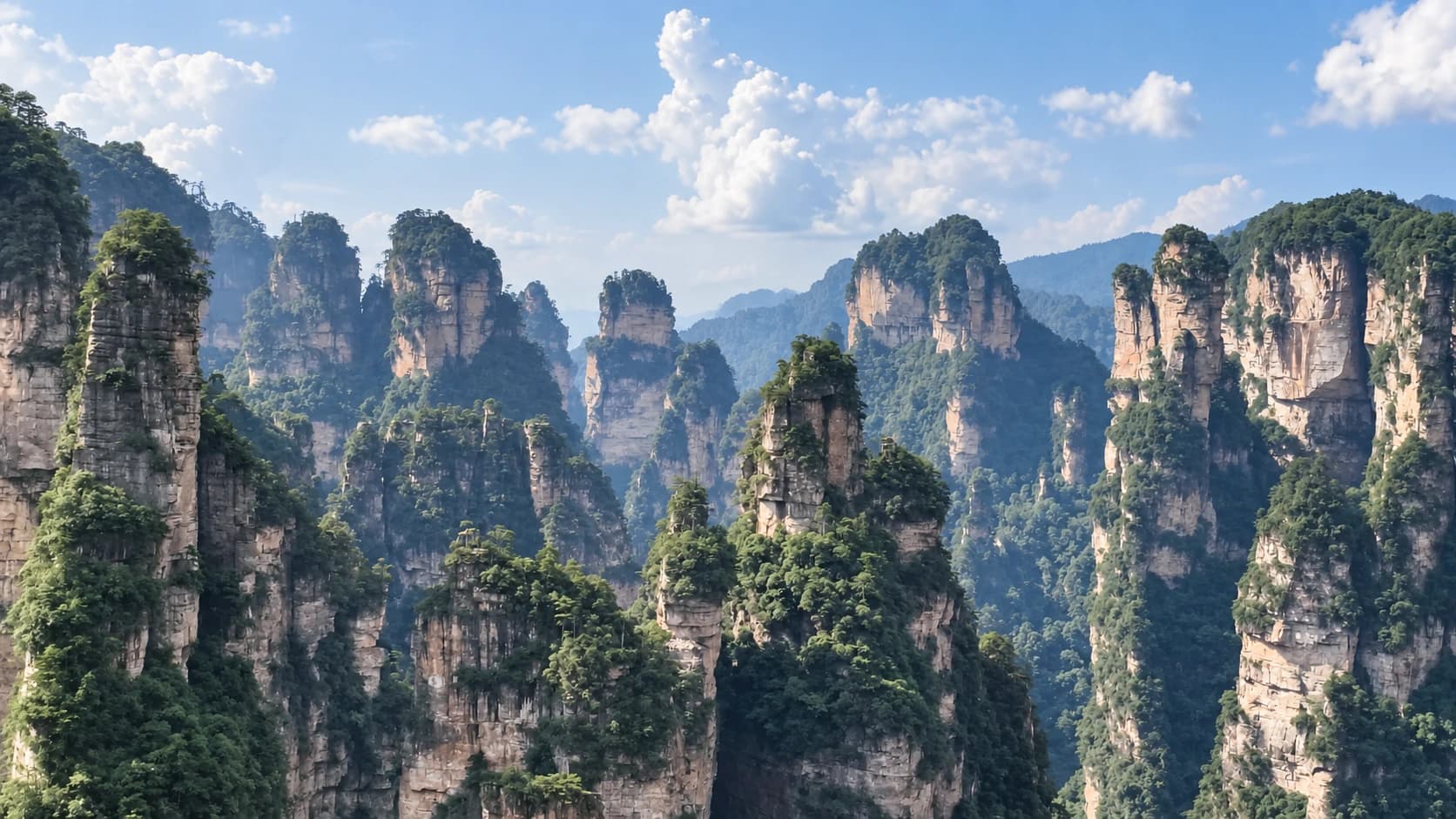
For a first visit, protect one full day for the Wulingyuan East Gate plateau. This is the strongest choice for the large, layered pillar panoramas most people came to see. Add Tianmen Mountain when you want the natural arch, cliff paths and dramatic mountain engineering. Add the South Gate, Huangshi Village and Golden Whip Stream when forest, water and a closer view of the rock matter more than another high viewpoint. Choose Zhangjiajie Grand Canyon and its Glass Bridge when the bridge and an engineered-height experience are a real priority, not because you assume it is part of the national park ticket.
There is no universal fourth “must-do.” With two days, you need to cut hard. With three, most first-time visitors can build a complete mountain trip. With four, you gain a weather buffer or one contrasting extra day. This guide makes that choice. The linked attraction pages and itineraries handle the detailed sequence after you decide.
The 90-second decision
| Day product | Choose it for | What the day actually contains | Main compromise | Realistic time |
|---|---|---|---|---|
| East Gate plateau | First visit, iconic pillar views, the biggest scenic scale | East Gate check-in, Tianzi cableway area, upper shuttles and viewpoints, Yuanjiajie, then a managed descent such as Bailong Elevator | Many transport links and queues; distant views depend heavily on visibility | One complete day |
| South Gate / Huangshi / Golden Whip | Forest, stream, quieter rhythm, closer rock scale | South Gate check-in, Huangshi cableway or hike, summit circuit, then a flexible Golden Whip section | More walking than the map suggests; a full stream traverse needs a confirmed exit plan | One complete day; shorten rather than rush |
| Tianmen Mountain | Heaven's Gate, cliff paths, cableways, city-base convenience | A live A/B/C transport sequence, Tianmen Cave, escalators and a chosen summit loop | Separate from Wulingyuan; route letters and open paths can change | One complete day |
| Grand Canyon / Glass Bridge | The bridge, height, canyon structures and a different engineered experience | Timed entry, bridge and the canyon route included in your current product | Separate Cili County attraction; weaker choice for signature pillars | 3–4 hours inside is an official baseline; protect most of a day door to door |
Choose East Gate + Tianmen for a first two-day trip. Choose East Gate + South Gate + Tianmen for the best-balanced first three days. On day four, add Grand Canyon if the bridge excites you, or keep the day flexible for weather and slower walking. A fourth scenic product is not automatically more valuable than seeing the plateau in clear conditions.
First understand the four different maps
1. East Gate is the plateau strategy
Wulingyuan East Gate (武陵源东门) is also associated with Wujiayu Check-in (吴家峪门票站) and commonly called Sign Gate (标志门). It is the practical base for a high-to-low day through Tianzi Mountain and Yuanjiajie. The route uses managed scenic buses plus paid vertical transport; it is not a road trip between viewpoints.
Save the exact East Gate ticket-office marker. A generic search for “Zhangjiajie National Forest Park” can lead to a different gate.
2. South Gate is the forest-and-stream strategy
South Gate (南门) is the National Forest Park Check-in (森林公园门票站). It is the logical start for Huangshi Village and Golden Whip Stream. It is not a second name for East Gate, and a Wulingyuan-town hotel is not automatically beside it.
Save the South Gate ticket-office marker. AMap's checked road route from East Gate to South Gate was about 24.1 km / 37 minutes. For a real morning transfer, allow roughly 50–75 minutes after pickup, traffic, weather and gate approach. That is a public-road transfer outside the park, not a scenic shuttle connection.
3. Tianmen starts in Zhangjiajie city
Tianmen Mountain rises above Yongding District. Its familiar city access point is the Tianmen cableway lower station. Tianmen Cave, the summit paths and its cableway system are a different attraction and ticket from Wulingyuan.
The checked road plan from the lower station to East Gate was about 33.6 km / 36 minutes in normal routing. Treat a change between the city and Wulingyuan as 60–90 minutes once luggage, hotel checkout, pickup and traffic are included. That is why a morning Tianmen entry and a Wulingyuan plateau afternoon make a fragile plan.
4. Grand Canyon is near Wulingyuan, but still separate
Zhangjiajie Grand Canyon (张家界大峡谷) lies in Sanguansi, Cili County. The Glass Bridge—often branded Yun Tian Du (云天渡)—is inside that attraction. It is not a Wulingyuan gate, and Wulingyuan admission does not make it an included stop.
Use the Grand Canyon visitor reception centre as the road-arrival anchor rather than an internal bridge coordinate. The checked East Gate road plan was about 28.6 km / 35 minutes; allow 50–75 minutes door to door. No internal park bus should be assumed between them.
East Gate plateau: choose it for the iconic Zhangjiajie scale
The East Gate day gives the clearest first-time answer to “Why did I come to Zhangjiajie?” You rise to the upper landscape, move across plateau sections, look into forests of quartz-sandstone columns, and descend back toward the valley network. The visual change in elevation is the point.
A coherent skeleton is East Gate → Tianzi Mountain Cableway (天子山索道) → He Long Park (贺龙公园) → upper scenic shuttle → Yuanjiajie (袁家界) → Bailong Elevator (百龙天梯) down. Ten-Mile Gallery (十里画廊) can be a finish when time, shuttles and energy remain. It is the first element to cut when the day runs late.
This is the most queue-dependent choice. A cableway, scenic buses and the elevator each create a separate timing risk. The elevator ride itself is brief; its approach, ticket check and queue can control the afternoon. Do not add another plateau branch only because it appears close on a schematic. Inside the scenic area, “close” can still mean a bus wait, a walk and a second queue.
Choose East Gate if:
- this may be your only Wulingyuan day;
- broad pillar panoramas matter more than stream walking;
- your group can manage viewpoint paths, standing and transfers even when using cableways;
- you can start early and keep optional stops disposable.
Think twice if solid low cloud is forecast for the whole day, several transport links are suspended, or your group becomes distressed by queues and crowded platforms. Mist can create dramatic layers; a flat whiteout can remove the depth that makes the plateau worth prioritising.
This route is lift-assisted, not step-free. Cableways and elevators save large climbs, but ordinary paths still include gradients, steps, wet stone and exposed viewing areas. A slower group should choose fewer upper stops and keep the same descent plan rather than attempting every viewpoint.
South Gate: choose it for forest, water and modular walking
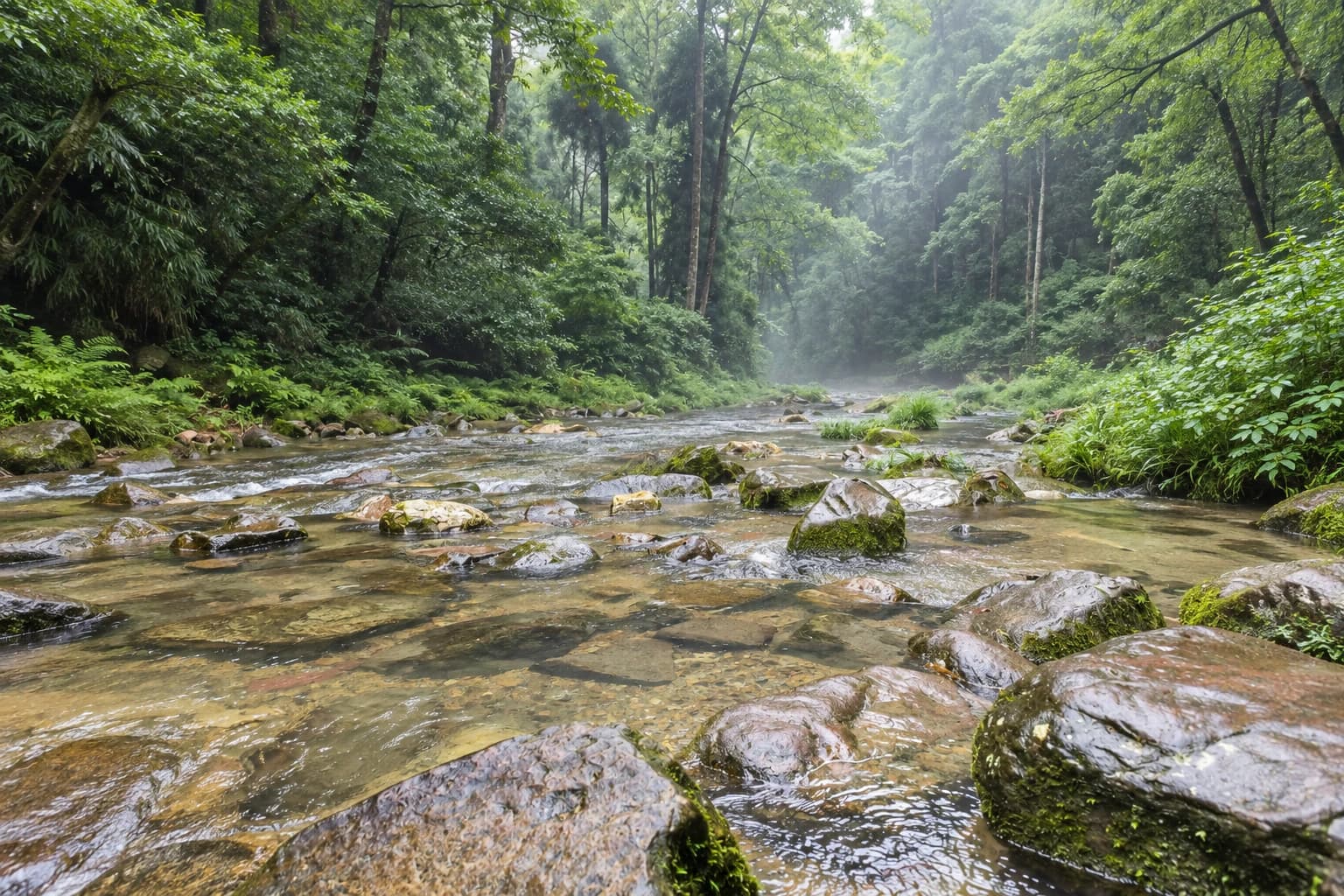
The South Gate day changes the scale. At Huangshi Village, the broad summit circuit opens across pillars and forest. Along Golden Whip Stream, the cliffs rise from the canyon floor while water, roots and vegetation remain at eye level. After an East Gate day, that contrast is more valuable than a second rushed collection of distant viewpoints.
The day has two independent choices:
- How to handle Huangshi's vertical section. Cableway return is the gentlest and most queue-sensitive. Cableway up with a hike down balances effort and variety but can be hard on knees. Hiking up then riding down suits strong walkers who start early and protect the last operating time.
- How far to walk Golden Whip. A short out-and-back from the South Gate side is easy to shorten. The full roughly 7.5-kilometre traverse toward Water Winding Four Gates (水绕四门) is a real half-day commitment and requires confirmation of the current shuttle and exit plan.
Do not write an invisible cross-park connection into the itinerary. Reaching the far end of Golden Whip does not guarantee that the next elevator, shuttle or chosen exit will still work for you. If you began with a driver or luggage at South Gate, emerging elsewhere also creates a retrieval problem.
Choose South Gate if:
- you already have one plateau day and want a different landscape;
- light mist makes the forest appealing even when long views are weak;
- you prefer a route that can shrink safely after lunch;
- your group enjoys walking more than repeated mechanical transfers.
Cut South Gate before East Gate on a first two-day trip if the signature pillars are your priority. Cut Huangshi's long hike before cutting the whole day if knees, heat or rain become the problem. In light rain, the stream and forest can be atmospheric. In heavy rain, water levels, falling debris and slick surfaces make “sheltered” a misleading description; follow closures and shorten immediately.
Macaques are another practical difference. Keep all food sealed inside a bag, never feed an animal and do not tug an item back. Step away and ask staff for help. A close animal photograph is not worth changing its behaviour or risking a bite.
Tianmen Mountain: choose it for a concentrated mountain-engineering day
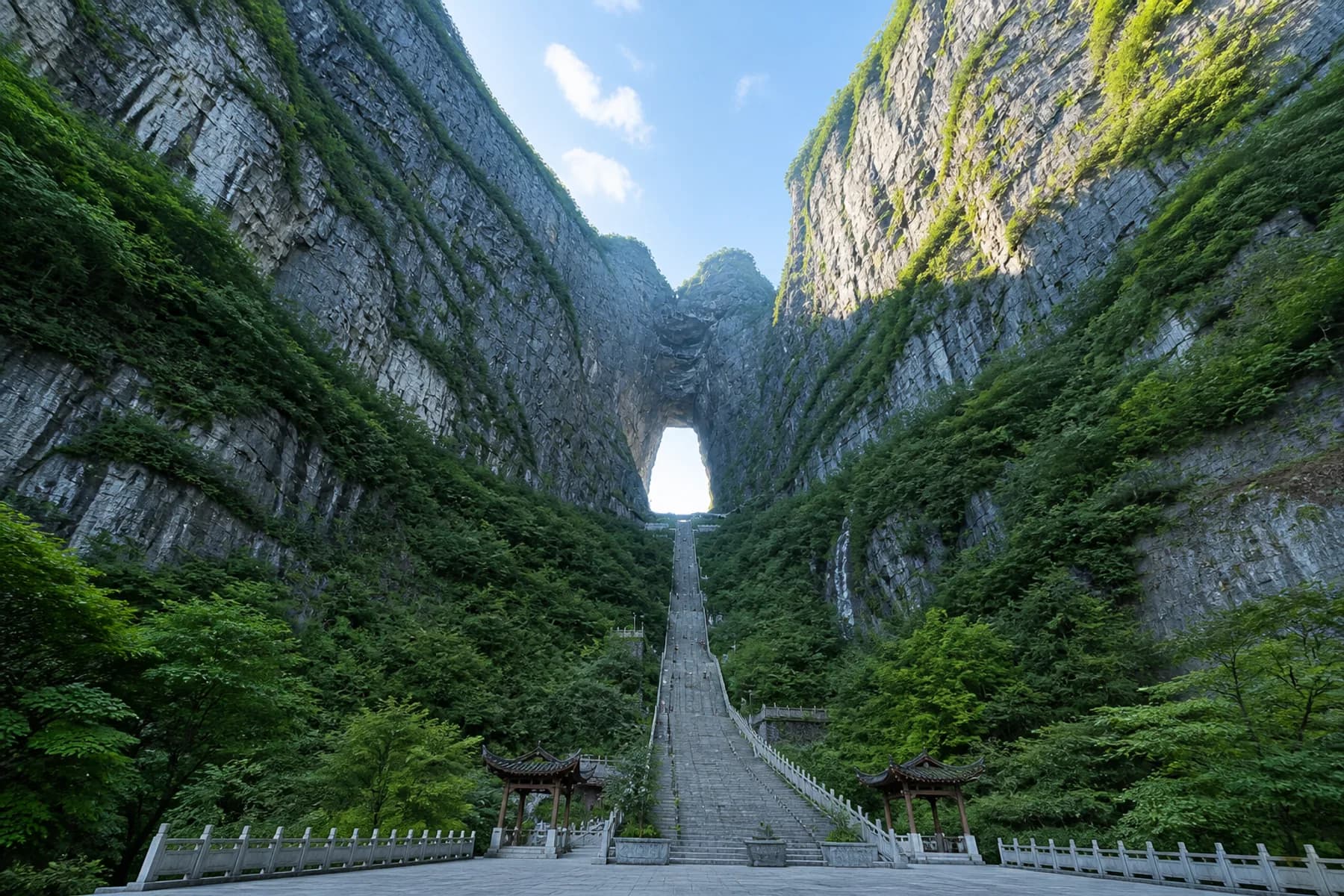
Tianmen combines a natural arch, high forest, cliff paths, escalators, cableways and the famous road below. It is visually and logistically different from Wulingyuan. Some travelers prefer that concentrated drama; others find the upper paths less important than an additional day among sandstone pillars.
Tickets are commonly sold as Route A, B or C, but the letters describe transport order, not three permanently fixed hiking trails. Maintenance and weather can change which cableway segment, shuttle or entrance each letter uses. A March 2026 Hunan government maintenance notice temporarily reduced the available sequence; a later notice restored several products under an adjusted pattern. The lesson is not to memorize that expired arrangement. Read the route printed on the product for your date.
Start with the full Tianmen route decoder, then compare the exact live Trip.com Tianmen Mountain product. Match its letter, starting point, finishing point, time slot, transport inclusions and passport fields to the current official notice. If you store luggage, use a location you can retrieve from the ticket's actual finish; do not assume every route returns you to the same lower station.
The summit is a network, so choose one coherent loop. Tianmen Cave and one open cliff section can be enough for a mixed-energy group. A longer west-to-temple circuit suits visitors who can walk several hours after the transport sequence. The 999 steps are visually famous but should not become a fitness test forced onto everyone; use the operating escalator option when knees, heat, ice or crowds make the stairway a poor choice.
As of a Hunan government notice dated May 13, 2026, the East Line Glass Walkway was closed for maintenance while the West Line and Panlong Cliff glass walks remained open. Treat that as a dated status, not a promise for your trip. A glass floor is a small route feature, not the reason to abandon the whole mountain if it is closed.
Choose Tianmen if:
- you are staying in Zhangjiajie city before or after a train or flight;
- the cave, cableways and cliff engineering matter as much as pillar scenery;
- you want one attraction with a clearly booked time slot rather than a multi-gate park day;
- your group can tolerate height and several managed transport stages.
Cut Tianmen first if your entire reason for traveling is Wulingyuan's pillar landscape and you have only two days with a poor city-to-park schedule. Do not cut it merely because “Zhangjiajie National Forest Park sounds more famous”; they deliver different experiences.
Grand Canyon and Glass Bridge: choose it when the bridge is the point
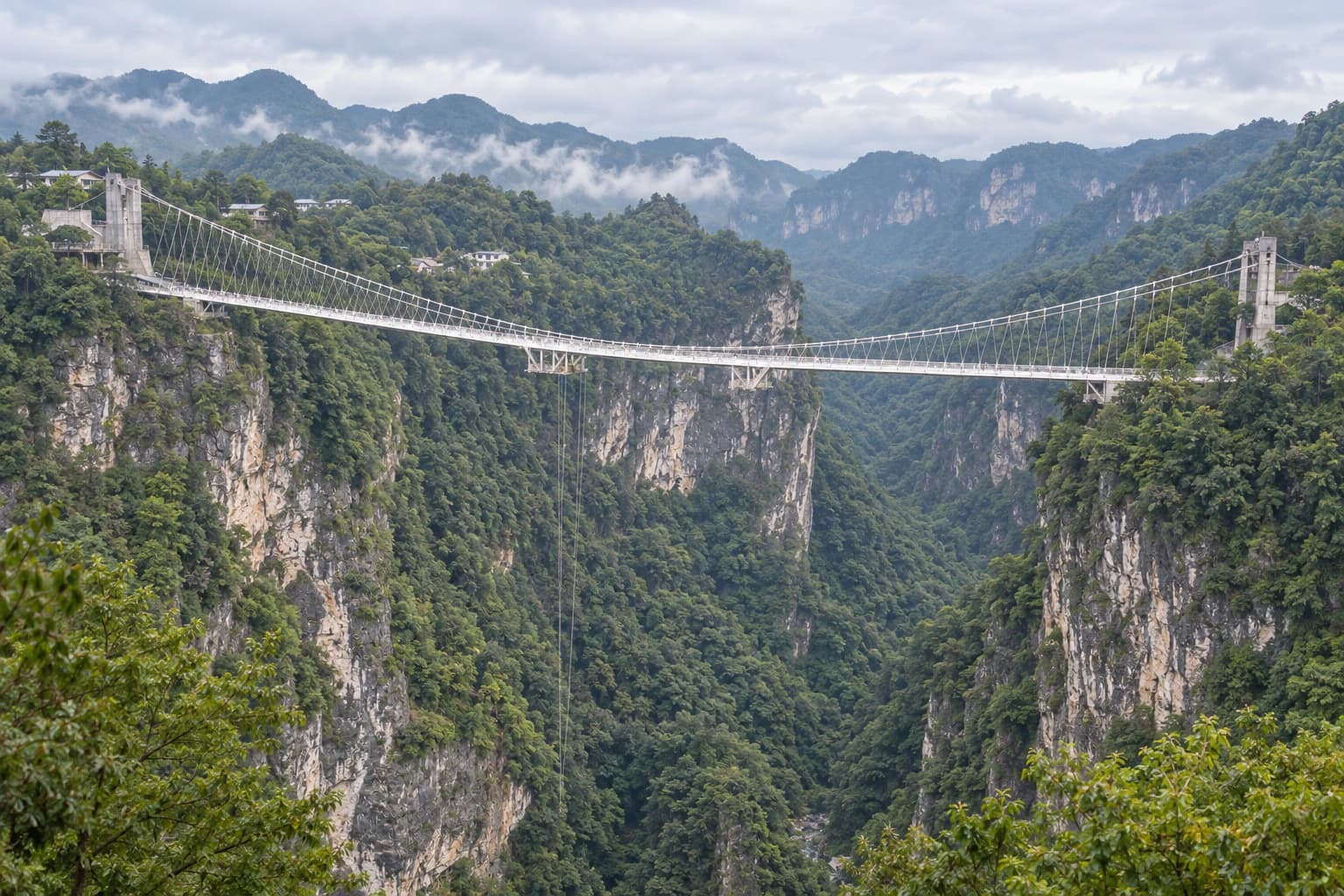
The Glass Bridge is visually dramatic: a long transparent deck suspended above the canyon. The attraction can also include a managed canyon descent and additional transport or entertainment elements depending on the live product. Its value is the combination of height, structure and canyon movement. It should not be sold to yourself as another Wulingyuan pillar day.
An official Hunan government page updated in May 2026 listed 07:30–17:00, a CNY 256 ticket including canyon and bridge, and 3–4 hours for the visit. Use those only as a dated planning baseline. Your current booking channel must confirm the open route, entry slot, inclusions, passport rules and final admission price.
Three to four hours inside does not make it an easy half-day add-on. Road transfer, early check-in, ticket control, queues, the one-way shape of parts of the route and return pickup can consume most of the useful day. If you pair it with anything, choose a flexible evening in Wulingyuan town rather than another timed mountain attraction.
Choose Grand Canyon if:
- walking onto the bridge is a top trip goal;
- your group enjoys engineered attractions and managed adventure more than another long natural trail;
- you have already protected at least one core Wulingyuan day;
- the live product is clear about which bridge, canyon and transport components are included.
Cut it first if height makes someone anxious, the bridge is the only element anyone wants, weather threatens operations, or this would replace your only East Gate day. Travelers with mobility limitations should ask about the exact current route rather than assuming a bridge visit is a flat out-and-back. The full experience can involve slopes, stairs, one-way sections and additional transport.
Choose a two-day plan
Best first visit: East Gate + Tianmen
This combination produces the clearest contrast: one day among Wulingyuan's signature pillars and one city-based mountain day focused on Tianmen Cave and cliff engineering. Stay in Wulingyuan for the East Gate night and in Zhangjiajie city for the Tianmen night when your wider arrival/departure plan supports a single hotel move.
Do not move bases before dawn solely to preserve the written order. If you arrive in the city late, do Tianmen first, then transfer to Wulingyuan after the visit. If the clear-weather window falls on the second day, move East Gate there.
Best nature depth: East Gate + South Gate
Choose this if Wulingyuan is the whole reason for the trip. You get a high panorama day and a forest-floor day without learning another ticket system. Use one Wulingyuan base and allow the morning public-road transfer to South Gate.
This is the better choice for strong walkers and the weaker choice for someone who regards Tianmen Cave as non-negotiable.
Bridge-first alternative: East Gate + Grand Canyon
This keeps one signature pillar day and adds the Glass Bridge. It works from a Wulingyuan base without a city hotel move, but the Grand Canyon road transfer still needs its own pickup plan. It is a preference-driven choice, not the default first-time recommendation.
What not to do in two days
Do not combine East Gate and South Gate into one “national park day,” then attempt Tianmen or Grand Canyon on the other. Gate transfer, internal queues and walking will strip the first day of its value. Do not book Tianmen and Grand Canyon for the same day because both listings appear to show half-day durations; their timed entries and separate roads leave little recovery room.
Choose a three-day plan
Balanced first visit: East Gate + South Gate + Tianmen
This is the strongest default. East Gate supplies the panorama, South Gate supplies forest and stream, and Tianmen changes both geology and transport style. It also gives limited weather flexibility: swap the two Wulingyuan days when a clear day favors the plateau, provided reservations and gate entries can be changed.
Use the complete three-day Zhangjiajie itinerary after choosing this combination. It supplies the day sequence without pretending that every optional stop will fit.
Thrill-focused: East Gate + Tianmen + Grand Canyon
Choose this when the bridge, cave, cableways and engineered access are central to the trip. You give up the quietest forest-and-stream day. That trade makes sense for some families and short-stay visitors; it is not a quality ranking.
Wulingyuan depth: two East/plateau days + South Gate
Experienced hikers or photographers may prefer two Wulingyuan upper-area days plus South Gate, especially when waiting for visibility matters. Build the second plateau day from current park guidance and open areas rather than repeating Yuanjiajie or inventing an internal transfer. This guide does not publish a fixed Yangjiajie or Tianzi cross-route because closures and shuttle patterns can change.
Cut-first rule for three days
If walking capacity is the constraint, keep East Gate, shorten South Gate and choose a reduced Tianmen summit. If transport complexity is the constraint, keep both Wulingyuan days and cut the city change. If height or engineered attractions are the problem, cut Grand Canyon before South Gate.
Choose a four-day plan
Four days can include East Gate + South Gate + Tianmen + Grand Canyon without combining full scenic products. The cleaner shape is two Wulingyuan days, one separate Grand Canyon day from the Wulingyuan side, then Tianmen from a city hotel—or the reverse according to arrival and departure.
Yet the smartest fourth day is often a buffer, not a fourth ticket. Hold it until the plateau forecast is clear, use it for a slower recovery day, or move the South Gate plan after wet weather. If every mountain day operates well, the extra time can go to Grand Canyon or an onward Xiangxi route.
The site's four-day itinerary uses Furong Town rather than Grand Canyon. Choose Furong when a historic town, waterfall and onward regional route matter more than another engineered scenic area. Choose Grand Canyon when you want to remain near Zhangjiajie and the Glass Bridge is a specific goal. Do not squeeze both into the same fourth day.
Weather: swap the day, not just the viewpoint
Visibility has more influence than season labels. Clear air reveals distance between pillar layers. Broken mist can create depth and changing openings. Solid cloud can erase an entire plateau panorama.
- Clear forecast: protect East Gate first. The plateau gains the most from long visibility.
- Light mist or intermittent drizzle: South Gate can work well because forest, stream and near rock retain detail. Huangshi viewpoints may open and close through cloud.
- Low cloud over Tianmen: expect the road and city panorama to disappear. Keep the day only if the cave, forest and atmospheric cliff walk still satisfy you.
- Heavy rain, thunderstorms, ice or high wind: no scenic product becomes a clever bad-weather backup. Cableways, glass areas, roads, stream paths and exposed walks may close. Follow the official notice.
Summer brings long green views, humidity, storms and strong demand. Autumn can offer comfortable walking and sharper air, with severe holiday crowding around the National Day period. Winter can produce snow and frost, but it also increases the chance of ice controls and transport changes. Spring brings fresh forest and fast-changing cloud. Pack for the day's mountain conditions, not only the temperature in Zhangjiajie city.
Mobility, children and older travelers
Mechanical transport changes effort; it does not remove it. East Gate requires transfers, walking and queue standing even if you use both cableway and elevator. Huangshi can be reduced to a cableway-return circuit, but the summit remains uneven. Golden Whip is gentler in gradient, yet distance accumulates and a full traverse creates an exit commitment. Tianmen uses escalators and cableways but includes exposed paths and changing levels. Grand Canyon's bridge can be level while the wider canyon route is not.
For a mixed group:
- select one hero view for the day rather than every named stop;
- keep a same-gate return option at South Gate;
- avoid the 999 steps at Tianmen when they add pain rather than meaning;
- confirm current accessible sections directly with the operator;
- never let a non-refundable add-on pressure someone with vertigo onto a glass floor.
Children need close supervision near railings, queues and macaques. A stroller may solve the flat approach and fail at steps or transfers; ask the attraction about the exact live route before booking.
Ticket stack: compare the final product, not the headline price
Think in three separate stacks.
Wulingyuan: park admission and timed gate entry, then any separately charged cableway, Bailong Elevator or sightseeing train. Hunan's official visitor page identifies Wujiayu as East Gate and National Forest Park as South Gate and says first-time visitors use advance timed reservations. Its posted hours and price are from 2023, so use them only for gate structure, then confirm the exact Trip.com Zhangjiajie National Forest Park listing against the current official booking channel. The same admission area can contain multiple gates; your reservation still needs the right entry.
Tianmen: the live A/B/C route product and its included cableways, shuttles and escalator sequence. Optional features can remain separate. The letter alone is not enough; read start point and direction.
Grand Canyon: the current canyon/bridge product, time slot and included internal components. Use the live official product rather than a generic “Zhangjiajie” ticket whose attraction, bridge access and internal transport are unclear.
Carry the original passport used for real-name booking. Save the Chinese product name and gate. Screenshot the order details, but let the official same-day board override an old screenshot when operations change.
Base changes and final planning rules
Stay near East Gate in Wulingyuan town for two Wulingyuan days and the easiest Grand Canyon pickup. Stay near the Tianmen cableway lower station in Zhangjiajie city for Tianmen, a late arrival, or an early train or flight. South Gate accommodation makes sense for an early forest start, but has fewer evening and onward choices.
One hotel move is enough for most three- and four-day trips. Put it after a scenic day only when luggage can remain at the hotel and the evening transfer is dependable. Never carry a morning attraction ticket that assumes a perfect 36-minute road estimate across districts.
Before paying, answer five questions:
- Which exact gate or lower station is printed on the product?
- Is this admission, vertical transport, or a bundle of both?
- What is the last transport you must catch to finish the planned direction?
- Which optional branch will you cut after a long queue?
- Which day can move if the plateau visibility is poor?
If those answers are clear, Zhangjiajie stops feeling like a maze. Choose one complete landscape per day, protect the East Gate panorama when the weather opens, and let South Gate, Tianmen and Grand Canyon earn their place by the experience your group actually wants.