Chongqing or Chengdu? Choose the experience, not the reputation
Choose Chongqing if you want a compact, high-impact city break built around steep terrain, rail lines threaded through towers, river crossings and one of China's most dramatic night skylines. Choose Chengdu if you want pandas, museums, teahouses, neighborhood food and enough breathing room to make a large day trip without turning every evening into another climb.
Neither city is a quiet alternative to the other. Both are huge, humid southwestern centers with serious food cultures, busy transport hubs and popular visitor zones. Their travel rhythm is different. Chongqing makes the route itself part of the attraction: the lift, stair street, bridge, monorail and changing road level matter. Chengdu makes pauses productive: tea, a park, a small noodle bowl, a museum sequence and a slower neighborhood walk can carry a half-day.
If you have three nights or fewer, choose one. If you have six or more nights in the region, combining them becomes sensible. The train ride can be as short as about 62 minutes on the fastest existing services, but a hotel-to-hotel move still consumes much of a half-day.
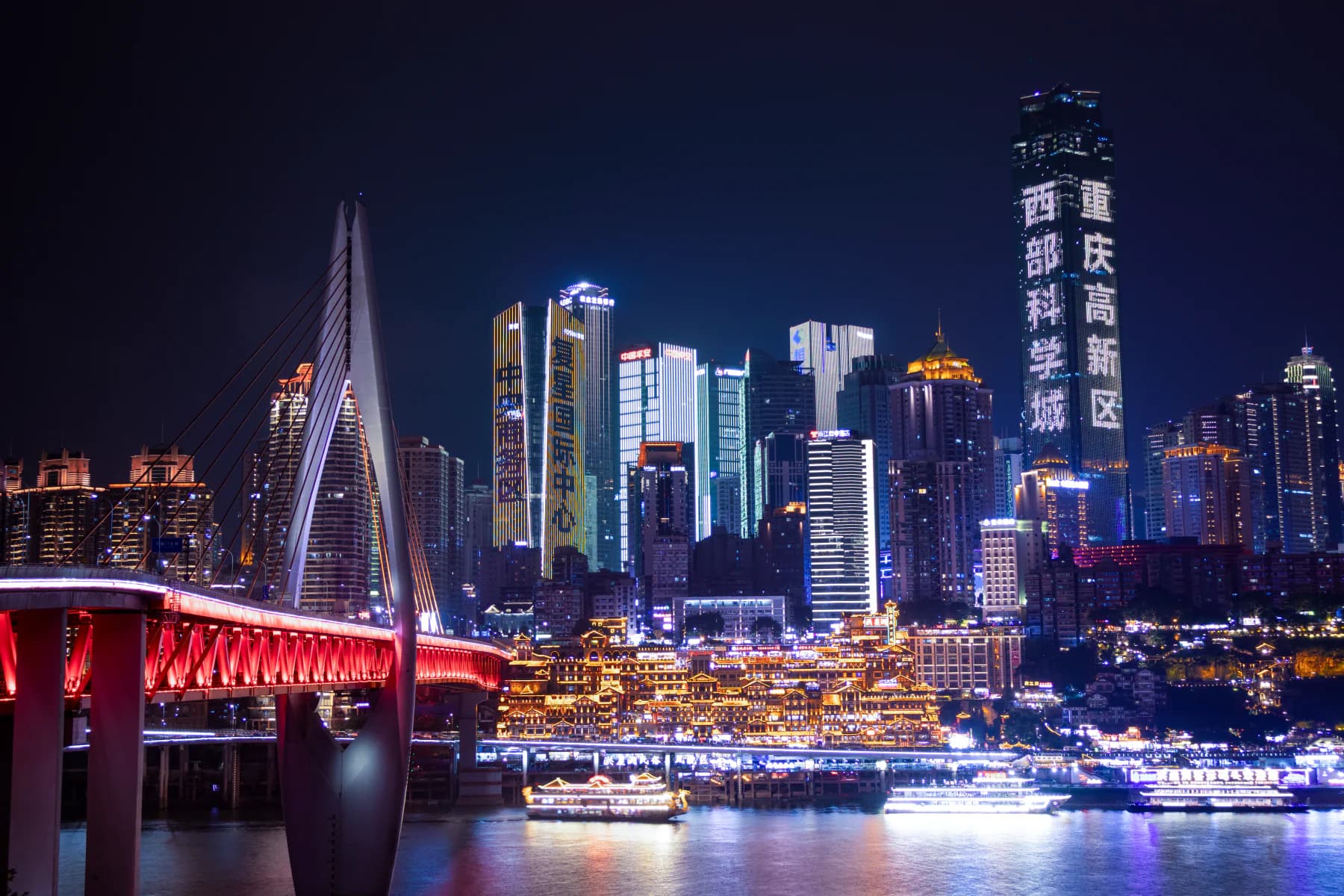
Chongqing's strongest case is visible in one frame: bridge, river, hillside buildings and a night skyline occupy different levels at once. Photo by Maple Doctor, cropped and resized, CC BY-SA 4.0.
The decision in one table
| Your priority | Choose Chongqing when… | Choose Chengdu when… |
|---|---|---|
| First impression | You want visual intensity and a city whose infrastructure is the sight | You want a rounded first stay with wildlife, history, food and public life |
| Ideal stay | 2–4 nights for the urban core; longer with Wulong or Dazu | 3–5 nights for the city plus one or two outward days |
| Pandas | One efficient urban-zoo panda morning is enough | Pandas are a primary trip goal and you want a dedicated base or several base choices |
| Food | Hotpot, xiaomian and bold late-night meals are central | You want a wider small-dish and snack grammar, tea culture and more easy tasting stops |
| Night | The skyline, bridges and riverbanks should anchor the trip | You prefer dinner, a river walk, teahouse performance or neighborhood nightlife |
| Walking | Stairs, slopes and route-finding feel like part of the adventure | Flatter central clusters and frequent seated pauses are more appealing |
| Museums/history | You want migration, wartime history, rock carvings or Three Gorges context | You want Ancient Shu, Three Kingdoms, poetry, archaeology and water engineering |
| Onward route | Wulong, Dazu, Zhangjiajie, the Yangtze corridor or Guizhou comes next | Sanxingdui, Dujiangyan, Leshan–Emei, Jiuzhaigou–Huanglong or western Sichuan comes next |
| Main failure mode | Underestimating elevation, heat, crowds and late-night return energy | Booking too many distant day trips and losing the slow urban time you came for |
The quick tie-breaker is this: pick Chongqing for spectacle and movement; pick Chengdu for range and recovery. That is a planning distinction, not a claim that one city is “more authentic.”
What a day actually feels like
Chongqing: the route is the attraction
A satisfying Chongqing day changes elevation and bank. You might begin above the river in Yuzhong, descend through old-city stairs, cross by cableway if it is operating, then finish on the South Bank as the skyline lights appear. A metro ride can become a viewing experience; a building can have usable street entrances many floors apart. The city rewards travelers who notice retaining walls, station depth and how bridges join steep neighborhoods.
This makes Chongqing unusually memorable in a short stay. It also makes weak routing expensive. Two pins that appear close can sit on different road levels, and a “ten-minute walk” can contain stairs, a lift, a footbridge and a search for the correct exit. Read the Chongqing destination guide for terrain-smart clusters, then use the 8D transport experience route when monorails, escalators, elevators, ferries and the cableway are the actual theme.
Chengdu: the pause is part of the itinerary
A satisfying Chengdu day usually has one structured anchor and one loose half. The anchor might be the Panda Base, Chengdu Museum, Wuhou Memorial Temple or Sanxingdui. The loose half might be tea in People's Park, noodles and side streets in Yulin, or a temple-to-river walk. Chengdu works best when you leave time for sitting rather than filling the gap with a second distant attraction.
That slower rhythm should not be mistaken for a small city. The panda sites, Sanxingdui and Dujiangyan lie in different directions, and Tianfu International Airport is far from the historic center. Chengdu becomes tiring when a traveler labels every site “near Chengdu” and forces two outward excursions into one day. The Chengdu destination guide owns the full city clusters; the relaxed-neighborhood chooser helps you pick one flexible half-day.
Walking effort: Chongqing is harder, but Chengdu is not effortless
Chongqing's central terrain is the clearest physical difference. Expect slopes, long station passages, stairs and entrances that do not face the road your map first chooses. The sensible technique is to ride uphill and walk downhill. Use metro for long moves, a taxi or ride-hail for a short climb, and your feet where the stair street itself carries the story. Shoes need grip in rain.
Travelers with limited mobility can still enjoy Chongqing, but the route needs active design. Favor riverfront viewpoints with road access, Line 2 for a seated view of the vertical city, a short zoo visit, and individual clusters. Ask a hotel for its exact vehicle entrance and level. Avoid describing any heritage lane or riverbank chain as fully step-free without a live check.
Central Chengdu is generally easier to divide into flatter, seated clusters. People's Park, Tianfu Square, Wenshu Monastery and Daci–Taikoo Li each allow pauses. Yet “flat” does not mean short. The Panda Base is large, Sanxingdui involves long galleries, Dujiangyan combines paths and bridges, and a complete Wangjiang-to-Anshun walk can reach several kilometers. Chengdu is the better default for older travelers, young children and mixed-energy groups because you can reduce a day without losing its theme.
Choose Chengdu on mobility grounds when several people need predictable seats and simple route cuts. Choose Chongqing despite the terrain when the group actively wants the vertical-city experience and accepts taxis between compact nodes.
Pandas: Chengdu wins on depth; Chongqing can solve the simpler request
Chengdu is the stronger panda destination. The Chengdu Research Base of Giant Panda Breeding is a dedicated institution with a large visitor campus, museum and several viewing areas. Other regional choices include Panda Valley, Wolong/Shenshuping and Bifengxia. Those places serve different trip shapes; they are not interchangeable branches of one attraction. The Chengdu panda-base chooser explains the current closure of the separate Dujiangyan Panda Base, gate choice, transport and which site fits a family or conservation-focused day.
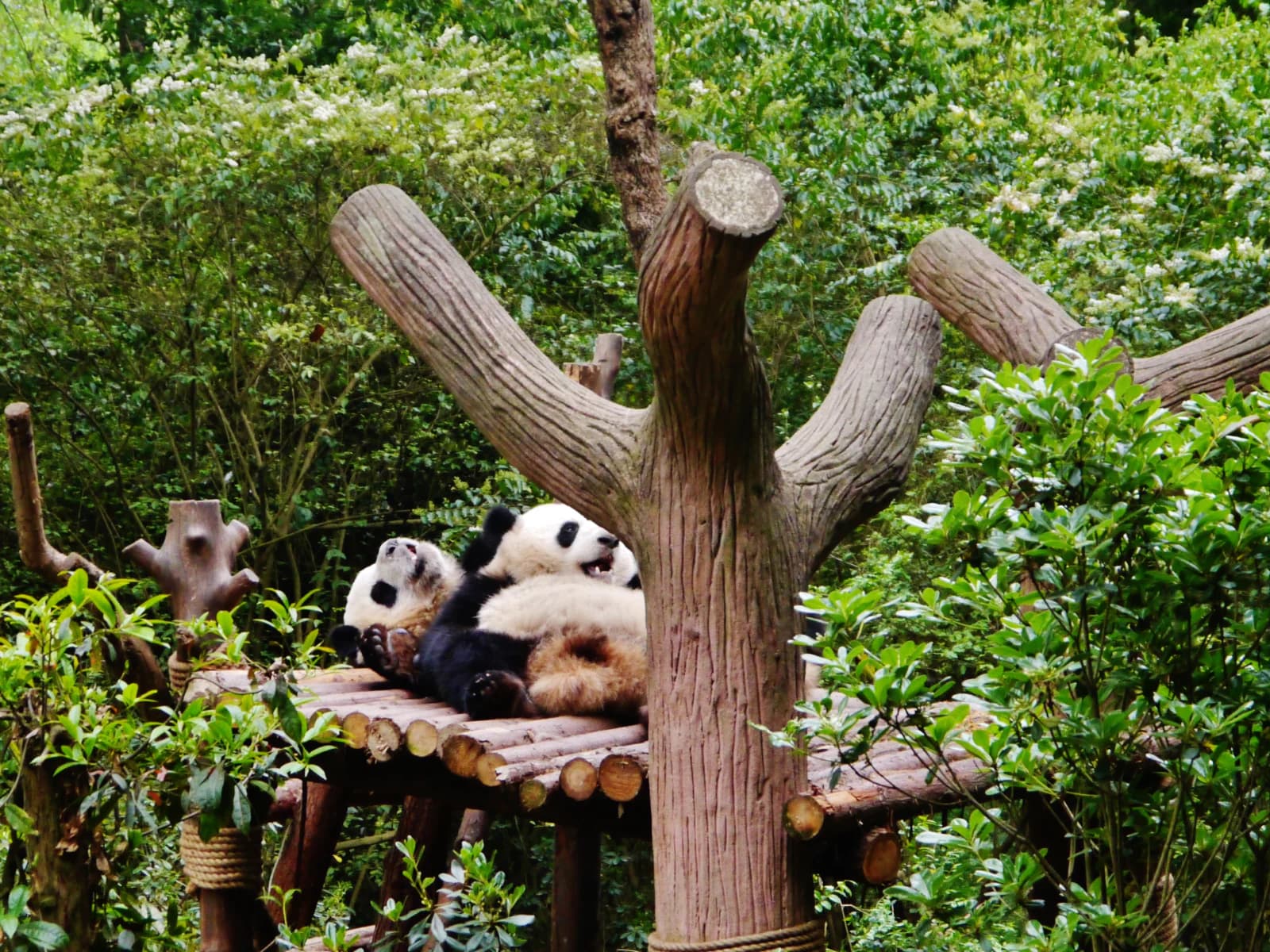
Chengdu supports a panda-led trip rather than a single zoo stop. Animal behavior, enclosure access and visibility vary on every visit. Photo by Zairon, resized, CC BY-SA 4.0.
Chongqing Zoo is a valid choice when you prefer Chongqing for every other reason and want pandas without changing cities. It sits on Metro Line 2, and a focused morning can prioritize the panda areas before one or two additional zones. The zoo remains a large, hilly animal park rather than a Chengdu-style panda institution. It offers less panda-specific depth but better efficiency inside a Chongqing stay.
No ticket guarantees an active panda, a named animal or a particular outdoor enclosure. Cooler mornings often produce more comfortable viewing conditions, but keepers, weather, welfare needs and the animal determine what you see. Compare the exact Trip.com Chengdu Panda Base product or Trip.com Chongqing Zoo product only after checking the current official notice, dated entry, passport handling and cancellation rule.
The decision is straightforward:
- Pandas are one item on a broader city trip: Chongqing Zoo is enough.
- Pandas are one of the main reasons for traveling: choose Chengdu.
- You want a mountain conservation context: base in Chengdu and give Wolong/Shenshuping a dedicated day; do not treat it as a small city add-on.
Food: choose the meal pattern you want to sustain
Both cities belong to a broader Sichuan flavor world, and both can be spicy. The useful difference lies in how a visitor builds several days of meals.
Choose Chongqing for a concentrated, forceful food chapter
Chongqing hotpot is an evening commitment. Red broth, often built around beef tallow, chile and Sichuan pepper, carries a rich aroma and heat that can intensify as the pot reduces. A divided pot helps mixed-tolerance groups, although the kitchen's exact broth and separation still need checking. Order a small first round, let staff explain cooking times, and put hotpot after the walking day.
Xiaomian makes the opposite meal: quick, compact and suitable for breakfast. The seasoning bowl can combine chile, peppercorn, preserved vegetables, soy and other aromatics. “Mild” remains relative, so taste before adding more oil. Sour-and-spicy noodles, grilled fish and cold desserts provide variation, but the city's most recognizable meals still lean intense.
Choose Chongqing when a short trip can support one noodle breakfast, one hotpot night and one lighter meal. Travelers with reflux, low chile tolerance or young children need a deliberate second lane: clear-broth noodles, plain rice, steamed dishes and restaurant staff who can explain the stock.
Choose Chengdu for a broader tasting rhythm
Chengdu makes it easier to alternate rich and light, quick and slow. Hotpot and chuanchuan skewers can carry one evening. Dan dan noodles, Zhong dumplings, chaoshou wontons, mapo tofu and vegetable dishes create smaller tasting units. A park teahouse adds time without requiring another heavy meal. The city rewards groups whose members want different levels of heat and texture.
The difference is wider than “Chengdu is less spicy.” A dish can still be hot, numbing or oily. Chengdu's advantage is the breadth of recognizable formats and the ability to pause between them. If the social setting matters as much as the dish, use the Chengdu teahouse and mahjong guide to distinguish a public park teahouse from a performance package or resident game.
For either city, learn three controls: 微辣 wēilà for mildly spicy, 不要辣 bú yào là for no chile, and 鸳鸯锅 yuānyāngguō for a divided hotpot. These are requests, not laboratory guarantees. Serious allergies, vegan diets and halal requirements need ingredient and cross-contact questions beyond spice level.
Night: Chongqing wins the skyline; Chengdu offers a gentler finish
Night is central to Chongqing's value. Qiansimen Bridge, Hongya Cave, the riverbanks and the towers behind them create several depths in one view. The South Bank gives the city room to become a skyline; central Yuzhong puts you inside the density. The visual effect survives without a rooftop, cruise or paid platform.
Build the day toward dusk rather than promising a fixed lighting minute. Weather, maintenance, crowd controls and event programming change. The South Bank photo route gives old streets the daylight and the public river edge the blue hour. Leave enough energy for the return: the final road pickup can sit above or below the promenade.
Chengdu at night is lower-key. Anshun Bridge and the Jin River offer a clear blue-hour or evening walk; Jiuyan Bridge adds bars and later noise. Taikoo Li and Wangping Street provide dining and retail energy. A Sichuan opera program can anchor an evening when its exact show, seat and language support are known. None needs to compete with Chongqing's city-scale spectacle.
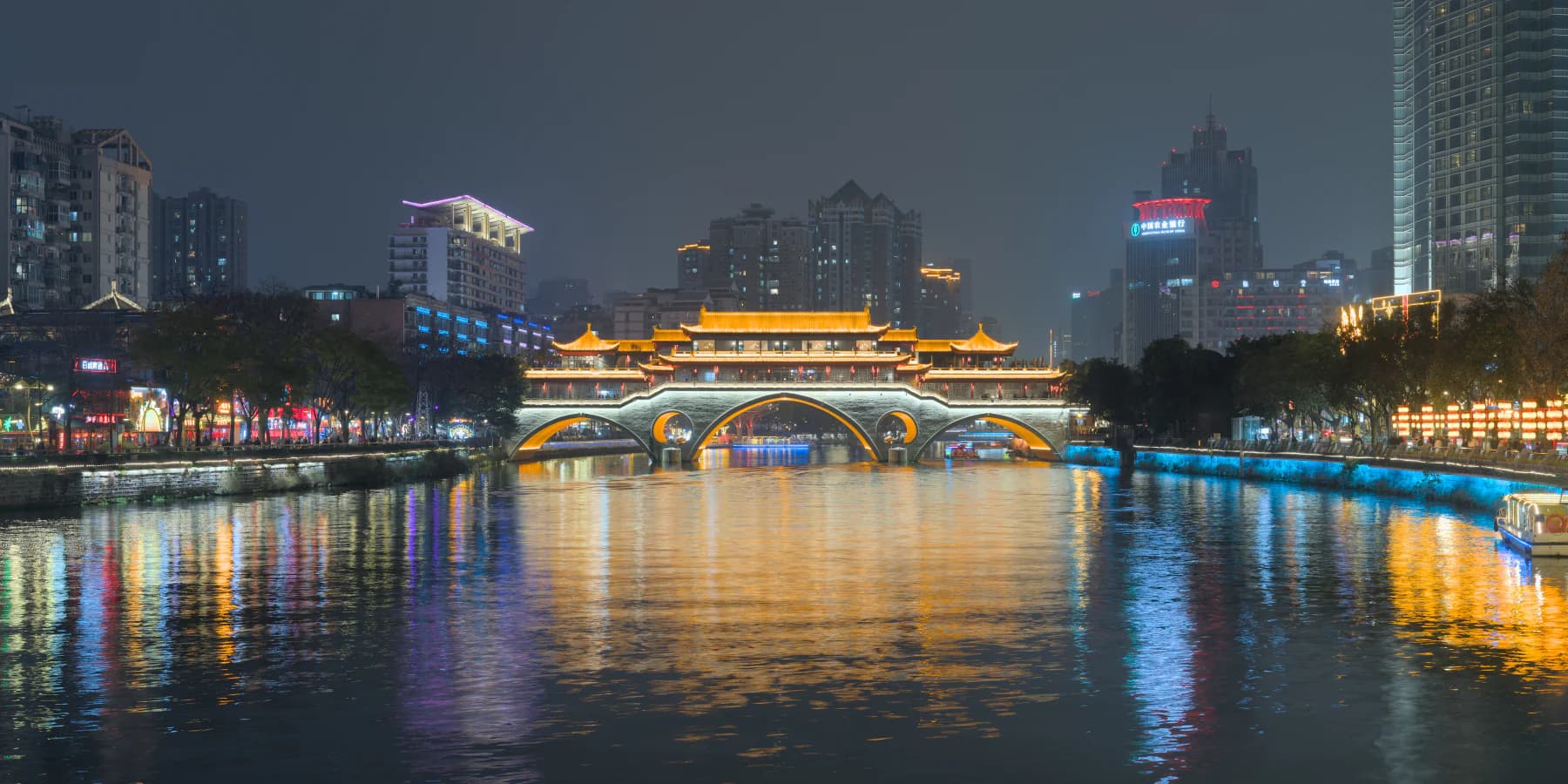
Anshun Bridge shows Chengdu's softer night rhythm: a river walk can finish the day without turning into a second sightseeing campaign. Lighting and reflections depend on current operations and weather. Photo by Daniel Lu, resized, CC BY-SA 4.0.
Choose Chongqing if photography and night walking are core trip goals. Choose Chengdu if the best evening is dinner, one illuminated river segment and a comfortable return.
Weather: both are humid; Chongqing magnifies the heat through terrain
Both cities sit in the humid Sichuan Basin region, with hot summers, limited sunshine in many cooler periods and rain that can make stone surfaces slick. Chongqing's municipal profile describes a humid subtropical monsoon climate with hot summers, plentiful rain, high humidity, frequent cloud and fog, and low average wind. Chengdu can also experience severe summer heat; it should never be sold as a cool alternative simply because its walking is easier.
The practical differences are about exposure:
- Summer: Chongqing's slopes, stairs and river-valley heat compound one another. Build outdoor clusters early and late, use metro and indoor resets at midday, and cut a viewpoint before cutting water or recovery time. In Chengdu, protect the panda morning, use a museum or tea break at the hottest point, and avoid stacking a large outdoor base with a long neighborhood walk.
- Spring: Both cities can work well, but rain changes paving, river views and mountain excursions. Bring grip and a compact rain layer rather than planning around a climate average.
- Autumn: Often the most appealing season for sustained city walking, yet western China can have prolonged rain. Holiday crowds can matter more than temperature during the first week of October.
- Winter: Temperatures are milder than northern China, while damp air and limited indoor heating in some buildings can feel colder than the number suggests. Layer for long outdoor periods. Chengdu's outward mountain routes and Chongqing's elevated districts can diverge sharply from downtown conditions.
Check the live forecast for the city and the actual day-trip destination. Wulong plateau weather does not equal central Chongqing. Wolong, Mount Emei and Jiuzhaigou do not equal Chengdu's urban forecast. Visibility is never promised: fog can add atmosphere and remove a skyline on the same day.
Getting between the cities: a short train still creates a move day
Existing high-speed services connect the cities in roughly 62 minutes at the fastest station-to-station. The much-publicized future 50-minute timing refers to the Chengdu–Chongqing Central Line, which was still under construction in 2026. Do not plan a current trip around an unopened line.
The issued ticket controls the station pair. Chengdu East is a common Chengdu anchor. Chongqing services can use Chongqing North, Chongqing West or Shapingba, among others. These are not interchangeable labels. Search by exact station name and compare the last-mile route to your hotel before paying.
Budget about four hours hotel to hotel, sometimes more:
- pack, check out and reach the correct station;
- pass identity checks and security with margin;
- take the train shown on the ticket;
- navigate a large arrival station;
- reach the next hotel, leave luggage and reset.
That is why a five-day “Chengdu and Chongqing” trip rarely contains five full sightseeing days. Check live Trip.com train inventory, then verify train number, station and passenger-document fields on the issued ticket. Do not copy a timetable from a blog or from this guide.
For a combined trip, stay near a useful metro network rather than beside the station unless departure is very early. In Chengdu, Tianfu Square, Chunxi Road/Daci or Wenshu can support a first stay. In Chongqing, Jiefangbei provides the easiest night return, while Shapingba can simplify a specific train but weakens the classic central-city evening.
Choose by the next stop, not only by the city itself
Chengdu creates a Sichuan and northwest corridor
Choose Chengdu when your next chapter is:
- Sanxingdui: a full museum day from one Chengdu base, without moving hotels.
- Dujiangyan: water engineering and an optional overnight for Mount Qingcheng or Panda Valley.
- Leshan and Mount Emei: a two- or three-day cultural and mountain extension rather than two rushed day trips.
- Jiuzhaigou and Huanglong: current rail plus road logistics make Chengdu the natural planning hub; use the Jiuzhaigou–Huanglong route chooser for the base and altitude sequence.
- Western Sichuan: only when you can give the road, altitude and weather several days. A Chengdu hotel does not make a highland valley a casual day trip.
Chengdu also fits naturally after Xi'an in a classic rail itinerary. The resulting trip moves from imperial and archaeological depth to Ancient Shu, pandas and Sichuan public life.
Chongqing creates a karst, rock-art and Hunan corridor
Choose Chongqing when your next chapter is:
- Wulong: karst bridges, a fissure gorge, Furong Cave and plateau weather. One night makes the separate transfers much more realistic.
- Dazu: Baodingshan and Beishan rock carvings, best treated as a full cultural day with live return transport.
- Zhangjiajie, Furong or Fenghuang: current rail geometry makes Chongqing a useful western gateway. The Chongqing–Zhangjiajie–Furong–Fenghuang route separates the move days and avoids treating four bases as day trips.
- The Yangtze corridor: when the river journey itself is the next product and you have verified the exact ship, pier, cabin and dated route.
The open-jaw pattern often saves a backtrack: enter through Chengdu, travel by train to Chongqing, then continue to Zhangjiajie or fly out of Chongqing. Reverse it when Xi'an, Leshan or the Sichuan mountains come after the two-city pair.
How many nights should you give each city?
Two nights: choose one, and keep it urban
In Chongqing, use one terrain-smart central day and one vertical-city or zoo half-day, then finish with the skyline. In Chengdu, choose either a panda morning plus central culture, or a non-panda city stay with museum, park, tea and food. A distant excursion consumes too much of a two-night visit.
Three nights: the cleanest one-city decision
Three nights give Chongqing two full city days plus arrival or departure time. They give Chengdu one panda or museum anchor, one central cultural day and one flexible half-day. Chengdu can fit Sanxingdui only if you accept that it replaces much of the urban depth.
Five nights total: still choose a lead city
Use three Chengdu nights plus two Chongqing nights when pandas and food variety matter, accepting a compressed Chongqing core. Use three Chongqing nights plus two Chengdu nights when night photography and vertical urbanism lead, accepting that Chengdu becomes pandas plus one city cluster. The move removes part of a day.
Six to eight nights: combine them properly
A balanced six-night structure is three nights in each city. With seven or eight nights, add one outward day or night to the city whose regional role matters more. Do not automatically add an excursion to both: Wulong plus Sanxingdui plus pandas can make the trip feel like repeated transfers.
One workable seven-night route is:
- Chengdu arrival and neighborhood dinner.
- Early Panda Base, then a light temple or teahouse afternoon.
- Central history, park and food; or Sanxingdui as the one full outward day.
- Train to Chongqing, hotel reset and a nearby dusk view.
- Old-city descent, Jiefangbei and Hongya/Qiansimen night.
- Liziba, one uphill transfer, Eling or another vertical-city cluster.
- South Bank heritage and river views, or a focused zoo morning before departure.
Choose for the people in your group
With young children: Chengdu usually wins because pandas, museums, parks and shorter central clusters are easier to alternate. Protect nap and meal rhythms. Chongqing works for a transport-loving child when you cut the stair routes and use Line 2, the zoo and one river view.
With older travelers: Chengdu is the safer default. Choose People's Park, a focused museum, a correct Panda Base gate and vehicles between clusters. Chongqing remains possible with a river-view hotel, road-accessible viewpoints and one attraction per half-day.
For photography: Chongqing wins for layered architecture, blue-hour transitions and transport framed against buildings. Chengdu wins for pandas, bamboo, teahouse material details and a calmer river evening. Photography does not justify blocking bridges, resident doors or zoo rails.
For food-first travelers: Chengdu wins on the number of distinct meal formats you can sustain for several days. Chongqing wins when the desired chapter is focused: noodles, hotpot and late-night intensity.
For museums and archaeology: Chengdu usually wins through Chengdu Museum and Sanxingdui, with Dujiangyan adding engineering. Chongqing becomes stronger when Dazu rock carvings or Three Gorges history is the specific interest.
For nightlife: Chongqing wins for night sightseeing. Chengdu may fit better when nightlife means bars, live performance, tea or a long dinner rather than skyline photography.
Cut-first rules when the plan becomes too full
In Chongqing, cut the distant viewpoint before cutting the return margin. Cut a second food street before cutting one proper hotpot meal. Cut a cross-city attraction before forcing a sequence of slopes in peak heat. Keep one full dusk-to-night river chapter.
In Chengdu, cut the second outward excursion first. Sanxingdui, Dujiangyan, Leshan and a distant panda base each deserve their own planning unit. Cut one commercial ancient street before cutting the park or neighborhood pause that makes the city distinctive. Keep one early, structured anchor and one flexible half-day.
For a combined trip, cut the second city entirely when you have fewer than five nights, an early flight, limited mobility or several other hotel moves nearby. The one-hour train headline does not repair a rushed itinerary.
Choose Chongqing when you want the city to confront you with scale, elevation and light. Choose Chengdu when you want wildlife, cultural range and a trip that improves when you slow down. Choose both only when the calendar can absorb a real move day and you can still give each city a complete chapter.