Chengdu relaxed streets and neighbourhood walks
Choose People's Park to Kuanzhai Alleys for a first visit, a proper tea stop and the simplest introduction to Chengdu street life. Choose Yulin for food, ordinary residential texture and a route that feels least like a checklist of attractions. Choose Wangjiang Tower Park to Jiuyan Bridge and Anshun Bridge for bamboo, literary history and a river finish at blue hour. Choose Daci Temple to Wangping Street for old-and-new contrasts, cafés and the easiest route to adapt around rain.
These are four separate half-day walks. Each protects time for sitting, eating, looking and changing course. A direct map distance only describes the shortest movement between anchors. Your actual total will be longer after park loops, side streets, crossings and photography. If you combine two routes into one day, keep a long indoor break between them; do not splice their street lists into one exhausting march.
Choose your walk
| Walk | Allow | Realistic walking | Best for | Food and tea | Photo character | Think twice if |
|---|---|---|---|---|---|---|
| 1. People's Park to Kuanzhai | 3–4 hours | About 2.5–3.5 km | First visit, tea, older relatives who want frequent seats | Tea is the center; snacks easy later | Plane trees, gaiwan tea, old lanes | You want a quiet local district without visitor crowds |
| 2. Yulin residential weave | 2.5–4 hours | About 2.5–3.5 km | Food, small shops, ordinary street rhythm | Strongest food choice; tea is optional | Storefronts, produce, bicycles, dusk signs | Uneven curbs, traffic or private thresholds are difficult |
| 3. Wangjiang to Anshun | 3 hours without the museum; 4–5 with it | About 4–5 km including park paths | Literary context, bamboo, sunset and nightlife transition | Light meal before or after; bars optional | Bamboo, red walls, river and bridge reflections | Heat, rain or a late start removes the park-to-blue-hour sequence |
| 4. Daci to Wangping | 3–4 hours | About 3.5–4.5 km | Modern Chengdu, cafés, flexible rainy-day stops | Most café choice; scattered meals | Temple details, shopfronts, riverside city life | You expect a preserved old quarter or dislike commercial streets |
For the gentlest physical plan, do only People's Park, take tea, then ride one metro stop or call a car instead of walking onward. For the fewest obvious tourist sights, choose Yulin on a weekday. For a date-night atmosphere, choose Wangjiang to Anshun and reach the river before dusk. For a mixed group that wants different things, Daci to Wangping provides the easiest sequence of temple, retail, coffee and river.
What “relaxed” should mean
A relaxed Chengdu walk has two or three anchors and at least one stop long enough to lose track of the itinerary. It is not a promise that every pavement is empty, flat or shaded. Kuanzhai receives tour groups; Yulin has delivery scooters and daily traffic; the riverfront grows busy in good evening weather. Chengdu's humid heat can turn three kilometres into serious effort.
Protect 45–90 minutes for tea, 30–60 minutes for one food stop and a margin for wrong exits or an interesting side street. Choose one optional branch to cut first. Begin earlier in hot or wet weather, but do not force the evening river route into bright afternoon solely to avoid crowds. For the Anshun reflections, the change from daylight to blue hour is part of the walk.
Save the Chinese place names and exact AMap pins before leaving Wi-Fi. Each pin identifies the entrance, street or station exit named. Live construction, temporary crowd controls and station access can still redirect the last few metres.
Walk 1: People's Park, tea and the lanes beyond Kuanzhai
Choose it for: a first Chengdu afternoon, an older traveler who wants seats, or anyone who wants tea to be the point rather than a five-minute prop.
Start: People's Park Metro Exit B, Line 2.
Core anchors: People's Park, Heming Teahouse, Citang Street, Binsheng Street, Kuanzhai Alleys, Paotongshu Street and Xiaotong Alley.
Finish: Kuanzhai Alleys Metro Exit B, Line 4.
Exit the metro beside People's Park rather than beginning at Kuanzhai. The park gives the route its rhythm: shaded paths, exercise, conversation and tables under the trees. Walk one short loop before sitting. That helps you distinguish the public park from the business operating a particular cluster of chairs.
At Heming Teahouse, approach a staff member instead of occupying a table and assuming it is free. Show the number in your group and ask “这里可以坐吗?” (Can we sit here?) and “可以看茶单吗?” (May we see the tea menu?). Check the current price, what refills are included and whether payment happens before or after service. Prices and systems change, so this guide does not invent a fixed amount. Order one tea you actually want to drink, then give it time. Forty-five minutes is a minimum useful pause; 60–90 minutes lets the park happen around you.
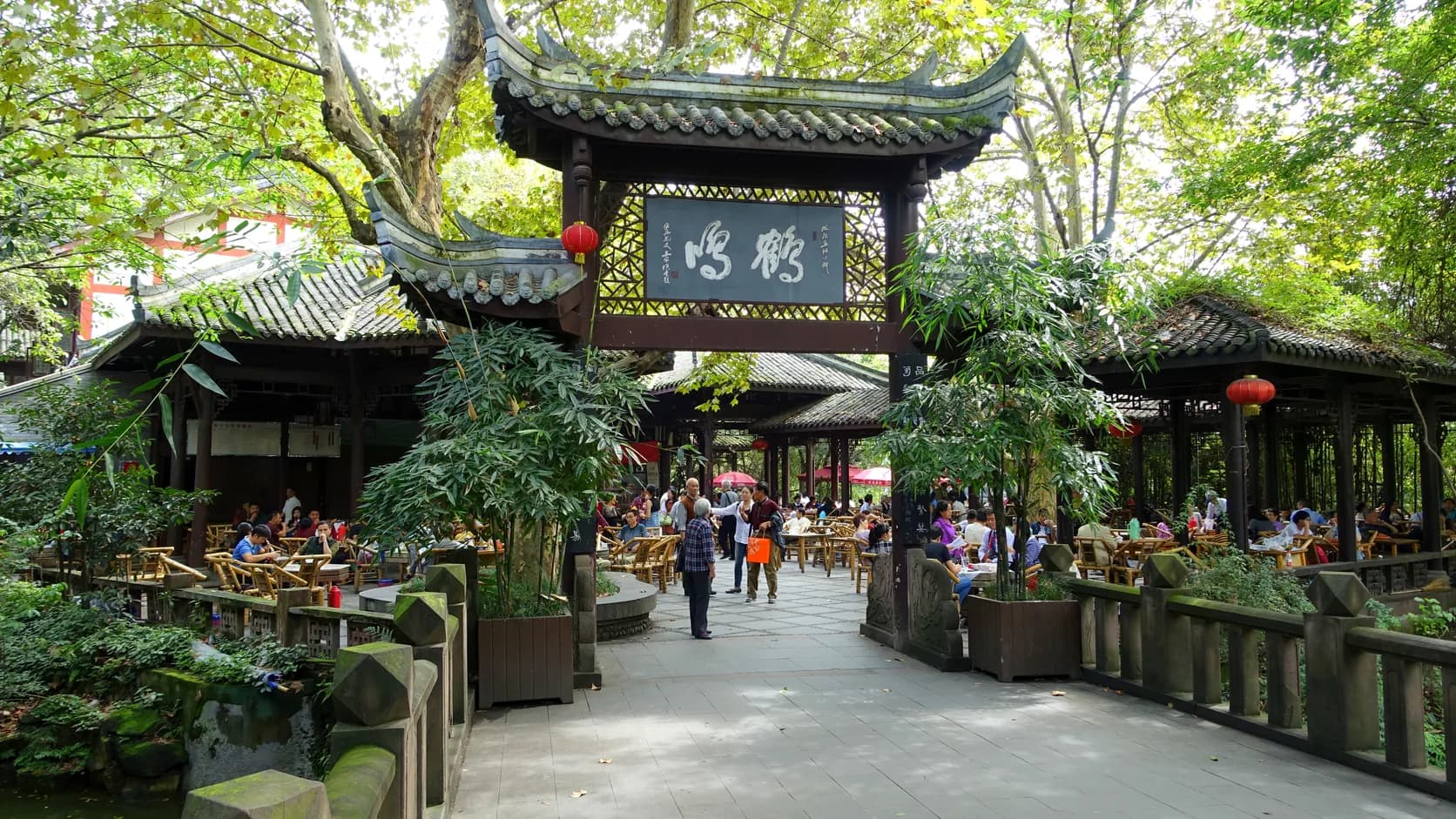
Teahouse in People's Park. Photo by Daderot, cropped from the original and dedicated to the public domain under CC0 1.0;

source
. The photograph does not represent today's seating, prices or crowd level.
From the park, use Citang Street and Binsheng Street as a transition rather than racing directly to a famous gate. The direct AMap walk from People's Park to Kuanzhai is only about 0.7 km / 9 minutes. The useful version takes longer because you pause at street corners and let the change from park edge to visitor district remain visible.
Wide and Narrow Alleys is a restored commercial heritage district, not an untouched residential time capsule. The three public lanes are free to walk, but a doorway, courtyard, shop, performance or table inside them may be private, ticketed or reserved. Enjoy the architecture without claiming every façade as “ancient” or treating a courtyard threshold as public access.
If you still have energy, continue north through Paotongshu Street to Xiaotong Alley. AMap measures Kuanzhai to Xiaotong at about 0.5 km / 7 minutes directly. This final piece brings smaller-scale cafés and street details after the main visitor lanes. It is optional: in rain, heat or peak holiday crowds, finish at Kuanzhai Metro instead.
Best time: a weekday morning for a calmer park or mid-afternoon when tea can roll into an early evening lane walk. Crowd tactic: arrive at the park first and treat Kuanzhai as the finish, not the whole experience. Accessibility: the park has many places to pause, but paving, thresholds and dense lane crowds vary; the simplest accessible version is a park loop plus tea, with a vehicle onward.
Walk 2: Yulin for residential streets and food
Choose it for: the strongest food-led walk, a repeat Chengdu visit, or street photography that depends on ordinary urban texture rather than monuments.
Start and finish: Fangcao Street Metro Exit C1, Line 8.
Sequence: Fanghua Street → Beilei Street → Yulin Third Alley → Yulin Fourth Alley → Yulin Market.
AMap's checked baseline is about 0.6 km / 8 minutes from Exit C1 to Fanghua Street, 0.7 km / 10 minutes directly from Fanghua Street to Yulin Market, and 1.0 km / 14 minutes from the market back to the metro exit. Those numbers reveal why this is a chooser route rather than a fixed trail: the direct line would be over quickly. The pleasure comes from weaving between the listed streets, looking down short alleys and choosing one place to eat. Expect roughly 2.5–3.5 kilometres after those detours.
Yulin is a living neighborhood. Apartment entrances, scooters, deliveries, pharmacies, produce stands and small restaurants share limited space. That ordinary use is the attraction, and it also sets the rules. Keep residential doorways clear. Do not photograph through windows. A market stall remains somebody's workplace even when it looks visually perfect. Point to the camera and ask before making a close portrait or a tight photograph of someone's hands.
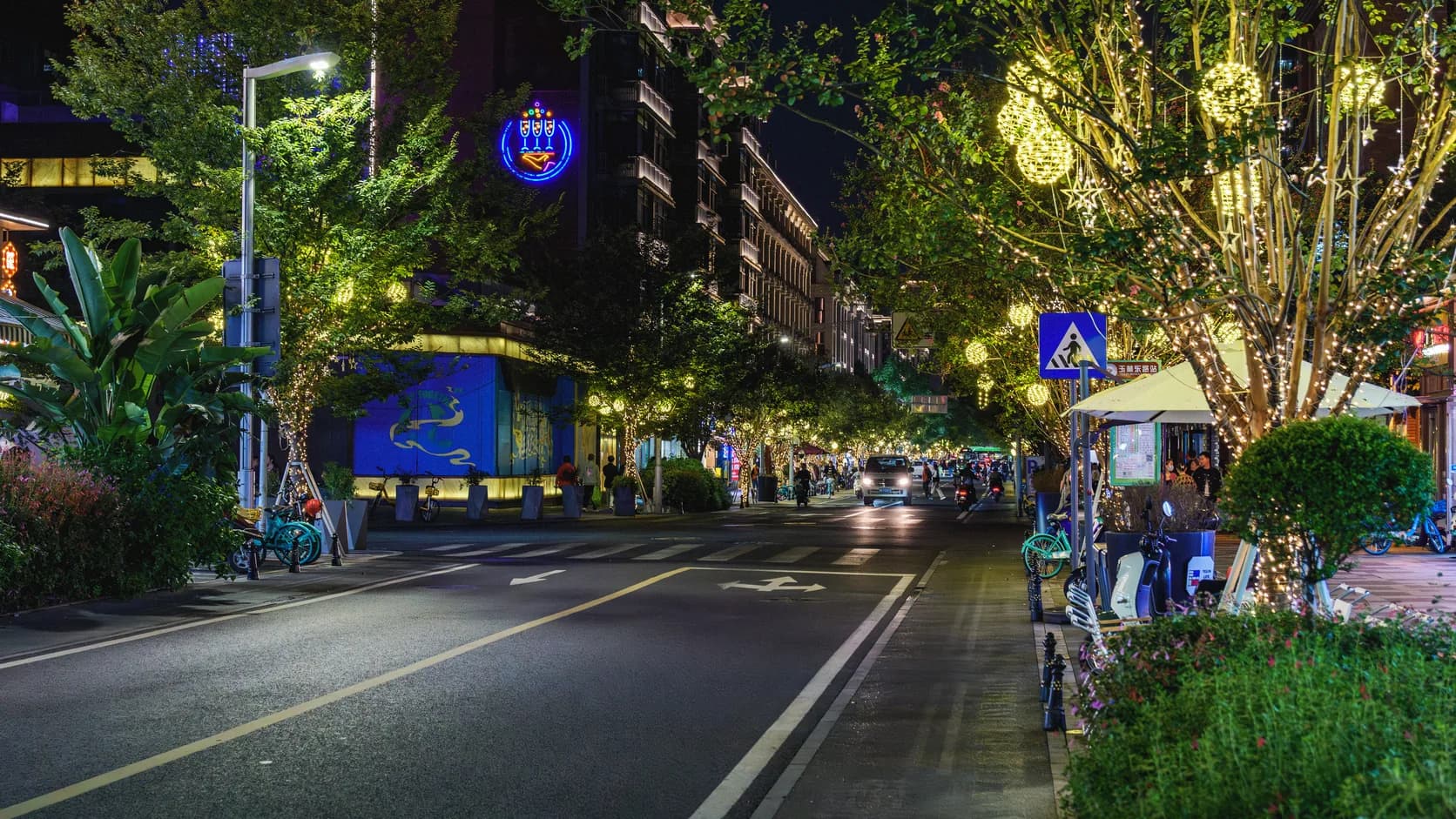
Yulin East Road in the evening. Photo by TurnOnTheNight, cropped from the original, licensed under CC BY-SA 4.0;

source
. Individual businesses and signs can change.
Do not arrive with a list of eight viral restaurants. Tenants, hours and queues change faster than the street pattern. Scan for an open place that matches the group, inspect the posted menu where available and commit to one real stop. A small meal plus one snack usually produces a better walk than constant queuing. If you have allergies or dietary limits, show a translated written card; pointing at a photo cannot reveal stock, sauce or cross-contact.
Start in late afternoon if you want both daylight storefronts and the first glow of signs. Start earlier in summer if the group is heat-sensitive, but recognize that some dinner businesses will not yet be active. After dark, use marked crossings and keep watching for quiet electric scooters. The neighborhood is not a pedestrian set.
Yulin is the least predictable option for a wheelchair user or traveler unsteady on curbs. The nominal distance is modest, but parked vehicles, threshold changes and narrow pavements create frequent decisions. A practical reduced version is Fangcao Street Metro to Fanghua and Beilei streets, then a meal and a ride-hail pickup on a legal road edge instead of completing the loop.
This walk can sit beside the classic half-day city walk, but it should not imitate it. The classic route explains central landmarks; Yulin is for observing how a neighborhood works. If a shop or lane feels too private, simply keep moving. There is always another street corner.
Walk 3: Wangjiang's literary park to Jiuyan and Anshun at night
Choose it for: bamboo, poetry and a strong daylight-to-night sequence. It is the best of these routes for a traveler who wants the photographs to change visibly over one walk.
Start: Sanguantang Metro Exit C, reached from Line 6; the interchange station also serves Line 13, so follow the live signs to Exit C.
Core: Wangjiang Tower Park → optional Sichuan University Museum → Jiuyan Bridge → Anshun Bridge → Hejiang Pavilion.
Finish: Dongmen Bridge Metro Exit B, Line 2.
AMap's checked walking legs are 0.7 km / 10 minutes from Sanguantang Exit C to Wangjiang, 0.5 km / 7 minutes from the park pin to the museum, 0.6 km / 8 minutes from the museum to Jiuyan Bridge, 0.5 km / 7 minutes from Jiuyan to Anshun, 0.4 km / 6 minutes to Hejiang Pavilion, and 1.0 km / 14 minutes from Hejiang to Dongmen Bridge Metro. Those connectors already total 3.7 kilometres; after the park interior and river wandering, plan on roughly 4–5 kilometres.
Wangjiang Tower Park connects its bamboo landscape and heritage area with Xue Tao, the Tang-period poet whose memory shapes the site. Give the park at least an hour. A fast lap loses the contrast between bamboo shade, red architectural details and the more ordinary recreational edges. Start roughly one to one and a half hours before sunset if you are skipping the museum. With the museum, begin much earlier.
The heritage section has specific photography controls. Current official rules allow ordinary handheld phone and camera use in permitted areas. Indoors, flash, selfie sticks, tripods and heavy supports are prohibited. Outdoors, do not block paths or sightlines, create a cordon or leave a tripod standing when staff ask it to be packed. Commercial, brand or publication work involving the collection or park identity may require written permission. The park's visitor notice also prohibits unauthorized commercial shooting, livestreaming and drones. Follow signs and staff instructions on the day; a public ticket does not create a production permit.
The Sichuan University Museum is an optional indoor branch, not a casual shortcut through campus. Its official ticket page currently lists regular hours Tuesday–Sunday, 09:00–17:00, with last entry at 16:30; it normally closes Monday except some holidays. It also lists a CNY30 ordinary adult ticket and CNY15 student ticket, with real-name reservation through the official mini-program. Holiday notices can override routine hours. If you cannot reserve or the museum closes before your sequence reaches it, continue to the river.
Time the Jiuyan-to-Anshun section for late daylight and blue hour. Jiuyan is a bridge district and nightlife anchor, while Anshun provides the clearer illuminated bridge-and-reflection composition. Lighting, weather and water conditions vary, so no guide can promise a precise switch-on time or a mirror reflection. Walk the public river edge until the angle works; do not enter a bar terrace or restaurant platform to copy an online frame unless you are a customer and staff permit photography.
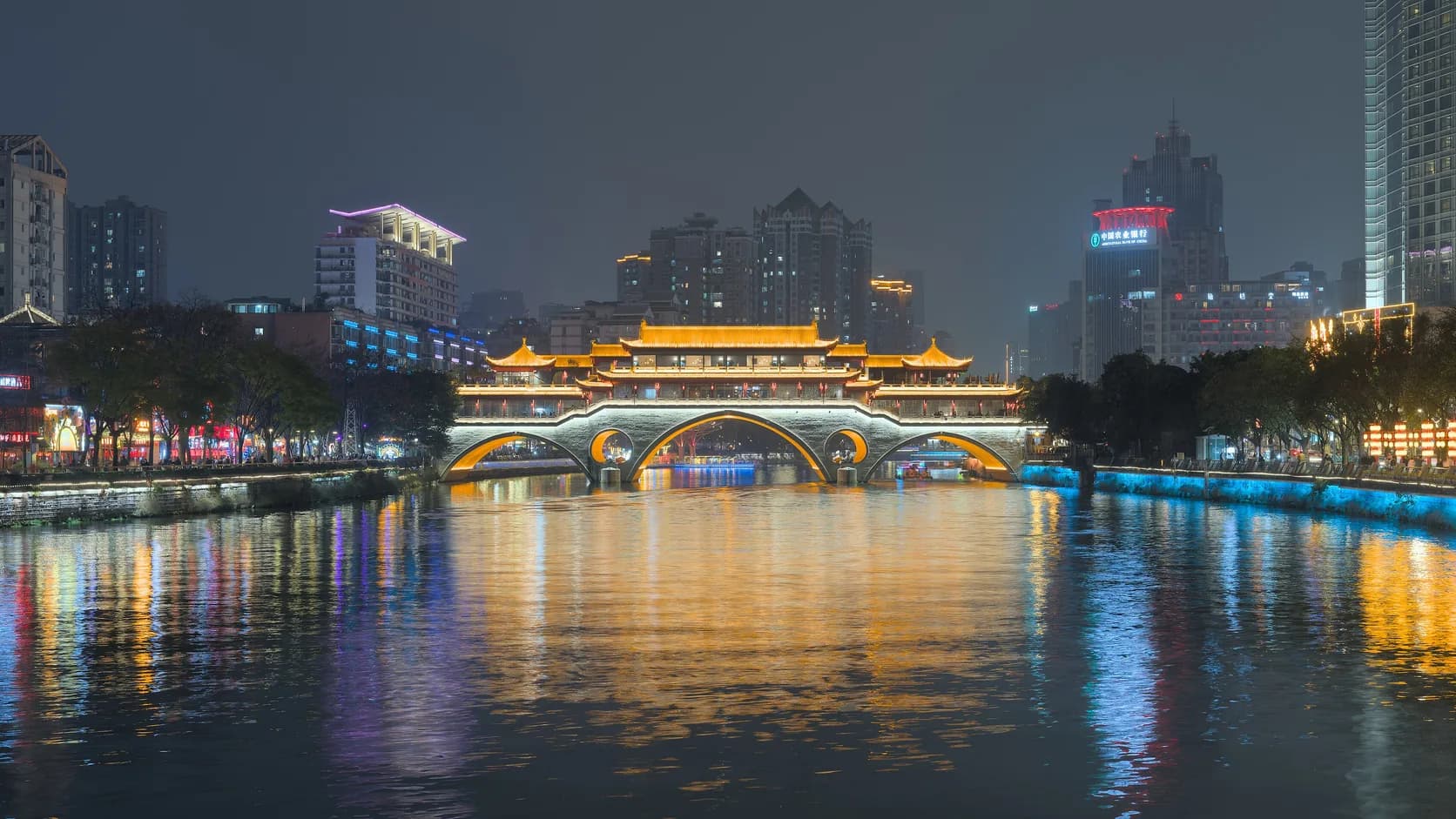
Anshun Bridge at night. Photo by Daniel Lu, cropped from the original, licensed under CC BY-SA 4.0;

source
. Lighting and reflections depend on current operations and weather.
Jiuyan's bars are optional. You can complete the entire visual sequence on public paths without purchasing nightlife. If you enter a venue, check the menu, minimum spend if any, closing time and terrace rules before ordering. Noise rises later, especially in good weekend weather. Families and quieter travelers should reach Anshun around blue hour and leave from Dongmen Bridge before the bar district peaks.
In heavy rain, cut the museum and river linger rather than rushing inside the protected park. In extreme heat, begin later but accept less park time. Surfaces by the river can be slick, and railings are safety boundaries rather than camera supports. This walk has more continuous movement and fewer guaranteed public seats than People's Park.
Walk 4: Daci Temple, Tangba Street and Wangping Street
Choose it for: an active temple beside contemporary retail, flexible café stops and a route that works when different people want architecture, shopping and riverside atmosphere.
Start: Chunxi Road Metro Exit C, Lines 2 and 3.
Sequence: Daci Temple → Tangba Street → Wangfu Street → Wangping Street.
Finish: Yushuang Road Metro, Lines 4 and 6.
Begin with Daci Temple, then look outward at the surrounding Taikoo Li architecture. Daci is an active religious site. Keep voices low, do not interrupt worship, and follow any room-level photography sign. Never use flash toward worshippers or turn incense practice into a posed backdrop.
The checked AMap baseline from Daci to Tangba Street is about 0.9 km / 13 minutes. Tangba to Wangping is about 1.3 km / 18 minutes. Wangping to Yushuang Road Metro is another 1.1 km / 15 minutes. Those direct legs total more than the route may appear to on a social-media map, and browsing adds distance. Cut Wangfu Street first if the weather or group energy changes.
Tangba and Wangping are best understood as evolving commercial and residential streets, not as a fixed roster of “must-visit” shops. Cafés, bookstores, restaurants and creative tenants change. Check today's opening state before crossing the city for one business. Shopfronts visible from a public pavement are part of the street scene; interiors, display tables, courtyards, rooftop areas and customer seating remain controlled by the operator. Ask before photographing extensively or setting up a tripod.
This is the easiest walk to pause during a shower because commercial interiors are frequent, but entering them creates a customer relationship. Buy something when you occupy a café table, follow posted policies and do not treat a small shop as free shelter for a group. In sustained rain, shorten the route to Daci and Tangba. Wet pavement can improve reflected light, but scooters, umbrellas and reduced visibility make intersections riskier.
The route finishes with a more contemporary slice of Chengdu than Kuanzhai. Use the river and neighborhood movement around Wangping for a final wide frame, then walk to Yushuang Road Metro. If nightlife is the priority, choose the Anshun route instead. Wangping suits a calmer meal or drink without making bars the whole destination.
Tea, mahjong and ear cleaning: how to participate without turning people into props
Sitting for tea
A tea stop begins with a seat check. In a park, chairs may belong to different operators or sections even when they look casually arranged. Ask staff for a table, request the menu and confirm the current tea price and refill practice before ordering. If you want food, outside snacks or an extra cup, ask first. Do not rearrange several tables for a large group without permission.
Gaiwan tea is designed to last. Let the lid hold leaves back as you sip, or ask staff to demonstrate. A refill may be included at some venues, but never assume it. Photograph your own tea and companions freely after they agree; ask before including neighboring customers prominently. The best “Chengdu tea” experience is often an hour of doing very little.
Mahjong
Mahjong in a park or neighborhood is a private social activity even when a table is visible from a public path. Do not hover over a game, identify the players in a close photograph or ask to join because it would make a good story. If someone invites conversation, accept or decline politely. If you want a photograph, ask the table and take “no” immediately. Avoid recording hands long enough to interfere with play.
Ear cleaning
Ear cleaning may be offered around busy tea areas, but it is a separate personal service, not part of park admission or a tea order. You can decline any approach. Before agreeing, ask for the full current price, what service is included, what will touch the ear and how tools are handled. Stop if you are uncomfortable. Skip it if you have ear pain, infection, recent surgery, a perforated eardrum or any uncertainty that deserves medical advice. Do not let a travel trend overrule your own consent.
Use the Chengdu teahouse and mahjong guide for venue-type comparisons, gaiwan ordering language, no-stakes beginner play and a complete add-on price check.
Ask both the practitioner and any identifiable client before photographing. A close-up of a procedure is not public simply because it takes place outdoors.
The boundary that prevents most awkward moments
A public path lets you pass through and make ordinary, unobtrusive photographs subject to local rules. It does not grant use of everything visible from it.
- A park path is public access; a teahouse chair, staff area or paid pavilion is not.
- A lane is public circulation; a residential doorway, courtyard and window remain private.
- A market aisle can be open to visitors; a stall counter and a vendor's portrait still need courtesy and often permission.
- A river walk is public; a bar terrace, restaurant platform, boat and rooftop are controlled spaces.
- A museum ticket permits an ordinary visit under current rules; it does not permit a commercial production, tripod or unrestricted photography.
- A temple courtyard may admit visitors while individual halls restrict images, voices or entry.
If a composition depends on crossing a rope, opening a gate, blocking a door or moving furniture, abandon it. Chengdu offers another frame within a minute.
Weather, crowds, access and nightlife
Heat: In the warmest months, begin a daytime walk early, carry water and choose the route with the most shade or indoor pauses. People's Park and Wangjiang have strong tree cover, but humidity remains tiring. Yulin's food businesses and Daci's commercial surroundings give escape points; the river route needs deliberate timing.
Rain: Light rain suits Yulin storefronts and Daci-to-Wangping reflections if footwear grips well. A downpour makes narrow pavements, scooter traffic and river edges harder. Do not shelter in a private doorway or temple hall that is not open for that use. The Sichuan University Museum can be a planned indoor branch only with its own reservation and opening schedule.
Crowds: Avoid Chinese public-holiday afternoons when possible. At Kuanzhai, move one lane away from a tour cluster instead of pushing through it. In Yulin, dinner demand is the crowd. At Anshun, blue hour concentrates photographers. Make one frame, step away from the railing and let others use the view.
Access: None of the four routes should be described as fully step-free without a live check. Metro stations have accessible routes, but the most convenient named exit may not be the lift exit. Ask station staff for the elevator route. People's Park offers the easiest seated version. Yulin has the most curb and parked-vehicle friction. Wangjiang adds protected-site rules and longer movement. Daci-to-Wangping has indoor options but several long street legs.
Nightlife: Jiuyan is the clear choice for bars and later energy. Arrive at Anshun during blue hour if you want the river scene without committing to a late night. Daci-to-Wangping supports dinner and drinks with a softer finish. People's Park and Yulin are stronger for daytime tea and early-evening food, respectively.
Fourteen photographs worth planning
Think in outcomes, not copied coordinates. These can all be made from permitted public or customer areas without directing strangers.
- A tea pavilion in context: tables small in the frame, tree canopy doing most of the work.
- Your own gaiwan still life: lid, cup and thermos or kettle, with no neighboring face in the background.
- People's Park path: a figure from your group beneath plane trees, leaving the path open.
- A Kuanzhai threshold: frame from the public lane without entering a closed courtyard.
- Lane compression: signs, rooflines and visitors layered with a 2× phone lens or short telephoto.
- Yulin storefront rhythm: several neighboring signs and doors rather than one promoted business.
- Market food detail: produce, steam or a vendor's hands only after permission.
- Yulin at dusk: bicycles or scooters held still against the first illuminated signs.
- Wangjiang bamboo and red wall: a quiet color contrast from the permitted visitor path.
- Literary detail: an inscription or architectural motif where photography is allowed, recorded with its location rather than a guessed translation.
- Jiuyan transition: the river and changing sky before artificial light dominates.
- Anshun reflection: bridge, river and enough dark edge to show place, made without occupying the railing for long.
- Daci old-and-new contrast: temple roofline and contemporary architecture while respecting worship.
- Wangping evening context: river edge, café exteriors and everyday movement in one wide frame.
Phone and camera guidance
A phone is enough. Use the 1× lens for teahouse, street and river context; use 2× for signs, tea details and layered lanes. Avoid aggressive digital zoom. Wipe the lens before night photography, brace the phone against your own body or a permitted fixed surface, and let night mode complete its exposure. Tap the bridge lights and reduce exposure slightly if signs and lamps turn white. Never use flash at the temple, inside protected rooms or toward strangers.
With a camera, a 24–35 mm equivalent lens covers most walking scenes. A 50–85 mm equivalent is useful for details and compression but increases the risk of isolating identifiable strangers without their awareness. Image stabilization and a moderately high ISO are more useful than a tripod for these routes. Remove a polarizing filter after dark; it costs light and can make handheld images worse.
Tripods are a poor default on busy pavements. Even where no sign prohibits them, legs create a hazard and occupy common space. Wangjiang's official rules specifically limit support equipment and require visitors not to block routes or sightlines. Commercial equipment, brand shoots, models, lights and repeated staging can trigger different permissions from ordinary travel photography. Ask the venue in writing before the day.
For people, permission matters more than focal length. Photograph your companions after asking them. For anyone else who is recognizable and central to the frame, ask first or choose a composition where people remain incidental. Tea drinkers, mahjong players, worshippers, market vendors and ear-cleaning clients are living their day, not performing for a visitor.
How these walks fit a Chengdu trip
Use Walk 1 in the Chengdu half-day city walk slot when tea matters more than covering landmarks. If you are following our five-day Chengdu itinerary, Yulin or Daci-to-Wangping works best as the flexible city half-day after a more structured attraction.
Wuhou Memorial Temple and Jinli Ancient Street already form their own history-and-commercial-lane cluster. Do not attach Yulin simply because both involve food; give each district enough time to have a distinct character.
A panda visit is also its own decision. Read which Chengdu panda base should you visit?, choose the base first and add only an easy evening walk afterward. The urban Chengdu Research Base can pair with Daci-to-Wangping or a short Anshun appearance if everyone still has energy. Panda Valley, Wolong and Bifengxia already consume too much transfer time for a guaranteed neighborhood half-day.
These routes need no tour booking. Public streets and parks remain easy to visit independently, while tea, museum admission, private venues and transport are paid separately where applicable.
Final choice
Pick People's Park to Kuanzhai when you have one Chengdu half-day and want the most recognizable local ritual. Pick Yulin when the meal and the space between landmarks matter most. Pick Wangjiang to Anshun when literature, bamboo and blue hour belong in the same story. Pick Daci to Wangping when your group wants flexible stops and a contemporary city ending.
Whichever route you choose, remove one stop before you leave. That empty time is what makes the walk feel like Chengdu rather than a list.