Chengdu teahouses and mahjong: choose the experience before the address
A Chengdu teahouse can be an open-air cluster of bamboo chairs in a public park, a courtyard business serving a neighbourhood, a stage venue selling tea with a performance, or a private room where an existing group plays mahjong. These are related parts of the city's social life, but they are not interchangeable products.
For a first visit, start with People's Park and Heming Teahouse because the public park, metro and tea seating are easy to understand together. Choose Jinqin Old Teahouse when the priority is a smaller courtyard and a neighbourhood rhythm. Choose Daqi Teahouse or another verified theatre-teahouse program when you actually want a scheduled performance. For mahjong, arrange a no-stakes beginner session with your own group or an identified instructor; a visible resident table is neither a public lesson nor an invitation.
The useful time commitment is 90 minutes for tea alone, three to four hours for the People's Park half-day, or a separate afternoon/evening for a performance or taught mahjong session. Do not stack tea, ear cleaning, opera, a full mahjong lesson and Kuanzhai Alleys into one rushed stop.
Use the national Chinese tea experience guide when you are comparing Chengdu's social park teahouses with a hosted tasting, hands-on brewing class, tea museum or production-area visit elsewhere in China.
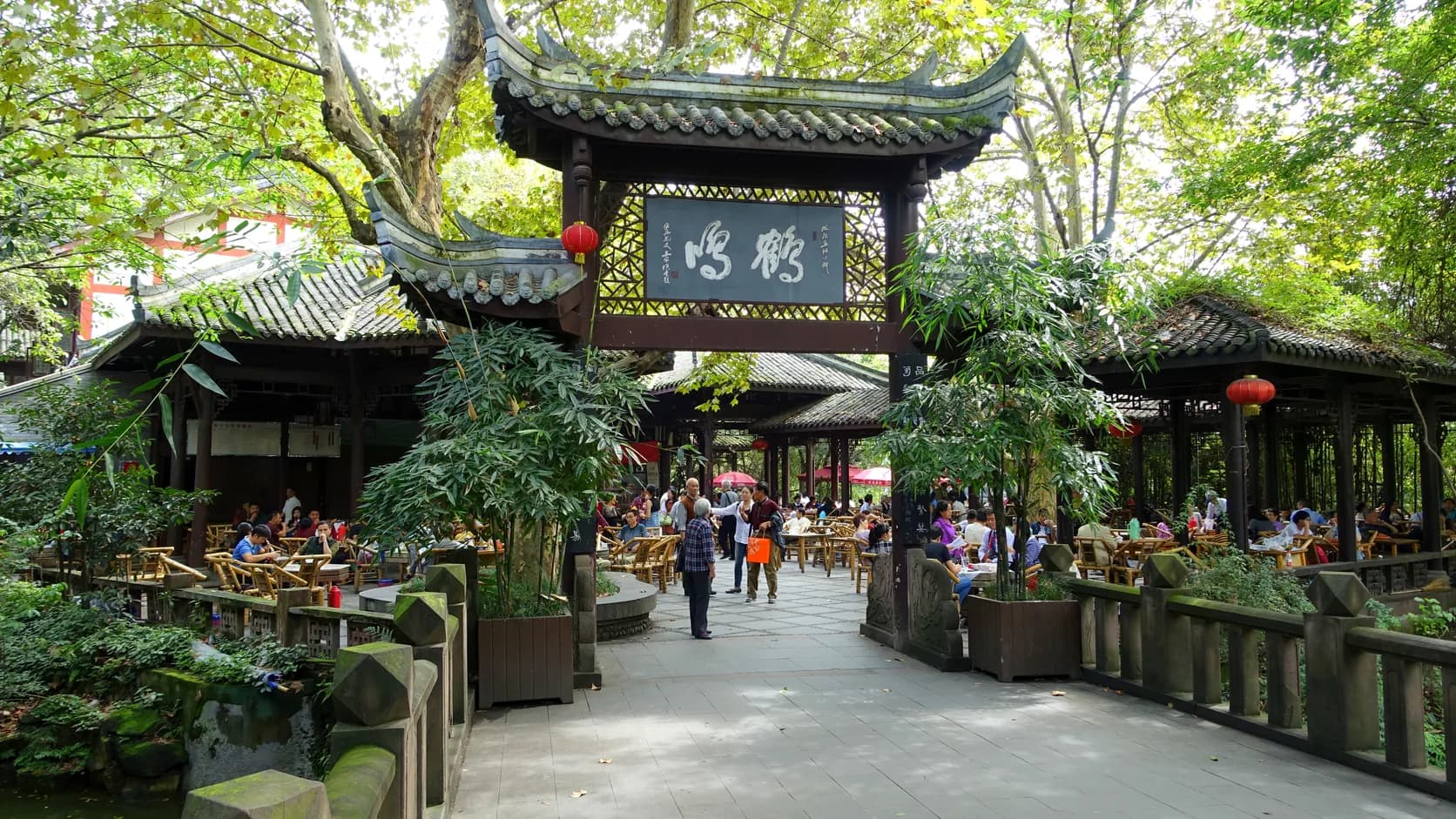
The open seating at Heming makes the social scale of a park teahouse visible. The photograph does not represent today's menu, table availability or crowd level. Photo by Daderot, dedicated to the public domain under CC0 1.0.
Pick the right kind of teahouse
| Experience | Best for | What you are buying | Main trade-off |
|---|---|---|---|
| People's Park / Heming Teahouse | A first visit, public life, easy pairing with central sights | A tea seat in a busy park setting | Popularity brings queues, conversation, sales approaches, smoke exposure and noise |
| Neighbourhood courtyard, such as Jinqin | A slower repeat visit and shared local space | Tea and a place to sit; any performance is a bonus | Less English support, shared tables and operating details that can change |
| Theatre-teahouse or performance package | Sichuan Opera excerpts, folk art or staged tea service | A timed seat or program, sometimes with tea | It is a show product, not an ordinary resident teahouse afternoon |
| Private mahjong room or taught session | Four friends who want to learn without disturbing another table | Room/table time and possibly instruction | Rules, fees, smoking policy and stakes must all be agreed before play |
One venue may cross categories. Daqi combines tea, snacks, lacquerware context and programmed performance; Heming may sell ordinary tea seating alongside optional services or programs. Ask what the specific price includes instead of assuming every customer bought the same thing.
Route 1: People's Park for the clearest first visit
Use People's Park (人民公园) as the start, not a taxi pin for a chair. Enter from the metro side, take a short loop through the public paths, and then approach Heming Teahouse (鹤鸣茶社) inside the park. This makes an important distinction: the park is public space; the chairs and service within a teahouse section belong to an operating business.
The current Chengdu visitor portal listed Heming at 09:30–21:30 on September 28, 2026. Treat that as a recently published baseline, then confirm the same-day notice when an evening visit matters. A private event, maintenance, severe weather or operating adjustment can affect seating even while the park remains open.
A practical three-hour sequence
- Walk the park for 20–30 minutes. Notice exercise, conversation and garden use before choosing a commercial seat.
- Ask staff for a table. Do not occupy an apparently empty chair; another customer may have retained it.
- Read the tea menu before ordering. Confirm the tea price, whether hot-water refills are included, and whether there is a separate seat, performance or service charge.
- Stay for 60–90 minutes. One tea stretched over refills is the point. Keep bags close without claiming a second chair in a crowded period.
- Add one nearby chapter. Walk to the Chengdu Museum for a reserved indoor visit, or follow the park-to-Kuanzhai section of the relaxed neighbourhood walks guide. Tea itself should remain the center of this half-day.
Earlier in the day usually gives a better chance of choosing a table. Midday and weekend popularity can produce a lively scene rather than contemplative quiet. If the atmosphere is too loud, crowded or smoky for your group, walk the park and use the neighbourhood alternative instead of ordering and immediately leaving.
Route 2: Jinqin for a neighbourhood courtyard
Jinqin Old Teahouse (金琴老茶馆) is in Fuqin, about a short walk from Fuqin metro station according to the current AMap listing. Chengdu's visitor portal describes it as a Qing-era courtyard building with mortise-and-tenon timber construction and lists 08:00–18:00 as of September 28, 2026.
This is the better choice when your goal is the courtyard, shared seating and an ordinary tea pause rather than a checklist of central attractions. The same official listing says professional Peking Opera performers appear from time to time. That wording matters: do not promise yourself a show on a particular afternoon, and do not confuse Peking Opera excerpts with Sichuan Opera simply because both can appear in a Chengdu teahouse context.
Use a simple two-to-three-hour plan:
- arrive outside the peak lunch-to-mid-afternoon period when possible;
- inspect the available courtyard and covered seating before paying;
- accept a shared table only when both staff and current occupants indicate it is available;
- order tea first, then add snacks only after checking the current menu; and
- leave the remaining time open for the Fuqin neighbourhood rather than crossing the city for another teahouse.
A neighbourhood business is not an open set for costume photography. Ask before moving furniture, using a tripod, photographing the counter or recording performers. Keep resident faces, conversations and mahjong hands out of close shots unless everyone concerned has agreed.
Route 3: choose a performance on purpose
A performance teahouse solves a different problem: it gives a visitor a scheduled cultural program without requiring fluent Sichuan dialect or an invitation into a resident gathering. It also packages the experience more deliberately, so compare the program rather than the word “tea.”
Daqi Teahouse (大旗茶馆), in the former Chengdu Lacquerware Craft Factory area, is a useful example. The city visitor portal listed 07:30–21:00 on September 28, 2026. A separate June 2026 city article described two free afternoon programs using combinations of tea ceremony, crosstalk, folk vocal art or instrumental music. The program is the volatile part: confirm today's times, language, seat rules and whether tea or snacks require a separate order.
For a commercial theatre-teahouse, ask these questions before paying:
- Is this ordinary tea seating, a fixed performance, or a combined package?
- What is the exact show date, start time and duration?
- Is seating assigned, and does the lowest price have a restricted view?
- Which drink or snack is included?
- Are face-changing, fire-spitting or long-spout tea demonstrations part of this session, or only another program?
- What happens if the cast, time or venue changes?
- May you photograph, and are flash, video or tripods prohibited?
“Sichuan Opera experience” often means a visitor-oriented sequence of excerpts and skills. It can be enjoyable, but it is not automatically a complete traditional opera. If plot, singing and a named production matter, check the performing company and program rather than choosing by a face-changing thumbnail.
How to order and drink gaiwan tea
A gaiwan (盖碗) has three pieces: lid, bowl and saucer. In a casual Chengdu teahouse, it is practical equipment rather than a test of choreography. Hold the saucer or steady the bowl according to the vessel and staff guidance; use the lid to keep leaves away from the drinking edge. Do not lift a freshly filled bowl by the hot rim or imitate a fast one-handed move when the porcelain is unfamiliar.
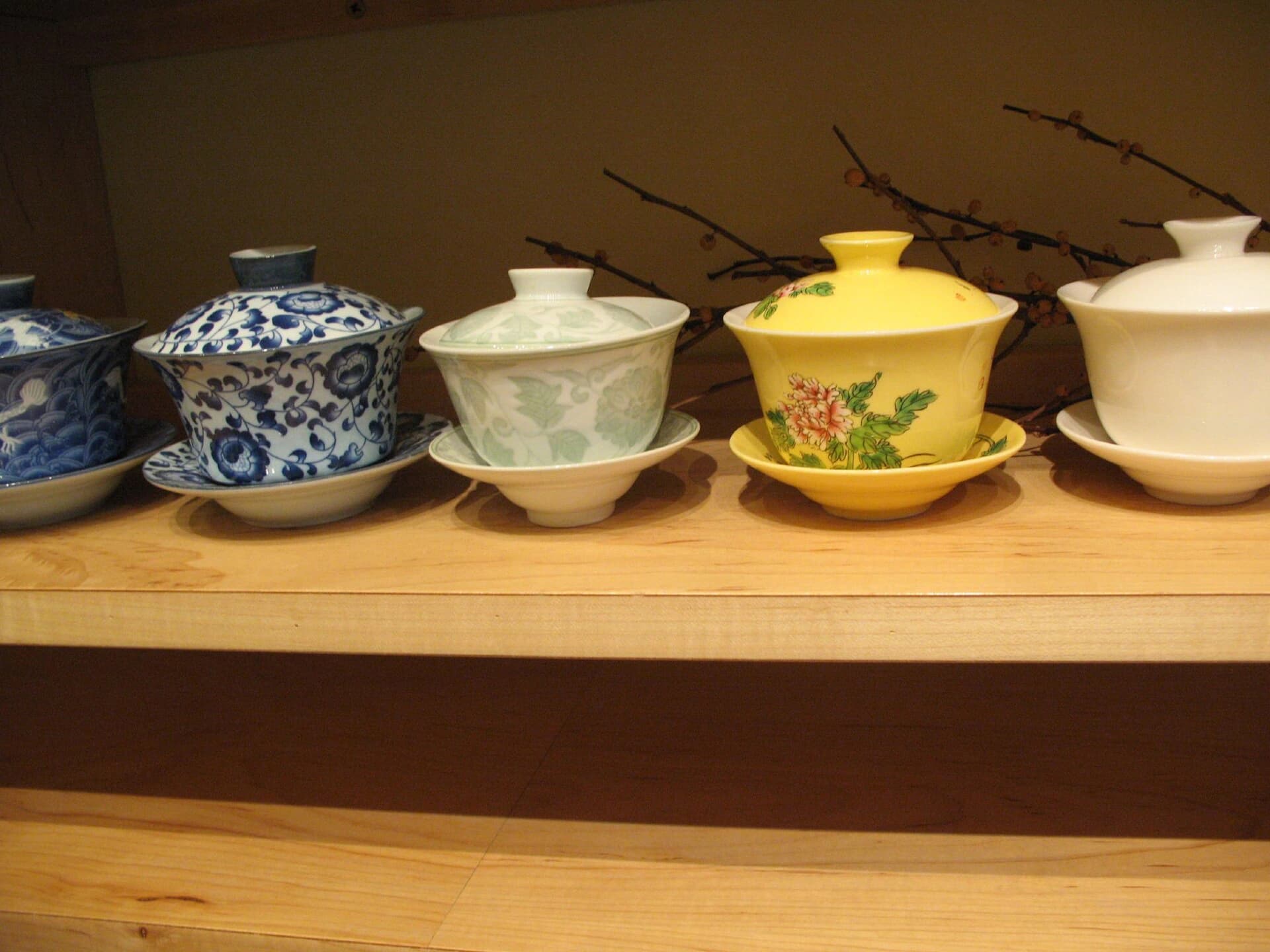
A gaiwan consists of lid, bowl and saucer; patterns and handling styles vary. Photo by Gary Stevens, licensed under CC BY 2.0.
Jasmine tea is an approachable first order, while green, black and darker teas can be available according to the venue. Price usually reflects the tea selected and the venue, not only the quantity of water. If you do not recognize the menu, point and ask for the price before service begins.
Useful phrases:
- 一位,一杯茉莉花茶。 — One person, one cup of jasmine tea.
- 可以看茶单吗? — May I see the tea menu?
- 这个多少钱?包括续水吗? — How much is this? Are hot-water refills included?
- 我们可以坐这里吗? — May we sit here?
- 麻烦加水,谢谢。 — More hot water, please. Thank you.
- 茶费和演出票是分开的吗? — Are tea and the performance ticket charged separately?
Do not wave the lid or kettle around to reproduce a supposed secret code. A small verbal request works. When leaving, return the lid to the bowl, check the table for your phone and payment receipt, and free the chair without rearranging the venue.
Mahjong: watching is not joining
Mahjong in Chengdu is social infrastructure: friends talk, play and spend time together. A table visible beside a path is still a group activity. Stand far enough away that you do not read over a player's shoulder, comment on a hand or block service. Never film faces, tiles or scorekeeping at close range without the whole table's permission.
If a player speaks to you, conversation does not automatically mean there is a vacant seat. Use “我可以看一会儿吗?” (May I watch for a while?) and accept the first answer. If invited to sit, establish whether you are only learning or entering the current game. A resident table cannot reasonably teach from zero while continuing its normal pace.
The safest beginner options
- Bring four people and book a room or table. Ask the business whether beginners are welcome, whether equipment is automatic, and whether staff can explain the controls.
- Arrange an identified instructor-led session. Confirm the language, rule set, duration, group size, location, cancellation terms and whether the price covers the room. A hotel concierge or established cultural operator is a better starting point than a stranger recruiting players in a comment thread.
- Learn the tile families before arrival. One short practice session at home prevents the first hour from becoming symbol translation.
- Play for points only. State this before sitting down: “我们是初学者,只打练习局,不打钱。” (We are beginners; we only want a practice game, with no money.)
Do not join a game that requires an unexplained deposit, transfer to a personal account, variable cash settlement or side bet. Leave if the organizer changes the participants, venue, scoring or money terms after arrival. The aim is a cultural and social lesson, not a gambling experience.
A rule preview, not a table contract
The Mahjong International League recognizes Sichuan Rules as one of the major international rule families. Its published introduction uses 108 suited tiles, allows pung and kong claims but not chow claims, requires a voided suit, and continues the hand after one player wins until three players have won or the wall is exhausted. This continuing format is commonly described in English as Sichuan “bloody” rules.
Local and commercial tables can add or alter procedures such as exchanging three tiles, declaring the suit to void, scoring patterns and kong payments. Before play, ask:
- 打什么规则? — Which rules are we using?
- 换三张吗?要定缺吗? — Do we exchange three tiles and declare a voided suit?
- 怎么算分? — How is scoring calculated?
- 只打分,不打钱,可以吗? — Can we play for points only, with no money?
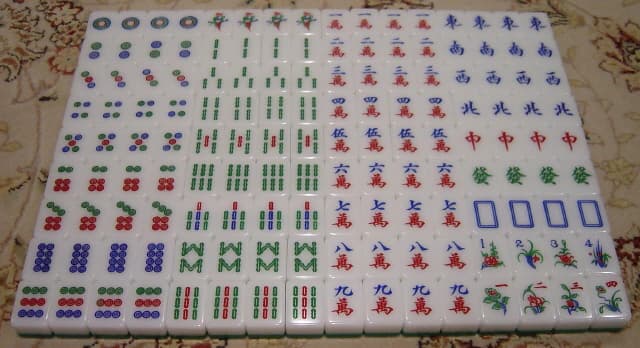
A general mahjong set shows the symbol families a beginner must recognize. Sichuan table configurations can omit the honor tiles visible here, so confirm the actual set and rules before play. Photograph by Immanuel Giel, public domain.
Smoke, noise, children and mobility
Teahouse atmosphere is not standardized. Outdoor or semi-open seating can be exposed to cigarette smoke, loud conversation, tile noise, portable speakers and service calls. Provincial public-place rules distinguish prohibited areas from places that may designate smoking and non-smoking zones, while on-the-ground layout and enforcement can vary. Inspect the actual table area before ordering.
Ask “有无烟区吗?” (Is there a non-smoking section?) and choose a seat upwind or indoors only when the venue confirms that space is smoke-free. A legal sign does not guarantee that smoke from an adjacent outdoor table will stay away. Travelers with asthma, migraine, sensory sensitivity or small children should keep an alternative venue and leave early rather than negotiate after a long order.
People's Park has level public paths, but individual tea sections can be dense with bamboo chairs, bags, kettle service and low thresholds. A wheelchair user or traveler with a stroller should ask staff to identify a wider table edge before paying. Keep children away from servers carrying boiling water and from automatic mahjong-table mechanisms. A quieter courtyard may have steps; a modern theatre package may have better assigned seating but needs a direct accessibility check.
Mahjong rooms can be particularly loud and enclosed. Confirm ventilation, smoking policy, stairs, toilet access and the ability to stop after a fixed session. Hearing protection may help a sensory-sensitive adult, but it should not prevent communication around hot water or moving equipment.
Ear cleaning and other add-ons
Ear cleaning (采耳, cǎi'ěr) is often marketed beside tea, but it is a separate personal service. Do not treat it as included in a tea order or as medical care. Before it begins, ask for the complete price, duration, tool hygiene process and every included step. State that no drops, medication-like product, massage or upgraded tool may be added without a new price and your explicit agreement.
The China spa, massage and wellness guide gives the fuller tool-hygiene, consent, practitioner-gender and stop-language checks for anyone deliberately considering the service.
Useful phrases:
- 我们只喝茶,不采耳。 — We only want tea, no ear cleaning.
- 总价是多少?包括哪些项目? — What is the total price, and which items are included?
- 不要加任何项目。 — Do not add any services.
Decline if the explanation is unclear or pressure replaces consent. Anyone with ear pain, infection symptoms, recent surgery, a perforated eardrum, bleeding risk or uncertainty should skip the service and seek qualified medical care if needed.
Weather and season strategy
Chengdu's humid basin climate makes tea an effective schedule tool, but not every teahouse solves the same weather.
- Hot or wet summer: choose deep shade or a ventilated interior, avoid the hottest exposed walk, and keep a museum as the weather swap. Heavy rain can blow into open pavilions even when a roof exists.
- Cool, damp winter: a courtyard can feel colder than the air temperature suggests. Choose a protected seat and carry a layer; do not assume an old teahouse is heated like a modern café.
- Spring and autumn: these are strong outdoor-tea seasons, which also makes popular parks busier. Arrive earlier and keep the rest of the day flexible.
- Poor air or smoke sensitivity: choose a modern indoor cultural venue only after confirming its no-smoking policy and ventilation. The word “indoor” is not enough.
Check the short-range Chengdu forecast rather than planning around a seasonal average. During a heat, storm or air-quality warning, shorten the park loop and use the tea stop as recovery rather than forcing a photogenic outdoor table.
The one-day and two-day combinations that work
For one culture-focused day, reserve the Chengdu Museum in the morning, walk to People's Park, take tea for 60–90 minutes, then continue only as far as Kuanzhai or your hotel. Book a separate evening performance if its live schedule is the priority. This keeps the public museum, ordinary tea and staged show as three readable experiences.
With two days, use People's Park on the central sightseeing day and place Jinqin or a taught mahjong session on the second afternoon. The two teahouses should not be consecutive photo stops: one shows a famous public park, while the other earns its place through courtyard time and neighbourhood context. Add the Chengdu destination guide for pandas, food and day trips rather than stretching this page into a complete city itinerary.
If the group has only one free afternoon, choose tea or mahjong. Tea works for mixed ages and uncertain energy. Mahjong works for four committed learners who can reserve a fixed session and agree on no-stakes rules. Watching strangers for twenty minutes can be an incidental part of a park visit; it is not a substitute for either experience.
Final booking and arrival check
The plan is ready when you can answer six questions:
- Is this a park seat, neighbourhood teahouse, performance package or private game room?
- What is today's opening window, and is there a closure or private event?
- What does the quoted price include: tea, refills, seat, show, room or instruction?
- Is the available area acceptable for smoke, noise, steps and weather?
- If playing mahjong, who are the four players, which rules apply and have all money stakes been excluded?
- Which single nearby stop will complete the half-day without rushing the tea itself?
That preparation preserves what is most useful about Chengdu's teahouse culture: time shared in a real social space. The cup, chair and tile table matter because they support conversation. Treat the people already using that space as participants in their own day, and the experience becomes much more than a staged “slow life” photograph.