Solo female travel in China: make the trip easy to execute
China can be an excellent solo destination for a woman who likes cities, trains, museums, food and independent days. Extensive public transport, busy evening streets and app-based payments remove some familiar travel friction. They do not remove the need to choose the right hotel, protect a late arrival, control what personal information you share or know how to ask for help.
The strongest first trip is built around low-friction decisions, not a promise that nothing will go wrong:
- Start with two or three well-connected cities rather than a long chain of remote stops.
- Put the first two nights in a staffed hotel that can register the passport stay.
- Reach the first hotel in daylight when possible; otherwise pre-plan the exact pickup point.
- Use daytime high-speed rail as the default between cities.
- Keep the original passport, phone power and Chinese hotel address under your control.
- Decide in advance what you will do if a driver, stranger, hotel or transport connection feels wrong.
This page is not a statistical declaration that China is universally safe or unsafe. Conditions differ by city, hour, event and individual circumstance. Its job is to reduce avoidable exposure and make the response to a problem faster.
Choose the route by friction, not by the number of famous places
For a first solo trip, use a linear route with direct trains and hotels near useful metro lines. Every extra base creates another arrival, another address to find and another room to assess.
| Route | Comfortable length | Why it works solo | Main trade-off |
|---|---|---|---|
| Beijing → Xi'an → Shanghai | 10–12 days | Major airports, direct high-speed rail, staffed attractions and distinct history | Large stations and long urban transfers require planning |
| Shanghai → Suzhou → Hangzhou | 7–10 days | Short rail legs, easy return options and a compact regional shape | Fast trains still use large stations; day trips can become rushed |
| Chengdu → Chongqing | 7–9 days | Short intercity rail, strong food and neighbourhood contrast | Chongqing's vertical streets make the last kilometre harder with luggage |
The first route is the most legible national introduction. Use the 10-, 14- and 21-day itinerary guide to allocate nights without copying a long attraction list. The East China route is the easiest test trip if you want fewer long transfers: Shanghai, Suzhou and Hangzhou give you three different city textures inside one rail region. The southwest pair works when food, contemporary urban form and slower neighbourhood days matter more than ticking off imperial capitals.
Do not make a remote scenic area the first night in China. Put it after a city where you have activated payments, tested your map app, confirmed the passport works in the rail system and learned how long a station transfer really takes. If the only transport arrives after dark and the property offers no staffed reception or reliable pickup, change the order or sleep in the gateway city.
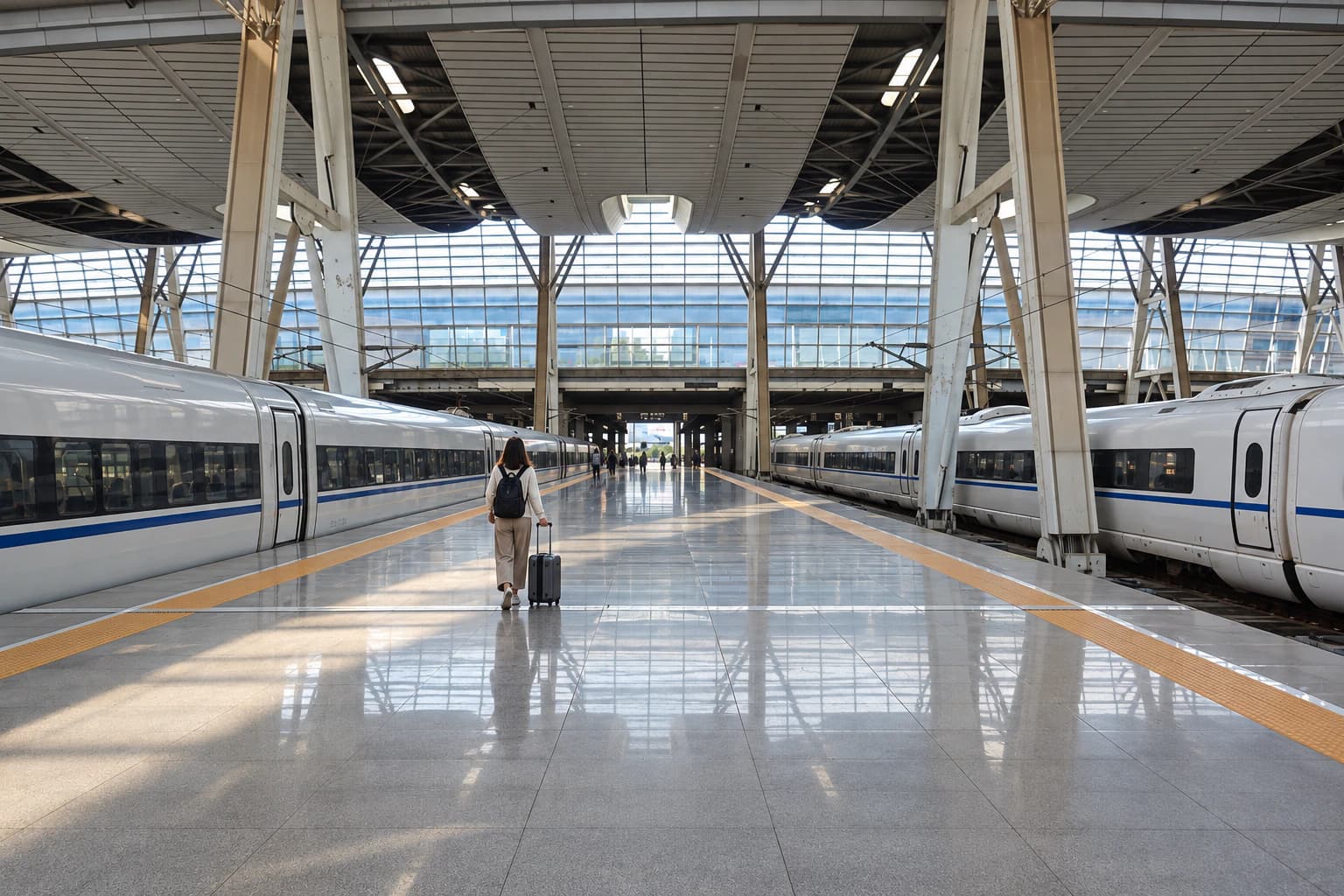
Book the first hotel for the arrival you actually have
The cheapest room is not automatically the best solo base. Judge the first property on five operational questions:
- Can the desk check in a foreign passport at your arrival time? Chinese authorities have stated that accommodation operators should not refuse international guests by claiming they lack a special “foreign guest qualification.” Occasional front-desk confusion still happens, especially at small properties.
- Is reception staffed when you land? A self-check-in message is not useful if it requires a domestic phone call, a Chinese ID workflow or a host who stops answering at midnight.
- Is the final walk simple? Prefer a main road, visible entrance and five-to-ten-minute walk from a metro exit over an apartment hidden inside a large residential compound.
- Is the room access controlled? Recent reviews should describe a functioning front desk, lift or floor access where applicable, and a room door that closes correctly.
- Can you change plans without losing the whole stay? A flexible first night is worth more than a small non-refundable saving when an international flight may be delayed.
At check-in, present the original passport and make sure the reservation includes every guest. A hotel normally records and submits the accommodation registration. If you stay in a private home, apartment or other non-hotel accommodation, the foreign guest or host must register the stay with the local public-security authority within 24 hours. The National Immigration Administration's March 2026 policy explainer launched an online pilot in seven provincial-level areas, but coverage and the local workflow can change. The accommodation and registration guide explains the current boundary; call 12367 for current immigration-service guidance when the local process is unclear.
For a first or late arrival, compare a staffed property on Trip.com only after checking the desk hours, exact Chinese address and recent foreign-passport reviews. A booking-platform badge is useful evidence, not a guarantee that the person working that shift knows the process.
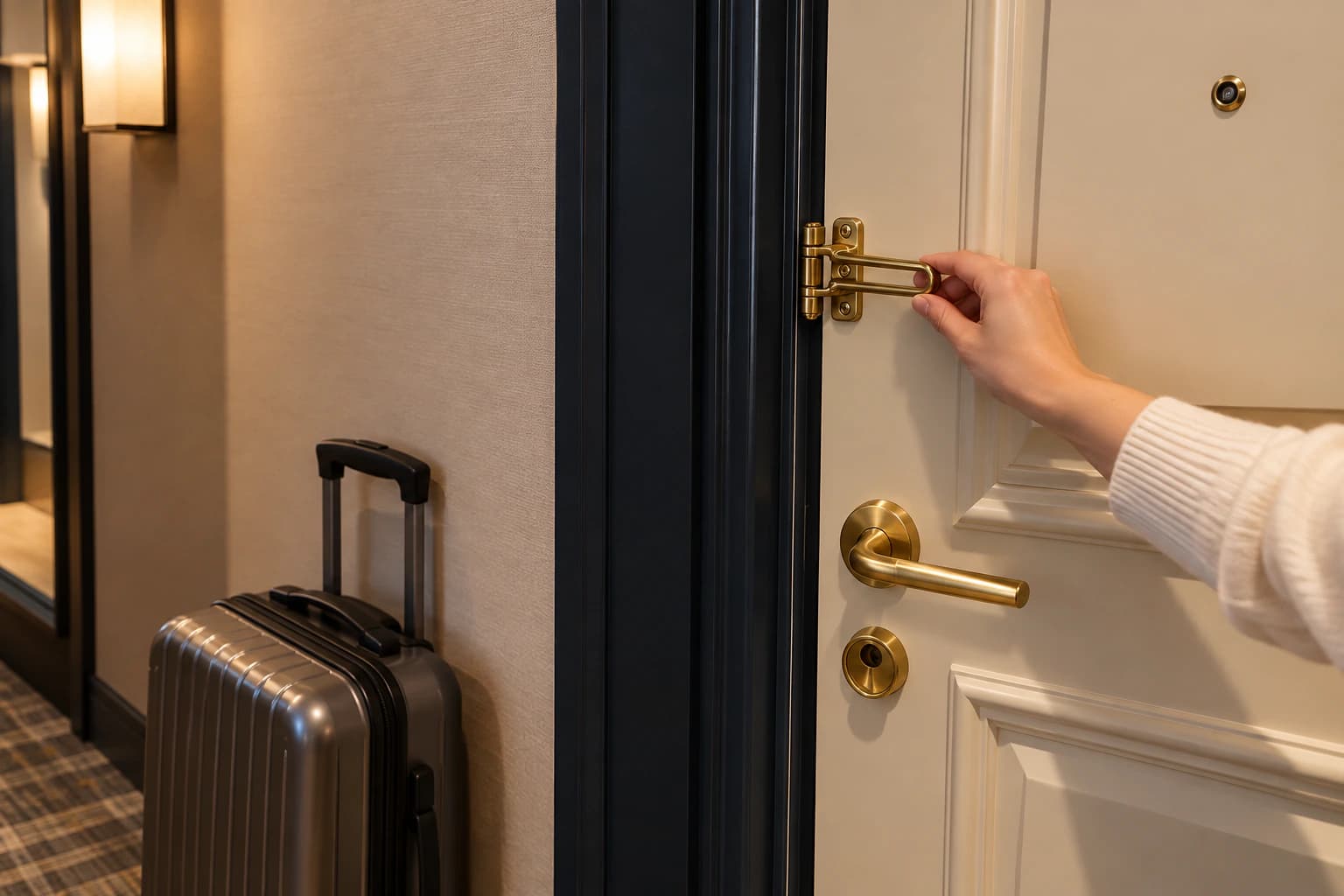
Once inside, check that the door closes, the latch engages and the phone can reach reception. Do not turn room inspection into a ritual of dismantling furniture. A practical check of the door, windows, emergency-exit route and visible damage is enough. Report a broken lock immediately and request another room; do not accept “it should be fine” when the primary lock does not work.
If you choose a hostel, book a women-only dorm if that is your comfort requirement. Confirm the late-arrival rule, locker dimensions and whether you need your own lock. A women-only room changes the sleeping arrangement; it does not replace registration, secure storage or a staffed way to resolve a problem.
Build a night-arrival plan before the aircraft or train departs
Daylight arrival is the easiest choice in an unfamiliar first city. When the timetable makes that impossible, write a four-part plan in your notes:
- Exact arrival terminal or station. Large airports and railway stations have multiple floors and designated app-car pickup zones.
- Exact hotel name and address in Chinese. Save it as text and a screenshot, plus the reception number.
- Primary transport and fallback. For example: airport express until its current last departure, then in-app ride-hailing; or official taxi queue if the app cannot locate you.
- Arrival check-in. Send one trusted person the car details when you leave and a short message when the room door is closed.
Do not accept a ride from someone walking through arrivals offering a private car. Use the signed taxi queue, a hotel transfer confirmed in writing or a ride recorded in a mainstream app. At a confusing pickup area, stay inside the terminal or beside staff until the app shows that the car has arrived. The best pickup point is often the designated zone, not the pin closest to the exit.
Before entering, match the plate and vehicle model shown in the app. Keep the ride in the app rather than cancelling to pay the driver directly. Use the rear seat and the seat belt. Follow the route at a broad level, but remember that airport roads, closures and one-way systems can create legitimate deviations. If the vehicle is wrong, the driver asks you to cancel, or the situation feels materially different from the booking, do not get in.
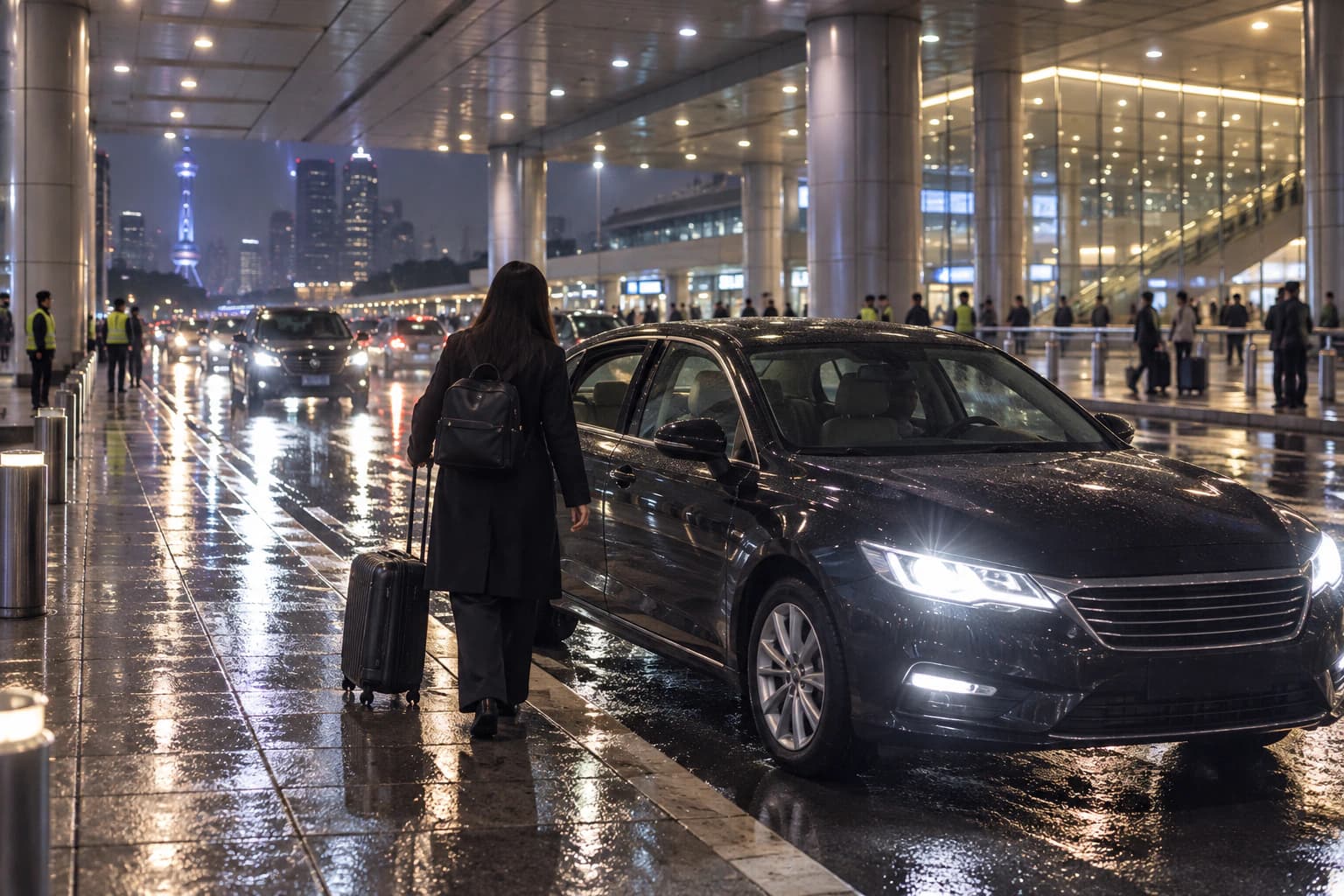
The image illustrates a planned pickup layout; it does not document a particular operator, station or guaranteed waiting area. Check the live signs and app instructions at the actual terminal.
If the phone battery is low, solve that before leaving the staffed building. Save the hotel address offline, carry a charging cable and keep a modest amount of RMB cash plus a physical payment card. Do not put the phone, passport and all payment methods in the same outer pocket.
Ride-hailing alone: reduce ambiguity at both ends
Most ride problems begin with the wrong pickup point, an unreadable hotel name or a call the traveller cannot answer. Use these habits:
- pin the official pickup zone and read its floor, gate or car-park code;
- send the destination in Chinese through in-app messaging;
- match the plate and model, then confirm the destination on your screen without announcing a room number;
- keep bags with you until the correct car is confirmed;
- share the in-app trip or live location with someone who is awake;
- end at the hotel entrance, reception or another staffed public point;
- if you need to leave early, choose a busy, lit place where another ride can be requested.
You do not owe a driver or stranger a detailed explanation of why you are alone, where you will sleep or what tomorrow's route is. Friendly conversation is common and often harmless. Give broad answers: “I am meeting friends later,” “My plans are not fixed,” or “Please take me to this hotel.”
Use direct boundaries when needed:
| English | Chinese | Pinyin |
|---|---|---|
| Please stop. | 请停下。 | Qǐng tíngxià. |
| I do not need help. | 我不需要帮助。 | Wǒ bù xūyào bāngzhù. |
| Please do not photograph me. | 请不要拍我。 | Qǐng búyào pāi wǒ. |
| Please take me to the hotel entrance. | 请送我到酒店门口。 | Qǐng sòng wǒ dào jiǔdiàn ménkǒu. |
| Please call the police. | 请帮我报警。 | Qǐng bāng wǒ bàojǐng. |
| I need an ambulance. | 我需要救护车。 | Wǒ xūyào jiùhùchē. |
Keep these as large offline text that you can show someone. A translation app helps with routine detail; in an emergency, a saved sentence plus the map pin can be faster than composing a perfect paragraph.
Daytime high-speed rail is the solo default
High-speed rail gives you an assigned seat, security-screened stations and predictable city-to-city structure. Book with the same passport you will carry. China Railway's current English FAQ says foreign passengers can buy real-name tickets with a valid passport and must use the ID associated with the e-ticket for entry and boarding. If the automatic gate does not read the passport, use the staffed lane.
Choose a departure that lets you leave the hotel after breakfast and reach the next reception before evening. A 10:00–14:00 departure often costs a little sightseeing time but avoids a predawn ride and a late unfamiliar arrival. Calculate hotel door to hotel door: checkout, city transfer, security, waiting, train, station exit and the next hotel transfer.
The high-speed rail planning guide explains station choice, missed trains, changes and full journey time. When you are ready to book an exact service, compare live inventory through Trip.com and the official 12306 channel. Carry the passport used for the reservation whichever channel you choose.
Luggage changes the safety and comfort calculation
The current 12306 English FAQ lists a 20 kg free carry-on limit for an ordinary adult passenger and a maximum sum of dimensions of 130 cm on EMU/high-speed trains or 160 cm on traditional trains. Enforcement and storage layout can vary, and a permitted bag does not come with reserved rack space.
For a solo trip, one suitcase you can lift a short distance plus one small personal bag is a useful ceiling. You may need to raise the case onto a scanner belt, move quickly when boarding begins or use stairs when the convenient lift is far away. Keep the passport, phone, cards and medication on your body rather than in the large case. On the train, place the suitcase where you can retrieve it without blocking an aisle or door.
Sleeper trains require a different comfort decision
An overnight sleeper can save a hotel night, but ordinary hard- and soft-sleeper accommodation is shared. Do not assume the compartment will be women-only or that buying one berth gives you the room. A soft sleeper generally offers fewer berths and a door; it still may be shared with travellers of any gender unless the selected product explicitly states otherwise.
Choose a sleeper when it meaningfully improves the route, you are comfortable in shared accommodation and the arrival time serves the next hotel. Choose daytime high-speed rail when sleep, privacy, a late-night station transfer or keeping valuables within immediate reach matters more. Avoid an overnight bus as a planning shortcut on a first solo trip when a train or flight provides a clearer documented journey.
Communication and boundaries without overexplaining
Solo travel creates repeated micro-interactions: a stranger asks for a photo, a host wants to add a chat contact, someone offers an unofficial tour, or a new acquaintance asks where you stay. Curiosity is not automatically a threat, but your answer is still your choice.
Use three levels:
- Polite limit: “No, thank you,” step back and keep walking.
- Direct boundary: show “Please stop” or “Please do not photograph me.”
- Exit: move to reception, a staffed ticket gate, security desk, shop counter or a group of families; call someone or request police help.
Do not move a new social interaction to a private apartment, unlisted car or a second venue you cannot identify. Tea, bar, karaoke and massage invitations from newly met strangers can become overcharging scams. If you want company, meet in a known public venue, pay your own bill and keep the return transport independent.
When you deliberately book a massage, spa or bathing visit, use the China spa and wellness guide to settle the practitioner gender, room type, clothing, draping, total price and exit plan before the service begins.
Limit real-time public posting. Share live location privately with a trusted person when useful, but publish the beautiful hotel view after checkout rather than identifying your current room or floor. Keep a simple check-in rhythm that someone will notice: after intercity arrival, before a remote day trip and when back at the hotel.
What to do when something feels wrong
The correct response depends on whether you are uncomfortable, actively followed, threatened, injured or the victim of a crime.
If someone is persistent or follows you
Enter a staffed, visible place. Tell reception, station staff, security or a shop employee: “这个人一直跟着我。请帮我报警。” (“This person keeps following me. Please help me call the police.”) Do not lead the person to your room, quiet street or private pickup point. Note the time, map location and visible description if doing so does not delay your exit.
If harassment occurs in a car or public place
End the ride or interaction at a busy staffed place when it is safe to do so. Preserve the booking, chat, receipt, vehicle details, photos or messages. Report in-app misconduct to the platform, but use 110 when you need police help or want to report a crime. Platform support is not a substitute for emergency services.
If you experience sexual assault
Get to a safe place first. Call 110 for police and 120 for urgent medical help. Contact your embassy or consulate and your insurer's assistance line if you want support navigating local police or medical procedures. If you may report the assault, avoid deleting messages or washing clothes that could contain evidence; write down the time, place, vehicle, people and sequence while you can. Reporting is your decision, but early medical care and evidence preservation can keep more options open.
Language and procedure vary. An English-speaking or female officer may not be immediately available. Ask for an interpreter and a copy or reference number for any report. National governments offer different forms of consular help, so save the current emergency contact for your own embassy or consulate before departure. The UK government publishes one detailed China-specific reporting and medical-care guide; it is useful process context, but its consular services apply to British nationals.
If your passport is lost or stolen
Go to the nearest police station or Public Security Bureau and obtain a loss report. Contact your embassy or consulate for a replacement or emergency travel document. Then ask the local exit-entry administration what visa or stay-document procedure applies before changing city or attempting international departure; China's visa reissuance guidance explains why both the loss documentation and new travel document matter. Keep a secure offline copy of the passport identity page, visa or entry record and recent accommodation confirmations; copies do not replace the original passport, but they help establish the details.
If you need medical help
Call 120 for an ambulance. Show your location pin, translated allergies and medication list. Bring the passport if possible and contact the insurer because payment and reimbursement procedures vary. For a non-emergency problem, a major public or international clinic in a large city may be easier to navigate than waiting until a remote stop.
The seeing a doctor in China guide gives the complete emergency, outpatient, registration, language, payment, pharmacy, records and insurance workflow.
Emergency numbers and what each one does
As verified against current government guidance on 2 October 2026:
- 110 — Police: immediate threat, crime report or urgent police assistance.
- 120 — Ambulance: medical emergency and pre-hospital care.
- 119 — Fire and rescue.
- 122 — Traffic police: road traffic accidents.
- 12367 — National Immigration Administration service: immigration and accommodation-registration questions; it is not a substitute for 110 or 120.
Save the numbers as plain text, not only inside an app. Emergency operators and local officers may have limited English. Say the city and show or read the address in Chinese. A hotel front desk, station service counter or nearby shop can help communicate, but do not delay an urgent call while searching for perfect translation.
The broader China safety guide covers medicine, insurance details, scams and domestic-flight battery rules. Recheck your own government's China travel advice shortly before departure because regional warnings, legal guidance and consular capacity can change.
A practical solo departure checklist
Two weeks before travel
- Verify entry permission for your passport and route through current official sources.
- Book the first two nights at a staffed property and confirm late-arrival handling.
- Set up 12306 or the chosen booking platform with the exact passport identity.
- Save your embassy or consulate, insurer and emergency contacts offline.
- Send one trusted person the flight, first hotel and broad route.
The day before each city move
- Confirm the full station name, train number and destination station.
- Screenshot the ticket, hotel name, Chinese address and reception number.
- Check weather, last local transport and the route from station to hotel.
- Charge the phone and power bank, and move essential items into the small bag.
On arrival
- Stay in the staffed terminal until the transport and pickup point are clear.
- Match an app-booked car before entering, or use the signed taxi queue.
- Present the original passport at hotel check-in.
- Check the room door and emergency-exit path.
- Send the planned arrival message, then enjoy the city without broadcasting the room.
The goal is not constant vigilance. It is a trip structure that leaves enough margin to notice a problem, change one decision and continue. A well-chosen route, registered room, daytime train and clear help plan do more for solo confidence than a long list of generic warnings.