Sanxingdui Museum
Sanxingdui is not a quick add-on to a Chengdu checklist. The museum is in Guanghan, roughly 47 km by Amap's road model from central Chengdu, and the collection rewards a slow, chronological visit. Give it a full day: travel out in the morning, spend about three to four hours in the main building, add the restoration hall only if it is open and you still have energy, then return without scheduling another ticketed attraction.
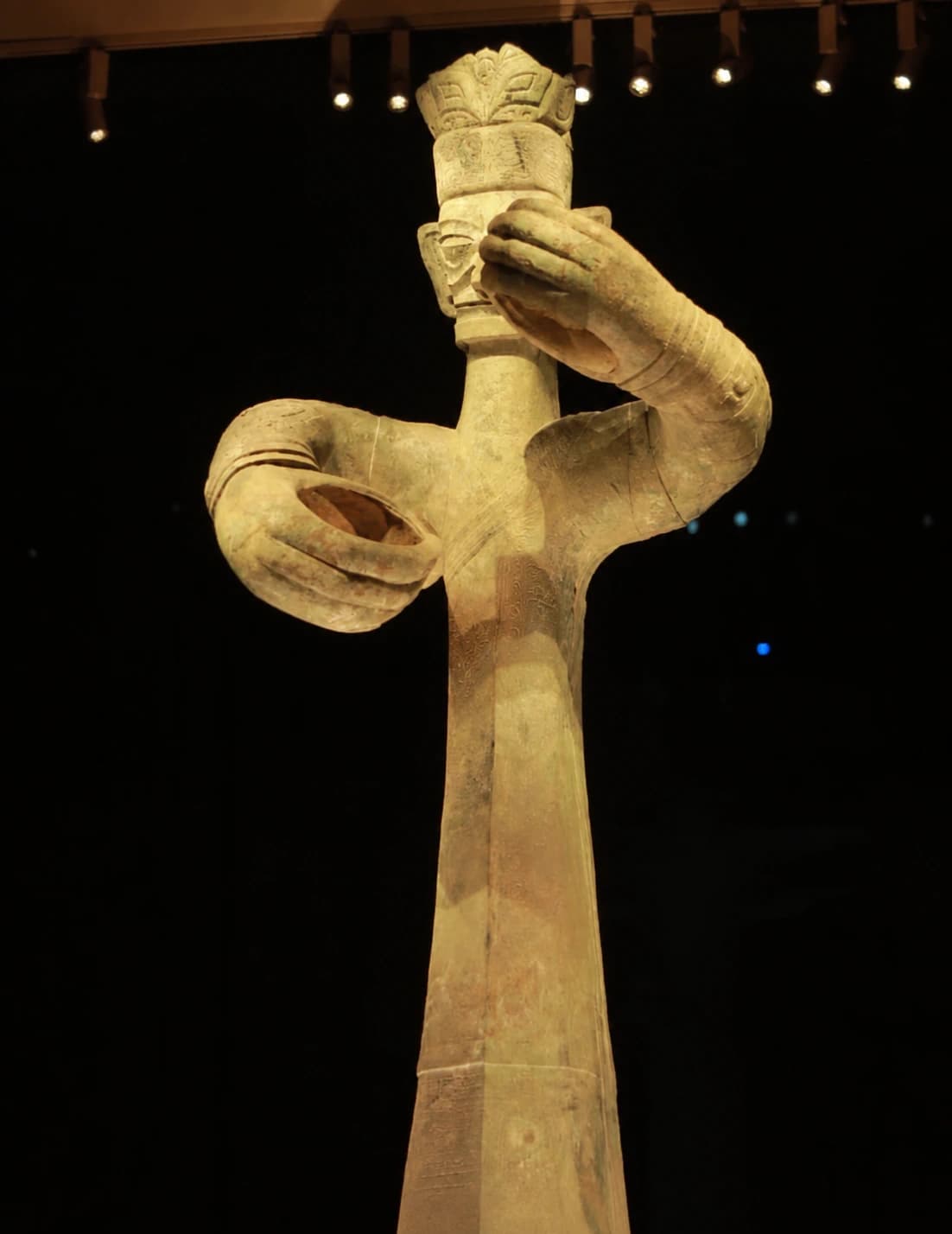
The most useful way to understand Sanxingdui is not to chase a list of strange-looking masks. Follow how an ancient Shu city used bronze, gold foil, jade and ivory to express authority, exchange and belief. That material story makes the famous objects feel connected rather than sensational.
Tickets, passport and opening hours
The museum currently lists the regular main exhibition-hall hours as 08:30–18:00, with last admission at 17:00. The restoration hall normally runs 09:00–17:00. On selected public holidays and during January, February, July and August, the museum may extend service to 08:30–20:00, with last admission at 18:00. Special holiday notices override the regular calendar, so recheck the official Sanxingdui website shortly before you go.
The standard adult ticket is currently CNY 72, with a CNY 36 student ticket for eligible visitors. Admission is real-name based. Foreign visitors should reserve through an official channel when possible, bring the original passport used for booking, and follow the current ticket-centre instructions for document verification. Do not rely on a screenshot or assume that a walk-up ticket will be available on a busy date.
The museum warns that it has not authorized unofficial sellers to represent its own ticketing or interpretation service. For travelers who need an international checkout, Trip.com currently lists a Sanxingdui product with ticket and optional guided-tour packages. Treat it as a separate booking service, compare the exact package inclusions, and use the museum's own notice as the final authority on entry rules.
Check Sanxingdui ticket and tour options on Trip.com
Getting there from Chengdu
Choose one transport plan before buying a timed ticket:
- Direct tourist bus: the museum currently lists departures from central visitor hubs including Chunxi Road, Jinsha Site Museum and the Panda Base. Stops and timetables can change, so use the live official transport notice rather than an old blog schedule.
- Train plus local transfer: take a train toward Guanghan, then continue by the current local bus or taxi arrangement. This can avoid some road uncertainty, but station transfers make it less seamless than the rail time alone suggests.
- Taxi or private car: Amap models Chengdu Museum to Sanxingdui at about 46.8 km / 55 minutes by car in ordinary routing conditions. Peak traffic, pickup time and the exact hotel location can add substantially.
Public transport is possible, but Amap's model from central Chengdu is about 2 hours 13 minutes before missed connections or waiting. If using transit, start early and keep the evening empty. Combining the Panda Base and Sanxingdui on one day looks efficient on a map but usually creates two reservation deadlines, two crowd-heavy visits and a rushed museum route.
The one-stroke route inside the museum
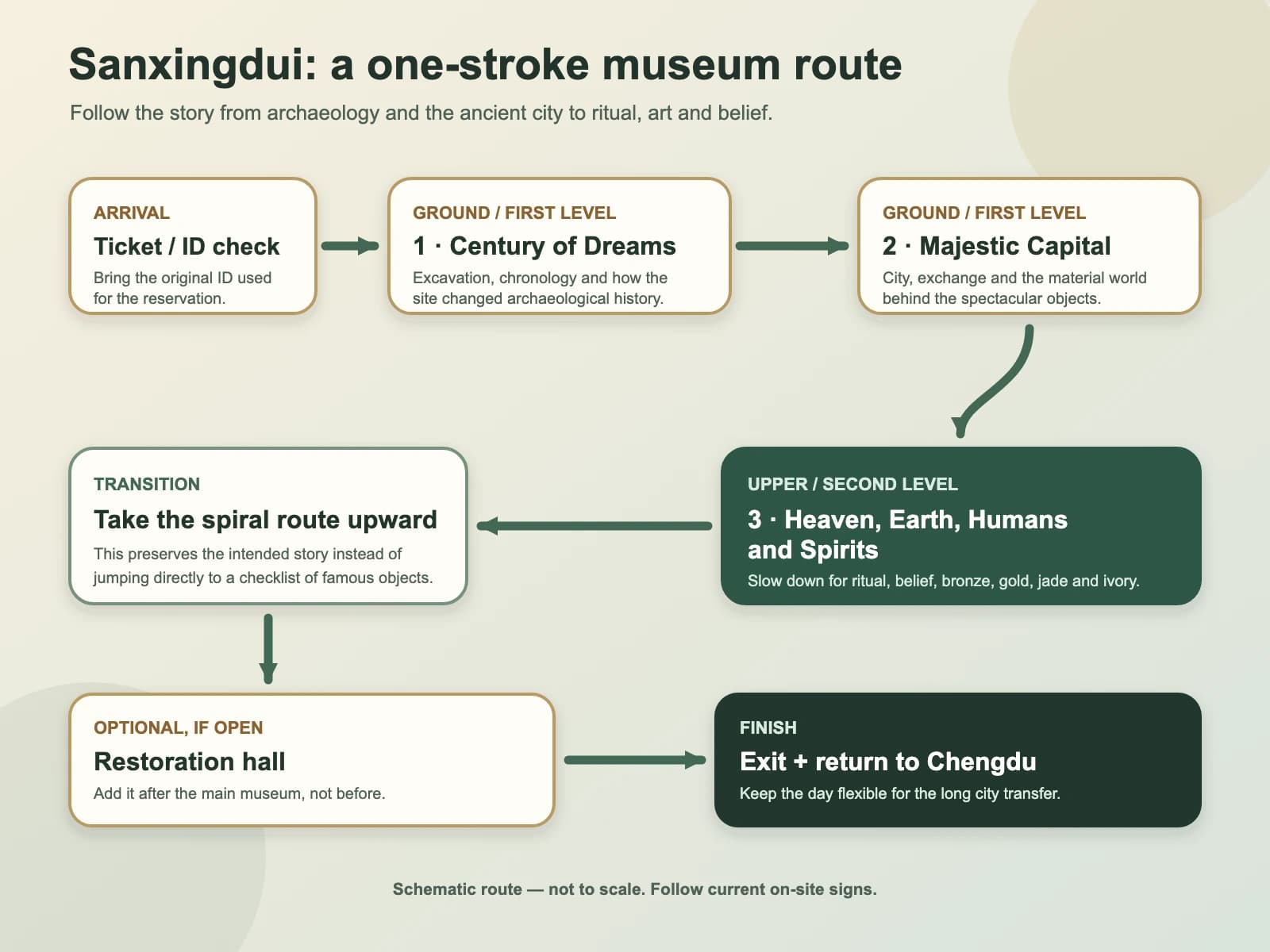
The new building has two main exhibition levels plus supporting space. The official exhibition structure works well as a continuous route:
- Ticket and security: arrive with the original booking document ready. Resolve any passport or ticket issue before joining the gallery flow.
- Century of Dreams: begin with the site's discovery, excavation and chronology. This section gives you the archaeological vocabulary needed later.
- Majestic Capital: stay on the first level for the ancient city's organization, technology and cultural exchange. Look beyond individual treasures: ask what the concentration of specialized materials says about labor and power.
- Spiral transition upward: resist jumping directly to the most photographed masks. The upward transition preserves the museum's intended narrative.
- Heaven, Earth, Humans and Spirits: slow down on the upper level. This is where ritual objects, bronze figures and gold-covered forms build a picture of how ancient Shu elites connected human and spiritual worlds.
- Restoration hall, if open: add it after the main exhibition. Its shorter hours mean it should be a flexible bonus, not the anchor of your route.
The museum has more than 1,500 pieces or sets on display. Trying to photograph every case is the fastest way to become exhausted. A better rhythm is one wide look at each section, one material to follow, and two or three objects to study closely.
A distinctive way to read the collection
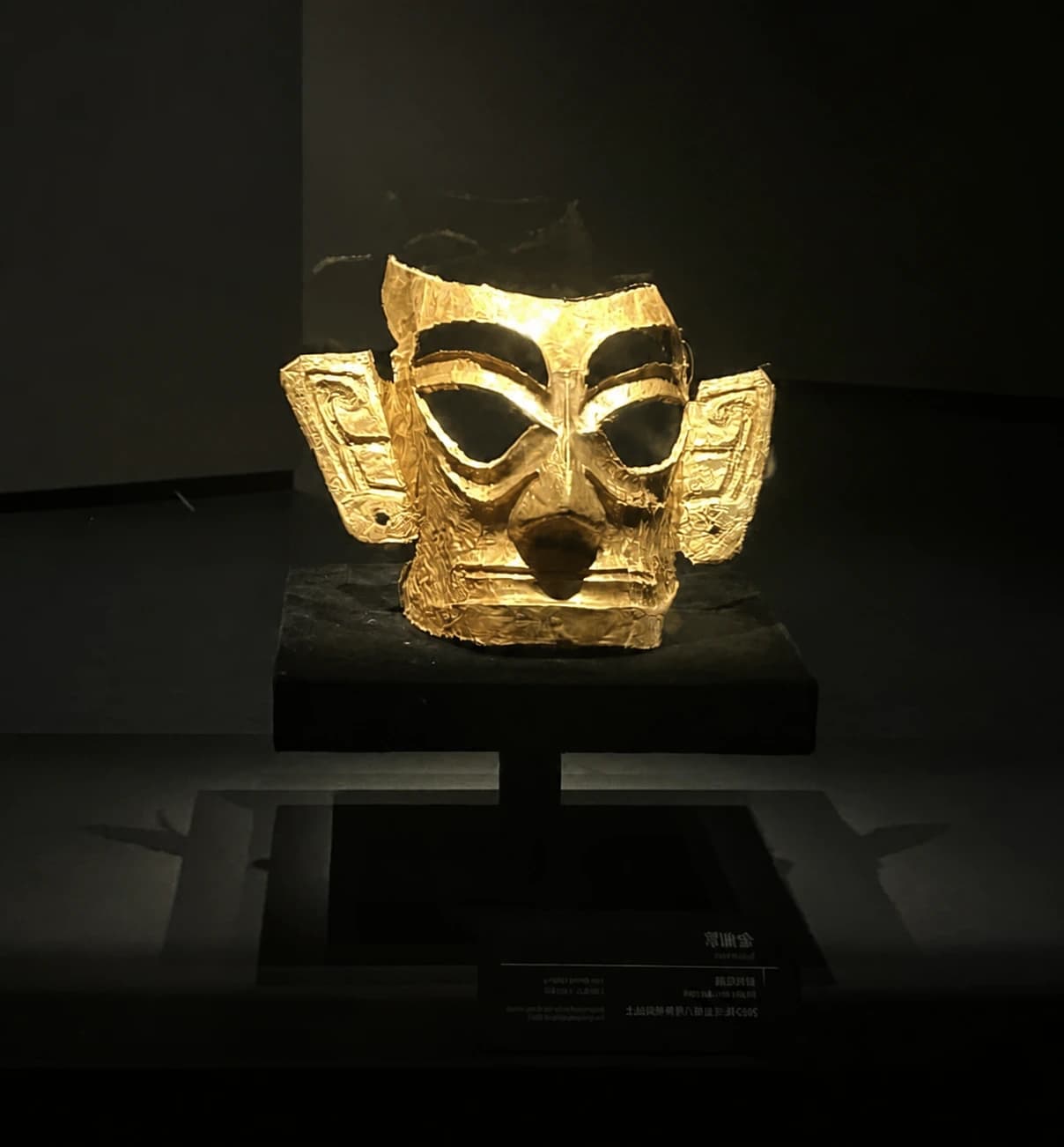
Pick a material trail instead of an object checklist:
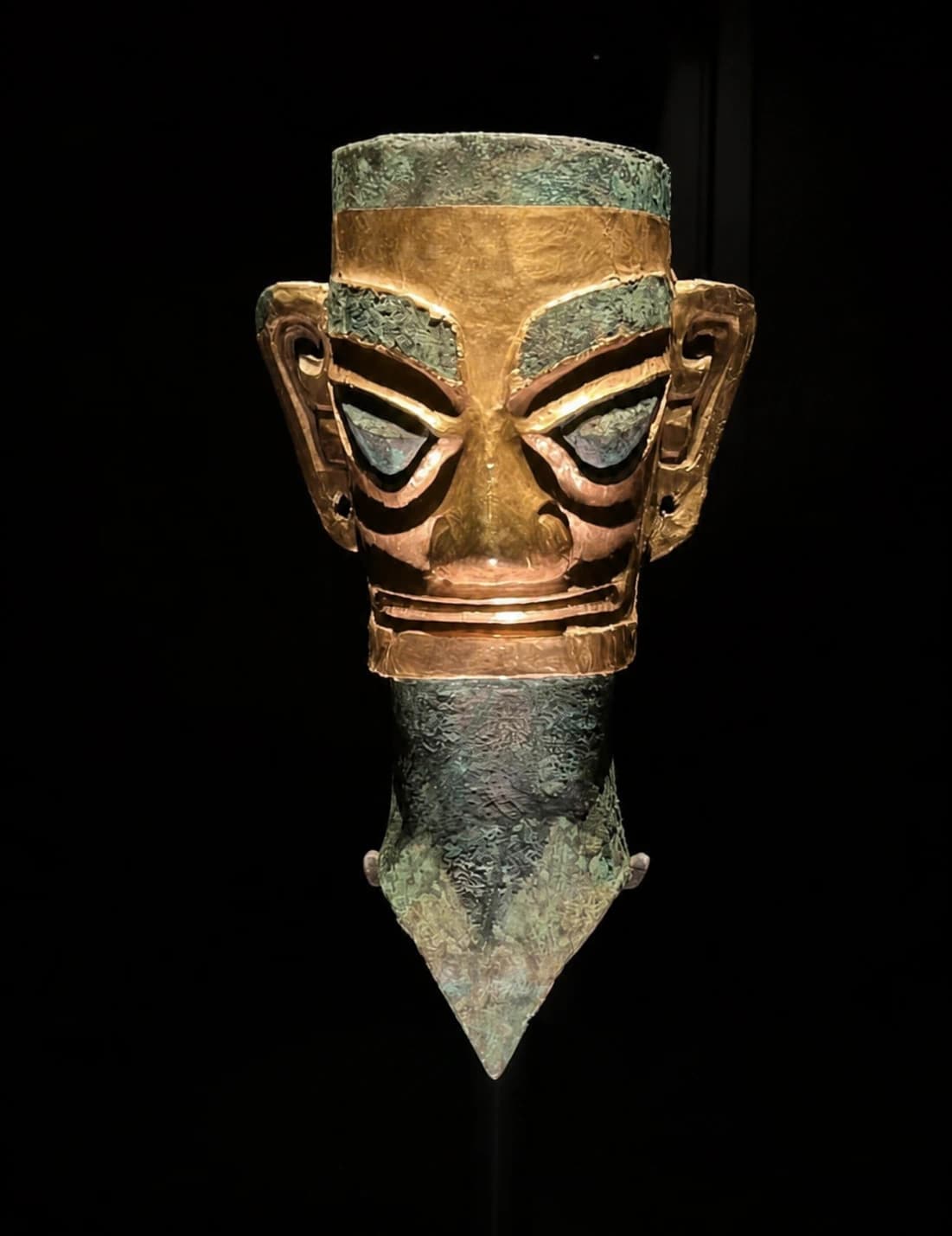
- Bronze: notice casting scale, hollow forms, projecting eyes and the way separate components were assembled. Monumentality was engineered, not accidental.
- Gold: look at thin foil fitted over a stronger core. Gold changes how light activates a face or surface; it is as much about visual presence as raw value.
- Jade: compare its controlled polish and inherited ritual associations with the more theatrical bronze forms.
- Ivory: treat it as evidence of networks, environment and concentrated resources, not simply decoration.
This approach also avoids a common disappointment: arriving expecting the museum to explain every symbol with certainty. Archaeologists can establish context, technique and comparison, but many beliefs represented by the objects remain open to interpretation.
Food without derailing the day
Eat a real breakfast in Chengdu and carry water. For lunch, choose by logistics rather than chasing one viral restaurant: a clean, busy place near the museum or your Guanghan transfer point, with a short menu and fast turnover. Useful local categories include Guanghan-style noodles, dumplings, rice dishes and Sichuan small plates. Ask about spice level before ordering; “not spicy” can still include chili oil or numbing pepper.
Avoid committing to a distant lunch reservation between gallery sections. Re-entry rules and security procedures can change, and an off-site detour can consume the time you saved by arriving early. If food is your priority, make dinner back in Chengdu the planned meal.
Where to stay
For most first-time visitors, stay in central Chengdu, not beside the museum. Tianfu Square, Chunxi Road and the Wenshu Monastery area offer better evening food, metro access and connections for the other two days of a Chengdu trip. Choose the exact district according to your departure point: Chunxi Road is convenient if your confirmed tourist bus leaves there; Tianfu Square is a flexible central base; a hotel near Chengdu East Railway Station may suit an early train connection.
An overnight in Guanghan only makes sense if Sanxingdui is part of a slower northern Sichuan plan or you have an unusually early entry strategy. The museum alone should not dictate all of your Chengdu accommodation.
Compare centrally located Chengdu hotels on Trip.com
Practical checklist
- Recheck the official opening notice and your booking status one day before travel.
- Carry the original passport or ID attached to the reservation.
- Arrive early enough for ticket resolution and security, not merely at your entry time.
- Use the first-level-to-second-level sequence before adding the restoration hall.
- Follow current no-flash, equipment and restricted-area signs.
- Keep the return evening flexible; road and transit times are models, not guarantees.
- Do not confuse the museum complex with an open excavation walk. Access is governed by the current visitor route.
Sanxingdui works best when it is allowed to be the day's main event. The reward is not just seeing iconic bronze and gold objects; it is understanding how a powerful, connected ancient city constructed a visual world unlike anything else in early China.