Du Fu Thatched Cottage
Du Fu Thatched Cottage (成都杜甫草堂博物馆) is most rewarding when you treat it as a literary landscape, not as an untouched Tang-dynasty home. Du Fu built a cottage near Huanhua Stream in 760 and wrote many of his best-known Chengdu poems here. The buildings visitors see today belong to a memorial complex repeatedly repaired and expanded over later centuries; the thatched residence itself is an evocative reconstruction.
That distinction makes the visit better, not worse. Follow the formal memorial axis first, then move into the looser cottage garden, and finish by the stream. With three poems in mind, bamboo, rain, a broken roof and a simple flower path become part of a story about displacement, hospitality and care for ordinary people.
Quick verdict: allow 90 minutes for the essential route or 2–2.5 hours with the Tang remains exhibition, audio interpretation and Huanhua Stream Park. It is a strong choice for literature, history and quiet gardens; travelers wanting one spectacular ancient building may prefer another Chengdu stop.
The route that prevents backtracking
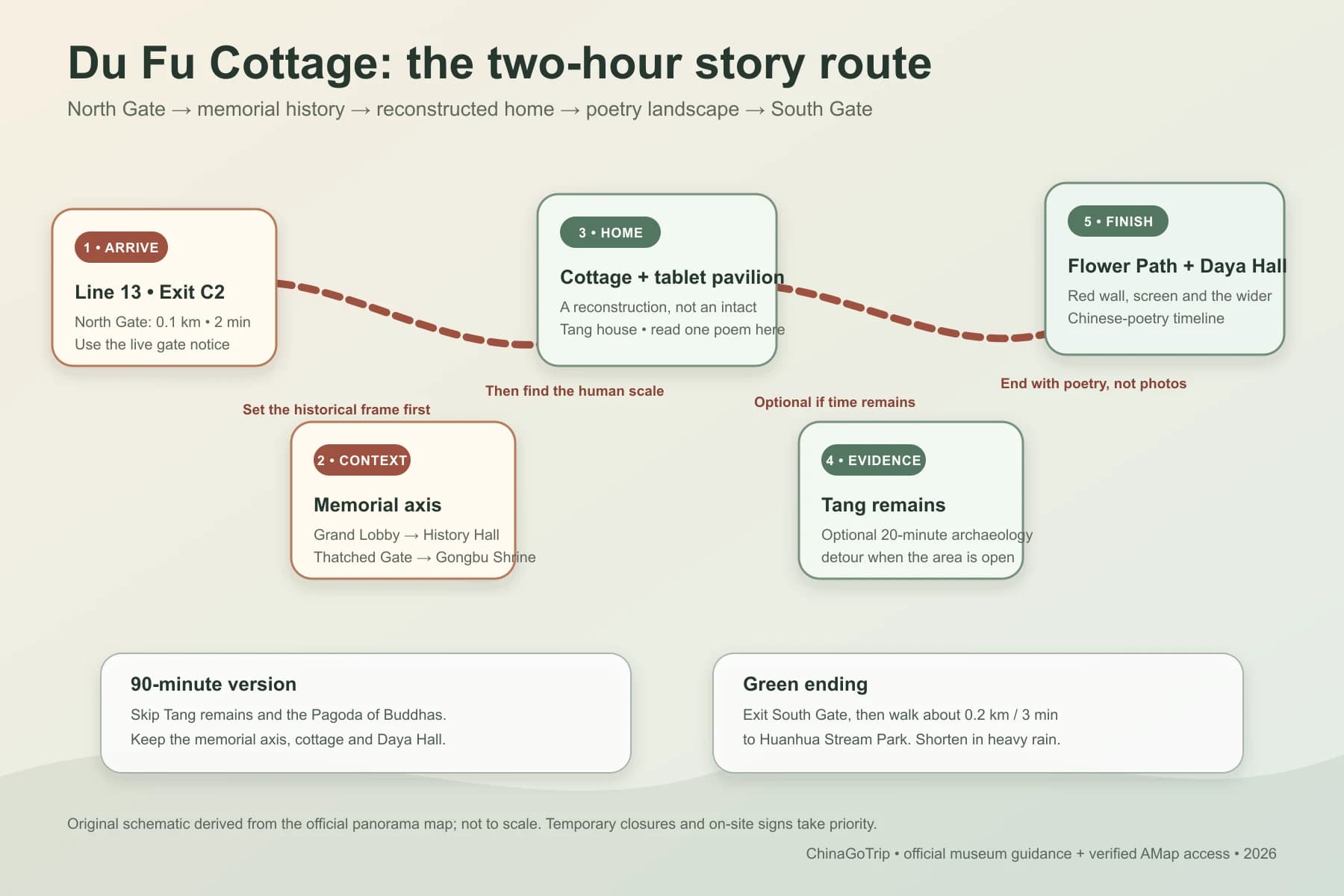
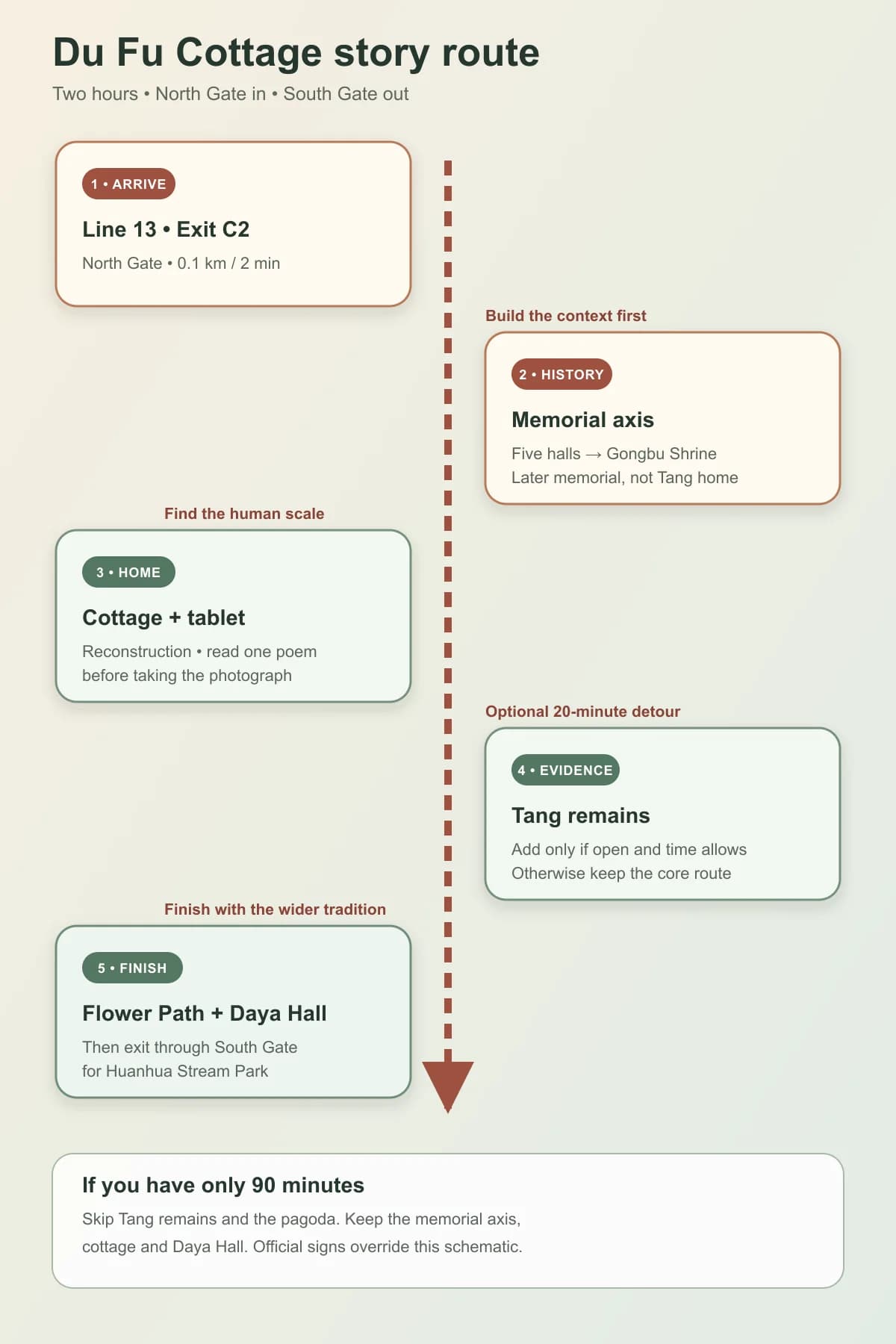
The grounds contain several gates, two different spatial ideas and more minor halls than most first-time visitors need. The clearest route is North Gate → memorial axis → reconstructed cottage → optional Tang remains → Flower Path and Daya Hall → South Gate. This keeps the historical explanation in the right order and places the free Huanhua Stream Park at the end.
Stop 1: North Gate and the memorial axis
Chengdu Metro Line 13, Du Fu Thatched Cottage Station, Exit C2 is roughly 100 meters from the North Gate ticket entrance—about a two-minute walk. This new direct access is easier than the older advice to walk from Line 4.
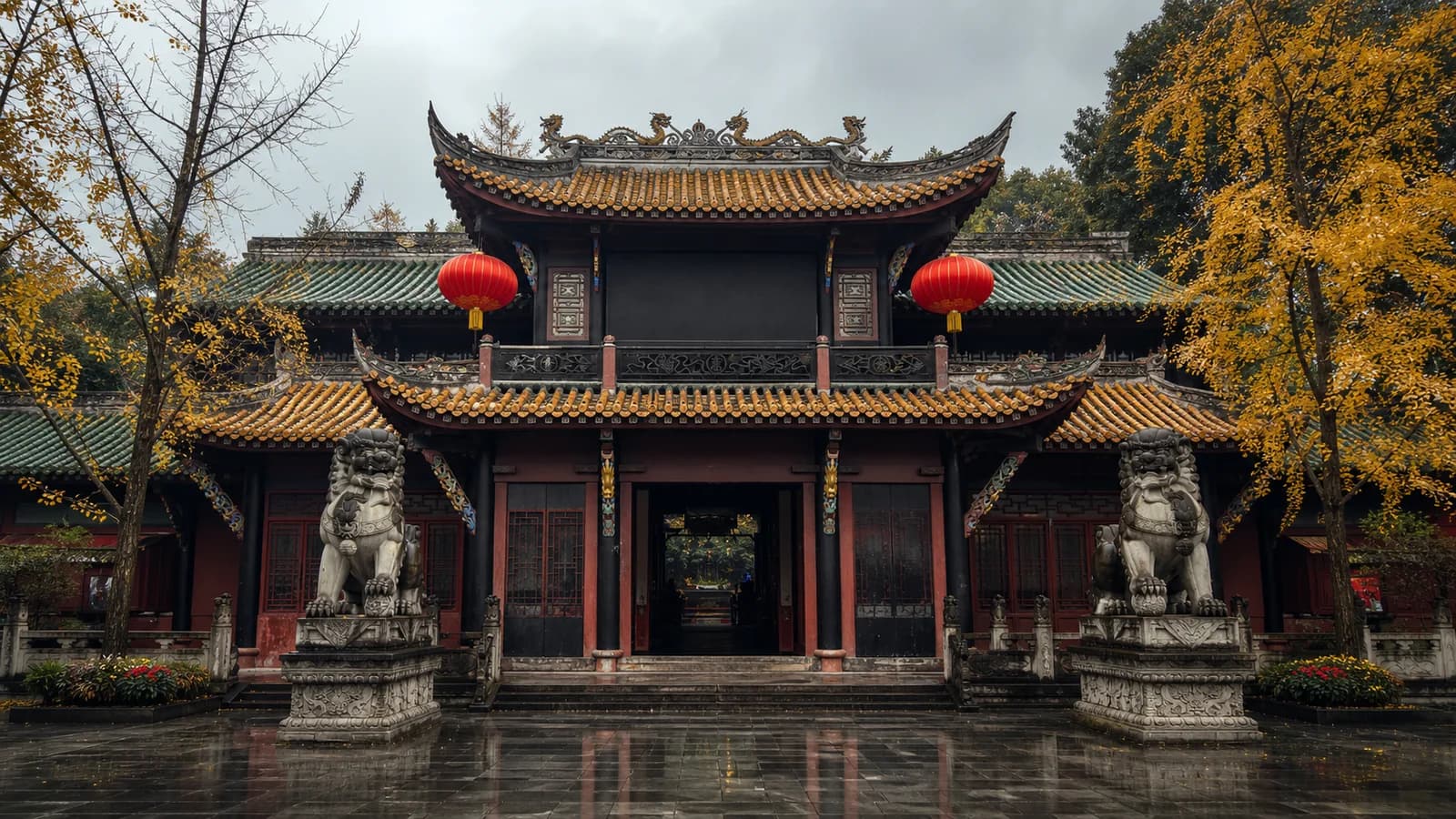
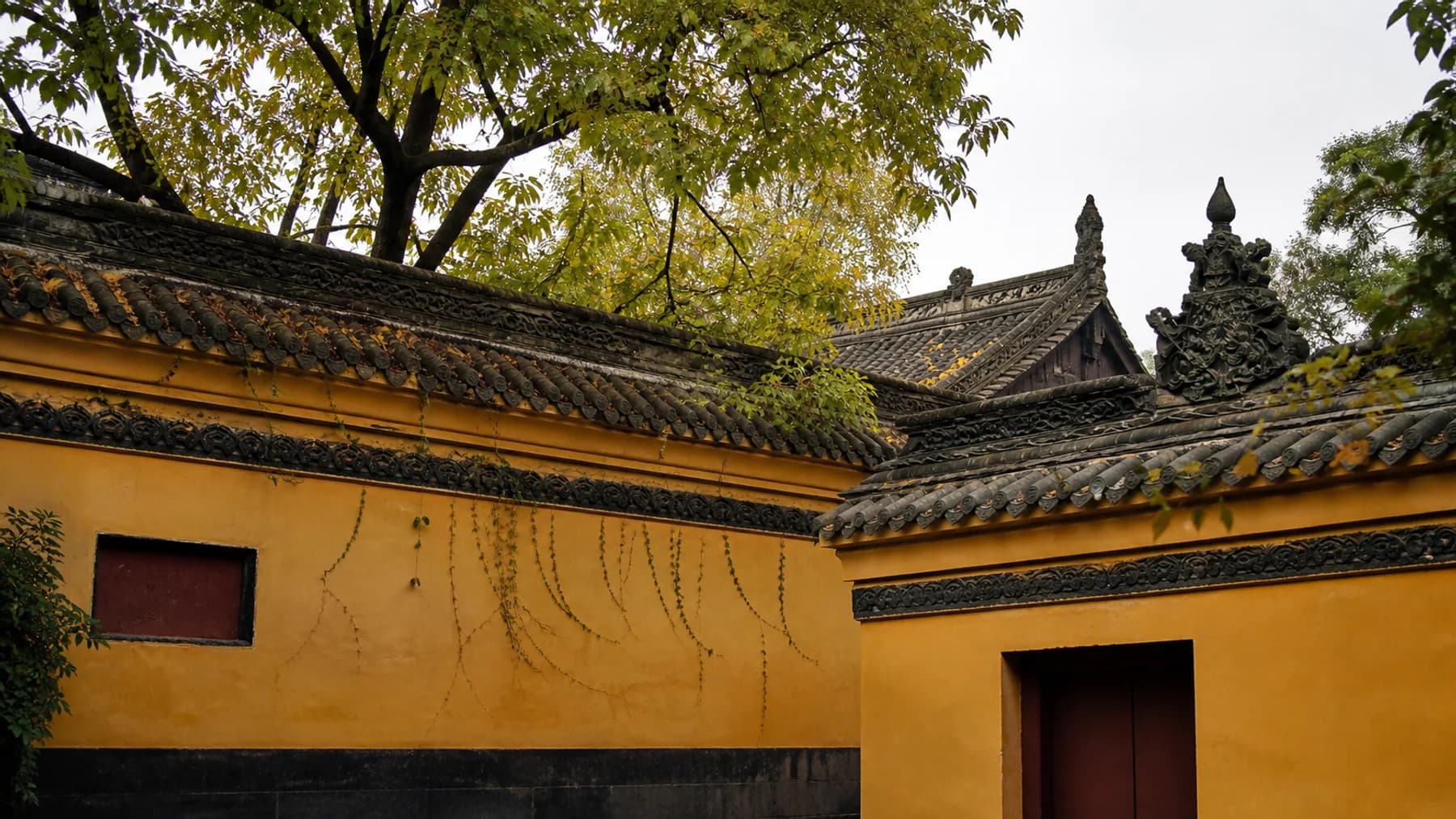
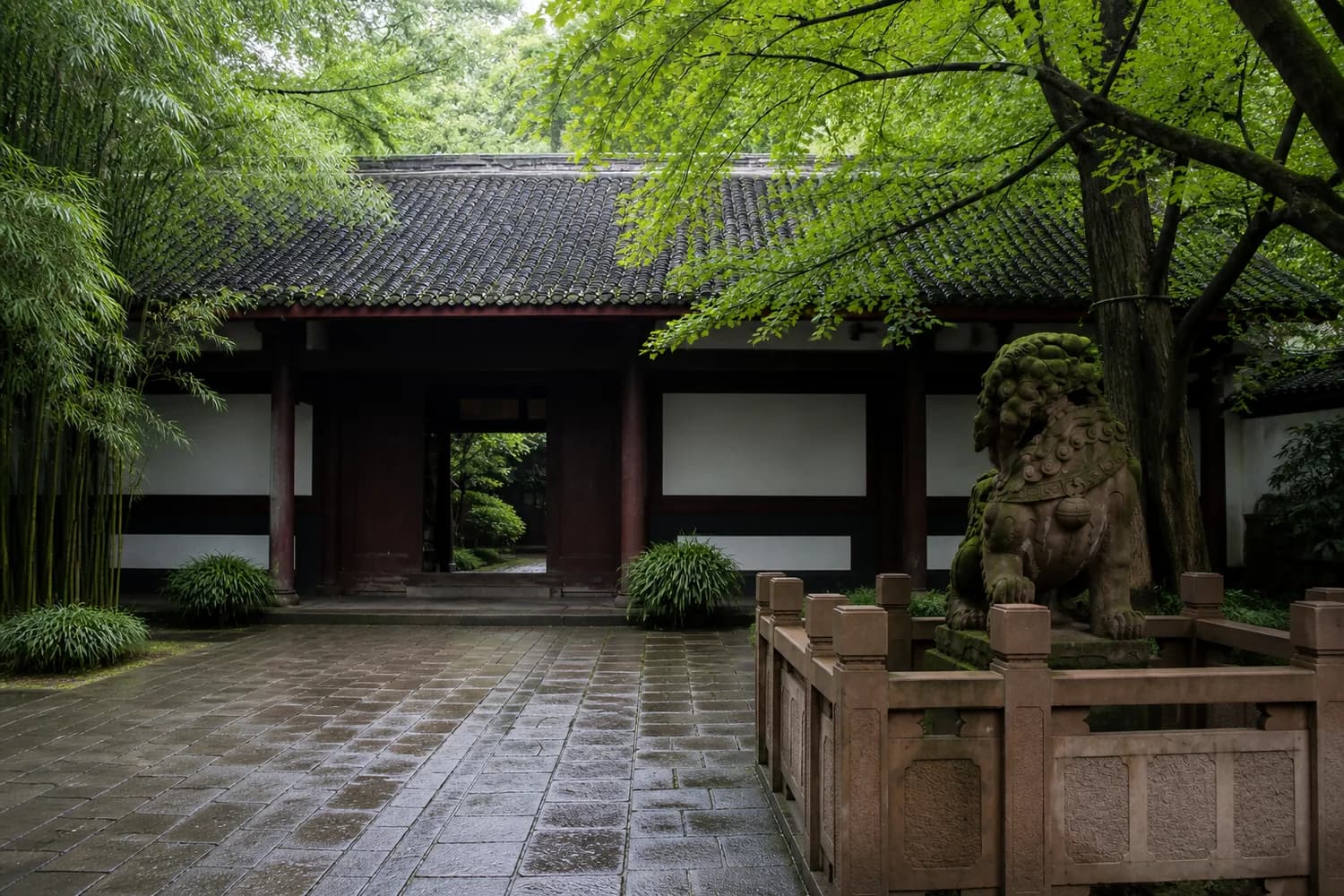
Inside, begin with the central sequence: the Grand Lobby (大廨), Hall of Poet-Historian (诗史堂), Thatched Gate (柴门) and Gongbu Shrine (工部祠). The symmetry and formal halls present Du Fu as the later “Poet-Historian,” whose verse recorded both private hardship and the disruptions of his age. Read the labels selectively: the goal is to understand why later generations built a memorial around him, not to memorize every calligraphy panel.
Stop 2: Shaoling tablet pavilion and reconstructed cottage
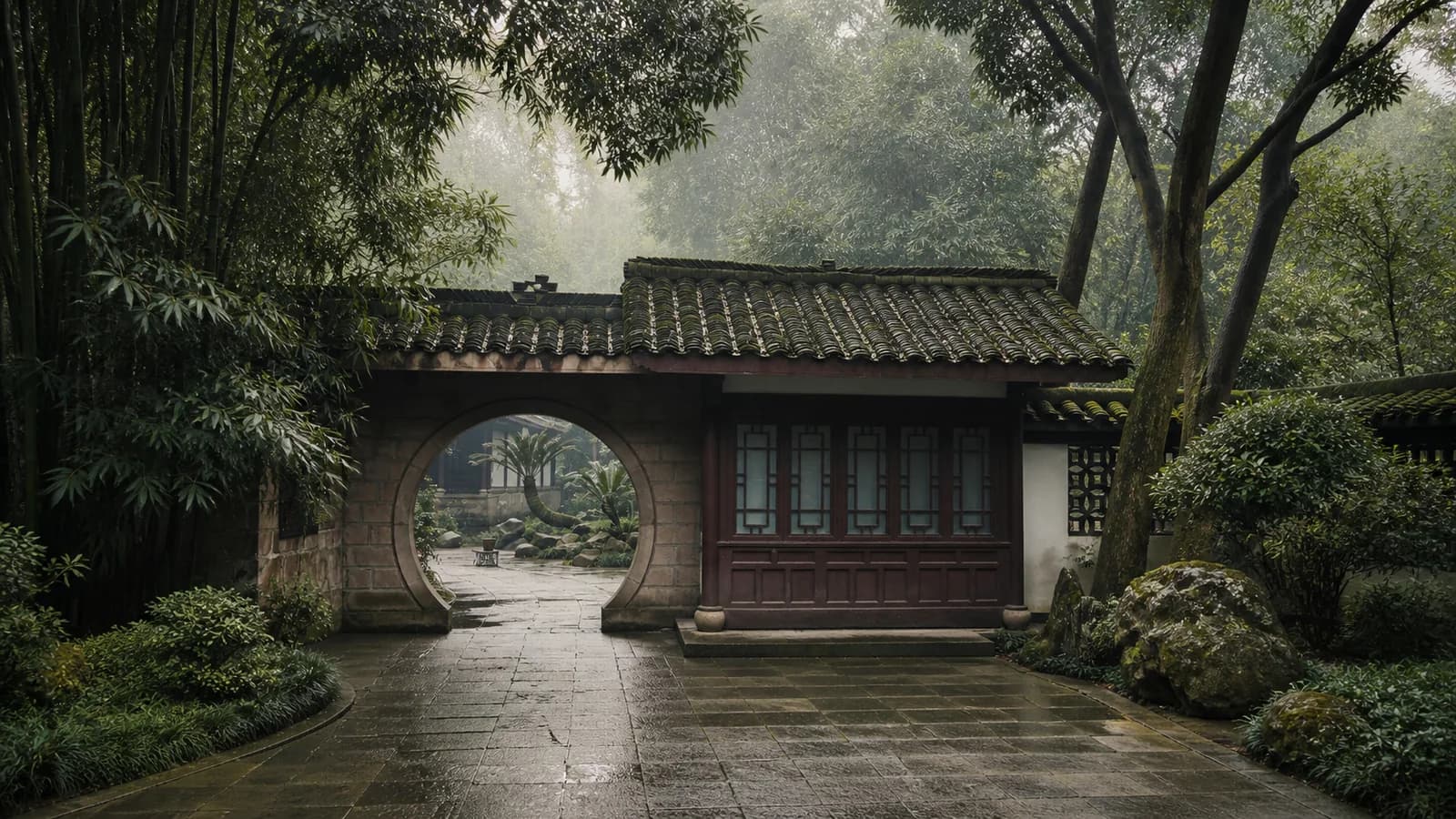
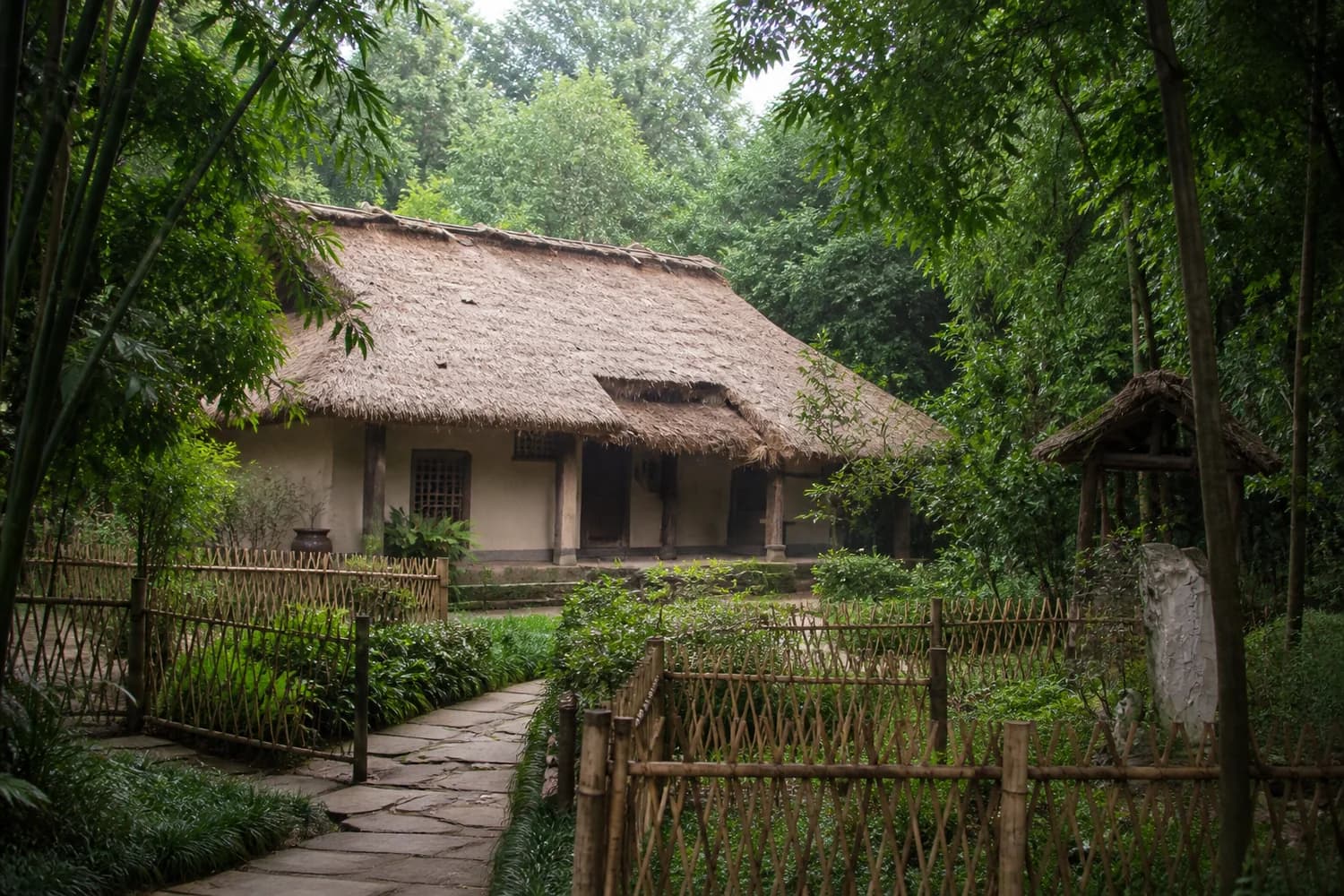
Move west toward the Shaoling Thatched Cottage tablet pavilion, then enter the garden around the reconstructed home. Its kitchen, study, low fences and thatch are based on literary and historical interpretation rather than a surviving floor plan from Du Fu's lifetime. Look for how the landscape shifts from ceremonial courtyards to domestic scale: narrow paths, bamboo, water and modest rooms make the poems easier to imagine.
This is the busiest photography area. If a queue forms at one doorway, circle the cottage first and return; the quieter side paths often explain the setting better than the front-facing photo spot.
Stop 3: Tang remains—or the 90-minute shortcut
The Tang Dynasty Site exhibition adds archaeological context beneath the polished memorial landscape. Choose it if you want material history and have two hours or more. On a 90-minute visit, skip this branch and continue toward the Flower Path; doing fewer sections with context is more valuable than rushing through every pavilion.
Stop 4: Flower Path, Daya Hall and South Gate
The Flower Path connects naturally with Du Fu's poem about receiving a guest: an ordinary path becomes an image of welcome and companionship. Daya Hall broadens the story from one Chengdu residence to Du Fu's place in Chinese literary history. From here, leave through the South Gate and walk about three minutes to Huanhua Stream Park. The public park is free and works as a flexible 20–40 minute ending rather than another required attraction.
Three poems that unlock the visit
You do not need to know classical Chinese. Read a short translation or summary before entering, then connect each poem to a different part of the site.
- “Song of the Thatched Roof Torn by Autumn Wind” begins with a damaged home but expands into empathy for people without shelter. Remember it at the reconstructed cottage: the point is not picturesque thatch, but how personal insecurity becomes social imagination.
- “Happy Rain on a Spring Night” notices timely rain quietly nourishing Chengdu. It changes a damp bamboo path from bad weather into part of the experience. Early morning after rain can therefore be especially atmospheric—provided your shoes have grip.
- “A Guest Arrives” turns the flower path, simple food and an opened gate into hospitality. Recall it near the Flower Path rather than treating the area only as a photo backdrop.
The museum's official WeChat account offers visitor interpretation, including bilingual audio access through its visit-guide menu; rental devices and QR-based options may also be available. Check current language and price information at the gate because the service mix can change.
Tickets, hours and entry
The official visitor page currently displays 08:30–18:30, with ticket sales ending at 17:30. The museum also publishes seasonal and holiday extensions; its standard ticket notice uses shorter base hours. Check the official notice on the day you visit rather than planning around an old screenshot.
- Full-price admission: CNY 50
- Half-price admission: CNY 25 for eligible visitors
- Annual ticket: CNY 100
Eligibility for discounts and free entry depends on current rules and documents. The museum may use timed reservations during busy periods, with booking windows announced through its official channels. Carry the original passport or ID used for the reservation, allow time for security screening and do not rely on a photo of the document.
Visitors should not touch or climb heritage features, use flash where prohibited, feed resident fish or cats, or conduct commercial activity without permission. Wet stone and timber thresholds deserve extra care after rain. Travelers using wheelchairs or strollers should ask staff for the least-stepped route, because the historic-style halls and garden paths are not uniformly barrier-free.
Which gate should you use?
- Arriving by metro: Line 13 Exit C2 → North Gate is the simplest first visit.
- Coming from Sichuan Museum: walk west about 600 meters to the East Gate, then join the memorial axis. This makes the two museums an easy same-day pair.
- Continuing to Huanhua Stream Park: leave by the South Gate; the park edge is about 200 meters away.
- Using older Line 4: Caotang North Road Exit B still works, but the walk to the North Gate is roughly 900 meters. Line 13 is now the more direct default.
Taxi drivers may choose a different gate, so show the gate name rather than only the museum name. The main museum map location is at 37 Qinghua Road, Qingyang District.
Food nearby: choose a dish, not a viral queue
The museum is not the place to build a rigid restaurant checklist. Eat before entry or after leaving, and choose a busy, clean shop around Qinghua Road/Caotang with visible prices. For a light lunch between museums, look for sweet-water noodles, dan dan noodles, wontons, tofu pudding or guokui. Ordering one small noodle bowl plus one shared snack keeps the afternoon comfortable; a large hotpot meal is better saved for the evening.
If you exit south, first complete the park loop and then walk back toward Qinghua Road for a broader choice. Do not cross the city merely for a social-media-famous branch—the literary west-Chengdu route works because its stops remain geographically coherent.
Where to stay for this part of Chengdu
- Qingyang Palace / Caotang: best for a quiet start, the cottage, Sichuan Museum and Huanhua Stream. Nightlife and late dining are limited compared with the center.
- People's Park / Tianfu Square: the best balance for first-time visitors. You retain easy metro access while staying closer to central food and evening walks.
- Chunxi Road / Taikoo Li: choose this for shopping and late dining, accepting a longer transfer to the western cultural sites.
Compare current hotel locations and cancellation terms on Trip.com, the site's first-choice booking partner. Check the nearest metro entrance on a map; “Chengdu city center” alone is too broad to be useful.
Best pairings—and what not to combine
The strongest half-day pairing is Sichuan Museum → Du Fu Thatched Cottage → Huanhua Stream Park. For a full west-Chengdu culture day, start at Qingyang Palace and Culture Park, continue through Sichuan Museum, then enter the cottage at the East Gate and finish south by the stream.
Wuhou Shrine and Jinli form a different southern cluster. They can follow by taxi in a long day, but combining both clusters leaves less time for the poetry and gardens that make this site distinctive. Giant Panda Base or Mount Qingcheng should be separate days.
Final practical advice
Arrive in the first hour if you want quiet garden photography, or after the largest morning groups have moved on. Overcast light suits the bamboo and red walls; summer afternoons can be humid, while wet paving becomes slippery. Bring water, but keep snacks for outside the memorial halls.
Most importantly, resist the urge to photograph every plaque. Read three poems, follow one coherent route and leave through the landscape that inspired them. That turns Du Fu Thatched Cottage from a pleasant garden into one of Chengdu's most meaningful cultural visits.