Classic China five-city route: 14, 18 or 21 days?
In this guide, the classic five-city route means Beijing → Xi'an → Chengdu → Chongqing → Shanghai. It is a useful first-trip arc because every stop has a different job: imperial and national history in Beijing, ancient-capital archaeology in Xi'an, a slower food-and-neighbourhood rhythm in Chengdu, vertical river-city energy in Chongqing, and a flexible contemporary finish in Shanghai.
It is not a list of China's five “best” cities, and it is not the only classic route. It deliberately leaves out major landscapes, southern China and smaller historic places. Its strength is movement: the first four cities form a logical rail chain, then a flight carries you east to a major international gateway without reversing the entire journey.
The route is workable in 14 days, balanced in 18, and spacious in 21. Fourteen days preserves the full idea but asks Xi'an, Chengdu and Chongqing to remain compact. Eighteen gives every city a distinct chapter and a fourth Shanghai night. Twenty-one adds room for a few carefully chosen outward days or slower mornings without adding a sixth base.
If you have not yet decided which parts of China belong in your first trip, use the broader 10-, 14- and 21-day China itinerary chooser first. That guide compares different national routes. This page starts after you have chosen these five cities and need to make the sequence honest.
Documentary photograph: Renek78 / Wikimedia Commons, CC0 1.0.
The decision in one table
| Time in China | Nights by city | What it feels like | Who should choose it |
|---|---|---|---|
| 14 days / 13 nights | Beijing 4, Xi'an 2, Chengdu 2, Chongqing 2, Shanghai 3 | Four moves and narrow intermediate-city priorities | Travelers who want all five cities and can keep each two-night base disciplined |
| 18 days / 17 nights | Beijing 4, Xi'an 3, Chengdu 3, Chongqing 3, Shanghai 4 | A second chapter in each middle city | Most first-time visitors committed to this exact route |
| 21 days / 20 nights | Beijing 5, Xi'an 3, Chengdu 4, Chongqing 4, Shanghai 4 | Slower recovery, weather flexibility and selected extras | Travelers who value depth or gentler mornings over another destination |
Count Day 1 as arrival and the final day as departure. None of these is a route with 14, 18 or 21 full sightseeing days. Every change of base also consumes usable time, even when the train ride looks short.
For families, older travelers, large luggage, mobility constraints or anyone who dislikes repeated checkouts, the 14-day version can still feel rushed. Remove either Chengdu or Chongqing and give those nights to the remaining four-city route, or choose the 18-day plan.
Why this order works
Beijing is the natural northern start
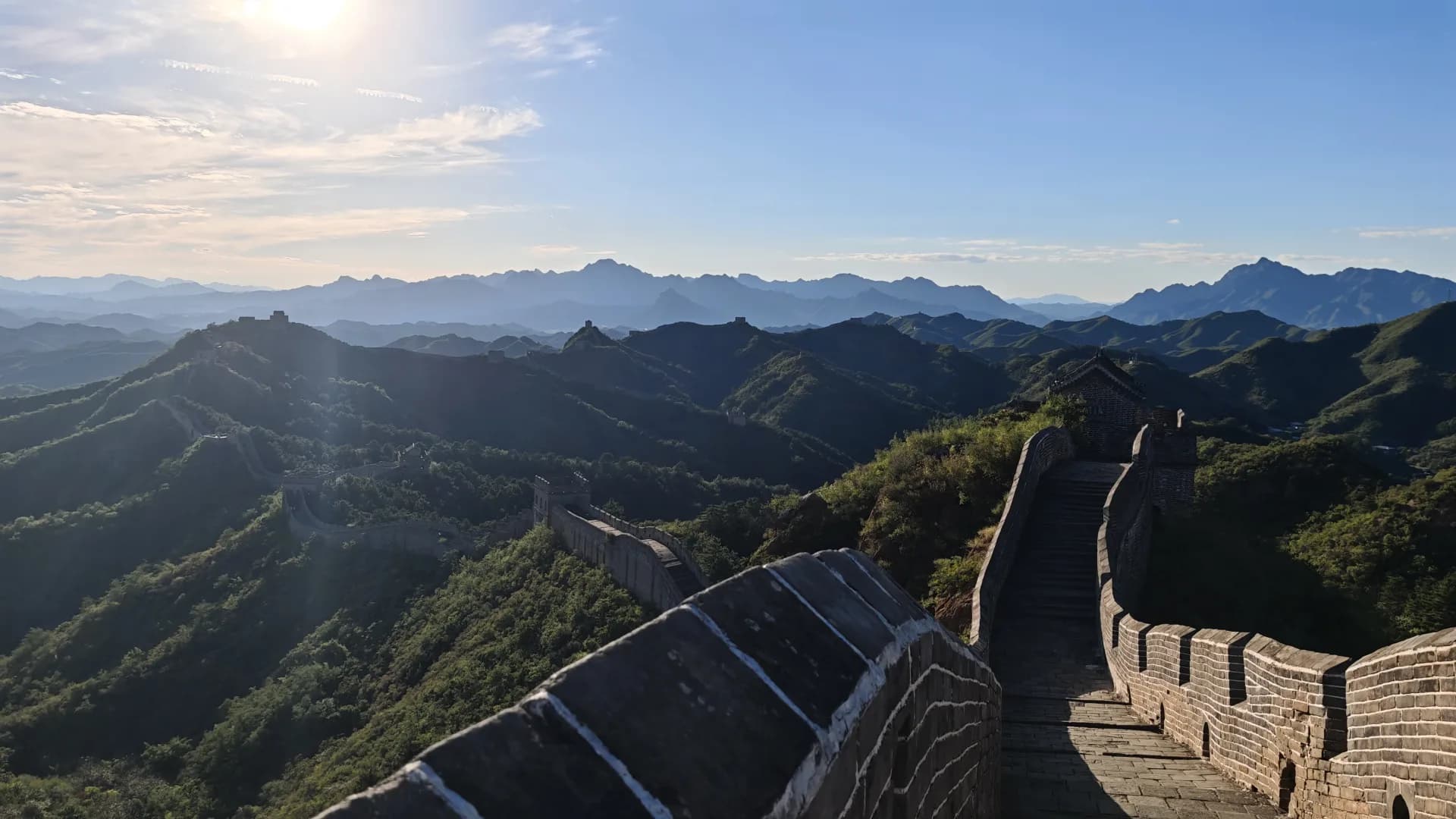
Beijing needs arrival recovery plus one outward Great Wall day. It also has the route's most fragile fixed entries, so placing it first lets you absorb jet lag before the first train. The useful intercity departure is usually Beijing West Railway Station (北京西站), not whichever station is closest to Tiananmen on a map.
Xi'an continues the history rather than repeating it
Xi'an moves the story from imperial institutions to archaeology, the Silk Road and the physical old-city frame. Xi'an North Railway Station (西安北站) is the high-speed rail anchor for both arrival from Beijing and continuation to Chengdu. It sits north of the historic centre, so a four-hour train never creates a four-hour hotel-to-hotel transfer.
Chengdu changes the tempo
After two history-heavy cities, Chengdu provides a useful change: an early wildlife or heritage excursion, slower neighbourhood time, tea and cuisine. Chengdu East Railway Station (成都东站) receives the Xi'an leg and offers frequent onward trains toward Chongqing.
Chongqing changes the geometry
Chongqing is close to Chengdu by train but not interchangeable with it. Chengdu's best hours often happen at street and courtyard scale. Chongqing's defining experience is movement through elevation, bridges, rivers and dense night views. A day trip from Chengdu gives you the transfer twice and removes the evening when Chongqing makes the most sense.
Shanghai releases the route toward an international exit
Shanghai is deliberately last. Its neighbourhood walks, museums, shopping and riverfront plans can expand or contract after a long domestic trip. More importantly, three or four nights there protect the international departure from a separate Chongqing flight delay.
The plan is open jaw: fly into Beijing and out of Shanghai. If international fares strongly favour the reverse, reverse the whole chain: Shanghai → Chongqing → Chengdu → Xi'an → Beijing. Do not fly into Shanghai, cross west, then return to Shanghai only because the original diagram pointed east.
The 14-day version: a compact but complete chain
Night pattern: Beijing 4 → Xi'an 2 → Chengdu 2 → Chongqing 2 → Shanghai 3. This is thirteen nights, with the first day used for arrival and Day 14 for departure.
Days 1–4: Beijing
Day 1 is airport access, check-in and one untimed local walk. Use Days 2–4 for the central imperial core, one Great Wall day and one second urban cluster. The Beijing destination guide and four-day itinerary help you choose those clusters. Move the outdoor day to the best forecast, and do not put a timed Forbidden City reservation on an international-arrival afternoon. The Great Wall section chooser explains why Badaling, Mutianyu, Jinshanling and Simatai are different days rather than interchangeable ticket labels.
Day 5: Beijing to Xi'an
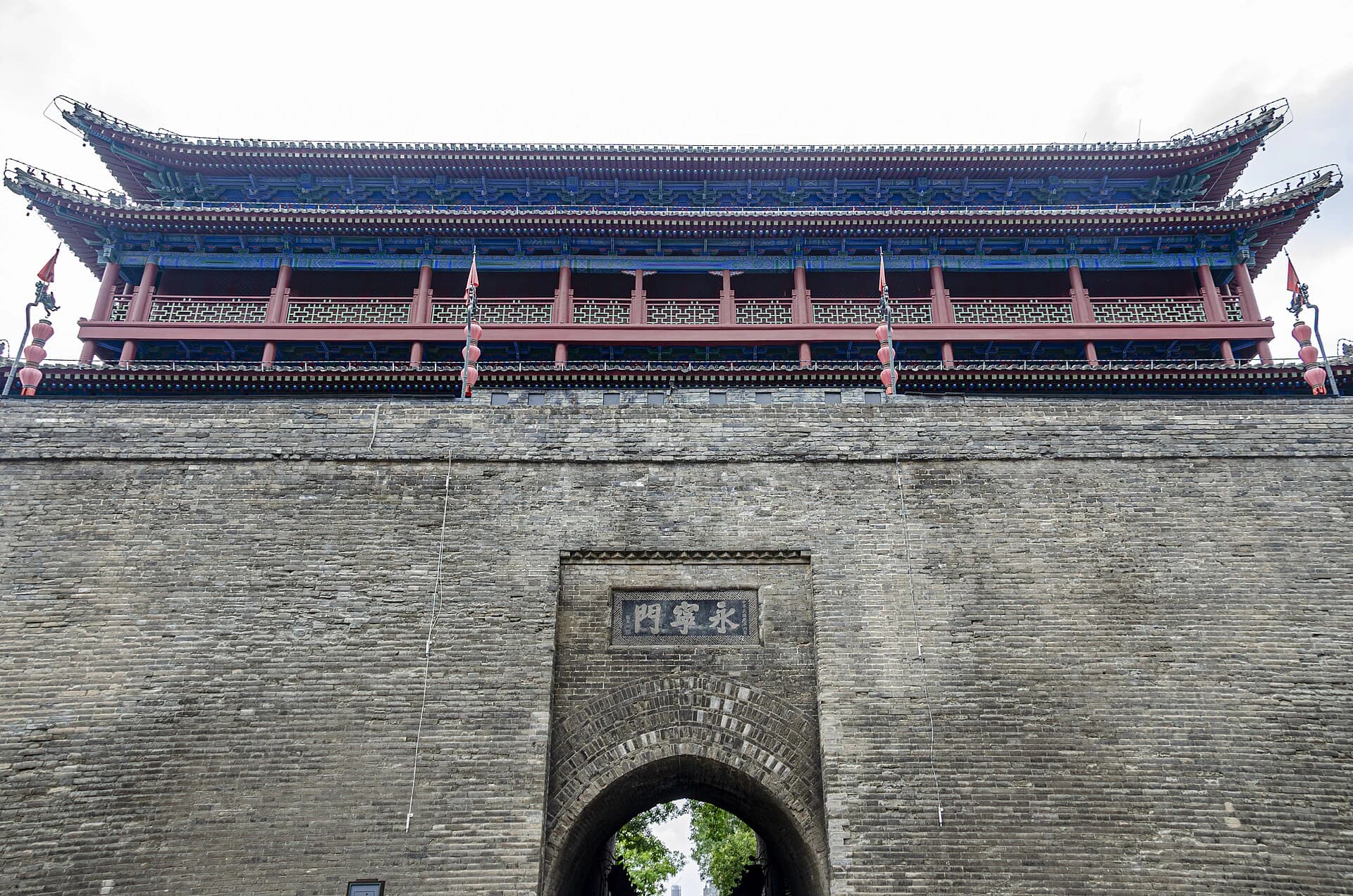
Current September 2026 inventory lists the fastest Beijing West–Xi'an North trains at about 4 hours 10 minutes. The real move is closer to six or seven hours once checkout, station access, security, boarding and the Xi'an hotel transfer are included. A late-morning departure may protect a useful Xi'an evening better than the nominally fastest dawn service. Use that evening for the City Wall area or a compact food walk; do not attach the Terracotta Warriors to the train day.
Day 6: Xi'an's outward archaeology day
Give the Emperor Qinshihuang's Mausoleum Site Museum its own half-to-full day and return for one old-city evening cluster. If your dated ticket is available through the exact marketplace product, compare the live Trip.com Terracotta Warriors listing with the official current admission rule. Check whether any guide, transfer or extra museum is actually included before paying.
Documentary photograph: YikyuenG / Wikimedia Commons, CC BY-SA 4.0.
Day 7: Xi'an to Chengdu
Current direct high-speed inventory shows headline minima around 3 hours 05 minutes from Xi'an North to Chengdu East. Treat it as a half-day move. Check in, choose one neighbourhood and have a proper meal. A panda visit after a midday arrival is a poor trade: the site is large and the preferred observation window is earlier.
Day 8: Chengdu priority day
Choose either an early visit to the Chengdu Research Base plus a light urban afternoon, or one outward heritage day such as Sanxingdui. Two nights do not support both. If pandas are the fixed priority, the exact Trip.com panda-base listing is useful only when it matches the live entrance, passport and inclusion rules. The panda-base chooser helps distinguish the facilities before you book.
Day 9: Chengdu to Chongqing
The fastest current train headline is around 1 hour 02 minutes, but this is still a hotel-change day. Chengdu East services can arrive at Chongqing North (重庆北站), Chongqing West (重庆西站), Shapingba (沙坪坝站) or Chongqing East (重庆东站), depending on the dated service. Choose the station by the exact train and hotel access, then use one connected afternoon and evening for the river-city views.
Day 10: Chongqing's full day
Give this day to the central peninsula, a river crossing and a second perspective after dark. Do not bolt on Wulong or Dazu: each is an outward travel job. The Chongqing three-day itinerary offers a menu, but this compact version takes only its connected urban core.
Day 11: Chongqing to Shanghai
A current direct train can consume roughly 10–13 hours, depending on service and Shanghai endpoint. A well-timed nonstop flight normally preserves more of this short trip. Use Chongqing Jiangbei International Airport, and confirm whether you land at Shanghai Hongqiao or Shanghai Pudong. The hotel transfer differs materially.
Days 12–14: Shanghai and departure
Use one full day for the Bund and a connected historic or commercial cluster, then one for a contrasting western neighbourhood or museum. Day 14 is departure. The Shanghai three-day itinerary has the right shape, but its arrival day must absorb the Chongqing flight.
Verdict: this is the shortest version I would present as the complete five-city experience. Xi'an, Chengdu and Chongqing each have only one full day; if that is too narrow for your group, remove a city or choose 18 days.
The 18-day version: five real city stays
Night pattern: Beijing 4 → Xi'an 3 → Chengdu 3 → Chongqing 3 → Shanghai 4. Seventeen nights give each intermediate city two usable full days around its incoming and outgoing transfers, while Shanghai gains weather and departure margin.
Use Days 1–4 in Beijing; Day 5 to Xi'an; Days 6–7 in Xi'an; Day 8 to Chengdu; Days 9–10 in Chengdu; Day 11 to Chongqing; Days 12–13 in Chongqing; Day 14 to Shanghai; Days 15–17 in Shanghai; Day 18 for departure. This schedule is a night ledger, not a command to fill every morning. The fourth Shanghai night belongs to the route design: it can absorb a late flight, a laundry afternoon or a missed weather window without touching the international departure.
In Xi'an, one full day stays with the Terracotta Warriors. Use the second for the City Wall, Beilin, a serious museum or the Big Wild Goose Pagoda area according to interest. The Xi'an three-day itinerary provides a complete city shape without pretending distant evening sites form one walk.
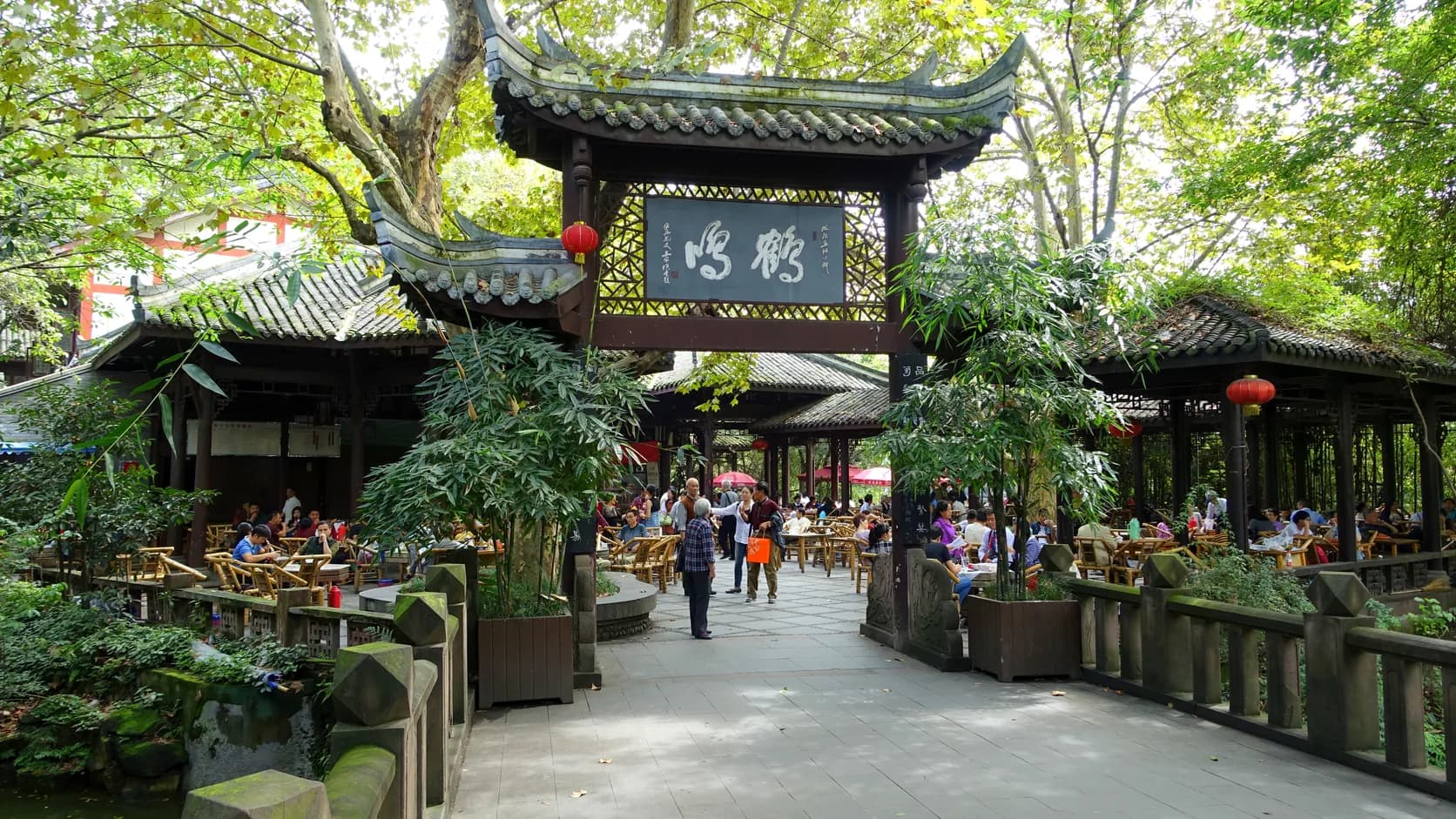
In Chengdu, use an early panda morning if that matters, then preserve a slower afternoon. The second full day can be urban food and neighbourhoods, Sanxingdui, or Dujiangyan. Treat those as alternatives, because the benefit of an 18-day route is not rushing three large excursions into one stop.
Documentary photograph: Daderot / Wikimedia Commons, CC0 1.0.
In Chongqing, give one day to the central peninsula and river crossings, then a second to another urban zone or a carefully chosen outward excursion. The destination guide explains why straight-line distance misleads in a city of stacked roads, steep exits and different river levels. Two full days are valuable even if you never leave the urban core: one can be slow and one can run into the night.
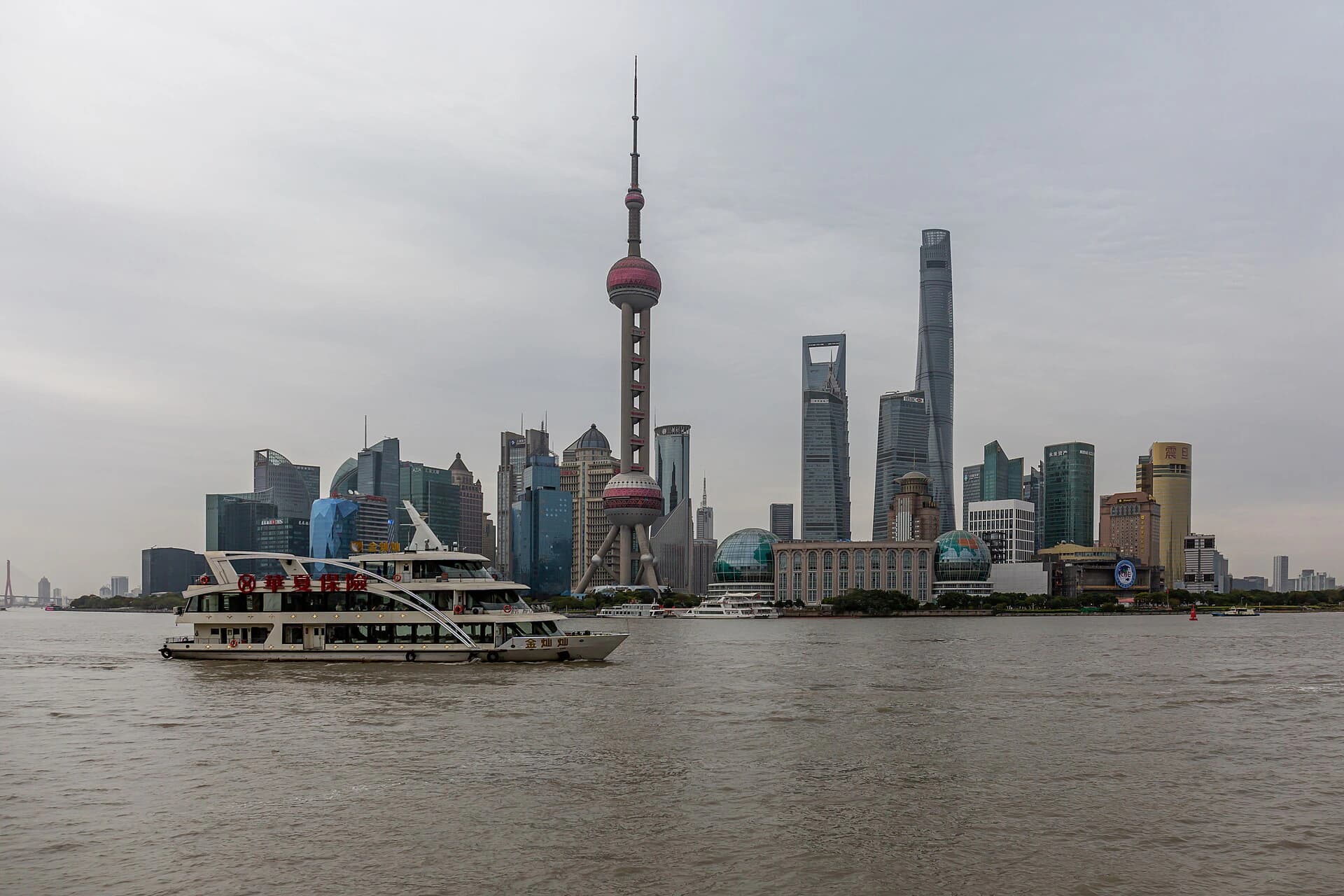
In Shanghai, three full days can cover one skyline and historic-core day, one neighbourhood or museum day and one deliberate flexible choice. If a paid observation deck matters, compare the live Shanghai Tower product only after checking visibility and the exact dated level. A water-town or Suzhou day is possible, but it replaces a Shanghai day; it is not free time created by a short train.
Documentary photograph: Balon Greyjoy / Wikimedia Commons, CC0 1.0.
Verdict: choose 18 days when all five cities matter. The four days beyond the compact version become a second Xi'an day, a second Chengdu day, a second Chongqing day and a more resilient Shanghai finish.
The 21-day version: depth without a sixth base
Night pattern: Beijing 5 → Xi'an 3 → Chengdu 4 → Chongqing 4 → Shanghai 4. The twenty nights sum exactly; Day 21 is departure. This version is for travelers who want the same route to breathe, not a mandate to buy an attraction every morning.
The day ledger is Beijing Days 1–5; train to Xi'an Day 6; Xi'an Days 7–8; train to Chengdu Day 9; Chengdu Days 10–12; train to Chongqing Day 13; Chongqing Days 14–16; flight to Shanghai Day 17; Shanghai Days 18–20; depart Day 21. Every move remains a move, even if a train has a short headline duration. Keep the first and last city buffers rather than spending them on a sixth checkout.
The fifth Beijing night buys a genuine weather swap for the Great Wall and room for a deeper palace, temple or neighbourhood day. Xi'an remains at three nights because its Terracotta Warriors day and one city day are already coherent; add a fourth only if archaeology or a specific museum matters more to you than the southwest. Chengdu's fourth night can support an additional outward heritage day or a recovery day built around tea, food and local streets. Chongqing's fourth allows a second urban geography beyond the central peninsula or one carefully chosen outward day, with a night back in the city. Shanghai's fourth protects the flight and leaves one flexible east-China day.
Avoid turning all of those optional days into simultaneous distant excursions. Great Wall, Terracotta Warriors, Sanxingdui, Dujiangyan, Wulong, Dazu, Suzhou and a water town are not one tidy checklist. Pick the two or three that fit your interests, then leave the rest of the added time for weather and ordinary city life. A three-week route can still become exhausting if every extra night is spent in a vehicle.
Verdict: choose 21 days for depth or gentler pacing. If a major landscape region is your true priority, use the longer duration to rebuild the itinerary around it instead of adding it as a sixth pin on this exact five-city chain.
Transfer-day reality
| Leg | Current headline | Honest planning unit | Default |
|---|---|---|---|
| Beijing West → Xi'an North | Fastest around 4h10 | 6–7 hours hotel to hotel | High-speed rail |
| Xi'an North → Chengdu East | Fastest around 3h05 | 5–6 hours hotel to hotel | High-speed rail |
| Chengdu East → Chongqing | Fastest around 1h02 | 3.5–5 hours after both city transfers | High-speed rail, terminal chosen by hotel |
| Chongqing → Shanghai | Direct rail roughly 10–13 hours; flights vary by date | Most of a day either way | Nonstop flight in 14/18 days; compare in 21 |
These are planning snapshots checked in September 2026, not permanent timetables. China Railway changes regular and holiday services, and a fast number is useful only if the station, departure hour and seat are workable. Compare live train inventory on Trip.com once the night pattern is fixed, then verify the station name, date, passenger document and train number character by character.
For Chongqing–Shanghai, compare nonstop flights on Trip.com by complete elapsed time, baggage terms and arrival airport. A cheap late flight into Pudong can erase the apparent saving if your hotel is west of the centre. A daytime train can be reasonable in the 21-day version for someone who prefers rail, but it is a deliberate full travel day.
Never put a separate Chongqing–Shanghai domestic ticket immediately before the international flight. Keep the final Shanghai nights. An airline does not protect an independently booked onward ticket because your domestic flight was late.
Booking hierarchy
- Verify entry permission and the international open jaw. The current national itinerary chooser links the official visa-free and transit-policy sources. A 240-hour transit itinerary has third-country and permitted-area rules that this five-city route may not satisfy.
- Choose 14, 18 or 21 days and lock the night pattern. Do this before buying any domestic leg.
- Book cancellable hotels by exact district and terminal access. Compare Trip.com hotels after checking the property pin, passport acceptance, front-desk hours and cancellation terms.
- Protect the final international flight. Shanghai belongs at the end with three or four nights, not as a same-day connection.
- Buy Chongqing–Shanghai air when the surrounding nights are stable. Include baggage and airport transfers.
- Buy rail as the live sale window opens. Keep passenger names and passport numbers identical across every booking.
- Reserve scarce attractions on their official release schedule. A train ticket does not solve a Forbidden City, Terracotta Warriors or museum slot.
- Save the Chinese hotel names, station pins and confirmations offline. A screenshot helps when data fails; the live record controls if a schedule changes.
Do not reserve a perfect attraction sequence first and then force trains around it. The order of dependency is international geometry → nights → hotels → long diagonal flight → rail → fixed attractions → flexible streets.
Where the route breaks
Too many outward days
Great Wall, Terracotta Warriors, Sanxingdui, Dujiangyan, Wulong and a Shanghai water town are all legitimate. They are not compatible as one outward excursion from every city in a 14-day chain. Protect the Great Wall and Terracotta Warriors, then choose at most one extra outward day in the southwest unless you have 18 or 21 days.
Treating Chengdu and Chongqing as one base
The short train creates the illusion that commuting saves a hotel change. It does not. You still travel from one hotel to a station, cross by rail, navigate a large terminal and return late. Sleep in both cities if you keep both. Otherwise, choose one and deepen it.
Choosing the fastest train before the right station
One Chengdu–Chongqing result may save minutes but arrive at a terminal that adds a long city transfer. Search the exact hotel route from Chongqing North, West, Shapingba and East before paying. The fastest rail time is not automatically the fastest hotel arrival.
Spending Shanghai's buffer elsewhere
Removing a Shanghai night to add another southwest excursion makes the international departure fragile. The final base absorbs delay, laundry, shopping, weather and a slower last morning. It is part of the transport design, not leftover time.
Swaps that preserve the logic
Cut Chongqing for a slower 14-day trip
Beijing 4 → Xi'an 3 → Chengdu 3 → Shanghai 3 uses the same thirteen nights with one fewer checkout. Fly Chengdu–Shanghai. This is the first cut for travelers who value depth more than seeing five names: Chengdu still supplies the southwest chapter, while Xi'an and Chengdu each gain a second full day.
Cut Chengdu if urban topography matters more than pandas and tea
Beijing 4 → Xi'an 3 → Chongqing 3 → Shanghai 3 is also coherent within thirteen nights. Xi'an–Chongqing has direct rail options, but verify the dated service and station. This version changes the emotional rhythm: the route moves from history into a dense night city without Chengdu's slower interval.
Replace the southwest pair with Guilin–Yangshuo for landscape
Do this as a block, not as a sixth pin. Give the Guilin–Yangshuo region at least three nights and expect flights from Xi'an and onward toward Shanghai. The Guilin four-day itinerary explains why the Li River cruise and Yangshuo countryside need more than one photo stop.
Replace one southwest city with Zhangjiajie only by adding time
Zhangjiajie needs multiple nights, weather flexibility and a gate plan. It is not an equivalent one-night swap. Use the Zhangjiajie route chooser and rebuild the sequence around three or four nights; otherwise keep the five-city arc.
Add Suzhou or Hangzhou from Shanghai only when a full day remains
In the 18- or 21-day route, you can use one Shanghai day for a short east-China excursion if the city itself is not a priority. In the 14-day route, adding another hotel is poor arithmetic. Keep Shanghai as the luggage base and verify the exact departure station.
Cut-first logic
When the route becomes too crowded, remove in this order:
- Optional outward excursions from Chengdu, Chongqing and Shanghai.
- One paid skyline viewpoint, show or nightlife stop.
- Chongqing from the 14-day version, converting it to a stronger four-city route.
- Chengdu or Chongqing from the 18-day version if your group wants longer bases rather than a fifth city.
- The entire five-city structure if the international open jaw is poor; use a route that matches your flights.
Do not cut the Beijing arrival night, the Great Wall day, the Terracotta Warriors day, the Chongqing–Shanghai transfer margin or the final Shanghai buffer. Those are structural parts of the route.
Which pace should you choose?
Choose 14 days for the shortest version that still explains why all five cities are present. It is brisk, with one full day in each middle city and no spare outward excursion.
Choose 18 days when you want the full five-city route without turning Xi'an, Chengdu or Chongqing into a train-linked sample. It adds a second full day in each and a fourth Shanghai night.
Choose 21 days when weather flexibility, slower mornings or selected outward days matter more than adding a sixth destination. The route remains coherent because the night count grows within existing bases.
If you are undecided between 18 and 21, name the three extra days before paying for them: one Beijing weather or depth day, one Chengdu choice and one Chongqing choice. If those jobs do not appeal to you, eighteen days is enough for this exact arc.
For a shorter first trip with every day already sequenced, use the structured 7-day Beijing–Xi'an–Shanghai route, 10-day route with Chengdu, or 14-day route with Guilin and Yangshuo.