Which Great Wall section should you visit from Beijing?
There is no single “best” Great Wall section near Beijing. Badaling, Mutianyu, Jinshanling and Simatai solve different travel problems. The right choice depends less on which wall looks most impressive in a photograph and more on four constraints: how reliably you can get there, how much climbing your group can handle, when you need to be back in Beijing, and whether your priority is history, landscape photography or a night experience.
Choose Badaling when this is your first visit, public transport must be simple, or your Beijing schedule is tight. Choose Mutianyu when you want a fully restored wall, green mountain views, several mechanical ascent choices and a more flexible family day. Choose Jinshanling when hiking and long-lens ridge views matter more than transport convenience. Choose Simatai when sunset or a lit evening section is the reason for going and you are willing to pair the wall with Gubei Water Town or stay overnight.
Those are starting points, not rankings. Badaling can be excellent before the tour-group peak. Mutianyu is not automatically quiet. Jinshanling's cable car does not make the whole visit easy. Simatai's night product covers a controlled part of a steep wall, not an unrestricted after-dark hike.
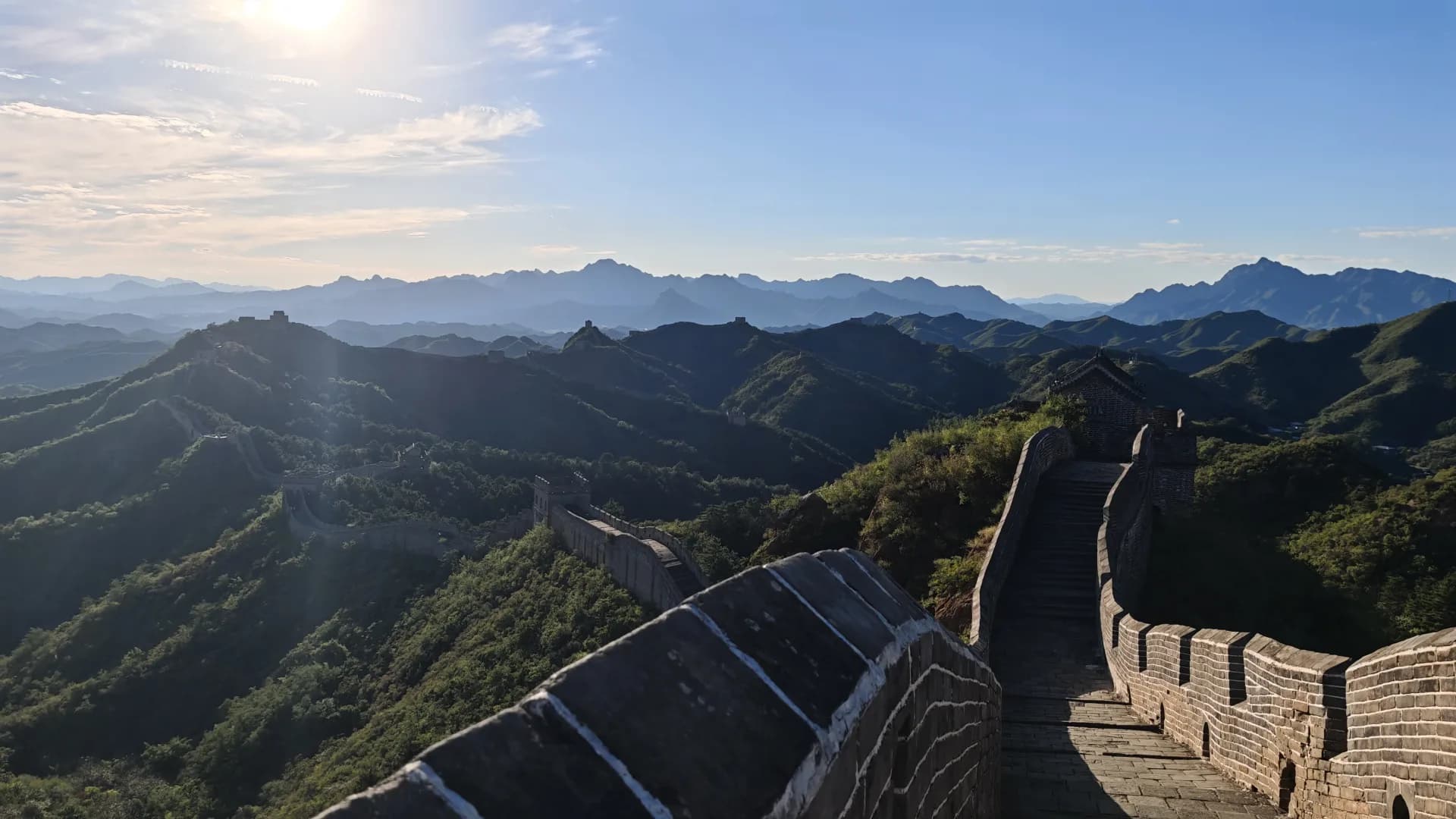
Jinshanling documentary photograph by Renek78, adapted from Wikimedia Commons and dedicated to the public domain under CC0 1.0.
The 60-second decision
| Your real priority | Start with | Why it fits | The compromise |
|---|---|---|---|
| Easiest independent day from central Beijing | Badaling | Direct railway station, mature signs and services, several ways to shorten the climb | The busiest of the four at predictable peak times |
| First visit with mountain scenery and a lift-assisted route | Mutianyu | Restored wall, forested ridges, enclosed cable car plus separate chairlift/toboggan system | The last transfer and internal shuttle add friction; popular days still feel busy |
| Serious walking, watchtowers and photography | Jinshanling | Long open sightlines, mixed restored and weathered character, early and late light | Remote, fewer dependable public departures and a physically harder day |
| Sunset, lit wall and an overnight escape | Simatai | Official night access beside Gubei Water Town, cable-assisted evening product | Long return to Beijing, high total cost and limited night walking area |
| Older traveller who wants a wall view with less climbing | Badaling or Mutianyu | The strongest lift and visitor-service choices | Neither wall is step-free once you move onto ordinary ramparts |
| Young children who will enjoy the descent | Mutianyu | Chairlift-and-toboggan option can make the day memorable | Height, weather and operating rules apply; the toboggan is not an accessibility service |
| Two-day Beijing stopover | Badaling first | Most predictable transport and easiest to fit around other sights | You trade some solitude for schedule control |
| Clear-weather photography day with a driver | Jinshanling first | Better room to wait for light and build layered compositions | Poor visibility erases much of the reason for choosing it |
If two options still look equal, cut the one with the risk you cannot absorb. A missed return at Badaling is inconvenient; a missed fixed coach from Jinshanling or a late Simatai departure can reshape the entire evening. A family that dislikes steep steps should cut Jinshanling and Simatai first. A photographer facing haze or rain should cut the longest transfer first and use the clearest forecast window, whichever section it falls on.
What all four sections have in common
Every option is a mountain outing. Restored paving, handrails, cable cars and shuttle buses reduce effort, but they do not turn the Great Wall into a flat promenade. Expect irregular stone, steep ramps, narrow stairs, exposed ridges and a return journey that feels harder after several hours outside.
Mechanical transport also works in segments. A cable car carries you between a lower station and one upper area; it does not move you along every watchtower. At Mutianyu, the enclosed cable car and the chairlift/toboggan system reach different points. At Badaling, the North Wall aerial cable car, the northern slide/pulley service and the South Wall funicular are separate products. At Jinshanling, the cable car removes part of the approach but leaves substantial wall walking. At Simatai, the night product normally uses the cable car to reach a tightly controlled illuminated section.
Wind, thunderstorms, ice, wildfire controls, maintenance and crowd management can stop a lift or close part of a route. Buy the wall ticket, shuttle, lift and night product as separate line items in your mental budget, even when a seller bundles them. Read the exact endpoints and last descent time before checkout.
Badaling: best when transport certainty matters most
Badaling is the easiest of these four to plan without a driver. High-speed trains run from Beijing North or Qinghe to Badaling Great Wall Station, and the rail segment can be roughly 20–35 minutes. The full trip is longer: allow time to reach the correct Beijing station, clear railway security, find the platform, exit a deep underground arrival station and walk through the scenic approach. Tickets can sell out on weekends and holidays, so the railway advantage only exists if you secure both outward and return trains.
Badaling's wall is broadly restored and visually monumental. The North Wall is the famous, busier branch; the South Wall often gives more breathing room. Steep ramps remain on both. Its advantage for a mixed-age group is not that the wall is easy, but that the site has the strongest combination of rail access, visitor facilities and mechanical choices. A traveller who cannot manage ordinary wall steps should confirm the operating accessible viewing route with staff rather than assuming a cable ticket solves every barrier.
Crowds follow a strong pattern. The approaches, main pass and lower North Wall become compressed after tour buses arrive. An early reserved train, a weekday outside national holidays, or a deliberate South Wall plan changes the experience substantially. The wall itself is wide enough for large numbers, but bottlenecks form where people stop on steep ramps and at famous viewpoints.
For photography, Badaling gives the most recognizable restored-wall geometry and the easiest chance to capture a classic ridge line on a short trip. It is less suited to empty-wall compositions during midday. Use the early hours, walk beyond the first cluster of towers if conditions and your return time permit, or turn south. Night access is a separate seasonal event rather than an extension of the daytime ticket. Beijing's 2026 programme runs from April 30 to October 6 and opens a central illuminated area between North Watchtower 4 and South Watchtower 4; verify the exact date and event ticket on the official 2026 notice.
For daytime planning, Beijing's current official attraction page lists 06:30–16:30 from April through October and 07:30–16:00 from November through March. It says advance reservation is not required and onsite purchase is available. Booking ahead is still useful when you also need a dated train, lift or night product; bring the original passport used for any real-name order.
A realistic Badaling day
Allow 6–8 hours hotel to hotel for a focused rail-based visit: about 60–90 minutes to reach and process through the Beijing station, 20–35 minutes on the train, 20–40 minutes from the Badaling platform through the approach, 2.5–4 hours at the wall, and the same sequence in reverse. Add time if your hotel is far from Beijing North or Qinghe, if you use Bus 877, or if you want both North and South routes.
Use the full Badaling guide to choose North or South, match the correct lift to its wall branch and check the current train and bus details. If a third-party ticket is useful, the existing Trip.com Badaling ticket shelf is the only section-specific booking link currently validated in this guide. Compare the date, passport requirement and included machines; “Great Wall ticket” does not necessarily include transport or a lift.
Exact anchors: Badaling Great Wall and Badaling Great Wall Station. Do not accept a driver or tour listing that substitutes Shuiguan Great Wall; it is a different ticketed site.
Mutianyu: the best-balanced first visit for many groups
Mutianyu pairs a restored wall with dense mountain vegetation and more route combinations than the name “cable car” suggests. The enclosed cable car reaches the Watchtower 14 area. A separate chairlift reaches the Watchtower 6 area, where a toboggan descent is also sold. This allows a short out-and-back near Watchtowers 14–15, a harder westward climb, an eastern route, or a longer traverse between the systems when the route is open and everyone has enough time and energy.
That flexibility explains why Mutianyu often works well for families. An enclosed cabin is easier for many small children and cautious riders than an open chairlift. A short walk near the upper station can produce mountain views without committing to the steepest western climb. The toboggan can be fun for eligible riders, but rain, ice, wind, queues and safety rules can suspend it. A return cable ticket is the safer default when one member of the group may not want the slide.
Mutianyu still requires more transfer planning than Badaling. Independent public transport usually means reaching a city departure point, using a tourist coach or bus toward Huairou, then handling the final approach. Many visitors choose a direct commercial coach because it removes the uncertain last transfer. Before paying, check the exact pickup pin, departure time, time allowed at the wall and return drop-off. “Five hours at Mutianyu” is very different from a five-hour tour including Beijing traffic.
The current official ticket directory lists daytime hours of 07:30–18:00 from March 16 to November 15 and 08:00–17:30 from November 16 to March 15, with onsite purchase and no advance reservation required for ordinary admission. Summer extensions, special events and night tours override the baseline, so use your dated product confirmation rather than treating those hours as a last-entry promise.
The site is often described as quiet. Treat that as relative to peak-time Badaling, not a promise. The lower service area, shuttle queue, cable platform and Watchtowers 14–15 can be crowded on fine weekends and public holidays. Space usually improves once you walk away from the lift exits, but the cost is more climbing.
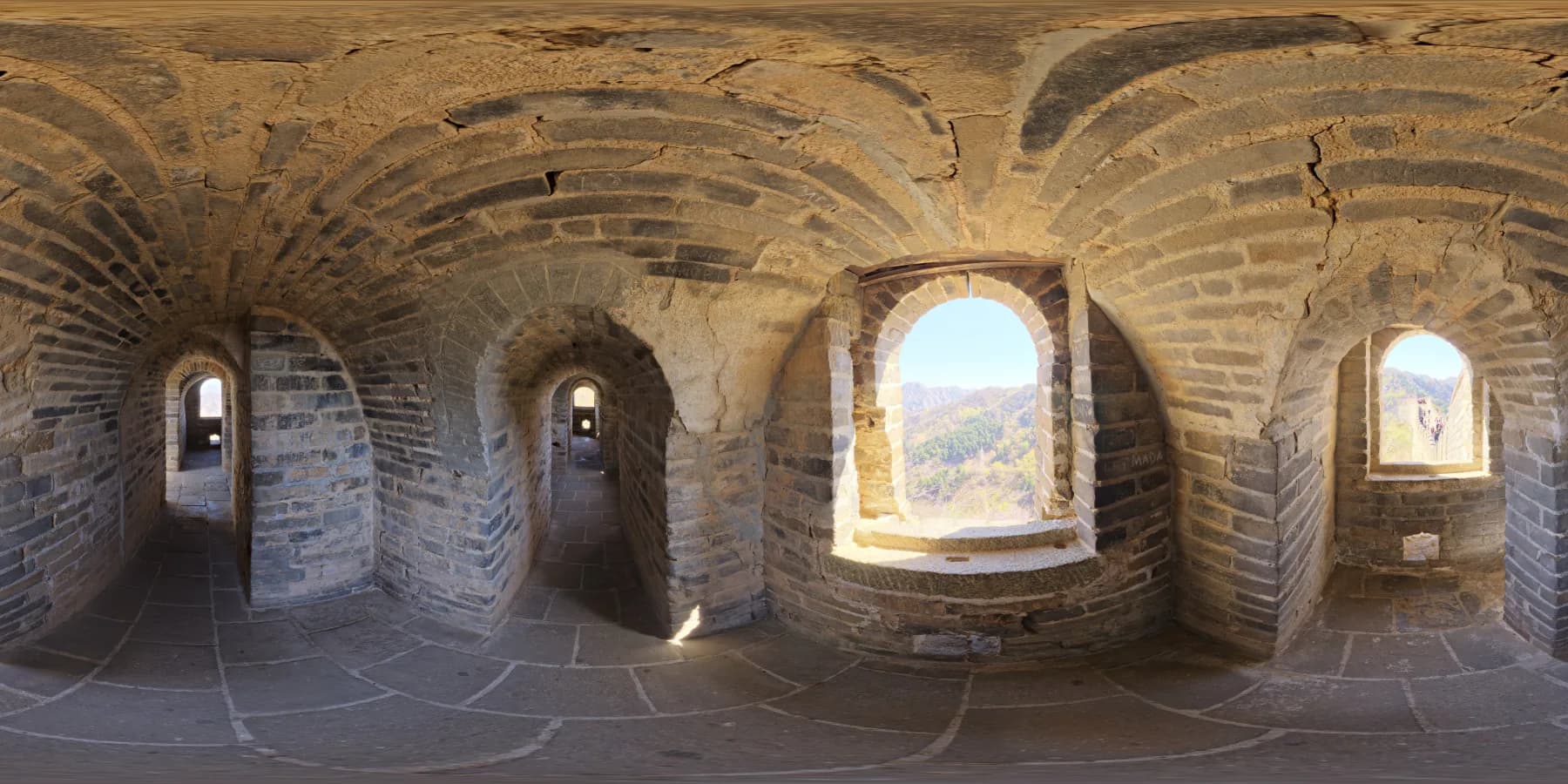
Mutianyu documentary panorama by Greg Zaal via Poly Haven, adapted from Wikimedia Commons and dedicated to the public domain under CC0 1.0.
For photography, Mutianyu is strong in spring blossom, summer green and autumn foliage. The enclosed Watchtower 14 cable route gives a good ratio of travel effort to ridge views. The western Watchtower 19–20 area is much steeper and local closures can change which steps are passable; follow posted controls rather than an old route diagram. The official site's route page identifies the separate Watchtower 14 cable and Watchtower 6 ropeway systems.
Mutianyu also operates dated night programmes. In summer 2026, the official notice lists evening lighting and cable operation to 21:00, with advance real-name booking through the official account or website. Do not assume that schedule applies year-round. Check the current Mutianyu notices for your specific date and weather warnings.
A realistic Mutianyu day
Allow 7–9 hours hotel to hotel with a direct coach or private car, and 8–10 hours if building the route from ordinary public transport and transfers. A sensible wall allocation is 3–4 hours, including shuttle and lift queues. A long Watchtower 14-to-20 climb or a cross-system route needs more.
Exact anchors: Mutianyu Great Wall is the scenic-area anchor. Drivers commonly stop at the lower ticket and parking zone before the internal shuttle; do not treat the map pin on the ridge as a road drop-off.
Jinshanling: choose it for the walk and the light
Jinshanling sits in Luanping County, Hebei, beyond Beijing's municipal boundary. The distance is part of the experience: the wall feels less like an urban attraction and more like a mountain landscape of closely spaced watchtowers. Restored stretches transition into visibly weathered masonry, giving photographers more texture than the uniformly restored surfaces at Badaling.
It is the strongest choice here for people who want three to five hours of purposeful wall walking. It is also the easiest choice to regret if transport or fitness is improvised. Ramps repeat, tower thresholds interrupt your rhythm, and the return can involve another ascent. The cable car shortens the lower climb near Xiaojinshan, but it does not create a flat circuit or carry you across the whole scenic area.
Independent transport is possible but less robust. A seasonal weekend-and-holiday direct bus has operated from Dongzhimen; schedules have changed by year and can depend on minimum demand or seasonal restart. Treat that as evidence of a service pattern, not a timetable to use without a current dated notice. A reserved driver or a current confirmed coach is the lower-risk option, especially for a weekday, sunrise, sunset or a group carrying camera equipment.
Peak-season operations illustrate why date-specific checking matters: the main gate, east gate and cable car can follow different schedules, and winter access changes again. Check the scenic area's official account or call 0314-8830222 the day before, then make your driver wait plan explicit.
Jinshanling suits experienced older hikers better than sedentary younger visitors. Age is less predictive than balance, knee strength and comfort on uneven stone. The main visitor area and cable can reduce effort, but there is no honest way to describe the photography routes as accessible. A mixed group can ride up, share a short central section and turn around early while stronger hikers continue only if they can still meet the agreed return point.
For images, a moderate telephoto lens is useful. It compresses repeating watchtowers and layered ridges, especially in side light. A phone's 2× or 3× camera can do the same without a heavy kit. Clear air matters more than dramatic clouds; in haze, the long transfer buys less visual advantage. Sunrise and sunset require a driver, nearby accommodation or an explicitly confirmed service because normal day-trip coaches are built around midday access.
A realistic Jinshanling day
Allow 9–12 hours hotel to hotel from central Beijing. A private vehicle commonly needs about 2–2.5 hours each way before holiday traffic, rest stops and city pickup. Keep 4–5 hours for the scenic area if hiking is the purpose. A “half-day at Jinshanling” usually means half a day on site, not half a day from your Beijing hotel.
Exact anchors: use Jinshanling Great Wall for the main scenic area. Jinshanling East Gate is a separate entrance with its own hours. Confirm the planned entry and exit before a driver leaves; do not assume every gate is open or that a car can meet you at any tower.
Do not plan an informal Jinshanling-to-Simatai through-hike from an old blog. Although the historical wall continues east, the two attractions have separate management, entrances and controlled open sections. Closures, heritage protection and exit rules can block old traverses. Treat them as separate visits unless both scenic-area operators explicitly confirm a legal through-route for your date.
Simatai: choose it for evening atmosphere, not maximum mileage
Simatai is the outlier. Its core advantage is an official night experience above Gubei Water Town, with lights below and a controlled illuminated wall above. It also retains a steeper, more visibly rugged character than Badaling or Mutianyu. Those two facts make it photogenic and operationally constrained at the same time.
The current daytime product lists 09:00–17:00, with wall entry ending at 15:00 and clearing at 16:30. Cable check-in runs later than the last wall entry, but that does not extend the daytime hiking window. The night product uses a separate ticket structure. The operator currently lists 18:00–21:40 from May through October, clearing by 22:40, with shorter winter evening windows. Its night package includes round-trip cable access and limits visitors to part of the East Tower 5–6 area. Check the exact product, because a Gubei Water Town bundle, a wall-only product and a daytime cable ticket are not interchangeable. The operator's current night listing is the safest place to confirm the date.
This makes Simatai excellent for a one-night escape. Arrive in the afternoon, check in, explore Gubei Water Town, ride the cable for the evening wall, then return without a long late drive. As a same-day trip, it demands more discipline. Central Beijing to Gubei is roughly a 2–2.5-hour road journey in ordinary conditions; public or tourist buses add schedule risk. A night visit can put you back at a central hotel near or after midnight.
Simatai is not the family or older-traveller default simply because a cable exists. The wall's gradients and steps remain serious. The controlled night segment is shorter than a daytime hike, but darkness changes depth perception and temperatures fall quickly. The operator advises several medical and mobility-risk groups against the night product. Families should check child ticket and cable rules on the live booking page, not rely on an old height threshold.
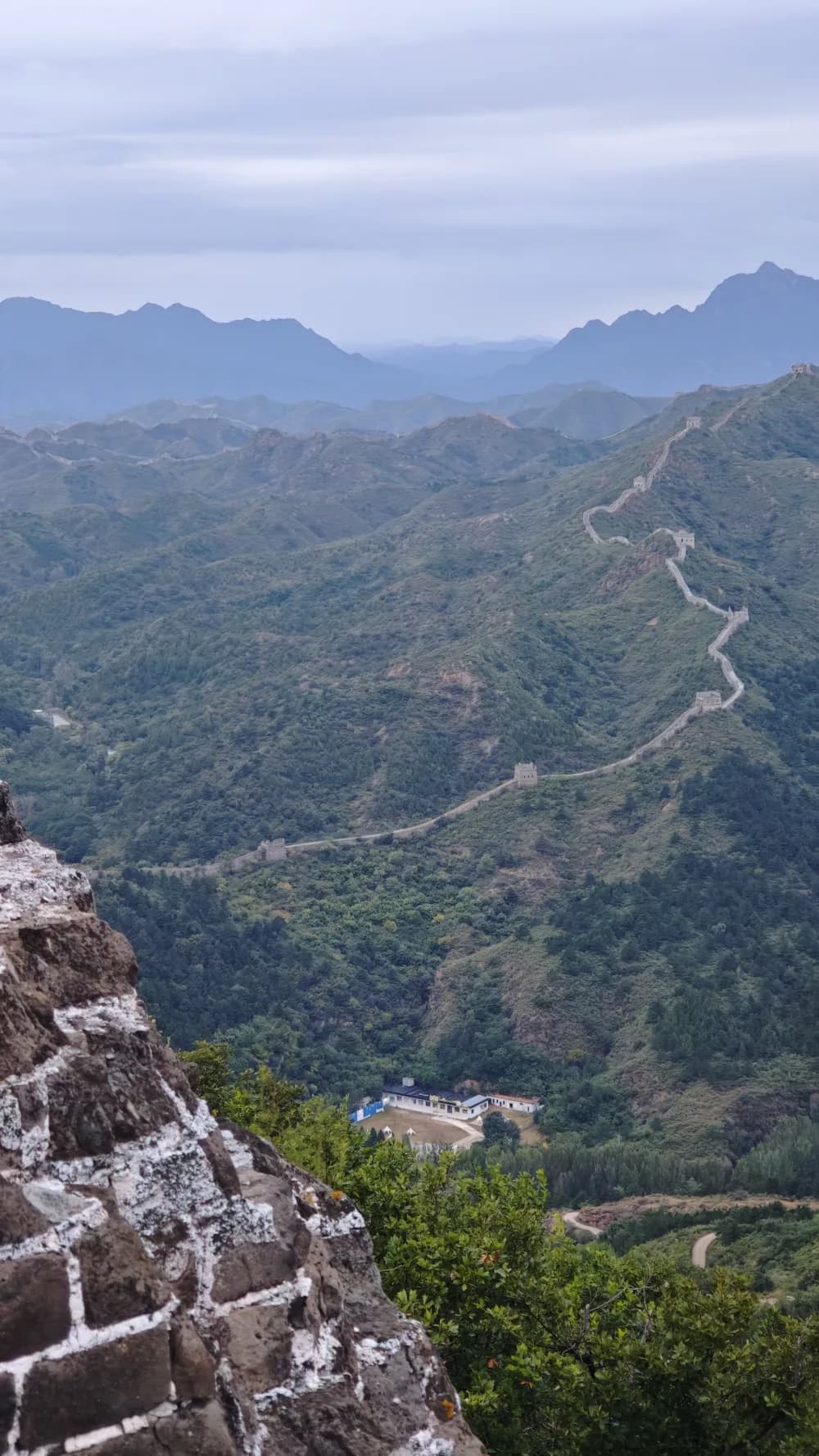
Simatai documentary photograph by Renek78, adapted from Wikimedia Commons and dedicated to the public domain under CC0 1.0.
Photography at night works best when you protect highlights and accept silhouettes. Use a stable railing-supported stance where permitted, keep the camera strap on and avoid blocking narrow steps with a tripod. Blue hour gives more wall detail than full darkness. The most dramatic unrestricted-looking images online may show closed or historical routes; follow the current barriers.
A realistic Simatai day
Allow 10–13 hours hotel to hotel for a same-day sunset or night visit. An overnight removes the stressful return and makes the water-town component feel intentional. If you only want a conventional daytime Great Wall hike and will not use Gubei Water Town, Jinshanling usually makes better use of the long transfer.
Exact anchors: Gubei Water Town is the resort arrival point; Simatai Great Wall identifies the wall attraction. The ticket hall and cable entrance sit within the managed resort approach, so follow the product's stated check-in point rather than asking a driver to reach the wall pin.
Transport complexity, compared honestly
Badaling: low complexity once return train tickets are confirmed. The remaining risk is choosing the wrong Beijing station, underestimating security time, or arriving at a similarly named Great Wall attraction.
Mutianyu: medium complexity. A direct tourist coach can make it straightforward, but every operator chooses its own pickup, return and time on site. Ordinary public transport adds a final transfer. A private car is convenient but still ends at the managed lower approach.
Jinshanling: high complexity without a driver or live confirmed weekend coach. It crosses into Hebei, has several gates and rewards early or late light that standard buses do not serve well.
Simatai: medium by direct coach, high for a late same-day return. The resort is easy to navigate once admitted, but ticket combinations and last transport matter. Overnight is the cleanest plan.
Do not compare only map driving times. Beijing traffic, hotel pickup loops, rest stops, scenic shuttles, ticket checks and the final walk routinely add one to two hours to a “two-hour transfer.”
Choose by fitness and group type
With children
Choose Mutianyu when the chairlift/toboggan is part of the fun and every child meets the current operating rule. Choose Badaling when predictable rail and extensive facilities matter more. Carry snacks and use the toilet before boarding any lift. Do not plan a long out-and-back simply because the children are energetic at the first tower.
With parents or older travellers
Choose a short lift-assisted Badaling or Mutianyu route. Ask three concrete questions: Can they handle high, uneven steps? Can they stand in a queue? Can they descend safely if the lift closes for wind? If any answer is no, make the upper-wall portion optional and keep a comfortable lower-area meeting point.
With strong hikers
Choose Jinshanling for sustained movement and visual variety. Mutianyu's longer western option is a good alternative when you need easier logistics. Set a time-based turnaround rather than a tower trophy. The descent and transfer home are part of the effort.
With a photographer who does not hike much
Choose Mutianyu's Watchtower 14 cable area or a short Badaling lift route. Jinshanling produces stronger layered ridges, but only if the photographer can move safely between viewpoints or accepts a shorter cable-assisted composition set.
Season and weather can overturn the decision
Spring: late March and April bring blossom windows, wind and large temperature swings. Mutianyu and Badaling are easier to use for a short flower-and-wall composition. Jinshanling's early gate can help serious photographers, but only with confirmed transport.
Summer: greenery is strong, but heat, humidity, thunderstorms and heavy rain create the highest closure risk. Start early, carry water and never continue onto an exposed ridge when thunder is nearby. Mutianyu and Badaling publish weather closures quickly; a flexible booking matters more than the “best” section.
Autumn: this is the most competitive period, especially around the National Day holiday and peak foliage weekends. Mutianyu's forest cover and Jinshanling's layered ridges are excellent, but road and lift queues expand. Read the China autumn foliage guide and avoid treating a color forecast as a precise appointment.
Winter: clear air can be superb, while ice, windchill and shorter lift hours make the wall harder. Badaling's rail access reduces road uncertainty. Mutianyu's enclosed cable is preferable to an open chair for many visitors. Jinshanling cable service may pause seasonally. Simatai can be atmospheric, but the night window and cold-weather rules differ from summer.
If visibility is poor, favor the section with the easiest transport and infrastructure. Long-range mountain layers disappear first in haze; that removes much of Jinshanling's photographic advantage. In rain or ice, cancel the ambitious hike before trying to rescue the booking.
Tickets and reservations: what to verify the day before
- The admission date and passport field. Bring the original document used in the order. A screenshot is not a replacement where real-name verification is required.
- Day versus night admission. Badaling, Mutianyu and Simatai night products are dated or seasonal and do not automatically follow a daytime ticket.
- Every machine by name and endpoint. Cable car, chairlift, toboggan, pulley, funicular and shuttle are separate systems.
- Last uphill and last downhill time. The final descent can stop before the scenic area closes.
- Weather operation and refund rules. A wall may remain open while a lift closes.
- Return transport. Save the boarding pin and driver's phone number in Chinese. Build a buffer before a fixed train or coach.
- The entry gate. This is especially important at Jinshanling and within the Gubei/Simatai resort.
Published hours are planning anchors, not permission to arrive at the final minute. Ticket sales, admission checks, uphill lifts and clearing times are four different deadlines.
A phone and camera shot list that works at any section
- Arrival context: one wide frame with the wall small against the mountains. It explains terrain better than another close tower.
- Repeating towers: use 2×–5× zoom from a safe turnout to compress ridges. Jinshanling is strongest; Mutianyu and Badaling also work when the air is clear.
- Human scale: place one companion on a lower bend, never on a parapet. Wait for a gap rather than asking others to move.
- Brick detail: frame drainage channels, arrow windows and repaired-versus-weathered masonry without touching or climbing them.
- Through a watchtower: use an arch or window as a foreground frame. Expose for the mountain view, then lift shadows slightly.
- Descent line: photograph the wall leading down before you descend. It often reads more clearly than an uphill view.
- Blue hour: at an official night section, shoot while the sky still holds color. Stabilize against your body or a safe wall edge and keep walkways open.
- Weather evidence: mist, snow and wet stone can be beautiful, but make one safety decision before one photographic decision. Stay inside the open route.
Drones are not a casual travel accessory at protected heritage sites and near controlled airspace. Do not launch without explicit current permission from the scenic-area operator and all aviation authorities.
Final cut-first logic
Choose Badaling if one transfer failure would ruin your Beijing plan. Cut it if you will only enjoy an empty wall and cannot arrive early or avoid a peak holiday.
Choose Mutianyu if your group needs multiple effort levels and values forested scenery. Cut it if you dislike shuttle-and-lift packages or your only coach gives too little time on site.
Choose Jinshanling if the wall itself is the day's main activity and you have clear weather, strong legs and dependable transport. Cut it first when visibility, knee confidence or return logistics are uncertain.
Choose Simatai if evening light, a lit wall and Gubei Water Town form one coherent trip. Cut it if you only have a standard daytime window or need to be back in central Beijing early.
For a first three-day Beijing trip, the three-day itinerary uses Badaling because transport certainty protects the rest of the schedule. The four-day itinerary also leaves enough structure for a full Great Wall day. Replace that wall day with Mutianyu when family route choice matters more; replace it with Jinshanling only when hiking is a primary trip goal; use Simatai when you are prepared to turn the excursion into an evening or overnight.