China night market guide: choose the experience before the address
A China night market can be an enormous open-air food maze, one narrow residential lane that becomes busy after dinner, a tourism bazaar selling crafts and snacks, or simply a normal food street that stays alive late. These are different experiences. Searching for “the best night market in China” before choosing the format is how travelers end up crossing a city for forty minutes, waiting in three viral queues and eating the same generic snack they saw in the previous province.
Use a night market as one controlled evening, not a test of how many dishes you can collect. Pick the format that fits your route, arrive before the deepest crowd, walk one complete reconnaissance lap, then order two or three small items whose price and preparation you understand. Pair a famous market with an ordinary seated meal elsewhere if food quality matters more than spectacle.
Current operation is the unstable part. Stall mix, pedestrian controls, weather closures, cleaning periods and last transport can change without an English notice. The named places below were map-checked and their public status was reviewed in October 2026, but they are planning anchors rather than promises of a particular vendor or opening hour. Recheck the live map listing and the venue or district's current notice on the day.
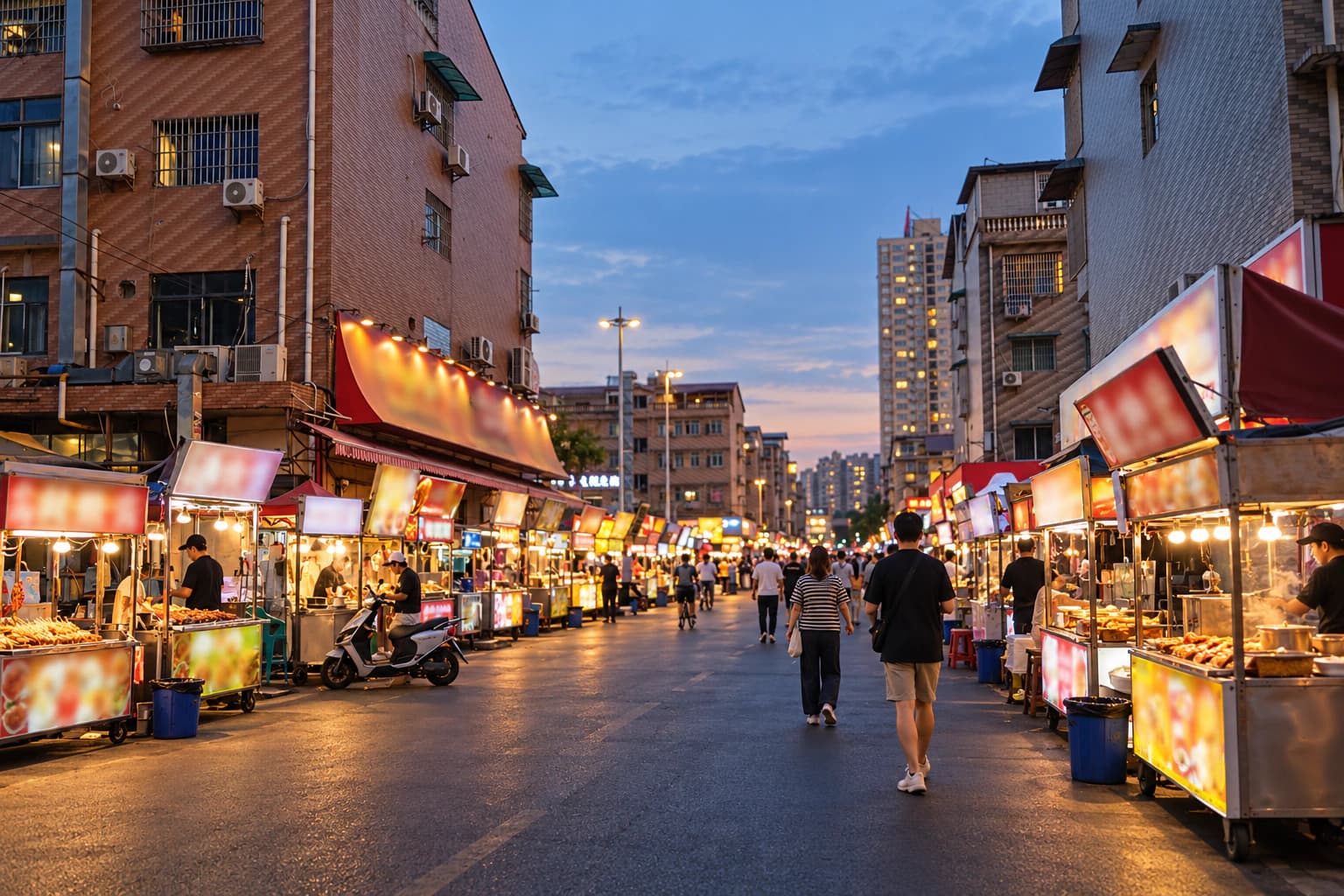
A broad market street lets you survey both sides before committing to a queue. The layout helps explain the format rather than any current stall list or crowd level. After a photograph by Huangdan2060, CC BY 4.0.
First decide what “night market” means for this trip
| Format | What you are actually choosing | Best for | Main weakness |
|---|---|---|---|
| Managed open-air food market | A designated area with many temporary or semi-permanent stalls and crowd controls | Maximum variety and one obvious evening destination | Repeated national snacks, peak-hour congestion, few comfortable seats |
| Living neighborhood food street | Ordinary shops and street-facing kitchens used by residents as well as visitors | A more grounded meal and easier comparison between kitchens | Less theatrical, vehicles and daily life still share the space |
| Tourism pedestrian market | Food mixed with crafts, souvenirs, costume photography and evening lighting | Atmosphere, browsing and groups with mixed interests | Food can be only one commercial layer; prices and queues reflect location |
| Indoor food hall | Fixed counters, seating, toilets and climate control under one roof | Rain, heat, families and travelers who need a lower-friction first meal | Less street atmosphere; closing time can be earlier and uniform |
| Wholesale night market | Produce, flowers or goods moving at commercial hours | Travelers with a specific trade or photography interest | It may not be designed for dining or casual tourists at all |
| Event or seasonal market | A festival, fair or pop-up tied to dates | Limited-time programming and performances | Never assume last year's listing proves this year's event exists |
The label does not prove licensing, quality or permanence. A managed venue may require registered vendors and display standards; an adjacent lane may contain independent businesses under different supervision. A mall hall may be more useful on a stormy night than a famous outdoor market. A flower wholesale session that begins after dark is still a wholesale operation, not automatically a street-food attraction.
Choose the city by the evening you want
Changsha: choose it for scale and the full open-air market sensation
Changsha is the strongest choice when the market itself is the event. Yangfan Night Market (扬帆夜市) is a large managed destination east of the old center; official public-safety reporting describes more than 500 stalls and very high holiday visitor volumes. That scale gives you selection, but it also makes “try everything” impossible. Go with three categories in mind—perhaps one hot savory dish, one cold or sweet item and one drink—and stop once those are satisfied.
Yangfan is not a natural add-on to every central itinerary. Treat the ride out and the ride back as part of the evening. If your day already includes Yuelu Mountain and Yuelu Academy, Orange Isle and central old streets, a giant market can turn a good day into exhaustion. Either make Yangfan the evening anchor or choose a smaller neighborhood food area near the hotel.
Do not confuse the market with proof of Changsha's finest Hunan cooking. It is excellent for comparing smells, cooking techniques and crowd energy in one place. Use a regular restaurant for a composed Hunan meal, especially if you need a precise spice level, a seat, or ingredient verification.
Nanning: choose narrow-lane energy and southern flavors
Nanning works for travelers who want a dense, humid, neighborhood-style evening rather than a monumental tourist sight. Jianzheng Road Night Market (建政路夜市) and Pingxi Night Market (平西夜市) are distinct map-verified choices, and current commerce reporting still recognizes both within the city's night-economy landscape.
Jianzheng is the more useful fit when you are staying around Qingxiu and want a compact food-focused lane. Pingxi suits a Jiangnan-side route or a visitor who wants a larger night-market outing. Do not attempt both on the same evening merely to compare them. Their shared weaknesses—narrow movement, repeated items, humidity and difficult pickup at peak time—compound rather than add value.
Rain changes this choice sharply. A light shower can cool the air; sustained rain can make temporary surfaces slippery and compress everyone under the same awnings. On a wet night, switch to a fixed restaurant or indoor hall and save the market for a dry evening. Nanning's best food experience does not depend on completing a famous lane.
Kaifeng: choose a managed heritage market, then compare it with ordinary eating
Kaifeng offers one of the clearest “atmosphere first” decisions. Drum Tower Night Market (鼓楼夜市) sits under a landmark and operates as a managed tourism market. District-government material describes registered vendors, standardized carts, price-display and service management. Those systems make the setting legible; they do not certify that every dish will be exceptional.
Use Drum Tower when you want the illuminated tower, a compact historic-center walk and small tastes in one sequence. If eating is the main purpose, compare it with Old Henan University West Gate Night Market (老河大西门夜市) or an ordinary Kaifeng restaurant on another meal. A visitor can reasonably prefer one for photographs and the other for dinner.
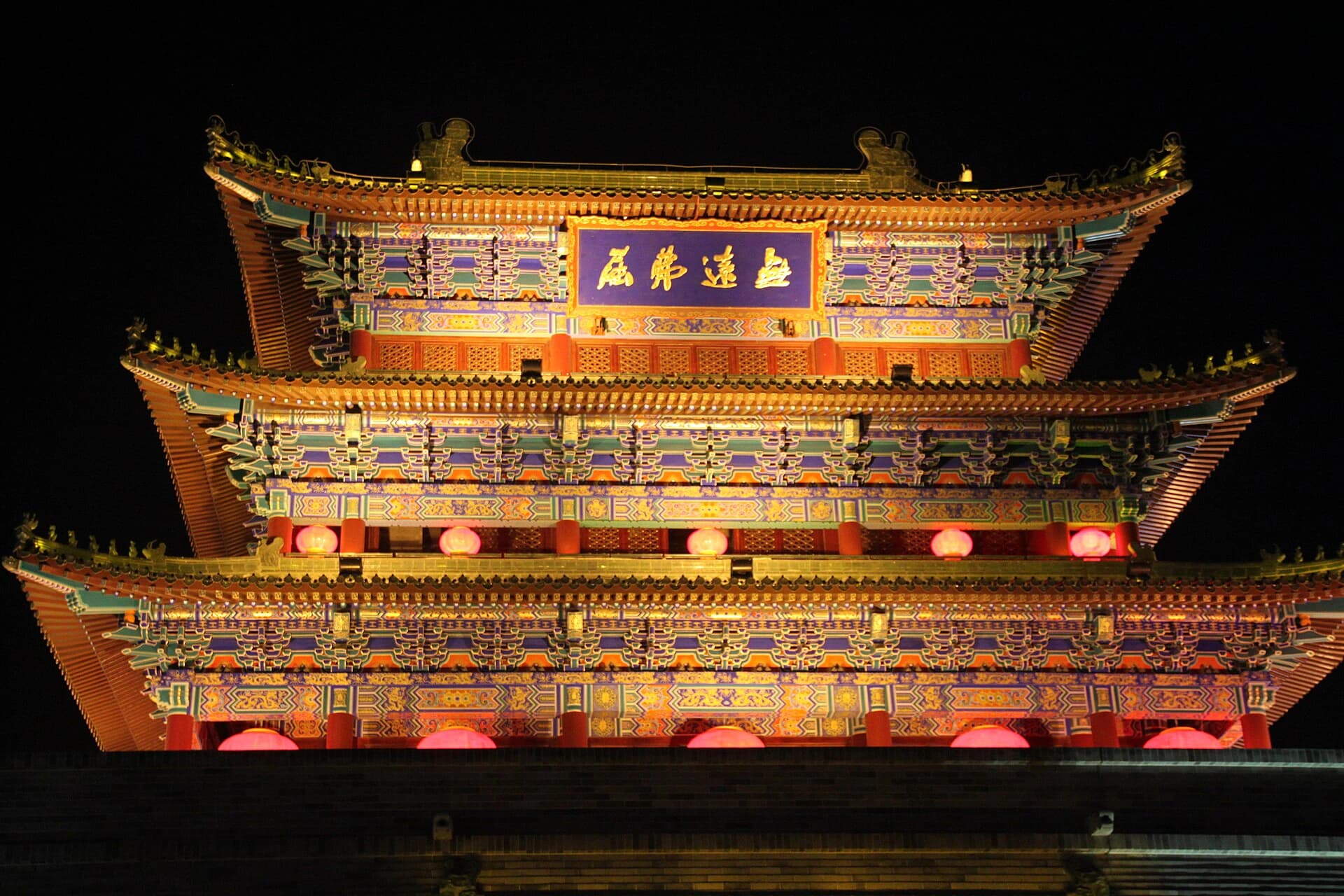
The Drum Tower gives Kaifeng's market a strong visual anchor. The landmark and food stalls still serve different purposes: photograph the tower, then judge each order on its own. Photo by Gary Todd, CC0.
Dunhuang: choose a Silk Road tourism bazaar after a lighter day
Shazhou Night Market (沙州夜市) in Dunhuang combines food, crafts and tourism browsing. That mix works after a museum or town day. It is less comfortable as the compulsory dinner after a long desert outing, especially when summer sunset pushes your return late. The dedicated Shazhou Night Market guide explains how to fit it around Mogao and Mingsha planning.
Eat before the desert if you know you become tired or impatient when hungry. On return, choose a drink, dessert or one cooked-to-order item rather than expecting every kitchen to remain in full service. Dunhuang also has sharp temperature swings: desert heat at dusk does not guarantee a warm late night in another season.
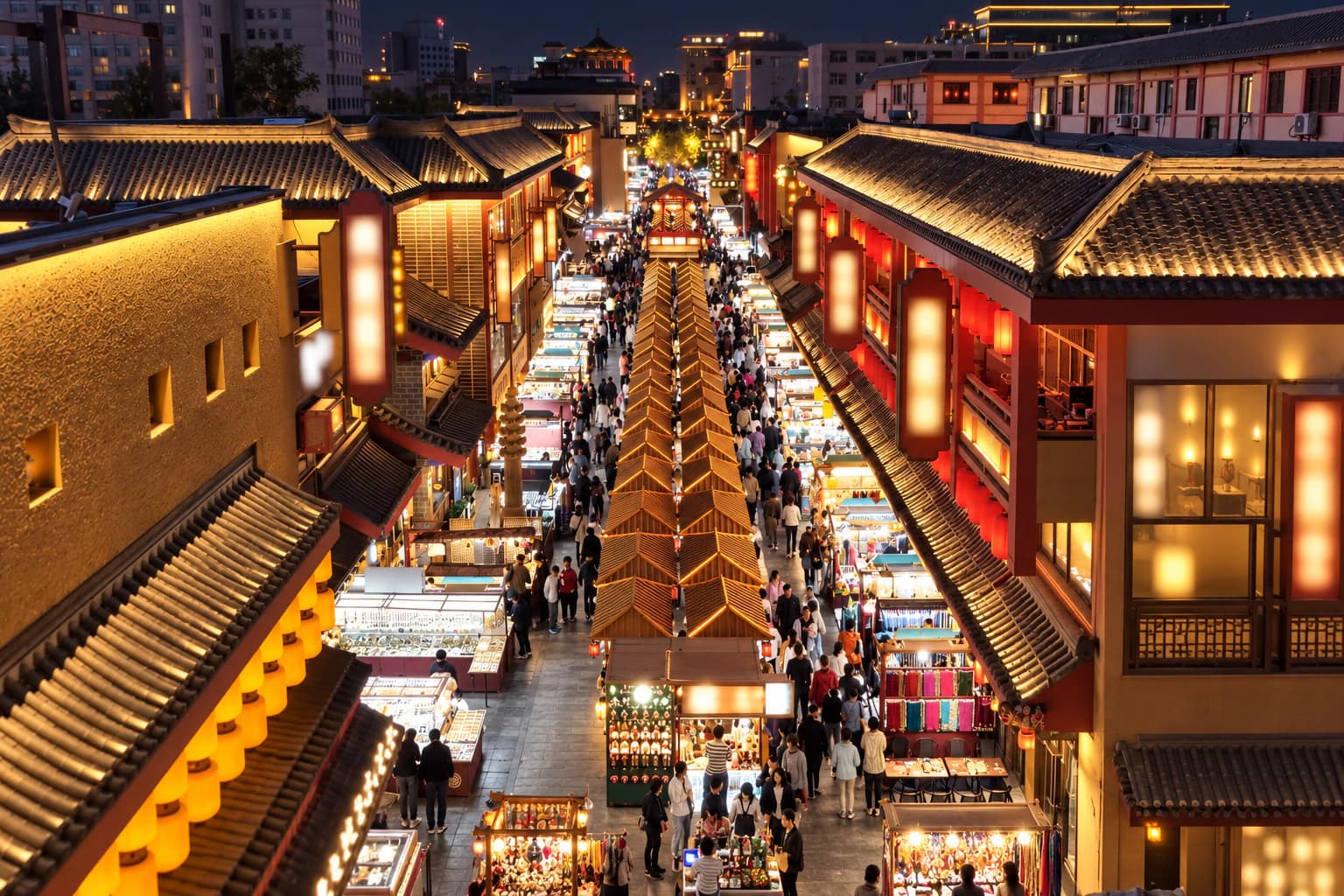
Shazhou works as a long tourism-market axis rather than one food queue. Use the scene to understand that spatial choice, then verify current vendors, products and crowd conditions on arrival.
Yinchuan: choose a northwest food market as part of a deliberate west-side evening
Huaiyuan Sightseeing Night Market (怀远观光夜市) in Yinchuan suits travelers who want a lively northwest market with strong student-area energy. It is in Xixia District, not beside every central hotel. Current official replies describe an actively managed venue, food-safety patrols and real parking/crowd pressure. The correct plan is a west-side evening, not a casual post-dinner detour from Xingqing District.
The most efficient sequence is the dedicated Lanshan Park and Huaiyuan Night Market plan: view first, market second, return route saved before the phone battery is low. Halal needs require more than assuming every northwest dish qualifies; use the Muslim-friendly China guide for the verification standard.
Urumqi: choose a living food street rather than a temporary-market fantasy
Hetian Second Street (和田二街) in Urumqi is better understood as a living commercial and food street. A 2025 micro-renovation and current district reporting describe a 641-metre street with resident life and heavy visitor pressure. That makes it valuable precisely because it is not only a staged evening market.
Use the Hetian Second Street food walk to keep the route compact. Respect building entrances, delivery work and residents moving through the same corridor. Ask before photographing a cook or customer at close range. In summer, Urumqi's late sunset shifts the visual rhythm later than travelers from eastern China may expect; dinner time and darkness are not the same thing.
Xishuangbanna: choose spectacle, browsing and photography
Mekong Starlight Night Market (湄公河·星光夜市) in Xishuangbanna is a tourism pedestrian district: lights, river atmosphere, souvenirs, food, costume photography and large evening crowds overlap. Choose it because the group wants that combination. Do not use it as the only evidence for what local Dai food or community life looks like.
Humidity, rain, insect exposure, costume-photo traffic and congested ride-hailing pickup are the operational issues. Visitors booking a commercial portrait session should separate the shoot from dinner; makeup, garments and camera timing are already a full task. The Xishuangbanna Dai costume photoshoot guide covers those boundaries in detail.
Xi'an: recognize a heritage food district, not one nightly pop-up
The Muslim Quarter / Huifang lanes (回民街 / 回坊) in Xi'an are a living heritage and food district around the Great Mosque and Drum Tower. Parts remain active through the day, so “night market” is an incomplete label. Go after dark for atmosphere, but return in daylight if you want to read the lanes, courtyards and religious context rather than only the busiest food frontage.
Do not assume every lamb dish, Arabic-style sign or green decoration answers a halal question. Decide your standard and verify it at the specific premises. Likewise, do not treat the most crowded Beiyuanmen section as the whole neighborhood. Smaller lanes can be calmer, but normal care around residences and worship spaces matters.
The two-hour market method
This sequence works better than a saved list of ten viral stalls.
Before leaving the hotel
Save the market's Chinese name, exact map pin and one pickup point on a wider road. Screenshot the hotel name and address in Chinese. Check live rain, last metro, phone charge and whether your mobile-payment setup actually works; the China apps guide and Alipay guide are better completed before hunger becomes the deadline.
If the market is a long ride from the hotel, decide the return mode before going. Metro is predictable until service ends. A taxi or ride-hailing car may be easier later, but the nearest legal pickup point can move during pedestrian controls. Your fallback should be a named intersection or mall entrance one or two blocks beyond the densest crowd, not “meet at the night market.”
Arrive before the deepest peak
For a market that is already operating, roughly 18:30–19:30 is often a useful planning target: late enough for stalls to be active, early enough to see the layout. This is a strategy, not an official opening time. Northern summer daylight, southern heat, winter closure, local dinner habits and market-specific rules can shift the useful window.
Walk one complete lap without buying. Note toilets, exits, fixed seating, active cooking, price boards and the quietest pickup direction. The first dramatic queue is not necessarily the best food; it is often simply the first queue visible from the entrance.
Order one small portion at a time
Share when traveling with others. One bowl, plate or set of skewers gives you information before the next decision. Three full portions ordered in the first ten minutes create waste and prevent comparison. If a stall cannot explain the price unit or insists on beginning before you agree, leave.
Use these short questions:
- 这个多少钱? — Zhège duōshao qián? — How much is this?
- 这个价格是一份、一串,还是一斤? — Is that price for one portion, one skewer, or one jin (500 g)?
- 一份有几个? — How many pieces are in one portion?
- 还要收别的费用吗? — Is there any other charge?
- 不要辣 / 少辣。 — No chili / less chili.
- 请现做,做好以后给我。 — Please cook it fresh and give it to me when it is done.
For seafood, fruit, meat sold by weight or a tray assembled after selection, point to the exact amount and confirm the total estimated price before cooking. For table seating, ask whether tissues, tea, sauce, tableware or a minimum order cost extra. An isolated visitor report does not establish a market-wide practice; the safeguard is to ask every time the pricing structure is unclear.
Leave a queue without regret
Set a threshold before you join. Ten minutes for an item you already wanted can be reasonable; forty minutes for something chosen because a video called it essential usually is not. If the line has barely moved after one cooking cycle, switch to the same category at another stall or buy a different dish. The evening is successful when you ate well and got home comfortably, not when you reproduced somebody else's checklist.
Payment that still works when the QR code does not
Overseas visitors can link supported international bank cards to Alipay or Weixin Pay, and official payment guidance also recognizes bank cards where the merchant has an accepting terminal and renminbi cash. In a market, actual acceptance varies stall by stall. A counter showing only a personal QR code may be less straightforward than a fixed shop with merchant payment equipment.
Set up and test mobile payment earlier in the trip. Keep a modest amount of small-denomination cash; Chinese law does not make “QR only” a reason to reject renminbi cash, but a tiny stall may have limited change. Do not hand over a large note for a very small purchase when a smaller note is available.
Before walking away, wait for the vendor to confirm receipt. Screen brightness, network delay and a loud environment can make the payment result easy to misread. Never scan an unrelated code sent by a stranger who claims to help. For a disputed payment, preserve the app record, stall location and time.
Food safety: judge the process you can see
A long queue is evidence of demand, not proof of safe handling. Prefer a stall that displays its operator or food-business information where required, keeps ingredients covered, separates raw and cooked food, uses clean utensils and cooks the item actively until hot. Clear prices and units are also a useful management signal.
The practical visual test is simple:
- Can you identify what is raw and what is ready to eat?
- Are the same tongs or boards moving between them?
- Is cooked food coming off heat, or sitting lukewarm for a long period?
- Are cold ingredients actually kept cold?
- Can the vendor explain the ingredient and price without pressure?
- Is there a clean place to eat it without balancing hot soup in a moving crowd?
Choose food cooked thoroughly and served hot. Be cautious with raw shellfish, pre-cut fruit exposed for long periods, warm dairy, unpasteurized drinks and items whose temperature control you cannot assess. Wash or sanitize hands before eating, but do not rely on sanitizer to solve unsafe food handling.
If you become unwell, hydration and the severity of symptoms matter more than proving which stall caused it. Seek medical help for persistent vomiting, blood, high fever, severe pain, signs of dehydration or symptoms in a medically vulnerable traveler. Keep the payment record, time, exact pin and photographs of the stall identity if you need to report a consumer or food-safety problem. China's market-regulation complaint platform and hotline use 12315; emergencies still belong with the relevant emergency service.
Allergies, vegetarian food and halal food need separate checks
“No meat,” “not spicy” and “halal” answer different questions. Shared oil, stock, sauces, dried seafood, nuts, sesame, dairy, egg and cross-contact can remain even when the visible topping looks safe.
For a serious allergy, show a Chinese card before money changes hands and ask whether the same oil, wok, tongs or board are used. Leave if staff cannot answer. Keep prescribed medication on your person, not buried at the hotel. A market with rushed communication is a poor place to test an uncertain dish.
Vegetarian and vegan travelers should use the detailed vegetarian and vegan China guide for broth, lard, oyster sauce, dried shrimp and shared-cooking questions. Muslim travelers should use the halal travel guide to set a personal verification standard. The national market guide cannot turn a stall's appearance into dietary assurance.
Crowd, transport and photography etiquette
Keep your bag in front where lanes narrow, but avoid treating a normal crowd as hostile. The common problems are simpler: stopping suddenly, hot food spilling, scooters or delivery carts entering a mixed-use lane, and groups separating around a queue. Choose one regrouping point before entering. Children need an adult assignment, not only instructions to call if lost.
Do not stand at the mouth of a stall to film a decision. Order or step aside. Ask before close-up photographs of vendors, customers or children; a public market is not consent to make one person the subject. Avoid flash near hot oil and steam, and never lean over a working surface for a top-down shot. Buying something does not purchase a portrait, but a quick request and one photograph after the rush is often more respectful than prolonged filming.
For the ride home, walk beyond the densest exit before calling a car. Confirm the license plate in the app, use the in-app route, and avoid accepting an unsolicited off-platform ride. Leave enough battery for the pickup conversation and hotel pin. The broader China transport guide covers train, metro, taxi and ride-hailing decisions.
Weather and season change the answer
- Hot, humid southern cities: arrive after the fiercest heat, carry water and choose freshly cooked food. Rain can compress the crowd under awnings and turn narrow surfaces slick.
- Dry northwest cities: summer evenings can begin late, while spring wind and dust make exposed food less appealing. Temperature can fall quickly after sunset.
- Cold northern winters: temporary stalls may shorten hours, reduce selection or pause. A fixed food street or indoor hall is a stronger primary plan.
- National holidays and major festivals: crowd management, road closures and queues can change the whole district. Go earlier, accept fewer orders and keep an easy exit.
- Storms and extreme weather: do not travel across a city for an outdoor market because an old listing says it opens daily. Choose an indoor dinner and move the market to another night.
Three route combinations that justify the detour
Heritage evening: Kaifeng or Xi'an
In Kaifeng, use daylight for the old-city attraction that matters most, rest, then walk to Drum Tower for the illuminated setting and two small tastes. In Xi'an, read the Great Mosque and Huifang lanes before the deepest evening pressure, take a seated meal that meets your dietary standard, then return to the main frontage for atmosphere. In both cities, architecture supplies the reason to be there; the market completes the evening rather than replacing the city's history.
Northwest evening: Yinchuan, Urumqi or Dunhuang
Choose one based on the existing route. Huaiyuan is a west-side Yinchuan food outing. Hetian Second Street is an urban neighborhood experience. Shazhou is a tourism bazaar that fits the Dunhuang circuit. They are not interchangeable entries on a national bucket list, and none deserves an extra flight by itself.
Southern evening: Nanning or Xishuangbanna
Choose Nanning when eating and narrow-lane local energy lead the decision. Choose Starlight when lighting, browsing, river atmosphere and commercial photography are part of the group's plan. In wet season, keep a fixed restaurant or indoor venue saved in advance. The most useful itinerary is the one that can change at 17:00 without losing the evening.
Final decision rule
Add a night market when it gives your route a distinct evening format, not because every China itinerary seems to require one. A first trip needs at most one destination-scale market and perhaps one living food street. More than that often repeats queues, smoke, skewers and souvenir lighting while displacing the restaurants, morning markets and neighborhood meals that explain regional food more clearly.
Use the China food city chooser when the larger decision is which city or regional route deserves the trip; this page remains the evening-market method after that city is chosen.
Pick one market, save the exact Chinese pin, understand the journey home, and arrive with two dishes in mind rather than ten stall names. Walk first. Confirm price, unit and ingredients. Watch the cooking. Order small. Leave while the evening is still enjoyable.
Fact-check boundary: public-market status, payment guidance, food-safety principles and the named POIs were reviewed on October 3, 2026. Stall mix, current hours, weather closures, prices, road controls and last transport must be checked again for the date of your visit.