Xishuangbanna costume photoshoot: plan the files, not just the outfit
A commercial costume photoshoot can be a satisfying part of a Xishuangbanna trip, especially for a solo traveler who wants a directed portrait rather than another phone selfie. It can also become a long, uncomfortable sales appointment if the headline package says little about the garment, photographer, original files, retouching or final delivery.
Make three decisions before comparing sellers:
- What is the styling actually claiming to be? A documented Dai garment, a contemporary Dai-inspired portrait look and a general tropical or cinematic costume are different products.
- Which finished files matter? Choose the number of photographs, video format and editing level before choosing a package name.
- How many settings can the schedule honestly support? One compact Gaozhuang route usually produces better work than rushing through a garden, temple, market and village in one evening.
For most first-time visitors, the best balance is one outfit, one assigned photographer, one compact Gaozhuang zone and a 60–90 minute shoot that crosses sunset or blue hour. Put every inclusion in writing, arrive already fed and leave the rest of Jinghong for normal sightseeing. A two-zone session is useful only when its car, access, weather fallback and extra time are explicit.
First, name the look correctly
Xishuangbanna's Dai clothing, brocade and silverwork are living forms of material culture. They are not a single universal costume. Communities, occasions, generations and makers use different garments and decorative details, and contemporary designers also adapt embroidery, plant dyes and tailoring for present-day wear.
Use these three labels when speaking to a studio:
Traditional or documented Dai attire
Choose this only when historical or cultural specificity matters to you. Ask which community, place, period, garment form and textile reference the outfit follows. Ask whether the cloth is handwoven, machine-made, vintage, newly made or simply printed to look woven. A seller should be able to explain the reference without relying on “local,” “ethnic” or “princess” as the entire description.
Do not expect a short tourist package to provide museum-level reconstruction. That is a specialist commission, and the research, fitting and handmade work should be treated accordingly.
Contemporary Dai-inspired commercial styling
This is the most common and often the most practical travel product. It may combine a fitted top, long skirt, current makeup, rented jewellery, flowers and camera-friendly tailoring. It can make a beautiful portrait without pretending to reproduce a particular historical ensemble.
Ask the seller to use that plain description. It gives the stylist freedom while keeping the cultural claim honest. It also makes it easier to reject a garment that is uncomfortable, revealing or unrelated to the sample you approved.
Tropical, Southeast Asian or cinematic costume styling
Some packages sell an “exotic,” film-like or generalized Southeast Asian mood. Choose it if that is the aesthetic you want, but do not let a location in Xishuangbanna turn the costume into “authentic Dai” by default. Likewise, Hani, Jinuo, Bulang and other ethnic identities are not alternate names for Dai. If the listing uses an ethnic label, ask what the garment is based on.
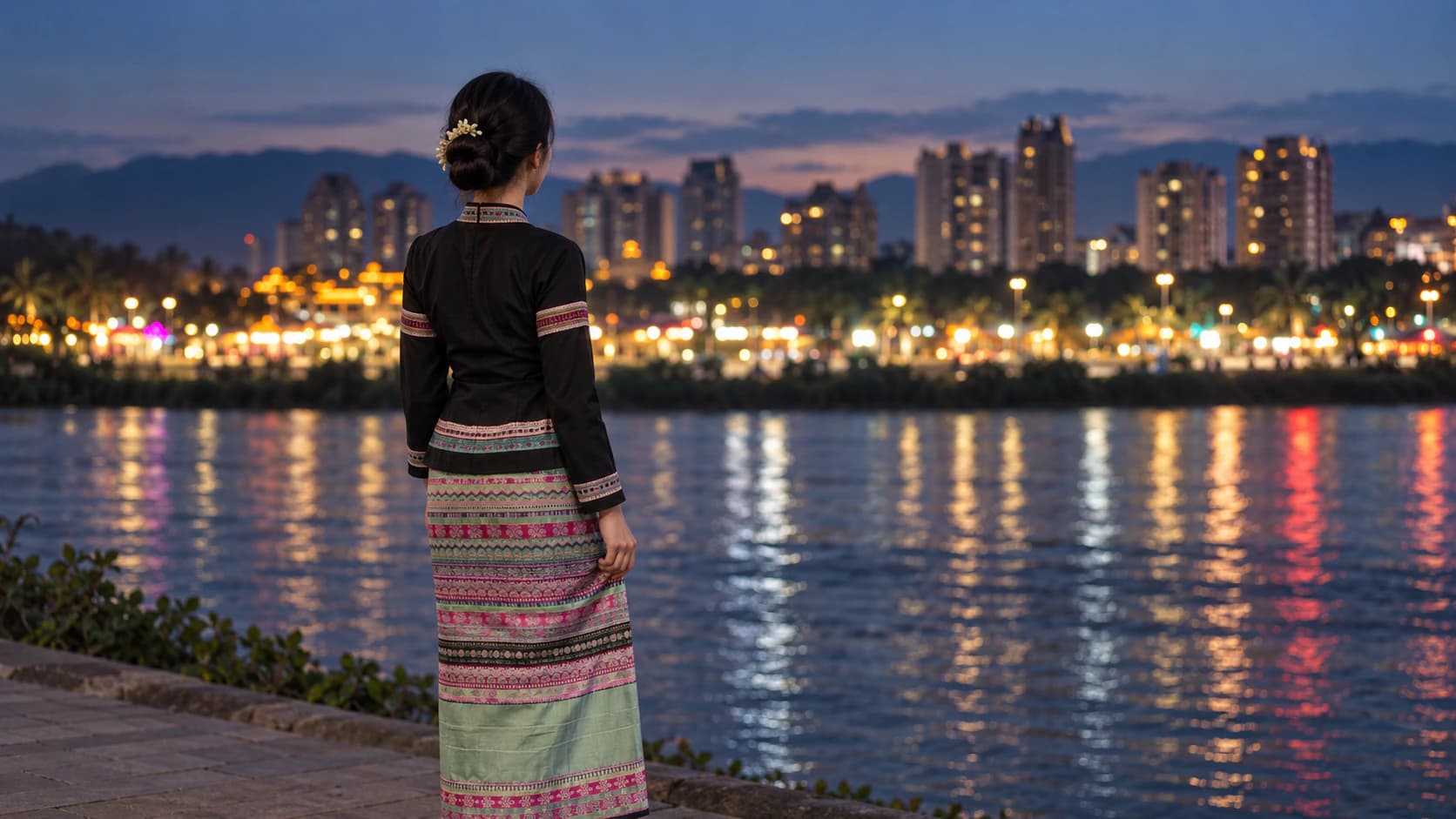
The portrait below demonstrates a useful commercial result rather than a certificate of historical accuracy or a promise of identical lighting. The subject is separated from the background, the sky still carries blue, the market lights read as atmosphere, and the face is not competing with hard night lighting. Use that relationship as a shot brief.
Choose the product before the seller
| Product | What it should contain | Best for | Main risk |
|---|---|---|---|
| Rental and self-shoot | one itemized outfit, fitting, accessories, return time and damage terms | travelers comfortable with a phone, tripod or companion | styling and hair may cost extra; no one is responsible for the final pictures |
| Makeup, hair and rental | named styling level, hygiene items, outfit tier and time | visitors who want a complete look but their own photographs | sample garment or flowers may be presented as upgrades after makeup begins |
| One-zone portrait | one look, assigned photographer, fixed camera time, one walkable setting and numbered files | the strongest first choice; efficient and easier to reschedule | “60 minutes” may include waiting, walking and selection rather than 60 camera minutes |
| Two-zone sunset-to-night | daylight setting, legal car, Gaozhuang night setting, buffer and weather fallback | travelers who want visual contrast in one appointment | transfers consume the best light; tickets and access may be excluded |
| Half/full-day story | location permissions, transport, meals, changing plan, assistant and larger deliverable | a deliberate editorial or couple commission | village and religious spaces require more than an ordinary tourist ticket |
A hotel “gift,” social-platform bargain and premium studio package can all lead to the same later decision: pay more for the photographs you expected to receive. Ignore the discount label. Compare the complete cost of the exact files you will take home.
Send this deliverables sheet before paying
Ask the seller to answer in the booking chat or contract. Keep the wording numerical.
People and time
- Is the price for one person, two people or one person with a studio model?
- How many outfits and changes are included?
- Who is the assigned makeup artist and photographer, and can you see recent complete client sets made by that level of team?
- When does paid shooting time begin: at check-in, after makeup, at the first frame or after arrival at the location?
- How long are makeup, fitting, travel, camera work, selection and changing back expected to take?
- Is the photographer working only with you, or rotating between clients at crowded sets?
Styling and hygiene
- Which garment tier and exact sample are included? Ask the shop to reserve it by photo or item number.
- Are hair, wig pieces, ordinary accessories, jewellery, headwear, flowers, lashes, adhesive, body decoration and makeup consumables included?
- Are applicators new or properly sanitized? You can bring your own lashes or sponge, but confirm compatibility first.
- Is a modest alternative available if the sample has a low neckline, exposed waist, tight fit or heavy headpiece?
- What is the garment deposit, and how are pre-existing stains, tears or missing ornaments recorded?
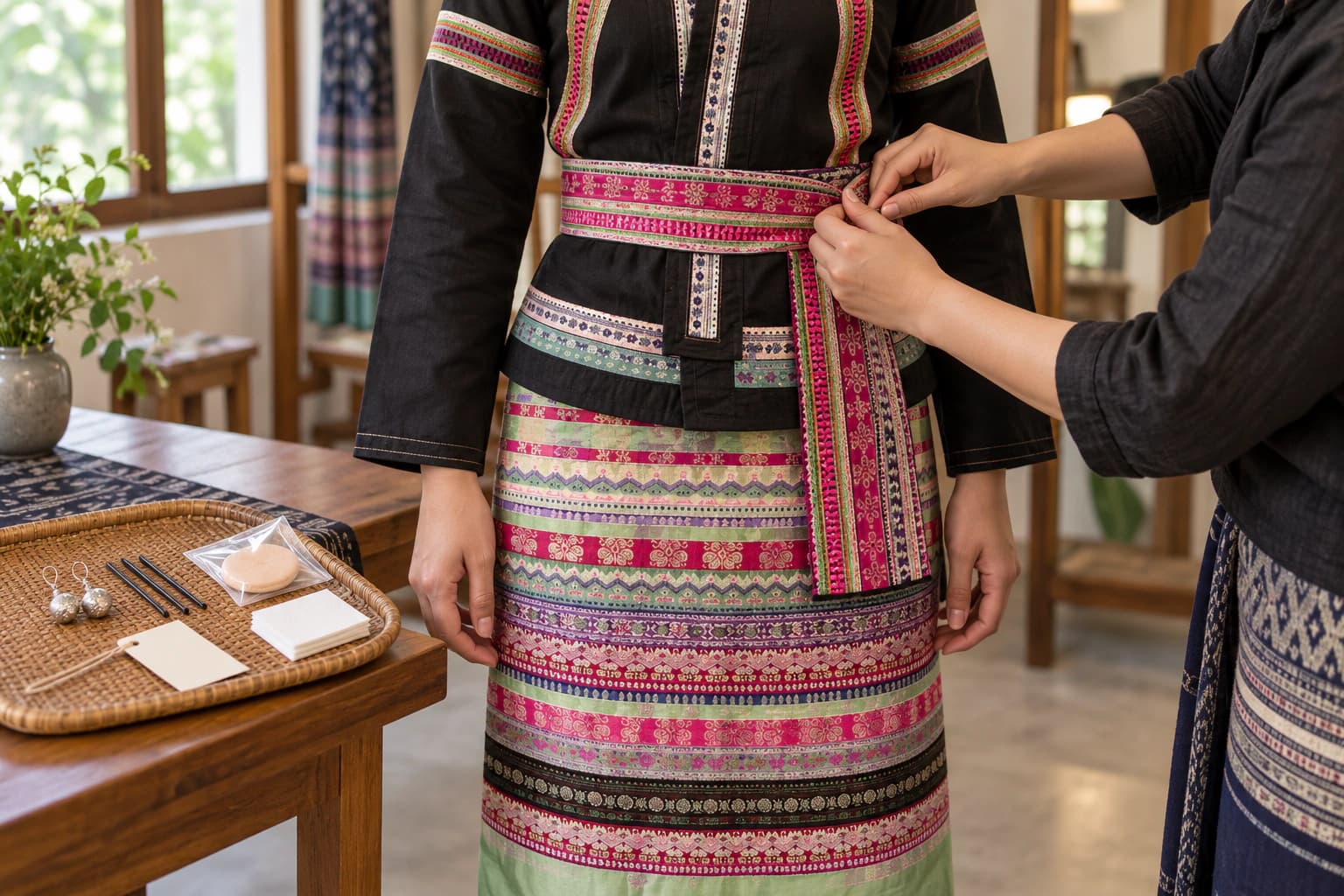
Photograph the garment's condition at handover and again when it is returned. Bend, sit, lift your arms and walk several steps during the fitting. Check that the skirt clears your shoes, the top closes comfortably, accessories do not catch the fabric and the headwear remains stable in a breeze.
Photographs and editing
Separate every file type:
- Originals: ask whether this means every usable camera JPEG, a small set of unedited selections or actual RAW files. “All originals” does not automatically mean camera RAW.
- Proofs: lower-resolution or watermarked previews used to choose images. Confirm whether you can keep them.
- Basic corrections: exposure, white balance and crop.
- Final retouches: skin, stray hair, garment wrinkles, background distractions and any body or facial reshaping. State what you do not want changed.
- Additional retouches: record the unit price before the selection appointment.
- Revisions: state how many rounds are included and what counts as a correction rather than a new edit.
Write down the included number of each file, resolution, delivery format, delivery date and download-link expiry. If you leave Jinghong the next morning, that is not a reason to accept an undefined later delivery.
Video
A video add-on needs its own brief: final duration, vertical or horizontal format, resolution, music rights, number of edited clips, whether original clips are included, revision count and delivery date. “One video” can mean a five-second montage, one unedited phone clip or a polished vertical sequence. They are not equivalent.
Total payment and cancellation
Ask for one total that includes garment, makeup, consumables, photographer, assistant, tickets, location or scene charges, car, originals, retouches and video. Confirm the deposit, remaining balance, rain reschedule, seller cancellation, client lateness, no-show, garment damage and refund rules.
Avoid paying most of the total before you have confirmed the reserved garment and named deliverables. Keep the order page, chat, contract, payment receipt and delivery messages. If a serious consumer dispute cannot be resolved with the registered business, China's official consumer and government-service channels include 12315 and 12345; retain the evidence needed to identify the merchant and transaction.
Portrait use and storage
Do not assume that paying for the files prevents the studio from posting them. Add a clear line stating whether the seller may use your face, body, video, behind-the-scenes footage or edited images for its portfolio, advertising or social account. If you refuse, record the refusal in writing. Also ask how long source files and proofs are stored and how deletion can be requested after delivery.
Pick one location strategy
Gaozhuang and Starlight Night Market: easiest compact route
Gaozhuang Xishuangjing is the practical base for the familiar night-market product. It concentrates rental shops, makeup rooms, warm lights and pedestrian activity. Starlight Night Market is roughly a 400-metre, six-minute mapped walk from the Gaozhuang anchor. In peak crowds or a long skirt, protect more time.
This route works because it does not require a car during the best light. Start on a quieter public-facing lane or riverside edge, then use the market lights after dark. Do not spend the whole booking waiting for one famous arch or staircase. Ask the photographer for three background types within the same zone: open sky, warm architectural light and tight market bokeh.
The tradeoff is crowd density. A seller calling the session “one-to-one” does not guarantee a private backdrop. Ask whether the team queues at shared sets and what it does when the selected location is blocked. Keep bags zipped, do not leave a phone or passport with an unknown assistant and choose shoes that can handle a sustained walk.
Jinghong Dajin Pagoda Temple: religious space, not a prop
Jinghong Dajin Pagoda Temple sits in the Gaozhuang area and is often visible in commercial portrait imagery. Treat it as a living Buddhist institution. A visitor entrance, a nearby public lane or a seller's previous photographs do not prove that a paid shoot, tripod, light stand, costume change or directed pose is allowed today.
Before including it, obtain current permission from the operator responsible for the exact space and equipment. Cover shoulders, upper chest and knees; remove a large headpiece if requested. Never change clothes on temple grounds, use an altar or religious statue as a pose prop, direct monks or worshippers, imitate ritual gestures, block a path or continue after staff ask you to stop. If permission is unclear, stay in the commercial district and compose with neutral lights instead of entering the worship area.
Tropical Flowers and Plants Garden: daylight texture without a long excursion
Xishuangbanna Tropical Flowers and Plants Garden is an urban garden on Xuanwei Avenue. It is different from the Chinese Academy of Sciences' much larger botanical garden at Menglun. AMap's no-live-traffic baseline from the urban garden to Gaozhuang is about 4.8 kilometres and 17 minutes by car. Walking, cycling and bus options exist, but a legal car is the sensible transfer in styled clothing, humidity or rain.
Use this as the daylight half of a two-zone package only after the current operator confirms admission, costume photography, equipment and commercial-session rules. Keep to paths, do not touch plants and do not let the photographer place you inside a planted bed. One clean foliage portrait, one full-length path frame and one textile detail are enough; leave 30–45 minutes of transfer buffer before the blue-hour set.
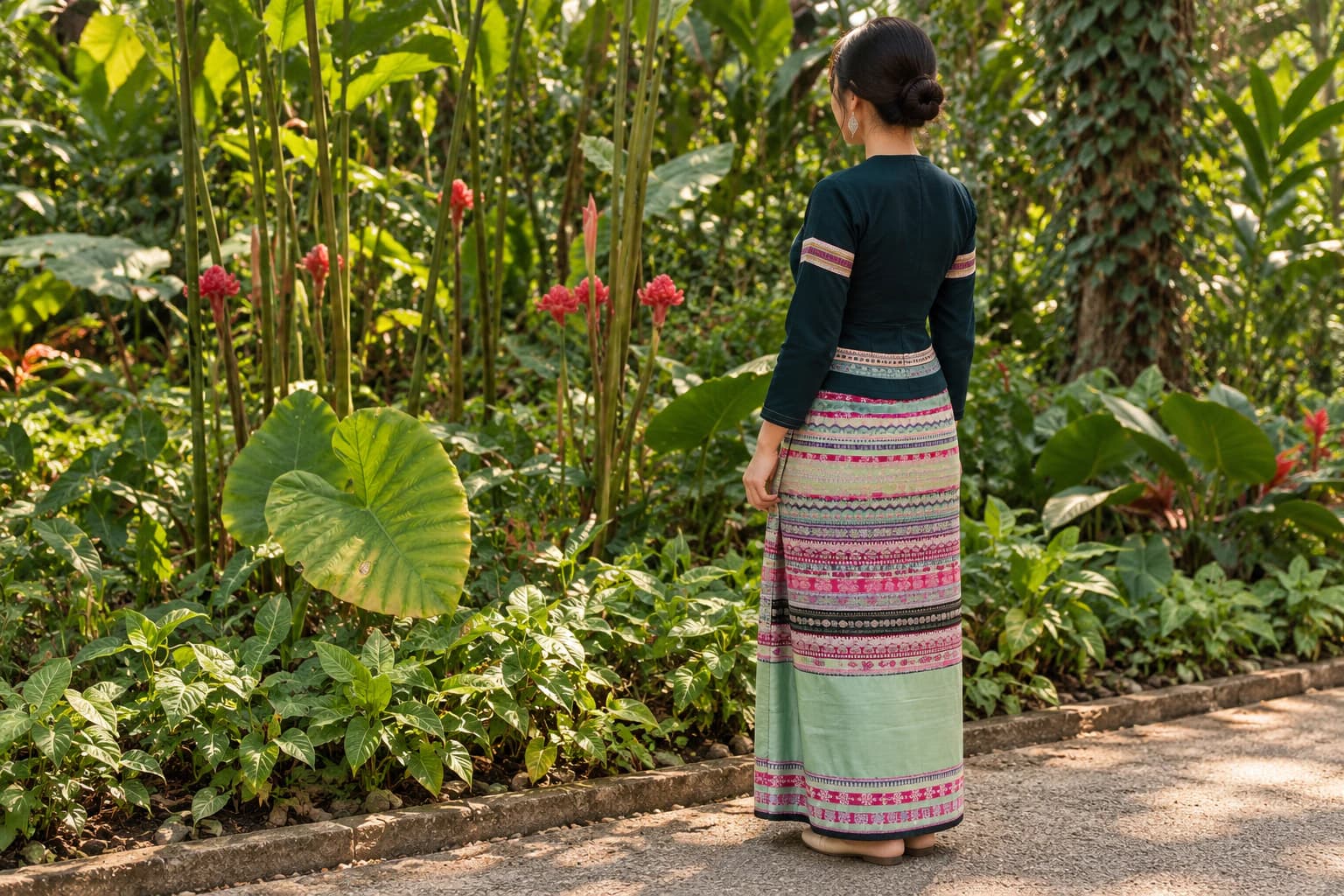
The frame below shows the useful visual relationship: the subject stays on the path, foliage creates depth, and the garment remains readable. It does not establish current access, flowering condition or commercial permission.
Manting Park: attractive, busy and permission-dependent
Manting Park provides landscaped greenery and Dai-style architecture, but it is a ticketed attraction and portrait activity can compete for the same paths. The no-live-traffic driving baseline to Gaozhuang is about 4.5 kilometres and 19 minutes. A short package can lose its daylight while changing, exiting and finding the car.
Choose Manting only when the studio has confirmed the current park rule, your entry arrangement and the equipment allowed. Keep the adjacent Grand Buddhist Temple visit separate from the commercial shoot. The temple is a living religious institution, not a free second set attached to the park ticket.
Dai Garden or a village: a separate cultural day
Xishuangbanna Dai Garden at Ganlanba is around 25 kilometres from Gaozhuang by road and belongs in a half- or full-day plan. It contains inhabited villages and temples as well as visitor products. A standard ticket is not blanket permission to run a commercial production in a lane, house, courtyard or religious space.
Choose a village commission only when the operator names the location, local host, community arrangement, fee, consent process, changing place and areas excluded from photography. Do not direct residents to perform daily life, photograph children, enter houses or stage ritual imagery without clear consent. If village culture is your main interest, visit Dai Garden as a real destination, with the photoshoot secondary.
The distant Xishuangbanna Tropical Botanical Garden is also a full sightseeing day, not an interchangeable green backdrop. Its scientific collections, vehicle system and rainforest branches deserve their own visit. Do not sacrifice that day for an unverified costume package.
Run sunset, blue hour and night in the right order
Check the date-specific sunset time and current forecast, then schedule backward. A workable two-zone plan looks like this:
- About 2.5–3 hours before sunset: arrive at the studio, confirm the garment and photograph its condition. Begin hair and makeup.
- About 75–45 minutes before sunset: finish the daylight garden or quiet-lane full-length frames. Make the widest image first while the background still has detail.
- About 45–20 minutes before sunset: return to the car, blot makeup and secure ornaments. Leave early rather than sacrificing blue hour to one more garden pose.
- From sunset through the first 20–30 minutes after it: make the key Gaozhuang portrait with visible blue sky and warm lights. Exposure is easier before the sky turns black.
- After blue hour: move to tight market bokeh, detail frames and a short video. Night is useful for close and medium images; it is less reliable for a clearly identifiable wide background.
- Before selection: verify that the promised outfit, couple, full-length, close, location and video frames were actually recorded.
This is a sequence, not a guarantee. Cloud, rain, haze, crowd control and venue rules can remove a setting. Put a one-zone Gaozhuang fallback in the contract so weather does not turn into an argument about whether the seller technically “showed up.”
Prepare for heat, rain and insects
Xishuangbanna is tropical. Broad climate guidance places the wet season around May to October, with the strongest rain commonly in the middle of that period. That helps planning, but only the current forecast and warnings should control your appointment.
For humidity, ask for anti-humidity primer, light layers of product and powder that can be retouched without turning heavy. Carry blotting paper, a clean small towel, spare hairpins, approved lash adhesive and a compact fan that will not disturb other visitors. Ask the artist to test the headwear by walking outside before the car leaves.
For rain, keep the costume in a garment bag until needed. Bring a plain clear umbrella, waterproof pouch for phone and passport, quick-drying closed or secure shoes and a second pair of socks. Do not let a trailing hem absorb puddle water; switch to a shorter garment or crop above the ground.
Use insect repellent before dressing and away from delicate textiles, jewellery and the photographer's gear. Wash hands before touching the outfit. Strong scent, oil or aerosol can stain fabric. If you are sensitive, ask the studio what can be applied safely and carry the product rather than improvising on location.
Build one indoor or covered fallback that does not require pretending the weather is good: fitting details, jewellery, seated side portraits, hands and fabric, makeup close-ups and a doorway silhouette. Confirm that the backup site is genuinely available and that the booking can be rescheduled when local warnings make travel unsafe.
Give the photographer a twelve-frame brief
A concise shot list prevents 80 near-identical poses and makes image selection easier. Ask for:
- one horizontal environmental portrait with recognizable atmosphere;
- one vertical full-length frame showing the whole garment and shoes;
- one mid-length three-quarter portrait;
- one side-back frame with a clean silhouette;
- one slow walking frame with the skirt controlled safely;
- one seated or supported pose that does not touch a religious object or plant;
- one hand-and-textile detail;
- one jewellery or hair detail;
- one frame with negative space for an album cover;
- one blue-hour portrait balancing face or body light with the background;
- one night bokeh close frame;
- one short vertical movement sequence if video is included.
Use simple movements: walk slowly, turn the shoulders away, look toward the light, hold your own skirt edge, rest a hand on the waist or adjust an earring. Avoid copying sacred gestures or turning a temple statue, altar or worshipper into a decorative object.
Ask the photographer to show the first full-length and first close portrait at useful magnification. Check eyes if visible, focus, neckline, waistband, skirt alignment, stray hair and background intrusions. This is the moment to correct the garment and camera height. It is not a promise that every later frame should be retouched on site.
Base yourself where the appointment ends
Gaozhuang is convenient when your shoot ends late in the night market and the studio is walkable. The disadvantages are noise, congested road pickup and pedestrian-only stretches. Old Jinghong around the Splashing Square area can be calmer for normal city meals but requires a ride after a Gaozhuang night session.
If the shoot is one part of a broader trip, use the Xishuangbanna city guide to choose the base for all days rather than moving for one appointment. You can compare Xishuangbanna stays on Trip.com, then verify the exact pin, nighttime noise, vehicle access, late reception, international-guest policy and the studio's real pickup point before paying.
A final booking message to copy
Send a compact request like this:
I want one adult, one modest contemporary Dai-inspired look and one assigned photographer. Please quote the complete price for makeup, hair, clean consumables, the exact outfit, accessories, 60–90 minutes of camera time in one Gaozhuang zone, all usable original JPEGs, eight final retouches and one 15-second vertical video. State any extra charge, the delivery date, one revision round, rain reschedule/refund terms, the garment deposit and whether you may publish my images. Please send recent complete work from the assigned team and confirm the exact meeting point and current location permission.
Replace the numbers with the product you actually want. A seller who answers each line gives you something measurable. A seller who responds only with sample portraits and “everything included” has not yet quoted a complete photoshoot.