Jinli Ancient Street
Jinli Ancient Street (锦里古街, Jǐnlǐ Gǔjiē) is a free folk-culture and food district beside Chengdu's Wuhou Shrine. It is photogenic after the lanterns come on, easy to reach on the new Line 10 extension and full of small snacks and craft demonstrations. It is also busy, commercial and much newer than its name suggests.
The best first visit is Wuhou Shrine before Jinli, then a 60–90 minute route through Jinli as daylight turns to evening. The paid museum supplies the real Shu Han history; Jinli supplies reconstructed western-Sichuan-style streets, folk crafts, food and night atmosphere. Visiting in that order prevents a snack street from carrying more historical weight than it should.
Jinli essentials
| Plan | Current practical answer |
|---|---|
| Admission | Free under normal operation |
| Recommended visit window | 08:00–22:30 |
| Typical merchant hours | 09:00–22:00; individual businesses vary |
| Official lantern baseline | Summer around 19:00; winter around 18:00; weather and daily operations can shift it |
| Time needed | 60–90 minutes alone; 3–4 hours with Wuhou Shrine |
| Best metro | Line 10 to Wuhou Shrine (Jinli) Station, Exit A2 |
| Verified walk | Exit A2 to the Jinli map location: about 225 m / 3 minutes on AMap |
| Address | 231-1 Wuhouci Street, Wuhou District |
| Chinese for maps | 锦里古街 / 武侯祠(锦里)地铁站A2口 |
The official Jinli site lists the district as free and recommends 08:00–22:30, with businesses generally operating 09:00–22:00. Major events such as the Chengdu Temple Fair can temporarily fold Jinli into a controlled event area. Check the official Jinli notices before a holiday visit rather than relying on a permanent “24 hours” claim.
Is Jinli actually ancient?
The name has deep historical roots in Chengdu's brocade culture. Historical texts connect “Jinli” with the city's Shu brocade industry, the Jin River and the workshops that made Chengdu textiles famous. The street you walk today, however, is a modern cultural project associated with Wuhou Shrine Museum.
Jinli's official history records planning and construction in the early 2000s, with the first phase opening on 31 October 2004 and the extension following later. Wuhou Shrine describes the present street as a concentrated interpretation of Three Kingdoms culture, western Sichuan folk customs, craft and food—not a perfectly preserved Qin–Han commercial lane.
That distinction improves the visit. Judge Jinli by how well it stages local architecture, folk skills, snacks, water, lanterns and public festival culture. For excavated history and original monuments, give your attention to Wuhou Memorial Temple next door.
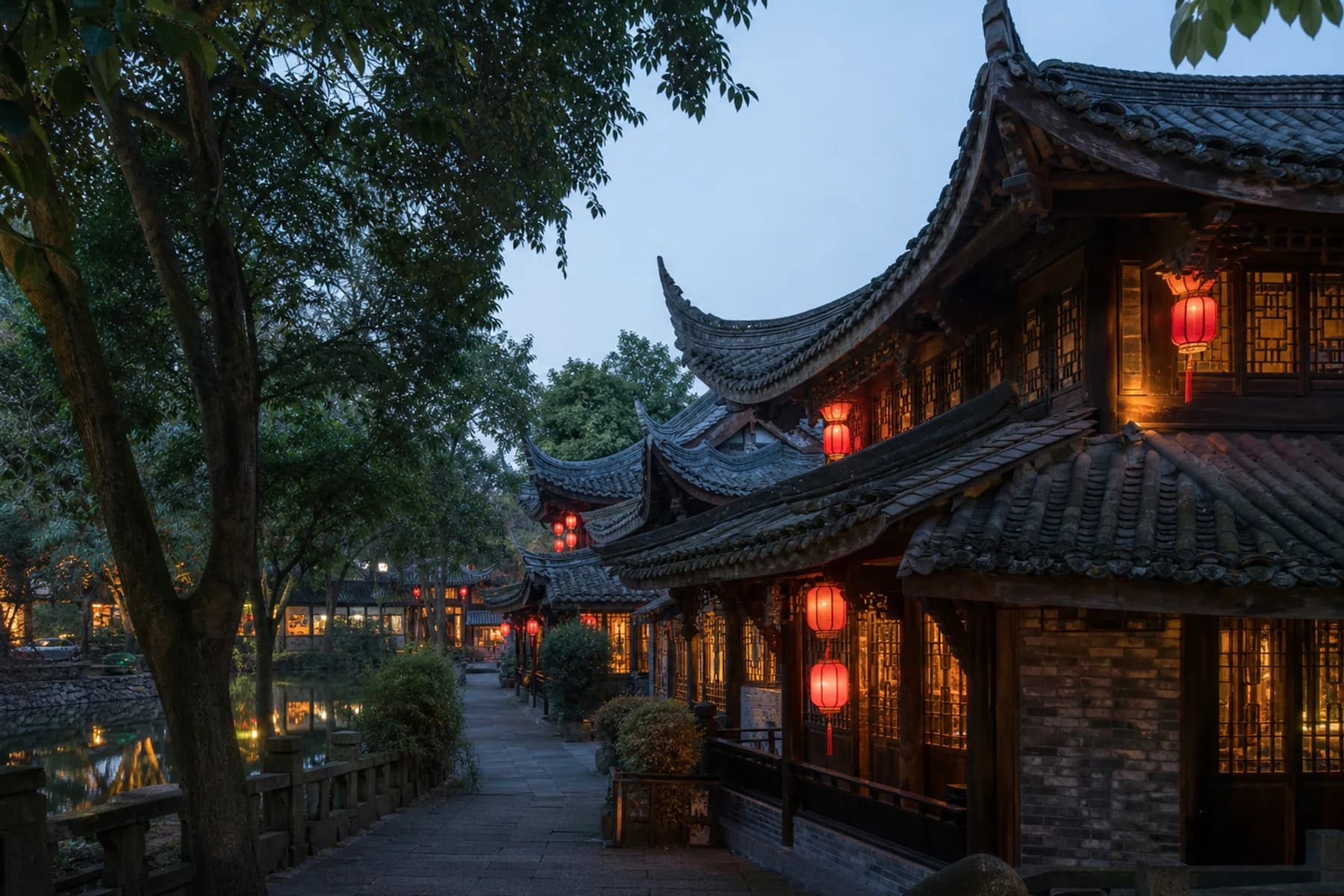
The route: history first, snacks second, lanterns last
Jinli looks like one straight lane near the entrance, but its northern end divides into named streets, waterside paths and a western extension. The route below distills the official 2025 guide map into six decisions. It is a schematic, not a substitute for evacuation signs or temporary crowd controls.
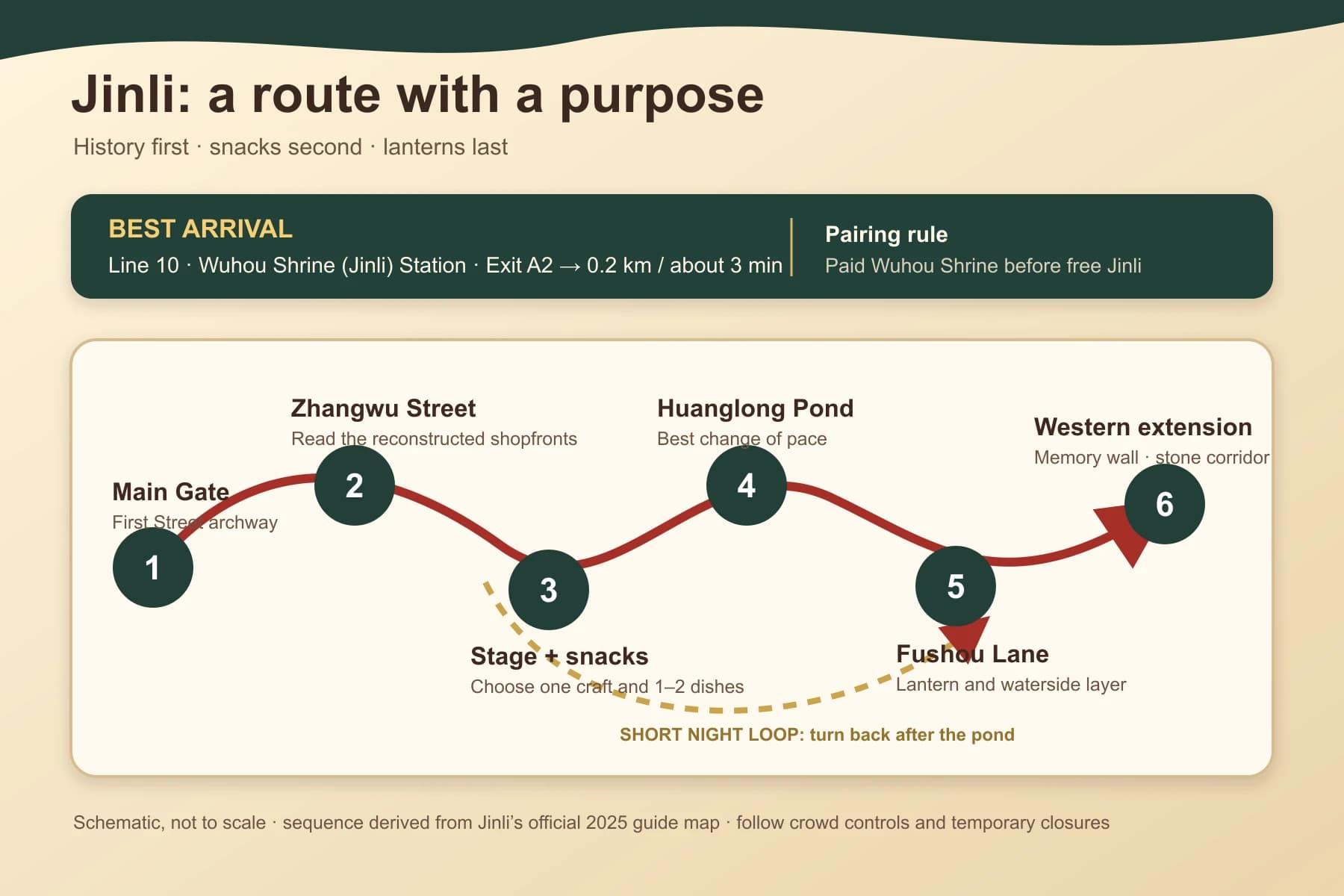
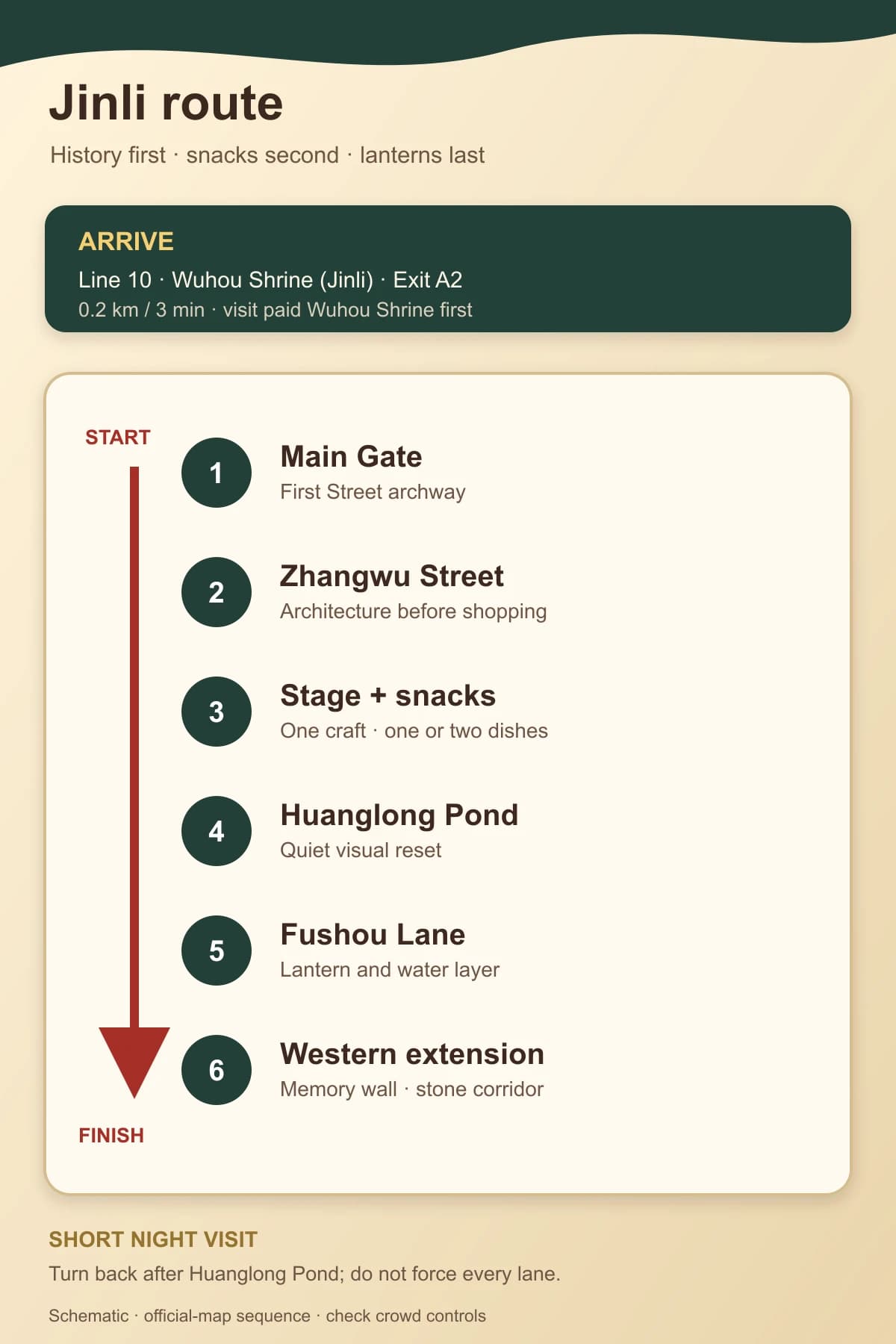
Original schematic derived from Jinli's official guide-map sequence. External metro walking distance was checked with AMap using GCJ-02 coordinates.
1. Main Gate and First Street archway
Use the entrance to reset expectations. The gate and sign announce a themed cultural district, not an untouched old town. Take the broad establishing photo here only if circulation is clear; the entrance becomes a bottleneck when groups stop beneath the archway.
2. Zhangwu Street: read the shopfronts before shopping
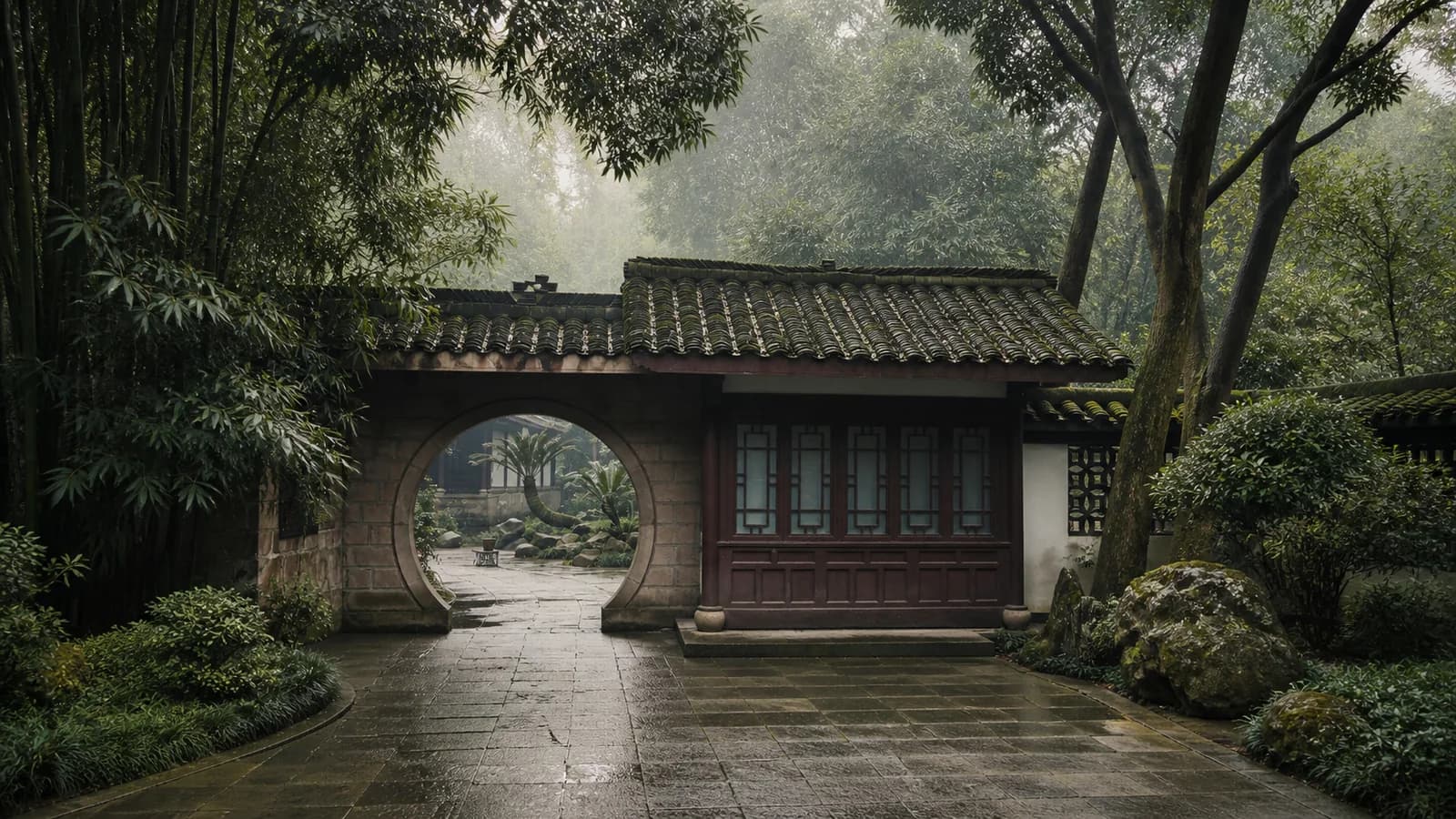
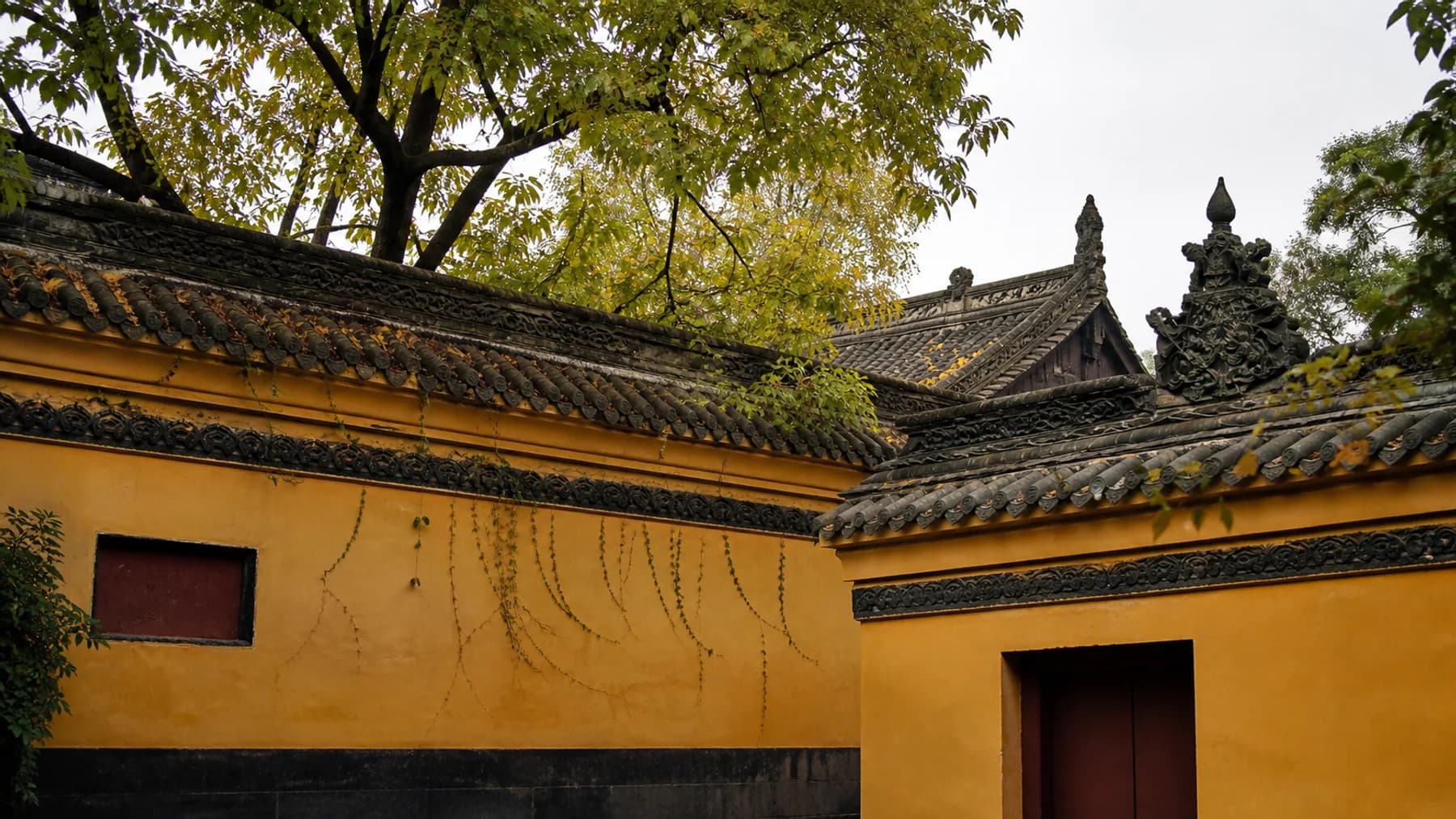
Look at the sliding timber panels, narrow building widths, grey tiles, upper stories and close relationship between storefront and lane. Jinli's own interpretation emphasizes these western-Sichuan-style commercial forms. This is the point to understand the architectural language before bright displays and food queues take over.
3. Stage and snack section: choose, do not collect
The official map marks the old stage among Jinli's principal landscapes. Treat any face-changing, shadow-puppet or folk performance as schedule-dependent; do not arrive assuming a free continuous show. Check the day's board and keep doorways clear.
This is also where the trip can dissolve into repeated snack purchases. Pick one savory item and one sweet item, share portions if possible, and keep moving toward the water.
4. Huanglong Pond: the visual reset
The pond, bridges and planting change the pace after the compressed food lane. Visit before full darkness if you want roof and water detail; return after lantern lighting if reflections matter more. Do not lean over barriers or step into landscaped edges for a clearer frame.
5. Fushou Lane: the lantern layer
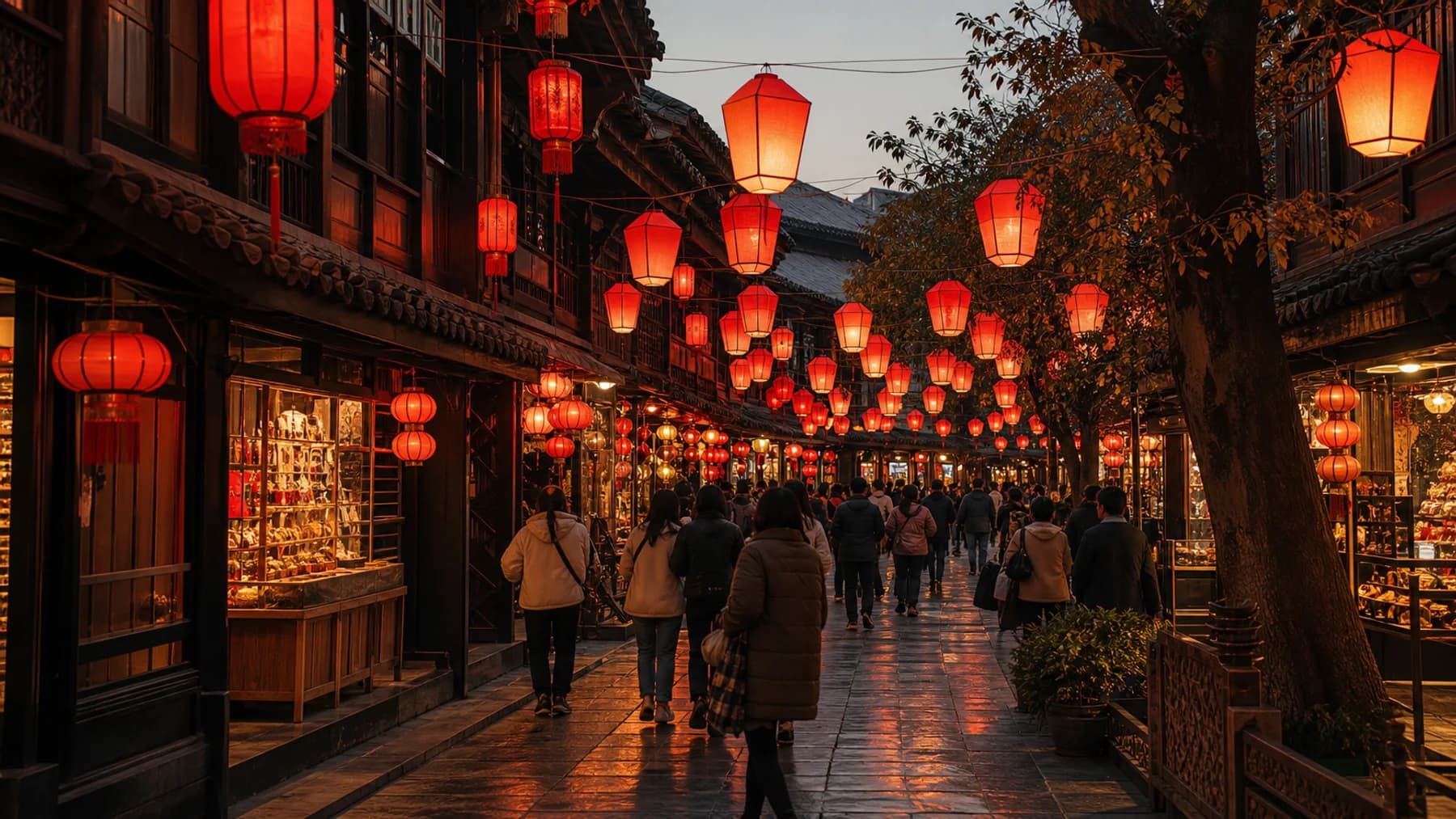
This narrower section earns its place after lighting. The official baseline is around 19:00 in summer and 18:00 in winter, but weather and operations can shift the actual moment. Blue hour—when there is still color in the sky—is often more balanced than complete darkness.
6. Western extension: folk memory, not another snack lap
Continue only if you still have attention. The official map identifies the Folk Memory Wall and Song Dynasty Stone Carving Corridor among this broader area's landscapes. The memory wall is especially distinctive: representative Sichuan craft works were sealed as a time capsule intended to be opened in 2109.
For a short night visit, turn back after Huanglong Pond or Fushou Lane. You do not need to trace every branch shown on the full site map.
What is worth stopping for: skill over souvenir volume
Jinli is strongest when a maker is demonstrating a process, not when a shelf merely repeats generic “ancient China” merchandise. Look for the transformation: sugar becoming a drawn animal, paper becoming a cut silhouette, bamboo becoming a woven form, or thread revealing the density of Sichuan embroidery.
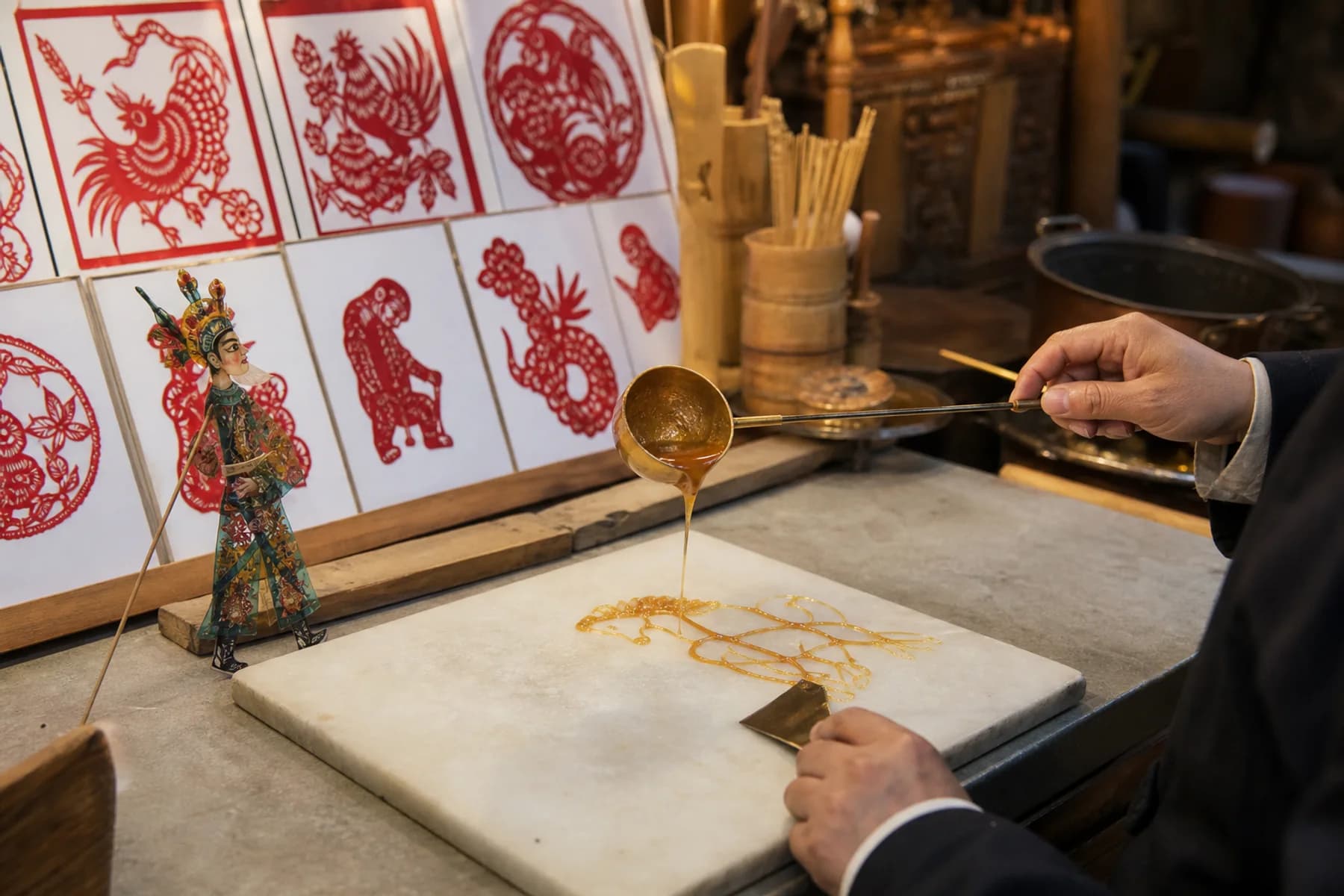
Use these filters before buying:
- Ask what is made onsite. A live demonstration does not prove every object on the stall is handmade there.
- For Shu embroidery or brocade, inspect the back and finishing. Serious textile work should have material, technique and care instructions—not only a dramatic sales story.
- For paper cutting or sugar painting, pay for the maker's time as well as the object. These are fragile, small experiences rather than durable “investments.”
- Treat shadow puppets as cultural objects, not costume props. Ask before handling a display piece.
- Skip pressured explanations. The official visitor notice warns against unregulated solicitation and distributed advertising in the crowded area.
What to eat at Jinli—and what to save for elsewhere
Jinli is good for a tasting flight, not automatically Chengdu's best full meal. Prices carry a major-attraction premium, seating is limited and the most photogenic counter is not necessarily the strongest kitchen. Choose high turnover, visible preparation and a clearly posted price.
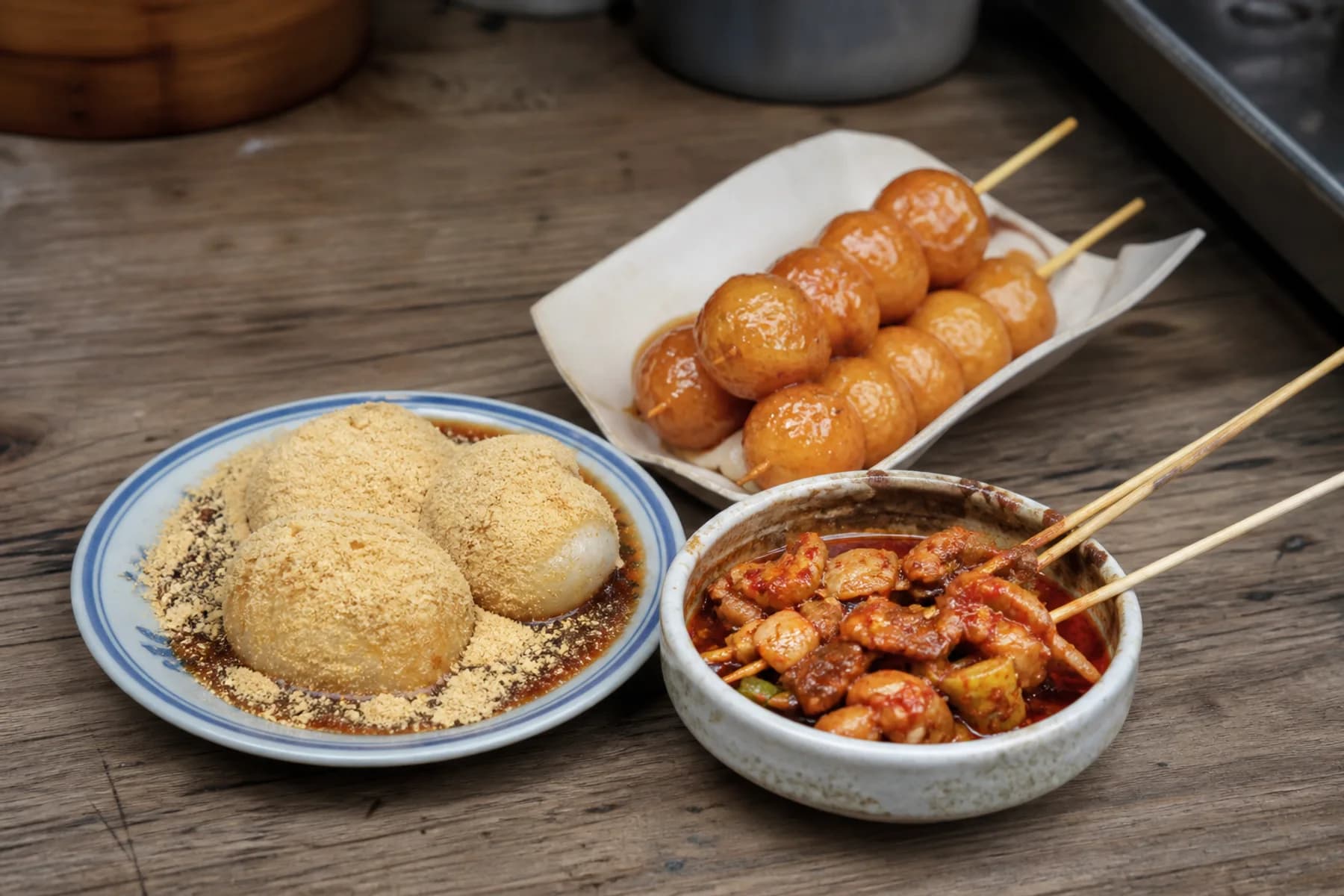
- Three cannons (三大炮): glutinous-rice balls tossed into soybean powder and served with brown-sugar syrup. The name comes from the sound and performance of making them. Ask about peanuts, sesame and soy if allergic.
- Tangyouguo (糖油果子): fried glutinous-rice balls with a glossy sweet coating, usually skewered. Share one portion; they are richer than they look.
- Bobo chicken (钵钵鸡): skewers served in a chili-rich seasoned bowl. Confirm the price unit and count your skewers; selections can include meat, skin, offal, vegetables and tofu.
- Cold jelly or noodles: a better savory choice when you want less fried food. “Slightly spicy” can still be assertive by international standards.
- Zhang Fei beef: a Three Kingdoms-branded specialty associated with Sichuan, but packaging and quality vary. Buy it only after checking the ingredient list, date and sealed condition.
Save hotpot, a full Sichuan banquet or a long teahouse session for a less compressed neighborhood. Jinli is the sampler between museum and evening, not a reason to abandon the rest of Chengdu's food geography.
When should you visit?
Morning: best architecture, weakest atmosphere
Between 08:00 and 09:00, the lanes are quieter and the structure is easier to see, but many merchants have not opened. Choose morning for photography or a calm walk—not for a full food-and-craft experience.
Late afternoon to blue hour: best first visit
Schedule Wuhou Shrine first, then enter Jinli with enough daylight to read the architecture. Eat one or two snacks, reach the pond, and let the lanterns switch the visual language. This is the most complete version without a separate return trip.
Full night: strongest lanterns, biggest crowd risk
Night works when atmosphere is the only goal. It is weaker for understanding architecture and easier to lose time in a slow crowd. On weekends and holidays, follow the dominant direction rather than trying to reverse through a packed lane.
Wuhou Shrine and Jinli: the correct order
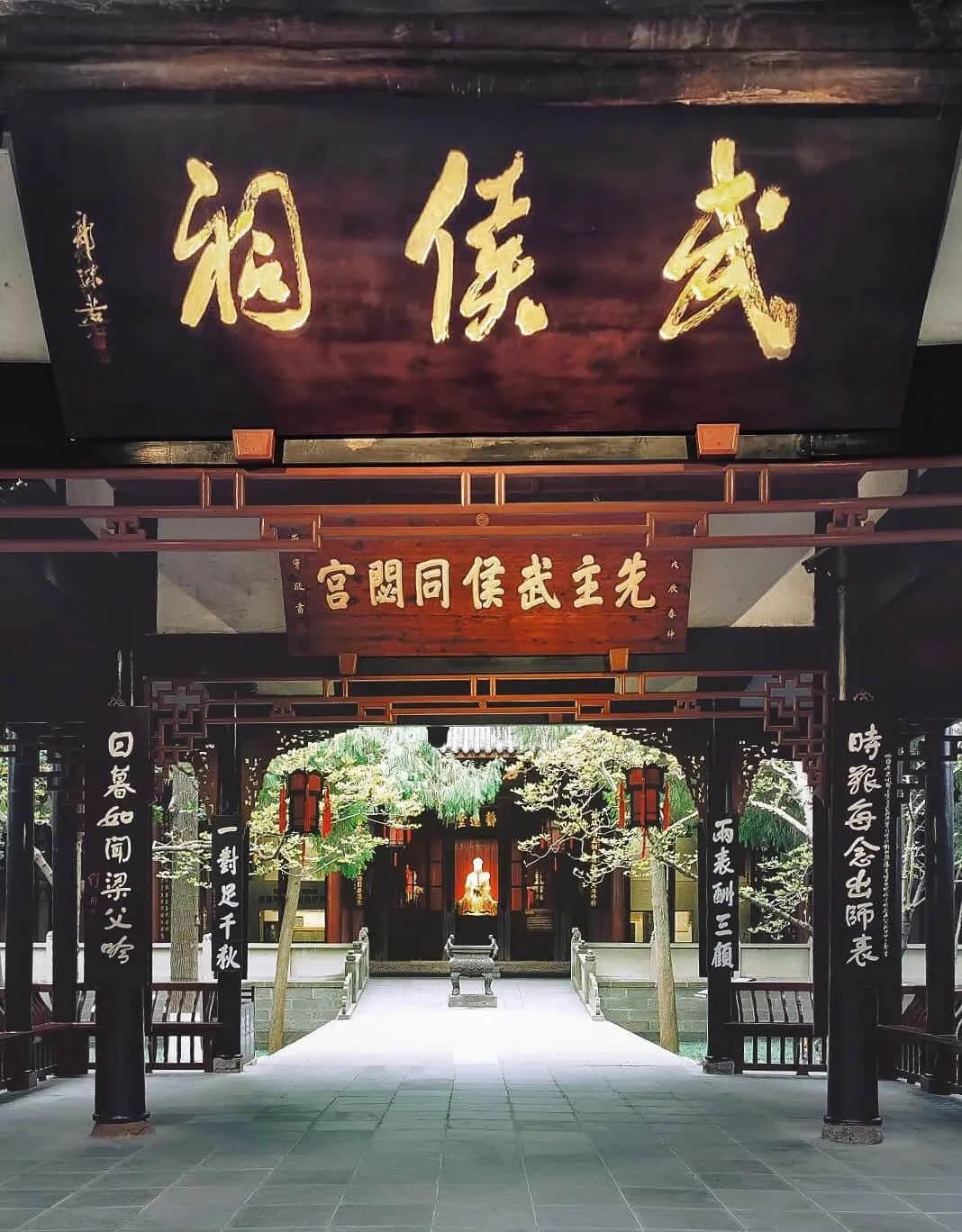
Visit the paid, time-limited museum first and the free, later-running street second. Wuhou Shrine explains Liu Bei, Zhuge Liang, the ruler–minister memorial tradition and the physical heritage complex. Jinli then shows how that Three Kingdoms identity is repackaged through public culture, design, food and performance.
Do not reverse the order unless your timed museum booking requires it. A large snack meal and crowded shopping lane make the quieter historical site harder to appreciate. Current museum tickets and last entry can change; use the museum's official channel for the day's rules.
Getting there without the obsolete metro detour
The current best approach is Line 10 to Wuhou Shrine (Jinli) Station, Exit A2. Jinli's official transport page says it is a three-minute walk, and AMap verifies about 225 m / 3 minutes to the Jinli map location.
Older guides route everyone through Gaoshengqiao Station on Lines 3 and 5. It remains a fallback, but AMap currently gives roughly 1.3 km / 18 minutes from Exit A to Jinli—far less convenient than the new station. Follow current station signage because a newly opened line or individual exit can still have temporary access changes.
Carry the AMap marker for Jinli Ancient Street. For taxis, use 锦里古街,武侯祠大街231号附1号, not a translated “old street” name.
Where to stay for Jinli
- Wuhou Shrine / Huaxi: useful for an early museum entry, Line 10 and medical-university access. Check traffic noise and the exact station exit; this is not automatically the best all-round first-trip base.
- Tianfu Square: better for Chengdu Museum and central transport while keeping Jinli within an easy ride.
- Chunxi Road / Taikoo Li: best for food choice, shopping and evening convenience. Jinli becomes a half-day excursion rather than your nightly neighborhood.
- Yulin: choose for a more local evening restaurant and bar environment, accepting fewer walkable headline sights.
Compare Chengdu hotels on Trip.com after choosing the district. Recent reviews about smoke, air-conditioning control, street noise and real metro walking distance matter more than “ancient street style” in a listing title.
Crowd, weather and visitor rules that matter
- Pets are not permitted, except certified guide dogs, under Jinli's current visitor notice.
- Commercial filming, organized performance and livestream selling require permission; ordinary visitors should still avoid obstructive tripods.
- Merchant deliveries normally occur before 10:00 and after 18:00. Watch for carts and service movement even when the lane appears pedestrian-only.
- Wet stone becomes slippery after rain. The pond edge, steps and crowded thresholds need more attention than the phone screen.
- During dense crowd flow, move with the prevailing direction, keep children close and do not stop suddenly at a lantern ceiling.
- Major festivals can change access, hours and pricing structure for the wider event area. “Free every day under all conditions” is too absolute.
Is Jinli Ancient Street worth it?
Yes as the evening half of Wuhou Shrine, and only maybe as a standalone attraction. The new metro station, free entry and official lantern schedule make it an easy pairing. The route earns its time through western-Sichuan-style architecture, a waterside change of pace, live folk processes and a compact introduction to Chengdu snacks.
Skip it if you dislike commercial heritage districts or already have stronger night-street plans. Do not skip Wuhou Shrine history and then expect Jinli's shopfronts to explain the Three Kingdoms. The rewarding version is simple: museum first, one craft, two snacks, pond at blue hour, lantern lane last.