Traditional Chinese medicine experiences: choose culture, wellness or medical care
A traditional Chinese medicine experience in China can mean four very different things: visiting a museum, joining a non-invasive cultural workshop, buying a leisure service, or receiving diagnosis and treatment in a medical institution. Decide which one you want before choosing a venue. The safest first encounter for a curious traveler is usually a museum or a supervised activity such as identifying plant specimens or making a scent sachet. If needles, prescriptions, medical claims or treatment of symptoms enter the conversation, use a qualified medical-care pathway instead.
This guide helps you classify the experience, check the provider, set consent boundaries and keep usable records. It does not diagnose a condition, recommend a treatment, promise benefit, or tell you to stop or replace prescribed medicine. “Traditional,” “natural,” “famous,” “university-affiliated” and “recommended online” do not by themselves establish that an individual service is safe or appropriate for you.
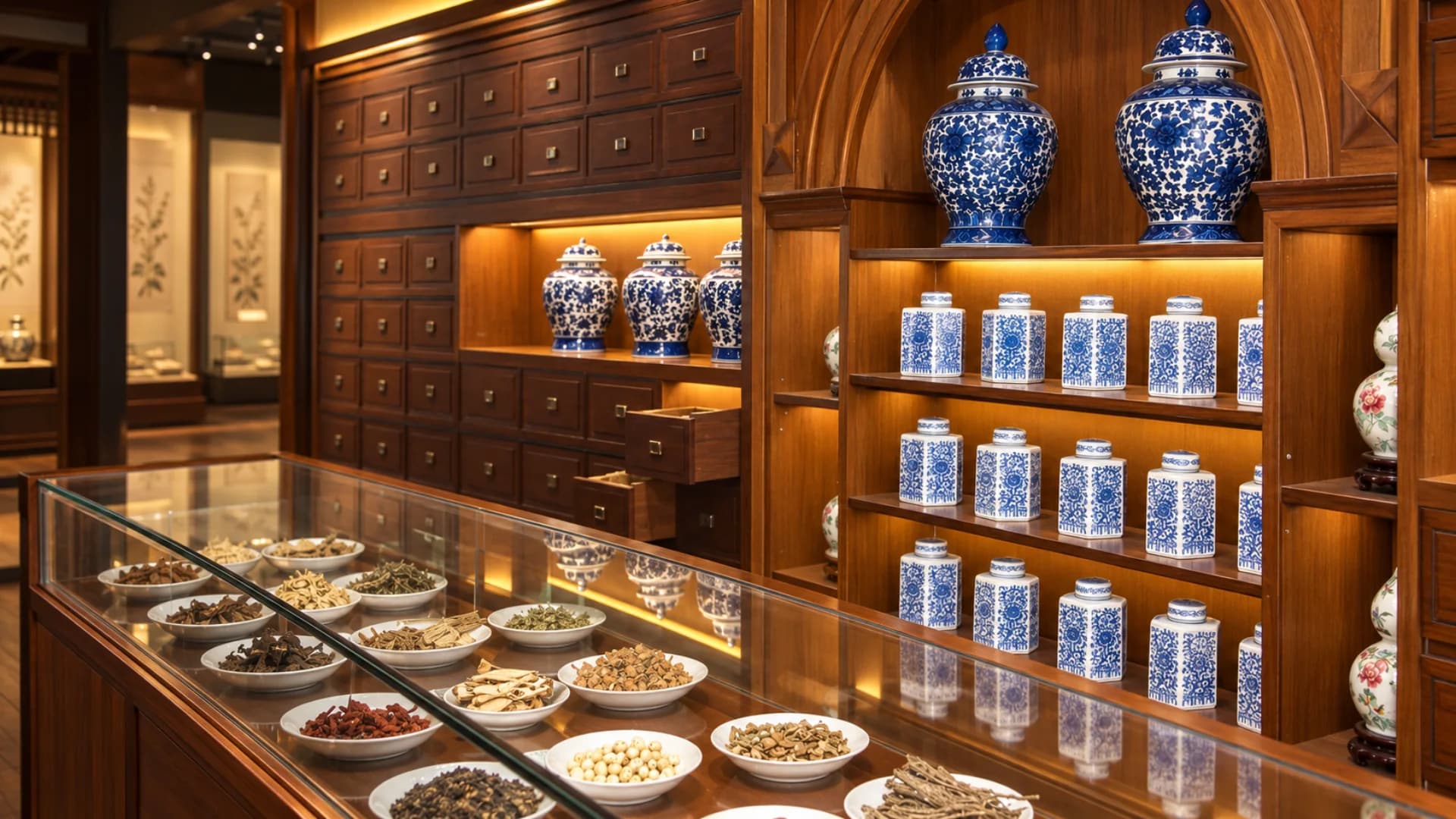
A museum can explain how materia medica was collected, classified and dispensed without asking you to accept a diagnosis or buy treatment. This scene illustrates a museum layout; it does not document a particular institution or authenticate the displayed materials.
Choose the category in 60 seconds
| Category | What you are doing | Appropriate venue | Main check | What it does not prove |
|---|---|---|---|---|
| Museum or heritage visit | Learning history, viewing instruments, specimens, texts and reconstructed pharmacies | University museum, public museum or documented heritage institution | Current opening notice, campus entry and reservation | That an exhibit is a medical recommendation |
| Non-invasive cultural activity | Herb identification, sachet making, calligraphy, tea, breathing or movement demonstration | Museum, cultural center or clearly described workshop | Ingredient list, allergy contact, supervision and whether anything is consumed | That a workshop leader is qualified to diagnose or treat |
| Leisure wellness service | Relaxation massage, foot therapy, bathhouse or spa treatment | Commercial wellness venue | Exact service, clothing, privacy, pressure, hygiene and price | That the service is medical 推拿 (tuīná) or treats illness |
| TCM consultation or treatment | Discussing symptoms, receiving a diagnosis, acupuncture, medical tuina, cupping or a prescription | A registered medical institution or properly filed TCM clinic with qualified staff | Institution identity, practitioner identity, consent, clinical record and follow-up | That a brand name, white coat or online popularity makes care suitable |
| Retail herb or health-product shopping | Buying packaged medicine, tea, food, supplements or loose ingredients | Hospital pharmacy, licensed pharmacy or ordinary shop depending on product category | Exact category, ingredient list, approval/registration where applicable, dose and interaction review | That every item called “herbal” is a medicine, safe to combine, or legal to carry home |
If a shop begins with a massage but then offers to diagnose an organ problem, sell a course of treatment or prescribe herbs, pause. Ask what kind of institution it is, who is making the clinical decision and what record you will receive. If those answers remain unclear, leave without accepting the medical part.
The easiest useful plan: one museum, no treatment decision
A good museum visit gives context before you meet commercial claims. You can see historical diagnostic tools, pharmacy furniture, materia medica specimens and changing ideas about health without exposing skin, ingesting a product or interpreting a sales pitch as a diagnosis.
Two current examples show how this works, but neither should be treated as permanently open:
- Beijing University of Chinese Medicine Museum currently publishes Tuesday–Saturday hours of 08:30–16:30 and directs visitors to reserve through its official WeChat channel. University-campus entry and real-name details can change. Its own site also posts temporary closure notices, so check the notice feed on the day. The Beijing municipal introduction describes medicine-history displays, specimens and a reconstructed pharmacy. Allow about 60–90 minutes and carry the identification requested in the current reservation instructions.
- Shanghai University of Traditional Chinese Medicine Museum announced its reopening after renovation in March 2026. Its current notice lists 09:00–16:00, last entry at 15:30, a CNY 15 individual ticket, campus security and advance contact for groups of ten or more. Recheck before going. A special organized event once included identification, sachet and clinician-led activities; that event does not make invasive treatment a normal museum service.
These examples fit naturally into Beijing or Shanghai sightseeing. Do not cross a city only because a social post says “free” or “no reservation.” Campus access, public holidays, weather closures and university events can override ordinary hours.
At a specimen display, “traditional use” describes history, not proof that the material is effective or safe for you. Do not taste an exhibit, handle a sample without permission or photograph another visitor. Animal-origin and protected-species displays are especially poor shopping lists: museum interpretation and modern legal trade are separate questions.
A cultural workshop still needs boundaries
Non-invasive does not mean zero-risk. A sachet can contain fragrant plants that trigger allergy or asthma. A moxa-making demonstration involves a combustible material even if nothing is burned. A tea tasting puts ingredients into the body. A movement class may be inappropriate for an acute injury or a traveler who is dizzy or unwell.
Before joining, ask:
- Is this a cultural demonstration, a wellness class or a medical service?
- Will I eat, drink, inhale, burn or apply anything to my skin?
- What are the complete ingredients, and can I participate without using them?
- Is photography allowed, and will the organizer photograph participants?
- Does the ticket include any retail product or later sales consultation?
Choose observation when the organizer cannot name the ingredients. Do not carry an unlabeled sachet, tea mixture or powder across a border simply because it came from a museum activity. Keep the ingredient card and original packaging if you plan to retain anything.
Tea culture has its own booking and sales logic; use the Chinese tea experience guide for tastings. Foot massage, spas, bathhouses and recreational bodywork belong in the spa, massage and wellness guide. Those pages help prevent a cultural day from turning into an unclear medical or retail purchase.
When it becomes medical care
Needles, diagnosis, prescriptions and treatment of a health complaint should move the encounter into a medical setting. Chinese rules for filed TCM clinics define their practice around TCM-guided use of Chinese medicines and non-drug methods including acupuncture, cupping and tuina. Filing and practitioner requirements apply. For a traveler, the practical test is not memorizing regulation; it is whether the venue can identify itself as a medical institution, identify the responsible clinician, create a patient record and explain where follow-up or complaints go.
Ask reception to write down:
- the institution's full Chinese name and address;
- whether it is a 医院 (hospital), 门诊部 (outpatient department) or 中医诊所 (TCM clinic);
- the clinician's name, professional role and registration information;
- the quoted consultation and procedure fees;
- the record, prescription, receipt and follow-up you will receive.
An ordinary product shop, hotel spa or attraction booth should not become your diagnostic shortcut. A famous old pharmacy brand may operate retail, museum and medical services in different rooms or branches. Confirm which counter you have entered.
For a complete passport, registration, language, payment, hospital, pharmacy and insurance workflow, use Seeing a Doctor in China. A typical non-emergency sequence is passport-based registration, department check-in, consultation, separately paid tests or procedures, return consultation, pharmacy and record collection. Exact apps and payment stages vary by institution.
Language is part of consent
A translation app can help with “Where is registration?” It is a poor sole interpreter for a procedure with meaningful risks, alternatives or aftercare. Arrange a qualified interpreter or a trusted bilingual adult when the discussion exceeds simple logistics. Do not use a child as the only interpreter for invasive care.
Bring an offline note with:
- allergies and previous serious reactions;
- diagnosed conditions, pregnancy possibility and recent procedures;
- all medicines and supplements by generic ingredient, strength and schedule;
- bleeding disorder, anticoagulant or antiplatelet use;
- implanted devices, immune suppression, skin infection, open wounds or fracture risk;
- the symptom timeline and what medical evaluation has already occurred.
Machine translation can mistranslate herb names, anatomy and negation. Ask the clinician to write the plan, ingredient names and warning signs. If you cannot explain your history or understand the answer, postpone non-urgent invasive treatment.
Consent is a conversation, not a signature
China's medical-dispute regulations require clinicians to explain the condition and medical measures; higher-risk special examination or treatment requires explanation of risk and alternatives and written consent in specified circumstances. They also give patients rights to access and copy medical records. Use those rights practically: ask what will happen, what could go wrong, what the alternatives are, who will do it and what to do afterward.
Before changing clothes or lying down, settle:
- the exact procedure and body area;
- whether needles, heat, electricity, skin puncture, scraping, oil or medicine are involved;
- practitioner gender if it matters to you;
- private room, shared room, curtain and chaperone arrangement;
- clothing and draping, including what skin must be exposed;
- pain or pressure signal and the words for “stop”;
- total price and whether follow-up is included;
- what happens if you decline partway through.
Useful phrases:
请先解释步骤、风险和其他选择。
Please explain the steps, risks and alternatives first.
我不同意这个项目。请现在停止。
I do not consent to this procedure. Please stop now.
我需要女医生 / 男医生,也需要遮挡。
I need a female / male clinician and appropriate draping.
请给我病历、处方、费用清单和发票。
Please give me the medical record, prescription, itemized charges and receipt.
Online visitor discussions show that room partitions, practitioner gender and exposed body areas can surprise first-time patients. Treat privacy as a pre-payment question. You can withdraw consent. A provider should not argue that embarrassment, severe pain or an unwanted body area is necessary merely because the session has started.
Acupuncture: check sterile practice and escalation
WHO's acupuncture benchmark describes training, infrastructure, procedure and safety requirements. China's infection-control guidance requires aseptic technique and skin disinfection, with one person, one needle, one use and one sterilization; disposable needles must not be reused. Ask to see each sterile single-use packet opened for you and a nearby sharps container.
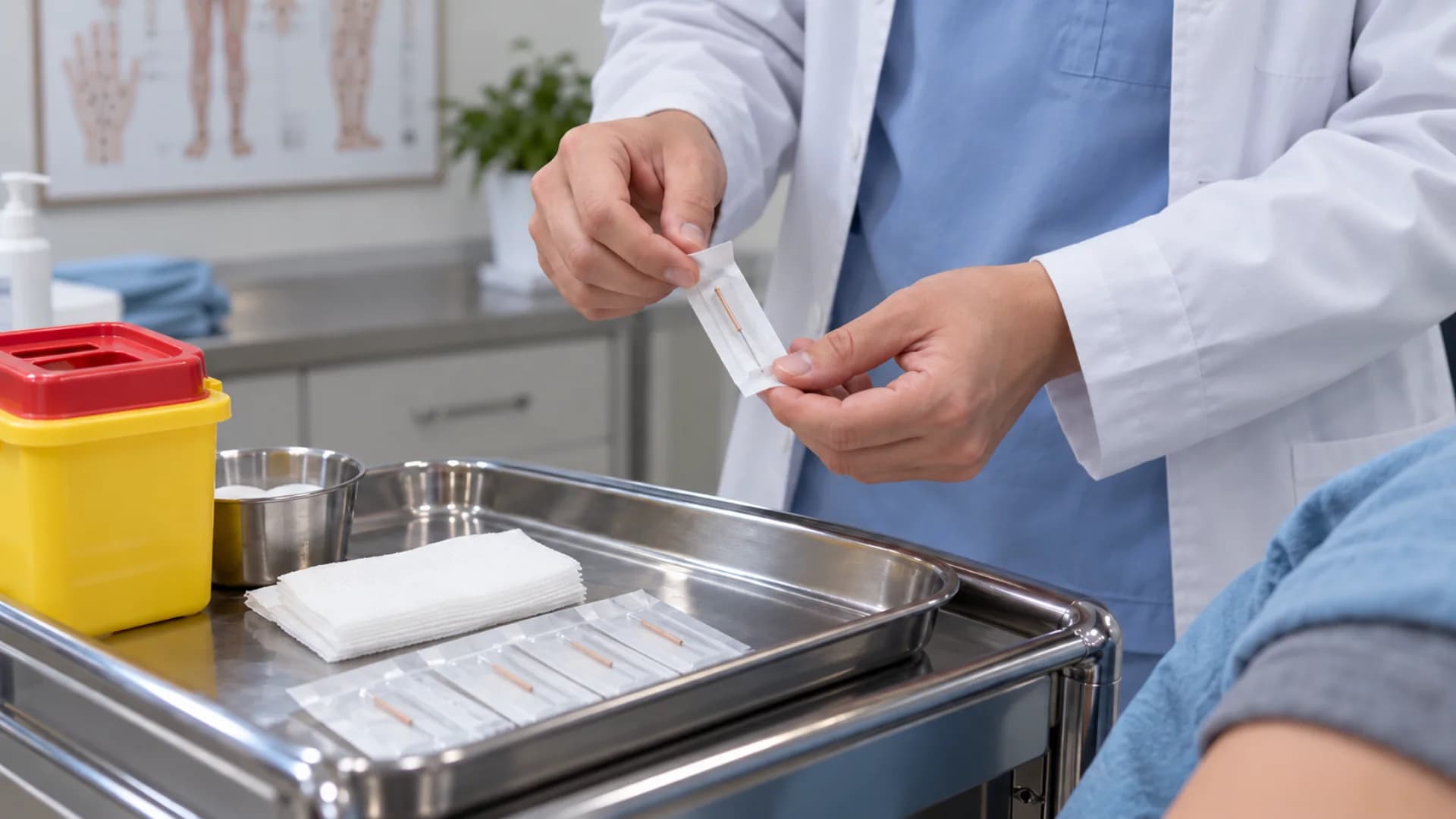
Sterile single-use preparation is a check you can ask to observe before treatment. This process image does not document a specific clinic or show every item required for every procedure.
Ask where needles will be placed, how deep the clinician expects to insert them, whether manual or electrical stimulation is planned and what sensation should make you speak up. Tell the clinician immediately about sharp or escalating pain, dizziness, nausea, sweating, faintness, numbness or difficulty breathing. Never accept needling through infected, inflamed or damaged skin.
Serious complications are uncommon in trained practice but possible. Published safety guidance includes infection and injury to nerves, blood vessels or organs, including pneumothorax. After needling around the chest, upper back or shoulder, sudden cough, chest pain, shortness of breath or painful breathing needs urgent medical assessment. Severe bleeding, new weakness, spreading numbness, fever or worsening redness also needs medical care. Do not let a clinic explain a new dangerous symptom only as a desirable “reaction.”
Do not change the dose of prescribed medicine because an acupuncture session felt helpful or because a practitioner outside the prescribing team advised it. Coordinate meaningful changes with the clinician responsible for that medicine.
Cupping: marks are expected; burns and infection are not
Dry cupping uses suction on intact skin. Wet cupping also breaks the skin and handles blood, creating a different risk category. Ask which one is being proposed. If you intended a cultural or relaxation experience, decline skin puncture rather than discovering it mid-session.
Round discoloration can persist after cupping. That mark does not measure “toxins,” prove a diagnosis or demonstrate benefit. Current cupping safety guidance lists persistent discoloration, scars, burns and infection; wet cupping adds bloodborne-infection and bleeding concerns. Avoid a commercial session over eczema, psoriasis, sunburn, a wound, an active rash or infected skin. Ask a clinician who knows your history before considering it if you use blood-thinning medicine, have a bleeding disorder, impaired sensation or fragile skin.
Fire cupping introduces an obvious burn risk. Confirm how heat is used and how the operator prevents hot material from contacting skin. Stop for burning pain rather than waiting for the operator to decide that the sensation is normal. If skin blisters, breaks, becomes increasingly hot or swollen, drains fluid, or is accompanied by fever, seek medical assessment.
Do not plan cupping marks immediately before a swim, formal photograph, hot-spring day or any activity where broken or irritated skin will be a problem. If you need a clinician at home to interpret the mark, take a dated photograph and keep the procedure record.
Tuina: distinguish medical treatment from leisure massage
The word 推拿 appears in hospitals, clinics and commercial massage menus. In a medical institution it may form part of an assessed treatment plan. In a leisure venue it may simply describe pressure, kneading or joint movement. The name alone does not identify the practitioner's qualification or make the session appropriate for an injury.
Before medical tuina, explain recent trauma, osteoporosis, surgery, clotting problems, anticoagulant use, neurological symptoms, pregnancy and any known fracture or spinal condition. Do not permit forceful work on an open wound or acute injury. Massage safety guidance records rare harms including nerve injury, fracture and blood-clot complications; risk may be higher for some older or medically vulnerable people.
Agree on clothing, body areas and pressure. “More painful” does not mean “more effective.” Stop for severe pain, electric-shock sensation, new numbness, weakness, dizziness or feeling unsafe. Be especially cautious about rapid, forceful neck manipulation; if that is proposed, ask what it is, why it is needed, what alternatives exist and who is qualified to perform it. Declining is a complete answer.
For relaxation without diagnosis, use a clearly priced leisure service and the separate China massage and wellness guide. For pain after a fall, weakness, loss of bladder or bowel control, fever, a hot swollen joint or another concerning symptom, seek medical assessment rather than testing a walk-in massage.
Herbs: identify the product before judging the claim
“Chinese herbs” can mean a clinician's prescription, a prepared patent medicine, individually weighed ingredients, a food, a tea, a supplement, a topical product or a souvenir. These categories have different labeling, evidence, dosing and border rules. Never treat them as interchangeable.
Bring your complete medicine and supplement list to a qualified prescriber and pharmacist. WHO safety work warns that herb–drug interactions can produce adverse events or treatment failure and that interaction data may be incomplete. “Natural” does not answer whether an ingredient affects bleeding, sedation, blood pressure, blood sugar, liver function, pregnancy or another medicine. Do not stop prescribed medicine to make room for a herbal formula.
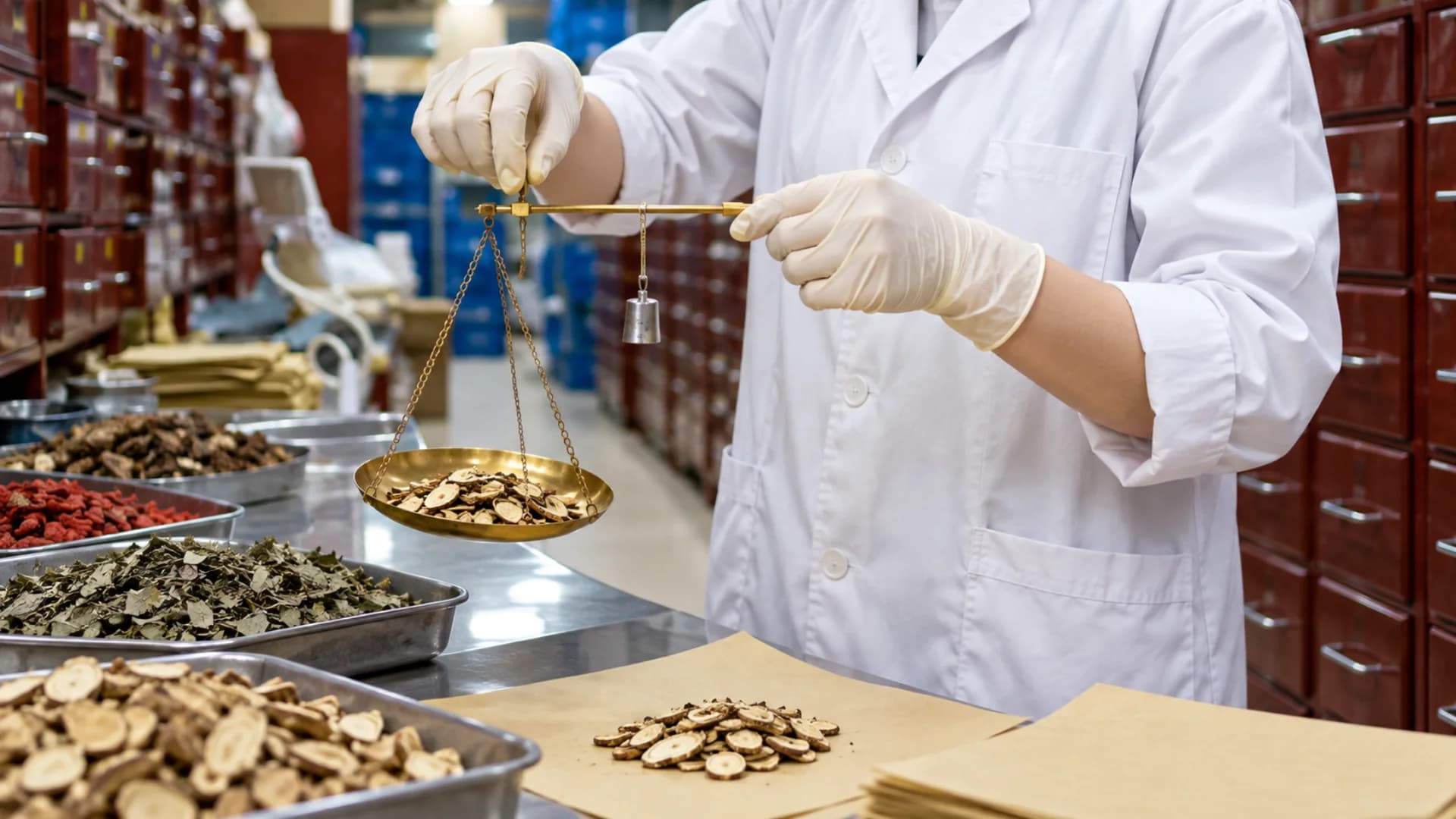
A dispensing workflow should end with an identifiable prescription, ingredients, instructions and receipt. This scene illustrates a layout; it is not evidence about a real pharmacy or the identity of any plant shown.
For a prescribed product, leave with:
- the prescription and working diagnosis;
- every ingredient name and amount, ideally with a botanical or standardized identity where available;
- preparation method, dose, route, duration and storage;
- known cautions, interactions and what reaction should stop use;
- manufacturer, batch and expiry for a packaged product;
- the institution and pharmacy contact;
- an itemized receipt.
NMPA labeling rules require regulated drug information such as ingredients, directions, adverse reactions, contraindications, precautions, batch, expiry, approval details and manufacturer as applicable to the product and label. A small package may move details to the insert. Check the exact item rather than inferring approval from traditional packaging. The NMPA public-service portal provides drug and practitioner-related queries, but a search result does not tell you that a product suits your condition.
Avoid loose “mystery powder,” decanted pills, unlabelled liquids and products whose ingredients the seller refuses to disclose. If a formula is made from weighed ingredients, photograph the prescription and packets before discarding any label. Ask whether the packet contains animal material, alcohol, allergens or ingredients that your home country restricts.
Wildlife, endangered species and customs
Traditional medicine supply chains can include plants and animal-derived materials subject to conservation law. CITES controls international trade in listed species and specified derivatives; China Customs also requires declaration or restricts certain valuable medicinal materials, animal and plant products, and endangered wildlife products. A retail receipt is not a CITES permit, an import authorization or proof that your destination country allows the item.
The safest traveler rule is simple: do not buy a product containing a threatened or unidentified wildlife ingredient. Do not accept “everyone takes it through customs” as legal advice. Check:
- the complete common and scientific ingredient identity;
- whether any part is animal-derived;
- CITES status and required export paperwork;
- China exit rules;
- transit-country and destination import rules;
- airline restrictions for liquids, powders and biological material.
When the seller cannot provide an exact ingredient list, leave it in China. This also applies to plant seeds, roots, soil-bearing material and homemade remedies. The China shopping guide explains receipts, declarations and general purchasing discipline, but it cannot clear a medicinal or wildlife product for a specific border.
Insurance: open the right case before non-urgent care
Travel policies often distinguish emergency treatment, medically necessary outpatient care, complementary treatment and elective wellness. Coverage, limits, recognized providers, pre-authorization and direct billing vary. Ask your insurer in writing rather than assuming that a hospital receipt guarantees reimbursement or that “wellness” is always excluded.
For a stable, planned consultation, ask the assistance line:
- Is this provider and service eligible under my policy?
- Do I need referral or pre-authorization?
- Is acupuncture, tuina or herbal medicine covered, limited or excluded?
- Must a registered physician prescribe or perform it?
- Does the facility bill directly, or do I pay and claim?
- Which diagnosis, itemized invoice, proof of payment, prescription and clinical notes are required?
Save the case number and the written answer. In an emergency, seek care first and contact the insurer as soon as practical. A travel-insurance operator cannot diagnose you, and a clinic's statement that “insurance will pay” does not bind the insurer.
Know when the experience is over and medical help begins
Call 120 for a medical emergency. Move from the experience venue to formal medical care for chest pain, breathing difficulty, loss of consciousness, seizure, severe bleeding, a serious allergic reaction, new weakness or paralysis, rapidly worsening symptoms, or a major injury. After a procedure, urgent warning signs include sudden chest or breathing symptoms, uncontrolled bleeding, spreading numbness or weakness, severe or increasing pain, fever, pus, rapidly spreading redness, confusion or fainting that does not promptly resolve.
Do not wait for the original operator to “balance” or repeat a procedure when you may be having a complication. Take the product package, prescription, receipt and procedure record with you. Show emergency staff exactly what was swallowed, applied or inserted and when.
The broader China safety guide lists emergency numbers and preparation. The doctor guide covers 120, emergency departments, passport registration, interpretation, payment, records and insurance in detail.
A practical half-day and a medical-day plan
For a culture-first half-day, reserve the museum through its current official channel, allow 60–90 minutes inside, join only a clearly described non-invasive activity, then have tea or lunch elsewhere. Do not book acupuncture or buy ingestible products on impulse at the exit. Photograph ingredient labels and research them later.
For a planned clinical day, choose the institution and department before leaving the hotel. Carry your passport, medication list, relevant records, insurer details and a translated clinical summary. Protect enough time for registration, consultation, payment, procedure, pharmacy and a return consultation. Avoid scheduling an invasive procedure just before a flight, long train, remote excursion or nightlife; you need time to notice a reaction and reach care. Keep the afternoon flexible and do not combine acupuncture, cupping, forceful tuina and unfamiliar herbs simply to make the visit feel comprehensive.
For a wellness afternoon, book one clearly priced service and keep the goal relaxation rather than diagnosis. Confirm privacy, practitioner gender, clothing, body areas and the right to stop. Do not let a leisure venue replace assessment of a new or worsening symptom.
Final checklist
Before a museum or workshop:
- check the current official notice, reservation and campus entry;
- ask whether anything is consumed, burned or applied;
- obtain the ingredient list and skip unidentified products.
Before clinical care:
- verify the medical institution and responsible clinician;
- bring passport, history, allergies and all medicines;
- arrange adequate interpretation;
- understand the procedure, risks, alternatives, price and aftercare;
- agree on privacy, draping and body boundaries;
- keep the medical record, prescription, itemized bill and receipt.
Before taking herbs home:
- retain original packaging and the complete ingredients;
- check interactions with your own clinician or pharmacist;
- verify CITES, China Customs and destination-country rules;
- leave unidentified wildlife, powders, roots and liquids behind.
The most useful TCM experience is the one whose category remains clear from start to finish. Learn in a museum, relax in a leisure venue, and use a qualified medical setting when you want medical care. That distinction protects both cultural curiosity and health decisions.