Chinese tea experiences: choose the product before the address
A “Chinese tea experience” can mean six very different things: sitting in an everyday teahouse, learning in a museum, joining a hosted tasting, brewing in a formal class, visiting a working tea area, or watching a staged performance with tea included. None is automatically more authentic than the others. They simply answer different travel needs.
For a first trip, the strongest low-risk choice is a museum or clearly priced hosted tasting followed by no compulsory purchase. Choose Hangzhou when you want green-tea landscape and origin questions, Chengdu for public teahouse life, Wuyishan for tea tied to mountain terrain and processing, and Chaozhou for concentrated gongfu brewing within a food-and-old-city trip. A farm or factory visit deserves a half-day and advance questions; it should not be an unplanned stop chosen by a driver.
The key is to separate drinking, learning, making and buying. You may enjoy all four, but ask which one you are paying for before the kettle appears.
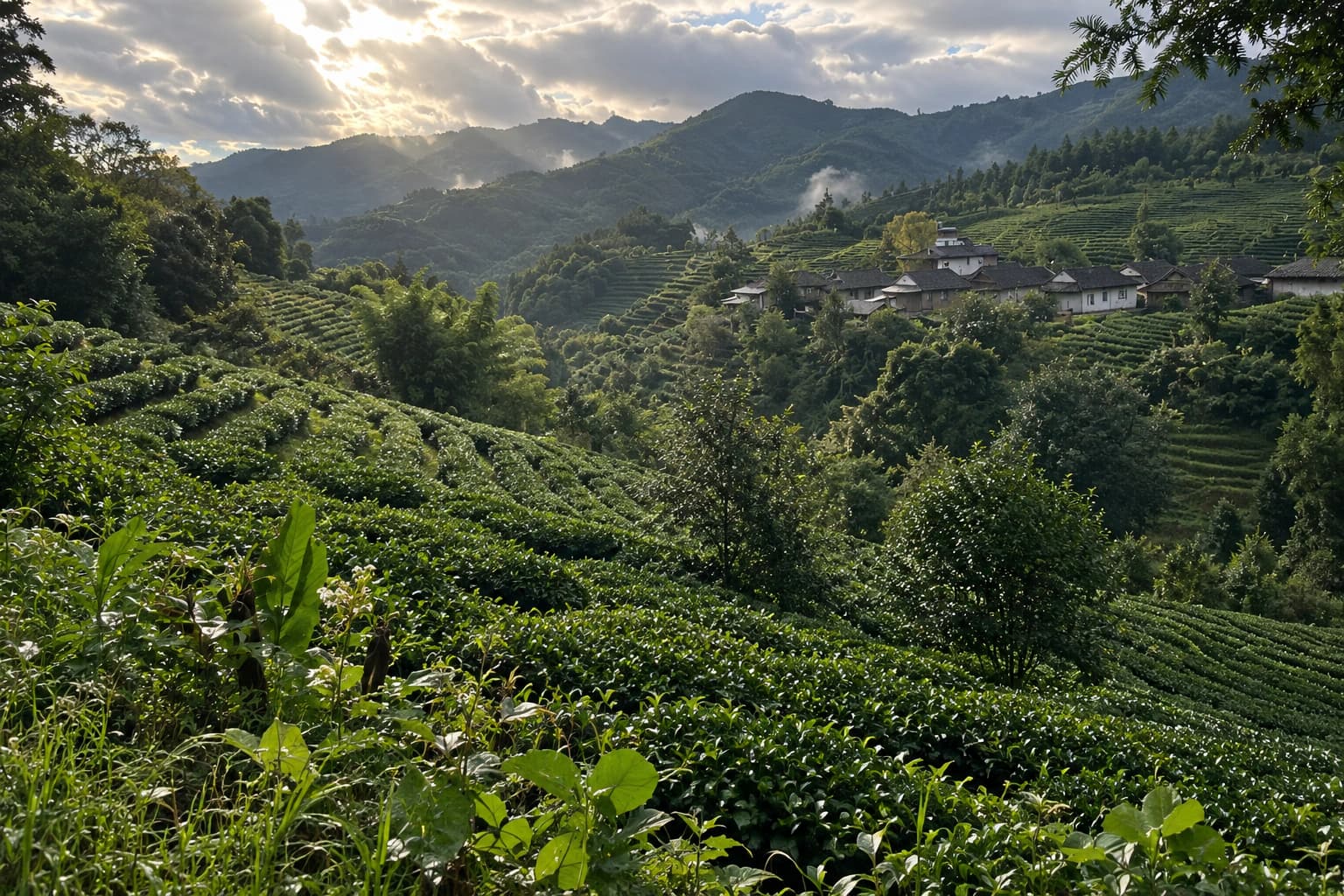
A tea landscape explains where production begins; it does not prove that a field is open to visitors or that tea sold nearby came from those rows.
The two-minute experience chooser
| Experience | What you actually do | Useful time | Best for | Ask before committing |
|---|---|---|---|---|
| Everyday teahouse | Order one tea, sit, talk and watch the room's normal rhythm | 60–120 minutes | Social atmosphere without a lesson | Tea price, refills, seat charge, smoke, noise and optional services |
| Tea museum | Learn categories, processing, utensils and regional context | 60–90 minutes | A first encounter and independent vocabulary | Which campus/exhibitions are open; whether an activity needs separate booking |
| Hosted tasting | Compare several teas while a host brews and explains | 60–90 minutes | Flavor comparison and questions | Number of teas, language, group size, total fee and whether buying is expected |
| Participatory tea class | Prepare tea yourself with guided technique | 90 minutes–3 hours | Travelers who want a skill, not only a drink | Hands-on minutes, tea and equipment used, historical claims, take-home items and sales time |
| Farm or production visit | Reach a growing area, see or try seasonal work, then taste | Half or full day | Origin, agriculture and processing depth | Transfer, walking, harvest status, weather, factory access, safety, inclusions and retail finish |
| Performance package | Watch a choreographed tea service, cultural excerpts or themed show | Fixed session | Visual entertainment and an easy group activity | Exact program, seat, drink included, duration, language and cancellation policy |
If the description uses only “tea ceremony,” ask for the actions in plain language. Will I brew? Will I watch? How many teas will I taste? How long is instruction? Is there a shop visit? Those answers reveal the product better than an elegant title.
There is no single Chinese tea ceremony
China's tea traditions are regional, social and practical. The UNESCO-listed element, inscribed in 2022, covers plantation management, leaf picking, manual processing, drinking and sharing. It describes six broad tea categories—green, yellow, dark, white, oolong and black—plus reprocessed teas such as flower-scented tea. It does not define one national choreography that every teahouse follows.
A Chengdu gaiwan at a bamboo chair, a Chaozhou gongfu session with small cups, a Hangzhou glass of Longjing and a Wuyishan rock-tea tasting can all be culturally meaningful. The vessel, leaf quantity, water temperature, infusion rhythm and social purpose differ. Treat “traditional” as the start of a question: traditional to which place, tea and community?
Modern classes also have value. A carefully designed session may use contemporary furniture, bilingual teaching and a simplified sequence. That does not make it fraudulent. The problem begins when a modern performance is sold as an unchanged dynasty ritual, or when atmosphere replaces a clear explanation of the tea, teaching and price.
Choose the region by the experience you want
Hangzhou: museum, landscape and buying literacy
Hangzhou is the strongest first choice when you want tea history, green hills and one practical lesson about origin. The useful sequence is China National Tea Museum → public tea landscape → one deliberate tasting. The official museum site confirms two campuses: Shuangfeng at 88 Longjing Road and Longjing at 268 Wengjiashan. They are different addresses; a search result for “tea museum” does not prove which entrance, exhibition or activity you have found.
Use the complete Longjing tea route for the museum–fields–village plan. Starting at the museum gives you vocabulary for processing and provenance before a scenic terrace becomes a sales setting. Walking through tea landscape is worthwhile even if you buy nothing.
Hangzhou also demonstrates why a place name is not enough. “Longjing” can be used loosely in tourist conversation, while protected-origin claims depend on defined production, processing and labeling systems. A 2025 market-regulation update describes standards, traceability and enforcement against false claims. As a visitor, look for the precise origin statement, producer, net weight, production details and applicable geographical-indication or traceability label. Do not try to prove authenticity from leaf color, a village courtyard or a high price alone.
Allow: half a day for museum plus one landscape/tasting block; a full day if paired with Lingyin. Cut: a second village or multiple shops. Do not: let a taxi or driver replace your chosen museum with an unnamed “tea center.”
Chengdu: an ordinary teahouse as social time
Choose Chengdu when the main experience is sitting, refilling and observing public life rather than studying origin. A park teahouse can be noisy, conversational and slow. The tea supports the time; it is not always the object of a formal tasting.
The dedicated Chengdu teahouse and mahjong guide compares People's Park, neighborhood courtyards, performance venues and private beginner mahjong sessions. It also explains gaiwan ordering, optional services, smoke and how to avoid treating a resident table as an invitation.
For the national decision, one rule is enough: go to Chengdu for the teahouse, not to collect tea shops. Give a well-chosen venue 60–90 minutes. Do not schedule a formal tasting immediately after it unless the comparison itself matters to you.
Wuyishan: terrain, rock tea and production depth
Wuyishan makes sense when tea is one part of a mountain trip. The landscape, cliff-side plots, processing knowledge and brewed result can be understood together. The Wuyishan destination guide separates the managed scenic areas, Nine-Bend River rafting, tea and the optional evening show; the three-day mountain–river–tea plan protects enough time for each.
Do not compress Wuyishan into a same-day “Dahongpao tea ceremony” stop. A scenic tea path, a producer's processing space, a hosted rock-tea tasting and the Impression Dahongpao performance are four different products. The current Fujian standard for traditional Wuyi rock-tea processing treats it as a multi-stage technical practice, which is a useful reality check against ten-minute “make your own tea” claims.
Allow: two nights for mountain plus one tasting; three nights when tea production is a core interest. Cut: the production visit if its access, host and transfer remain vague. Keep: one unhurried tasting after the landscape, when you can still ask questions.
Chaozhou: small cups, concentrated brewing and food
Chaozhou is the best fit when you want gongfu tea as part of a living food culture. Build the day around the Chaozhou old city and Paifang Street, a real meal and one clearly scoped tea session. The strength is concentration: tea can sit naturally between lanes, craft, temple courtyards and dinner rather than requiring a separate rural expedition.
Ask whether the host will explain warming vessels, leaf quantity, short infusions, fragrance and small-cup service, and whether you will brew. A 2024 Chaozhou government account describes those elements in an official exchange program; that one-off event does not create a daily public timetable.
The city government has identified two small non-state tea-culture museums: Phoenix Dancong Tea Museum outside the old city and Chaofu Gongfu Tea Culture Museum at 10 Zaifu Lane. Because current public hours and booking access need direct confirmation, treat them as leads, not guaranteed walk-ins. In the old city, a pre-agreed tasting often fits the route better than a speculative long transfer to Phoenix.
Allow: two hours for a hosted session or one relaxed tea pause within a full old-city day. Cut: a remote plantation extension on a short first visit. Add Phoenix: only when Dancong production is a trip priority and the current host, transport and access are confirmed.
Pu'er and southern Yunnan: a specialist production extension
Choose Pu'er when a farm or production visit is the reason for traveling, not a convenient extra. A rural experience may combine a road transfer, tea fields, picking instruction, hand processing or cake pressing, tasting and a final shop. Rain, harvest stage and current production work can change what is possible.
Ask the operator to separate demonstration from commercial production. Confirm whether the field is actually part of the producer's operation, whether visitors may pick, which steps are hands-on, whether equipment is shared, how long each step takes, and whether you take home the material you worked on. A souvenir cake made during a class is meaningful; it is not automatically a verified old-tree or protected-origin product.
Allow a half-day after reaching Pu'er, not “one hour including transfer.” Keep the activity refundable or movable in heavy rain. If the experience ends with a tasting, decide your maximum purchase before departure.
Beijing or Shanghai: choose access over origin
If you are not visiting a tea-producing region, a good urban museum program, specialist tasting or private class can still be the right choice. Beijing and Shanghai are useful for bilingual instruction, controlled indoor conditions and fitting tea into a larger city itinerary. They are weaker for making landscape or harvest claims.
Ask for the named teacher or host, language, address, class size and what you will do. Avoid adding a cross-country tea detour merely to satisfy an abstract idea of authenticity. A focused urban class can teach more than a rushed village sales stop.
A class is only useful when the booking describes participation
Before paying for a tasting, class or performance, obtain written answers to these questions:
- Is this a tasting, hands-on brewing class, farm visit, factory visit or performance?
- How many minutes are instruction, participant brewing, free drinking and shopping?
- Which teas are included, and may the selection change?
- What language does the host actually teach in?
- What is the maximum group size? Is the quoted price private or shared?
- Does every participant have a gaiwan or pot, or does one host brew for everyone?
- Are transport, entry, equipment, protective clothing, snacks and take-home tea included?
- Is tasting linked to a minimum purchase or sales presentation?
- What are the cancellation rules for rain, harvest changes, illness or late arrival?
- May guests photograph or record, and are other participants protected from close filming?
- For a farm, what walking surface, steps, heat, mud or factory hazard should you expect?
- For a historical theme, which parts are documented practice and which are modern presentation?
A host who cannot promise a particular harvest can still offer a good visit if the fallback is clear: indoor processing explanation, stored leaf comparison or guided tasting. A host who refuses to describe the product before payment is a poor choice.
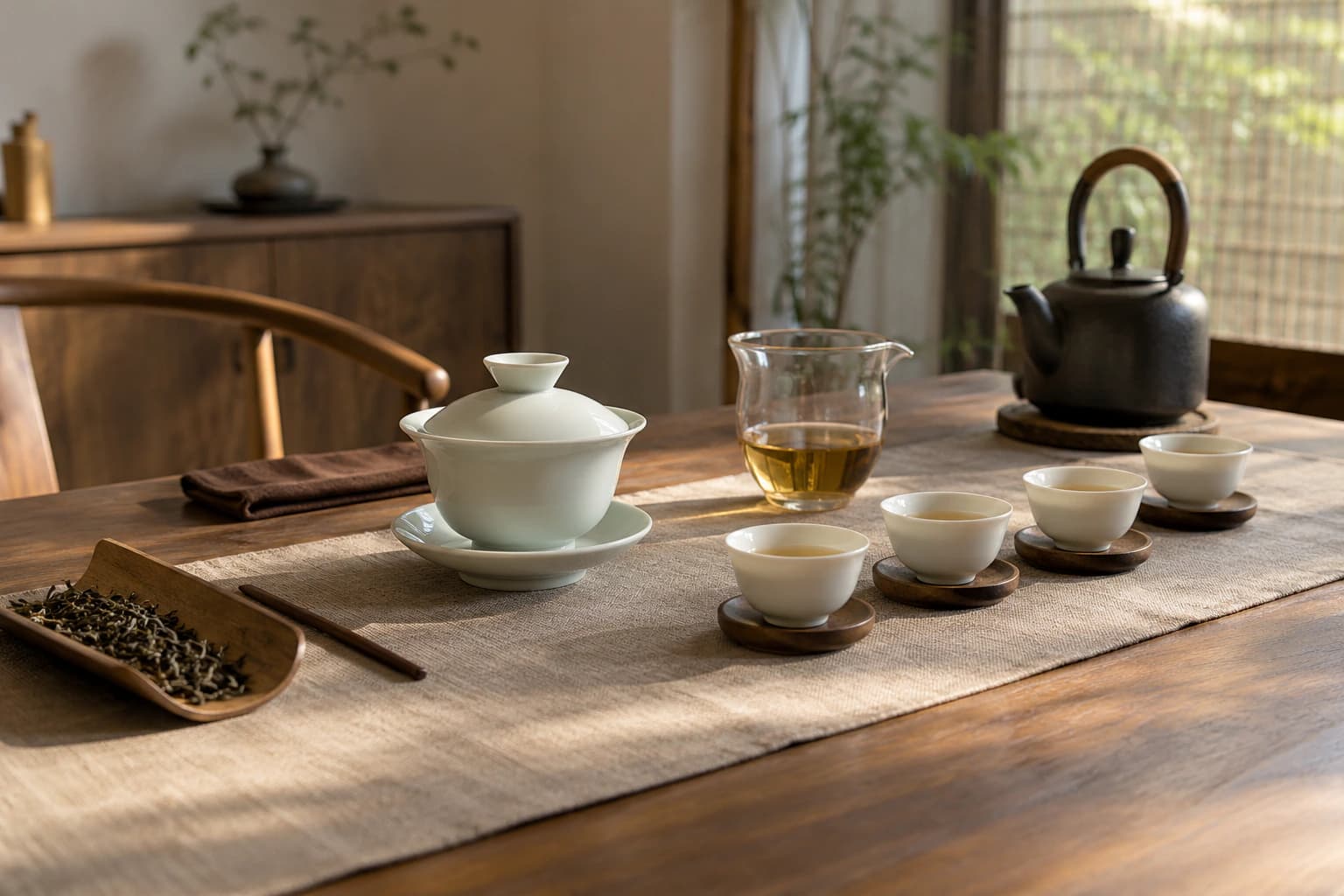
A hosted table can support tasting or instruction. Confirm whether you will brew, how many teas are included and when any retail conversation begins.
Tea-table etiquette without performing a script
You do not need to imitate every gesture. Watch the host, handle hot vessels slowly and ask when unsure.
- Wait for the host to indicate a cup. In a formal session, several cups may serve different teas or purposes.
- Accept a small pour. Multiple infusions are normal; a small cup does not mean poor value.
- Smell before or after drinking when invited. Do not assume every cup is an aroma cup.
- Keep perfume and strongly scented hand cream away from a serious tasting. They can dominate aroma for the whole table.
- Do not touch dry leaves or shared utensils without invitation. A production sample may need to remain uncontaminated.
- Ask before photographing the host, workers, private home, process sheet or other guests. A tea farm is a workplace, not an open portrait set.
- Decline another infusion plainly. Leaving a little tea or saying you have had enough is better than forcing yourself to finish.
Tea generally contains caffeine, with the amount changing by leaf, portion and brewing. If caffeine, pregnancy, medication or another health issue matters, obtain appropriate medical advice and tell the host your practical limit. “Low caffeine” is not the same as caffeine-free. An herbal infusion is a different product, even when a menu calls it tea.
Useful phrases:
- 这是品茶、茶艺课,还是表演? — Is this a tasting, a tea class or a performance?
- 我可以自己泡吗? — May I brew it myself?
- 一共喝几种茶? — How many teas will we taste in total?
- 课程包括买茶吗? — Does the class include a tea purchase?
- 我只想体验,今天不买茶。 — I only want the experience; I will not buy tea today.
- 请少一点,谢谢。 — A smaller amount, please.
How to taste without being pushed into a purchase
A tasting creates hospitality; it does not create a debt. Decide before sitting whether you are open to buying, and say so. If buying is possible, set a total budget and start with a small sealed quantity.
Use this order:
- Ask what the tea is before the story grows. Region, specific origin claim, tea type, cultivar if relevant, harvest or production year, and grade should be stated separately.
- Ask for the selling unit. Prices may be quoted per gram, 50 g, 100 g, 500 g or one
jin(斤, 500 g). Repeat the total package weight and total price. - Compare the exact product. Confirm that the sealed package contains the same named tea and grade you tasted.
- Inspect the label and seller. Look for producer/business identity, net content, applicable standard, production/best-before information, storage and origin claim. A gift box is not traceability.
- Get an itemized receipt and written return policy. A spoken promise is difficult to use after leaving the city.
- Pause. Photograph the label for your own comparison, leave, and buy later if the decision still feels good.
Do not negotiate a prestige tea from an undefined opening price. If you cannot evaluate the claim, reduce the quantity rather than trying to win the bargain. Avoid bank transfers to an unrelated personal account, off-route shops selected by a driver, and shipping arrangements without a trackable order and recipient details.
Useful buying phrases:
- 这个价格是多少克?总价多少? — How many grams is this price for, and what is the total?
- 产地、年份和等级写在哪里? — Where are the origin, year and grade written?
- 包装里是刚才喝的同一款吗? — Is the package the same tea we just tasted?
- 可以先买小包装吗? — Can I buy a small package first?
- 请给我小票和退换货说明。 — Please give me the receipt and return/exchange terms.
- 谢谢,我再考虑一下。 — Thank you; I will think about it.
No national “fair price” table would be honest. Origin, harvest timing, cultivar, processing, storage, grade, package and seller service can all change price. Transparent units and a modest first purchase protect you better than a universal number.
What a farm or production visit should show
Fresh leaf is only the beginning. Different tea categories use different sequences of withering, fixing, rolling, oxidation, drying, roasting or aging. A visitor activity may simplify one step for safety and time. Ask the host to identify what you are doing, what professionals do differently, and whether the material is a demonstration batch.
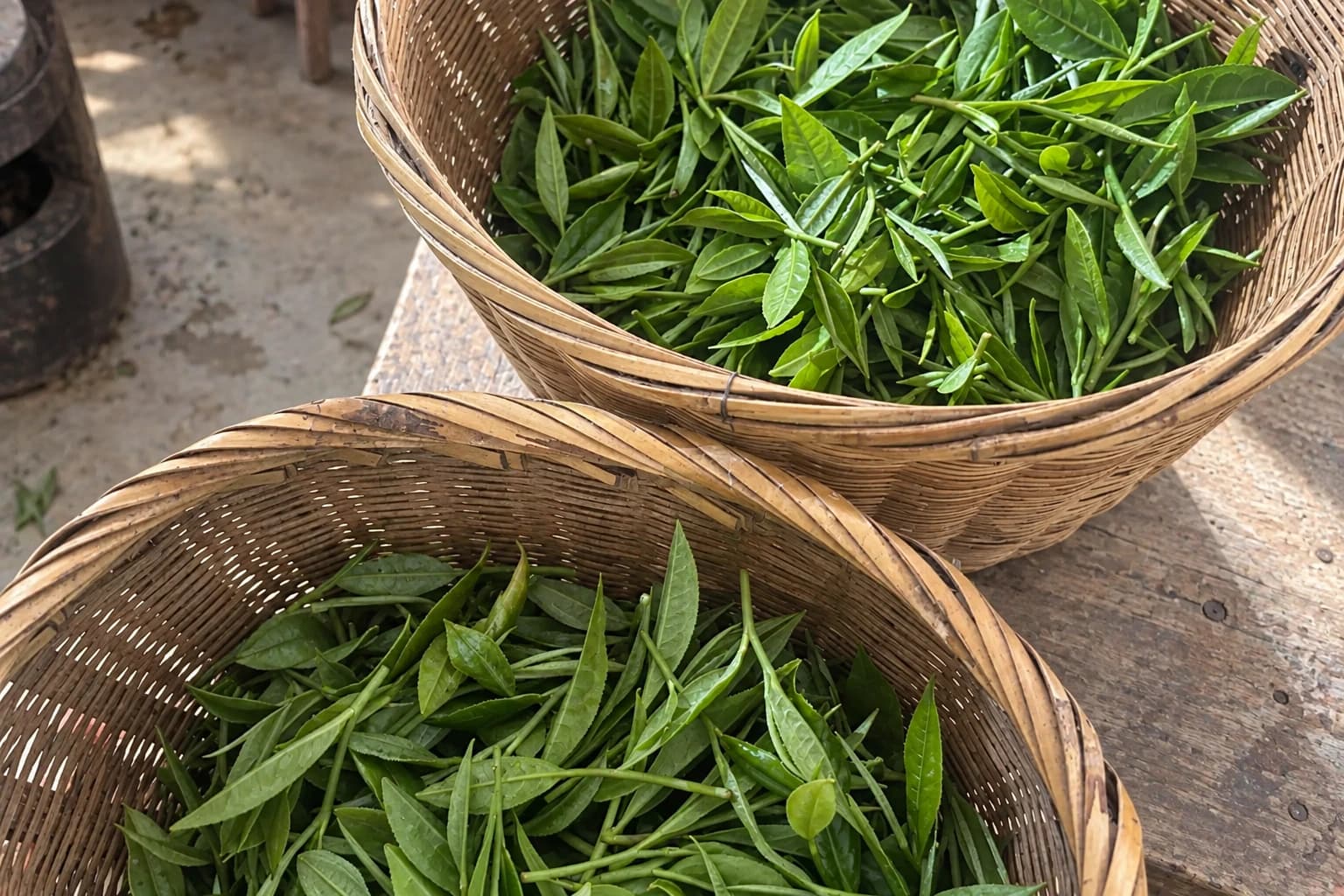
Fresh leaves make the production side visible, but they do not identify cultivar, origin, harvest standard or final tea category by themselves.
The best production visit answers four questions:
- Place: why does this terrain or climate suit the tea?
- Leaf: which plant material is being picked, and what selection standard is used?
- Process: which transformation creates the tea's category and style?
- Cup: how can you recognize the processing choices in aroma, body and finish?
Picking is seasonal. A provider should never manufacture a harvest for photographs or allow visitors to strip working bushes without instruction. Stay on public or host-approved paths, wear shoes for wet soil, keep away from hot pans and moving equipment, and do not assume children can enter a processing room.
Performance packages: enjoy the show, read the label
A long-spout pour, costume, music or “Song-style” setting can be an enjoyable visual program. Book it as a performance unless the itinerary includes real participant instruction. The title of a dynasty or heritage form does not prove that every gesture, costume and object is a historical reconstruction.
Check whether the package includes a complete named production, short cultural excerpts, an emcee-led demonstration or simply tea served during another show. Ask whether your ticket includes a drink, whether seats are assigned, and whether photography is permitted. If learning is the goal, choose a smaller class with individual equipment. If entertainment is the goal, choose the stronger program and stop judging it as a quiet tasting.
Children, older travelers and access
Tea activities can be calm but involve boiling water, breakable vessels, low seating and long concentration. For a child, ask whether the provider offers warm rather than boiling practice water, one-to-one handling, a shorter session and a clear minimum age. Keep small hands away from kettles, burners and automatic equipment.
For an older traveler or wheelchair user, ask about vehicle drop-off, field gradients, steps, toilet access, chair backs and the length of floor seating. A museum or urban tasting may deliver more learning with less physical strain than a farm. A picturesque old room can have thresholds and narrow passages; a modern class can be more accessible without being less meaningful.
Food allergies also matter. Tea sessions may include nuts, sesame, dairy, gluten-containing pastries or preserved fruit. Ask about snacks separately from the tea. Do not treat a host's assurance that something is “traditional” as an allergen list.
Packing, shipping and border checks
Dry, commercially packaged tea is easier to carry than liquids, fresh leaves or homemade food. Keep the original sealed label and receipt, protect the package from moisture and strong odors, and place fragile teaware in hand luggage only when airline security rules permit.
Your destination country's plant, food and customs rules control import. A seller's statement that “everyone takes it abroad” is not clearance. Check the relevant customs authority before buying loose tea, fresh leaves, seeds, wooden gift boxes or high-value quantities. If shipping, confirm carrier, declared contents, tracking, duties and what happens if the parcel is refused.
Do not put freshly processed or still-warm tea straight into an airtight travel bag without the producer's storage instruction. For valuable tea, ask for the exact storage conditions in writing.
Three routes that use tea without letting it take over the trip
One free afternoon in a major city
Choose one reputable museum, hosted tasting or everyday teahouse within 30 minutes of your main route. Allow 90 minutes plus transport. Do not combine a museum, class and shop unless they are one transparent program. This is the right plan in Beijing or Shanghai and a good fallback in rain.
One tea-led day in Hangzhou or Chaozhou
In Hangzhou, use the Shuangfeng museum, tea landscape and one tasting. In Chaozhou, use the old city, one substantial meal and one gongfu session. Both days teach tea, but Hangzhou emphasizes origin and landscape while Chaozhou emphasizes brewing and social food culture.
A two- or three-night specialist chapter
Choose Wuyishan for mountain landscape, rock tea and a structured destination route. Choose Pu'er for a verified farm/production visit with rural transfer. Protect a weather-flexible half-day, keep one tasting independent from shopping, and leave time to compare what the landscape promised with what the cup delivers.
Final check before you sit down
Your plan is ready when you can answer seven questions:
- Which experience type have you chosen?
- What will you personally do, and for how long?
- Which tea, host, language and group size are confirmed?
- What is included in the total price?
- Can you complete the experience without buying tea?
- If you may buy, are the unit, origin claim, label, receipt and return terms clear?
- Does the route still work if a harvest, outdoor field or performance changes?
Tea becomes a better travel experience when it stops being a vague symbol. Choose one concrete job—social time, learning, brewing, production or performance—then give it enough time to unfold. The cup will make more sense, and the invitation to buy will be much easier to evaluate.