Shanxi ancient architecture route: 7, 9 or 10 days
Shanxi rewards travellers who want to understand old buildings rather than collect old-looking backdrops. In one province you can compare a cave-temple landscape, Liao–Jin urban monasteries, a towering timber pagoda, Tang-period halls in rural Wutai County, Jinci's layered ritual landscape, Pingyao's city fabric and temples filled with painted sculpture.
The route only works when you respect its geography. Make Datong the northern base, use a hired vehicle for the county sites, treat Taiyuan as a transport and interpretation hinge, and finish in Pingyao. Seven days gives you the northern and central essentials. Nine days earns the Wutai County timber halls. Ten days lets you look slowly rather than converting a rare building into a twenty-minute photo stop.
If a game-first pilgrimage is your real motive, use the Black Myth: Wukong Shanxi route. This guide ranks stops by architectural, sculptural and mural value, access reliability and route geometry; it does not repeat game-location evidence.
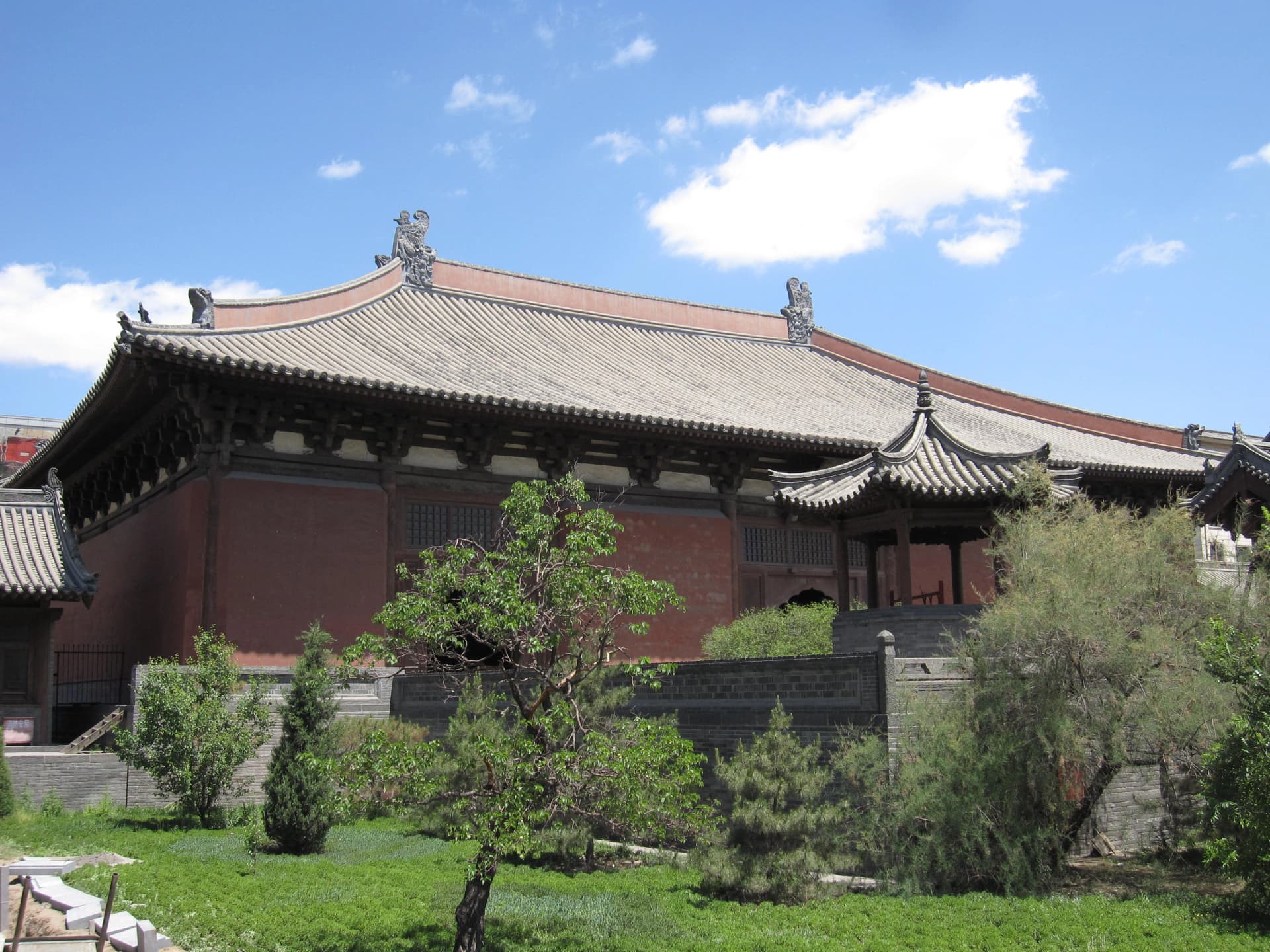
The Daxiong Hall at Shanhua Temple is a useful first lesson in reading roof mass, bracket work and courtyard sequence. Photograph by Angus Cepka / Wikimedia user Zeus1234, CC BY-SA 3.0.
Choose the trip before booking the sites
| Time | Overnight bases | Hotel changes | Best for | Deliberate omission |
|---|---|---|---|---|
| 7 days / 6 nights | Datong 3 → Taiyuan 1 → Pingyao 2 | 2 | First-time visitor who wants the strongest range with rail between bases | Foguang and Nanchan; choose Hunyuan or Yingxian |
| 9 days / 8 nights | Datong 3 → Wutai County 2 → Taiyuan 1 → Pingyao 2 | 3 | Architecture-focused traveller with a licensed driver for county transfers | One Pingyao outer temple may still need to be cut if conservation or departure time intervenes |
| 10 days / 9 nights | Datong 3 → Wutai County 2 → Taiyuan 1 → Pingyao 3 | 3 | Slow looking, separate Shuanglin and Zhenguo visits, and a real weather buffer | Taihuai's central Wutai Mountain cluster remains optional rather than forced |
Arrive in Datong and depart from Taiyuan or the most useful onward rail hub. You can reverse the route, but preserve the night blocks. A late arrival followed by an early county drive is a poor first day, and a rural temple followed by an unprotected flight is a poor last one.
The seven-day version is the honest minimum. Current visitor reports repeatedly show that a compact Taiyuan–Pingyao–Datong trip already feels full. Adding Wutai County because two more temple names fit in a spreadsheet creates long road days, meal problems and very little time to study the buildings.
How to look at the architecture without needing a degree
Use four questions at every stop.
- What exactly is old? A hall may have an early structural core, later roof work, repainted surfaces, replaced fittings and sculptures from another period. Read the on-site panel and the dedicated guide before assigning one date to everything you see.
- How does the frame carry the roof? Stand far enough back to see the building's width, roof profile and bracket layers. Then move closer to compare column spacing, bracket sets, eaves and the meeting of timber and infill wall.
- How do sculpture and mural belong to the room? Painted figures are not museum objects placed against neutral walls. Their scale, sightline, light and arrangement were designed for a ritual interior. If the hall is open, look from the permitted threshold before reaching for a camera.
- What is the conservation boundary today? Scaffolding, a rope or a dark hall is part of the current visit. It does not justify stepping over a barrier or aiming a lens through a prohibited opening. Record what was actually visible, not what an old blog promised.
This method prevents period confusion and makes even a partial opening worthwhile. A closed interior can still leave a courtyard sequence, roof structure or exterior material to study. Conversely, a famous date alone does not make a rushed stop meaningful.
Seven days: the strong first architecture route
Day 1 — Datong old city: Shanhua before Huayan
Finish the day in Datong. Drop luggage before starting. Begin at Shanhua Temple, where the courtyards and major halls give you a readable introduction to Liao–Jin architecture. Allow 60–90 minutes. Walk the central sequence once without trying to photograph every roof, then repeat the most interesting section and compare the bracket work from near and far.
Continue to Huayan Temple only if the live last-entry time leaves a comfortable margin. Huayan adds a different spatial and sculptural experience; it should not become a second rushed ticket. If arrival is late, do Shanhua properly and keep Huayan for the next evening.
Stay near Datong's old city for three nights. It gives you restaurants, a short first-day walk and simpler departures than changing hotels for each northern excursion. Compare Datong hotels on Trip.com after checking the exact pickup arrangement with any driver.
Day 2 — Yungang as cave architecture, not a photo corridor
Finish the day in Datong. Give Yungang Grottoes the full outward block. Cave access can change for conservation, so the current open-cave notice matters more than a saved itinerary. Carry the passport used for the reservation and leave enough time for the staffed document process.
Look at the sequence from cliff and forecourt to cave interior. Scale, excavation depth, column-like rock forms, sculpture and later painted surfaces work together. A three-hour focused visit after entry is more useful than racing through every open doorway. Check the exact Yungang listing on Trip.com, then let the official timed admission and same-day cave list control.
Do not add Yingxian or Hunyuan after Yungang. Both require another road corridor, and cave art is visually dense. A quiet evening in Datong preserves attention for the next day.
Day 3 — choose Hunyuan or Yingxian
Finish the day in Datong. This is the seven-day route's main choice.
Choose Hanging Temple when cliff construction and the relationship between architecture and terrain matter most. General scenic entry and the narrow, capacity-controlled climb are separate decisions. The exterior gives the full composition and is the correct choice for vertigo, limited mobility, severe wind, a sold-out climb or a queue that would consume the visit. The climb gives close structural experience but involves exposed, constricted circulation. Check the authorized overseas listing on Trip.com, and carry the original passport even when you intend only to view from below.
Choose Yingxian Wooden Pagoda when a complete timber monument matters more than a cliff setting. Visitors do not climb the pagoda under current conservation rules. Give the exterior 60–90 minutes: circle it, compare the repeated roof levels and bracket bands, and observe how the vertical mass changes with distance. Add nearby Jingtusi only if access is confirmed that day.
A hired vehicle can connect Hunyuan and Yingxian in one long day—the current map model gives roughly 56.4 km / 53 minutes by car between the two pins—but that number excludes climb-ticket uncertainty, queues, lunch and slow looking. The seven-day plan chooses one. The other returns in the nine-day route.
Day 4 — rail to Taiyuan, then one interpretive institution
Finish the day in Taiyuan. Use a train from the correct Datong station to the correct Taiyuan station; search by station name rather than city alone. The fastest result is not useful if the hotel transfer erases the saving. Compare exact train numbers and stations on Trip.com.
After luggage drop, choose Shanxi Museum for province-wide chronology or the Northern Qi Mural Museum for a narrower burial-art focus. Check the live gallery and reservation status. Do not schedule both after a transfer: the purpose of this afternoon is to give names and chronology to what you have already seen.
Day 5 — Jinci, then move to Pingyao
Finish the day in Pingyao. Start at Jinci. It is a layered landscape, not a single hall: water, bridges, ritual axes, old trees, sculpture and successive architectural periods need at least half a day. The published window can change seasonally; check the current historic-core entry and last admission before committing to the onward train.
Check the exact Jinci product on Trip.com, then arrange luggage so it does not travel through the complex with you. Leave it at the hotel, in a confirmed staffed facility or in the prebooked vehicle that will take you onward; returning across Taiyuan only to collect bags wastes the route's southward momentum. Book Pingyao Gucheng only if it is the correct station for the chosen train and hotel; Pingyao Station and Pingyao Gucheng are different arrival points.
Day 6 — Pingyao as an urban system
Finish the day in Pingyao. Pingyao Ancient City is the route's urban-architecture day. Public streets and the paid monument product are separate. Choose one north–south or east–west street spine, then examine how courtyard institutions, shopfronts, walls, gates and narrower residential lanes fit together.
Do not turn the multi-site ticket into a completion challenge. Select a financial-history courtyard, one civic or defensive structure and ordinary streets between them. Vehicle restrictions and uneven paving make straight-line map estimates misleading. Sleep inside or immediately outside the wall according to luggage tolerance, not according to a generic “best hotel” list.
Day 7 — Shuanglin or Zhenguo, then depart
Finish at your departure station with a protected buffer. Choose Shuanglin Temple for painted sculptural ensembles. It is outside the wall and uses a separate admission. Current map planning gives about 8.5 km / 20 minutes by car from the broad ancient-city pin; walking takes far longer and is not the sensible default before a train.
Choose Zhenguo Temple (镇国寺) for timber-hall history and a quieter outer complex. Use the exact Zhenguo AMap pin. It is about 16.4 km / 30 minutes by car from the ancient-city pin in the no-live-traffic model. Mapped transit takes substantially longer and includes walking.
Conservation is decisive in 2026: published work semi-closes Shuanglin's Thousand Buddha Hall into 2028 and Zhenguo's Ten Thousand Buddhas Hall into 2027. Other areas can remain open, but do not book the day for one promised sculpture or interior. Confirm the visible halls and photography rules shortly before travel. If the result is too limited, spend a deeper morning in Pingyao and protect the train.
Nine days: add the county timber halls without backtracking
The nine-day route keeps Days 1–3 in Datong but uses both northern road corridors and continues south rather than returning to the same base.
Day 4 — Yingxian Pagoda to Wutai County
Finish the day in Wutai County, outside the Taihuai scenic core. If Day 3 was Hunyuan, visit Yingxian early today. If Day 3 was Yingxian because Hanging Temple access failed, use the morning for a confirmed Hunyuan exterior visit or a Datong fallback, then continue.
The drive from Yingxian to the Wutai County bus-station anchor is roughly 148.6 km / 2 hours 50 minutes in current no-live-traffic planning. This is a one-monument transfer day. Agree in writing on legal pickup, waiting, tolls, luggage, meal stop and final hotel. Arrive before dark; rural night navigation is not the place to discover that two hotels share a similar Chinese name.
Day 5 — Foguang and Nanchan as a dedicated road day
Finish the day in Wutai County. Start with Foguang Temple. Its value is not one date on a sign: read the East Main Hall on raised ground, the broad roof and bracket scale, the surviving timber surface, and whatever interior view current conservation allows. The current map model puts it about 32 km / 39 minutes by car from the county bus-station anchor.
Continue to Nanchan Temple (南禅寺) only with a confirmed driver or a public heritage-line timetable that genuinely works. The temples are 46.2 km / about 1 hour 01 minutes by car apart, and the route search returned no useful ordinary public-transit plan. Use the exact Nanchan AMap pin. County authorities have reported heritage bus routes serving the two sites, but a launch notice is not today's departure board. Confirm the stop, service day and last return.
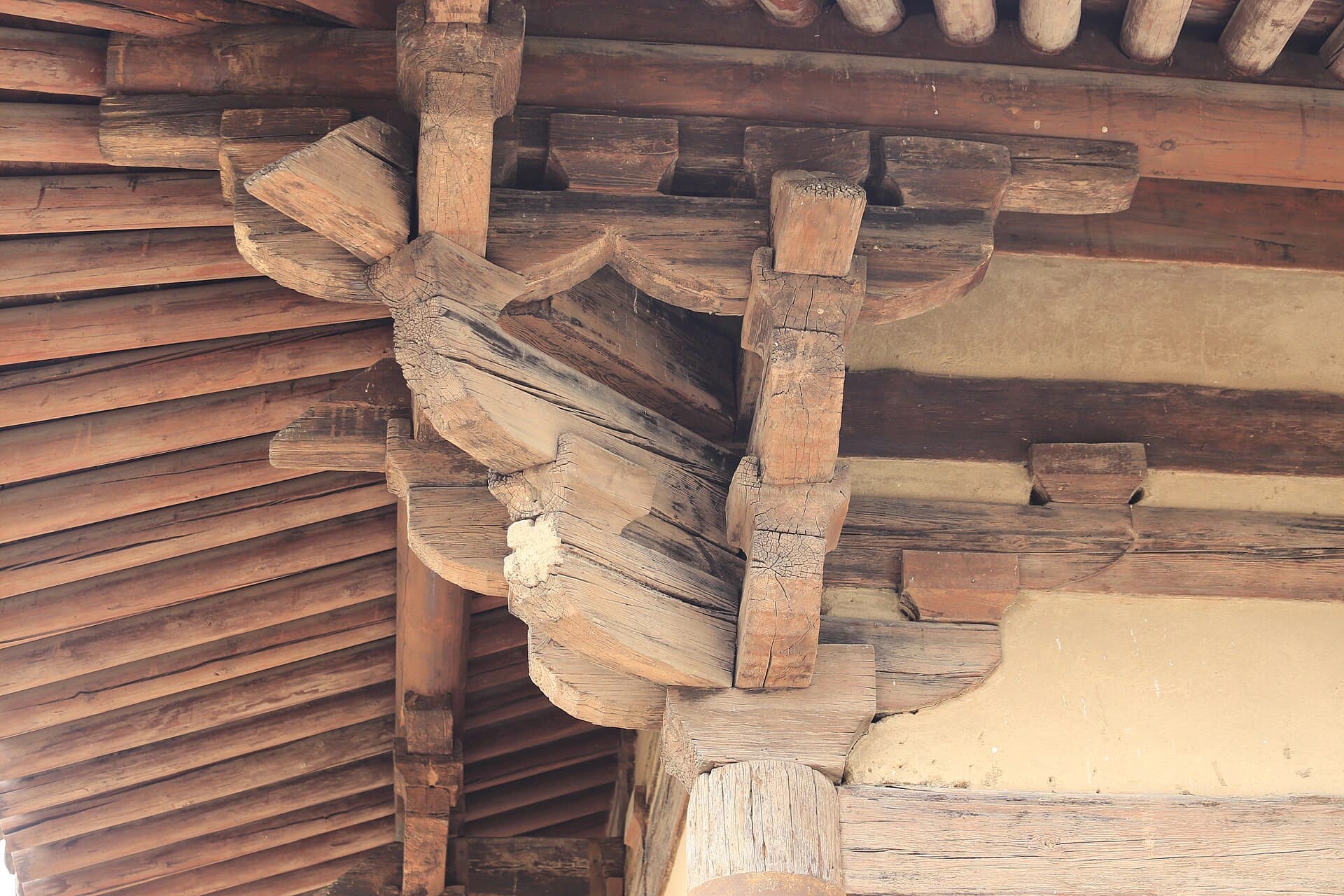
A close view of Nanchan's timber brackets shows why a county-temple day needs time for material and structural detail. Photograph by Zhangzhugang, CC BY-SA 3.0.
Do not imitate the most compressed five-temple charter loops. A recent visitor report described a seven-hour loop with no meal break. It may be efficient transport, but it is poor architectural study. Pack water and a simple lunch, use toilets when available, and give the two primary halls the day. Secondary temples belong only after their access is confirmed and both main visits remain unhurried.
Days 6–9 — Taiyuan and Pingyao
Day 6 finishes in Taiyuan: travel from Wutai County, then use only a museum or a rest afternoon. Day 7 finishes in Pingyao: visit Jinci, collect luggage and move by rail. Day 8 finishes in Pingyao: study the walled city. Day 9 finishes at the departure station: choose Shuanglin or Zhenguo.
This structure has three hotel changes, but each change advances the route. Returning from Foguang to Taiyuan as a day trip would put roughly two hours of driving on each side before local access and would still leave Nanchan awkwardly placed.
Ten days: separate the conservation-sensitive ending
The best tenth day is not another city. Keep the nine-day route through Day 8, then give the two Pingyao outer temples separate mornings.
Day 9 — Shuanglin: arrange a car from Pingyao after breakfast, spend 90–150 minutes according to current hall access, and return for a quiet afternoon inside the city. Painted sculpture rewards comparison across groups, expressions, scale and sightlines. Flash, tripods and interior photography may be restricted; the rule on the hall controls.
Day 10 — Zhenguo: use a driver and the verified pin. Shuanglin to Zhenguo is about 19.6 km / 27 minutes by car in the current model, so a single charter could combine them physically. Separate days are better while both complexes have conservation limits: if one site's visible core is reduced, you still have time to adjust rather than forcing a fixed loop.
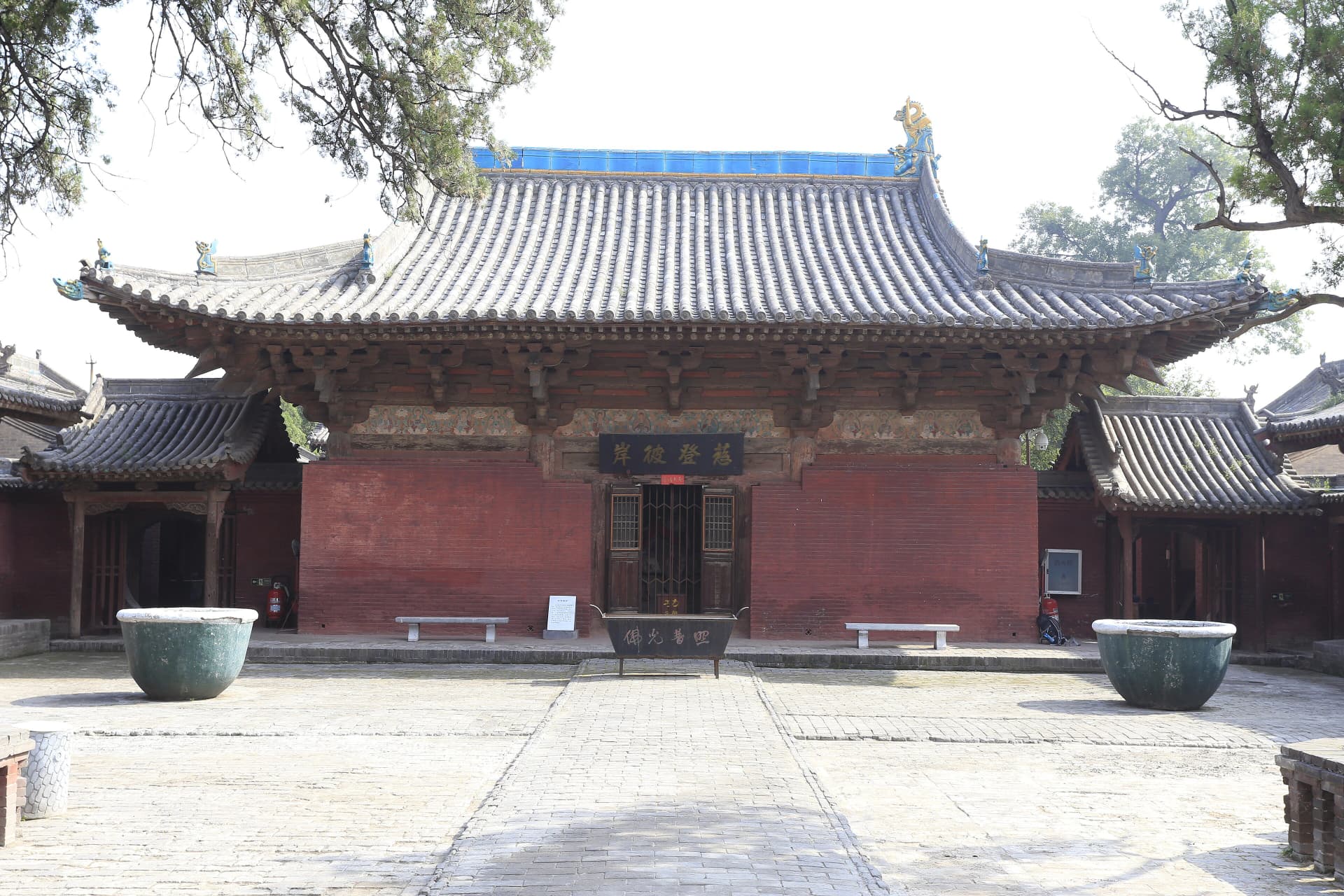
Wanfo Hall's timber mass is visible in this documentary photograph, while current conservation work may change the accessible view. Photograph by Zhangzhugang, CC BY-SA 3.0.
If sacred landscape matters more than the Pingyao finish, use Day 6 for a restrained Taihuai temple cluster and move Taiyuan/Pingyao one day later. That variant adds mountain access rules and another geographic focus. It is not the default architecture route because Foguang and Nanchan are county temples, not walkable extensions of central Wutai Mountain.
Driver, public transport or self-drive?
Use rail between Datong, Taiyuan and Pingyao. Use a licensed driver or charter for Hunyuan, Yingxian and especially the Wutai County temple day. Public buses can work for a single county stop, but they need live confirmation and should not be the invisible foundation of a two-temple day.
When hiring a vehicle, confirm these points before payment:
- the exact Chinese names and map pins, not just “Wutai temples”;
- pickup hotel, departure time and planned finish city;
- whether the driver waits through the visit;
- tolls, parking, driver meal and overtime;
- where luggage remains while you are inside;
- the cancellation plan for wind, rain, road control or a temporary closure.
Self-driving is not the automatic independent-travel solution. International licence and rental eligibility depend on current Chinese permit, rental and insurance rules. Unless you have independently confirmed that you can legally drive and are comfortable with rural navigation, use a licensed driver. This guide does not infer eligibility from nationality or from an international permit alone.
Do not assume a temple ticket office stores a full suitcase. On transfer days, keep luggage in the booked vehicle or a confirmed staffed facility. Photograph bags before they are loaded, keep passport and valuables with you, and save the hotel name in Chinese.
Closures, reservations and the plan-B ladder
Ancient architecture is a conservation itinerary. A useful plan expects partial access.
One week before travel: check official or current operator notices for Yungang open caves, Hanging Temple climb inventory, Jinci seasonal hours, the Foguang/Nanchan service day, and Pingyao outer-temple repair status.
The evening before each road day: reconfirm with the driver or operator. Wind can suspend the Hanging Temple climb. Rain, ice or road controls can affect county routes. A normal map result does not prove that a protected hall will open.
At the gate: follow the posted notice even when it conflicts with an old screenshot. Use this fallback order:
- Keep the site but switch to exterior architecture and permitted courtyards.
- Use a nearby verified monument within the same base, without creating a cross-province rescue mission.
- Return early for a museum, rest or deeper old-city walk.
- Protect the next hotel or train; never let a closure turn into an unsafe night transfer.
For Hunyuan, the complete exterior view of Hanging Temple is a valid visit. For Wutai County, if one temple closes before departure, do not automatically substitute an unknown rural site; confirm the alternative's access, pin and return geometry. For Pingyao, use the city itself as the dependable fallback while Shuanglin and Zhenguo conservation continues.
Temple etiquette, murals and painted sculpture
Many route stops are active or ritual-adjacent Buddhist sites as well as protected monuments. Dress for shared religious space, keep doorways clear and let worshippers complete their actions. Do not touch timber, painted clay, murals, railings or offerings. Avoid pointing a selfie stick toward an altar or arranging theatrical poses around sculpture.
Photography permission is hall-specific and changeable. A courtyard permit does not imply interior permission. When photography is allowed, disable flash and sound, keep the camera behind the barrier and avoid tripods unless explicitly permitted. Low light is a conservation reality, not a cue to illuminate the object. Ask staff before making commercial, staged or tripod-based work.
At Yungang, cave closure and no-photo signs control. At Foguang and Nanchan, do not use this page's exterior images as evidence that an interior is open. At Shuanglin and Zhenguo, restoration screens can change both visibility and camera rules. Looking carefully from the approved position is still the primary experience.
Mobility, steps and physical load
This route is not technically difficult, but it accumulates standing, thresholds, rough paving and vehicle time.
- Hanging Temple climb: narrow, exposed and constrained; the exterior is the accessible-value alternative.
- Yungang: substantial walking and standing even when a shuttle reduces one segment.
- Foguang: rural approach, uneven surfaces and elevation within the complex; do not promise step-free access.
- Nanchan: smaller, but historic thresholds and courtyard surfaces remain.
- Jinci: a long landscaped approach plus bridges, thresholds and steps around older structures.
- Pingyao: uneven streets and vehicle controls; a hotel inside the wall can trade atmosphere for luggage friction.
- Remote temples: food, seating, toilets and shelter may be limited.
For limited mobility, keep the seven-day corridor, view Hanging Temple from below, hire door-to-door vehicles for the outer temples and cut one site before cutting rest. Ask each operator about the actual entrance-to-hall route; “wheelchair available” and “step-free historic hall” are different claims.
Season changes the pace more than the route
Spring and autumn usually offer the most comfortable walking, but wind, dust and cold mornings affect cliff and county sites. Carry a layer inside the vehicle and keep the Hanging Temple exterior as the reliable product.
Summer adds heat, rain, school-holiday demand and storm disruption. Start urban temples early, carry water and avoid depending on the last county return. Wet stone, timber thresholds and steep steps require a slower pace.
Winter gives short daylight, cold halls and possible ice or mountain-road disruption. Finish county driving earlier and avoid a plan that reaches an unfamiliar hotel after dark. Do not assume every interior or shuttle keeps the same seasonal schedule.
There is no season in which closures become impossible. The extra tenth day is valuable because it absorbs weather and conservation changes without requiring you to “make up” a temple at night.
Book in the right order
- Fix arrival in Datong and departure from Taiyuan or the most useful onward rail hub.
- Reserve the three long-stay bases: Datong, Wutai County only for the nine/ten-day route, and Pingyao.
- Confirm a licensed driver for Hunyuan/Yingxian and the Wutai County day.
- Book capacity-sensitive or timed attractions, then trains by exact station.
- Recheck conservation and weather during the cancellation window.
- Save every hotel, station and rural temple in Chinese with its exact AMap pin.
The finished journey should feel like a sequence of architectural questions, not a list of old buildings. Seven days shows the range. Nine days reaches the rural timber halls responsibly. Ten days gives fragile interiors and your own attention the time they deserve.