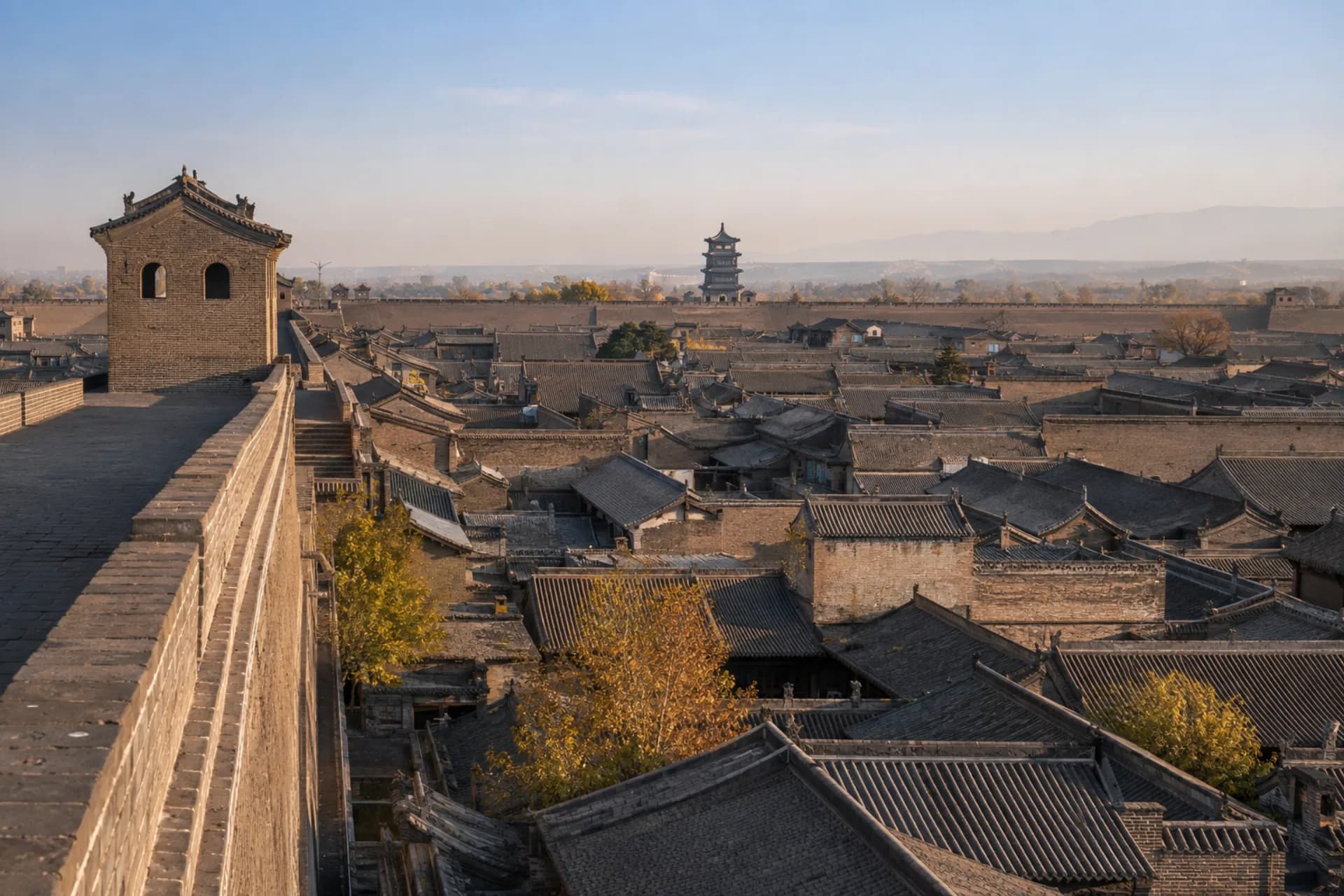
Shuanglin Temple
Shuanglin Temple is part of the UNESCO Ancient City of Ping Yao property, about six kilometers southwest of the walled city. UNESCO records more than 2,000 painted sculptures in the temple. Their scale, grouping, gesture and color reward close, quiet looking with historical interpretation.
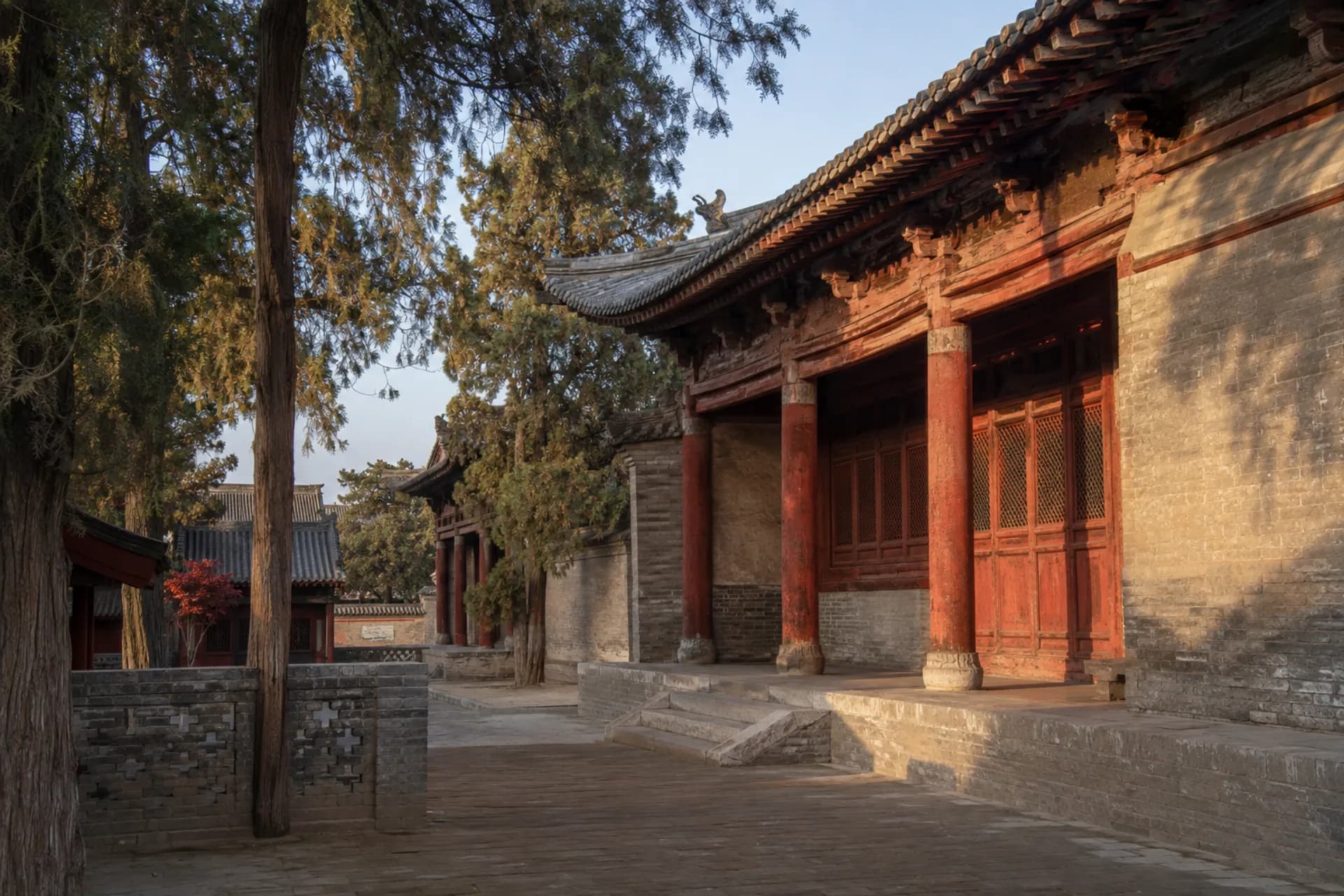
This illustrative view represents a northern Chinese temple courtyard; it does not reproduce Shuanglin's current exterior or any protected sculpture.
Plan 90–150 minutes
Start with the site's historical overview, then visit a limited number of open halls slowly. Look at how figures form narrative groups and how architecture controls the view. An informed guide or reliable audio/text resource is more valuable here than a fast photo circuit.
Choose three ways of looking. First, step back to understand how a whole group fills the hall. Second, compare posture, clothing, facial expression and gesture between figures. Third, look for how colour survives and where conservation makes the viewing distance necessary. Do not reduce the collection to a list of “lifelike” statues.
Open halls and viewing distance can change for conservation. Do not touch thresholds, walls or sculpture platforms. Follow every posted photography rule; if photography is permitted, avoid flash and equipment that blocks narrow spaces.
Current conservation work
A July 2026 notice says the Thousand Buddha Hall (千佛殿) is under conservation with partial closure planned through September 2028 because wall paintings and painted sculpture require protection. This does not establish that the whole temple is closed, but it materially changes a visit centred on that hall. Confirm the visible areas and ticket terms with the official Pingyao platform before travelling.
Conservation is part of responsible access, not a defect to evade. Do not peer behind screens, photograph through work barriers or demand entry because an older guide shows the hall fully open. If the affected collection is your only reason for coming, postpone or ask the official service exactly what remains visible.
Ticket and identity checks
Confirm the current admission, opening, last entry and passport path on the day. Do not assume the Pingyao Ancient City monument product includes Shuanglin, or that an older multi-day ticket remains valid. Carry the original identity document used for purchase.
The official 2026 visitor notice lists Shuanglin as a separate CNY35 ticket. Use that as a current baseline, then recheck temporary conservation, holiday hours and foreign-passport entry. A city combined ticket does not automatically add this external temple.
Complete the road plan
Shuanglin is outside the wall and needs a legal taxi, driver or currently published public route. Agree on the exact destination, waiting arrangement, fare and return before leaving Pingyao. Mobile service and ride availability are not a substitute for a confirmed pickup.
Allow time for the driver to wait or set a specific reunion point. If using a one-way taxi, check return availability before entering. Keep a buffer before any train because the six-kilometre distance does not account for waiting, traffic or restricted access near the old city.
The temple's historic surfaces, thresholds and compact halls can create mobility barriers. Ask about the current reduced-step route and seating. A short exterior approach does not prove that every viewing area is accessible.
Pair Shuanglin with one calm old-city half day. Add Zhenguo Temple only when its separate northeast road leg, current opening and total daylight are workable.
Choose Shuanglin when painted Buddhist sculpture is a central interest and the conservation-limited route still offers enough value. Choose a longer Pingyao city day if the group's priority is urban planning, finance or easy access between sites.