Xinjiang first-trip route and season chooser
Xinjiang is not one circuit. It is a set of route systems separated by distances large enough to consume a day even when the map shows one province. Ili and Altay–Kanas are both labelled “north Xinjiang” online, yet they branch west and north from different gateways. Kashgar and the Pamirs form a far-southwestern journey. Urumqi and Turpan make the shortest low-friction axis. A longer southern Silk Road adds oasis cities along the basin, rather than functioning as a casual extension to Kashgar.
That is the first decision: choose one route system before choosing attractions. Seven days should answer one regional question. Ten days can deepen one region or join a compact Urumqi–Turpan chapter to Kashgar by air. Fourteen days can combine two systems with an internal flight or overnight train, but it still cannot make Ili, Kanas, Kashgar and the Pamirs one relaxed holiday.
This guide uses seasonal patterns to change the corridor, not to promise flowers, autumn colour, snow or an open mountain road. Check the destination forecast, official road status, scenic-area notices and your exact transport again before every remote leg.
The quick chooser
| Route system | What you are really choosing | Minimum useful trip | Transport shape | Best first-trip fit | Cut it when… |
|---|---|---|---|---|---|
| Urumqi–Turpan | Museum and city context, one mountain day, then Silk Road ruins and oasis engineering | 5–7 days | Rail between cities; car or tour for outward sights | Short trip, mixed ages, public-transport confidence | July–August desert heat or a nature-first goal dominates |
| Ili via Yining | Sayram Lake plus one grassland or valley area, with Yining as gateway | 7–10 days | Road circuit with several bases | Green mountain country, lake, broad landscapes, slower photography | You have fewer than six nights or dislike long road days |
| Altay, Kanas and Hemu | A managed mountain-and-village scenic system with gateway, shuttle and luggage changes | 7–9 days | Flight or train to gateway, then road and scenic shuttles | Strong landscape priority and tolerance for changing operations | You want to add Ili in the same week |
| Kashgar and the Pamirs | Lived-in old-city streets, markets and a separate high-road extension | 6–8 days | Flight or long rail to Kashgar; road vehicle for Pamirs | Culture plus high mountain scenery | Permit eligibility, altitude or road uncertainty is a poor fit |
| Southern Silk Road | Kashgar plus Yarkand/Shache, Hotan and other oasis cities | 10–14 days | Linear rail, road and occasional flight | History, trade, food and a slower south-focused journey | Signature northern landscapes are your main goal |
“Minimum useful trip” starts after arrival in Xinjiang. If your international or domestic connection lands late, add a gateway night rather than counting the arrival evening as a sightseeing day.
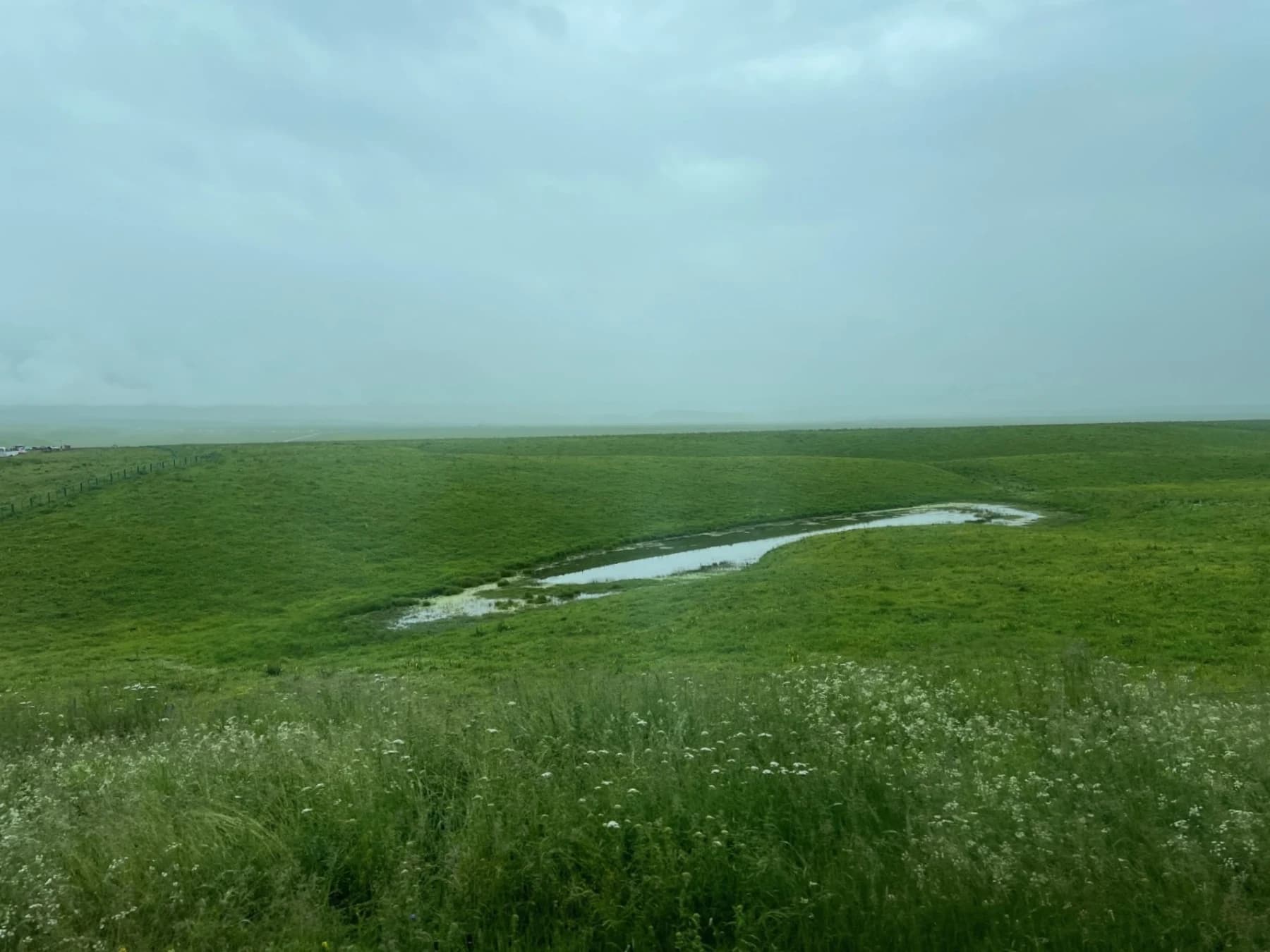
Nalati shows why Ili earns a road-based trip of its own. Grass colour, flowers, visibility and road access change with weather and season; this scene is not a promise for a particular date. Photo by Yoshi Canopus, CC0 1.0.
“North Xinjiang” is two different journeys
The most useful correction for a first-time visitor is to stop treating “north Xinjiang” as a single loop. Current visitor reports repeatedly describe fatigue after trying to change base five times in a week. The geography explains it.
Ili runs west and southwest from Yining. Sayram Lake is west of the city; Nalati, Kalajun and Xiata sit in other directions and use different road bases. The Ili grassland chooser exists because “see the grasslands” is not one stop. Choose one major grassland or valley system, sleep near it, and protect the return connection.
Altay–Kanas lies far to the north. Even after reaching Altay or Burqin, Kanas and Hemu use managed gates, shuttles and local lodging patterns. An airport name does not mean the aircraft door is beside the lake. Leave detailed gate, shuttle, winter-product and autumn-demand choices to the destination pages; at province level, the decision is simply whether Altay deserves the whole northern chapter.
Combining Ili and Altay is possible with enough time and a carefully checked flight or a long road transfer. It is rarely the best use of one first week. If you have ten days, the stronger trip is usually one of them with weather margin. If you have fourteen, join them only when both landscapes matter more than adding Kashgar and you accept another travel day.
What each corridor does best
Urumqi–Turpan: the compact first answer
Urumqi is a transport and context hub, not merely a connection. Give the Xinjiang Regional Museum a deliberate block, then choose Heavenly Lake or West Baiyanggou in Nanshan as one weather-dependent outward day. They point in different directions and should not be combined as a rushed double trip.
Turpan adds a lower, hotter oasis landscape and an entirely different historical layer. High-speed rail reaches Turpan North Railway Station (吐鲁番北站), but Jiaohe, the karez sites, Gaochang, Tuyoq and the Flaming Mountains remain spread around the basin. Pair Jiaohe Ruins with one karez interpretation site, or choose the Gaochang–Tuyoq–Flaming Mountains route; do not turn both into one exposed summer marathon.
This axis has the lowest planning friction because the city-to-city sector is rail-friendly and both cities offer indoor recovery. It is the strongest seven-day choice for a group that wants history, food and one or two landscapes without living from a vehicle.
Ili: the road-trip landscape answer
Use Yining Railway Station (伊宁站) or the current airport service as the gateway, then stop thinking in day trips. Spend a real city day in Yining, one or two nights around Sayram or Bole, and several nights around one chosen grassland or valley. A repeated return to Yining wastes the very hours that give a mountain route its light and pace.
Ili best suits a driver-based journey, a small group or a confident self-driver who can use Chinese navigation and comply with local driving, insurance and rental requirements. Independent rail or air can reach Yining, but it cannot finish the regional circuit. A “no-car” itinerary normally still purchases local transfers, a driver or a group product for the landscape legs.
Altay–Kanas: the high-impact but operation-heavy answer
Choose Altay when Kanas and Hemu are the reason for crossing Xinjiang. The trip can be excellent in summer, a short and variable autumn window, or winter under an entirely different operating model. That variation is exactly why this page does not freeze a gate, shuttle schedule or colour date.
Altay Railway Station (阿勒泰站) is a gateway anchor, not the final scenic entrance. Verify the actual arrival point, road transfer, scenic gate, last shuttle, luggage handling and hotel access as one chain. One missing link can turn a plausible map into an unusable day.
Use the Altay, Kanas and Hemu route guide to choose bases and turn that chain into a seven- or nine-day plan.
Kashgar and the Pamirs: culture first, high road second
Kashgar deserves at least two city days before it becomes a mountain gateway. Old City lanes, Id Kah, museums, architecture and trading spaces form the first chapter. The Karakul Lake and Muztagh Ata road and Tashkurgan form a separate high-altitude chapter with documents, checkpoints, weather and return margin.
Kashgar Laining International Airport (喀什徕宁国际机场) makes a two-region trip much more plausible than driving across the province. Still count a flight as a move: checkout, airport access, identity checks, boarding, baggage and a new hotel usually remove a half-day or more.
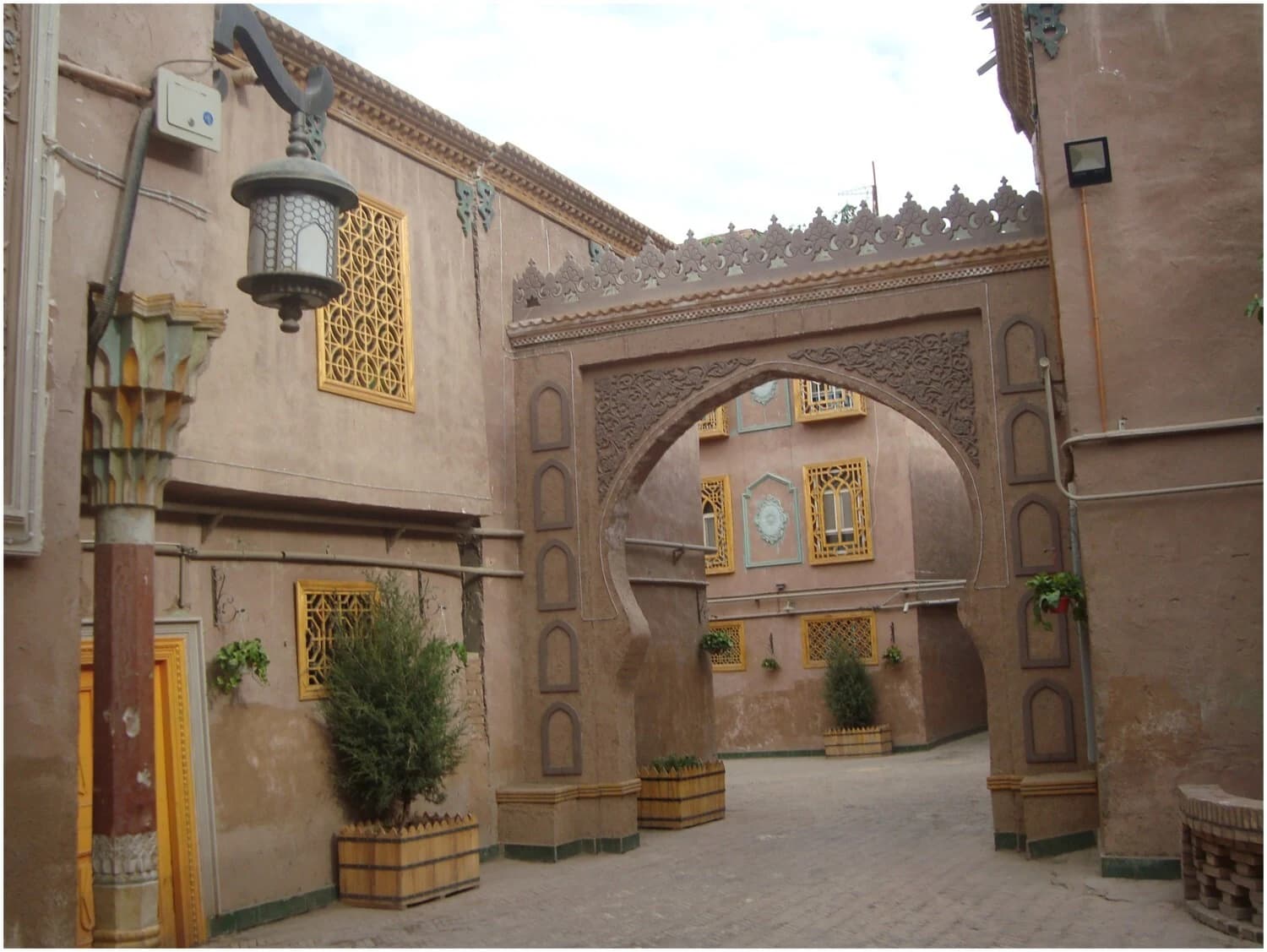
Kashgar's lane scale is a reason to keep city time before the Pamir road. Public and residential boundaries change street by street, so treat closed doors and private thresholds as private. Photo by Madlen Kobi, CC BY 4.0.
Southern Silk Road: a linear journey, not an add-on
A Kashgar–Yarkand/Shache–Hotan corridor suits travelers who value oasis history, markets, craft and overland continuity. It does not deliver the same trip as Ili grasslands or Kanas. Rail can reduce driving, but every city change still means checkout, station access, security, baggage and a new hotel.
Give the corridor ten days or more, and decide whether the Pamirs belong in the same trip. If they do, fourteen days is the more honest minimum. If you have only seven, keep Kashgar and one approved outward journey rather than collecting southern-city station stamps.
Three executable seven-day routes
Each version below has seven days and six nights. Arrival is Day 1; departure is Day 7. Do not count six full sightseeing days.
Option A: Urumqi and Turpan, two main bases
Night pattern: Urumqi 3 → Turpan 2 → Urumqi 1.
Use the first Urumqi night for arrival. Give one day to the museum and city, then one to Heavenly Lake or Nanshan according to weather. Take rail to Turpan on Day 4, use two nights for one coherent ruins-and-oasis route, and return to Urumqi on Day 6 to protect the flight. If your confirmed ticket departs from Turpan or another open-jaw connection works cleanly, remove the final backtrack.
Cut first: a second Urumqi mountain day or the second Turpan outward circuit. Do not cut the final transport buffer.
Option B: Ili, one lake and one grassland
Night pattern: Yining 2 → Sayram/Bole 1 → one grassland or valley base 3.
Day 1 is Yining arrival; Day 2 is city context and vehicle preparation. Move west for Sayram, then commit to one southern or southeastern landscape base. Whether Nalati, Kalajun or Xiata fits depends on season, road status, desired walking and the driver plan. Six nights do not support all three.
Cut first: the second grassland. If your departure requires Yining, move the final grassland night back to Yining rather than gambling on a long same-day road connection.
Option C: Kashgar and the Pamirs
Night pattern: Kashgar 3 → Tashkurgan 2 → Kashgar 1.
Use two full city days, then begin the approved Pamir route after confirming documents, passenger eligibility, road status and accommodation. Two Tashkurgan nights allow a slower ascent and reduce the pressure to race back. The final Kashgar night protects the departure.
Cut first: an extra market, show or roadside photo stop. Do not remove the return buffer or try to add Hotan.
An Altay-only seven-day route can also work as gateway 1 → Kanas 2 → Hemu 2 → gateway 1, but treat that only as a planning frame. Confirm the live scenic-gate and shuttle sequence before attaching dates to it.
Ten days: deepen one region or join only two systems
Ten days means nine nights. The best default is still one region with better light, weather margin and fewer one-night hotels.
Ten-day Ili without a race
Use Yining 2 → Sayram/Bole 2 → one grassland or valley base 4 → Yining 1. Four nights near one landscape are useful when they contain a transfer day, one main scenic day, one weather-flexible day and a slower departure morning. This structure also gives the driver a coherent circuit rather than repeated out-and-back days.
Ten-day Altay
Keep the nine nights inside the Altay system: gateway recovery, Kanas and Hemu with shuttle margin, one flexible landscape day, and a protected final gateway night. Add a short Irtysh River or Five-Colored Beach stop only when it lies naturally on the confirmed transfer. Do not spend the extra nights driving to Ili simply because both appear under “north Xinjiang.”
Ten-day Urumqi–Turpan plus Kashgar
Use four nights for the Urumqi–Turpan axis and five nights for Kashgar–Pamir: for example Urumqi 1 → Turpan 2 → Urumqi 1, then fly to Kashgar for Kashgar 2 → Tashkurgan 2 → Kashgar 1. The internal flight day is a travel day with perhaps one untimed evening walk. If the live flight timing forces a same-day Turpan–airport connection with little margin, move back to Urumqi the previous night.
This is the only two-system ten-day combination in this guide that remains broadly defensible because the first chapter is compact and the second has a major airport. It is still busier than a nine-night Ili or Altay trip.
Fourteen days: two route systems, not four
Fourteen days means thirteen nights. Think of it as two good regional trips joined by one deliberate transfer.
Most balanced: Urumqi–Turpan plus Kashgar–Pamir
Night pattern: Urumqi 4 → Turpan 2 → Kashgar 5 → Tashkurgan 2, with the Kashgar nights split around the mountain extension. Fly between the northern hub and Kashgar. Use the extra Urumqi and Kashgar nights as weather, museum and transport buffers rather than adding another remote region.
Landscape-led: Urumqi–Turpan plus Ili
Night pattern: Urumqi 2 → Turpan 2 → Yining 2 → Sayram/Bole 2 → one grassland base 4 → Yining 1. This has more base changes than the first option, but the geometry remains legible. Fly or take an overnight rail sector between the Urumqi area and Yining according to the live timetable; do not assume a daytime train saves a sightseeing day.
High-impact, high-friction: Altay plus Kashgar
Night pattern: Altay/Burqin gateway 2 → Kanas 2 → Hemu 2 → Kashgar 4 → Tashkurgan 2 → Urumqi 1. This works only when the current flight chain is bookable and your scenic transfers connect cleanly. It contains two mountain systems and at least two aviation days. Choose it because those two landscapes are your highest priorities, not because social media calls it a complete Xinjiang loop.
Do not add Ili to any of these fourteen-day versions. If Ili, Kanas and Kashgar are all non-negotiable, expand the trip beyond two weeks or accept that the holiday will be organized around airports, checkout and luggage.
Let the month change the corridor
| Period | Stronger candidates | What can disappoint | Planning response |
|---|---|---|---|
| December–February | Urumqi/Turpan history; Kashgar city; specialized Altay winter trip | Snow is not guaranteed in every city; cold, short daylight and winter access models | Choose winter operations deliberately; do not reuse a summer road plan |
| March–April | Turpan and Kashgar city/culture; flexible southern route | Dust, wind, late snow at altitude, dormant northern landscapes | Keep outdoor days movable and use city or museum alternatives |
| May–June | Ili begins to make sense; Urumqi, Kashgar and Pamir options expand | Flowers and green-up vary; high roads may still be affected by snow | Choose the corridor, then check current growth, road and scenic notices |
| July–August | Ili and Altay landscapes; Pamirs with altitude pacing | Peak demand, hot gateways, very hot Turpan, thunderstorms and long road days | Reserve key transport and regional lodging; move exposed Turpan visits to cooler hours |
| September–October | Altay or Ili according to live conditions; Kashgar and southern corridor | Autumn colour is brief and variable; first snow can disrupt high routes; National Day crowds | Pick one autumn target and protect a gateway buffer |
| November | City, museum and food-led Urumqi/Kashgar/Turpan trips | Shoulder-season service reductions and early winter road change | Verify every scenic-area and long-distance sector before booking |
Autumn is where itinerary promises become least reliable. A note published from one golden week does not establish the same colour dates next year. Altitude, latitude, wind, rain and cold fronts can shift the display. Make the landscape region the trip, but make the exact colour a bonus.
The same principle applies to Ili flowers and grass. A green Nalati photograph proves the landscape exists; it does not prove your week will look like that. Ask for current visual and operating evidence close to departure, then keep a city, museum or lower-elevation alternative.
Duku Highway is a live road decision
Do not build a fixed itinerary around an assumed Duku Highway (独库公路) opening. Xinjiang's transport department reported that the road reopened on June 1, 2026 after extensive snow and ice clearance, while another official response records only 133 open days in 2025. These are historical examples, not annual dates.
The northern section also used a reservation arrangement during 2026 construction and traffic management. Before departure, check the latest Xinjiang transport road notice, official road-network channels, weather and police controls. A driver saying “it normally opens in June” is not a live status check.
If Duku is closed, the trip needs a different corridor or a long diversion. Do not ask a driver to force a closed, controlled or weather-affected road to preserve an online itinerary.
Choose the transport tool by the gap
Fly across route systems
Use flights when moving between Kashgar and northern gateways, or when a surface transfer would consume more than a day. Urumqi remains the main hub, but direct regional services are seasonal and frequency can change. Search the exact date before committing hotel nights on either side. Compare current domestic flights on Trip.com, then check baggage and change terms rather than buying the lowest headline fare automatically.
Use rail for basin cities and overnight repositioning
Rail is useful between Urumqi and Turpan and along several southern-city sectors. An overnight sleeper can preserve daylight if everyone can sleep on board and manage luggage, but it is not a free night: station access, security, shared space and early arrival have a cost. Read the China rail itinerary guide, then check live train inventory. Urumqi Railway Station (乌鲁木齐站) is the main high-speed anchor; do not confuse it with Urumqi South when booking pickup.
Hire a driver for the final landscape system
Ili, the Kanas gateway chain and the Pamir road need a road solution even when you arrive by train or plane. Get the vehicle type, legal operator, pickup, planned rest, fuel, tolls, luggage space, hotel, cancellation terms and emergency contact in writing. Confirm whether the driver stays with you, changes at a county boundary or hands you to scenic shuttles.
Self-drive only when the legal and practical chain works
Self-drive can add flexibility, but it demands much more than an international licence and a translation app. Confirm that you can legally drive, rent and insure the vehicle in mainland China; that the contract permits the planned region; and that you can use Chinese navigation, fuel and parking systems. Never make Duku or a border road the first test of those systems. A rented car also cannot bypass scenic shuttles, access controls or a closed road.
Documents, border areas and checkpoints
Carry the passport or identity document used for flights, trains, hotels and attraction bookings. Build extra time around transport hubs and long road sectors; do not photograph identity checks, border infrastructure, police or military facilities.
China's National Immigration Administration introduced an electronic Border Administration Area Permit flow in 2026. Its official FAQ says the online route is for eligible mainland residents aged 16 and above. Foreign nationals, overseas Chinese and residents of Hong Kong, Macau and Taiwan use designated in-person channels, and foreigners may also need separate travel documentation for border management areas that are not open to them.
That distinction matters for Pamir and other border-area plans. Do not rely on a screenshot saying “the permit takes ten minutes.” Before paying for a road tour, ask the local authority or qualified operator to confirm your nationality or document type, every intended stop, the issuing channel, processing time and refund terms if approval is unavailable. A permit does not override a road closure or a place that is not open to your traveler category.
Altitude, heat, dust and snow
Xinjiang combines desert basins and high mountains, so a provincial forecast is weak evidence. Turpan can be dangerously hot while a Pamir stop is cold and windy. Yining can be warm while an Ili pass needs a jacket. Altay can receive early snow while Kashgar remains dry.
Use layers, sun protection and water even in summer. Put a warm and wind-resistant layer in the day bag rather than the luggage compartment. In spring and during dry windy periods, dust can affect roads, flights and respiratory comfort, particularly around the basin. Travelers with significant respiratory, cardiovascular or altitude-related concerns should discuss remote high-country plans with a clinician before travel.
For the Pamirs, ascend conservatively and keep the first high day light. Headache, nausea, unusual fatigue and sleep disturbance should change the schedule. Severe or worsening symptoms need descent and medical assessment, not a tighter sightseeing plan. Do not treat bottled oxygen as permission to ignore symptoms.
Hotels, luggage and the final connection
Choose gateway hotels for transport, not decoration. Before a mountain circuit, a property near the correct station or airport can be worth more than an atmospheric address across town. In smaller bases, confirm passport registration, heating or cooling, hot water, vehicle access, late arrival, breakfast timing and cancellation terms.
Keep one smaller road bag and leave unnecessary luggage at a verified city hotel or with a confirmed transfer provider. Ask whether Kanas/Hemu or grassland lodging requires a shuttle, walk or vehicle change between the gate and the room. “Hotel pickup included” should name the actual hotel, time and vehicle.
Protect the final flight with a gateway night or at least half a day. Long-distance road trips fail at the end when travelers assume the last map estimate is a schedule. Weather, roadwork, checkpoints, fuel, traffic and scenic shuttles can all add time.
Respect, photography and drones
Xinjiang's old cities, villages, markets, mosques and grassland communities are lived places. Ask before photographing an identifiable person, child, vendor, worshipper, home interior or private courtyard. Buying food does not buy a portrait. Step aside when a lane or market is working space, and follow posted dress, worship and visitor boundaries at religious sites.
Do not reduce an ethnic community to a costume backdrop. If you book a portrait or costume experience, separate the commercial set from ordinary residents and private thresholds. Ask before publishing images that include local people, even when the scene was captured from a public lane.
China's national unmanned-aircraft rules require real-name registration through the civil aviation UOM platform and establish controlled airspace around borders, airports, military and security areas, important infrastructure and some protected heritage. Xinjiang also has its own low-altitude management framework. Register the aircraft, check UOM and current local/scenic rules, and obtain any required permission before every launch. Never infer permission from another traveler's footage. In border, checkpoint, religious or populated areas, leave the drone packed unless the responsible authority has clearly allowed that exact flight.
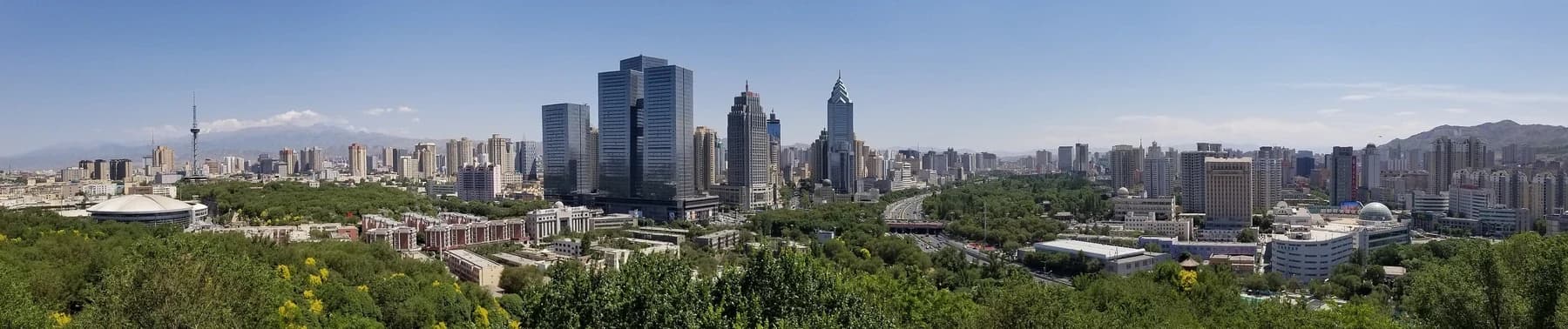
Urumqi is the province's main logistics hinge, but the skyline does not reveal the transfer time to Ili, Altay or Kashgar. Photo by Y Chen, CC BY-SA 4.0.
Book in the order that can break the trip
- Choose the corridor and dates. Do not buy isolated attraction tickets before the route exists.
- Confirm traveler eligibility and border documents. This comes first for Pamir and other controlled-area plans.
- Secure the long transfer. Book the internal flight, long train or gateway sector that joins the trip.
- Confirm the road product. Vehicle, driver, seasonal road, scenic gate, shuttle, luggage and refund terms belong in one chain.
- Book scarce regional nights. Use flexible cancellation where weather or road status can change the route. Compare hotels on Trip.com only after you know the correct base.
- Add scenic tickets and local experiences. Recheck the live operator rule instead of assuming last year's product remains unchanged.
- Reconfirm 72–48 hours before remote legs. Check forecast, road and scenic notices, pickup and document status.
The cut-first rules
- Seven days: choose one of Ili, Altay or Kashgar–Pamir. Urumqi–Turpan is its own compact alternative.
- Ten days: keep one deep region, or join only Urumqi–Turpan and Kashgar by air.
- Fourteen days: choose two route systems. Do not attempt Ili, Altay and Kashgar together.
- Bad weather: remove the most remote optional stop, not the gateway buffer.
- A road closes: change the corridor; do not force an unofficial detour.
- A flight disappears: add a night or remove a region rather than building two fragile same-day connections.
- The group tires: keep two nights in one base and remove the second grassland, second mountain day or secondary sunset stop.
The best first Xinjiang trip is not the one that draws the largest loop. It is the one whose landscapes, transport and season all point in the same direction—and whose final connection still works after one slow road day.