Altay, Kanas and Hemu: an executable 7- or 9-day route
Choose this route after the Xinjiang first-trip chooser has already answered the province-level question: Altay is the northern landscape chapter you want. This guide solves the harder local problem—where to arrive, where to sleep, how to move luggage through managed gates, and whether Kanas, Hemu and Baihaba all deserve time.
The route is not one scenic drive. It has at least four transport layers: a regional gateway such as Altay City or Burqin; an outer scenic gate; an internal transfer centre; and a village bus or hotel pickup. A rail ticket to Altay or a flight to Kanas Airport completes only the first layer. A room whose English listing says “Kanas” may be in Jiadengyu, the old village, the new village or another settlement with a different final connection.
Seven days is enough for two Kanas nights, two Hemu nights and protected gateway nights. Nine days adds a real weather-flexible day and makes an optional Baihaba substitution possible after document and access checks. Neither version should promise autumn colour, first snow, a winter road opening or a particular viewpoint. Those are live conditions, not itinerary components.
The decision in one table
| Place | What it contributes | Minimum useful time | Operating friction | Keep it when… | Cut it when… |
|---|---|---|---|---|---|
| Kanas | Lake, Three Bays, forest and an optional high viewpoint | Two nights, one full day | Outer gate, transfer centre and separate branches | This is your main Altay landscape | Cloud defeats the viewpoint branch; cut that branch, not the whole lake day |
| Hemu | A broad village valley that rewards an afternoon and next morning | Two nights | Current entrance, scenic shuttle, village bus and hotel handoff | You want slower light and a village stay | Your trip has fewer than six nights after reaching Altay |
| Baihaba (白哈巴) | A border village reached through an additional eligibility and transport decision | One night or a deliberate day substitution | Document eligibility, live open-area rules, separate product and luggage handoff | Your passport is eligible, the exact area is open and it replaces another block | Eligibility is unclear, weather is poor or you have only seven days |
| Five-Colored Beach | A short Burqin-area river landscape | One late-afternoon block | Light, weather and onward-road timing | It fits beside a Burqin gateway night | It threatens the last scenic transfer or departure buffer |
There is no universal winner between Kanas and Hemu. Kanas supplies the most structured lake-and-river day. Hemu rewards staying still. Baihaba is the first cut because its border-area and transfer complexity can exceed its value on a short first visit.
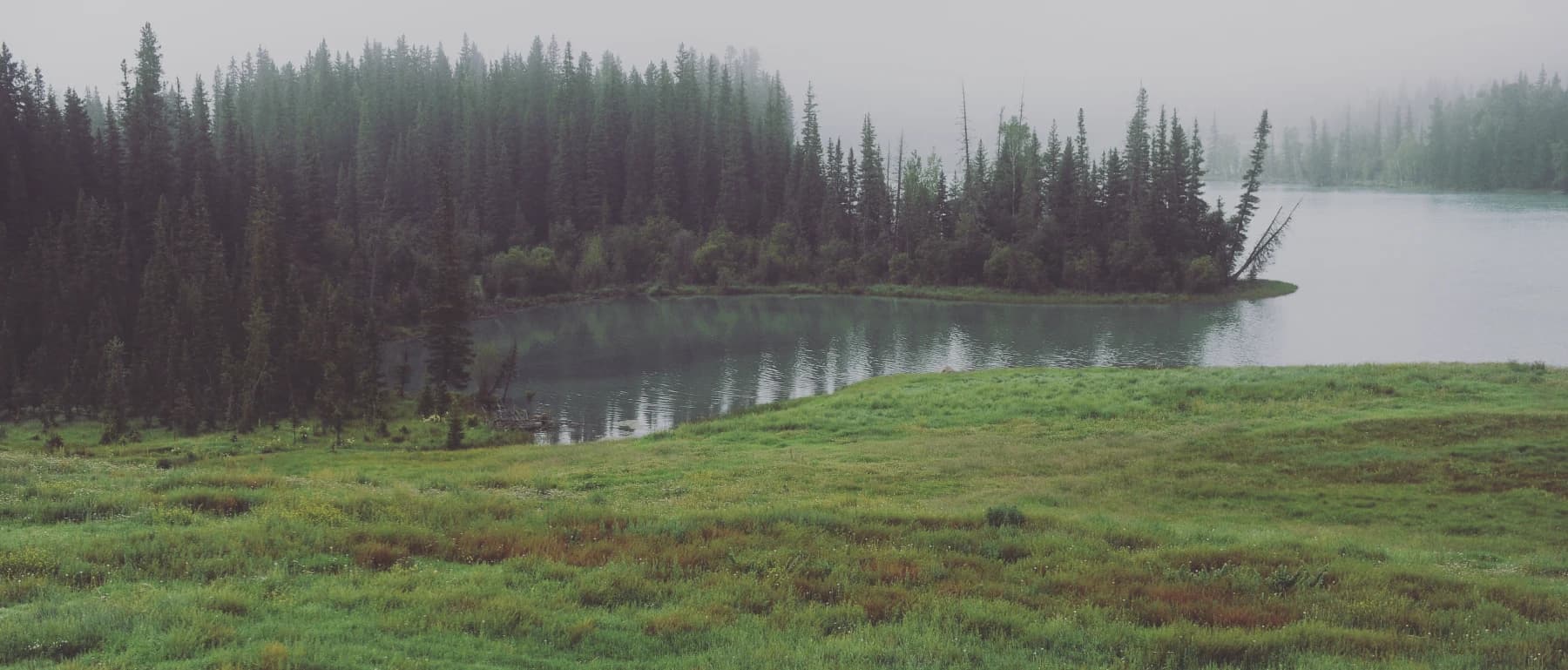
Low cloud can be atmospheric at lake level while erasing the value of a high viewpoint. Build the Kanas day around visibility, not a fixed checklist. Photo by Muye Ma, CC0 1.0.
Learn the transport layers before buying anything
1. Regional gateway
Altay Xuedu Airport (阿勒泰雪都机场) and Altay Railway Station (阿勒泰站) serve Altay City. The city is useful for a late arrival, supplies, a recovery night and onward road transport. It is not a practical base for a daily Kanas commute.
Burqin Kanas Airport (布尔津喀纳斯机场) is closer to the scenic system, but its name still does not mean the terminal is beside Kanas Lake. Confirm the dated flight, arrival time and onward vehicle before removing a gateway night.
Road mapping gives roughly 109 kilometres from Altay Railway Station to Burqin coach station in clear conditions. Treat the map's driving time as a baseline only; pickup, road works, stops, weather and holiday traffic can lengthen it substantially.
2. Lower transition base
Burqin Coach Station (布尔津客运站) anchors the county town. Burqin gives you ordinary hotels, meals, supplies and a simpler place to hold large luggage. It also places Five-Colored Beach within a possible gateway-day plan. It is still not inside Kanas.
The mapped Burqin–Jiadengyu road is about 123 kilometres and can take more than two hours even before a busy gate or bad conditions. Do not schedule a late flight, this road, ticket collection, the gate shuttle and a village hotel pickup as one fragile chain.
3. Outer gate
Jiadengyu Ticket Station (贾登峪门票站) is the familiar Kanas outer gateway in the main-season model. It is where a road vehicle, luggage plan and scenic transport can diverge. Sleeping in Jiadengyu can provide newer or simpler road-side accommodation, but it adds a gate-and-shuttle sequence to each Kanas day.
Hemu has its own operating entrance and product. Map searches currently return more than one Hemu access label, reflecting changed or seasonal road approaches. Use the Chinese gate printed on the current ticket or operator message, not an old saved pin. Ask your hotel to identify the exact arrival point and the final village bus stop in writing.
4. Internal transfer and village pickup
Kanas Transfer Centre (喀纳斯换乘中心) is the internal network hub. Branches toward the lake, Three Bays return corridor, Guanyu area, villages or Baihaba should be treated as separate timed choices. Park closing time is less useful than the final departure at every connection you actually need.
Hemu adds another village layer. “Shuttle included” may mean only the gate-to-service-centre sector. Confirm whether a village bus, electric cart or hotel vehicle completes the final leg, and where full-size luggage transfers. Visitor reports are consistent on one point: assuming that one driver or one luggage service covers the whole chain causes avoidable stress.
Choose the right sleeping base
Altay City: a transport and recovery night
Use Altay City when your train or flight arrives late, when winter weather makes an immediate road transfer unwise, or when the onward connection needs a fresh daylight start. It offers the widest backup options. Do not keep returning there between scenic days.
Burqin: the stable transition base
Burqin is useful at the beginning or end of the route. It separates a long arrival from scenic transport, lets you repack, and gives a natural slot for Five-Colored Beach when light and road timing cooperate. It is a poor substitute for sleeping near Kanas if it creates repeated long road days.
Jiadengyu: outside access with an extra daily transfer
Jiadengyu can suit travelers who prioritize a road-accessible hotel, simpler large-luggage handling or a lower room-risk tolerance. The trade-off is another gateway sequence before and after Kanas. Check whether your ticket permits the necessary entry pattern and whether the last shuttle returns in time for the hotel.
Kanas old village or new village: early position, more handoffs
An inside-area stay can place you closer to the lake and transfer network. “Old village” and “new village” are not interchangeable booking labels. Ask for the Chinese property name, nearest stop, expected walk, luggage pickup, heating, hot water, meal availability and international-guest acceptance. The old village can be better positioned; the new village may involve another internal-bus step. Room quality varies property by property, so do not infer comfort from the settlement name.
Hemu old or new village: book the stop, not the marketing name
Hemu spreads across a valley. A room can be scenic yet awkward for a traveler with a suitcase, stroller or reduced walking tolerance. Ask the hotel to send a map pin, Chinese stop name, pickup hours and a photo or description of the walk from the road. Confirm insulation and heating separately for cold-season stays.
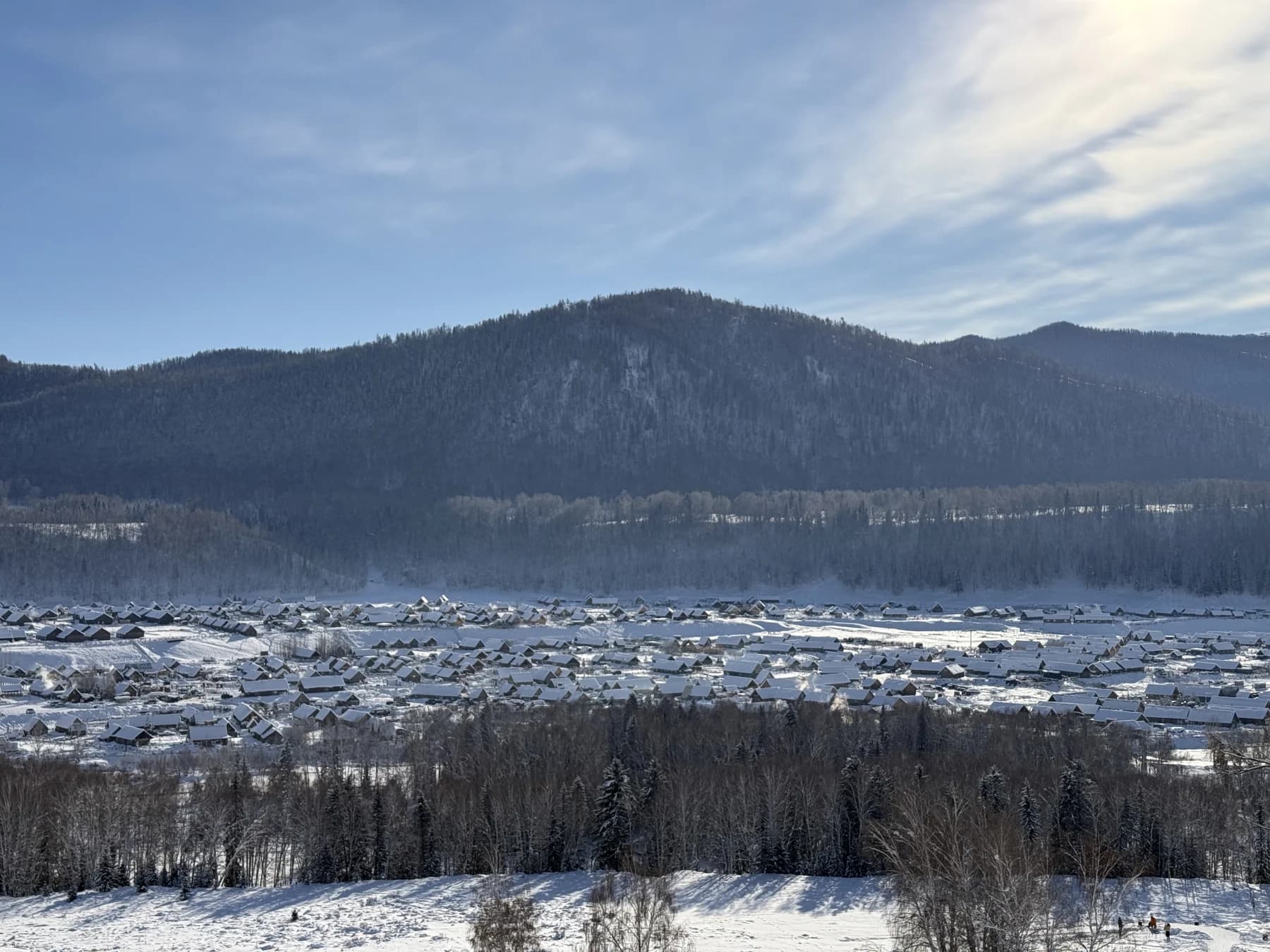
Hemu is a broad settlement, not one hotel cluster. The exact stop and pickup matter as much as the room. Snow cover, road access and village transport vary by date. Photo by Pazakui, CC BY 4.0.
Read scenic tickets as transport contracts
Do not compare only headline admission. For each dated product, write down:
- the exact scenic area and Chinese product name;
- the operating entrance for your date;
- whether the mandatory gateway shuttle is included;
- whether internal branches or a high viewpoint require another ticket, capacity slot or queue;
- one-entry or re-entry validity, especially if sleeping outside;
- the passport used for booking and collection;
- current child, student or older-traveler concessions and the document they require;
- the cancellation rule for weather or road interruption;
- the last bus at every transfer needed to reach your room; and
- how checked luggage reaches the hotel.
Check the exact dated Kanas product on Trip.com and compare its inclusions with the official operator channel. For Hemu, use the same test on the current Hemu listing. Product names, prices, reservations, entrances and operating hours can change; this guide deliberately does not freeze them.
Private or rental vehicles do not automatically bypass a scenic shuttle. A summer bus model, a shoulder-season controlled-access model and a winter licensed-vehicle or self-drive product can be entirely different journeys. Rebuild the transport chain if the season changes.
The 7-day route: six nights, two core landscapes
This version assumes Day 1 arrives in the Altay region and Day 7 departs. It contains six nights: gateway 1 → Kanas area 2 → Hemu 2 → gateway 1.
Day 1: arrive and protect the route
Sleep in Altay City when arrival is late or onward road transport is uncertain. Sleep in Burqin when you can reach it in daylight with a confirmed vehicle and want the simpler launch. Buy water, portable breakfast and any medication here. Repack a two- or three-night scenic bag; leave a large case only with a hotel or driver that has confirmed storage and later retrieval.
Day 2: move to Kanas without stacking attractions
Travel toward the confirmed Kanas outer gate, collect or activate the exact product, take the managed transport and complete the hotel handoff. If the day runs smoothly, use remaining light for a short public lake or village walk. Do not force Guanyu Pavilion or the full Three Bays sequence into an arrival afternoon.
Night 2: Kanas old/new village or Jiadengyu, chosen according to the ticket and comfort trade-off.
Day 3: one complete Kanas day
Use visibility first. If the high viewpoint is open, capacity is available, the group handles steps and the mountains are visible, take that branch early. Otherwise start at lake level. Protect enough time for the Three Bays corridor and the return sequence.
The Kanas guide gives the detailed lake–Three Bays–optional viewpoint logic. Its essential rule is to choose two priorities and work backward from the final shuttle. A cruise is optional. An improvised forest shortcut is not.
Night 3: the same Kanas-area room. Keeping the room removes one luggage move and provides a fallback if weather delayed Day 2.
Day 4: Kanas to Hemu is a transfer day
Check the live road and scenic product before leaving. The move may involve hotel pickup, village bus, Kanas transfer centre, outer gate, road vehicle, Hemu entrance, another scenic shuttle and a final village pickup. A through-looking map does not guarantee through luggage.
Ask both hotels and the road operator to name the party responsible for each suitcase at each handoff. Carry passport, medication, power bank, water, insulating layer and one night of essentials in your day bag. Use Hemu's late afternoon only after the room is reached; do not promise sunset after an uncertain multi-stage move.
Night 4: Hemu.
Day 5: Hemu slowly
Give Hemu a morning and an afternoon. Choose the open public viewpoint or river route that suits weather and mobility, then leave time for the village without treating homes, yards or working animals as props. The Hemu guide explains the current village logic in more detail.
Horse riding is optional and should never be the default transport assumption. Use an established operator, match the route to experience, wear the offered safety equipment, ask who leads the horse, and refuse an animal or route that appears poorly managed. Do not leave marked or currently permitted areas.
Night 5: the same Hemu room.
Day 6: return to a gateway
Leave enough time for every internal bus before the road transfer. Sleep in Burqin when it simplifies a next-day road or airport move; sleep in Altay City when departing by train or Altay flight. Five-Colored Beach is an optional late-day addition only when the road, light and ticket make it comfortable. Check the dated product rather than preserving a sunset plan in bad weather.
Night 6: Burqin or Altay City.
Day 7: depart
The final gateway night is part of the itinerary, not wasted time. Keep it when a flight or train matters. Remove it only after the same-day road connection has ample margin, flexible terms and a weather-independent backup.
The 9-day route: eight nights and a real buffer
The recommended no-Baihaba version contains eight nights: gateway 1 → Kanas area 3 → Hemu 3 → gateway 1.
- Day 1: arrive in Altay City or Burqin.
- Day 2: enter Kanas and settle in.
- Day 3: full Kanas day.
- Day 4: Kanas flexible day. Recover a missed viewpoint or spend a slower day around the lake and open marked paths. Do not invent a new remote excursion simply because the first day went well.
- Day 5: transfer to Hemu.
- Day 6: full Hemu day.
- Day 7: weather-flexible Hemu day, a slower public walking route or an earlier staged return if the next forecast is poor.
- Day 8: return to Burqin or Altay City; add Five-Colored Beach only when it remains low-risk.
- Day 9: depart.
Three nights in each core area are not three identical sightseeing days. One is partly consumed by arrival or transfer. The extra day protects the trip from cloud, a long queue, a delayed handoff or a tired family member.
Baihaba substitution, not addition
If the exact area is open to your passport category, the dated product is available and luggage transport is confirmed, replace one Kanas or Hemu night with Baihaba. A possible eight-night pattern is gateway 1 → Kanas 2 → Baihaba 1 → Hemu 3 → gateway 1. Do not use this as a booking instruction until the operator confirms the direction, gate, border document, room, village transport and luggage sequence.
Mainland China's 2026 electronic Border Management Area Permit service is limited to eligible mainland residents aged 16 and over. It does not establish online eligibility for foreign passport holders, Hong Kong, Macao or Taiwan residents, overseas Chinese or accompanying children. National Immigration Administration rules also state that foreigners entering border-management areas not open to foreigners need the appropriate Foreigner Travel Permit. In practice, you must ask the current operator or local immigration authority whether your nationality can visit Baihaba, what document is required, which public areas are open and where it is processed before buying a non-refundable product.
If eligibility or an important public area remains uncertain, cut Baihaba. Kanas and Hemu already make a complete Altay trip.
Luggage: assign every handoff
The phrase “luggage transfer included” is incomplete. Put the route into a message and request a line-by-line answer:
- regional station or airport → Altay/Burqin hotel;
- hotel → road vehicle;
- road vehicle → scenic gate;
- gate → scenic bus luggage hold or transfer desk;
- internal centre → village stop;
- village stop → hotel door; and
- the reverse chain on checkout morning.
Ask about maximum size, accepted bags, closing time, claim receipt, weather cancellation and what happens when the hotel vehicle cannot reach the normal stop. Keep valuables and one night of essentials with you. If a provider covers Kanas and Hemu but not Baihaba, that missing leg can decide whether Baihaba belongs in the itinerary.
Families, older travelers and limited mobility
The problem is cumulative friction rather than one spectacular hike. Boarding several buses, standing in queues, carrying a child, finding a toilet and walking from a village stop can exhaust a group before the main view.
Plan one priority branch per half-day. Use the high viewpoint only when the steps, exposure, visibility and return queue all suit the group. At Three Bays, choose one open boardwalk segment rather than forcing every stop. Ask whether a stroller must fold for each shuttle and whether the hotel path is paved; a carrier may be more practical for a small child when used safely.
Carry food that the group will actually eat. Do not assume meals remain available near a late bus. Save Chinese hotel and driver contacts offline. Give an older traveler a seat-and-toilet plan at each hub, not merely a scenic goal. If anyone is cold, dizzy, unusually breathless or unsteady, return to a staffed area and seek help rather than continuing to a viewpoint.
Season changes the operating model
Summer: longest service window, highest capacity pressure
Summer usually supports the most complete shuttle-and-village-bus model, but it also brings queues, thunderstorms and heavy road demand. A 2026 Xinjiang police report described heavy summer tourism volume across the wider Kanas area; that is a system-wide pressure signal, not a prediction for your day. Reserve core rooms and transport, start early and never schedule a tight onward flight after a scenic exit.
Autumn: a short visual window, not a date promise
Forest colour can shift with altitude, cold fronts, wind and rain. A golden visitor photograph from one year does not establish next year's week. Demand can rise before conditions are clear, while early snow can alter roads or viewpoint operations. Book flexible terms where possible, check current visual and operating evidence close to departure, and keep the landscape day valuable even without peak colour.
Shoulder season: fewer assumptions
Service can reduce before a social-media calendar says “winter.” Confirm the currently operating gate, last transport, village hotel heating, meals and road vehicle. A closed branch should trigger a simpler lake or village day, not an attempt to walk along controlled roads.
Winter: rebuild the route from zero
Do not apply summer ticket, bus or road logic to winter. The Xinjiang transport department reported completing snow clearance on the Ahe Highway in late April 2026; that date describes one year's work, not an annual opening. Later official transport reporting emphasizes avalanche, ice, wind-blown snow and extreme-weather management across Altay mountain roads.
Confirm the day's approved vehicle model, snow tyres or chains, driver experience, road status, rescue contact, daylight, heated room and cancellation terms. A snowy photograph proves that snow can occur; it does not prove a road is open or that winter service will match another month.
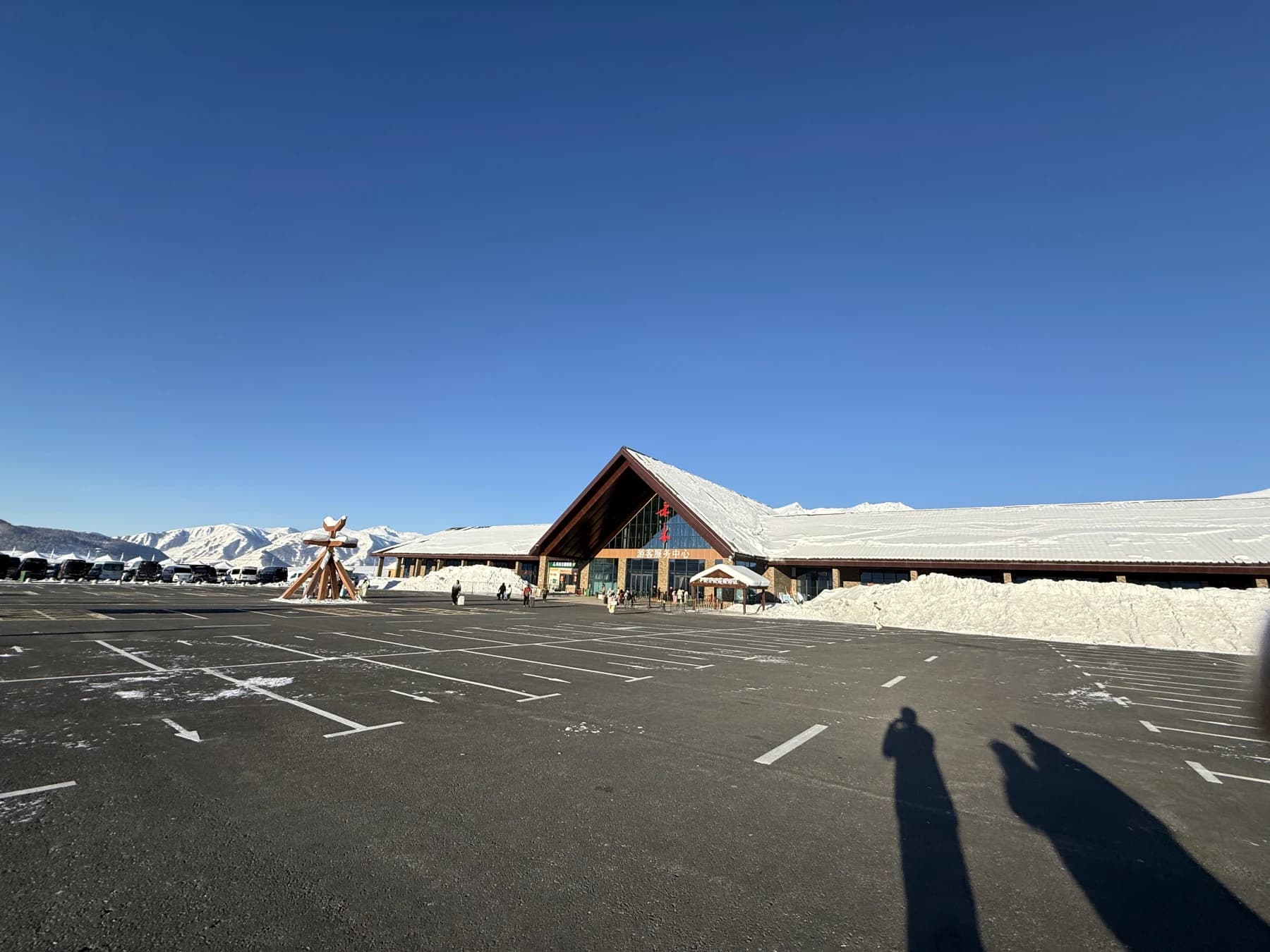
A winter gateway can involve ploughed roads, large snowbanks and a vehicle system that differs from summer shuttles. Verify the live operating model instead of copying a warm-season route. Photo by Pazakui, CC BY 4.0.
Walking, riding, drones and photography
Use only currently open marked paths. Official scenic guidance has required some hiking routes to be reported to management and prohibits smoking or open flame in protected terrain. Ask at the staffed centre before any longer walk; do not infer access from another visitor's GPS track. Turn around when weather, daylight or the last transport threatens the return.
Treat horse routes as regulated activities, not shortcuts between villages. Confirm the operator, supervision, duration, insurance position, weather cancellation and exact finish. Never pressure an animal for a photograph or enter grazing land without permission.
Drone footage online is not permission. China's national unmanned-aircraft rules, CAAC registration/airspace requirements, local scenic restrictions, nature protection and border controls can all apply. Check the UOM system and current local rule; never launch near border, police, military, airport, crowds, wildlife or other restricted infrastructure.
For ordinary photography, stay on public paths and viewing areas. Ask before photographing residents, working animals or private homes. Avoid doorways, yards and religious or family activity unless clearly invited. A long lens does not turn private life into a public attraction.
Bad-weather and disruption cut rules
Use these rules before sunk cost takes over:
- Dense cloud: cut the high viewpoint first; keep the lake shore or lower valley if open and safe.
- Late arrival at the gate: cut optional branches; reach the confirmed room before the final transport.
- Road warning or heavy snow: stay at the staffed gateway. Do not ask a driver to “try the road.”
- Baihaba uncertainty: cut Baihaba before Kanas or Hemu.
- One lost day in the 7-day plan: keep one full Kanas day, one Hemu night and the final gateway night. Remove the second Hemu night only if the transport chain remains safe.
- One lost day in the 9-day plan: consume the flexible day. Do not rebuild the route around a rushed replacement.
- A tight departure: move out of the scenic system earlier. The flight or train buffer outranks a last sunrise.
Book in dependency order
- Fix the arrival and departure gateway with a recoverable first and last night.
- Check the current road and scenic operating model for your season.
- Verify Baihaba passport eligibility before including it anywhere.
- Choose Kanas and Hemu bases by actual Chinese address, gate and stop.
- Buy the dated scenic products only after the base and entry pattern agree.
- Contract the road transfers and write down luggage responsibility.
- Recheck road, weather, ticket, last-bus and hotel-pickup messages 48–72 hours before each remote move.
This order prevents the most expensive mistake: buying a room, ticket and driver that each work individually but do not connect.
Final route test
Your plan is ready when you can answer these questions without saying “probably”:
- Which terminal or station do we arrive at?
- Which town holds the first and last gateway night?
- Which Chinese gate is printed on each scenic product?
- Where does the road vehicle stop?
- Where does the mandatory shuttle end?
- What village bus or hotel pickup completes the journey?
- Who carries each suitcase at every handoff?
- What are the last departures on our exact date?
- Is Baihaba open and document-feasible for every traveler?
- Which branch do we cut first for cloud, snow, fatigue or delay?
When those answers are explicit, Altay stops being an intimidating collection of transfers. It becomes a two-landscape trip with a clear gateway, enough nights to absorb uncertainty and a safe way out when the mountains change the plan.