Shanghai qipao photoshoot: choose the result before the studio
A Shanghai qipao photoshoot can become one of three very different souvenirs: a polished 1930s glamour portrait, a quiet daytime street story, or a low-key night sequence built from rain, shadows and practical lights. All three may be sold as “old Shanghai,” yet they need different garments, makeup, locations, camera work and time.
That is why choosing a studio from its most dramatic cover image is unreliable. A basic listing may include only clothing and makeup. Another may add an outdoor photographer but charge separately for every retouched photograph. A private session may include the room, styling and same-day selection while withholding most original files. The meaningful comparison is the complete result you can take away.
This guide helps you define that result, inspect real client work, agree on deliverables and choose a location that a small crew can use responsibly. It does not rank studios. Portfolios, assigned staff, venue access and package details change too quickly for a durable league table.
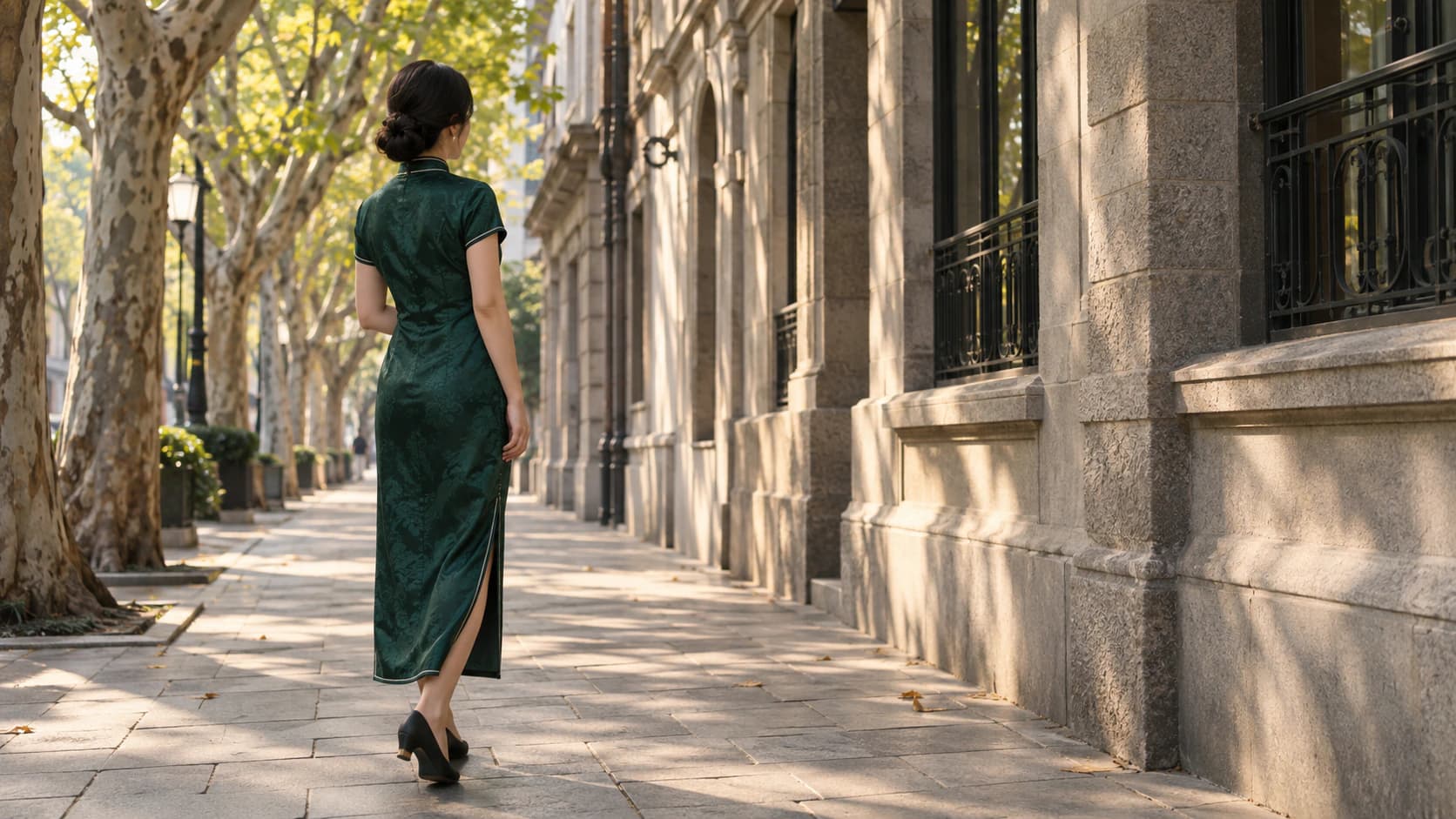
Illustrative effect reference created for this guide. It is not a documentary photograph or a promise of a specific street, access condition, studio result or garment inventory.
Use this visual relationship for a restrained outdoor set: the qipao supplies one clear color, trees soften the upper frame, and stone facades establish Shanghai without turning every photograph into a landmark postcard. A small route and natural movement usually produce a more coherent album than rushing through four famous locations.
The quick decision
Choose a commercial package when you want a fitted garment, complete hair and makeup, posing direction, controlled light and retouched files without assembling a team. It is the easier option for a solo traveler, a first portrait session or anyone who wants an interior set when the weather changes.
Choose DIY rental plus a friend or independent photographer when you want lighter makeup, more natural walking pictures, control over every original file and a public route at your own pace. It works best when the garment can be tried on before the shoot and the photographer already understands how to photograph fitted clothing without forcing stiff poses.
Choose rental only when the experience of wearing the qipao matters more than a polished album. A phone, a shaded street and eight planned frames can be enough. You still need a return deadline, a weather plan and shoes that let you walk safely.
If you want to own a garment made for repeated wear rather than rent one for a shoot, the Shanghai custom tailoring guide explains construction choices, movement tests, fitting calendars and final acceptance.
Allow three to four hours for a complete commercial appointment even when the photographed portion is shorter. Dressing, garment changes, hair, makeup, transfer, shooting, image selection and changing back all use time. A multi-look studio or a distant set can take much longer. Ask for the appointment's start-to-finish window, not just “one hour of photography.”
Choose one visual direction
1. 1930s glamour
This is the formal result: sculpted hair, defined eyes and lips, a long fitted qipao, elegant jewelry and a composed posture against stone, wood, brass or a controlled studio interior. It suits a visitor who wants one polished hero portrait, several full-length photographs and a small number of carefully retouched files.
Ask for soft directional light, restrained highlights, a complete garment silhouette and natural skin texture. A dark dress against a dark set needs edge light or a lighter wall. A pale embroidered qipao needs enough distance from a bright facade to keep the pattern visible.
Do not request the “style” of a named director, television series, photographer or film. A title can hide several visual choices and invites imitation instead of a clear brief. Describe the actual result: warm practical lamps, deep shadows that retain detail, a 50mm perspective, low saturation, one reflective surface and no modern objects in the final frame.
2. Restrained daytime qipao
This is the easiest style to integrate into a real Shanghai day. Choose a calf-length garment with a moderate slit, low heels or polished flats, and makeup that remains comfortable outdoors. The photographs rely on walking, turning, reading a doorway, adjusting a cuff and looking along the street rather than theatrical furniture or a heavy set.
Jade, ink blue, cream, tobacco brown and muted floral fabric work well under plane trees and beside pale stone. Very shiny satin can clip in direct sun. Tiny high-contrast patterns may create moiré on phone video. Photograph the chosen garment in window light before committing.
This direction is the best fit for the plane-tree architecture walk if photography is only one part of the afternoon. Keep the complete qipao session to one compact section of that larger route rather than wearing a restrictive garment for all 3–5 hours.
3. Cinematic neon or rainy noir
This style comes from light and blocking, not from copying a famous screen work. Ask for a dark garment with a visible edge, one warm practical light, a cool ambient street tone, wet reflections when weather supplies them naturally, and a simple action such as waiting under an arcade or turning toward a doorway.
The face still needs controlled exposure. “Dark and moody” should not mean crushed black fabric, orange skin or a background replaced by saturated neon. If you want a neon note, use one indirect colored light or reflection and keep any real sign out of focus rather than building the frame around readable branding. Request one clean color reference before the team applies a heavy grade to every delivered file.
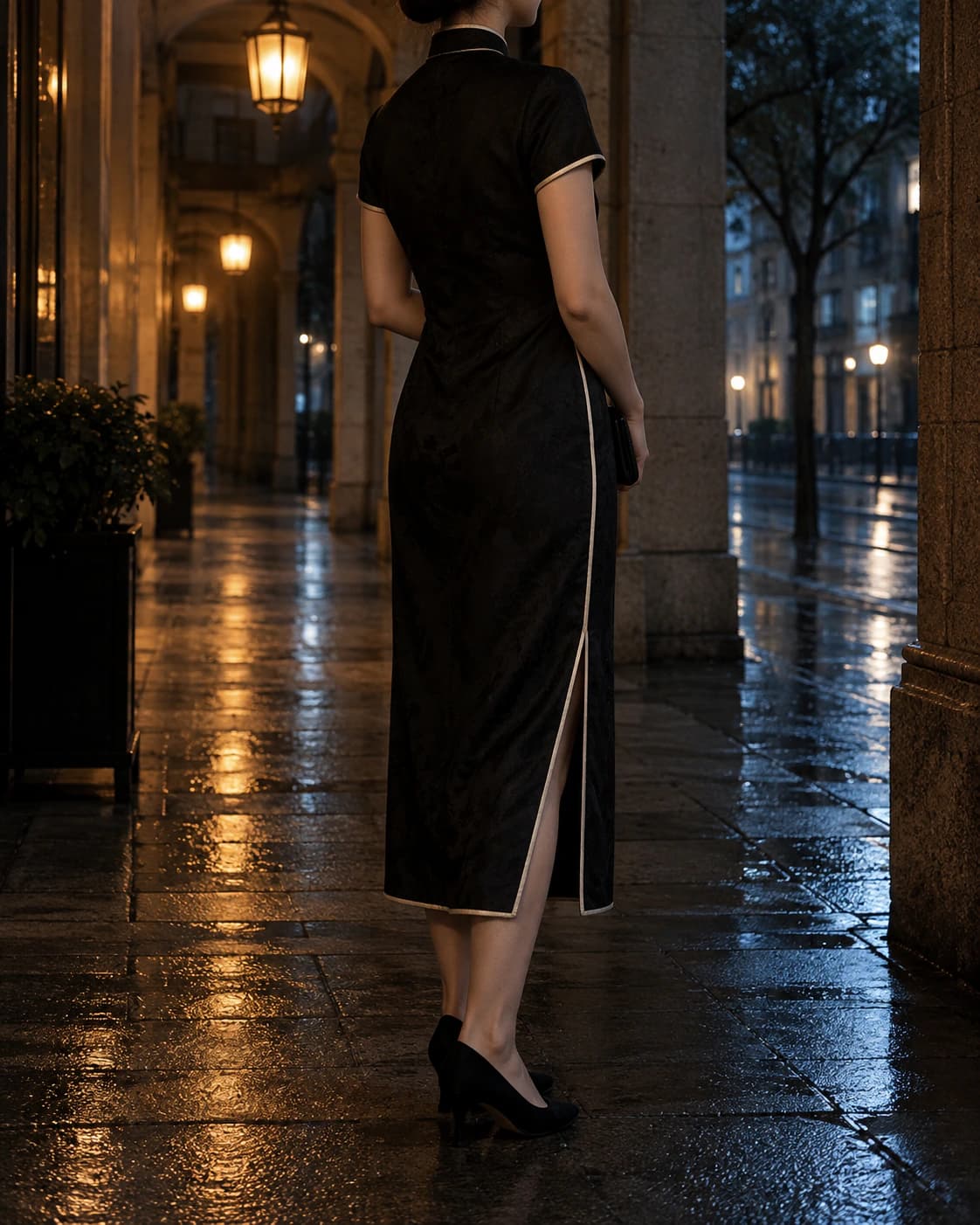
Illustrative effect reference created for this guide. It is not a documentary photograph or a promise of weather, venue access, an operator setup or final client results.
The useful lesson is modest: black fabric remains readable because pale piping separates it from the shadow, while warm lamps and cool reflected street light create two layers. You do not need a smoke machine, crowded neon street or unsafe roadway pose to make the frame feel cinematic.
Compare the complete package
Ignore labels such as “premium,” “film story” and “museum quality.” Ask the seller to complete this table for the exact option you intend to buy.
| Decision | What must be written down |
|---|---|
| Garment | Number of qipao changes, size range, alterations or clips, shoes, jewelry, outer layer, deposit and damage policy |
| Styling | Makeup, lashes, hairpiece or wig, hairstylist, change between looks, allergy process and removal help |
| Team | Assigned photographer and makeup artist, language support, assistant and whether the sample portfolio belongs to that team |
| Location | Exact studio or route, indoor fee, admission, transfer, changing room and written permission for a professional setup |
| Camera time | Start-to-finish appointment window, actual shoot time, number of sets and late-arrival rule |
| Files | Number of captured originals, whether all usable originals are delivered, format, resolution and transfer method |
| Retouching | Included retouched images, skin and body limits, color style, revision count and price for extra images |
| Delivery | Same-day previews or selection, final deadline, download-link expiry and rush fee |
| People | Solo, couple, friend, family or child pricing and whether each person receives styling and files |
| Changes | Rain, illness, location refusal, operator cancellation, rescheduling, refund and no-show terms |
| Rights | Private use, commercial use if needed, studio portfolio permission and deletion request |
Ask for one total price after every selected item has been added. “Makeup included” does not reveal whether lashes, hairpieces, removal or a second look cost extra. “All photos” may mean compressed previews rather than full-resolution originals. “Outdoor shoot” does not explain transport, admission or a rain substitute.
Save the package page and booking conversation. When staff suggest an upgrade during fitting or image selection, ask for the new total and the exact added deliverable before agreeing. There is nothing inherently wrong with buying an extra retouch; the problem is discovering that the useful files were never in the first quote.
Judge client photographs, not campaign covers
Request two or three complete recent client sets from the assigned photographer and makeup artist. A complete set exposes consistency in a way that a grid of hero images cannot.
Look for:
- a full-length frame where the hem, slit and shoes are visible;
- a seated or walking pose that proves the garment permits movement;
- a close portrait with natural skin texture and hair edges;
- hands that look relaxed rather than hidden in every image;
- straight doorways and believable body proportions after retouching;
- fabric detail in both highlights and shadows;
- backgrounds that match the location promised in the package;
- several clients with different face shapes, ages and body types.
Ask to see one unretouched preview beside the delivered retouch. You are checking whether the team's normal edit agrees with your preference. If you dislike narrowed shoulders, elongated legs, reshaped jawlines or very smooth skin, say so before selection: keep body shape and facial structure unchanged; correct only temporary blemishes, flyaway hair and distracting fabric wrinkles.
For an outdoor package, inspect work made in ordinary cloud, haze or crowds, not only one empty sunrise on a perfect day. For an interior package, check that several clients receive different poses and crops. A beautiful set that repeats the same chair, hand position and expression for everyone may be efficient, but it is not a personalized story.
Fit the garment for movement
A qipao can look correct in the mirror and fail as soon as you walk, sit or raise an arm. Try it with the undergarments and shoes you will actually wear.
Perform five checks before makeup is complete:
- walk ten normal steps without shortening your stride unnaturally;
- sit on a firm chair without the skirt pulling sharply across the hips;
- lift both forearms as if holding a phone or handbag;
- breathe fully and turn the shoulders without the collar pressing the throat;
- inspect the side closure, armholes, bust and slit from front, side and back.
Choose the size that moves cleanly rather than the smallest one that closes. Temporary clips should shape loose fabric without creating folds visible from the camera side. If a studio cannot fit the preferred design, change the dress rather than planning to reshape the body in editing.
Bring seamless neutral undergarments and, when useful, a slip that the studio approves. Avoid adhesive products you have not tested on your skin. Tell the stylist about fabric, cosmetic and lash-glue sensitivities before the appointment. A clean base layer also makes a shared garment more comfortable in humid weather.
For public routes, low block heels or flats are more useful than thin high heels. Carry the portrait shoes and walk between frames in comfortable footwear. The photographer can compose a full-length image after you change shoes on a dry, level pavement.
Hair and makeup that survive the route
Bring two front-facing photos of yourself in ordinary light and two reference portraits that show the desired intensity, not another person's face. State what you want preserved: brow shape, freckles, eyelid form, face shape, hairline or natural skin texture.
For 1930s glamour, a waved or pinned hairstyle creates most of the period signal. It does not need a large wig or ornate headpiece. Confirm whether the team builds the style from your own hair, adds pieces, or supplies a complete wig. Ask how the hairline and pins will look in profile.
For a daytime route, use a secure low bun, soft wave or short natural style that tolerates humidity and wind. Prioritize comfortable lashes, controlled shine and lip color you can repair. For a night set, ask the makeup artist to check the face under both warm and cool light before leaving the studio; a base that looks balanced at the mirror may turn gray or orange under street lamps.
Carry blotting paper, lip color, tissues, a few hairpins and a small mirror. Do not bring an entire dressing table onto a narrow pavement. A small crew should be able to move in one trip and clear the frame immediately when residents or visitors need the space.
Three location plans
The distances below are direct AMap walking legs in GCJ-02 coordinates. They describe movement between anchors, not total time. Photography, crowds, crossings and permission checks make the real session longer.
Route A: Yuanmingyuan Road to the Bund — formal city glamour
Start at Yuanmingyuan Road Pedestrian Street, use the stone facades and colonnaded edges around the wider Rockbund area, then finish at the northern Bund Viewing Avenue. AMap measures the direct walk at 0.9 km, about 13 minutes. Allow 60–90 minutes for a compact portrait set.
Use Yuanmingyuan Road for the full garment, doorway geometry and walking frames. Move to the waterfront for one city portrait rather than attempting an entire second session. The Bund guide explains the larger area; the free skyline guide is better when Shanghai's towers, not the qipao, are the main subject.
The Bund is a heavily managed public attraction. Shanghai's urban-management authority has specifically acted against on-site solicitation, prolonged occupation of viewpoints, and medium or large light stands and tripods that disrupt crowd order. A pre-arranged photographer should work handheld or with minimal equipment, leave a clear pedestrian path, make each setup quickly and follow staff instructions. Public access does not authorize blocking pavement or turning a busy viewpoint into a private set.
Best conditions: a weekday morning for cleaner pavement, or the final 60–90 minutes before sunset for warmer facade light. Blue hour adds skyline lights but also more people. Finish near East Nanjing Road and return by Metro Line 2 or 10, or use a legal ride-hailing pickup away from the most crowded waterfront edge.
Route B: Nanchang Road, Fuxing Park and Sinan — restrained daytime story
Begin at the Nanchang Road Tourist Service Center. Walk to Fuxing Park, a direct 0.3 km / 5-minute leg, then continue to Sinan Mansions, another 0.1 km / 2-minute mapped leg. Allow 60–90 minutes after adding side streets, waiting and a shoe change.
This route suits a softer qipao, natural hair and a sequence of walking, bench, garden-edge and facade frames. Photograph on public paths. Do not treat an open gate, hotel entrance, residential lane, cafe table or villa courtyard as permission to stage a crew. Sinan Mansions mixes commercial, hospitality and residential uses, so current signs and staff directions control individual spaces.
The route is compact enough to stop when the garment becomes uncomfortable. It also returns easily to Middle Huaihai Road and Metro Line 13. If you want a longer architecture day after changing back into ordinary clothes, continue with the French Concession citywalk.
Route C: an indoor old-Shanghai set — rain insurance, not assumed access
1192 Lane Old Shanghai Style Street is mapped inside Century Link at LG2, 1192 Century Avenue. Its recreated streets and covered location explain why it appears repeatedly in qipao portfolios. It is also a managed shopping-center interior. Confirm the current opening status, the exact area available, whether a paid photographer may work there, and whether lights, stands or costume changes need approval. A social-media post proves that someone made a photograph; it does not grant the next crew permission.
Century Avenue Station gives this option strong return logistics. Keep the set small, avoid shop entrances, and have a studio-only fallback if mall management restricts professional work on the day.
Shanghai Film Park is a different proposition. Its 1930s Nanjing Road set, shikumen lanes and period streets look ideal on paper, but the current operator-sourced visitor notice says commercial filming and advertising are prohibited. It also warns that active productions can close or interrupt roads. Current ordinary hours are listed as 08:30–16:30, last entry 15:30, with later holiday hours, but recheck the current Shanghai Film Park notice before traveling to Songjiang. Do not book an outside paid shoot there unless the park gives written permission for the exact activity and equipment.
Rain and interior alternatives
Light rain can improve a night frame, but it should never be promised. It also creates slippery stone, damp hems, makeup transfer and equipment risk. A useful weather plan names the replacement result rather than saying “we shoot in all weather.”
Choose among three substitutions:
- Studio set: preserve the complete makeup, garment and file package; replace location variety with controlled light and more portrait time.
- Covered arcade or doorway: only with current access and permission; work handheld, keep the entrance open and never shelter on a resident's threshold.
- Reschedule: best when the paid value depends on the Bund, plane-tree light or a night reflection. Put the decision time, refund and new-date policy in writing.
Carry a clear umbrella only if it belongs in the shot and can be used without blocking others. A long qipao hem should not drag through puddles. If rain begins after makeup, protect the face and hair first, change into walking shoes, and let the photographer decide whether the equipment can continue safely.
In hot or humid weather, schedule outdoor photographs first and the most controlled close portraits before shine and flyaway hair increase. In winter, wear a coat between frames and limit exposed standing time. Ask whether an indoor waiting and changing space remains available throughout the appointment, not only at check-in.
A schedule that protects the rest of your day
Commercial session
Use this baseline and adjust it to the written package:
- Arrival and contract check — 15 minutes: confirm selected package, balance, garment return, final location and weather decision.
- Garment fitting — 20–40 minutes: try the complete outfit, sit and walk, then make one clear choice.
- Hair and makeup — 60–90 minutes: longer for a sculpted wave, wig or second look.
- Transfer and setup — 20–40 minutes: include elevators, parking, ride-hailing and walking in ordinary shoes.
- Photography — 45–90 minutes: one compact route or two controlled interior sets is enough.
- Change, return and file check — 20–40 minutes: confirm that originals were recorded and the return is signed off.
- Selection — 20–60 minutes: if same-day selection is included, budget for it instead of squeezing it before dinner.
Do not put a timed train, airport transfer, cruise or theatre entry immediately afterward. Protect at least 60 minutes beyond the promised finish. If the studio keeps the qipao until you return from an outdoor route, confirm its closing time and the late-return fee before leaving.
DIY session
Use 90 minutes for one route: 15 minutes to dress and test movement, 60 minutes for eight planned frames, and 15 minutes to change or reach the return point. Put the garment deadline in the phone calendar. Photograph the dress at pickup and return so existing damage, accessories and deposits are clear.
Consent, privacy and public boundaries
A portrait session can involve close physical direction. Agree on the boundary before the camera starts. The photographer may demonstrate a shoulder angle or hand position without touching you. If adjustment is necessary, staff should ask first. You can replace any seated, leaning, lifting or paired pose without explaining why.
Write down who may receive and use the files:
- the photographer and retoucher assigned to the order;
- the delivery platform or cloud link;
- the studio portfolio, social accounts and advertising;
- any makeup artist or location partner who wants to repost;
- facial or body retouching services outside the core team.
Portfolio permission should be optional and specific. Declining it should not reduce the files you paid for. Ask how long unselected originals remain stored and how to request deletion after delivery. Download everything before the link expires, then make a second local or cloud copy.
In public, avoid photographing residents through windows, workers who cannot move away, worshippers, children, security posts and people receiving services. Do not block a building entrance while waiting for a clean background. A narrow lane may look empty for two seconds and still be someone's route home.
The garment is clothing, not permission to perform a stereotype. Keep gestures, props and captions grounded in the visual concept you chose. Fans, cigarettes, weapons, mahjong tiles, alcohol bottles and exaggerated “socialite” acting are optional narrative objects, not proof of Shanghai history. Use a prop only when it has a clear purpose and the location permits it.
An eight-frame shot list
This list works for a commercial team or one friend with a phone. Complete it before adding novelty poses.
- Full garment, front three-quarter: camera around waist height, feet visible, one step of space around the hem.
- Walking profile: a short natural stride, eyes toward the route, hands occupied lightly with a small bag or cuff.
- Back and collar detail: hair lifted clear of the collar, garment seam and piping sharp.
- Window-light portrait: face turned toward soft light, background one or two stops darker.
- Seated frame: knees and hem arranged comfortably, spine long, one hand relaxed rather than hidden.
- Architecture wide: the figure occupies less than one third of the frame and the facade supplies context.
- Reflection or doorway layer: shoot through clean glass or use a bright threshold, without entering private space.
- Closing motion: one turn, coat-on frame or walk away from camera that ends the set naturally.
For a phone, use the main lens for full-length frames and a 2× or 3× optical lens for portraits when the device has one. Avoid the ultra-wide lens close to the body; it stretches limbs and bends architecture. Tap the face, reduce exposure slightly when highlights clip, and make a short burst during each step or turn.
For a camera, a 35mm lens covers the architecture frames and a 50–85mm range gives calmer portraits. Start around 1/250 second for walking, open the aperture only enough to keep the important garment edge sharp, and raise ISO before accepting motion blur. At night, stabilize your body against a legal fixed position rather than placing a tripod in a busy path.
Capture five seconds of simple video at each setup: fabric moving during a step, a hand closing a cuff, a turn beneath a lamp and the final walk away. Ask for a version without embedded commercial music if you plan to edit or publish it later.
What to carry
- passport copy or booking name if the operator requires identity confirmation;
- written package and exact meeting pin;
- seamless neutral undergarments and an approved base layer;
- comfortable walking shoes plus the portrait shoes;
- coat or shawl that covers the garment between frames;
- lip color, blotting paper, tissues, hairpins and a small mirror;
- water, but no staining drink near a borrowed garment;
- power bank and enough phone storage for originals and video;
- a foldable bag for your clothes and accessories;
- the studio address, return deadline and local contact in Chinese.
Keep jewelry and props minimal. Every object creates something else to track during a public route and another possible damage charge at return.
The booking message to send
You can adapt this short brief before paying:
I want one [1930s glamour / restrained daytime / cinematic night] qipao look for one person. Please confirm the exact qipao size range, hair and makeup, assigned photographer's recent complete client set, start-to-finish appointment time, exact location, indoor fee or permission, all-original-file policy, number of retouched images, revision count, delivery deadline, rain/reschedule rule, garment return time, total price and whether my face or photographs may be used in your portfolio. Please list any possible extra charge separately.
Attach two visual references and label what you like: garment silhouette, light, hair, framing or color. Do not ask the team to copy another client's face, body, pose sequence or complete creative work.
Continue planning Shanghai
Pair the session with sightseeing only after changing back into comfortable clothes. The Shanghai city guide helps place it within a longer stay. Choose the plane-tree architecture route for a quiet daytime continuation, or the free skyline route when you want blue-hour city photographs without wearing the qipao for another long walk.
One coherent look, one compact location plan and a written file contract usually produce a better result than the largest costume closet or the longest list of landmarks. Decide what the final twelve photographs should feel like, then pay for the team and route that can actually deliver them.