Shanghai custom tailoring: buy a fitting process, not a “24-hour suit”
Shanghai is a sensible place to commission clothing when you can stay long enough to complete at least one meaningful fitting and one final acceptance check. It is a poor plan when you arrive with a screenshot, pay in full, leave the city the next morning and expect the finished garment to solve every fit problem by international post.
The best outcome begins with one decision: do you need true bespoke work, made-to-measure, an altered ready-made garment, or ordinary alterations? These are different services with different timelines, risks and prices. In Shanghai, all four may be described in English as “custom.” The label on a storefront is therefore less useful than asking how the pattern is created, when you will try the unfinished garment, and who can change it after that fitting.
This guide covers the purchase from first brief to final packing. It does not rank permanent “best tailors.” Market tenants, staff, turnaround and quality change, and a tailor who handles a standard business suit well may not be the right maker for a structured qipao, unlined linen jacket or formal evening dress.
Use the Shanghai Chinese brands shopping route for ready-to-wear retail and the China shopping guide for national product categories. Custom tailoring is a commissioned service with repeat appointments, so it needs its own schedule and evidence trail.
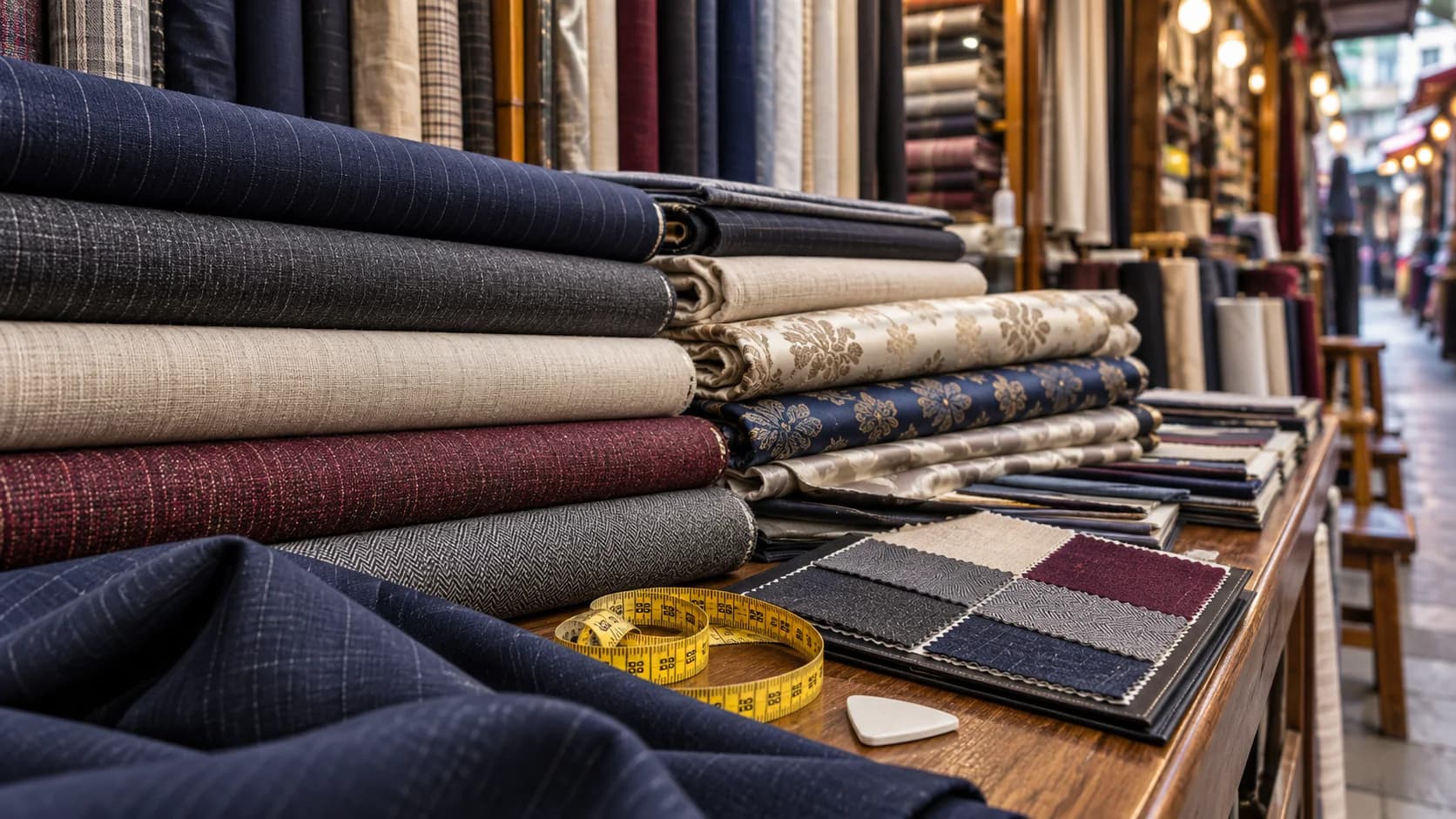
Fabric selection is only the start. This editorial scene illustrates the decisions at a tailoring counter; it does not document a particular Shanghai shop or prove any fabric claim.
The quick feasibility test
| Time remaining in Shanghai | What is realistic | What to avoid |
|---|---|---|
| One day | Compare makers, buy fabric only when you understand its use, alter a simple hem or sleeve if a reputable workshop confirms same-day work | A new suit, fitted qipao or formal dress promised without a proper fitting |
| Two to three full days | Straightforward alterations; possibly a simple made-to-measure shirt or loose garment with an early fitting and in-person pickup | Complex jackets, corseted dresses, highly fitted qipao and anything required for a fixed event immediately after departure |
| Four to six days | Some made-to-measure shirts, trousers, simple dresses or jackets when the maker controls production and confirms a fitting slot before payment | Assuming “four days” includes corrections discovered at final pickup |
| Seven to fourteen days | A practical minimum for many visitor commissions: measurement, intermediate fitting, correction and final check | Filling every day with distant day trips that make fittings impossible |
| Three to six weeks | The safer window for a structured suit, multiple garments, difficult posture correction, formal dress or qipao with construction changes | Paying for speed you do not need or approving by photo when you can return in person |
These are planning bands, not Shanghai-wide production rules. A workshop with an in-house cutter may move faster than a sales counter that sends work elsewhere. Public holidays, wedding season, fabric availability and remake work can lengthen any promise. Ask for dated appointments, not “about a week.”
If the garment must be worn at a wedding, conference or performance, set the contractual final delivery several days before the event, not the morning of it. Your event date is not the tailor's alteration buffer.
Know which product you are buying
Bespoke or fully drafted custom
A bespoke process normally begins with a pattern drafted for your body rather than a pre-existing size block. It may include a basted fitting in which major seams and internal structure remain adjustable. The cutter uses that stage to change balance, shoulder slope, posture, sleeve pitch, waist position and other relationships before finishing the garment.
The word bespoke alone proves none of this. Ask: “Will you draft a new individual pattern? May I see the first fitting before the lining and buttonholes are finished? Who is the cutter?” If the answer is that measurements are entered into a factory system and a standard block is modified, the product may still be good, but it is closer to made-to-measure.
Made-to-measure
Made-to-measure, often abbreviated MTM, adjusts an existing house pattern using measurements and posture observations. It can provide an excellent result for a traveler whose body is reasonably compatible with the block and whose preferences are clear. The crucial variable is the fitting process: some MTM orders arrive nearly finished, leaving limited room for structural correction; others include an intermediate stage.
Ask which adjustments are built into the pattern, which are made after construction, and whether the shop will remake a piece when alteration cannot correct it. A long measurement sheet does not automatically mean bespoke construction.
Made-to-order and altered ready-to-wear
A made-to-order garment may use an existing model in your selected size, cloth and details. An altered ready-to-wear suit starts as a finished garment, then changes sleeve, trouser, waist or other accessible seams. Both can be the right answer when the base garment already fits the shoulders, chest and balance.
Do not pay bespoke expectations for a ready-made jacket with shortened sleeves. Ask to see the garment or base sample before committing and write base size plus included alterations on the order.
Alterations only
An alteration changes clothing you already own. Hemming trousers is relatively contained. Shortening a jacket sleeve with working buttonholes, narrowing shoulders, changing a qipao collar or restructuring an armhole is not. Bring the exact shoes, shirt, bra or base layer that controls length and shape. Ask what cannot be changed cleanly before the garment is opened.
Choose a buying environment, then choose the maker
The South Bund Soft-Spinning Material Market at 399 Lujiabang Road (陆家浜路399号) remains a major comparison venue. It is near Nanpu Bridge Metro Station and brings many small tailoring businesses into one building. That concentration makes it useful for seeing sample garments, fabric books and working styles without crossing Shanghai.
The market is a venue, not a quality certificate. Each tenant is a separate business. Stall numbers, staff, production arrangements and hours can change. Compare at least three makers before paying, then record the registered merchant name shown on the payment or receipt—not only the market nickname or a salesperson's social-media account.
An independent studio elsewhere in Shanghai can offer quieter appointments, more consistent house styling and a clearer single team. It can also charge more for presentation and service without using a fundamentally different production method. Judge what happens behind the consultation: who measures, who drafts or adjusts the pattern, where cutting and sewing occur, how many fittings are included, and who has authority to approve a remake.
A luxury hotel arcade or famous shopping street does not guarantee technical fit. A crowded market stall does not guarantee value. The process is the product.
Shortlist a maker in 30 minutes
Bring one garment that fits reasonably well, two reference images, your event or use case, and a written maximum budget. At each candidate, perform the same short audit.
- Ask for recent, ordinary client work. Inspect an unfiltered complete suit or garment from front, side and back. Campaign photographs hide balance and construction.
- Handle sample garments. Look at collar contact, lapel roll, pattern matching, seam smoothness, buttonholes, lining attachment, hem and inside finishing. For a qipao or fitted dress, inspect the collar, piping, closures, darts, side seams and slit reinforcement.
- State one fit problem. Examples: a low right shoulder, trousers pulling at the seat, sleeves rotating forward, a collar standing away, or a dress that restricts stride. Listen for a specific diagnosis rather than “custom will fix it.”
- Ask who does the work. Separate salesperson, measurer, cutter, sewer and alteration tailor are normal, but responsibility must remain clear.
- Request the full timeline. Get measurement, first fitting, second fitting if any, promised completion, correction buffer and final collection dates.
- Test communication. Ask the maker to repeat your three non-negotiables in their own words. Translation apps help with vocabulary but do not replace agreement.
Leave if the salesperson refuses to write a total, will not identify the fiber composition, pressures you to pay before showing samples, or promises an extremely short delivery without reserving a fitting. Also leave if the only answer to a structural fit concern is “we can Photoshop the photo” or “everyone wears it tight.”
Build a one-page garment brief
A reference image communicates mood, not a complete specification. Make a one-page brief for each garment and let the tailor annotate it in Chinese if useful.
For a suit or jacket, include:
- primary use: business, wedding, travel, dinner, performance or frequent office wear;
- climate and season at home;
- preferred silhouette: close, regular or relaxed;
- jacket length, shoulder expression, waist suppression and lapel width;
- single- or double-breasted front, button count and vent style;
- trouser rise, waistband, pleats, side adjusters or belt loops, leg shape and hem;
- lining level and internal construction promised;
- usable pockets and whether a phone must fit;
- shoes and shirt to be worn at the fitting.
For a qipao or dress, add:
- collar height and whether it feels comfortable while sitting;
- sleeve shape, arm movement and intended base layer;
- closure type, opening direction and whether decorative fasteners are functional;
- fitted or relaxed ease at bust, waist and hip;
- finished length and shoes;
- slit position and maximum height;
- piping, lining and seam-finish choices;
- pattern placement across the front, back and major seams;
- walking, sitting and stair requirements.
Use body-neutral instructions. “I need a full walking stride and room to sit for two hours” is clearer than “make me look thinner.” A tailor needs functional ease, posture and silhouette priorities, not permission to force the body into a photograph.
Measurement: numbers plus posture
Wear thin, stable clothing to the first measurement. Empty pockets. Stand naturally instead of pulling shoulders back or holding the stomach in. A rigid “good posture” creates a garment for a pose you cannot maintain.
A capable measurer observes shoulder slope, forward or erect posture, chest and back balance, hip level, arm position and asymmetry in addition to circumferences. More numbers are not automatically better; the value comes from converting them into a pattern and checking that pattern on the body.
Tell the tailor about mobility needs, braces, prostheses, sensory issues, pregnancy-related change, weight change or a device carried under the garment when relevant. You decide how much personal information to share. The garment specification can state the functional requirement without a diagnosis.
Photograph the completed measurement sheet with permission. Ask whether measurements describe the body or the finished garment; they are not interchangeable. Request a written record of the chosen base size or pattern system when the order is made-to-measure.
Fabric: verify the claim before discussing “Super” numbers
Choose fiber and weave for the real use. Tropical-weight wool can suit warm offices and travel. A heavier worsted may drape better in cool weather. Linen breathes but wrinkles; that is a property, not automatically a defect. Silk can show abrasion and water marks. Stretch blends may improve movement but do not guarantee shape recovery. For qipao and dresses, surface beauty must be balanced against seam stability, opacity, lining and comfort.
Ask the seller to write:
- fiber composition and percentage;
- mill or brand only when it is being sold as such;
- fabric book name, bunch number, article code and color code;
- whether the cloth is in stock or must be ordered;
- whether the quoted cloth shown is the cloth that will be cut;
- care method and shrinkage or color-transfer warnings;
- enough reserve cloth for a later repair, when available.
Photograph the swatch beside its book label and your order. If a selvage carries a mill name, photograph it, but do not treat a printed edge as conclusive authentication. Ask for the remaining offcuts at delivery. Offcuts help with future repairs and make substitution harder, though they still do not independently certify origin.
Do not buy on thread count alone. “Super 120s,” for example, describes fiber fineness within a wool-classification context; it is not a universal score for durability, origin, construction or value. Very fine cloth can be less forgiving in a suitcase. Compare handle, opacity, recovery after gentle crushing, intended season and how the sample garment hangs.
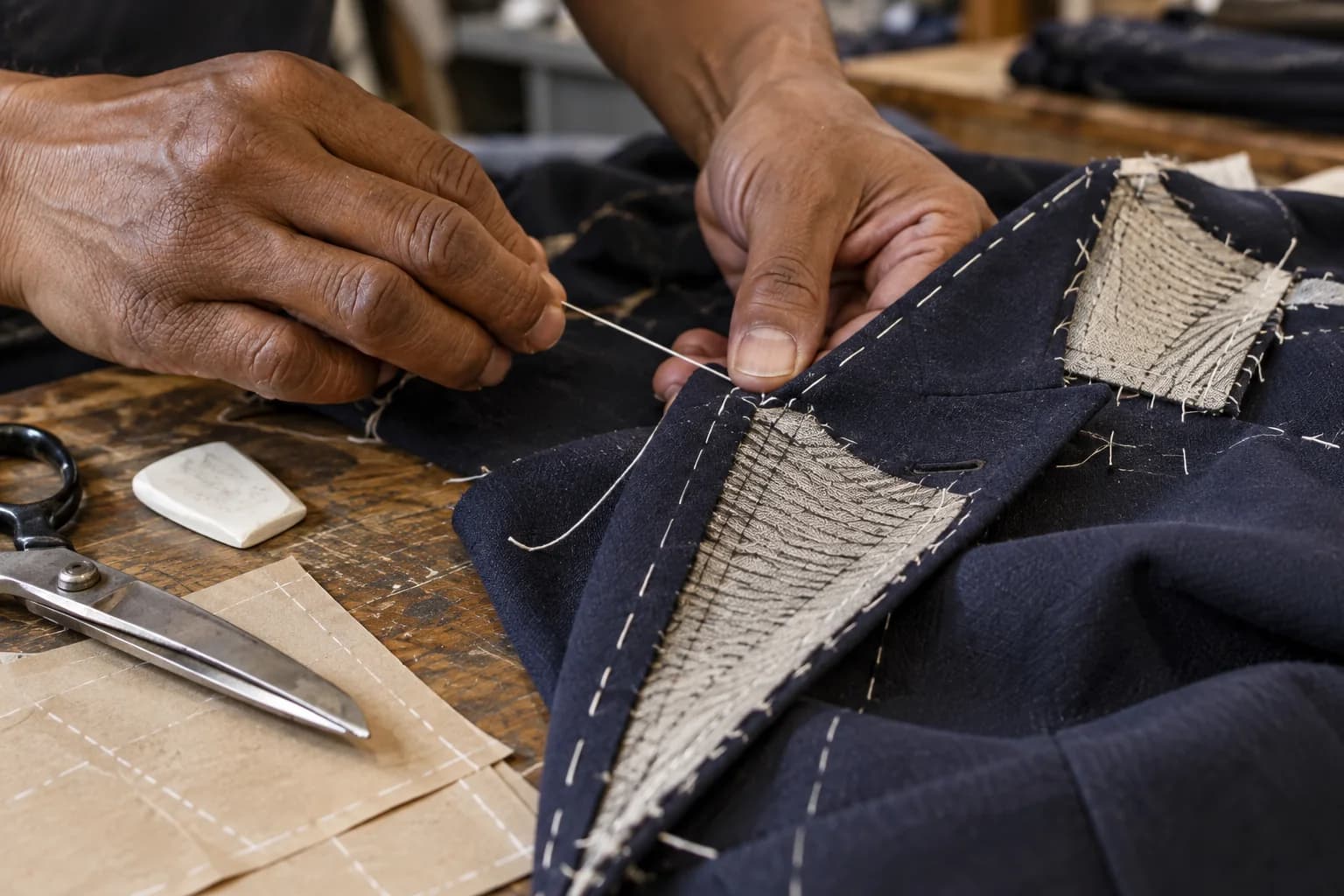
Visible basting can make a fitting more informative because major relationships remain adjustable. This process image illustrates construction rather than documenting the methods of any named Shanghai tailor.
Make the quote comparable
A verbal “two-piece suit” or “qipao package” hides too much. Ask for an itemized total in RMB before paying. The order should identify:
- every garment and spare item;
- exact fabric and lining;
- construction level promised in ordinary language;
- buttons, embroidery, handwork or special closures;
- pattern drafting or made-to-measure basis;
- number and type of fittings;
- included alterations and their deadline;
- rush fee, delivery fee, card fee or translation/service fee;
- tax and invoice status;
- deposit or advance payment, balance date and accepted payment method;
- remedy if the merchant misses the written deadline or the garment materially differs from the agreed specification.
Ask whether the quote depends on purchasing several pieces. A “free shirt” can distract from a jacket that does not fit; list the shirt's fabric, fitting and delivery like any paid item. Do not accept a blank order sheet to be completed after payment.
For payment, use a method that produces a traceable merchant record. Save the transaction, invoice or receipt, order form, shop address, registered business name, contact, fitting messages and photographs in one phone folder backed up online.
Deposit language matters
Chinese receipts may use 定金, 订金, 预付款 or another description for money paid before completion. These terms can have different contractual consequences, and English “deposit” does not resolve the difference. Do not rely on a memorized legal slogan at the counter. Write what happens if you cancel, the merchant cancels, fabric becomes unavailable, a deadline is missed, or an uncorrectable specification error appears.
Pay the smallest advance that reasonably secures fabric and production, then keep a meaningful balance for final acceptance. If a merchant requires full payment, the written specification and remedy become even more important. A tourist's departure pressure reduces practical bargaining power after the money is gone.
Fittings: test motion before studying the mirror
Wear the planned shirt, base layer, bra, belt if relevant, and shoes. Bring nothing bulky in pockets. At every fitting, use neutral front, side and back photographs for comparison after asking permission.
For a jacket or suit:
- Stand naturally with the jacket buttoned as intended.
- Check whether the collar stays near the shirt collar without a gap or roll.
- View shoulder ends and sleeve hang from both sides.
- Look for horizontal or diagonal pulling at chest, waist and back.
- Sit, reach forward, shake hands and raise forearms as you would at work.
- Put a phone in the chosen pocket.
- Check shirt-cuff exposure with arms relaxed, not held rigidly.
- Sit and walk in the trousers; inspect rise, seat, thigh, knee and hem with the correct shoes.
For a qipao or fitted dress:
- Take ten normal steps and climb several safe stairs.
- Sit on a firm chair for two minutes.
- Breathe fully and turn the torso.
- Lift the forearms, reach for a bag and test the actual event movement.
- Inspect collar pressure, armholes, bust, waist, hip and slit from every side.
- Check that closures lie flat and pattern placement does not create an unintended focal point.
- Confirm the hem after shoes are on.
Describe the symptom before prescribing a fix: “the collar touches my neck,” “the right sleeve twists,” “the pocket opens when I stand,” or “my stride stops here.” Let the cutter identify the structural cause. Pinning only the visible wrinkle can move the problem elsewhere.
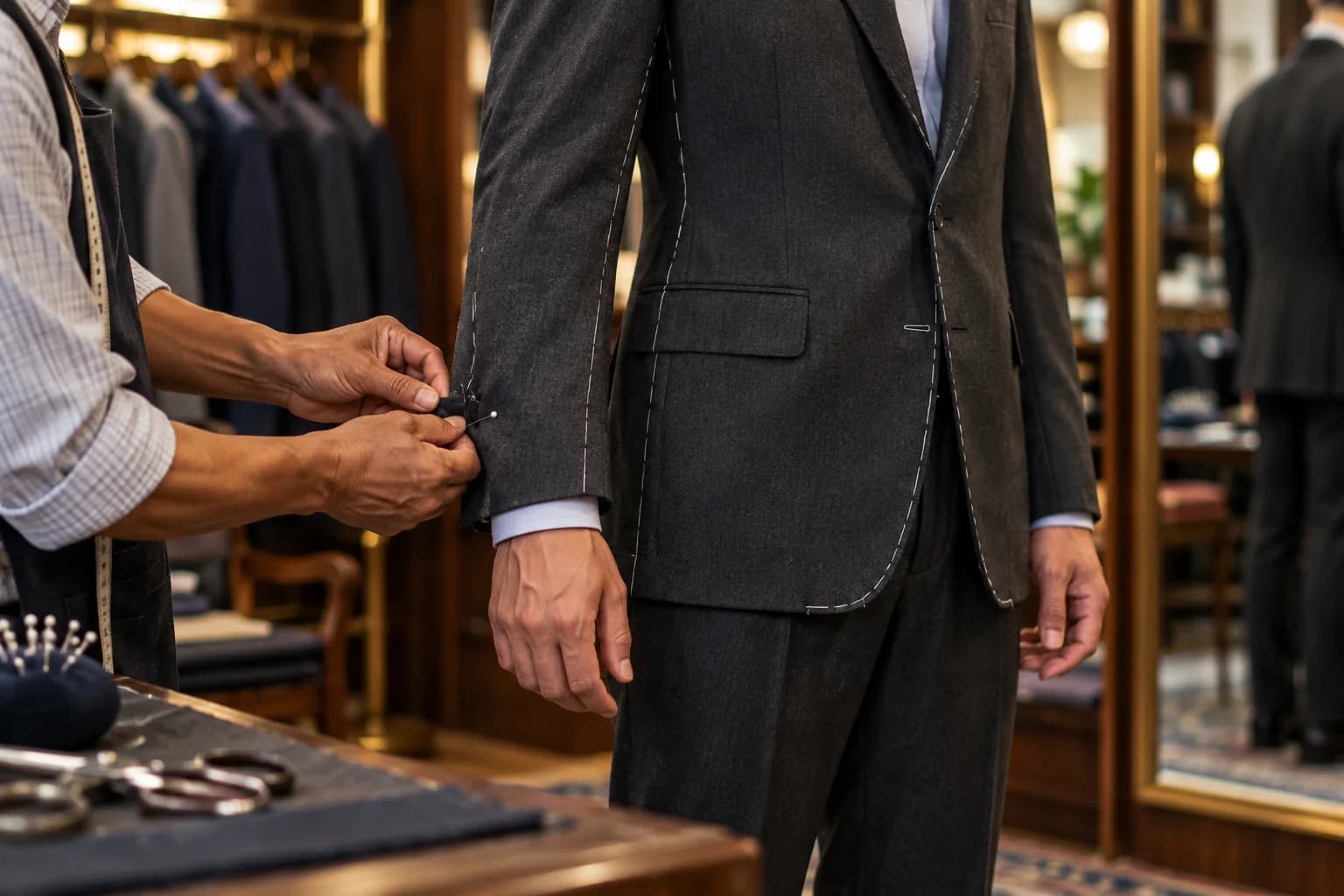
An intermediate fitting should test balance and movement while change is still possible. This scene illustrates a fitting layout; actual construction and equipment vary by maker.
Do not approve a fitting merely because the salesperson says wrinkles are normal. Some are normal consequences of movement and cloth; others reveal balance, pitch or tightness problems. Ask which marks will disappear after pressing, which require alteration and which are a limitation of the chosen model. Record the agreed changes in the order chat before leaving.
Final pickup is an acceptance appointment
Allow at least 45–60 minutes, preferably early enough for same-day correction. Arrive in the same supporting garments and shoes. Inspect under neutral light, then repeat the movement test.
Check the delivered order against the written specification:
- fabric, color, lining and garment count;
- major dimensions and silhouette;
- buttons, closures, pockets, cuffs, vents, slits and hem;
- left-right balance and pattern matching where promised;
- loose thread, skipped stitch, puckering, needle damage, stain, shine or press mark;
- functioning zip, buttonhole and fastener;
- spare buttons, offcuts, garment bag and care instructions;
- invoice, receipt and any tax-refund documents.
Photograph a defect before it leaves your sight. Mark it with removable tailor's chalk, a pin placed by staff, or a written diagram—never with permanent ink. Agree on the specific remedy and pickup time. “Fix everything” is hard to verify; “right sleeve rotates forward and cuff is 1.5 cm longer than left when standing naturally” is actionable.
Do not let departure anxiety turn an unfinished garment into acceptance. If correction cannot be completed, decide in writing among local alteration reimbursement, merchant-paid return shipping, partial refund, remake or another concrete remedy. The right solution depends on the defect and agreement; it is not automatically a full refund.
Remote alterations and international delivery
Remote work is the weak point of travel tailoring. A photo cannot reliably show balance, shoulder shape or the amount a seam can release. Before leaving Shanghai, ask for:
- a named after-sales contact who can authorize a remedy;
- the period during which fit corrections are included;
- whether a local tailor may alter the garment without ending the merchant's responsibility;
- the maximum reimbursable local-alteration amount and required evidence;
- who pays each direction of shipping for an agreed defect;
- courier, declared value, insurance and customs-description responsibility;
- what happens if the parcel is delayed, lost, taxed or returned;
- whether the merchant keeps your pattern and for how long;
- written measurements and fabric codes for a future order.
Never mail a valuable garment internationally on the basis of “send it back and we will see.” Obtain the return address, recipient, phone number, courier method, declared description and remedy before dispatch. Photograph the garment, label, packaging and parcel weight. Keep tracking and customs forms.
For a repeat remote order, compare your current body measurements with the original and state every desired difference. Even when the pattern is saved, cloth, workshop staff and production can change. A successful first suit is evidence for another fitting, not proof that every future order will be identical.
Defects, disagreement and refunds
Customized goods do not carry a blanket promise that a customer can change their mind after completion. China's statutory seven-day no-reason online-return rule excludes goods made to a consumer's specification. That does not erase remedies when goods or services fail an agreed quality requirement. The written order, actual defect, merchant promise and applicable law matter.
Start with the smallest remedy that produces the agreed result: correct, remake the affected piece, replace an incorrect component, reimburse a documented local alteration, reduce the price, or refund when the contract purpose cannot reasonably be achieved. Keep communication factual and specific.
If direct discussion fails:
- Ask the market management or building's consumer-service desk to mediate when the merchant trades inside a managed venue.
- Preserve the seller's registered Chinese name, address, order, payment, invoice, messages, dated photographs and the remedy requested.
- Use China's 12315 market-regulation complaint channel when the dispute falls within its scope. A vague English shop nickname is much less useful than the registered seller and evidence.
- For a high-value or complex dispute, obtain qualified local legal advice rather than assuming a social-media formula decides the case.
Do not threaten, publish personal information or surrender the only original documents. Keep the garment when practical until the return terms are written; handing it back without a receipt can create a second evidence problem.
Packing, airline baggage and customs
Let a freshly pressed garment cool and dry before packing. Ask for a breathable garment bag, then use one of two methods:
- Carry-on garment fold: turn one jacket shoulder partly inside out, nest the other shoulder into it, align lapels gently and fold once at the waist with tissue or a soft shirt between surfaces.
- Large checked suitcase: place trousers along their crease, use a broad fold, keep hard shoes and toiletries away from the garment, and avoid compressing structured shoulders under heavy objects.
Carry irreplaceable wedding or event clothing in the cabin when airline rules permit. A garment bag does not automatically receive an extra baggage allowance; confirm dimensions and item count with the operating airline. Put invoices, fabric codes and the tailor's contact in digital storage rather than the checked bag.
China Customs applies personal-use, reasonable-quantity and truthful-declaration principles to passenger baggage. Your next country applies its own import allowance, duty, tax and declaration rules to purchases made in China. A suit worn once is not automatically exempt, and several similar new garments can look commercial. Keep the invoice and check the customs authority for the country where you will enter. This guide cannot turn a purchase into a nationality-specific allowance.
If the merchant ships later, the parcel is an import into the destination country and may attract duty, tax, brokerage or documentation requests. Agree who bears those costs; “free shipping” does not mean tax-free import.
Departure tax refund: check the shop, not the market reputation
China's current departure-tax-refund framework lowered the qualifying same-day spending threshold at one participating tax-refund shop to RMB 200 in 2025. That threshold does not make every tailor eligible. The actual merchant must be a participating refund shop, the traveler and goods must meet current conditions, and the seller must issue the required documents.
Ask before the deposit:
- Is this exact registered merchant a departure-tax-refund shop today?
- Will this order receive the required VAT invoice and refund application form?
- On what date is the sale recorded if deposit and balance are paid separately?
- Will the goods be finished within the current departure window?
- Can they remain in the condition required for customs verification?
- Does “refund upon purchase” apply, and what card or guarantee process does it use?
Do not choose a weaker tailor for a possible refund. Fit, delivery and evidence are worth more than an assumed percentage. Follow the complete China departure tax-refund guide for eligibility, documents, Customs inspection, departure-port procedure and current official links.
A schedule that fits a Shanghai trip
Seven-night visit
- Day 1: arrive and settle; do not measure after a long flight if swelling or posture feels unusual.
- Day 2 morning: compare makers, confirm brief, measure and pay the agreed advance.
- Day 4 or 5: intermediate fitting before a full sightseeing day.
- Day 6 morning: final fitting and corrections.
- Day 7: pickup buffer, packing and documents.
Keep appointments near the center of the day plan. A market visit at South Bund can pair geographically with an ordinary central-city afternoon, but avoid a distant water town or theme-park reservation before a fitting. Use the Shanghai two-day citywalk to place regular sightseeing around fixed tailoring appointments rather than moving those appointments repeatedly.
Four-night visit
Pre-arrange the first appointment and send only general preference references—not final measurements—before arrival. Measure on Day 1, fit on Day 3 and reserve Day 4 for collection. Choose made-to-measure or alterations only when the maker confirms the construction stage and correction buffer. Treat international shipping as a fallback, not the default plan.
One- or two-night stopover
Buy ready-to-wear and use simple local alterations, or commission only when you are comfortable completing the process on a later Shanghai visit. The Shanghai Chinese brands route is better suited to a short retail day. A rushed “custom” order is not more authentic than a well-fitting finished garment.
The order message to send before paying
You can adapt this concise brief:
I want one [garment] for [use and climate], finished by [date and time]. Please state whether this is a new individual pattern, made-to-measure from a house block, made-to-order, altered ready-to-wear, or alterations only. Confirm the exact fabric composition and code, lining and construction, included fittings, measurement and fitting dates, all fees, advance payment and balance, included corrections, remake/refund remedy for a material specification error, international aftercare and whether this registered merchant can issue current departure-tax-refund documents. Please write every agreed change on the order.
Attach no more than two or three reference images and label the exact feature in each: lapel width, trouser rise, collar shape, sleeve, silhouette or fabric mood. Do not ask a maker to reproduce another designer's complete protected design or another client's garment exactly.
Final checklist
Commission in Shanghai when the city stay can support the process. Choose the service model before the maker, judge samples before fabric marketing, and put fit, material, price, dates and remedies into one written order. Attend the intermediate fitting, move in the garment, and keep enough time for correction before the international departure.
A successful purchase is not the cheapest quote, the most measurements, the fastest promise or the most famous market stall. It is a garment whose construction matches the order, whose movement matches your life, and whose final acceptance happens while the responsible team can still fix it.
Location, consumer, tax-refund and customs baselines checked October 3, 2026. Market tenants, opening hours, production times, merchant participation, tax procedure and border rules can change; verify them for the actual order and departure.