Shanghai plane-tree photo walk: Changshu Road to Xujiahui
Shanghai's “plane-tree district” is not an official district with a gate. It is a convenient name for the connected historic streets west of the center where mature trees, garden residences, apartment buildings, schools, churches and ordinary neighborhood life share the same blocks. The famous Wukang Road corner belongs to this wider urban landscape, but it is not the only place to photograph it.
This guide follows a quieter, southbound route from Changshu Road Station through Fenyang Road, Dongping Road, Taojiang Road and Hengshan Road, then finishes in Xujiahui Park. The direct movement between the principal anchors is only about 2.2 km, or roughly 30–35 minutes without stops. For photography, allow 3–5 hours. The extra time is what turns a location list into a useful shoot: waiting for a clean crossing, comparing both sides of a facade, making one wide frame and one detail, resting, and deciding whether one optional interior deserves your daylight.
The route works even when every gate is closed. Its spine is made from public pavements, street junctions and a public park. A hotel garden, school building, museum interior or church service can add context, but none is treated as guaranteed access. When the person and garment are the main subject, use the Shanghai qipao photoshoot guide for styling, package and shorter location choices.
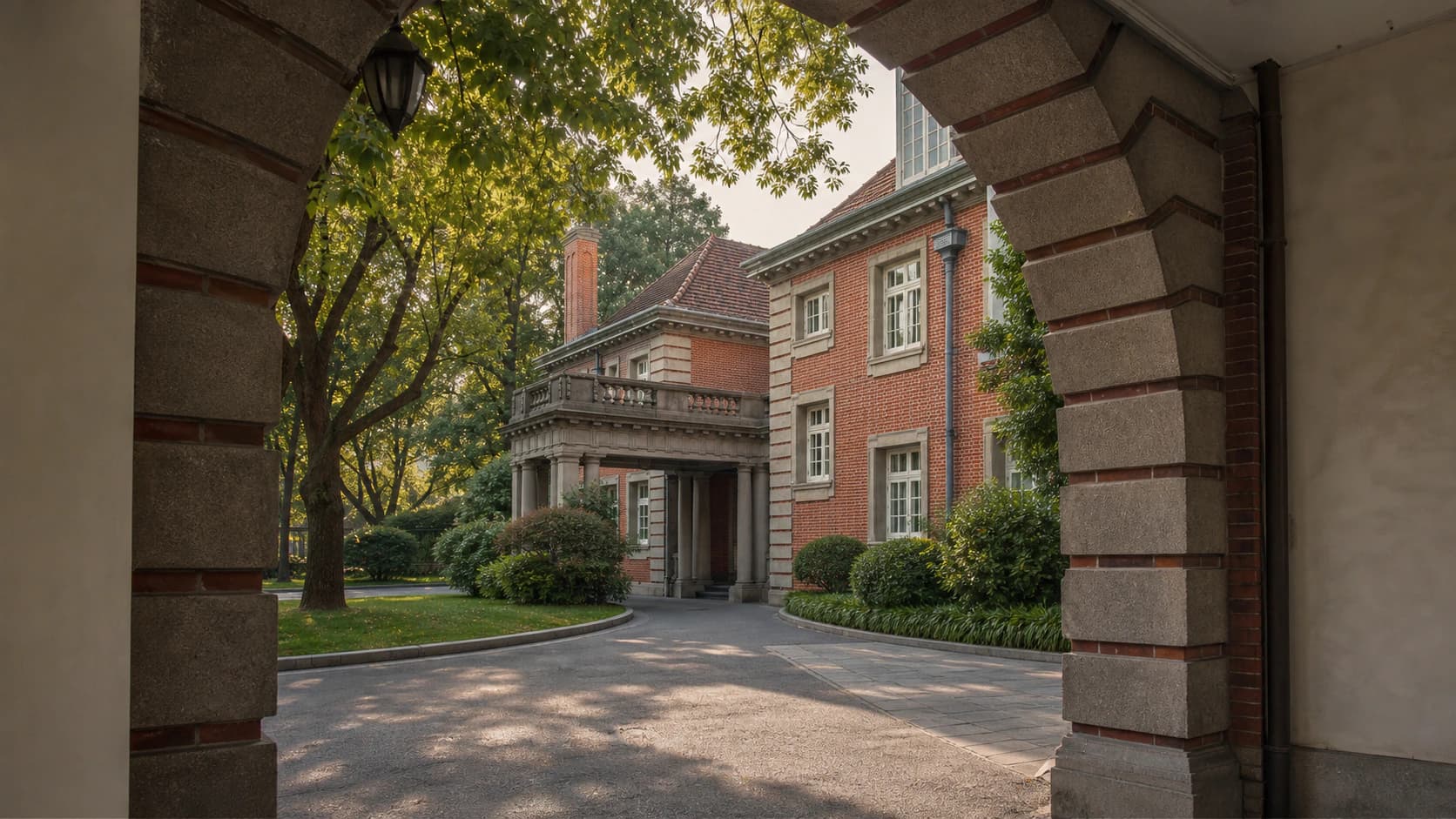
This is the visual relationship to look for throughout the walk: trees create the upper frame, a residence or institutional building supplies the architectural subject, and the street or garden setback explains scale. The strongest set will include all three layers rather than a collection of isolated doors.
Decide when to walk
Choose one of two main light plans.
Early morning: quiet streets and summer comfort
Start around 06:30–08:00 when heat and empty-street photographs matter most. This is particularly useful in humid summer weather. Delivery vehicles, bicycles and residents will still be present, but there are fewer groups waiting at recognizable facades. Shops and museums will be closed, so treat the morning as a pure exterior walk and finish with breakfast after Xujiahui Park.
Morning light can be patchy beneath a dense canopy. Expose for faces or pale walls rather than the brightest leaves, and accept some deep shade. A phone's HDR mode helps, but aggressive HDR can make foliage and stucco look unreal. Take one normal frame as well.
Mid-afternoon to sunset: warmer facades and a park finish
Start around 14:00–15:00, adjusting earlier in winter. This gives time for an optional museum or campus visit before the route shifts toward the warmer light on Hengshan Road and the softer end of day in Xujiahui Park. It also brings more pedestrians, parked vehicles and commercial activity.
Do not assume every building faces the light at the same moment. Work each block from both directions. When a facade is flat and dull, photograph its shaded details and save the wider street frame for the next block.
Overcast and rain
Overcast weather is good for pale walls, red brick and tree trunks because it reduces harsh contrast. Light rain adds reflections but also narrows already busy pavements. Use a short lens, keep the tripod at home and make photographs from under an awning only when you are not blocking a business entrance. In heavy rain, shorten the route to Fenyang Road and one confirmed indoor stop, then take the metro rather than trying to reproduce a dry-weather shot list.
Autumn colour is never a fixed appointment. Temperature, rain, wind and street maintenance change the canopy each year, and different blocks turn at different speeds. Plan around a current local forecast or recent street view, not a promise that one calendar week will be golden. Green summer leaves, bare winter branches and wet spring bark each reveal a different version of the same architecture.
The complete route at a glance
- Changshu Road Station, Exit 2 — start and camera setup.
- Shanghai Conservatory of Music, Fenyang campus — red brick, gates and the relationship between campus and street.
- No. 45 Fenyang Road — pale stucco, red tile and garden-residence proportions; exterior-first because it is an operating hotel.
- Shanghai Museum of Arts and Crafts — the route's clearest formal villa composition; interior optional.
- Pushkin Monument and the Dongping–Taojiang junction — converging streets, canopy and movement.
- Taojiang Road — the best section for a sequence rather than a single landmark.
- No. 8 Hengshan Road — red-brick arches, repeated geometry and a stronger urban scale.
- Shanghai Community Church exterior — brick gable and tree trunks from the public pavement.
- Xujiahui Park — rest, greenery and the final wide environmental frames.
The official Shanghai city-walk portfolio includes the Hengshan–Dongping–Taojiang–Fenyang corridor as part of a longer Xuhui route. The order here is shorter and photography-led: it starts at the easiest metro arrival, keeps the architectural changes progressive, and ends where you can sit down instead of doubling back.
Stop 1: start at Changshu Road, not at a viral doorway
Use Changshu Road Station Exit 2 on Metro Lines 1 and 7. Before walking, clean the phone lens, turn off any permanent beauty filter, confirm that location data is optional rather than necessary, and decide whether the finished set will be vertical, horizontal or both.
Make one simple arrival frame before looking for “old Shanghai”: station signage, bicycles, the first canopy and the flow of the crossing. It gives the later architecture sequence a contemporary beginning. Avoid placing a camera bag on a tactile path or using the station exit as a portrait set.
The checked walk to the Shanghai Conservatory of Music, Fenyang campus is about 100 metres / 2 minutes from the mapped exit and campus edge.
Stop 2: Shanghai Conservatory and the Fenyang Road threshold
The Shanghai Conservatory of Music (上海音乐学院) occupies several historic and modern buildings around the Fenyang Road campus. The public-facing value is the relationship between the institutional buildings, street garden and surrounding music district. Do not make entry the condition for enjoying this stop.
The conservatory maintains a campus-opening program, but public spaces, individual buildings, exhibitions and event access do not all follow one rule. Identity checks, exams, performances or temporary management can change the usable area. Carry your passport, read the current sign and follow gate staff. If visitors are not being admitted, photograph only from the public pavement and continue.
For the street frame, stand square to the building or gate and use 1× on a phone or roughly 24–35mm on a full-frame camera. Keep the camera level so walls remain vertical. Then move farther along the pavement and use 2× or 50–70mm to compress a red-brick section behind one tree trunk. This second image usually communicates the district better than a very wide shot filled with road surface.
Do not photograph students through classroom windows, point a long lens past a security position or treat people entering the campus as background models. The purpose is to show a school embedded in the city, not to document individuals.
Continue south along Fenyang Road. The movement from the conservatory to the museum area is short; the useful material lies between the pins.
Stop 3: No. 45 Fenyang Road and the limits of a reference image
No. 45 Fenyang Road is now Fenyang Garden Hotel. The residence was designed by László Hudec and uses pale stucco, red roof tiles, arches and deep garden setbacks. Those elements make it one of the route's most immediately readable garden residences.
It is also where a photo guide needs to be honest. The building is an operating hotel, not a public museum courtyard. A gate that is open for guests does not create general permission for a portrait session. Do not move past a reception or security point without approval, and do not photograph hotel guests at close range.
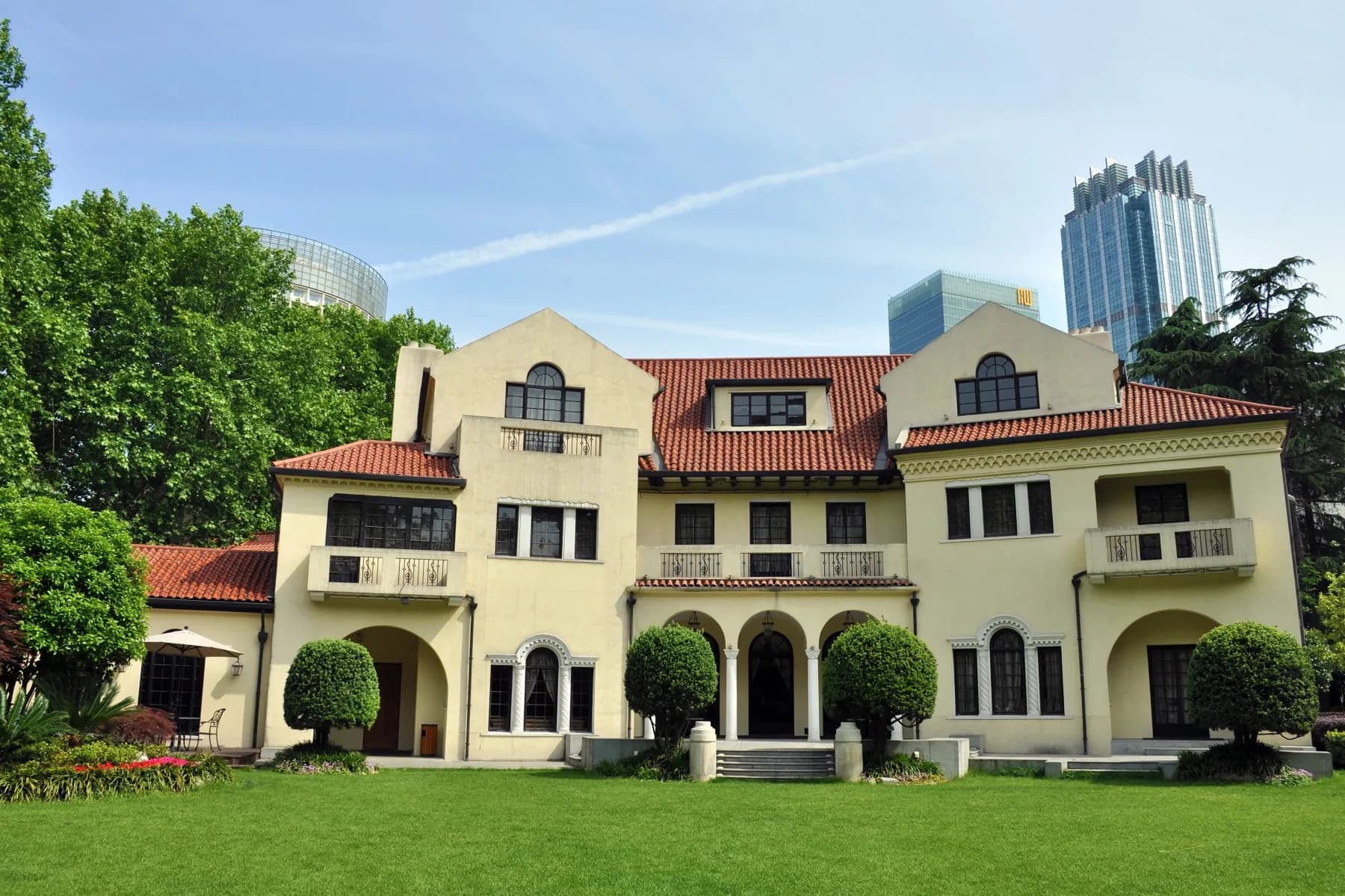
The documentary photograph shows the complete garden-side composition: a low central arcade, asymmetric wings, red tile and clipped greenery. Use it to understand the building, not as a promise that the lawn-side camera position is available to a walk-in visitor. From public space, look for partial views that combine roof, pale wall and foliage. A 50–85mm view can isolate the roof-and-arch rhythm without putting the gate itself in the center.
If the facade is largely hidden, spend no more than five minutes here. The route becomes stronger when you accept a closed view and continue to a public or ticketed site rather than arguing for access.
Photograph by Fayhoo, adapted from Wikimedia Commons under CC BY-SA 4.0.Stop 4: use the Museum of Arts and Crafts as the formal architecture frame
Walk about 300 metres / 5 minutes from the conservatory area to the Shanghai Museum of Arts and Crafts at 79 Fenyang Road. The pale main building, red roof and broad approach create the most formal, symmetrical composition on this route.
Check the maintained official channel and the sign at the entrance before planning an interior. Recent schedules have included a midday closure and a Monday closure, but holiday and exhibition arrangements can override a copied timetable. The route does not fail if the building is closed: photograph whatever exterior is visible from the public entrance, then continue.
If admission is operating, the museum adds a different visual and cultural layer. The building houses Shanghai craft traditions rather than a generic mansion display. Give the objects attention before treating corridors or stairs as backdrops. Follow indoor photography rules, keep flash off unless explicitly allowed, and do not occupy a staircase for repeated portraits.
For the exterior, begin with a centered 24–35mm frame only when you can stand safely and keep the camera level. Then move closer for three details:
- the transition between white wall and red roof;
- one curved opening or stair relationship;
- a craft, sign or doorway that proves the building's current public purpose.
That sequence prevents the page's mistake in reverse: the museum should not become merely a “white villa” photo prop.
Stop 5: Pushkin Monument and the three-street junction
From the museum, walk about 300 metres / 5 minutes to the Pushkin Monument, near the meeting of Fenyang, Dongping and Taojiang roads. The monument is a navigation hinge rather than the route's grandest subject. Its value is spatial: several street directions, tree trunks and different facade setbacks become visible within a compact area.
Make one frame that places the monument within the junction, then turn around and photograph the street opening behind you. A 35–50mm field of view keeps the monument recognizable without making the roadway look excessively broad. Wait for a legal crossing signal if you need the opposite side; do not step into the carriageway to gain a perfectly centered background.
This is a good place to change the visual rhythm. The first part of the route has named buildings. The next part should read like a neighborhood sequence: walls, balconies, leaf shadow, bicycles, shopfront reflections and the distance between a garden house and the pavement.
Stop 6: photograph Taojiang Road as a story of five frames
Use Taojiang Road as a slow connector toward Hengshan Road. Do not search for one “correct” house. Walk one side, cross only at a safe junction, and build a compact story:
- Establishing frame: the canopy and the full width of the street.
- Architecture frame: a facade with enough pavement or wall to explain its setback.
- Detail: tile, brick, balcony, gate hardware or a heritage plaque that can be photographed without entering.
- Movement: a bicycle, pedestrian or vehicle passing through the scene without becoming an identifiable close portrait.
- Transition: the view toward the next junction, giving the sequence direction.
On a phone, use 1× for the establishing view and 2× for details. Avoid 0.5× unless the pavement is so narrow that no other lens can include the subject; the ultra-wide lens easily bends tree trunks and makes a modest residence look theatrical. If you use it, keep important architecture near the center and correct the verticals gently.
The popular temptation is to use a private doorway as a full portrait set. A better portrait uses the public street as the context: place the subject at the edge of the canopy shadow, leave room for bicycles and residents, make two or three frames, then move. Never lean equipment on a residential gate or photograph through a window.
Stop 7: No. 8 Hengshan Road changes the scale
The checked walk from the Pushkin Monument area to No. 8 Hengshan Road is about 600 metres / 8 minutes. Red brick, white stone trim, arches and the water-tower precinct create a stronger, more repeated geometry than the detached residences earlier in the route.
First photograph the architecture from across the street at a legal pavement position. Use 2× or 50mm to stack the arches and remove unrelated signs at the edges. Then move closer and make a tighter detail frame of brick, stone and shadow. A person can stand beneath an arch for scale only when the space is open and their position does not block an entrance.
No. 8 is a reused commercial and cultural complex rather than an empty heritage set. Individual businesses and internal areas can change. Read the current boundary and opening sign; do not assume every courtyard visible online is always open or free. The exterior architecture is enough to justify the stop.
If your light is fading, choose No. 8 or the church exterior for the strongest frame. Do not spend the remaining blue hour repeating both from every angle.
Stop 8: frame Shanghai Community Church from the street
The Shanghai Community Church at 53 Hengshan Road is next to the No. 8 area. Its brick gable and tall window appear between mature street trees, producing a composition that is specific to this part of Shanghai.
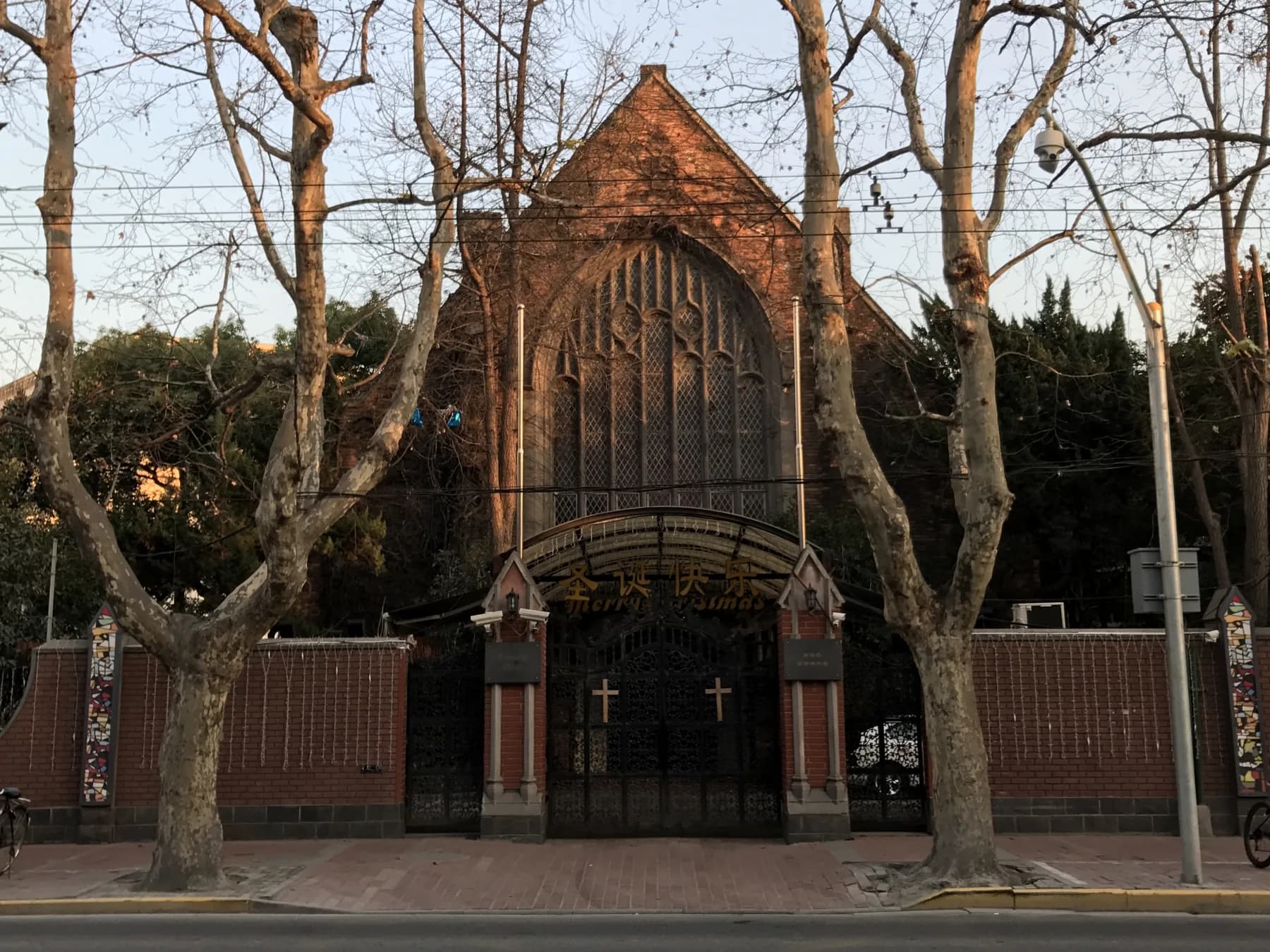
The achievable public-street picture is the facade behind the tree trunks. Stand on the opposite pavement, keep the camera level and try 1× for the full gable and 2× for the window and brick pattern. The overhead wires and street equipment are part of the real urban scene. Removing all of them in an edit can make the result less truthful than the place.
Treat worship access separately from exterior photography. A service is not a sightseeing session. Do not photograph through the gate into a congregation, enter merely for a portrait, use flash or set up a tripod at the entrance. If a maintained public notice welcomes visitors outside services, follow that notice and the staff's instructions; otherwise the exterior completes the stop.
Photograph by Fayhoo, adapted from Wikimedia Commons under CC BY-SA 3.0.Stop 9: finish in Xujiahui Park
The checked walk from No. 8 Hengshan Road to Xujiahui Park is about 900 metres / 12 minutes. The direct leg is still short, but the character changes from heritage street to a larger urban green space.
Official visitor information lists the park as an open, free public green space and identifies the preserved Pathe Villa, often called the Little Red House, and an industrial chimney among its cultural features. The park itself is listed as open 24 hours, but exhibitions, buildings, cafes and facilities inside keep their own schedules. Do not arrive late expecting every interior to remain open.
Use the park in three ways:
- Rest: review the set and identify what is missing before the light disappears.
- Environmental portrait: place a person on a path or bridge with greenery around them, keeping other park users out of close focus.
- Final contrast: photograph a retained historic element against the surrounding commercial skyline to show how the district changes at Xujiahui.
If you finish near sunset, make the last frame before the sky becomes black. A blue sky and one lit window usually say more than a heavily brightened night scene. Handhold against a railing only where doing so does not obstruct movement; tripods are unnecessary for a travel set.
A shot list that produces a varied final album
Do not give every stop equal weight. A useful 12-image edit could contain:
- Changshu Road arrival and contemporary street life.
- Conservatory red brick behind one plane-tree trunk.
- Fenyang Road canopy with a residence partially visible.
- No. 45 roof-and-arch detail from an allowed position.
- Museum of Arts and Crafts full facade.
- Museum material or craft detail, if entry is available.
- Pushkin Monument within the three-street junction.
- Taojiang Road wide street frame.
- Taojiang movement frame with a bicycle or pedestrian at a respectful distance.
- No. 8 Hengshan Road repeated arches.
- Community Church gable between trees.
- Xujiahui Park environmental finish.
This gives the set a beginning, architectural progression and ending. Ten versions of one mansion may receive more likes individually, but they do not explain the walk.
For a person-led set, repeat only four portraits: one full-length street frame, one walking frame, one close architectural portrait and one park finish. Use the remaining images for place and detail. The result will feel like travel rather than a costume catalogue.
Phone and camera settings that fit these streets
Phone
- Use 1× for most street views and 2× for facade details and portraits.
- Keep vertical correction modest. Correcting an extreme upward angle can stretch people and crop rooflines.
- Tap the pale wall or face, then lower exposure slightly if leaves or sky are clipping.
- Use burst mode for a bicycle or walking frame, then delete near-duplicates.
- In low light, hold the phone with both hands and lean against a stable public railing only when permitted.
- Avoid portrait-mode blur around tree branches, railings and bicycle spokes; those edges often reveal the software cutout.
Interchangeable-lens camera
A 24–70mm lens is sufficient for the complete walk. Use 24–35mm for a building in its street context, 50–70mm for compressed tree-and-facade layers, and a shutter speed fast enough for pedestrians or bicycles. A longer lens is optional, but it also increases the risk of intruding on private windows.
In daylight, start around aperture priority at f/5.6–f/8 with auto ISO and a minimum shutter near 1/250 second for street movement. These are starting points, not rules. Under deep shade, protecting the shutter speed is more useful than insisting on the lowest ISO.
Carry one battery and a small cloth rather than a full studio kit. Large reflectors, light stands and repeated costume changes turn a shared pavement into a commercial set and may require permission.
Public space, privacy and commercial shooting
The route passes homes, a school, a hotel, businesses and a church. “Visible from the street” does not mean “available for any production.” For ordinary handheld travel photographs:
- remain on public pavement unless a sign or staff member clearly admits visitors;
- keep residential doorways, tactile paving and bicycle access clear;
- do not photograph through windows or over walls;
- avoid identifiable close portraits without consent;
- follow security instructions immediately;
- ask before using a cafe, lobby or hotel garden as a set;
- arrange permission in advance for a photographer, lighting, crew, costume rack or repeated takes.
If a location refuses entry, the correct fallback is already in the route: make the exterior available from public space and continue. Do not substitute a nearby private doorway merely because it looks similar.
Three shorter versions
90-minute architecture sampler
Start at Changshu Road, walk Fenyang Road to the Museum of Arts and Crafts, then continue to the Pushkin Monument and exit via Hengshan Road Station. Keep only one wide and one detail at each anchor. Skip every interior.
Two-hour portrait route
Start at the Pushkin Monument, use Taojiang Road for walking portraits, photograph the arches at No. 8 Hengshan Road, then finish with the church exterior. This is the strongest compact sequence when a person, outfit or editorial look matters more than complete neighborhood coverage.
Low-energy version
Take a taxi or metro to Hengshan Road, photograph No. 8 and the church exterior, then ride to Xujiahui Park. The area is generally flat, but curb cuts, narrow pavements, wet leaves, construction and building thresholds can make a continuous step-free line uncertain. Check the live map and use a car between anchors when fatigue or mobility is the main constraint.
The famous Wukang Road alternative
Choose the Wukang Road and Anfu Road alternative when the wedge-shaped Wukang Building is the result you specifically want, or when shops and cafes matter as much as architecture. Begin near Xujiahui Park or Shanghai Library, photograph Wukang Building from a legal crossing position, walk north along Wukang Road, and finish eastward on Anfu Road toward Changshu Road.
That version is more immediately recognizable and usually busier. The Fenyang–Taojiang route on this page gives more varied architecture and a clearer public-space rhythm; Wukang gives the famous establishing shot. Do not combine both full routes unless you want a long day and are willing to lose the best light while walking between repeated streets.
If you want English architectural interpretation rather than independent navigation, Trip.com lists a guided city walk that explicitly covers Wukang Road and Anfu Road. Check the exact Trip.com walk, confirming the meeting point, language, duration and selected-date availability before paying. The public streets remain free to visit independently.
For a broader sightseeing day that continues through Yongjia Road, Sinan Mansions and Xintiandi, use the Shanghai French Concession city walk. Its job is a complete neighborhood day; this page's job is the photographic result. If you want a second architecture-led day, the two-day Shanghai city-walk itinerary pairs the western historic streets with Suzhou Creek and North Bund rather than repeating another plane-tree route.
Add one Xujiahui extension, not three
After the park, choose one extension according to the remaining light and energy.
- Architecture and religion: continue to St. Ignatius Cathedral, checking current worship and visitor access before entering.
- Books and indoor rest: use a current Xujiahui cultural venue or mall rather than adding another exposed street.
- Dinner: choose a visible, currently operating restaurant near the metro. The route does not depend on a saved cafe or an old viral storefront.
Do not automatically add the Bund at sunset. Crossing the city at the best light defeats the point of a slow western-neighborhood walk. Use the Shanghai city guide to give the Bund, Old City and Pudong their own coherent day. For a separate evening built around river views and blue hour, use the free skyline photo route.
What to carry
- comfortable closed shoes with grip for wet leaves and polished thresholds;
- a light layer in spring and autumn, and sun or rain protection in summer;
- water, especially when beginning before shops open;
- a fully charged phone and offline Chinese place names;
- your passport if you hope to enter a campus, museum or other identity-controlled venue;
- one small camera setup rather than a pavement-blocking production kit;
- a simple cleaning cloth, because humidity and rain quickly soften phone images.
Save these English–Chinese pairs before leaving:
- Changshu Road Station — 常熟路站
- Shanghai Conservatory of Music, Fenyang campus — 上海音乐学院汾阳校区
- No. 45 Fenyang Road — 汾阳路45号
- Shanghai Museum of Arts and Crafts — 上海工艺美术博物馆
- Pushkin Monument — 普希金纪念碑
- Taojiang Road — 桃江路
- No. 8 Hengshan Road — 衡山路8号
- Shanghai Community Church — 上海国际礼拜堂
- Xujiahui Park — 徐家汇公园
If one entrance is unclear, show the Chinese name and AMap pin rather than relying on the English name alone.
Final planning checklist
Before departure, decide the result and the boundary:
- choose early morning or mid-afternoon rather than hoping for every kind of light;
- save all nine map anchors;
- treat school, museum, hotel and church entry as optional;
- select four priority frames in case weather or construction shortens the route;
- carry a lens setup that stays in your hand or small bag;
- keep portraits short and doorways clear;
- finish at Xujiahui Park instead of backtracking;
- check any optional interior on its maintained official channel that morning.
The route succeeds when the final set shows a living district: canopy, facade, public street and contemporary use in the same story. It does not require an empty road, a private lawn or a perfect week of autumn colour.