Guilin or Yangshuo? Build the route around one river transfer and one countryside day
Guilin, Yangshuo, Xingping, the Li River and the Yulong River are often sold as five separate “must-sees.” They are better understood as three different travel jobs:
- Guilin is the arrival and city base. It is useful for the airport, major railway stations, an easy first night and a small amount of city sightseeing.
- The Li River is a north-to-south scenic transfer. A full cruise can replace a road or rail move from Guilin toward Yangshuo; it should not automatically become an extra river day.
- Yangshuo is the countryside base. The Yulong River, village lanes and karst fields provide the slow, close-up landscape experience that the larger Li River cruise does not.
For most first trips, the efficient answer is one night in Guilin and two or three nights in Yangshuo. Add Xingping only when sunrise, quiet river-town hours or access to the station side of the county is a real priority. Staying in Guilin, Yangshuo and Xingping in a short trip usually creates more luggage handling than landscape variety.
This guide makes the route choices. Use the detailed Guilin, Yangshuo, Li River and Yulong River pages after your bases and transfer method are fixed.
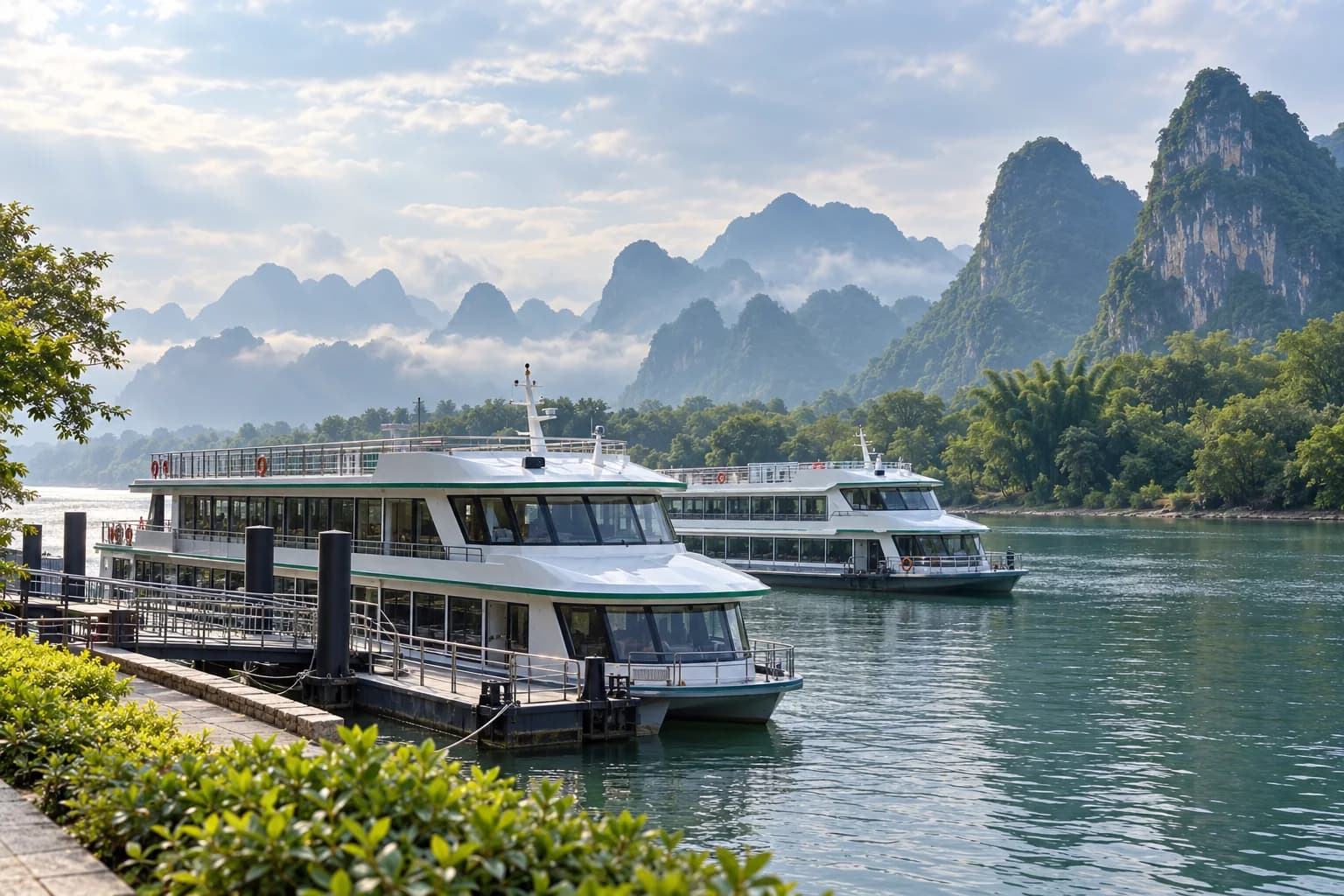
This scene explains the cruise-versus-land-transfer decision; it is not a live view of a particular pier or vessel. Check the exact pier, boat, pickup and sailing status on your current ticket.
The one-minute decision
| Your trip | Bases that usually work | Main landscape choices | What to cut |
|---|---|---|---|
| 3 days / 2–3 nights | Guilin 1 night + Yangshuo 2 nights | Full Li River cruise or faster land transfer; one Yulong countryside day | Xingping overnight, Xianggong sunrise and repeated short river rides |
| 4 days / 3–4 nights | Guilin 1 night + Yangshuo 3 nights; or Guilin 1 + Yangshuo 2 + Xingping 1 for a photography-first trip | Cruise, Yulong day and one contrasting land/viewpoint block | A fourth base and a second cruise-like day |
| 5 days / 4–5 nights | Guilin 1–2 nights + Yangshuo 3 nights; optional Xingping 1 night | Add weather resilience, a slow village day or a deliberate Longji extension | Filling every day with another karst lookout |
Count the arrival and departure days honestly. An evening flight into Guilin plus an early departure from Yangshuo does not create five full sightseeing days. If one endpoint is another Chinese city by high-speed rail, the correct station may shape the order more than the number of nights.
How many nights should you keep in Guilin?
One night is the default
Keep one Guilin night when you arrive through Guilin Liangjiang International Airport (桂林两江国际机场), Guilin Railway Station (桂林站), Guilin North (桂林北站) or Guilin West (桂林西站) and want the full Li River cruise next morning. The night absorbs flight or rail uncertainty, lets you collect food and cashless-payment backups, and protects a timed pier transfer from the arrival journey.
That first evening can hold one compact city block: Elephant Trunk Hill, the riverside or East West Street. Do not turn it into a late checklist before an early cruise pickup.
Zero nights can work on a land-transfer route
Skip Guilin city accommodation when you land early enough for a confirmed direct coach or private transfer to Yangshuo, or when your useful train already arrives on the Xingping side and Guilin has no specific attraction you want. Guilin airport's official service currently lists intercity coaches to Yangshuo, but departure times and availability belong to the live ticketing system. Treat an old timetable in a blog as a clue, not a connection guarantee.
Skipping Guilin does not pair well with the standard full Li River cruise, because the usual full-route product starts from a Guilin-side pier. If the cruise is your priority, place it immediately after a Guilin night instead of backtracking from Yangshuo.
Two nights are justified by a real second job
Use two Guilin nights when one of these is true:
- you arrive too late to count the first night as usable;
- your group wants an unhurried city morning before changing bases;
- you need a weather or transport buffer before a high-priority river sailing;
- you are adding Longji Rice Terraces and have designed it as a separate overnight or full-day extension;
- an older traveler, young child or large-bag group needs a slower start.
Do not add a second Guilin night simply because several downtown parks appear on a list. The strongest contrast in a short trip comes from moving to the Yangshuo countryside, not from collecting more urban karst viewpoints.
Li River cruise, train or road: choose the transfer before the attractions
The full Li River cruise is most valuable when it performs two jobs at once: a major scenic day and the move toward Yangshuo. Rail and road are better when time, luggage, weather flexibility or mobility is the priority.
| Move | Choose it when | Friction you must solve |
|---|---|---|
| Full Li River cruise | The river panorama is a top reason for the trip; everyone can manage a long, scheduled day | Exact pier, pickup, vessel/product grade, luggage handling, weather status and final arrival point |
| High-speed rail toward Yangshuo Station | You are coming from or continuing to a rail-connected city, or you want the Xingping side first | “Yangshuo” station is by Xingping, not by West Street; add the road transfer to your actual hotel |
| Road transfer | Door-to-door convenience matters, you have several bags, or the group needs stops and flexible timing | Peak traffic, vehicle size, child seats if required, and confirming the exact hotel pickup/drop-off lane |
The full cruise is not a simple hotel shuttle
The current official Li River system sells multiple products. Your ticket should name the pier, boat or service grade, pickup arrangement, meal inclusion, sailing status and endpoint. Depending on the product, the Guilin-side departure may use Mopanshan Wharf (磨盘山码头) or Zhujiang Wharf (竹江码头). These are outside the compact city center, so “departing Guilin in the morning” does not mean walking from a downtown hotel to the boat.
Official visitor information has allowed ordinary suitcases aboard with staff-directed storage, but that does not mean every seller collects a suitcase from your hotel or delivers it to your Yangshuo room. Ask four written questions before payment:
- Where exactly does the vehicle collect me, and is that transfer included?
- Can my specific suitcase size travel on this sailing?
- Where do I reclaim it at the Yangshuo end?
- How do I reach my booked hotel from that endpoint?
Keep passports, medicine, electronics, rain protection and one warm layer in a day bag that stays with you. If a seller offers separate luggage delivery, record the provider, destination hotel, cutoff time and proof of handover. Do not leave the whole route dependent on an informal promise in a chat.
Cruise inventory and holiday release windows change. If the river day is the trip's anchor, compare the exact current product through Trip.com’s Li River listings, then verify the same details in the official 漓江售票处 channel before relying on a pickup or pier.
Rail is fast only after the last-mile transfer is counted
Yangshuo Railway Station (阳朔站) sits on the Xingping side of the county, not beside central Yangshuo or West Street. A previously checked AMap planning model placed it roughly 7.8 km from Xingping old town but about 33 km by road from West Street; road conditions can make the latter transfer much longer than the train ride itself.
Rail therefore works especially well when you want Xingping first, when you are continuing toward another railway city, or when weather makes a fixed river sailing unattractive. It is not automatically the quickest door-to-door solution for a hotel in the Yulong countryside. Search by the full Chinese station name, compare the train plus road transfer, and book the actual rail segment through Trip.com trains only after the destination station and passenger document details are correct.
Road is the least romantic and sometimes the best answer
A prearranged road transfer can remove the most difficult parts of the day: getting to a distant pier, handling large bags, making several older travelers change vehicles, or crossing from the Xingping-side station to a rural hotel. Ask the hotel for the Chinese pickup instructions and the nearest point a standard vehicle can reach. Countryside properties sometimes use small lanes or bridges that are obvious on a photo but awkward for a large van.
Yulong River: raft, cycle, walk or combine them?
The Yulong River is not a smaller copy of the Li River. It is a countryside day with a menu of route-specific raft sections, paved and unpaved lanes, bridges, villages and the Ten-Mile Gallery area. Choose the movement style before choosing photo stops.
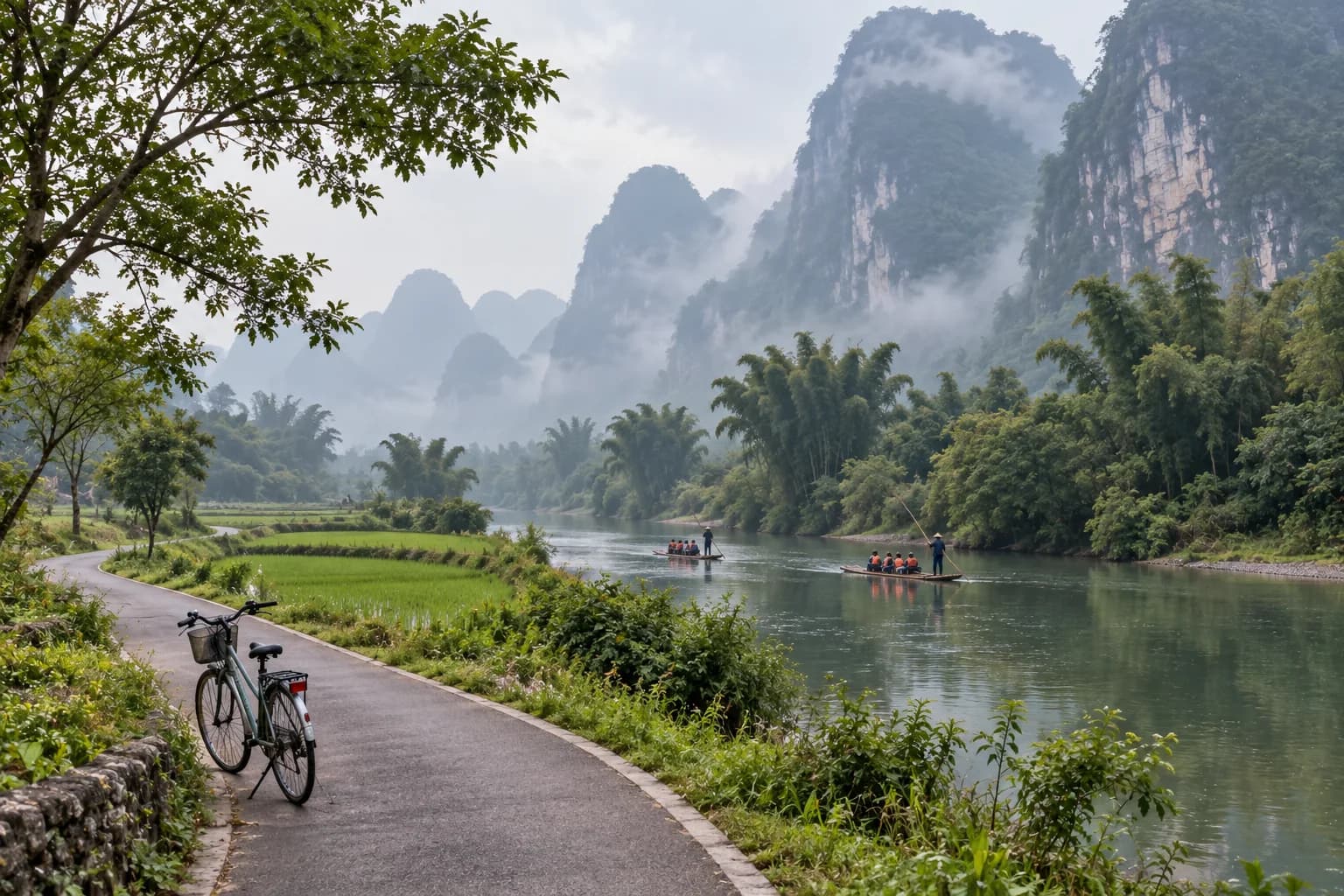
Raft routes, passenger rules and lane conditions vary. Use this as planning context, then verify the exact wharf product and the day's weather before setting out.
Choose a raft for the water-level view
A raft gives the slow, low perspective that a road cannot. It suits travelers who can board safely, accept a fixed start and endpoint, and want the river itself to be the main experience. It does not suit every age, height, weight or health situation.
Current official rules differ by wharf and raft type. For example, the official Longcun (龙村) two-person product currently excludes children under 1 meter and adults aged 70 or above, and states route-specific single-rider and combined-weight thresholds. The official Qing'edu (青厄渡) group-raft page uses a different child arrangement. That difference is the important fact: do not copy one blogger's restriction across the whole river.
Before buying, open the official Yulong product page for the named departure and arrival wharves and check:
- minimum height and age rules for children;
- upper-age, pregnancy, mobility and listed health restrictions;
- passenger count and combined-weight rules;
- one-way or return format, and how you leave the endpoint;
- the current closure, delay and refund terms.
Trip.com can be useful for an English-language comparison of current Yulong rafting products, but the official wharf rules control eligibility. Never divide a group across rafts or send a child ahead until staff confirm the current arrangement.
Choose cycling for freedom, not for an exact viral route
Cycling works when you want to stop at fields, bridges and cafes without a boarding time. A normal bicycle is enough for a short, flat river segment; an e-bike extends range but increases speed, weight and braking risk. Test both brakes, tires, lights and battery display before leaving the rental point. Photograph the vehicle and confirm the return location, deadline and damage terms.
The countryside is not one sealed recreational trail. Routes can mix quiet lanes, village junctions, narrow bridges, shared road edges, construction and wet surfaces. Download an offline map, keep the hotel name in Chinese, and turn back before fatigue or darkness makes navigation harder. A social-media “secret lane” may enter a farm, guesthouse or controlled riverbank; a beautiful post does not prove public access.
Choose walking for a short, deliberate section
Walking is best around one bridge-and-village cluster, not as a plan to cover the whole valley. It suits travelers who want details at field level and do not want to manage a rental return. The cost is range: summer heat, rain and sparse shade can make a seemingly short map line feel long. Ask your hotel to mark a public start, a public finish and a reliable pickup point.
The most balanced day combines two modes
For many visitors, the useful pattern is one verified raft section plus one short bicycle or walking loop. Arrange the land segment around the raft endpoint instead of building an ambitious route first and forcing the ticket into it. This creates contrast without spending the entire day in transport.
Does Xingping deserve a separate night?
Xingping (兴坪) is a real base decision, not an automatic add-on. It is useful for a quieter Li River section, early or late riverside hours, the nearby Yangshuo rail station and access toward some elevated viewpoints. It also adds a hotel move, another road connection and more dependence on current local access.
Stay one night in Xingping when
- sunrise, river photography or quiet pre-group hours are a primary reason for the trip;
- your arriving or departing train uses Yangshuo Station at a time that makes a Xingping-side night practical;
- you deliberately skipped the full Guilin-to-Yangshuo cruise and want a shorter Li River land/water block;
- you can travel with a compact bag or send the main suitcase directly to the next base;
- you have at least four days and are willing to remove another activity.
Visit without staying when
- you want the old-town lanes and one public river viewpoint but not a sunrise start;
- a driver or current tour can combine the stop with your station transfer;
- your Yangshuo hotel is already a quiet countryside property and another check-in adds little;
- weather makes a high viewpoint uncertain.
Skip Xingping when
- you already take the full Li River cruise and have only three days;
- the group has large luggage, limited mobility or a tight departure connection;
- the only reason is reproducing one famous social photograph;
- mist or rain has removed the long view and you do not value the town itself.
Xianggong Hill: a viewpoint, not another base
Xianggong Hill (相公山) can reward a clear sunrise with a high Li River bend view, but it should remain an optional timed excursion. Access may involve a dark pre-dawn road, steps, current local entry arrangements and a return transfer. Public information is less stable than for the official river products, so do not freeze an old opening time, price or ferry plan into the itinerary.
Use it when the group is comfortable with steps, the forecast supports a long view, and a licensed local driver or current accommodation contact has confirmed the road, access point, return and fallback. Skip it for mobility concerns, heavy rain, very low cloud or a same-morning rail connection. A viral image taken from a private roof, field edge or restricted path is not an invitation to enter.
Three days: make the cruise and countryside different
Best first-trip structure
Day 1 — Arrive Guilin; sleep in Guilin. Keep the evening small and prepare one day bag. Confirm the pier pickup and sailing status.
Day 2 — Full Li River cruise; sleep in Yangshuo. Treat the cruise as the transfer. After arrival, reach the hotel, collect or place bags and use the evening for a meal or short walk. Do not add another river excursion.
Day 3 — Yulong countryside; sleep in Yangshuo or depart late. Choose one verified raft plus a short land segment, or a cycling/walking-only day if anyone is ineligible for rafting. If departure is early, move this block to the previous afternoon and reduce it.
This is the cleanest short itinerary because the Li River gives wide-scale scenery and the Yulong day gives close countryside detail. The route avoids returning to Guilin and avoids moving to Xingping for one photograph.
Weather-flexible three-day alternative
When the full cruise is suspended or a fixed sailing does not fit, go by road or rail on Day 2. Use a public Xingping riverside block only if it lies naturally on the transfer, then keep Day 3 for the Yulong countryside. Do not buy a stack of short substitute boat rides simply to replace the word “cruise.”
For a more stop-by-stop version after this structure is chosen, open the Guilin three-day itinerary.
Four days: add one layer, not another checklist
The easiest four-day plan is one Guilin night and three Yangshuo nights:
- Day 1: arrive and use a compact Guilin evening;
- Day 2: full Li River cruise and move to Yangshuo;
- Day 3: Yulong raft/cycle/walk day;
- Day 4: choose one contrasting block—cave/interior, cooking, a slow village loop, or a weather-dependent Xingping visit—then depart or sleep in Yangshuo.
This keeps the fourth day flexible and avoids packing again. It suits families, first-time travelers and anyone who wants the trip to feel like a holiday.
A photography-first variation is Guilin 1 + Xingping 1 + Yangshuo 2. Use land or rail to Xingping, sleep for early light, then move once to Yangshuo. If you use the full cruise as well, the Xingping block can repeat similar Li River scenery; keep it only when the light and quiet hours are the point.
The existing Guilin four-day itinerary includes a broader regional structure. Use that if Longji, rather than Xingping or an extra Yangshuo day, is the fourth day's priority.
Five days: add resilience or a genuinely different landscape
Five days allow the route to breathe. A strong no-rush plan is Guilin 1 + Yangshuo 3 + one final gateway or Xingping night:
- Arrive Guilin.
- Cruise to Yangshuo.
- Yulong countryside.
- A weather-selected Yangshuo day: cycling, cave, cooking or a slow village circuit.
- Xingping/station-side block or departure buffer, depending on the onward journey.
If Guilin is also the departure gateway, move back on Day 4 evening or Day 5 with a conservative buffer. If Yangshuo Station serves the next train, an optional Xingping night can simplify the final road transfer.
Longji is the better fifth-day addition when rice terraces and mountain villages matter more than another river bend. It is a separate road-and-possibly-overnight commitment, not a casual half-day from Yangshuo. Replace one Yangshuo night or add time; do not compress Longji, a cruise, Yulong, Xingping and Guilin city into five hurried days.
Luggage: decide the bag route before the people route
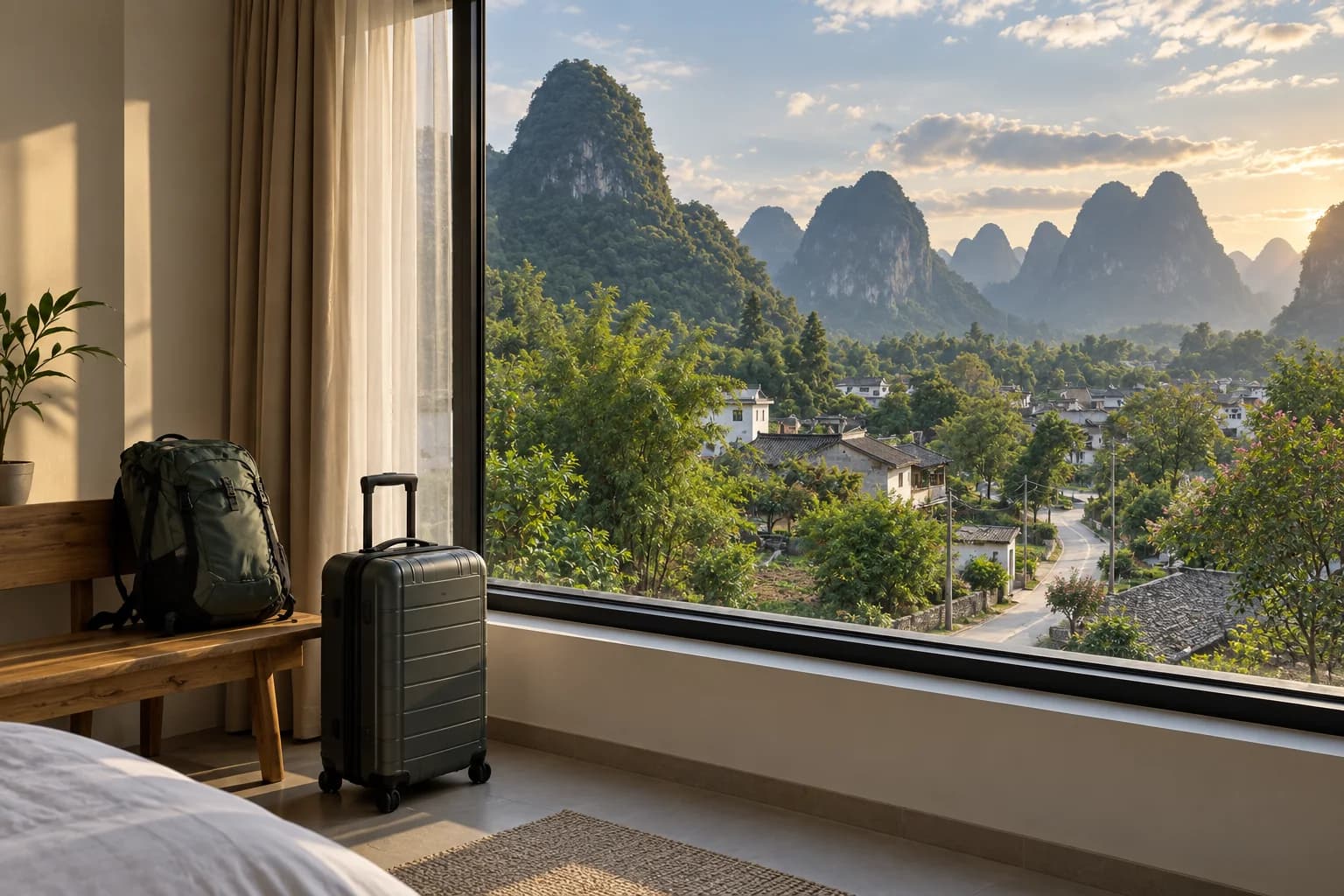
The useful hotel is the one that reduces your next transfer. Views, vehicle access and noise vary by property; verify the actual address, room position and pickup point before booking.
Write one line for every move: bag starts here → travels by this provider → is reclaimed here → reaches this hotel this way. If any arrow depends on “probably,” solve it before buying a timed ticket.
- Cruise day: verify onboard acceptance or a named transfer service; carry valuables yourself.
- Rail day: travel as light as possible and leave time for security, lifts and the correct exit.
- Xingping stop: use a station transfer or verified storage plan; do not assume a scenic site accepts large cases.
- Yulong day: leave the main suitcase at the hotel and carry a small water-resistant bag.
- Hotel change: confirm the nearest vehicle-accessible point, especially for riverside lanes and pedestrian old-town addresses.
When comparing accommodation through Trip.com’s Yangshuo hotels, read the map before the room photos. Message the property with your arrival method and Chinese station or pier name. Ask whether the room faces a road, bar, courtyard, lift or construction area, and whether luggage can be held outside check-in hours.
Where to stay in Yangshuo: convenience, countryside or station side
Central Yangshuo / West Street side
Choose the central area for restaurants, evening activity and easy tour pickups. It works for a first visit without a scooter. The tradeoff is noise. “Near West Street” can mean music, delivery vehicles and late foot traffic; ask for a high floor or inward-facing room and check the actual walking route from the taxi drop-off.
Yulong River countryside
Choose the countryside when morning calm, cycling access and karst views matter more than a dense restaurant choice. Confirm whether a normal car reaches the entrance, how dinner works after dark, and what the property offers when rafting stops. A view room is useful only if the windows, road position and current construction match the listing.
Xingping / Yangshuo Station side
Choose Xingping for rail geometry, quiet river hours or an intentional photography block. It is not a substitute for the Yulong countryside: reaching central Yangshuo and its western valley still takes a road transfer. Staying here solely because the rail ticket says “Yangshuo” is a common map-reading error.
Rain, water level and visibility change the decision
Light mist can create beautiful layers while hiding distant peaks. Heavy rain and high water can suspend Li River sailings or Yulong rafting; low water, wind and operational controls can also alter routes. In June 2026, the official Li River operator published a full-route suspension during heavy rain and high water, then managed reopening through later notices. A confirmed booking is not permission to ignore a same-day closure.
Use a three-part weather rule:
- Check the official operator notice, not only a generic forecast.
- Keep one land alternative that does not depend on a river departure.
- Read the selected product's change/refund terms before payment; do not assume every seller handles a closure the same way.
After rain, stone steps, rural lanes and raft boarding areas can be slippery. If visibility removes the long view, do not force Xianggong; use a lower, closer countryside route or an indoor block. In hot months, put cycling and walking early, keep the middle of the day shaded, and carry more water than a short map distance suggests.
Older travelers, children and mixed-mobility groups
For a mixed group, choose the route that everyone can complete rather than splitting at an isolated wharf.
- Cruise: confirm vehicle-to-boat walking distance, boarding steps, onboard seating, toilets and the Yangshuo-side exit.
- Raft: check the exact official route's age, height, weight, pregnancy, health and mobility rules. “Family raft” is not a universal category.
- Cycling: use a short out-and-back lane, not a one-way commitment; do not treat an e-bike as a mobility aid without testing balance and brakes.
- Walking: choose a public bridge or village segment with a known pickup point.
- Xianggong: stairs and a pre-dawn transfer make it an easy item to remove.
Parents should keep dry clothes and essential medicine outside checked luggage. Older travelers often benefit more from one well-located Yangshuo hotel and a private road transfer than from saving a small amount on multiple shared pickups.
A booking order that prevents most mistakes
- Fix arrival and departure gateways, including the exact railway station or airport.
- Decide whether the full Li River cruise is a priority or merely one possible transfer.
- Place Guilin nights around that decision.
- Choose central Yangshuo, Yulong countryside or Xingping as the main southern base.
- Reserve the high-consequence pieces: cruise, intercity rail and refundable rooms.
- Select the exact Yulong raft route only after checking every passenger's eligibility.
- Leave Xianggong, short boat rides and weather-sensitive viewpoints until conditions are clearer.
The route is successful when each day has a distinct job: arrive, transfer through the big river landscape, explore the close countryside, then depart without backtracking. More pins do not improve that sequence.