Longji Rice Terraces
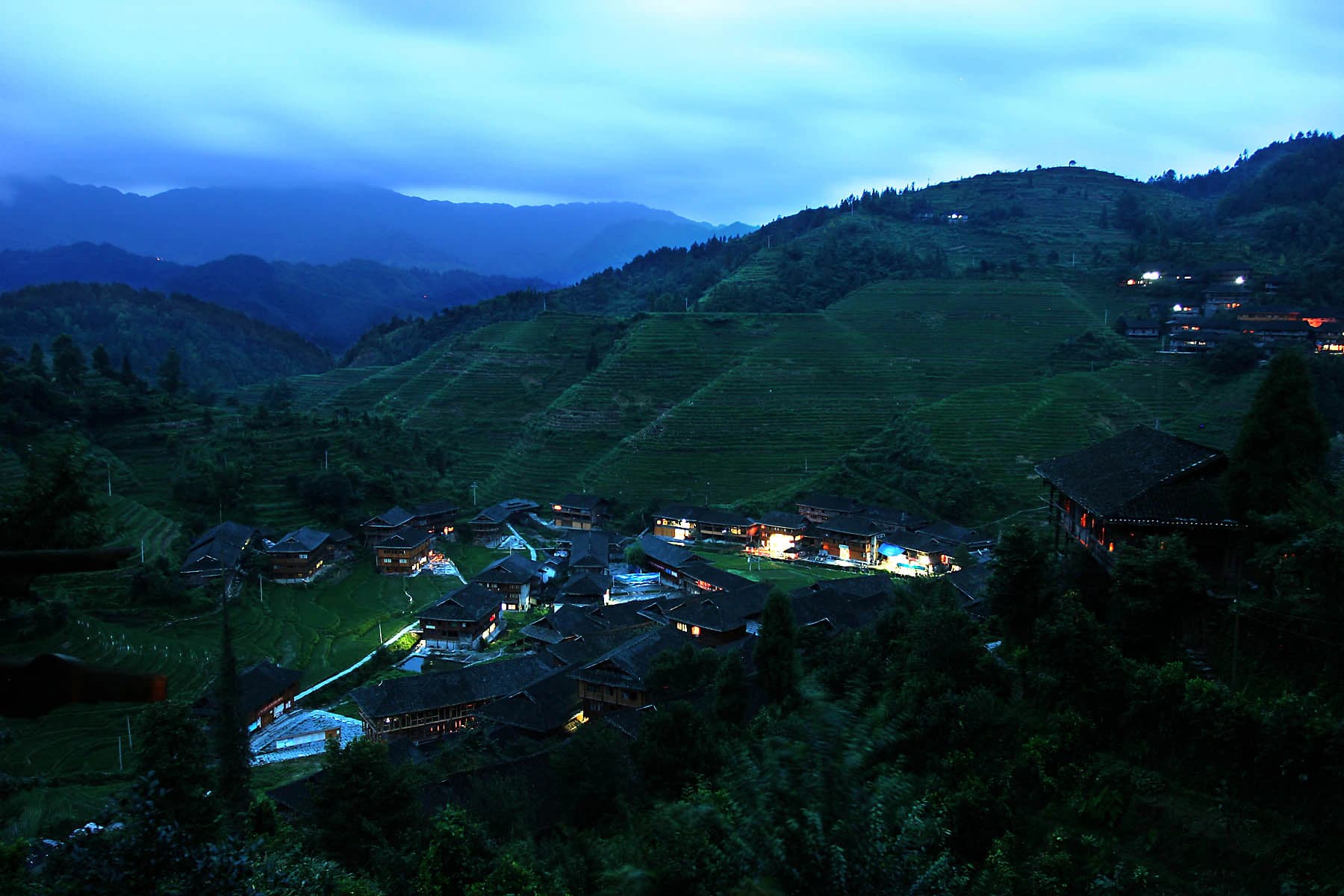
The most important Longji decision is not which camera to bring. It is which village zone to visit. Longji Rice Terraces (龙脊梯田) is a large mountain landscape containing several separated communities, not one entrance followed by a single walking loop. Trying to cover Ping'an and Jinkeng on the same Guilin day trip turns the experience into transfers, ticket checks and staircases.
Choose Ping'an for the most compact first visit, Jinkeng/Dazhai for the biggest landscape and an overnight, or Ancient Zhuang Village for a quieter cultural layer. A focused day in one zone is much better than collecting village names.
Quick visitor facts
- Allow: a full day from Guilin; one night if sunrise, sunset or slow village walking matters.
- Current price baseline: Longji scenic area listed an adult admission ticket at ¥80, a scenic shuttle at ¥40 and Golden Buddha Peak cable-car fares of ¥100 return or ¥55 one way when checked in August 2026. Reconfirm the selected product and entrance notice before paying.
- Terrain: stone lanes, uneven steps, steep gradients and limited flat walking. Rain changes the difficulty quickly.
- Best base for a simple day trip: Ping'an.
- Best base for scale and an overnight: Jinkeng/Dazhai.
- Do not assume: that a vehicle advertised for “Longji” finishes at your chosen village. Confirm the final drop-off and every transfer before paying.
The decision map
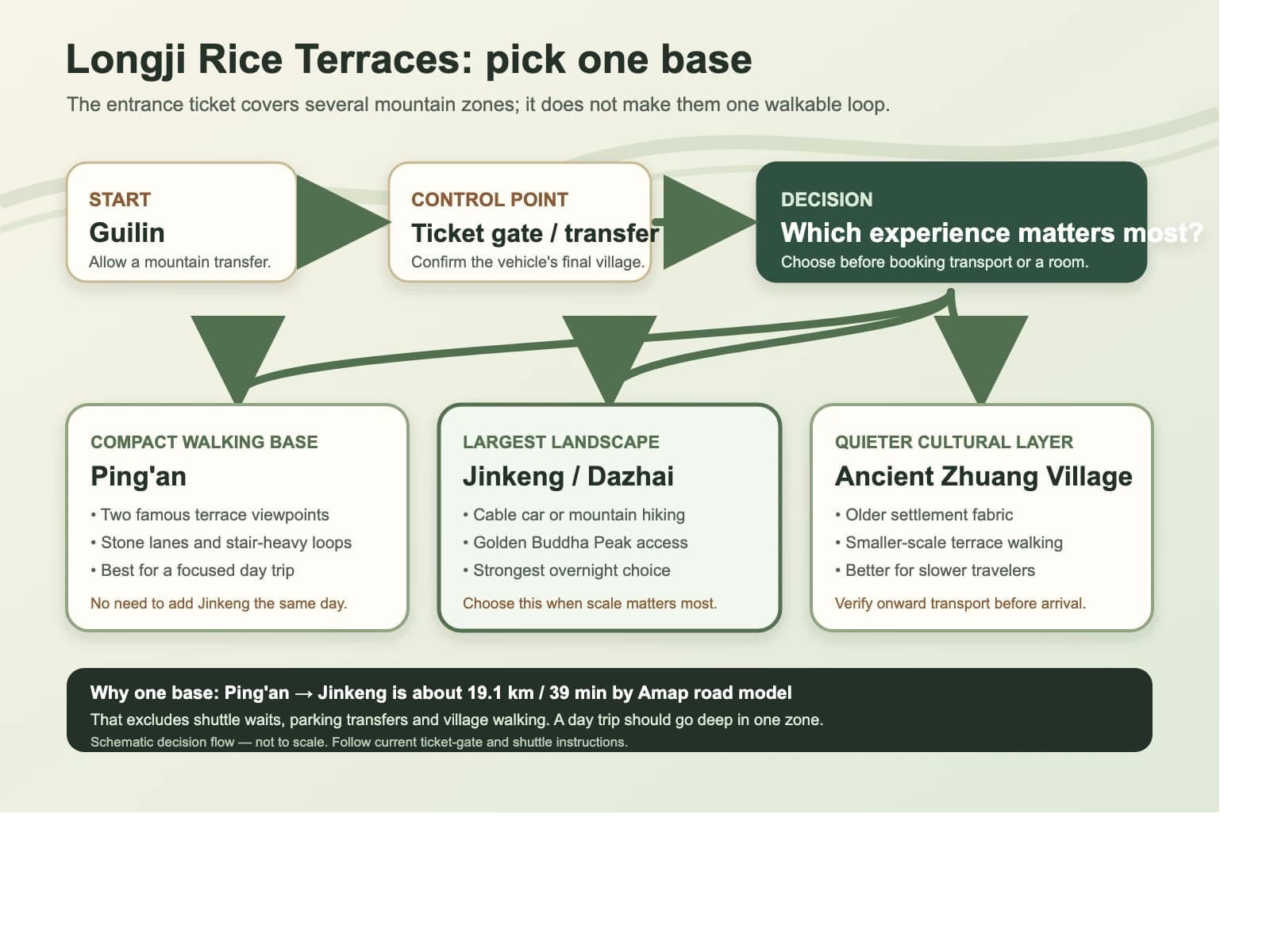
The diagram is a decision aid, not a geographic map. Amap's road model placed Ping'an and Jinkeng roughly 19.1 km and 39 driving minutes apart when checked; that estimate excludes shuttle waits, parking transfers and village walking. It is evidence that they are separate bases, not a promise of a 39-minute door-to-door connection.
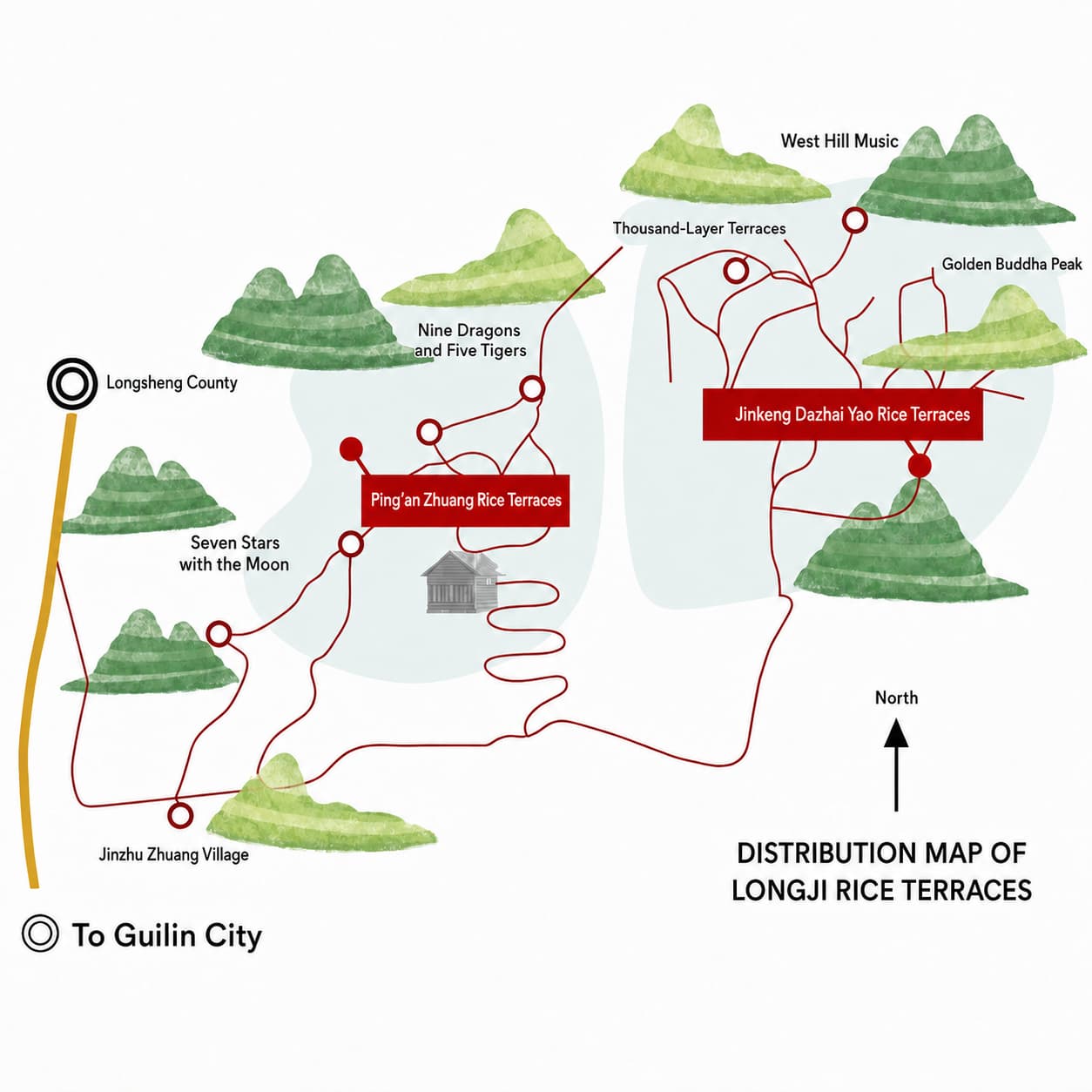
Option 1: Ping'an for the most coherent day trip
Pick Ping'an Zhuang Village (平安壮寨) if you want a recognizable Longji landscape without making transport the main event. The classic walking network links village lanes with the Seven Stars with the Moon and Nine Dragons and Five Tigers viewing areas. Expect repeated stairs rather than a smooth ridge promenade.
A practical sequence is:
- Arrive at Ping'an and confirm the return meeting point before leaving the vehicle.
- Walk through the inhabited village slowly; wet stone and luggage wheels do not mix well.
- Choose one primary viewpoint, then add the second only if time, weather and knees agree.
- Eat in the village before beginning the descent.
- Leave a buffer for the transfer back to the scenic-area gate.
Ping'an suits first-time visitors, photographers who want village-and-terrace compositions, and travelers who must return to Guilin the same evening. Its weakness is that the popular paths can feel busy at peak times. Start early, but do not promise yourself sunrise unless you sleep in the village.
Option 2: Jinkeng/Dazhai for the largest landscape
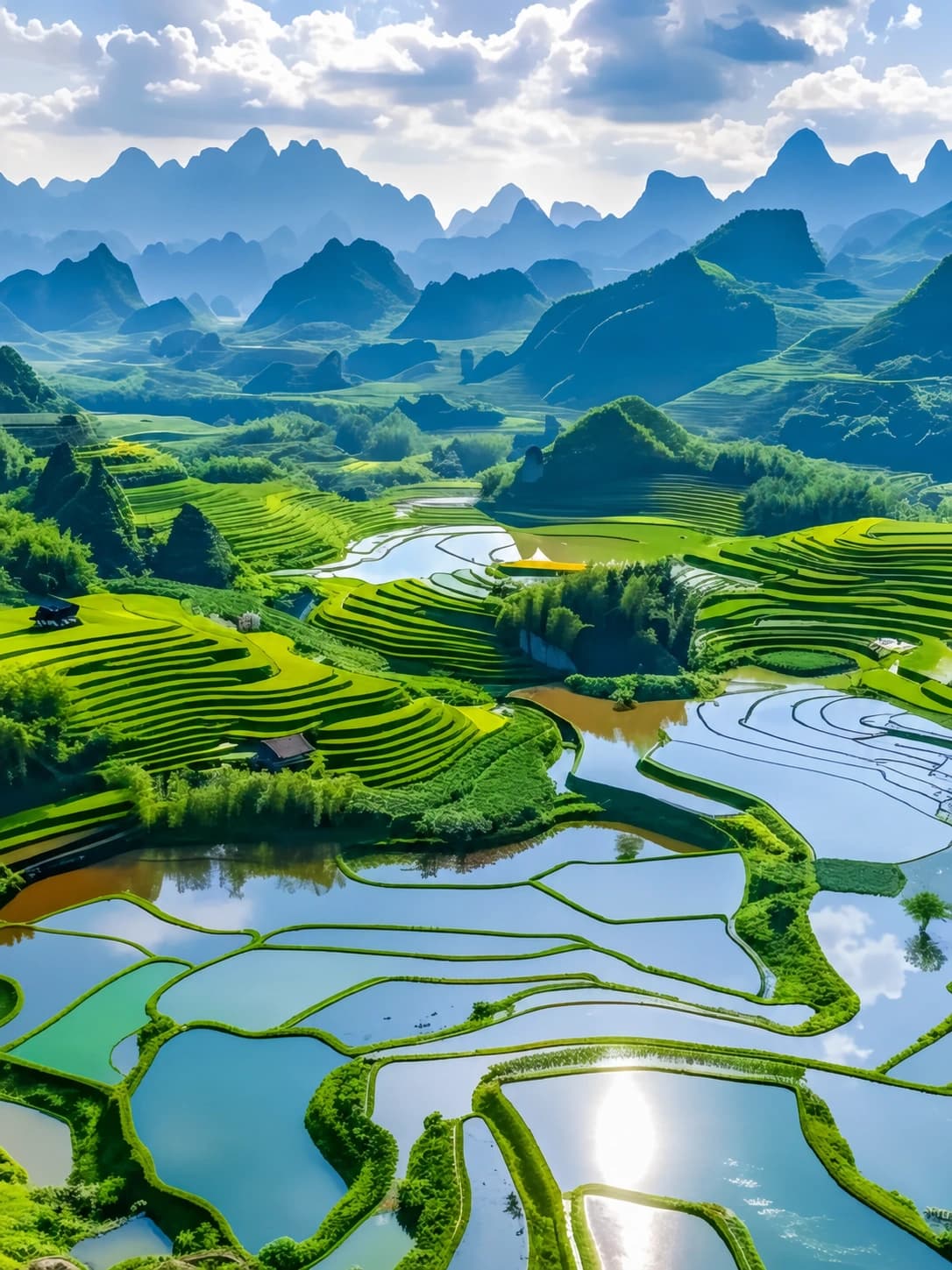
Choose Jinkeng Red Yao Terraces (金坑红瑶梯田) when scale matters more than compactness. The mountain bowl is broader, accommodation is spread across different elevations, and the Golden Buddha Peak cable car creates a useful choice between mechanical access and a longer climb.
For a day visit, make Golden Buddha Peak the anchor and decide in advance whether you will ride both ways, ride one way and walk, or hike without the cable car. Do not casually add every named platform: map distance understates vertical effort. For an overnight, choose the lodging location by the viewpoint you actually want at dawn, not by the phrase “inside Longji.”
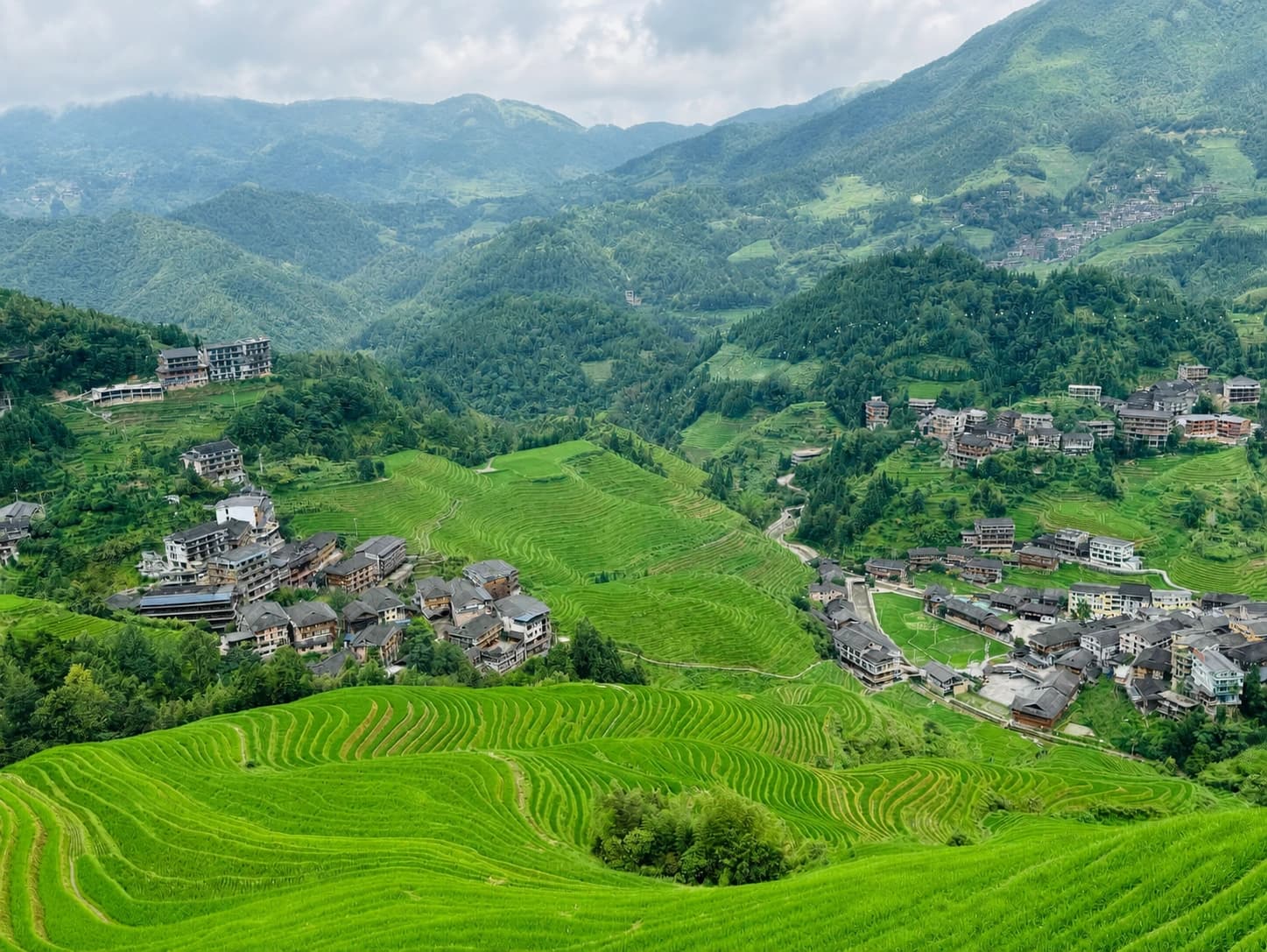
Jinkeng is the strongest choice for travelers who enjoy mountain guesthouses, want time for changing light, or prefer one deep landscape day. It is a poor add-on after a morning in Ping'an.
Option 3: Ancient Zhuang Village for a quieter layer
Longji Ancient Zhuang Village (龙脊古壮寨) offers older settlement fabric and a smaller-scale terrace experience. Choose it because you want to pay attention to timber houses, stone paths, water systems and the relationship between farming and settlement—not merely because it sounds “less touristy.” It is still a living community and part of a managed scenic area.
Confirm the final vehicle stop and the onward journey before arrival. This is the option most likely to disappoint travelers who book a generic Longji transfer and assume every village is interchangeable. It works best for slower walkers with a private transfer or a clearly documented shuttle plan.
When the terraces look different
Longji is agricultural land, so appearance follows water, planting, growth and harvest rather than a fixed photo calendar.
- Water-filled terraces: often associated with late spring and early summer, creating reflective lines after fields are prepared.
- Green season: summer usually emphasizes layered texture and dense vegetation.
- Golden fields: harvest color is commonly sought in early autumn, but weather and agricultural decisions can shift the best days.
- Winter: quieter and graphic, but snow is occasional rather than guaranteed.
Check recent local conditions shortly before travel. A viral image from another year does not establish this year's planting or harvest timing. Fog and rain can hide distant ridges, yet they can also make nearby terraces more atmospheric; the right response is a shorter, safer route, not chasing multiple villages.
Food that belongs to the mountain day
Longji meals are most useful when they solve the route rather than interrupt it. Eat near your chosen village, ideally before the final descent. Common regional dishes may include bamboo-tube rice, chicken, cured meat, tofu and seasonal mountain vegetables, but preparation, availability and portions vary by guesthouse and season.
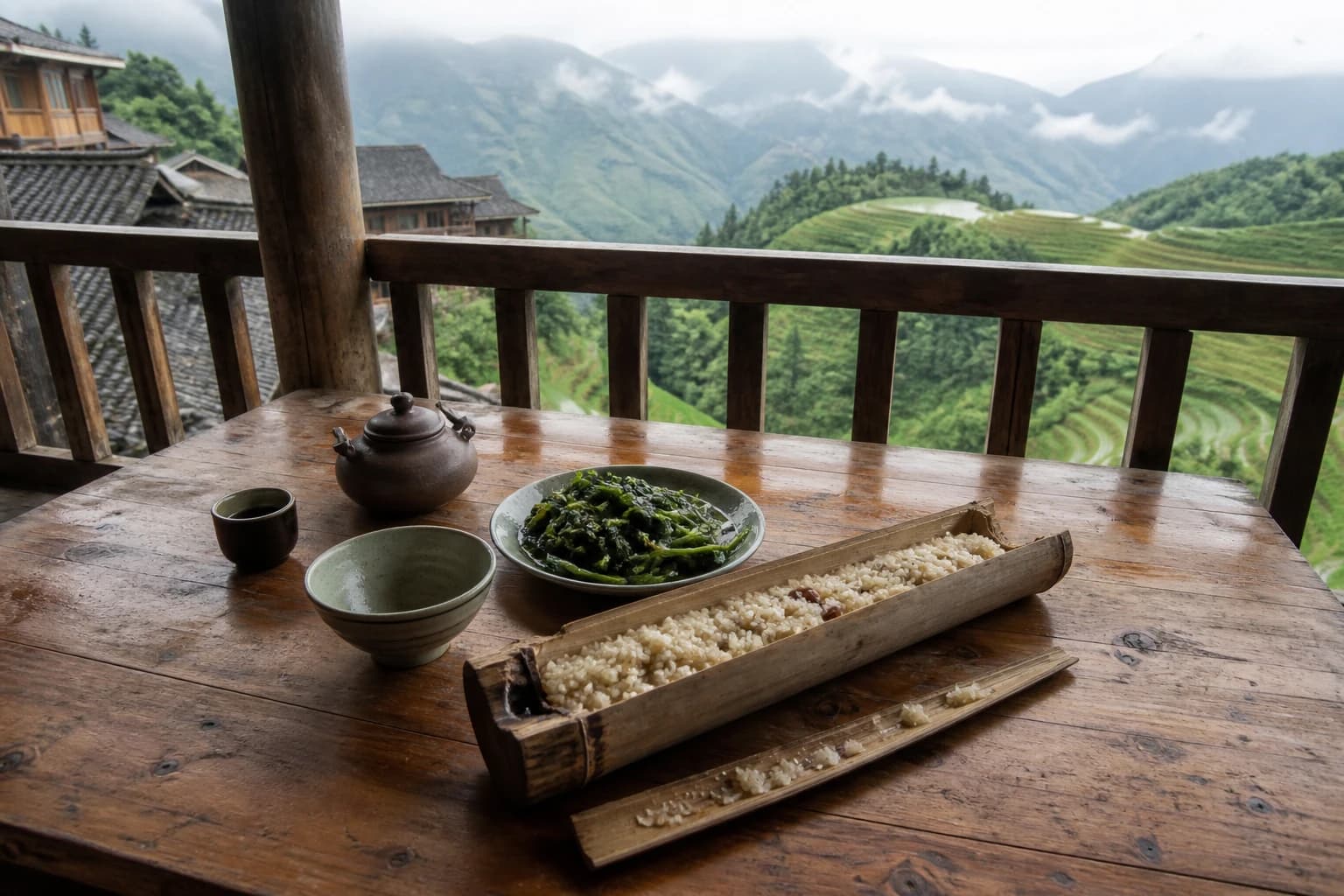
Use three checks instead of chasing a single famous restaurant: ask the price before ordering, ask how long a dish takes, and order one or two shared dishes before adding more. Bamboo-tube rice can take time, while a heavy banquet is a bad match for a steep afternoon climb.
Getting there without the classic mistake
From Guilin, transfers normally involve a road journey to the scenic area and may involve another shuttle or vehicle change. Timetables, pickup points and access rules change, so this guide does not reproduce a brittle list of departure times.
Before booking, get written answers to four questions:
- Does the fare include the Longji admission and scenic shuttle?
- Is the final village Ping'an, Dazhai/Jinkeng or Ancient Zhuang Village?
- Where is the return meeting point, and how much walking is required to reach it?
- Can the vehicle carry your luggage, or must it be moved separately on steep lanes?
Travelers arriving from Yangshuo should budget a much longer road day than those starting in Guilin. If Longji is important, sleep in central Guilin before the excursion or stay one night in the terraces rather than sandwiching it between two Yangshuo activities.
Where to stay
Stay in central Guilin for the simplest day trip, especially if you have an early transfer and a train or flight on another day. Stay in Ping'an for compact access to its two famous viewpoints and an easier one-night introduction. Stay in Jinkeng/Dazhai for the broadest mountain experience and the strongest sunrise/sunset logic.
When comparing mountain rooms, prioritize the exact village, walking distance from the vehicle stop, stair count, luggage help and heating or cooling over a generic “terrace view” label. Search Trip.com hotels by the specific village name, then confirm the transfer directly with the property.
What to bring
- Shoes with grip; smooth soles are a liability on wet stone.
- A light waterproof layer and a dry bag for electronics.
- Sun protection and drinking water.
- A small overnight bag if staying in the mountain; large wheeled luggage is awkward.
- Offline Chinese place names for your chosen village and pickup point.
Longji rewards a narrow plan. Pick one base, understand its vertical route, eat where the route naturally pauses, and let weather decide how far you extend the walk.