China Business Travel and Half-Day Routes
A productive China business trip needs two separate plans: a work chain that cannot fail and an optional three- to five-hour city module that can be canceled without consequences. Never place a timed attraction, cross-city photo stop or non-refundable tour before a buyer meeting or flight.
Chinese regulations define the M visa for commercial and trade activities; the L visa is for tourism and the Z visa is for work. Visa-free entry may cover business or exchange for eligible nationalities, but eligibility, permitted purpose and duration change. Check the current China embassy or National Immigration Administration guidance for your passport and activity. Exhibiting, attending meetings and taking local employment are not interchangeable legal categories.
Protect the work chain first
Book in this order:
- official event registration and buyer/exhibitor badge;
- entry permission or visa suited to the real purpose;
- hotel near the venue or a direct metro line;
- arrival with one full buffer night before the first critical appointment;
- payment, mobile data and translation setup;
- only then, a flexible half-day route.
Use the venue's official name and hall, not just the event title. Large exhibition campuses can take 20–40 minutes to cross after security. Save the gate, hall, booth and contact in Chinese and English.
A practical exhibition day kit
Carry passport, badge confirmation, local contact, power bank, universal charging strip, water, throat lozenges, notebook and a one-page sourcing brief. Keep a pen and note system accessible: after each supplier conversation, record product, requirement, price basis, MOQ, certification claim, sample action and follow-up owner immediately.
Do not approve a supplier because the booth looks polished. Photograph the booth number with permission, collect the legal company name, and separate manufacturer, trading company and agent claims. The Canton Fair guide and Yiwu buyer guide provide deeper quotation and due-diligence workflows.
Shanghai: choose river skyline or western streets
Three hours: North Bund to public ferry
Start at Tiantong Road, cross Zhapu Road Bridge, continue through the northern Bund, then use a public Huangpu ferry if time and service align. Finish near Lujiazui metro rather than walking back. This gives architecture and skyline without a paid observation deck or reservation.
Use it after meetings in central Shanghai or Pudong, not between Hongqiao and an evening flight. Protect 90 minutes beyond the map estimate for the airport or rail terminal. The free Shanghai skyline route has the exact sequence and crowd alternatives.
Four hours: plane-tree district
Use Changshu Road or South Shaanxi Road as the anchor and walk one coherent set of streets rather than collecting distant internet-famous cafés. This route is better after meetings in Jing'an, Xuhui or the central west and has many easy metro exits if a client call interrupts.
Shenzhen: one compact bay loop
For a relaxed afternoon, start at Houhai, move through the Shenzhen Bay commercial/cultural cluster and finish at Talent Park near sunset. The route combines indoor shelter, contemporary architecture and the bay without crossing the city. Heat and thunderstorms make the mall an essential fallback, not a failure.
Do not attempt this from Shenzhen World Exhibition & Convention Center during a short gap: the venue is near the airport side, and cross-city travel can consume the available time. For an exhibition-day opening, use the venue district; for a free half-day after checkout, store luggage first and then choose one metro-connected cluster. The Shenzhen technology guide offers an alternative for visitors whose business interest is hardware or EVs.
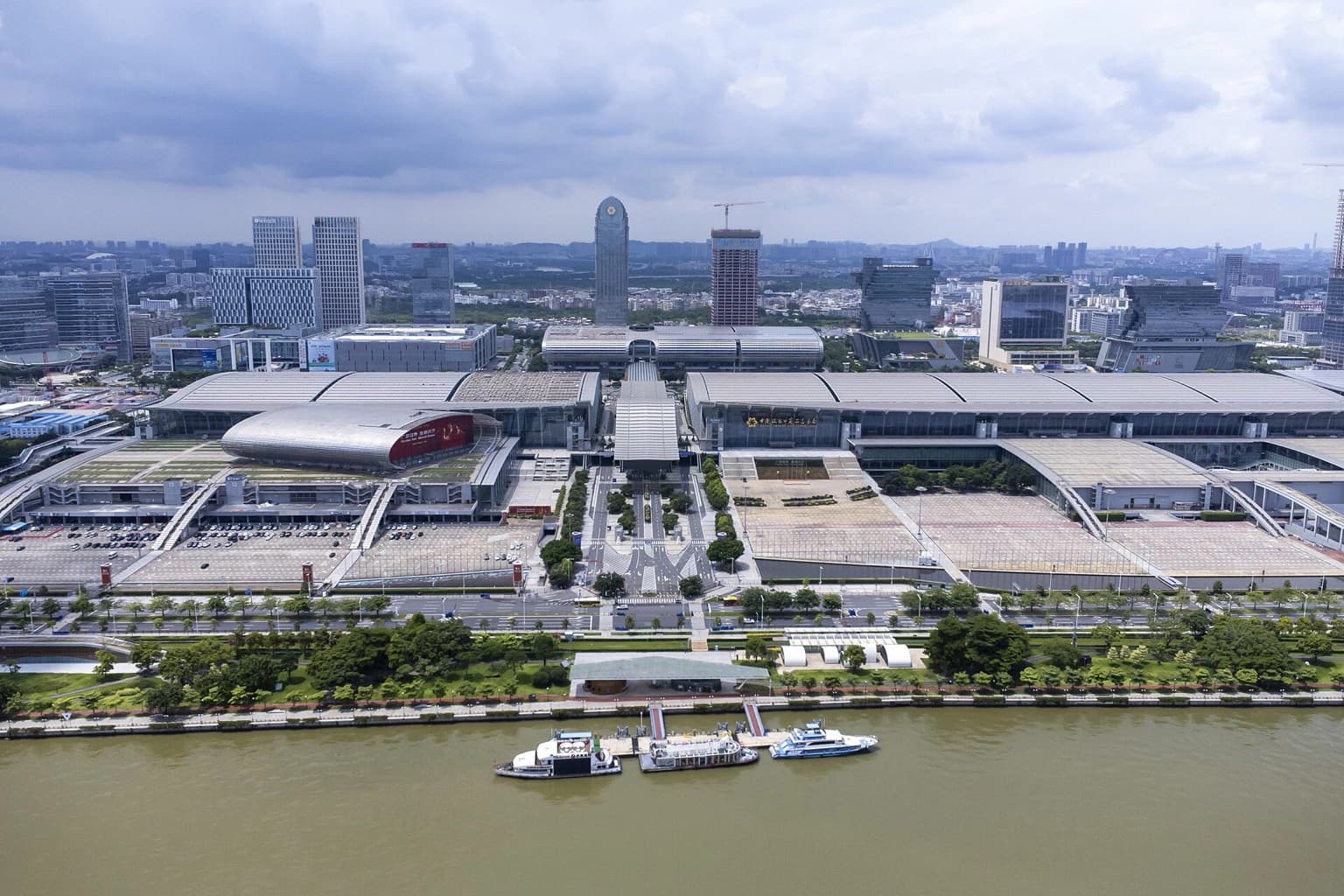
Guangzhou: Canton Fair and Pazhou
Most Canton Fair visitors say they are too tired after the halls for a cross-city evening. Instead, stay on the Pazhou side, where the fair sits; everything below starts within a stop or two of it.
Haizhu tram.
- Where: board opposite Wanshengwei station (Lines 4 and 8, exit B).
- Fare: ¥2 flat, paid with a transit card or QR code.
- Running: trams come about every ten minutes.
A sunset loop.
- Ride the tram to Pazhou Pagoda for the quiet Water Culture Park.
- Walk the riverbank facing the new financial district.
- Climb to the elevated garden near the Vipshop building to watch the sun set behind Canton Tower.
- Catch the tram from Huizhan West at dusk. The stretch past Liede Bridge has the best skyline view, ending at Canton Tower.
Huangpu Ancient Port. Bus 229 runs from the fair area to this old riverside village, with cheap Cantonese snacks.
- Prices: boat congee from about ¥8, big oysters about ¥5 each.
- Getting back: return by bus to Wanshengwei and ride the tram to Canton Tower.
Hangzhou: lakefront, not the full lake
From Longxiangqiao or Ding'an Road, walk a small eastern or southern lakefront section and connect it with the old-city streets. Do not circle West Lake in a business-trip half-day. A practical route is Hubin → Jixian Pavilion shoreline → Yongjin Gate → Liulang Wenying, with an exit toward Wushan Square if time remains.
Keep the route flexible in rain and on public holidays. West Lake traffic can slow road transfers sharply; return by metro rather than waiting for a car beside the busiest shore. If the work base is Future Sci-Tech City or a distant convention venue, choose a nearby neighborhood instead of forcing the lake into a three-hour gap.
Luggage, payments and connectivity
Use the hotel, railway station's staffed facility or an established storage provider; never leave samples or a work laptop in an unverified shop. Keep confidential documents with you. Set up at least two payment methods and a data fallback before the first meeting. The Alipay guide and network guide cover current visitor setup.
For samples, batteries, prototypes or restricted technical goods, check airline, customs and export rules before packing. “Hand carry” is not a substitute for proper commercial documentation.
Half-day decision rule
Only start the route if the work commitment is complete, luggage is secured and the return to the next fixed point has a separate buffer. One continuous neighborhood with two metro exits is a business travel asset; three famous places across a city are a missed-flight plan.