Canton Fair first-time visitor guide: choose a phase before booking Guangzhou
The Canton Fair is useful when you have a product brief, a commercial reason to meet several suppliers and enough time to compare what they actually offer. It is a poor sightseeing attraction and a costly place to arrive with only the idea that you might “find something to sell.” The exhibition complex is enormous, each phase covers different industries, and a busy booth conversation is the beginning of supplier due diligence rather than the end.
Choose your path before making a hotel reservation:
- Ordinary leisure visitor: skip the fair unless you have a genuine trade purpose and qualify for its registration process. Spend the day in Guangzhou instead. The fair is built for negotiation, not retail browsing, and a buyer badge is not an attraction ticket.
- First-time overseas buyer: attend the phase that contains your exact category, register through the official Buyer Service System, build a booth shortlist, and allow at least one complete day. Two days are better when you need comparable quotations or several product families.
- Exhibitor or service provider: use the official exhibitor channel and current exhibitor manual. Buyer registration does not give you a booth, permission to solicit in aisles, or access to exhibitor-only processes.
The fair's official English name is the China Import and Export Fair (中国进出口商品交易会), although “Canton Fair” is the name most visitors use. This guide was verified on October 3, 2026. It separates the current confirmed session from future editions whose dates and procedures are still unannounced.
Current confirmed session: the 140th Canton Fair
The official fair website currently confirms the 140th Canton Fair, Autumn 2026, at the China Import and Export Fair Complex, No. 382 Yuejiang Middle Road, Haizhu District, Guangzhou. Public negotiation hours are 09:30–18:00 on each fair day.
| Phase | Confirmed dates | Main product decision |
|---|---|---|
| Phase 1 | October 15–19 | Electronics, home appliances, consumer electronics, machinery, automation, power, new energy, vehicles and parts, lighting, chemicals, hardware |
| Phase 2 | October 23–27 | Housewares, kitchen and tableware, ceramics, glass, gifts, festival products, home décor, garden goods, furniture, building materials, sanitary ware |
| Phase 3 | October 31–Nov 4 | Apparel, textiles, shoes, bags, toys, baby products, food, medical and health products, personal care, sports, outdoor, travel and pet products |
Confirm the current category list and any adjustments on the official Canton Fair website before booking. A broad label such as “electronics,” “home” or “health” is not precise enough: your target may sit in a subcategory, an adjacent hall or a different phase.
The 141st spring session and 142nd autumn session in 2027 are unannounced as of this verification. Their exact dates, phase categories, opening hours, registration arrangements and special transport measures are unknown. Do not copy the traditional April or October pattern into a non-refundable booking. The China festivals and events calendar explains how to hold flexible travel plans while an annual event is still unannounced.
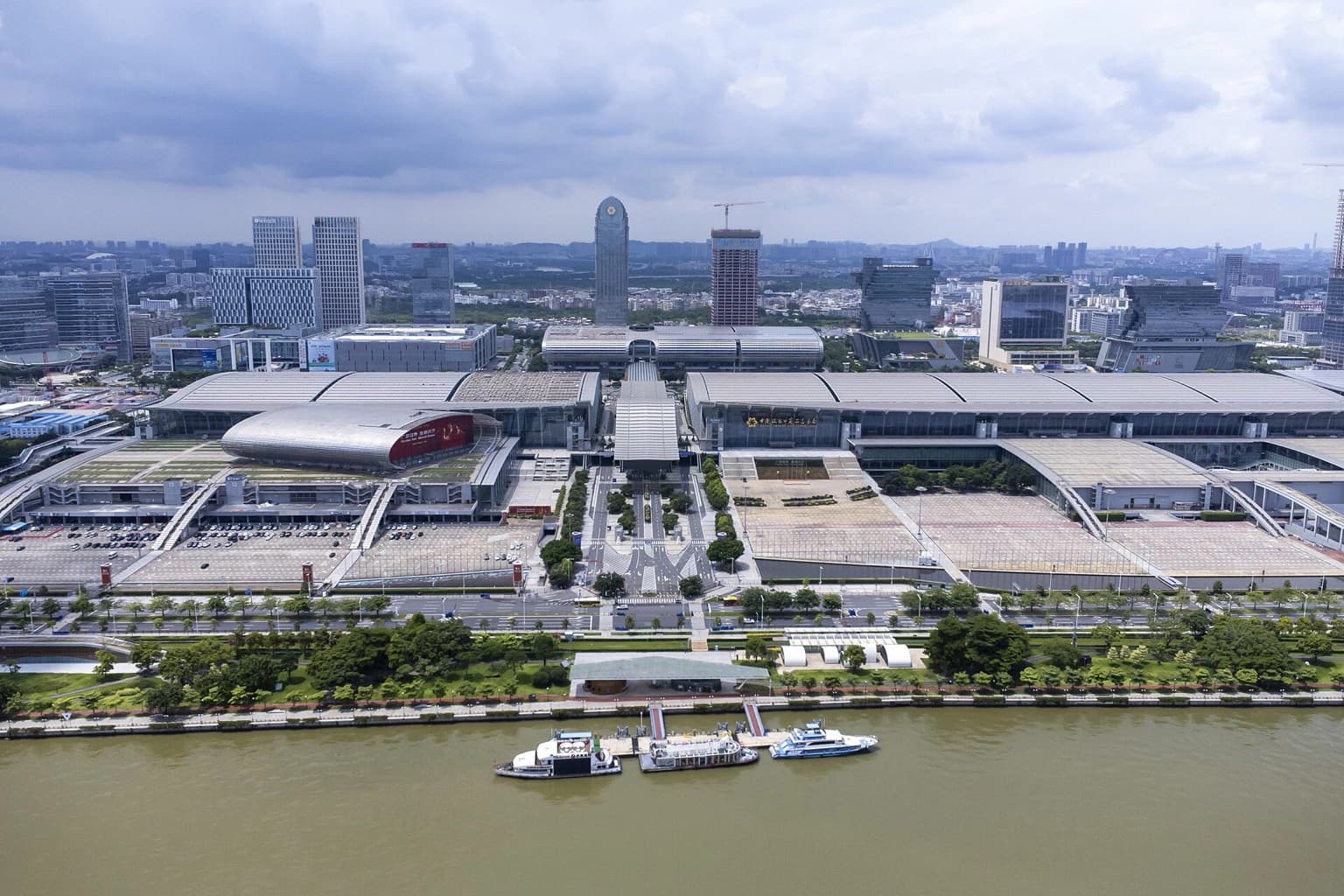
The aerial view shows why a hall-level plan matters: the Canton Fair Complex is a multi-area campus, not one exhibition room. Photo by Tim Wu, CC BY-SA 4.0.
Pick the phase from your specification, not from a viral product video
Start with the product you need to source, then work outward. A first visit becomes manageable when one sentence can define the task: “I need food-contact-safe stainless-steel lunch boxes in two capacities, private-label packaging, an initial order of 1,000 units and test documentation for my market.” “I want ideas for my shop” is too open.
Choose Phase 1 when the technical specification, component system, energy source or mechanical performance drives the purchase. Bring model requirements, voltage and plug standards, communications protocols, material tolerances, target certifications, spare-parts expectations and the destination market. A functioning display sample does not prove production consistency or regulatory compliance.
Choose Phase 2 when material, finish, dimensions, packaging and home-use design are central. Ask how decoration, glazing, food-contact claims, wood species, fire performance, load ratings or moisture resistance are tested. Photographing an attractive display without recording the exact material and quotation creates an unusable comparison later.
Choose Phase 3 when size ranges, fabric composition, care labels, safety requirements, formulation, shelf life, medical claims or consumer packaging matter. Food, medical and personal-care categories can create import requirements that a general trading conversation cannot settle. Verify rules in the market where you will sell, not merely whether the product may leave China.
If two categories fall in different phases, compare the cost of two Guangzhou stays with the value of seeing both in person. The gap days are not exhibition days. A small buyer is often better served by attending the phase tied to the harder-to-verify product and researching the simpler category through later samples.
Registration and the buyer badge
Use the official Buyer Service System reached from the Canton Fair website. A first-time overseas buyer should create the account early, complete company and personal information, submit the requested identity document and photo, apply for the buyer badge, and retain the application receipt or QR code. At collection, bring the original identity document used in the application, the official preregistration receipt or QR code, and a business card. Requirements can change by session or collection point, so read the current official buyer guide rather than relying on an old checklist.
Returning buyers should not assume they need a new badge. Current official guidance says a previously issued overseas buyer badge may remain usable across sessions. Check its condition and current validity before travel; replacement policies and fees are session-specific.
An official Canton Fair invitation can support a business-travel file, but it is separate from the badge process and does not guarantee a Chinese visa or entry. Apply through the appropriate Chinese diplomatic mission or authorized visa channel for your nationality and location. Keep the company name, visit purpose and dates consistent across the invitation request, visa application, flights and fair registration.
For the October–November 2026 session, eligible ordinary-passport holders from China's current 50-country unilateral program may enter for business for up to 30 days without a visa. This is nationality-specific, most participating countries' current arrangements expire on December 31, 2026, and paid work or a stay over 30 days needs the appropriate permission. Check your passport and purpose against the Ministry of Foreign Affairs visa-free FAQ immediately before departure; a fair badge, invitation or previous visa-free trip does not establish eligibility. Travelers outside the listed program need another valid entry basis.
Avoid anyone selling a “guaranteed badge,” borrowed credential or gate shortcut. A person offering to bypass identity checks creates an access risk and may be collecting passport data for an improper purpose. Use only official registration, collection and help channels. Do not send a passport scan to an unknown social-media account, translator or hotel concierge.
For exhibitors, the boundary is equally clear. Start at the official exhibitor portal and use the manual for the current session. Booth application, construction, staff credentials, exhibits, intellectual-property rules and on-site services are exhibitor processes. A buyer badge is not permission to display samples or approach other buyers as an unregistered seller.
Build a one-page buying brief before entering
A fair day is too expensive to spend inventing requirements in front of suppliers. Prepare one sheet per product family with:
- product name, reference image and intended use;
- target country and applicable standard or regulation;
- material, dimensions, tolerance, color and finish;
- required functions, test method and acceptance threshold;
- annual estimate and realistic first-order quantity;
- target packaging, label language, barcode and carton limits;
- sample deadline, production deadline and preferred shipping term;
- acceptable quality-inspection stage;
- questions about tooling, artwork, warranty and replacement parts;
- fields for company legal name, booth, contact, quotation version and next action.
Bring the brief offline as well as on your phone. Venue connectivity can become congested, a battery can fail, and a supplier should be able to mark differences directly on a printed page. Put sensitive target prices and internal margins in a separate document. A public handout should describe what success looks like without revealing your maximum budget.
Build a three-level booth list: ten must-see suppliers, ten alternatives and a small discovery allowance. The fair's current platform and phase map are more dependable than an old influencer route. Save the Chinese and English company names, hall, booth number and product category. Booth locations and exhibitors can change between sessions; reconfirm after the official directory for your edition is live.
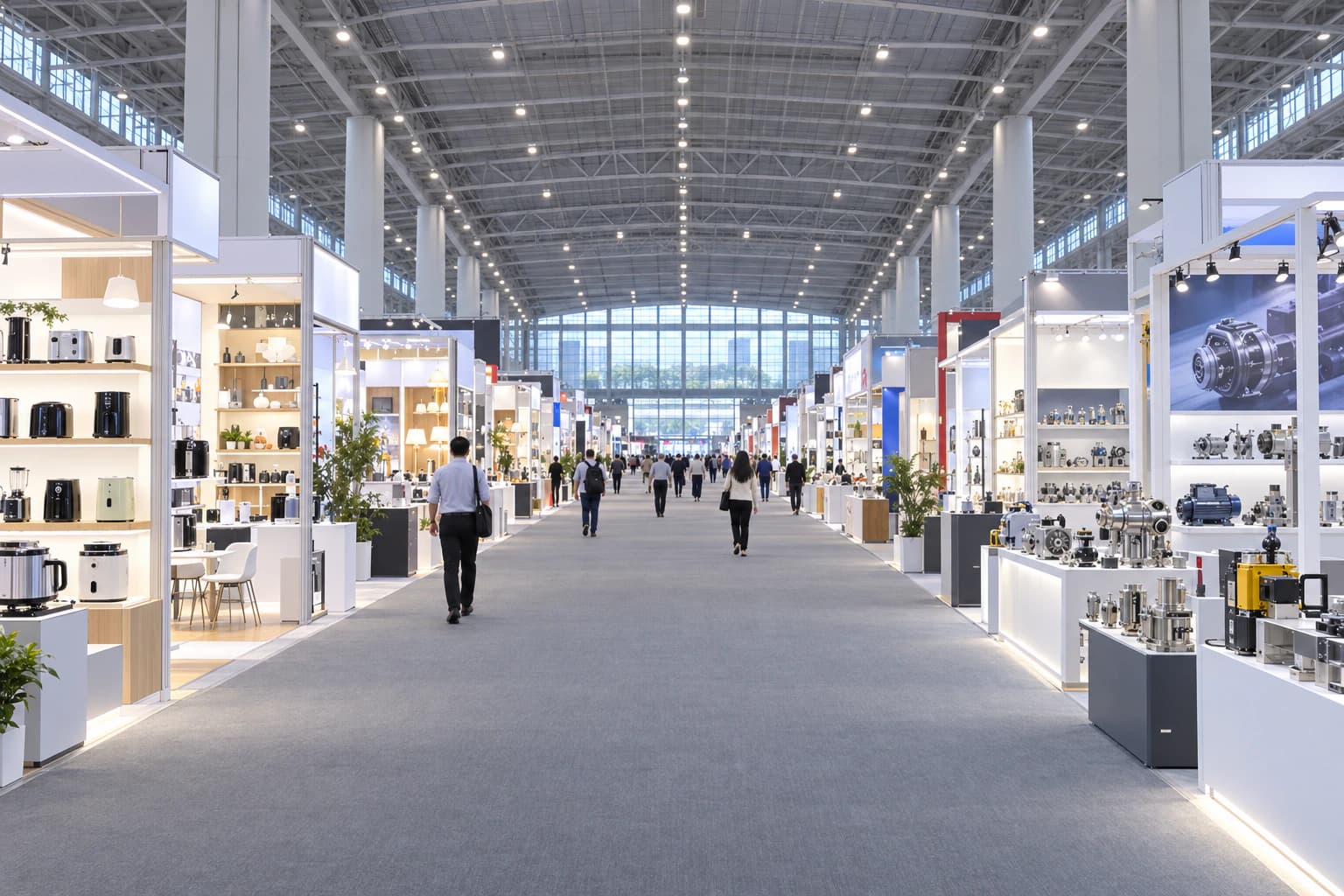
A useful hall plan limits backtracking: group appointments by area, then keep a short discovery block instead of walking every aisle.
Stay and travel: plan around Pazhou geometry
The complex is in Pazhou (琶洲), southeast of central Guangzhou. For the current session, official guidance identifies Xingangdong Station (新港东), Metro Line 8, for Areas A and D, and Pazhou Station (琶洲), Lines 8 and 11, for Areas B and C. Follow the current entrance signs and staff instructions. Exit letters, pedestrian routes and crowd controls may change, and the nearest station on a map is not always the fastest gate for your badge or hall.
Choose accommodation from the job:
- Pazhou or nearby Haizhu: best for early arrival, carrying samples back and reducing peak-hour uncertainty. The trade-off is less evening atmosphere and strong fair-period demand.
- Zhujiang New Town: useful for client dinners and a more central business base, with a longer commute to the complex.
- Near a practical Line 8 interchange: a budget compromise when rooms close to the venue are expensive, provided the route does not require several transfers.
Compare changeable Guangzhou rooms on Trip.com, but verify the exact map pin, station walk, cancellation deadline and fair-period rate before paying. “Near Canton Fair” can describe a property across a river channel or a difficult road crossing. Do not assume a hotel shuttle will operate; ask for the current session's timetable in writing.
From Guangzhou Baiyun International Airport, allow city-scale transfer time rather than treating the exhibition as an airport stop. From Guangzhou South Railway Station, use the current metro or taxi route and protect time for station navigation. If you are arriving by high-speed rail from Shenzhen, Hong Kong or another city, the high-speed rail planning guide explains station choice, ticket identity and transfer buffers. Do not schedule a 09:30 must-see meeting after a same-morning long-distance arrival.
Carry a small power bank that meets current aviation and rail requirements, water, comfortable shoes, passport, badge documents, business cards and a light layer for air-conditioning. Use a rolling case only when samples justify the crowd friction. Leave large luggage at the hotel or an officially provided facility whose current rules you have verified; do not expect every entrance to accept it.
A realistic first buyer day
08:30–09:15 — arrive and solve access. A registered visitor with a badge can move toward the correct entrance. A first-time visitor collecting a badge needs a larger buffer and must use the designated current-session point. Do not put your most important supplier at opening time until the badge is physically in hand.
09:30–11:30 — visit the three highest-priority booths. State the product, market and expected quantity in the first minute. Ask whether the exhibitor is the manufacturer, a trading company or part of a group, but treat the answer as a claim to verify. Handle samples and record model codes. Leave with one defined next step, not a bag of catalogs.
11:30–12:15 — normalize notes. Complete missing fields while conversations are fresh. Rename photographs with the supplier and model; never rely on a gallery full of unlabelled products. Ask permission before photographing a booth, prototype, visitor or document.
12:15–13:00 — eat and reset. Venue queues vary. A portable snack is useful, but follow current entry rules and respect food restrictions in halls. Do not schedule continuous meetings through lunch merely because the doors remain open.
13:00–15:30 — compare alternatives in the same category. Keep the specification fixed. When a quotation changes, identify the changed material, configuration, quantity, packaging, tax treatment or trade term. “Cheaper” is meaningless if the comparison is not like for like.
15:30–16:30 — discovery block. Walk a limited relevant zone. This is where the fair can reveal a production method or supplier you did not know to search for, without letting discovery consume the day.
16:30–17:30 — return to finalists. Resolve contradictions, request written quotations and agree on the sample and follow-up plan. Do not send a large deposit because closing time creates urgency.
After 18:00 — back up evidence. Export contacts, photograph paper notes, and create a shortlist while the booth context remains clear. A client dinner can be useful, but commercial promises made over dinner still need written confirmation by the legal entity.
Ask for a comparable quotation
A proper request for quotation is a controlled comparison, not “best price?” Ask each candidate to state:
- legal company name, business role and production location;
- exact model, specification, materials and included accessories;
- minimum order quantity and price breaks for the same configuration;
- sample cost, delivery time and whether it is credited against an order;
- tooling, mold, artwork and packaging charges;
- production lead time after sample and artwork approval;
- quality-control process and whether independent inspection is accepted;
- applicable test reports or certifications, including issuing body, scope, model and validity;
- Incoterm, named port or place, carton dimensions and gross weight;
- payment terms, warranty, defect remedy and spare-parts availability.
Do not use “factory” as a synonym for “safe.” A capable trading company may coordinate several factories well; a manufacturer may still lack the compliance or process control your market needs. Verify the legal entity, business license, facility, references, production capability and bank beneficiary. If a factory audit matters, arrange it after the fair rather than accepting a staged same-day visit as complete proof.
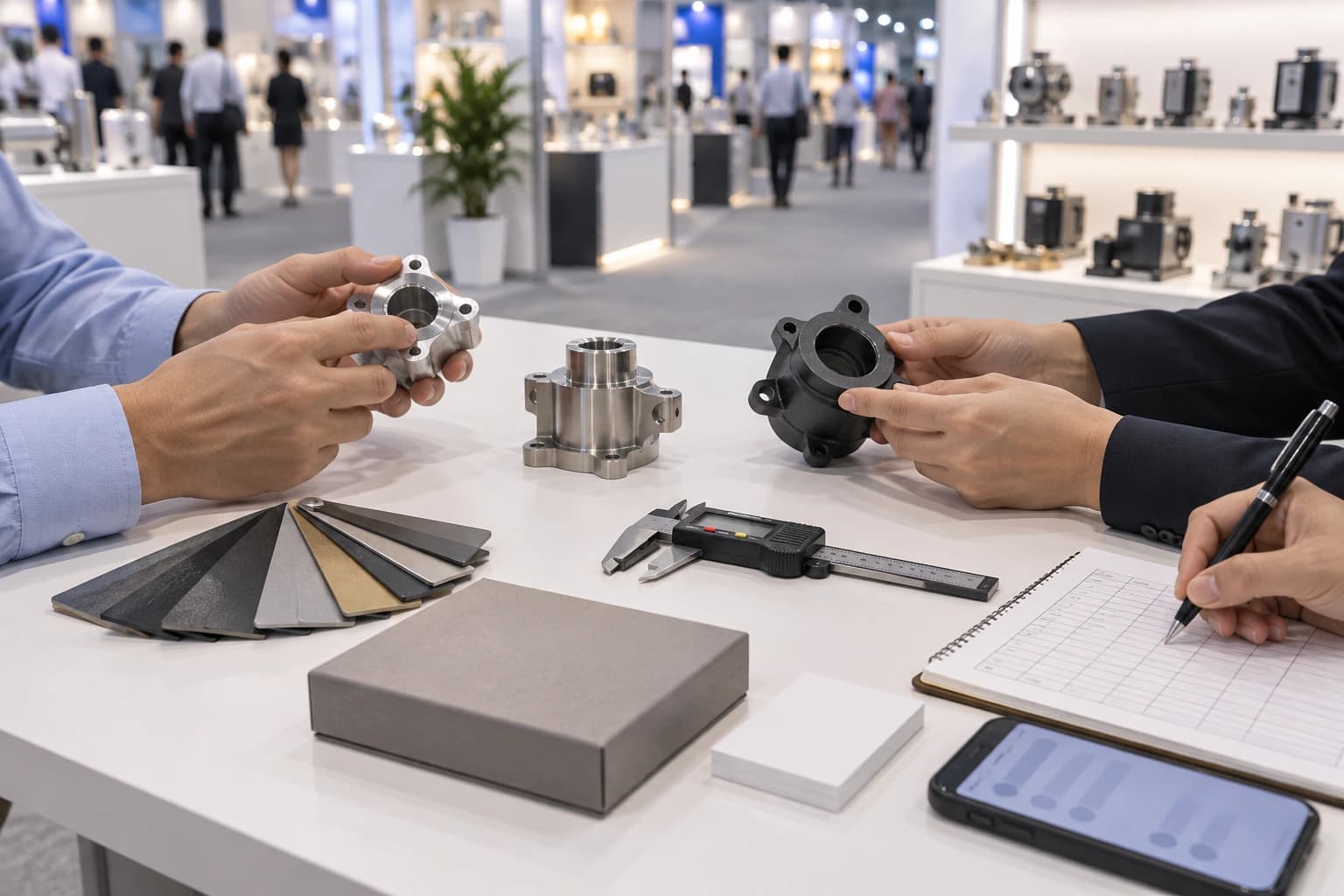
Comparable quotes begin with the same specification, quantity, packaging and delivery term. Record each variation before discussing price.
Interpreters and companions
Hire language support for technical accuracy, not merely navigation. Give the interpreter a glossary before the fair: materials, processes, tolerances, defects, certification names, Incoterms and sensitive questions. Explain that you need complete translation, including uncertainty and disagreement. After each booth, ask for a two-minute recap away from the counter so assumptions do not become facts.
Confirm who employs and pays the interpreter, whether they receive supplier commissions, how confidentiality is handled, and whether they may keep documents or photographs. An interpreter introduced by a supplier can still be helpful, but the relationship should be disclosed. For confidential designs, use an appropriate agreement and share only what the discussion requires.
Companion, interpreter and on-site service registration rules are session-specific. The rules for a previous fair do not prove access at the next one. Check the current official buyer guide and register every attendee through the correct channel. Do not hire an unknown person at the gate to “fix” access.
Samples are evidence, not souvenirs
Many booths display reference units rather than retail inventory. A sample may be free, paid, refundable against an order, available only after the fair, or unavailable because it is the booth's sole unit. Ask for the model, condition and sample terms in writing. If the production sample will differ from the display, list every difference.
Do not build a plan around rumored last-day giveaways or sample sales. Exhibitors decide what happens to displays, and crowded closing-hour bargaining is a poor substitute for a controlled sample order. A paid sample with a documented specification is often more valuable than a free object with no traceable model.
Think about transport before accepting products. Batteries, liquids, chemicals, magnets, sharp tools, medical products, food, seeds and commercial quantities can face airline, railway, courier, export or destination-customs restrictions. Ask the carrier and your destination authority about the exact item. The broader China arrival and customs guide covers traveler boundaries, while commercial importing requires product-specific advice. Shipping samples through a documented courier can be safer than placing uncertain items in checked or cabin baggage.
Payment, fraud and intellectual-property boundaries
The fair's official setting does not replace transaction due diligence. Before paying, match the supplier's legal name to its documents, contract and bank beneficiary. Treat a request to pay an unrelated individual or last-minute third-party account as a stop signal. Verify any bank-detail change through a second known channel, not by replying to the same email that announced it.
For a new supplier, use a staged process: verified quotation, controlled sample, written specification, appropriate contract, pre-production approval and independent inspection where the risk justifies it. Payment terms depend on category, bargaining power and order size; there is no universal safe percentage. Avoid a large same-day deposit made only to preserve a “fair price.” A legitimate commercial deadline can be written into a quotation and reviewed after the hall closes.
A certificate logo on a booth wall is not proof that your exact model complies. Ask for the report, issuing organization, applicant, product scope, standard, date and validity, then verify it with the issuer or appropriate database. Obtain specialist advice for regulated electrical, food-contact, medical, children's or protective products.
Respect other companies' intellectual property as well as your own. Ask before photographing products or booth materials. Do not copy a design because it is openly displayed, and do not assume a supplier owns the brand or patent it offers to reproduce. Limit disclosure of unreleased designs, watermark sensitive drawings, keep a record of what was shared and obtain jurisdiction-appropriate legal advice for important tooling, ownership or exclusivity terms.
If an on-site dispute arises, preserve the booth number, company names, receipts, messages and photographs obtained lawfully, then use official fair staff or the current complaint channel. A complaint desk can document and route a problem; it cannot replace a contract, inspection, bank verification or legal counsel.
Follow up while every promise is still testable
Within 24 hours, send each shortlisted supplier a concise note identifying the fair, booth, people, product and agreed next action. Attach your controlled specification rather than asking the supplier to reconstruct it from memory.
Within 48 hours, put comparable offers into one table. Normalize currency, quantity, configuration, packaging, trade term, tooling, lead time and sample cost. Mark every blank as an open question. A low unit price under EXW and a higher FOB quotation are not directly comparable.
Within one week, reduce the list. Request documents and samples only from candidates that answer consistently. Plan any factory audit or video verification, decide who will inspect production, and confirm the contracting entity. Send polite closure messages to the others; a supplier that is unsuitable for one order may fit a later product.
After the sample arrives, test it against the written acceptance criteria. Do not approve mass production because the object “looks fine.” Record measurements, function, packaging and failures. Sign or otherwise control the approved reference sample, then state how production units will be judged against it.
When one day, two days or no fair is the right answer
Choose one full day when you have one narrow category, ten priority booths and a comparison brief. Choose two days when you need technical follow-ups, several related subcategories or interpreter-supported meetings; use day one to screen and day two to resolve evidence gaps. Stay for more only when scheduled meetings and product breadth justify the cost.
Skip the fair when you want retail souvenirs, have no import route, cannot define the product, or plan to select a supplier only by price. For small electronics exploration rather than trade procurement, the Huaqiangbei guide explains how Shenzhen's markets differ from a formal export exhibition. For ordinary brands, gifts and tax-refund decisions, use the China shopping guide.
A successful Canton Fair trip rarely ends with a dramatic order on the exhibition floor. It ends with a short, documented supplier list; comparable samples; clear unanswered questions; and enough evidence to continue due diligence after Guangzhou. That is the standard worth planning the phase, badge, hotel and fair day around.