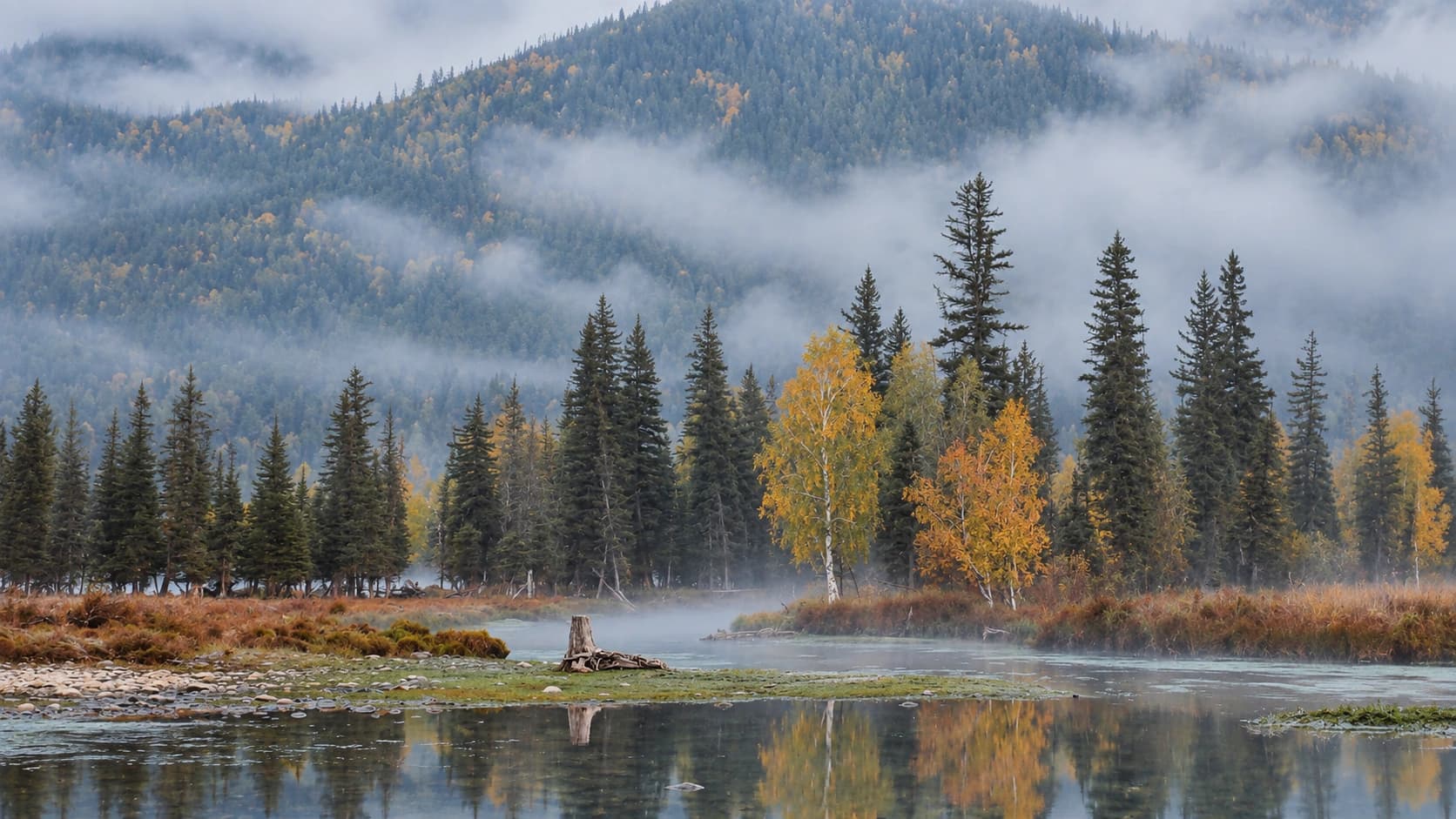
China in autumn: follow the colour south
China does not have one national peak-foliage week. Colour begins in cold northern grasslands and high mountains in September, reaches western valleys and the northern city belt through October, then moves into eastern China, southern ginkgo country and lower-elevation forests in November and early December.
That long season is useful: you can plan around the month you already have. It is also why a post saying “China peaks in October” is not actionable. Kanas may be past its strongest gold while Beijing is still green; Beijing can be near peak while Tengchong's ginkgo is only beginning.
Every date range below is a historical planning window, not a forecast. Wind can strip leaves overnight. Rain changes reflections and trail conditions. Altitude can move colour by days within the same scenic area. Choose a place that remains worthwhile when the leaves are early, late or less vivid than expected.
The September-to-December colour calendar
| Planning window | Strong candidates | Landscape character | Main planning risk |
|---|---|---|---|
| Early–mid September | Hulunbuir, Greater Khingan foothills, upper Changbai Mountain | Golden grass, birch and early mountain colour | Very short season; cold nights and long road days |
| Mid-September–early October | Kanas, Hemu, Changbai lower slopes | Yellow forest, rivers, villages and possible early snow | Holiday crowds, gateways and weather-sensitive transfers |
| Late September–mid October | Ejina poplar forest, western Sichuan high valleys, northern mountain roads | Desert gold or high-altitude larch and scrub | Huge distances, altitude and fast-changing road conditions |
| Mid–late October | Jiuzhaigou, Bipenggou, Beijing outer mountains | Coloured forest with lakes, snow peaks or ridgelines | Timed entry, scenic buses and high demand |
| Late October–early November | Beijing parks and Great Wall, Qinling foothills, Huangshan villages | Red leaves, mixed woodland and historic architecture | Weekend congestion and year-to-year timing shifts |
| Early–mid November | Huangshan, Huizhou villages, Wuyuan countryside | Maple, persimmon, white walls and misty mountains | Cloud can hide peaks; village colour is uneven |
| Mid-November–early December | Nanjing, Suzhou and Hangzhou parks, Tengchong | Ginkgo avenues, red maples and late southern colour | Famous trees concentrate visitors into small areas |
A range this broad should guide where to investigate next, not trigger a non-refundable booking. Close to departure, look for dated local photographs, official colour reports and current transport notices.
Choose the landscape before the destination
A useful autumn plan begins with the picture and travel experience you want:
- Gold forest around water: Kanas and Hemu.
- Multicoloured forest reflected in blue-green lakes: Jiuzhaigou.
- Snow mountains above an organised valley day: Bipenggou or other western Sichuan valleys.
- Red leaves with imperial-city or Great Wall context: Beijing.
- Mist, granite peaks and villages: Huangshan and southern Anhui.
- Harvest displays and village roofs: Huangling, which is different from a foliage trip.
- Late-season ginkgo: Nanjing or Tengchong.
- Open grassland turning yellow: Hulunbuir, where the road trip matters as much as one viewpoint.
If the visual idea is unclear, the itinerary often becomes a cross-country collection of names. A strong trip normally stays within one region for four to seven days.
1. Changbai Mountain: the first mountain colour
Changbai Mountain is an early-season choice. Elevation creates several bands: exposed summit terrain can feel wintry while the lower forest is still changing. The result is more than leaves—volcanic slopes, waterfalls and broad forest matter even when the exact colour line disappoints.
Choose the north, west or south slope before booking transport. They have different gates and sightseeing systems; they are not interchangeable entrances to one small park. The Changbai seasons and transport guide explains the access decision.
Build one buffer day because cloud, wind and safety controls can remove the crater-lake view. Autumn works best when you still value the forest and waterfall route without a guaranteed Tianchi photograph.
2. Hulunbuir: grassland gold rather than maple red
Hulunbuir is for travellers who want open scale: yellow grass, birch, river bends and long horizons. The trip is usually vehicle-based, and the hours between viewpoints are part of the experience. It is a poor match for someone seeking a compact rail itinerary or dense red maple forest.
The season can turn quickly. Nights become cold, wind strips birch leaves, and rain can make minor tracks muddy. Choose a driver and route that stay on legal roads, and make each day useful with two or three landscape zones rather than a list of isolated photo pins.
Combine grassland, river and a forest edge so the day still has variety if one patch is past peak. Avoid a schedule that promises a different sunrise and sunset platform every day; weather and driving time usually control more than the shot list.
3. Kanas and Hemu: China's classic golden-water trip
Kanas is the strongest choice when autumn colour is the main purpose of the journey and you can allow several days in Altay. Golden deciduous trees line blue water, while darker conifers keep the slopes from becoming one flat yellow mass.
Regional guidance has identified late September to early October as a strong historical period, and the Xinjiang culture and tourism department documented yellow and orange slopes in late September 2025. Those records describe past seasons, not 2026 colour. See the regional planning guidance and the dated 2025 tourism report as examples of evidence to compare with current images.
The practical challenge is the park system. Entry gateways, sightseeing buses and last return times govern the day. The Kanas route guide divides the lake, Three Bays and optional high viewpoint into a workable sequence.
Add Hemu only with another overnight. Hemu gives village roofs, river mist and a broader valley, but it also adds another road and shuttle chain. A rushed “Kanas plus Hemu in one day” plan sacrifices the slow morning conditions that make either place worth the journey.
4. Ejina and desert poplar: a specialist road trip
Ejina's poplar forest is visually different from mountain foliage: bright yellow trees against desert, water channels and open sky. It is a short, high-demand season in a remote area. The destination makes sense when this landscape is the central purpose of the trip, not as a quick side excursion from a major eastern city.
Use early to mid-October only as a research starting point. Check the year's current colour, water conditions and scenic-area notices before committing. Golden Week can create severe pressure on transport and accommodation. If your dates are fixed around October 1, reserve a realistic base early and avoid a same-day long-distance arrival followed by a full park route.
The Tarim Basin also has later desert poplar colour, often extending beyond Ejina's period, but it belongs to a separate southern Xinjiang road itinerary. Do not treat the two as interchangeable pins on one trip.
5. Western Sichuan: altitude creates several autumns
Western Sichuan has no single peak week. High passes can turn early or receive snow while lower valleys remain green. This is useful for a flexible road trip but risky for a rigid “three famous viewpoints in three days” plan.
Bipenggou is one of the more structured choices: scenic transport, lakes, forest and snow-mountain views fit into a defined day. It still requires current checks for operating zones, weather and high-altitude comfort. Other Ganzi and Aba valleys can offer larch, red scrub and mountain backdrops, but road time and altitude often exceed what photographs suggest.
Choose one base and one main valley per day. Keep the first high-altitude day light, carry warm layers, and do not force a long walk when headache, nausea, dizziness or unusual breathlessness develops. A beautiful colour forecast does not reduce altitude risk.
6. Jiuzhaigou: the best water-and-forest contrast
Jiuzhaigou Valley is the clearest choice for coloured forest reflected in blue-green lakes. It has an organised sightseeing-bus system and several valleys, so the practical task is selecting stops rather than trying to walk every branch.
National government reporting documented autumn colour in the valley on October 10, 2024. That proves what one dated season looked like, not an annual peak. Different elevations and valleys can show different stages on the same day. Use the dated government images for landscape expectations, then check current park updates.
Protect a full day inside Jiuzhaigou and avoid putting a flight or long transfer immediately after the park. Add Huanglong only as a separate higher-altitude landscape. The three-day Jiuzhaigou–Huanglong itinerary uses one base and keeps the transfer sequence realistic.
7. Beijing: the flexible late-October choice
Beijing is the practical autumn choice when you also want history, museums and neighbourhood days. A late or weak colour display does not ruin the trip. Fragrant Hills is famous for red leaves, while ginkgo, maple and dawn redwood appear across other parks on different schedules.
The official 2025 Fragrant Hills notice reported only 5% red leaves on October 17 and expected a stronger display after Frost's Descent. That example shows why “mid-October” can be too early in a specific year. The city park service also published a park-by-park colour guide, which is the kind of current update to seek for your own dates.
For a landscape with historical structure, combine changing woodland with Badaling Great Wall or another currently open Great Wall section. Use a weekday, start early and confirm transport. A mountain section can colour earlier than central-city parks, so do not apply one Beijing percentage to the entire municipality.
8. Huangshan and Huizhou: mist, peaks and village colour
Huangshan is strongest when you value cloud, granite and pine even without peak foliage. Autumn adds warm forest patches and clearer air, while nearby Huizhou villages bring white walls, dark roofs, persimmon and fields into the same regional trip.
Cloud can hide the mountain for an entire day. Use at least two nights in the region and avoid making a single summit sunrise the only purpose. Decide between a mountain-focused plan and a village-focused plan before choosing the base: Tangkou serves the main mountain approach, while Huangshan City and county towns fit different village circuits.
Tachuan is often promoted for autumn, but a famous name does not guarantee even colour or quiet paths. Pair it with a broader southern Anhui day so one crowded viewpoint does not control the trip.
When the route is settled, compare an exact Tangkou or city property rather than a generic “Huangshan” result; Trip.com hotel search spans a large area, so verify the pin against your chosen gate and morning transport.
9. Wuyuan and Huangling: harvest colour is not a foliage forecast
Huangling is best known for shaiqiu: crops arranged to dry on terraces and rooftops. Those reds and yellows are a managed harvest display, not the same phenomenon as a forest reaching peak colour. It can be rewarding even when the surrounding trees are mostly green.
Later in autumn, Wuyuan villages can add maple, persimmon, mist and pale architecture. Conditions vary by village and slope. Use the Wuyuan east-line route to understand how the villages fit together instead of chasing each viral tree as a separate taxi stop.
Choose Huangling for the roof-and-harvest composition. Choose a broader village route for architecture and countryside. Combining both makes a more resilient trip than booking around one “red maple peak” prediction.
10. Nanjing and the lower Yangtze: the late city season
Nanjing offers one of the easiest late-autumn trips: ginkgo, plane-tree avenues, red maples and historic sites can be combined with museums and city food. Mid-November into early December is a historical planning period, but each species changes on its own schedule.
Do not build the day around one crowded avenue. Pick a morning foliage area, one indoor cultural stop and a second park or neighbourhood for late light. Rain often deepens leaf colour but makes stone paths slippery. A weekday helps more than arriving with a long list of “hidden” camera pins.
Suzhou and Hangzhou fit the same broad late-season band and work well as alternatives when the larger regional itinerary already includes Shanghai. Their gardens and parks offer a more intimate architecture-and-leaf composition than northern mountain scenery.
11. Tengchong: the late ginkgo finale
Tengchong extends the autumn idea into late November and early December. Ginkgo Village is the seasonal headline, while volcanic, geothermal and historic sites make the wider destination useful when leaf timing shifts.
Go only after a near-date colour check. Outside the short yellow period, the village is not automatically worth a dedicated outward trip. Keep Heshun Ancient Town, the Rehai geothermal area or another non-foliage day in the plan.
If staying overnight, compare a practical urban base with a Heshun-edge stay and verify the exact road access, slopes, heating and international-guest policy. Trip.com's Tengchong search is a starting list, not proof that every property fits a ginkgo or early-departure route.
Four trip shapes that work
Five days in late September: Altay gold
- Day 1: arrive in Altay or the confirmed gateway; no scenic-area sprint.
- Days 2–3: Kanas core route plus a weather or slow-photography day.
- Day 4: Hemu with an overnight only if transport is confirmed.
- Day 5: return buffer.
This trip has high scenery payoff and high transport commitment. Avoid attaching another distant province.
Four days in mid-to-late October: Jiuzhaigou water and forest
- Day 1: reach the Jiuzhaigou base.
- Day 2: full Jiuzhaigou scenic-area day.
- Day 3: buffer, second valley focus or weather fallback.
- Day 4: Huanglong on the departure-side route only when altitude, weather and transport fit.
This is the most structured first autumn trip and the easiest to understand without self-driving.
Five days in late October: Beijing history plus colour
- Two days for central Beijing history and museums.
- One weekday for a current colour park.
- One day for a Great Wall section with autumn woodland.
- One flexible day for weather or a second park.
This plan remains strong if foliage timing is imperfect.
Six days in November: Huangshan, Huizhou and Nanjing
- Two to three days for Huangshan and a nearby village circuit.
- Transfer by rail after checking the real station-to-hotel chain.
- Two full Nanjing days for one foliage area, one major historic site and an indoor fallback.
Use Trip.com trains only after fixing the regional order and exact stations; similar city and mountain names can hide a costly transfer mistake.
Golden Week changes the decision
The National Day holiday around the beginning of October overlaps some of the strongest northern and western windows. It also brings the year's most intense domestic travel demand. If those are your only dates:
- choose one region and reduce transfers;
- secure the arrival gateway, park entry and first nights before adding photo stops;
- avoid an arrival-day scenic ticket that assumes an on-time long-distance transfer;
- enter major scenic areas at the first workable time;
- keep one day whose value does not depend on a famous viewpoint.
A slightly less famous valley with a stable base can produce a better autumn trip than a headline destination reached through exhausted transfers.
How to check live colour without being misled
Five checks are more useful than a generic “peak forecast” graphic:
- Use dated images from the exact place. Confirm the upload date and whether the image was actually made that week.
- Compare elevation. A summit photo does not describe the entrance village, and a valley report does not describe a high pass.
- Look for wind and rain after the image. One storm can remove much of the canopy.
- Check current access separately. Colour can be excellent while a road, shuttle branch or high trail is closed.
- Treat editing cautiously. Extreme orange saturation can make mixed green forest look fully turned.
For a remote colour-first trip, make the final go/no-go assessment several days before departure while keeping cancellation terms in view. For Beijing, Nanjing or another city, decide the specific park later and preserve the rest of the itinerary.
Pack for temperature range, not the arrival city
Autumn mountain trips can move from a warm transport hub to frost or snow in one day. Carry a breathable base layer, warm mid-layer, wind-resistant outer layer, rain protection and shoes with grip. A light hat and gloves earn their place in Altay, Changbai and western Sichuan earlier than many visitors expect.
For photography, one normal zoom is usually more useful than several heavy lenses. Bring spare power because cold shortens battery life. Use a long lens for compressed ridges or distant forest layers, and a normal lens for villages, lakes and travel context. Do not enter closed slopes or roadside traffic lanes for a cleaner foreground.
The best autumn itinerary is not the one with the most predicted peaks. It is the one where the season improves a trip that already works: Kanas still has water and villages, Jiuzhaigou still has lakes and waterfalls, Beijing still has history, Huangshan still has granite and cloud, and Tengchong still has a wider landscape beyond one ginkgo grove.