Jiuzhaigou Valley
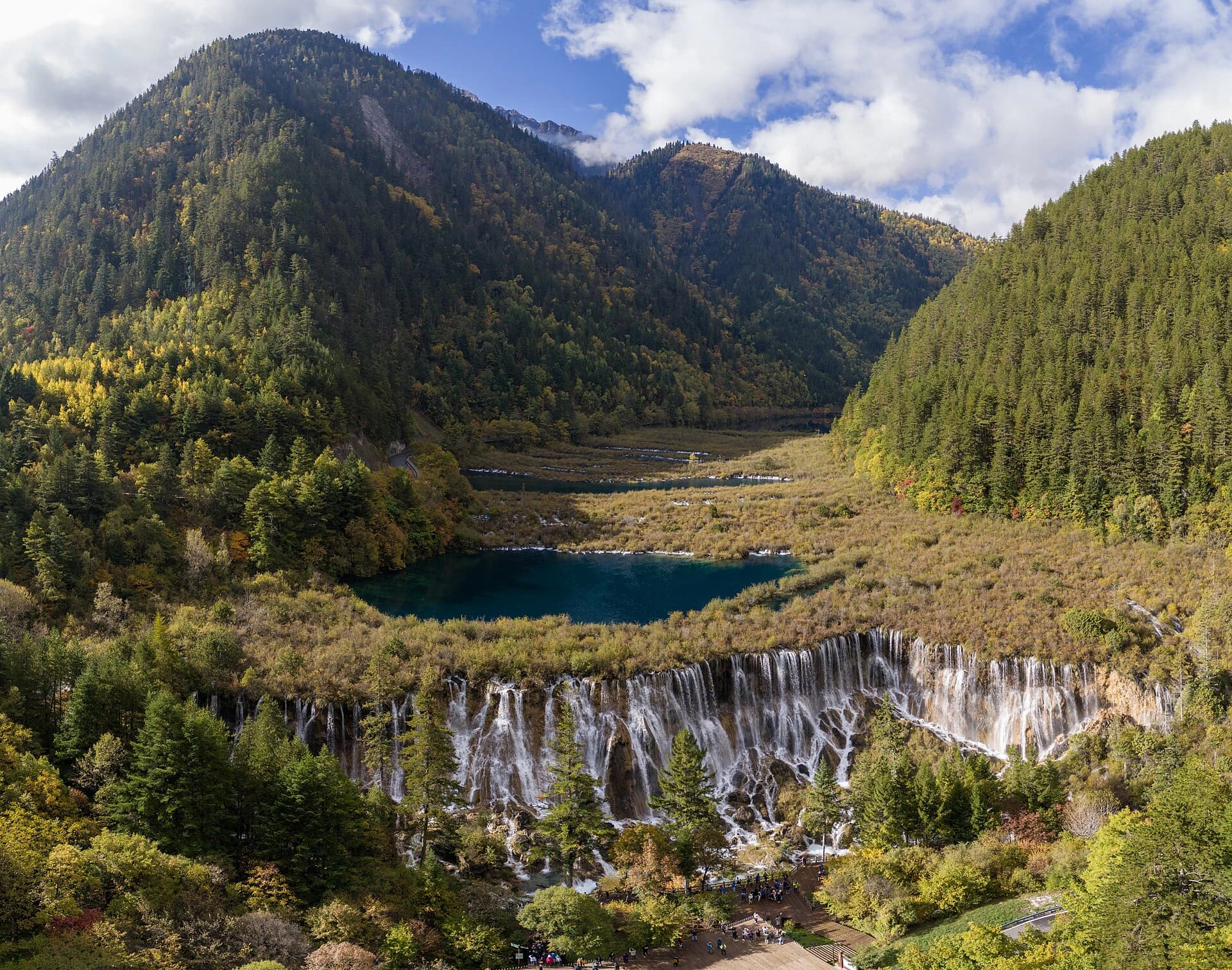
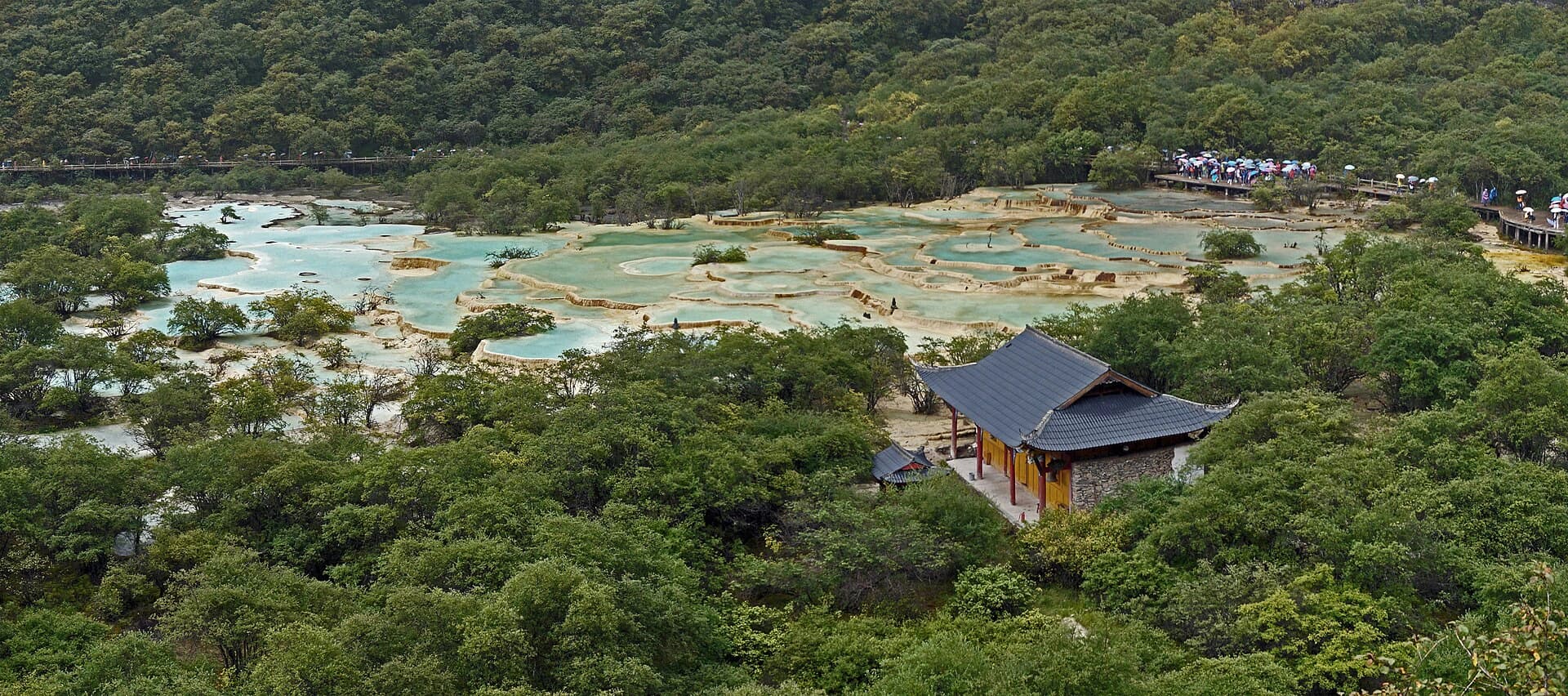
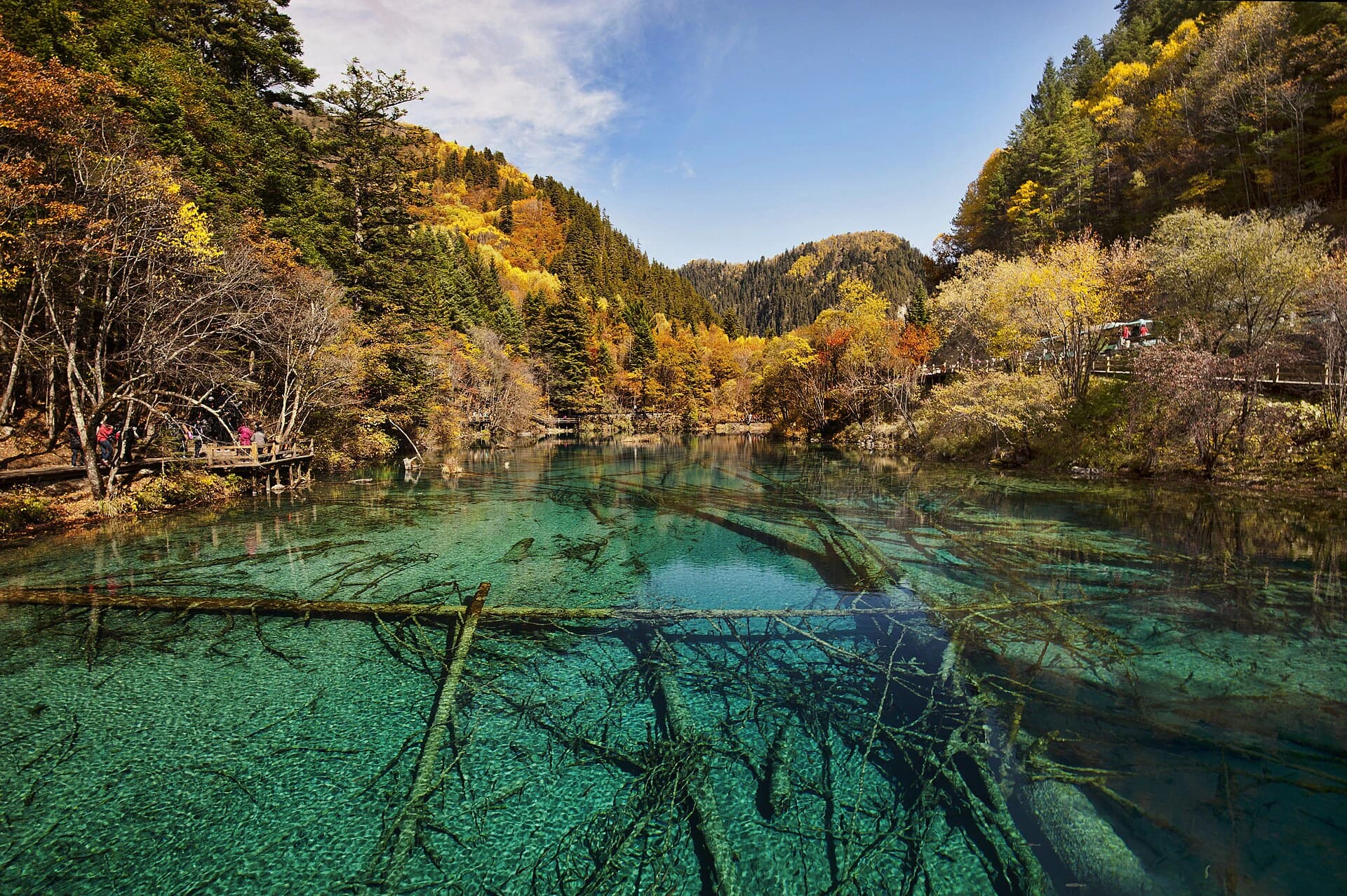
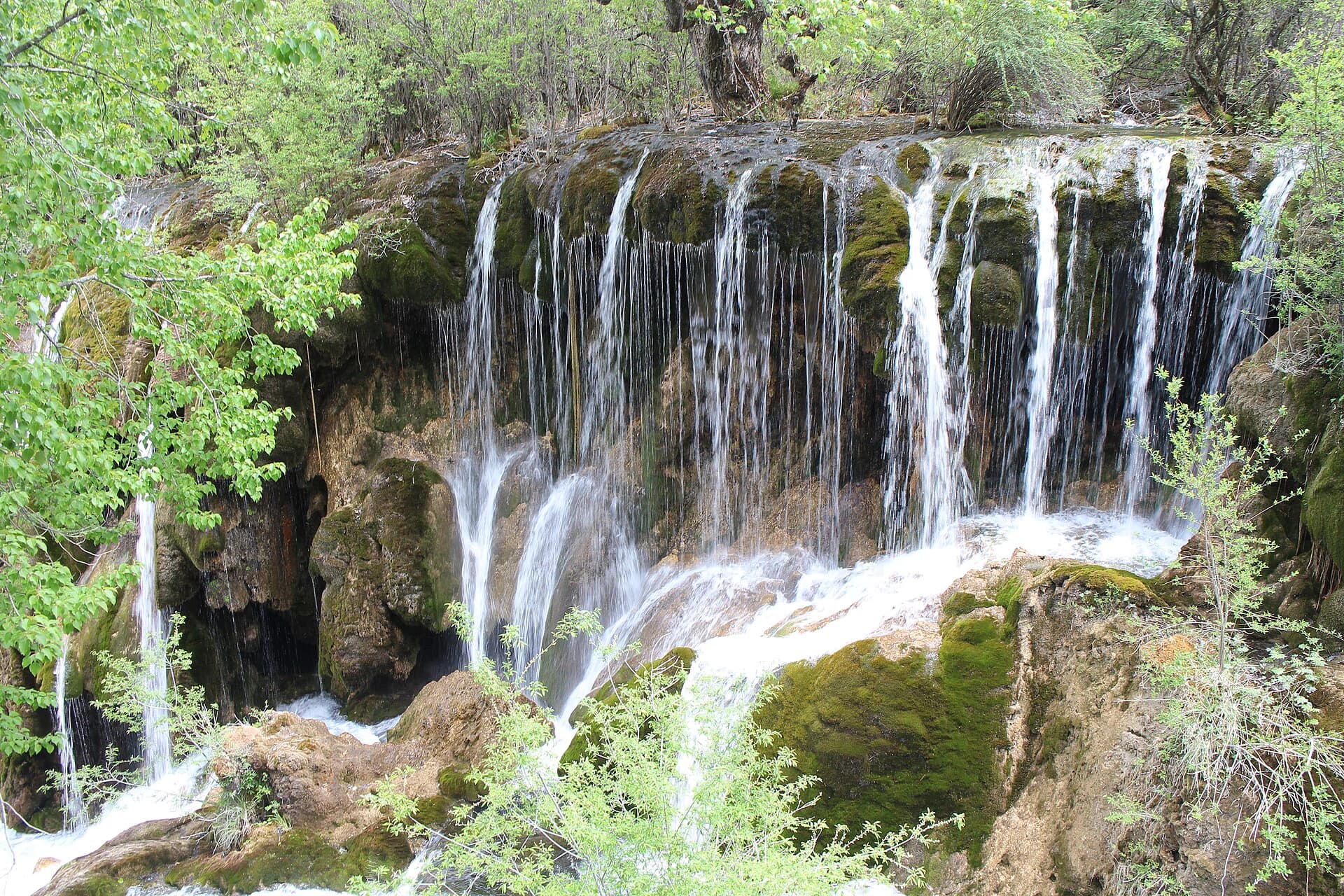
Jiuzhaigou Valley (九寨沟风景名胜区, Jiǔzhàigōu Fēngjǐng Míngshèngqū) is worth a full day for the way blue-green lakes, pale travertine edges, waterfalls, reed beds and forest change across three connected valleys. The pleasure is not collecting every named lake. It is riding the long connectors, then slowing down for a few adjacent landscapes where the water and forest can be read on foot.
The park works like a Y. Shuzheng Valley forms the lower stem; Rize and Zechawa are the two upper branches; Nuorilang is the hinge between them. Sightseeing buses are dispatched according to live crowd conditions, so the strongest plan is adaptive: accept the first useful upper branch, ride high, walk selected sections downhill, reset at Nuorilang, then give the second branch and Shuzheng a defined amount of time.
Give each valley a clear role
| Valley | What it contributes | A selective first-visit core |
|---|---|---|
| Rize Valley (日则沟) | The highest choice density: clear lakes, waterfalls, forest and several useful walking links | Five Flower Lake → Pearl Shoal → Pearl Shoal Waterfall; add the upper forest-and-wetland sequence only when time, energy and current access support it |
| Zechawa Valley (则查洼沟) | A shorter high branch with broad mountain scale and a concentrated colour stop | Long Lake + Five-Color Pond, using the day's signed bus and walking connection |
| Shuzheng Valley (树正沟) | The long exit valley, where lakes, cascades and reeds create a satisfying final chapter | Choose one meaningful sequence around Rhinoceros Lake, Shuzheng Lakes/Waterfall, Sparkling Lake or Reed Lake rather than leaving the whole valley to exhausted leftovers |
The names matter less than the contrast. A strong day includes a detailed lake, a waterfall sequence, a high-valley view and one lower-valley lake or reed landscape. Water level, reflections, foliage, snow and visibility change with season and weather; none is guaranteed by the ticket.
The selective one-day route
This diagram is a decision sequence, not a scale map or fixed bus timetable. Follow current signs and staff directions whenever they differ.
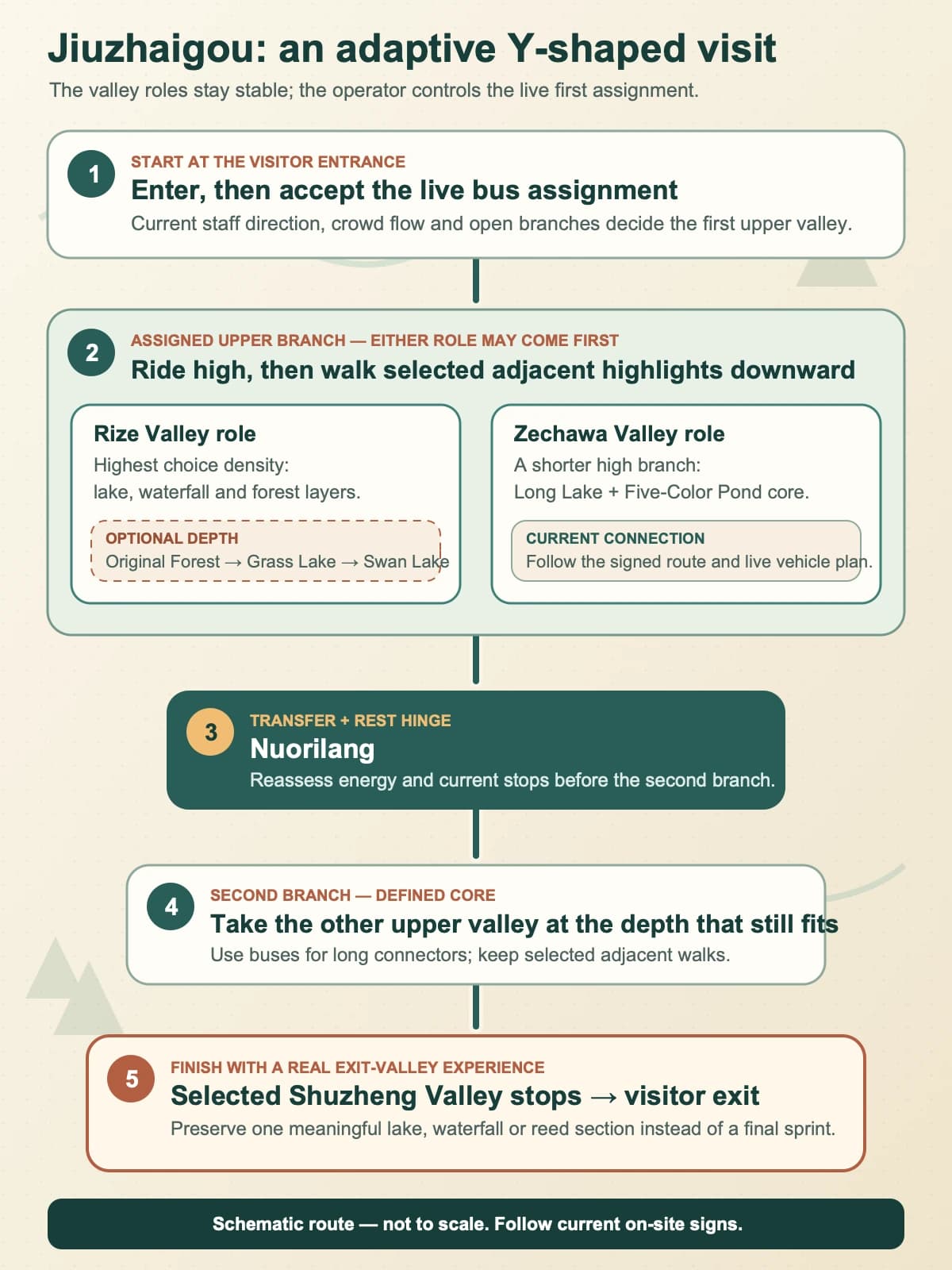
1. Enter with the day ready, then accept the live assignment
Arrive for a full opening-to-closing day with the dated reservation already confirmed. The first bus may serve Rize or Zechawa according to live operations. Treat either as a valid start. Leaving the flow merely to force a saved branch order can consume the time that makes the walking sections enjoyable.
An early arrival usually creates more usable daylight, but it does not guarantee a particular first bus or a queue-free entrance.
2. Ride high on the first branch and walk selected sections downhill
If Rize comes first, make Five Flower Lake and the Pearl Shoal–Pearl Shoal Waterfall sequence the dependable core. Strong walkers with a generous time margin can continue higher toward Original Forest → Grass Lake → Swan Lake when those stops are open and the day's transport supports the sequence. That upper section adds quieter forest and wetland character; it is optional depth, not a compulsory prelude.
If Zechawa comes first, build the branch around Long Lake and Five-Color Pond. Their exact bus and walking connection can change with daily routing, so use the current signed sequence rather than assuming an old online loop.
Whichever branch comes first, pair nearby stops into one continuous downhill walk where the open boardwalk allows it. Use the bus for long gaps and elevation changes. This hybrid rhythm reveals more of the landscape than repeatedly boarding for one isolated photograph.
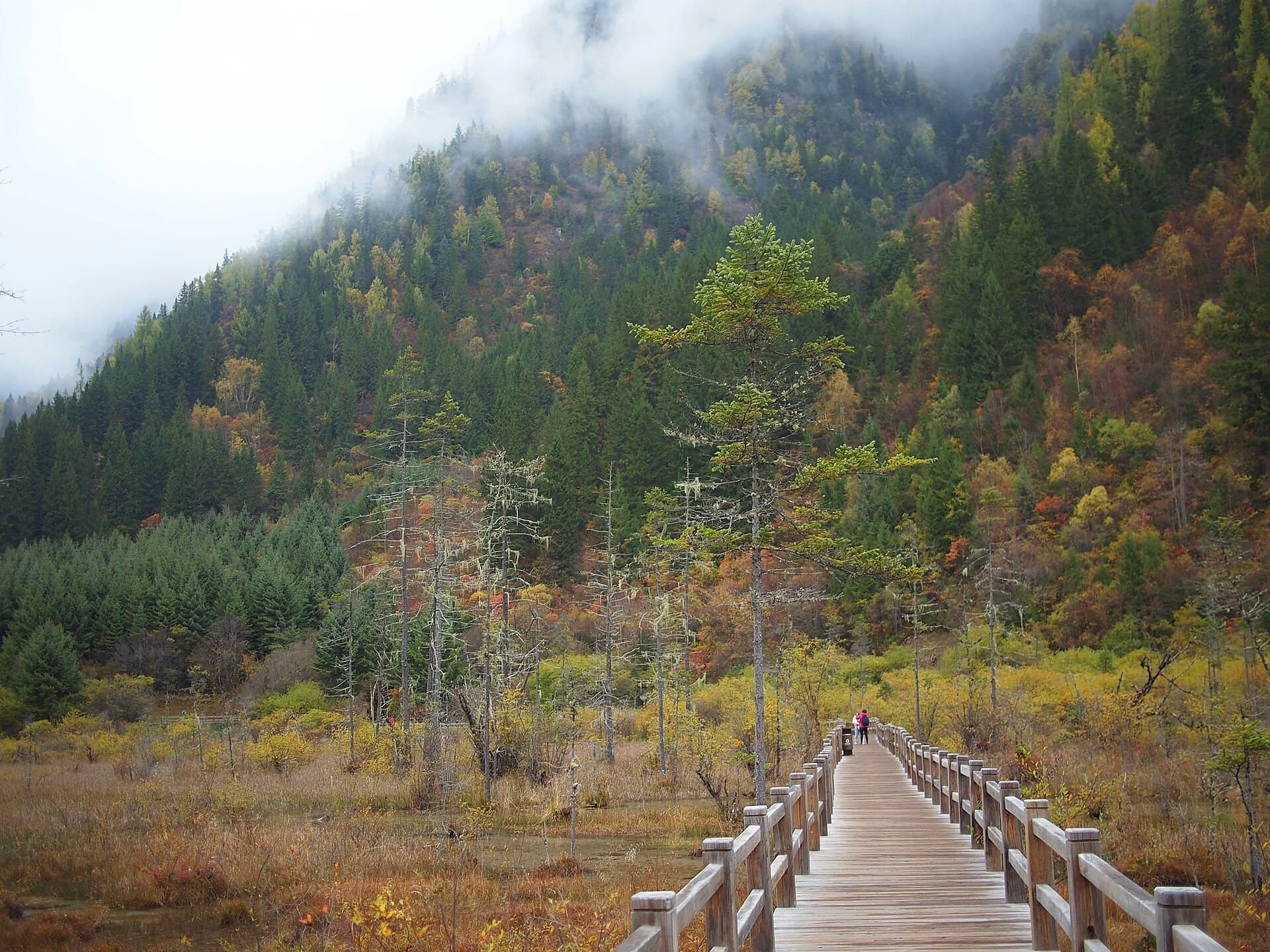
3. Use Nuorilang as the reset point
At the central Nuorilang area, check the time, legs and current branch directions before committing to the second half. This is the route hinge: rest, consult the live map or staff, and decide how much of the other upper branch remains realistic. Confirm any services you need on the current official map instead of assuming every facility is operating.
4. Give the other upper branch a defined core
When the first branch was Rize, the Zechawa core is Long Lake plus Five-Color Pond. When the first branch was Zechawa, the Rize core is Five Flower Lake plus the Pearl Shoal waterfall sequence. Keep the optional upper Rize forest section only if daylight and energy remain strong.
This definition protects the best contrasts without turning the afternoon into a race between bus stops. If live routing or access changes, preserve the experience types—a high lake, detailed water, a waterfall walk—rather than every saved pin.
5. Finish intentionally in Shuzheng
Reserve time for one lower-valley sequence on the way out. Rhinoceros Lake gives a broad water-and-mountain pause; Shuzheng Lakes and Waterfall show water stepping through the valley; Sparkling Lake offers a more compact lake stop; Reed Lake changes the texture completely. Choose the section that is open and fits your remaining legs, then use the bus for the final connector to the exit.
Shuzheng is not merely the corridor back to the gate. One deliberate stop here makes the Y-shaped day feel complete.
A lower-energy or family version
Keep the same structure while shifting more distance to the bus:
- Accept the first upper branch and keep its two-stop core.
- Use Nuorilang for a genuine rest and reassessment.
- Take the second branch only to its defined core; leave the optional Original Forest–Grass Lake–Swan Lake depth for a day with stronger legs.
- Select one Shuzheng stop with the clearest return connection.
- Shorten a walking link as soon as stairs, altitude, weather or crowding reduce comfort.
This version still contains the valley's essential contrasts. Boardwalks are not automatically step-free, and buses still require boarding and waiting. Travellers using a stroller, wheelchair or mobility aid should ask the official service channel about the day's accessible stops, gradients and loading arrangements before relying on a continuous route.
2026 tickets, hours and capacity
The following facts were checked against Jiuzhaigou's official notices on 21 August 2026:
| Item | Current official baseline |
|---|---|
| Peak season | 1 April–15 November; admission CNY 190 + sightseeing bus CNY 90; daily capacity 41,000 |
| Current August hours | Entry 07:30–14:00; scenic area closes 18:00 |
| Low season | 16 November–31 March; daily capacity 23,000 |
| Published winter time reference | The February 2026 notice used entry 08:30–14:00 and closing 18:00; recheck the notice for your own winter date |
Use the official Jiuzhaigou website and its latest reservation notice before paying. The notice lists the 九寨沟旅游官方平台 WeChat/Alipay mini-program, the 阿坝旅游网 WeChat mini-program and the Abatour mobile booking site as official channels. If a date sells out, the official platform may offer a waiting-list function, but that is not confirmed admission.
Compare the exact Jiuzhaigou National Park ticket options on Trip.com, then check whether the selected option includes the sightseeing bus and accepts the traveller document you will carry.
For a foreign passport, confirm the accepted document field and the collection or entry method with the official ticketing service before payment. The current public notices reviewed here do not explain that workflow clearly enough to promise that a particular checkout or gate procedure will work.
Reach the visitor entrance, not a generic park pin
Use the exact Jiuzhaigou Visitor Centre AMap marker for a road transfer or accommodation check. Confirm the driver's drop-off, the hotel's morning transfer and the walking route before the visit; the wider Jiuzhaigou area contains many pins that are not the admission entrance.
For arrival order, Goukou bases and combining the valley with Huanglong, use the Jiuzhaigou trip guide.
Let weather and conservation rules improve the day
After heavy rain, check the latest official notices because geohazard controls can alter open sections and bus routing. Inside the valley, stay on designated boardwalks, follow staff around controlled areas, keep out of the water, do not feed wildlife, and leave drones grounded unless specifically authorised. Smoking and open flame threaten a forested World Heritage landscape. At higher stops, choose a comfortable pace and reduce the route if breathlessness, headache or unusual fatigue develops.
The winning Jiuzhaigou day is not the one with the longest checklist. It is the one that uses live transport intelligently, walks the most revealing adjacent sections and still has enough time to enjoy Shuzheng on the way home.