Beijing historical costume photoshoot: choose the result before the outfit
A Beijing historical costume photoshoot can be as simple as renting an outfit and asking a friend to use your phone, or as elaborate as several hours of makeup, location work and retouching. The difficult part is not finding a shop. It is knowing whether the price buys clothes, styling, photography, usable files, a legal setting, or only some of those things.
Start with the finished picture you want. A restrained Ming-inspired portrait, an ornate Qing palace look and a floating Chinese-fantasy image require different clothes, makeup, accessories, locations and editing. The word “Hanfu” is often used loosely in marketplace titles, but these three directions are not interchangeable. Qing palace costume is not Hanfu, and fantasy styling is not a reconstruction of a historical dynasty.
This guide gives you a way to brief a provider, test its ordinary client work, understand the package, and choose a setting without assuming that a tourist ticket permits a commercial shoot.
The quick decision
Choose styling only plus DIY photographs if you have a patient companion, like natural phone images and want to control the pace. This is often the strongest value. Recent visitor reports describe rushed add-on photographers and sharply negotiable walk-up offers; a good outfit and makeup artist can matter more than buying an unclear photo package.
Choose a studio package if makeup, costume detail and consistent light matter more than proving that you were inside a famous monument. A studio is also the safest choice for fantasy sets, elaborate headpieces, winter weather, small children or anyone who wants privacy while changing.
Choose a styling plus location shoot if Beijing's red walls, grey lanes, lake edges or monumental scale are essential to the story. Buy it only after the provider names the exact location, explains its current permission plan and lists the delivered files. “Near the Forbidden City” may mean a public street outside the museum, not admission to its courtyards.
Do not book a package that promises a commercial shoot inside the Palace Museum. The museum's current visitor rules prohibit unauthorized commercial photography, and its prohibited-items list includes commercial rigs such as sliders, jibs, reflectors and floor-standing supports.
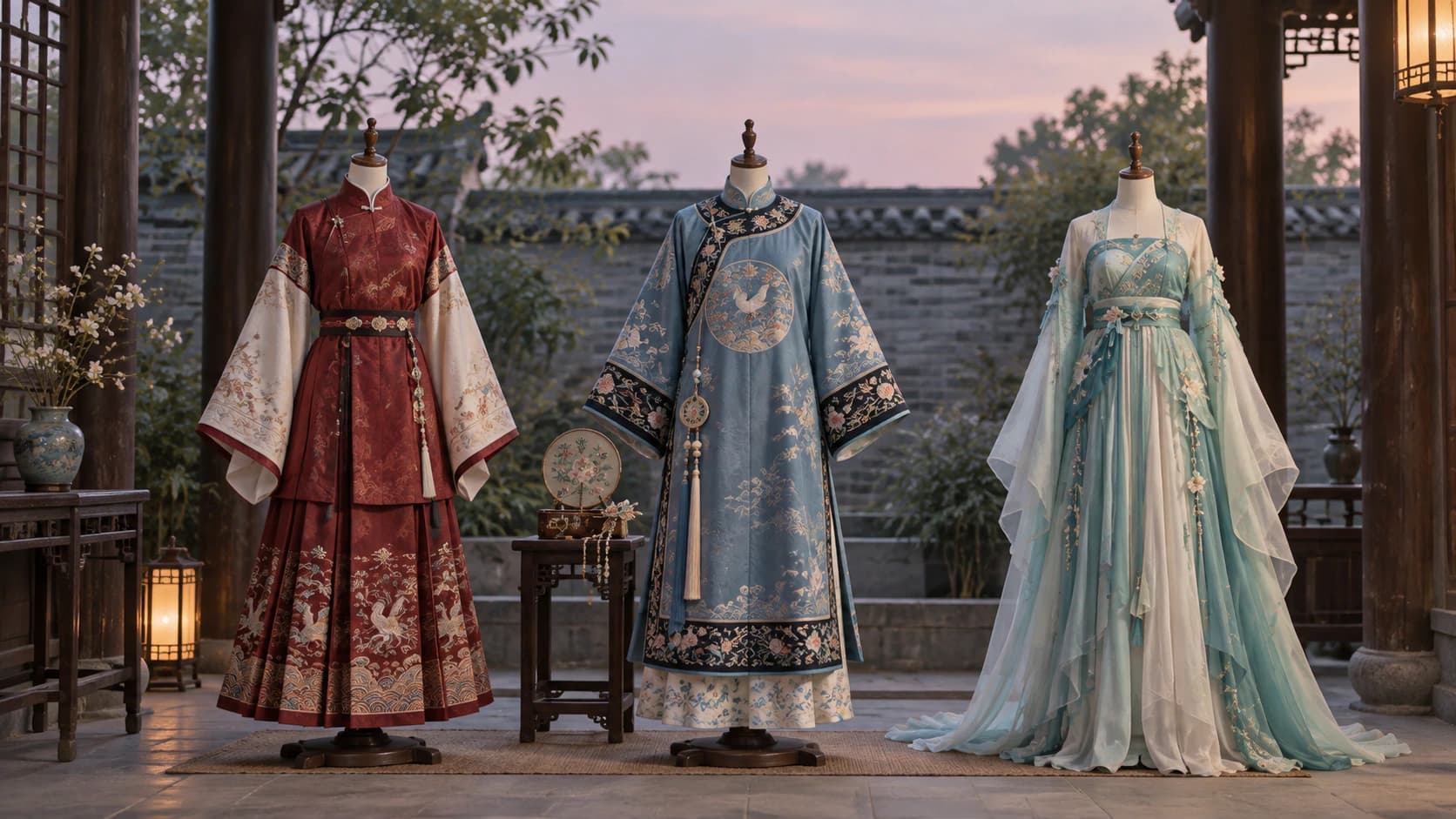
Illustrative effect reference created for this guide. It shows three broad visual directions, not authenticated historical reconstructions, a documentary photograph, a real studio inventory or a promise of venue access or final results.
Choose one of three style directions
Ming-inspired: structured, restrained and easy to place in Beijing
Choose Ming-inspired styling when you want an upright silhouette, clean layers and a portrait that feels composed rather than theatrical. Commercial wardrobes vary widely, but common visual cues include a standing collar, long jacket or robe, horse-face skirt and restrained hair ornaments. Treat “Ming-style” as the start of a conversation, not proof that every fabric, closure and accessory belongs to one historical period.
This direction works well against grey brick, red walls and simple timber architecture. Deep red and ivory produce a formal result; blue and white can feel quieter and less heavy. One recent visitor deliberately replaced dense gold ornament with small pale floral accessories and preferred the softer result. That is the useful principle: choose a palette that suits your face and the location before choosing the most expensive headdress.
Ask the shop for three full-length photographs of the exact outfit on an ordinary client: front, side and seated. Check whether the skirt keeps its shape, the collar lies flat, the sleeves reach the intended point and the shoes or visible underlayers match. A close portrait can hide a poorly fitted lower half.
Qing-inspired: strong palace drama, with more weight and setup
Choose Qing-inspired styling when the attraction is the ornate palace image: a straight robe silhouette, decorative trim, formal hair or headdress and a more theatrical pose language. Shops may call this a “gege,” princess or palace look. These are commercial visual labels; they do not turn the package into a precise historical recreation.
The look needs more preparation than a simple dress rental. Confirm the headdress weight, how it is fixed, whether your own hair must be a minimum length, and whether earrings are clip-on or pierced. Ask to see the back and sides of recent client hairstyles. A polished front-view sample can hide visible pins, unfinished padding or an unstable hairpiece.
Qing-inspired styling is often marketed with palace architecture, which creates the greatest access risk. Build the package around a studio, a confirmed park zone or a public exterior plan that still works if staff refuse the first spot. Never let a portfolio image substitute for today's venue permission.
Chinese fantasy: choose atmosphere over historical claims
Choose Chinese-fantasy styling when you want flowing fabric, unusual colour, cinematic movement or a story inspired by wuxia, xianxia or contemporary guofeng imagery. This is the most flexible option and the least dependent on an imperial monument. A controlled studio set, a simple lakeside, reeds, bare branches or a quiet grey wall can support the image without pretending to represent a specific dynasty.
Fantasy packages are especially sensitive to retouching. Ask how much of the final scene is captured in camera and how much is added later. Request one complete before-and-after pair from an ordinary client. If the final result depends on replaced skies, reshaped clothing, artificial mist or altered architecture, decide whether that is the product you want. Heavy editing is not inherently bad; surprise editing is.
Judge client work, not the hero portfolio
A provider's best nine images answer only one question: what can this team produce under ideal conditions? You need to know what it delivers on an ordinary booking.
Ask for a complete recent client set from the same package, photographer and makeup level. The useful set includes at least one unretouched frame, the final retouched version and enough surrounding images to show consistency. If the provider serves several branches, confirm that the examples come from the branch and team handling your slot.
Use this six-part test:
- Face consistency: skin can be polished without erasing features, changing face shape beyond recognition or giving every client the same expression.
- Hair from every angle: look for clean attachment points, balanced ornaments and no obvious hair-net edge in side and rear frames.
- Costume fit: check shoulder line, collar, waistband, sleeve length, hem and visible underlayers in a full-body photograph.
- Hands and props: fingers, fans, sleeves and jewellery should look natural after retouching. Over-edited hands and repeating ornaments are easy warning signs.
- Background honesty: a real Beijing setting should retain believable verticals, shadows and crowd removal. A replaced background should be disclosed as compositing rather than presented as access to a venue.
- Set consistency: compare the weakest delivered frame with the strongest. One extraordinary photograph does not compensate for a package of soft focus, duplicated poses or unusable crops.
Separate sample work from client work in your message. Ask directly: “Are these model samples or photographs delivered to paying clients on this package?” Then ask whether the named photographer and makeup artist are guaranteed or only requested. If the answer is “our team has the same standard,” assume the portfolio is shared until proven otherwise.
Turn the package name into a written deliverable
“All-inclusive,” “travel photography,” “Hanfu experience” and “one-hour shoot” do not have stable meanings. Current marketplace listings use similar titles for styling only, outfit rental, studio portraits and multi-hour location packages. Compare line items.
Before paying a deposit, save the seller's answers to all of these questions:
- Style and inventory: exact look, costume code or screenshot, size range, premium clothing zones, colour alternatives and what happens if the selected outfit is unavailable.
- Clothing period: pickup time, latest return time, same-day versus next-day return, off-site use, cleaning fee, damage deposit and the condition in which the deposit is released.
- Makeup: base makeup, false lashes, double-eyelid tape, hairpieces, wig padding, ornaments, hand-painted details and removal supplies.
- Staff: one-to-one or shared makeup artist, named photographer, language support and whether an assistant comes to the location.
- Time: check-in, expected queue, styling duration, transfer, actual shooting time, outfit-return buffer and late-arrival rule.
- Location: exact map pin, indoor or outdoor backup, admission ticket, transport, permission, changing arrangement and who pays if the venue refuses the shoot.
- Files: number of photographs taken, whether all usable originals are included, file format, resolution, delivery channel and download-expiry date.
- Retouching: exact final count, whether you select the images, revision rounds, additional-image price, body/face changes and background replacement.
- Delivery: preview deadline, final deadline, rush fee and what remedy applies if delivery is late or incomplete.
- Cancellation: customer cancellation, rain, extreme heat or cold, haze, attraction closure, staff illness, venue refusal and rescheduling deadline.
- Privacy: whether the provider may publish your face, behind-the-scenes footage or final images. Refuse portfolio use in writing if you do not want it.
Do not accept “everything included” as the final answer. A checkable deliverable reads more like: “One outfit from the standard zone, one makeup and hairstyle, 60 minutes of shooting at the confirmed exterior location, all usable JPEG originals, eight retouched files selected by the customer, one revision round and delivery within seven days.”
Understand the common extras before you arrive
The lowest visible price is often a base layer. None of the following is automatically dishonest, but each needs to appear before checkout:
- premium or newly arrived costumes;
- larger sizes or children's outfits;
- wig pads, elaborate headdresses and upgraded jewellery;
- false eyelashes, eyelid tape, body makeup or decorative face details;
- a photographer when the base package covers styling only;
- more shooting time, a second location or transport;
- raw files, high-resolution files or files without the provider's preset;
- retouching sold per image;
- a faster delivery date or a second revision;
- costume cleaning, late return, repair or deposit deductions.
One firsthand visitor report described a quote falling from CNY 699 to CNY 299, while another described separate makeup and per-photo charges from a walk-up photographer. These are individual reports, not a current price list. Their practical lesson is that verbal totals are unstable. Put the final price, currency, inclusions and maximum possible extras in the order or booking chat.
Pay through a platform or merchant channel that produces a receipt and dispute record. Avoid moving the payment to an unrelated personal account merely to secure a discount. Keep screenshots of the selected option because marketplace titles can remain the same while inclusions change.
Choose a setting by permission and visual job
The map pins below identify the correct place. They do not grant shoot permission. Beijing's heritage venues can apply different rules to an ordinary visitor taking handheld personal photographs and a paid team carrying costumes, reflectors, stands or multiple clients.
Studio: the reliable choice
Use a studio when the costume itself is the subject. You gain a changing room, mirrors, controlled light, secure storage and a weather-independent plan. It suits close portraits, family sessions, fantasy sets, elaborate Qing-inspired hair and any package promising a precise number of finished images.
Ask for a phone video of the actual set, not only final photographs. Check floor area, ceiling height, visible backdrop seams and whether another client will be using the room. A small set can create excellent half-length work but may not support a full robe, long train or group portrait.
Shichahai: open water and old-city layers
Use the Shichahai map pin for the general lakes area. Water, willow, grey roofs and distant towers support restrained Ming-inspired or fantasy portraits without needing a palace interior. The Shichahai guide explains the wider area.
This is still a shared public environment. Keep equipment handheld, do not block lakeside paths, avoid private doorways and do not treat residents, boat staff or other visitors as background extras. A paid photographer should be ready to move when staff or crowd conditions make a setup inappropriate.
Guozijian Street: grey brick and scholarly scale
The Guozijian Street map pin identifies the public street, not the Temple of Confucius or Imperial Academy interior. The street's grey walls, trees and gates suit a quieter outfit and can be photographed with a phone or small camera while walking.
Keep the shoot on public pavement, leave entrances clear and ask before using any shopfront. Do not step into a courtyard, temple or museum merely because the exterior was available. The nearby Temple of Confucius guide is for a normal cultural visit; its ticket is not commercial-shoot authorization.
Municipal parks: attractive, conditional and zone-specific
Temple of Heaven, Beihai Park, Jingshan Park and Zhongshan Park appear frequently in commercial portfolios. That does not make every zone or method available today.
Beijing's municipal park authority actively manages commercial shoots that disrupt visitors, including teams carrying large amounts of equipment or clothing, occupying paths, changing makeup or clothes on site, following subjects for long periods or gathering a crowd. Temple of Heaven has specifically acted against on-site paid photography without permission. Zhongshan Park's current visitor rules refuse commercial photography in heritage areas, narrow passages and crowded locations and prohibit commercial shooting that disturbs order.
For a booked shoot, ask the provider to confirm in writing:
- the exact gate and zone it will use;
- whether the work is treated as commercial by the park;
- what approval or registration it currently relies on;
- which equipment it will carry;
- the immediate backup if staff refuse the setup.
For DIY personal photographs, carry a phone or small handheld camera, change before entering, keep the session short and follow every current sign and staff direction. Buy the park ticket through its current official channel and carry the original passport used for purchase. A styling appointment never replaces admission or identity checks.
Palace Museum: visit normally, do the paid shoot elsewhere
The Palace Museum map pin is useful for sightseeing, but the museum is not a commercial photoshoot location for this plan. Its current rules prohibit unauthorized commercial photography and prolonged occupation of public space; commercial rigs and weapon-like props are also prohibited.
If you have a timed ticket, follow the Forbidden City visitor guide, take ordinary handheld travel photographs that comply with staff directions, and keep the paid team outside. A provider advertising “Forbidden City photos” should identify whether it means an exterior street, a nearby park, a studio backdrop or unauthorized work. Make it state the answer before payment.
Build a schedule that survives real delays
A one-hour camera session can occupy half a day. Protect time for choosing clothes, queueing, makeup, hair, dressing, travel, security, shooting, changing back and checking files.
A realistic half-day plan is:
- Arrival and outfit check — 20–30 minutes. Inspect the exact garment, test the closure, photograph existing marks and confirm the return time.
- Makeup and hair — 90–120 minutes. Seller estimates of 60–90 minutes can work when the shop is quiet; the extra buffer protects against a shared artist or complex hairpiece.
- Dressing and movement test — 15–20 minutes. Sit, walk, lift the hem safely and check the headdress before leaving.
- Transfer and entry — 30–60 minutes. Allow more for central security, ticket collection or a park gate that differs from the taxi drop-off.
- Photographs — 60–90 minutes. Fewer locations and a deliberate shot order usually beat rushing through three backgrounds.
- Return — 45–90 minutes. Traffic, walking and removing hair accessories take time. Do not plan around the final minute of the rental.
- File check — 10 minutes. Confirm that the agreed originals exist, the provider has your correct contact details and the delivery deadline is recorded.
Do not schedule a fixed Forbidden City, train, airport or performance entry immediately after styling. One current marketplace review described a three-hour wait that caused the traveler to miss a palace visit. Protect the attraction reservation; the photoshoot can be moved more easily than a sold-out ticket.
Makeup and wardrobe checks that matter on camera
Bring reference images of makeup intensity as well as costume style. “Natural,” “Chinese style” and “princess” are subjective. Ask for a base that matches your neck in daylight, then check it near a window before leaving. Tell the artist about allergies, contact lenses, sensitive skin and any product you do not want used.
False lashes and eyelid tape are common package boundaries. Decide whether you want them instead of discovering a charge while seated. If you have tightly curled, textured, very short or very long hair, send a current photograph in advance and ask what the chosen structure requires. Do not let a heavy hairpiece depend on painful pins simply because the sample used it.
For the outfit:
- request measurements, not only S/M/L;
- wear a thin neutral base layer that will not show at the collar;
- bring comfortable shoes unless the supplied shoes are confirmed in your size;
- check whether the hem touches wet or dirty ground;
- learn how to gather long fabric on stairs without dragging it;
- use the restroom before the final dressing layer;
- carry a warm layer that can go over the costume between frames in winter;
- in summer, keep blotting paper, water and a small fan nearby without placing bags in a public path.
Do not use replica swords, knives, bows or other weapon-like props in security-sensitive heritage areas. The Palace Museum expressly prohibits weapon-like shooting props, and other venues can apply their own safety rules.
Shoot in an order that protects the result
Start with the images that depend on fresh makeup, stable hair and empty space. A useful 60-minute sequence is:
- Full-length identity frame: front and three-quarter view, simple background, outfit fully visible.
- Medium portrait: face, collar, hair and hand placement; one looking at camera and one looking away.
- Walking frame: short controlled movement that shows skirt or sleeve shape without running through a crowd.
- Seated or architectural frame: only where sitting is allowed and the costume will not damage or touch a protected surface.
- Detail frame: embroidery, fan, hair ornament or hands, with the provider checking edges and focus.
- Environmental frame: the widest image that explains Beijing without making you tiny.
- Insurance frame: repeat the strongest composition with a clean phone photograph before leaving.
Ask the photographer to show you focus and exposure after the first three frames, not only at the end. Correct a slipping collar, uneven hair ornament or unsuitable crop immediately. Save experimental motion, props and dramatic edits for the final part of the session.
Weather and crowd plans
Beijing's light and comfort change sharply through the year. Spring wind can lift long sleeves and carry dust. Summer heat weakens makeup and makes layered robes uncomfortable. Autumn gives attractive colour but busy parks and holiday demand. Winter produces clean lines and quieter scenes, with cold hands, battery drain and limited tolerance for standing still.
Your weather clause should state who decides to move indoors, how late a change can be made and whether the replacement is a studio, another date or a refund. Light rain can darken grey brick, but it also marks hems and makes stone slippery. Do not accept “rain or shine” when the package depends on outdoor clothing, hair structure and a distant background.
For crowds, use a tight frame before asking strangers to clear space. Early entry can reduce visitors, but it never guarantees an empty heritage site. Crowd removal in retouching may be more realistic than occupying a popular viewpoint. Ask how many people the package will remove without an extra fee and whether the edited architecture will remain believable.
Returns, refunds and delivery disputes
Photograph the costume at pickup and return. Include the hem, cuffs, closures, jewellery and any existing stain or loose thread. Have the shop acknowledge pre-existing damage in the booking chat. At return, ask for a message stating that the complete set was received and the deposit-release process has started.
Before booking, distinguish four outcomes:
- Customer cancellation: deadline, retained deposit and whether a one-time reschedule is allowed.
- Weather reschedule: who makes the call and whether studio substitution needs your consent.
- Venue refusal: full refund, another legal setting or styling-only price; the operator should not transfer its permission risk to you without saying so.
- Provider failure: substitute staff, shortened session, missing files or late delivery, with a defined partial or full remedy.
If the delivered set is incomplete, describe the gap in counts and deadlines: “The order promises all usable originals and eight retouched JPEGs by September 28; I received four retouched files and no originals.” Ask the merchant to resolve it through the same platform where you paid. If that fails, use the platform's dispute process. China's National 12315 platform is the formal consumer-complaint channel under the current market-regulation complaint rules; keep the merchant name and address, receipt, order page, chat, your requested remedy and evidence of the mismatch.
Two workable booking plans
The low-risk DIY plan
Book styling only at a shop near your planned area. Choose one outfit from the included zone, confirm a return deadline with at least two hours of margin, and ask a companion to photograph you with a phone. Use Shichahai or Guozijian Street as a flexible walking environment, keeping the setup handheld and brief.
Make one full-length image in open shade, one medium portrait against a plain wall, one walking frame and one environmental image. Use the phone's real 2× or 3× camera for portraits when light is good; avoid digital zoom. This plan gives you many originals immediately and removes photographer-delivery risk.
The controlled booked plan
Choose a studio package with a named style, full line-item total, recent ordinary client set and exact file counts. Add one nearby exterior only if the operator confirms current access and a backup. Keep the studio hero portrait as the guaranteed result, then use the outdoor segment for movement and Beijing context.
Select your retouched images before leaving if possible. Ask for natural skin and body proportions, straight architecture and no unrequested background replacement. Download every original promptly and copy it to a second device or cloud folder before the link expires.
Final booking checklist
Before you pay, you should be able to answer all ten questions:
- Is the look Ming-inspired, Qing-inspired or Chinese fantasy?
- Is the exact outfit included, correctly sized and available at your time?
- What makeup, hair and accessories cost extra?
- Is the photographer included, and is the portfolio from that team?
- How many original and retouched files will you receive?
- Where exactly will the shoot happen, and what makes that commercial setup currently usable?
- What is the legal, weather and crowd backup?
- When must the outfit return, and how is the deposit released?
- What are the cancellation, reschedule, revision and delivery terms?
- May the provider publish your face or files?
If any answer remains vague, buy less: styling only, a studio session, or no booking. Beijing supplies the visual context without forcing an unauthorized palace setup. The best package is the one that can still deliver the promised photographs when the first outfit, first location or first weather plan changes.
For a costume-friendly old-city setting that does not depend on palace access, compare the routes in the Beijing hutong guide. If architecture and city history matter more than dressing up, the Beijing Central Axis route is the stronger photography day.