Mount Hua
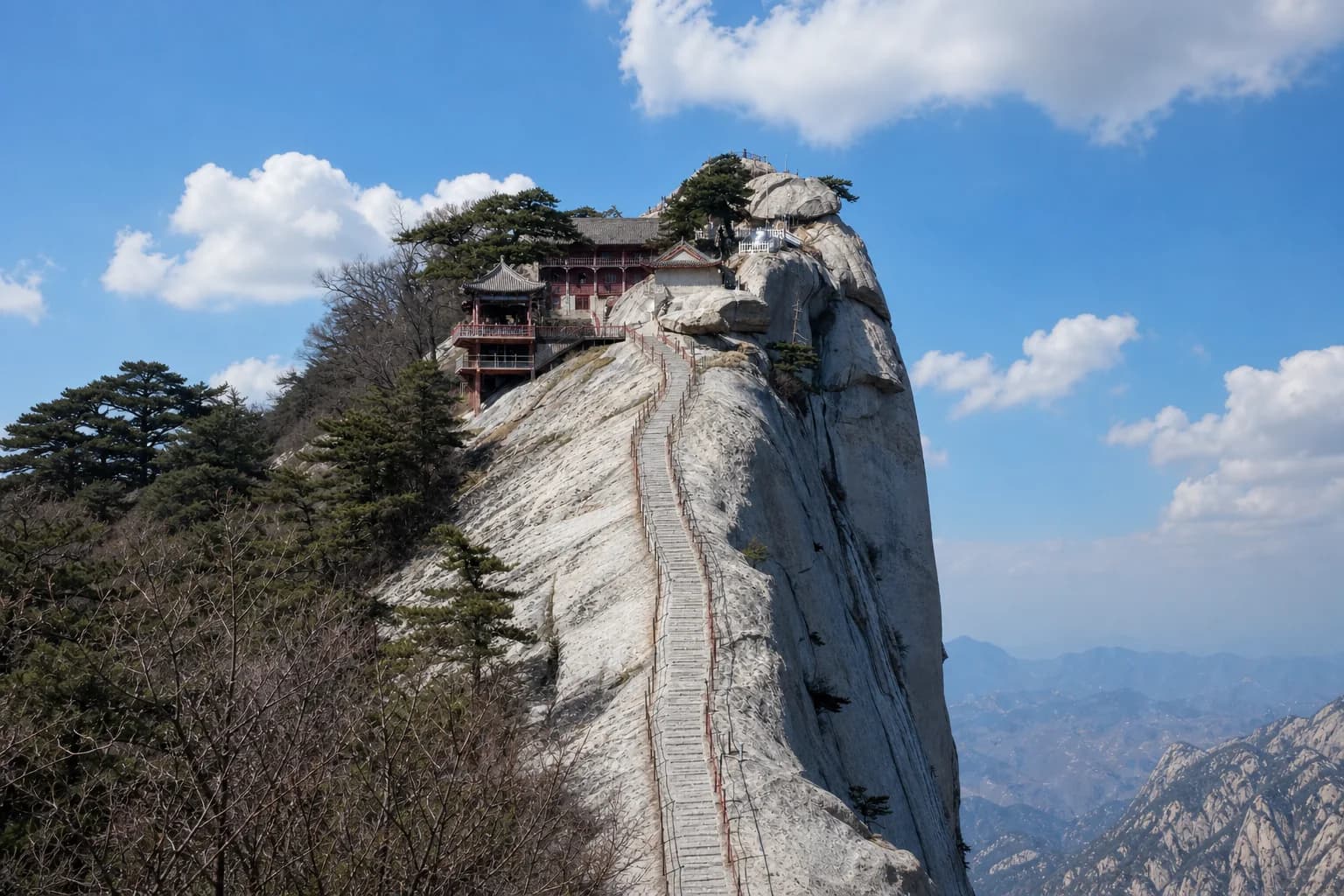
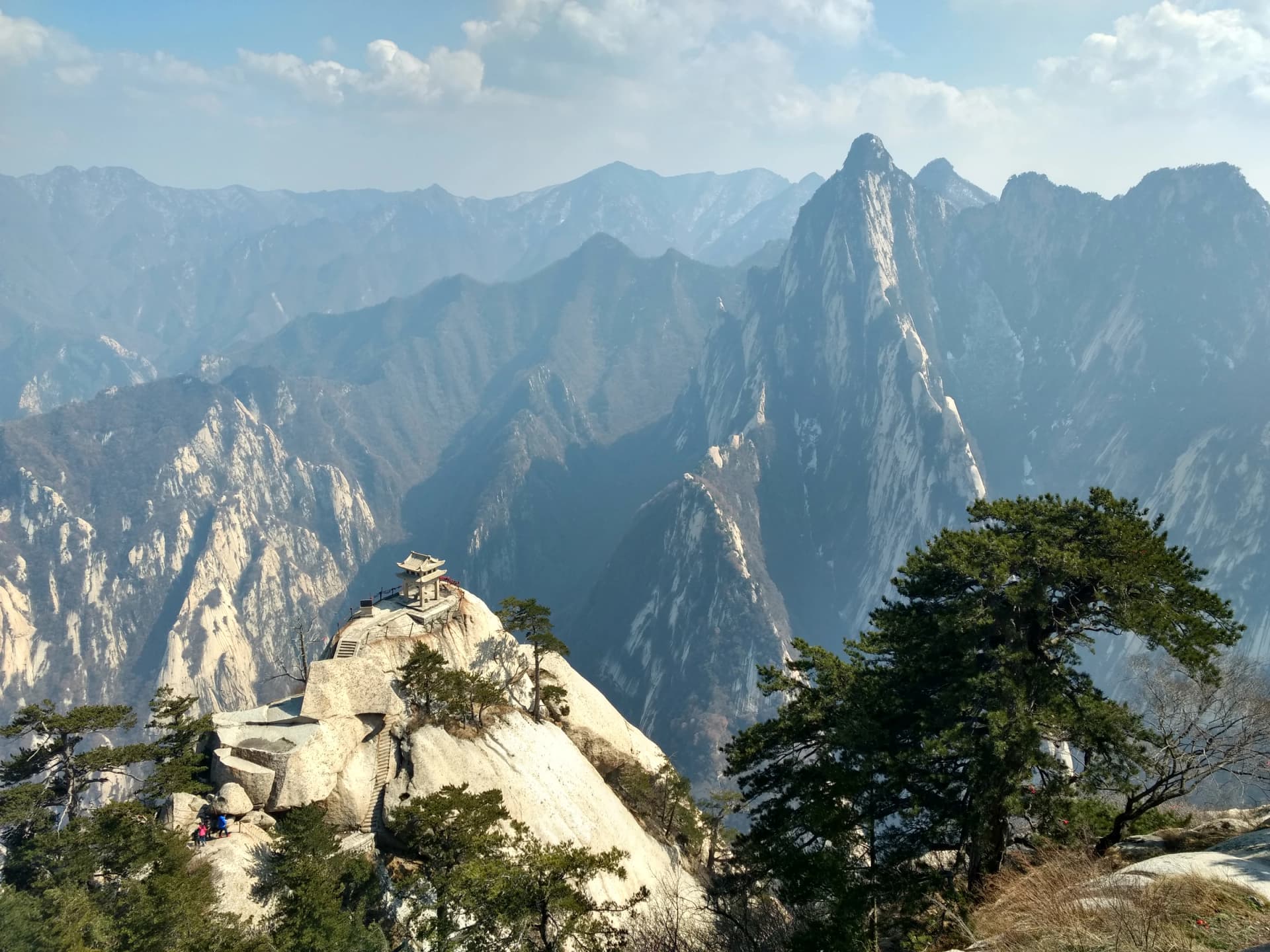
Mount Hua (华山, Huàshān) is a granite mountain journey rather than a single summit ride. Pale cliffs, stone stairways, wind-shaped pines and small Taoist buildings connect five peaks above Huayin, in Weinan. The rewarding decision is to choose a mountain product that matches your legs: a focused West Peak return, a directional West-to-North traverse, or the traditional ascent from Yuquan Temple.
Even the assisted routes feel like a real mountain day. Recent visitors using both cableways still described hours of stairs and descent queues, while strong walkers disagreed sharply about how tiring the same traverse felt. Plan a full day, keep one cut-first branch, and let the final descent—not the number of peaks—set the pace.
Choose one of three mountain products
| Product | Best fit | Shape of the day |
|---|---|---|
| West up, West down | A first view of the higher western side, a simpler exit or a shorter weather window | Ride the West system, focus on West and South peaks, then reverse before your return margin becomes thin |
| West up, North down | A full first visit with enough stamina for a long directional traverse | West → South → East → Central → North, then descend through the North system |
| Yuquan traditional ascent | Experienced hikers who want the historic stair route to be the main experience | Start at Yuquan Temple, climb to North Peak, then continue only if daylight, energy and live descent options remain generous |
West up and West down: the clearer exit plan
This route gives you the higher western scenery first and keeps your arrival and departure on the same system. West Peak and South Peak make a satisfying core. East Peak becomes an optional extension only when the return walk, cableway queue and live closing instruction still fit comfortably.
The benefit is control, not effortless access. Every added peak creates a ridge walk that must be reversed. It suits travellers who value time at a few strong viewpoints, families comfortable with mountain stairs, and days when cloud or wind may shorten the usable window.
West up and North down: the broad five-peak traverse
This is the strongest overview when you want to experience the connected mountain rather than one summit area. The official route guide estimates about 1 hour 30 minutes from West Peak via South Peak to East Peak, then about 2 hours 40 minutes from East Peak via Central Peak to North Peak. Those are route estimates, before generous photo pauses, food, queues and personal pace.
The directional logic reduces major backtracking, but the day remains demanding. Recent visitors on the reverse North-to-West traverse reported long stair sections and late finishes even with two cableways. For the West-to-North version, make East Peak or any controlled cliff activity the first thing to remove when the final-descent buffer narrows.
Yuquan Temple to North Peak: the traditional ascent
The historic walking route begins at Yuquan Temple (玉泉院). The operator's route guide gives a baseline of about 6 km and four hours to North Peak; the other peaks come after that first major climb. This is a dedicated hiking product, not simply the cableway day with one fare removed.
Start with enough daylight and a confirmed descent plan. Reaching North Peak can be the complete objective. Continuing through Central, East, South and West peaks belongs to strong hikers with ample time, suitable weather and a live cableway or approved walking exit.
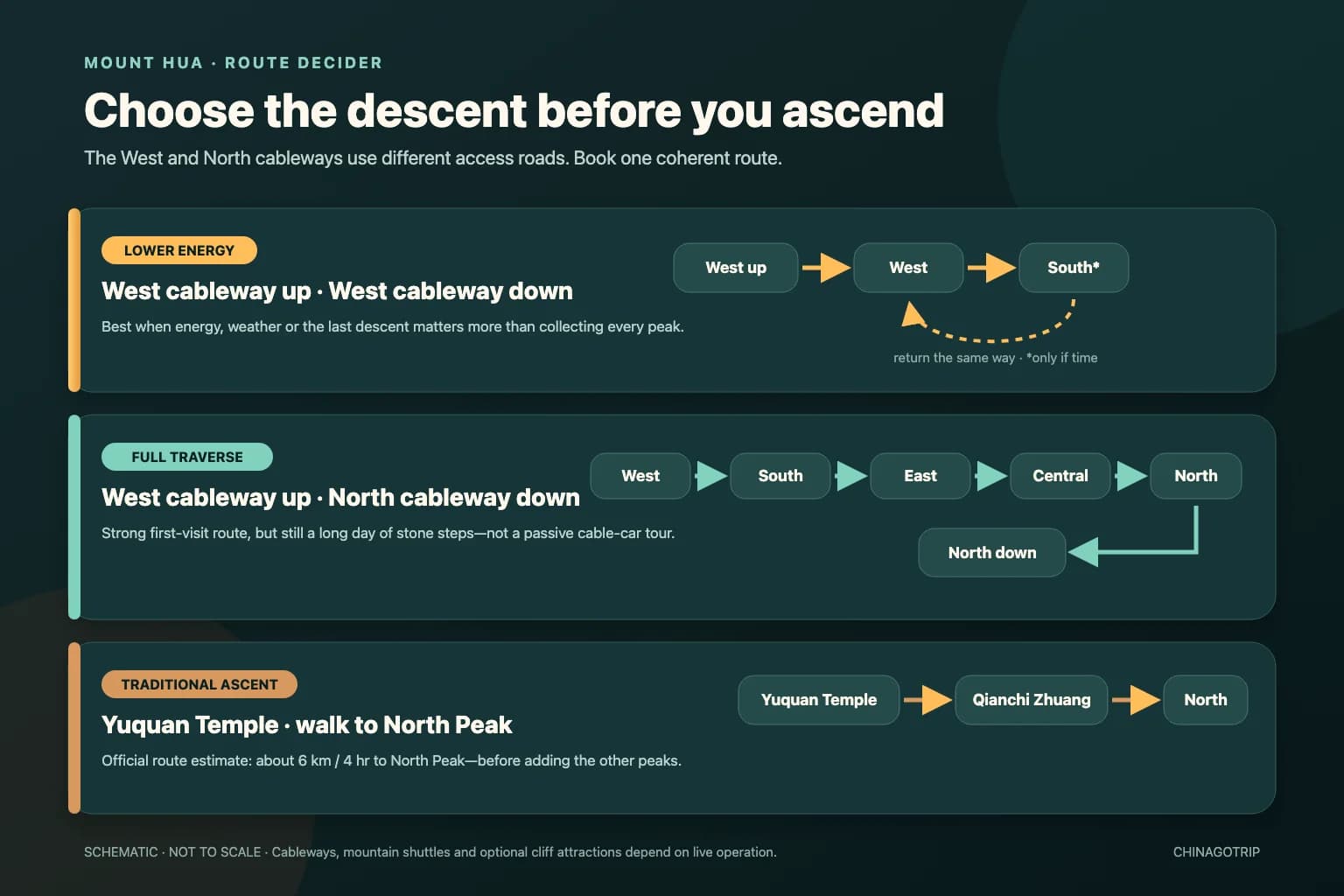
This is a schematic route, not a scale map. Follow current signs and staff instructions at every junction.
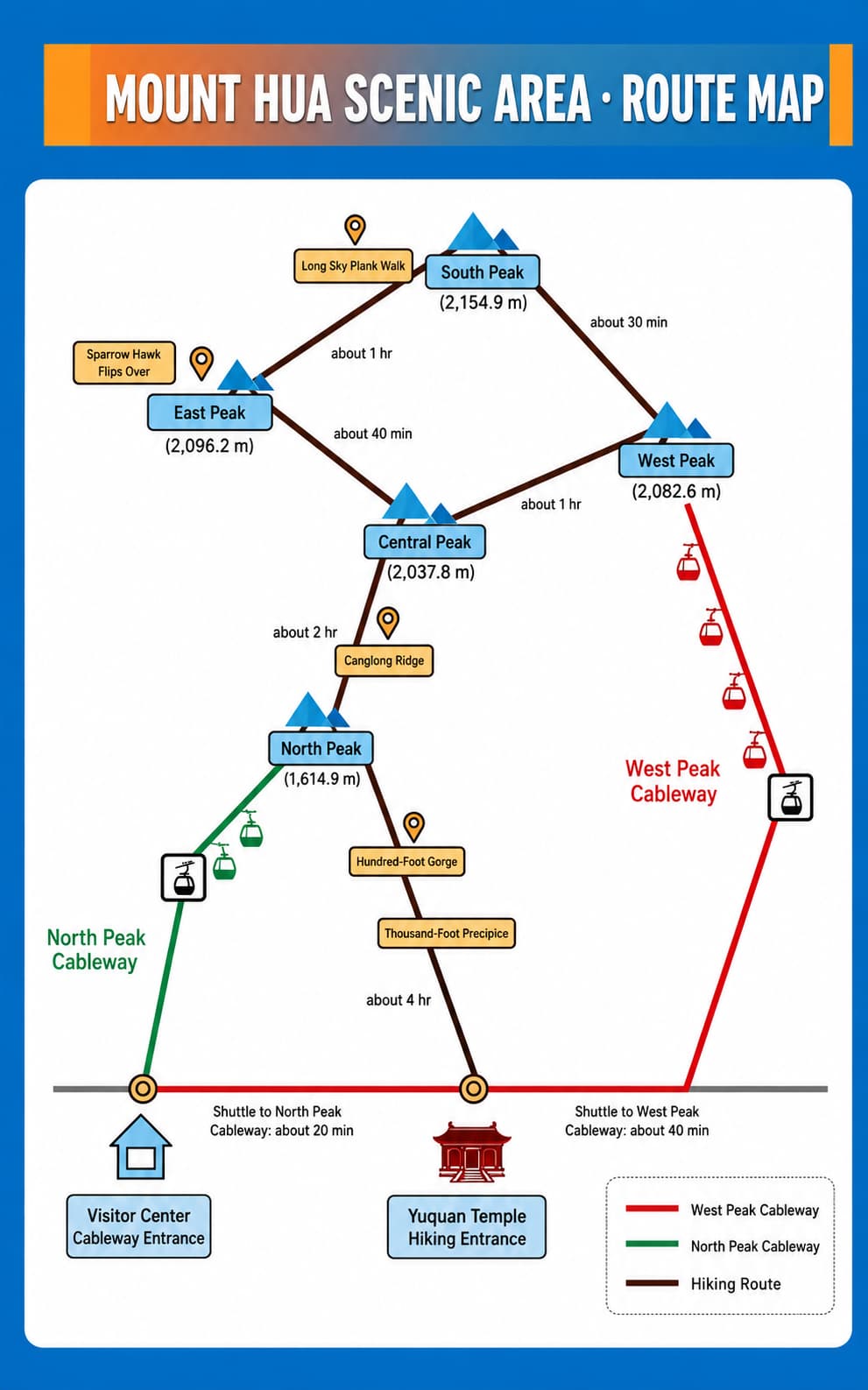
Match admission, entry bus and cableway before paying
Mount Hua has separate product layers. Scenic-area admission, the North Peak mountain-entry bus, the West Peak mountain-entry bus, the North Peak cableway and the West Peak cableway are not one interchangeable ticket. The visitor centre is the transfer hub for assisted products; Yuquan Temple is a different external start for the traditional ascent.
The operator's current baseline checked on 21 August 2026 lists admission at CNY 160 from March through November and CNY 100 from December through February. Recheck the selected date because capacity, time slots, concessions and temporary offers can change.
On Trip.com, the adult resources inspected on 23 August 2026 separated ordinary hiking admission from admission plus a named one-way uphill mountain-entry bus. Those bus resources did not include the corresponding cableway or the return bus. Open the current Mount Hua product chooser on Trip.com, then match each line item to your up route and down route rather than relying on the headline.
For passports, the official operator directs relevant passport ticket types to the staffed special-ticket service. The inspected Trip.com adult admission and named entry-bus resources instead supported direct passport verification at their stated gate. Confirm the document, redemption point and selected route in the exact checkout you buy; do not extend one adult workflow to concessions or another product.
Use the official Mount Hua visitor information and the same-day operating notice for trail, cableway, vehicle, capacity and last-descent decisions.
Choose Xi'an or Huayin as your base
Xi'an: one mountain day inside a broader city trip
Stay in Xi'an when Mount Hua is one weather-dependent day among the Terracotta Warriors, the old city and other Shaanxi experiences. The independent pattern is a booked train from Xi'an North to Huashan North, followed by local ground transport to the mountain. Protect the return with a substantial buffer: visitors have reported that a late cableway queue can turn a comfortable schedule into a very late arrival back in Xi'an.
Compare Xi'an stays on Trip.com by their practical connection to Xi'an North and by the neighbourhood that serves the rest of your trip. A Xi'an hotel does not imply mountain pickup or protection for a missed return train.
Huayin: earlier start, luggage control and weather flexibility
Stay in Huayin when Mount Hua is the trip's main purpose, when you want the traditional ascent, or when a weather buffer matters more than another Xi'an evening. A local night can turn arrival, sleep and luggage into separate tasks rather than adding them to the mountain morning. Check the exact property's position against Huashan North Station, Mount Hua Visitor Centre or Yuquan Temple; a “Huashan” name alone does not identify the useful gate.
Compare Huayin stays on Trip.com, then verify the selected property's foreign-guest policy, luggage storage, transfer, breakfast and cancellation terms. Those services vary by property and room.
Summit lodging is a different product. It can improve sunrise position, but recent guests described basic fittings, variable bedding and cold or wet conditions. Choose it only after confirming the exact open property, its walking access from your route, water and heating, and how you will descend the next day.
Reach the correct external start
For assisted routes, navigate to Mount Hua Visitor Centre (华山游客中心), not the broad mountain pin. AMap's model checked on 23 August 2026 placed it about 4.8 km / 13 minutes by road from Huashan North Station. The coordinates are 110.098064, 34.538229 (longitude first). Treat the time as a dated planning estimate, not a taxi or shuttle promise.
For the traditional ascent, navigate to the external approach below Yuquan Temple. The same AMap check modelled Huashan North to that approach at about 6.8 km / 16 minutes by road, and the visitor centre to it at about 3.2 km / 15 minutes. These are separate starts. Do not use an internal cableway station or mountain road pin as evidence that a private car may enter the controlled area.
Book the issued rail service and verify local transport for the exact date. Map transit results do not prove a fixed local bus, free shuttle, luggage policy or last connection.
Let weather decide the ambition, not the visit's value
Mount Hua remains visually powerful in moving cloud: granite walls appear and disappear, pines sharpen against mist, and Taoist buildings become small markers in a much larger landscape. A shorter West return can still be a complete day when visibility or wind makes the full traverse a poor fit.
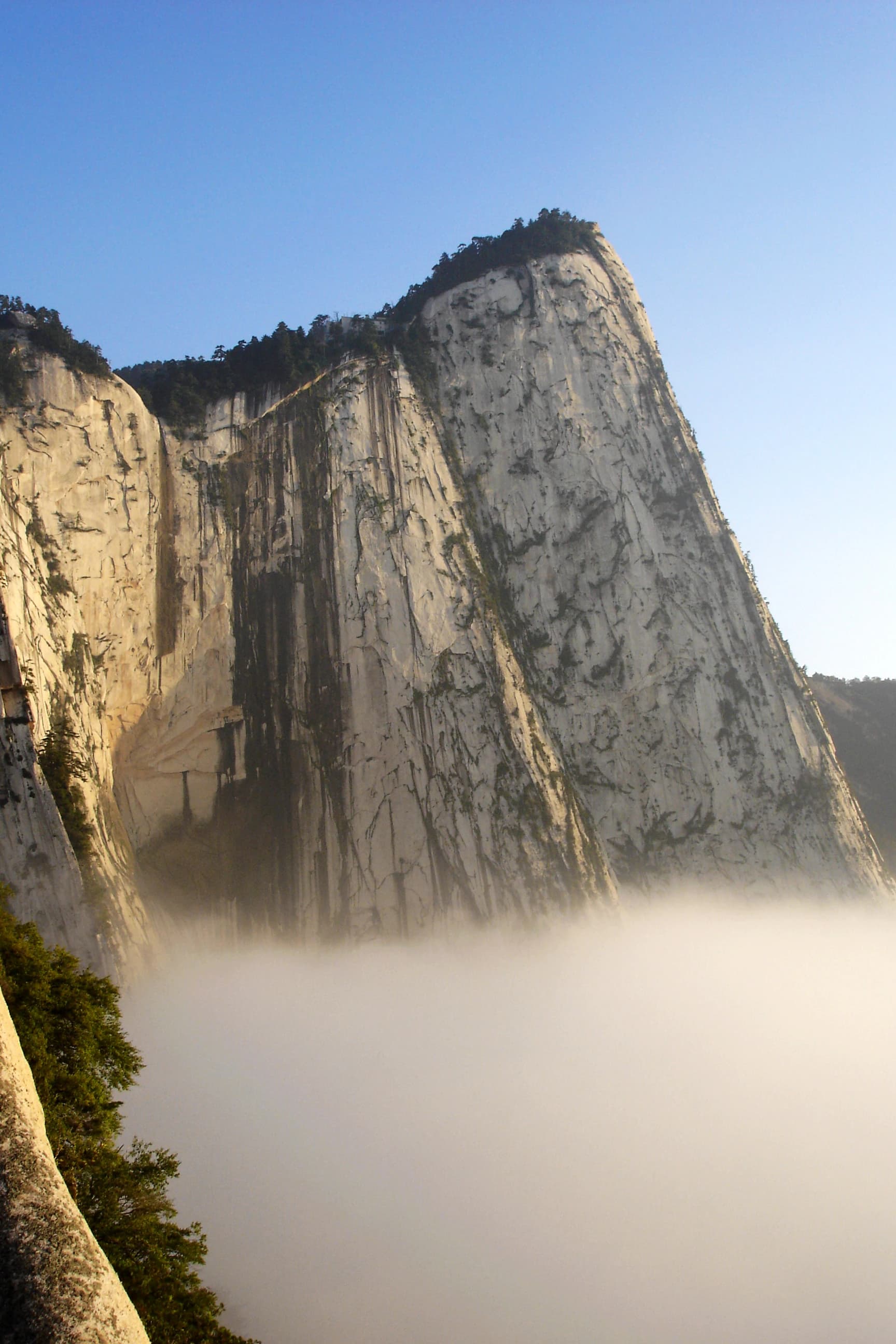
Rain, ice, lightning, strong wind, heat, wildfire controls and maintenance can affect one trail, cableway or optional activity without closing every product. Read the live board before committing to a directional traverse. Keep rain protection, a warm layer, grippy footwear, water, compact food, a charged phone and both hands available for steep stairs.
Night hiking and sunrise require an independent go/no-go decision. Visitor reports include rain-soaked clothing, severe summit cold, a high-wind warning and a sunrise completely lost to cloud on an earlier trip. A night ascent is worthwhile only when the operator permits it, the weather and route are suitable, your lighting and clothing are adequate, and the descent plan does not depend on a guaranteed sunrise or a remembered cableway opening.
Add Xiyue Temple as a lower-effort Huayin layer
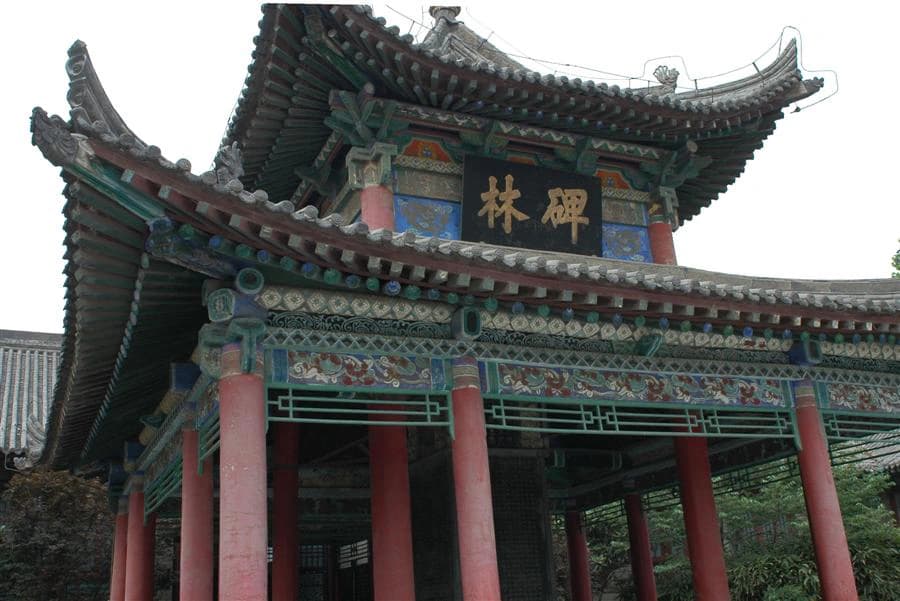
Xiyue Temple (西岳庙) gives the mountain story a quieter architectural counterpart: old trees, courtyards and ceremonial buildings connected to worship of the Western Sacred Mountain. It works best on a Huayin arrival afternoon, a post-mountain half day, or a weather-buffer day—not as another stop squeezed between the peaks and the last train.
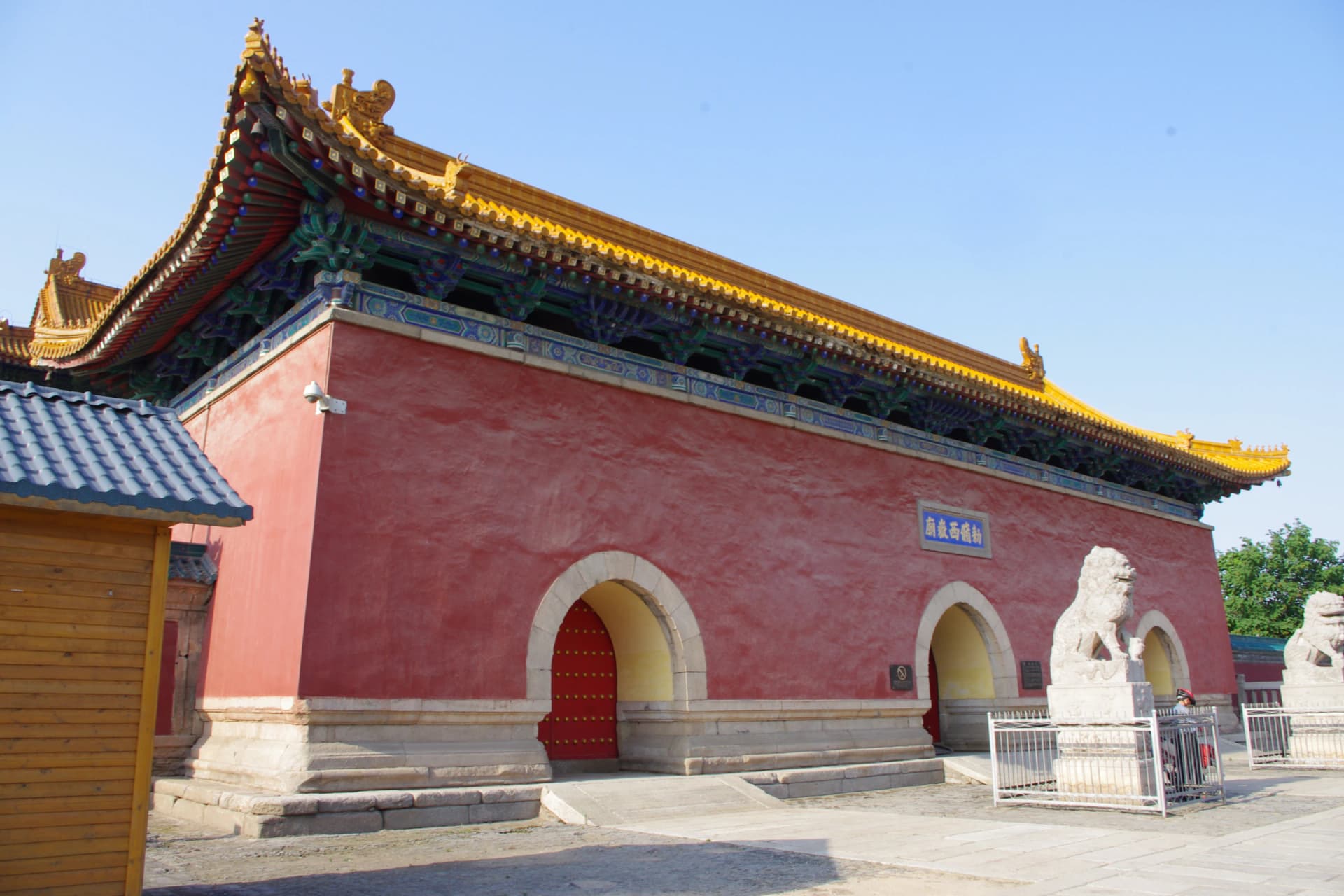
Xiyue Temple is a separate attraction. The Mount Hua admission resource inspected on 23 August 2026 listed one Xiyue Temple entry within its stated 48-hour validity, but that inclusion is product-specific and can change. Recheck the exact ticket, current opening, passport procedure and interiors before pairing it.
The most satisfying Mount Hua plan is coherent from the first booking: choose the base, match every paid component to one route, protect the descent, and keep one shorter mountain day ready for weather. The granite, pines and five-peak scale provide the reward without needing every branch.