Chinese breakfast field guide: order the format, then learn the city
Breakfast in China is easier to understand as a set of local systems than as one national menu. A Beijing commuter may pair hot soy milk with a filled bun. A Tianjin griddle turns batter, egg, sauce and a crisp wafer into jiānbing guǒzi. Wuhan's guòzǎo culture makes sesame-coated noodles a morning ritual. Guangzhou morning tea can occupy a whole table and much of a morning. In Yanji, a market breakfast may begin with soup and rice before you start sampling stalls.
The useful travel skill is recognizing the format. Is this a one-window counter where you pay and collect immediately? A shop where tickets for different foods go to different counters? A noodle place where you choose toppings and heat? A teahouse where tea, dishes and table service each affect the bill? Once you know the format, unfamiliar dish names become manageable.
This guide gives you a breakfast vocabulary, regional choices, allergy boundaries and a one-week tasting plan. It avoids permanent shop rankings because stalls move, opening hours change and popular dishes sell out. Use the current storefront, menu, live map listing and staff answer on the day.
If the first decision is where to build an entire food trip, start with the China food city chooser; return here once you need breakfast formats, dish names and counter tactics.
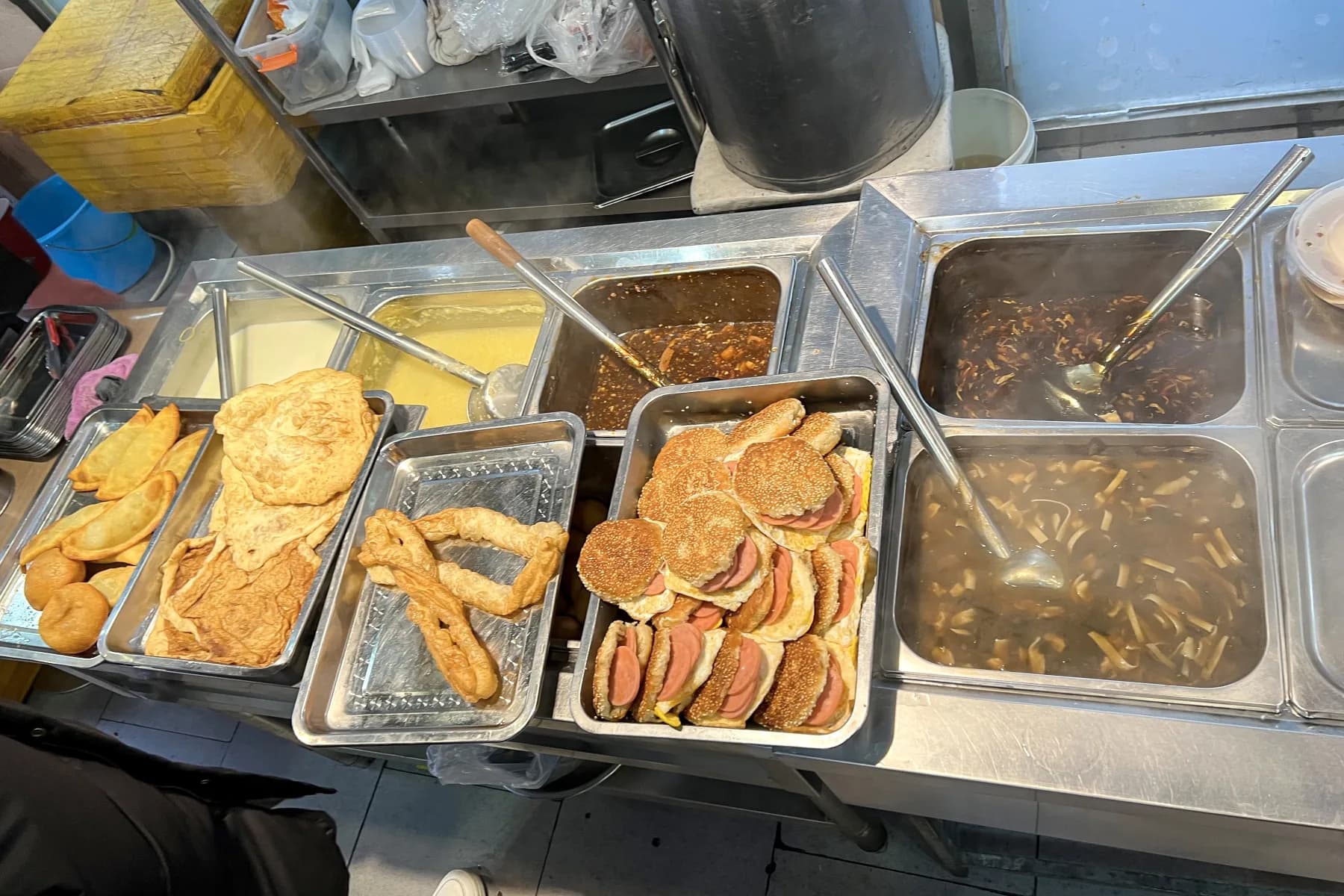
A northern breakfast counter rewards a quick scan: identify the cooked staple, the drink or soup, then ask whether you pay once or collect at several windows. Photo by N509FZ, CC BY-SA 4.0.
Choose a breakfast format before choosing a famous dish
| If you want… | Look for… | Typical order | Time to allow | Main question |
|---|---|---|---|---|
| Fast and portable | A griddle or takeaway counter | Jianbing, baozi, shaobing or a rice roll | 10–20 minutes, plus any queue | “Do I pay here and collect here?” |
| Warm and gentle | Steam baskets, congee pots or soy milk | Baozi plus congee; youtiao plus soy milk | 15–30 minutes | Is the soy milk sweetened? What fills the bun? |
| A local noodle ritual | A compact noodle shop with topping boards | One bowl, heat adjusted, side dish optional | 20–35 minutes | Are broth, toppings and spice included? |
| A social meal | A teahouse or dim sum restaurant | Tea plus two or three shared dishes | 60–90 minutes | Is there a tea or service charge? How are dishes ordered? |
| A tasting circuit | A working morning market | One small item at two or three stalls | 60–120 minutes | Which foods are made now, and where can you stand without blocking trade? |
For a first morning, one hot staple and one drink is enough. A queue does not tell you portion size, ordering logic or whether every item suits you. Watch one complete transaction before joining. Notice whether customers scan a QR code, tell the cashier a list, receive paper tickets, or point at trays. Keep every ticket until you have collected every item; some multi-counter shops use one slip per dish.
The core vocabulary: what the words actually buy
Pronunciation helps, but showing the Chinese characters is more reliable in a noisy shop.
The portable and steamed basics
- 包子 bāozi — a filled steamed bun. Fillings range from pork and beef to vegetables, mushrooms, egg and chives. Ask 什么馅? shénme xiàn? (“What filling?”). A vegetable name does not establish that the filling, cooking fat or seasoning is meat-free.
- 馒头 mántou — an unfilled steamed wheat bun. Some versions contain sugar, milk or flavoring; plain appearance is not a complete ingredient check.
- 油条 yóutiáo — a long fried dough stick, often paired with soy milk, congee or tofu pudding. It is crispest soon after frying. Anyone managing wheat, shared oil or cross-contact needs to ask directly.
- 烧饼 shāobing — a baked or griddled wheat bread, sometimes layered, sesame-coated or filled. The word describes a broad family rather than one recipe.
- 饭团 fàntuán / 糍饭团 cífàntuán — a rice roll or ball wrapped around fillings that can include youtiao, preserved vegetables, pork floss or egg. Point to every filling you want and remove unwanted items explicitly.
- 煎饼馃子 jiānbing guǒzi — a thin griddled crepe with egg, sauce, scallion and a crisp fried element, strongly associated with Tianjin in its local form. Variants elsewhere may add sausage, lettuce or other fillings.
The bowls and drinks
- 豆浆 dòujiāng — soy milk, served hot or cold and sweetened or unsweetened. Ask 甜的还是不甜的? tián de háishi bù tián de? (“Sweet or unsweetened?”). It contains soy; the ladle or machine may serve flavored versions too.
- 粥 zhōu / 稀饭 xīfàn — congee or thin rice porridge. It may be plain or cooked with meat, fish, century egg, stock or beans. Do not infer the base from the color alone.
- 豆腐脑 dòufunǎo / 豆花 dòuhuā — soft tofu pudding. Northern versions are often savory with gravy and toppings; sweet versions are common in other regions. The savory sauce may contain meat stock, dried seafood or wheat-thickened gravy.
- 馄饨 húntun — wontons, usually filled and served in broth. Check both filling and soup base.
- 汤 tāng — soup. A clear broth can still be made from bones, meat or seafood.
Noodles, rice noodles and dumpling-shop breakfasts
- 热干面 règānmiàn — Wuhan hot dry noodles, tossed rather than served in a bowl of broth, usually with sesame paste and condiments. The topping station changes the final flavor and allergen profile.
- 牛肉面 niúròumiàn — beef noodles, particularly important in Lanzhou's morning rhythm. The broth, noodle width, chili oil and garnish are choices; a beef-noodle sign alone does not establish a halal standard.
- 小面 xiǎomiàn — Chongqing-style noodles whose seasoning bowl can be aromatic and hot. 清汤 qīngtāng asks for a non-spicy presentation, but stock and other ingredients still need checking.
- 米粉 mǐfěn / 米线 mǐxiàn — rice noodles, common in southern and southwestern breakfasts. Rice noodles can arrive in pork, beef, chicken or fish broth, so “rice” does not mean allergen-free or vegetarian.
- 小笼包 xiǎolóngbāo — small soup-filled buns associated with Jiangnan food traditions. The filling and hot liquid inside demand a careful first bite.
- 生煎 shēngjiān — pan-fried buns, crisp underneath and often filled with pork and hot juices.
- 肠粉 chángfěn — steamed rice-noodle sheets common in Guangdong, served plain or around egg, beef, pork, shrimp or other fillings with sauce. Ask about the filling and sauce separately.
Use six phrases that work at almost any counter
Save these in a phone note with large Chinese text:
| Task | Chinese | Meaning |
|---|---|---|
| Order a portion | 要一份这个。Yào yí fèn zhège. | One portion of this, please. |
| Order one item or bowl | 要一个这个。/ 要一碗这个。 | One of this / one bowl of this. |
| Eat here or take away | 堂食 tángshí / 打包 dǎbāo | Dine in / takeaway. |
| Reduce heat | 不要辣 bú yào là / 微辣 wēilà | No chili / mildly spicy. |
| Ask the price | 这个多少钱?一共多少钱? | How much is this? What is the total? |
| Clarify collection | 在哪里取?这个票给谁? | Where do I collect it? Who gets this ticket? |
If a board shows a surprisingly low price, ask whether that number is for one item, a small serving, or a set that requires another purchase: 这个价格是一份吗?需要配别的吗? (“Is this price for one portion? Does it require anything else?”). Confirm the total before cooking begins when a menu is unclear. At a market, point to the quantity as well as the food; 一个 means one piece, while 一份 means one portion and may contain several pieces.
Mobile payment usually makes the transaction faster, but it does not explain the ordering sequence. Set up your China travel apps before arrival, keep a payment fallback, and use the receipt screen to verify the amount. A crowd behind you is a reason to prepare your order in advance, not a reason to skip the total.
When breakfast happens
There is no dependable nationwide breakfast cutoff. Neighborhood counters may begin before office hours and finish when the morning batch sells out. A noodle shop may continue through lunch. A Guangzhou teahouse can serve dim sum beyond a commuter breakfast window. A tourist food street may stretch “breakfast” later than the residential pattern around it.
Use a two-check method:
- The night before: look at the venue's current map listing and recent operating notice. Check the date of the information rather than trusting the first hours shown.
- That morning: confirm that the storefront is open and the desired food is actually being made. Construction, a holiday, private catering or sold-out dough can change the plan without a map update.
Go early for a working market or a signature item with limited batches. Go later for a relaxed teahouse. On a train or flight day, choose a simple counter close to the hotel or station and keep 20 minutes between collection and departure. A famous detour across town is poor transfer-day geometry.
Match the city to the breakfast experience you want
Beijing and northern cities: a compact hot pairing
Beijing makes a useful first lesson because a basic order can be small: soy milk or congee, a youtiao, and one bun or sesame bread. 豆汁 dòuzhī, a fermented mung-bean drink, is a distinct Beijing taste rather than another name for soy milk. Try a small amount if you are curious; there is no cultural obligation to finish an unfamiliar fermented flavor.
Northern savory tofu pudding, stuffed buns and fried dough create a satisfying cold-weather breakfast, but “warm and plain-looking” does not settle broth, lard or filling questions. Travelers who need vegetarian or allergy precision should choose visible, simple items and ask one question at a time.
Tianjin: the griddle breakfast
Watch a jianbing order before placing yours. The cook spreads batter, adds egg, flips the crepe, brushes on sauce and folds it around a crisp element. Decide whether you want scallion, coriander, chili and extra egg before your turn. Say 不要香菜 for no coriander and 不要葱 for no scallion.
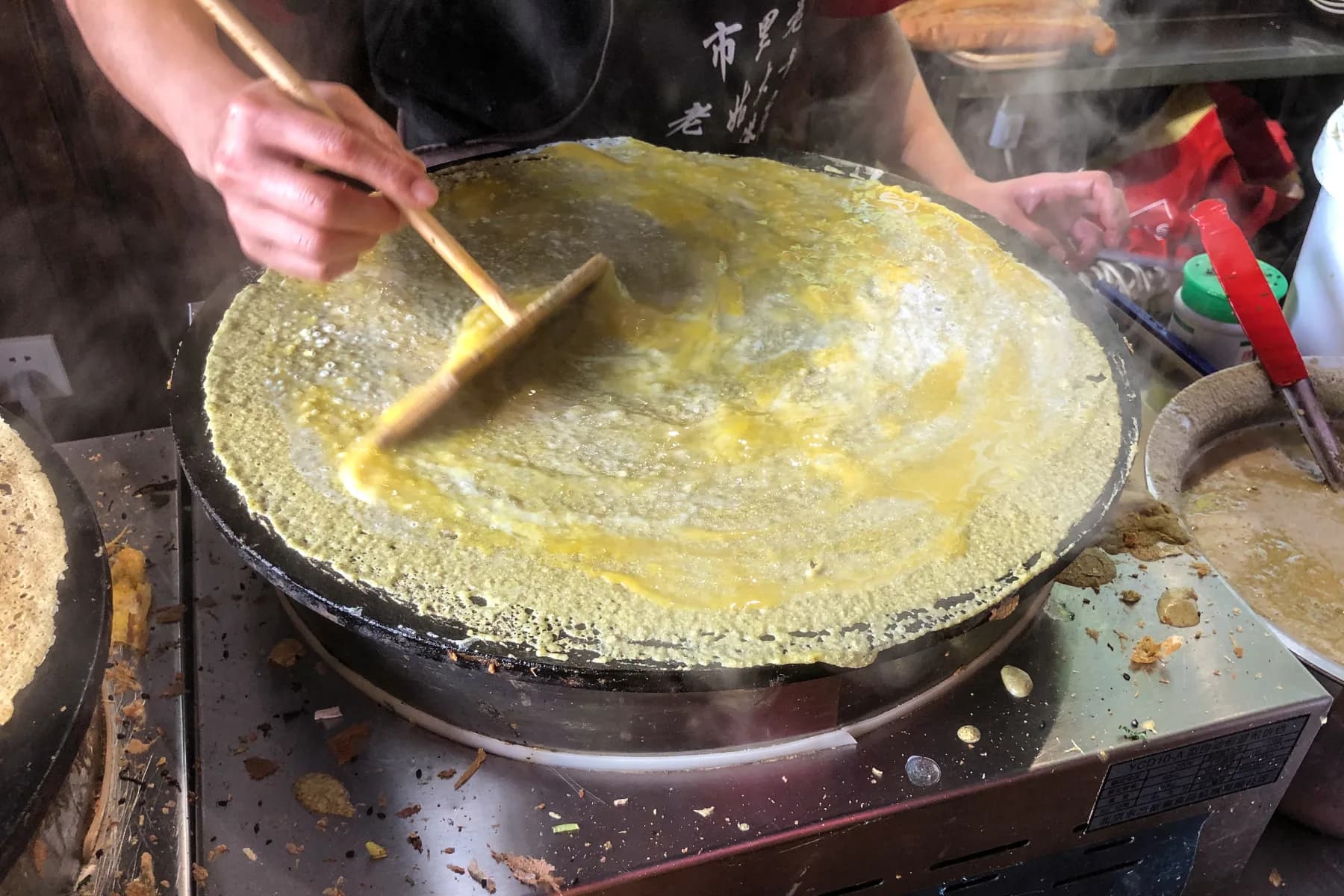
The griddle makes the order sequence visible: batter, egg, sauce, herbs and the crisp filling all create separate opportunities to ask or opt out. Photo by N509FZ, CC BY-SA 4.0.
The breakfast cluster around Tianjin's Northwest Corner is widely visited, and the Northwest Corner metro station is the clearest transport anchor. Treat the district as a sampler rather than a checklist: choose two foods, split portions if traveling with someone, and leave when the queue density stops being enjoyable. 锅巴菜 gābācài combines crisp pieces with gravy; 面茶 miànchá is a thick grain-based bowl often finished with sesame paste; 卷圈 juǎnquān is a fried roll. Ask about fillings, sauce and frying oil when those matter.
Shanghai and Jiangnan: four staples, buns and noodles
Shanghai's official food introduction groups dàbǐng (flatbread), yóutiáo, cífàntuán and dòujiāng as the traditional breakfast “Four Heavenly Kings.” That set gives you an efficient tasting plan: choose one bread or rice item, one drink, then add a bun only if you are still hungry. A cifantuan can conceal pork floss, preserved vegetables or youtiao, so ask what goes inside.
Shengjian and xiaolongbao suit travelers who want a more substantial first meal. The liquid inside can be extremely hot. Lift one carefully, bite a small opening, let steam escape and sip only when comfortable. Scallion-oil noodles provide another Shanghai morning or light-lunch option, though the seasoning and toppings still vary by shop.
Guangzhou and the Pearl River Delta: morning tea is the event
早茶 zǎochá (“morning tea”) is a social meal built around tea and shared dishes. It is a different planning unit from a five-minute street breakfast. Allow at least an hour, more for a popular weekend sitting. Ask how ordering works: a paper card, QR menu, trolley or staffed station. Confirm the tea charge and whether it applies per person.
Start with two or three dishes for two people, then add. Cheong fun, steamed buns, congee and dumplings can look small but accumulate quickly. Shrimp, pork, lard, oyster sauce, egg and wheat appear often; rice wrappers do not make the whole dish free of those ingredients. If a table is shared during a busy period, keep bags compact and let the meal stay communal rather than turning the table into a photography set. The Guangzhou guide helps place morning tea within a wider food-focused stay.
Wuhan: learn the verb “guozao”
In Wuhan, 过早 guòzǎo means having breakfast, and the meal has unusual cultural weight. Hot dry noodles are the best-known entry point: alkaline noodles tossed with sesame paste and condiments, rich enough to become a complete meal. Mix from the bottom immediately so the sauce coats the noodles before they clump. Order one bowl first; add 豆皮 dòupí or 面窝 miànwō on another morning rather than stacking every specialty at once.
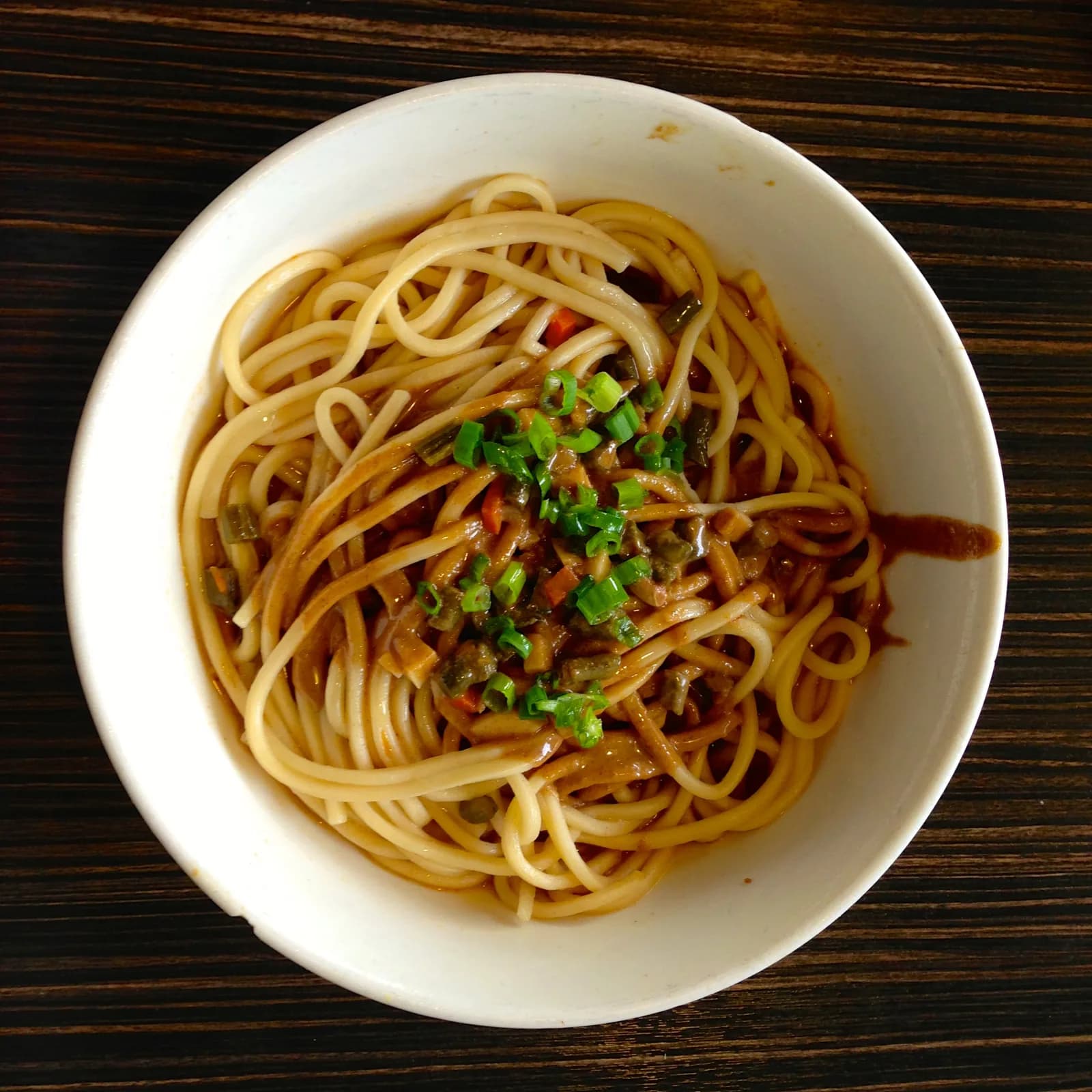
Hot dry noodles should be mixed promptly so the sesame-rich sauce reaches the whole bowl. The image shows the finished texture; each shop's condiment and allergen mix still needs checking. Photo by ZhengZhou, CC BY-SA 4.0.
Shanhaiguan Road snack street is an easy map anchor for a concentrated Wuhan breakfast, and official city coverage describes more than 30 breakfast businesses around the street. It can also be crowded. Arrive with one priority, keep collection tickets, and ask which counter handles each item. A long line signals demand, not an obligation to wait.
Chongqing, Lanzhou and the noodle-first morning
Chongqing xiaomian is a direct route into the city's flavors, but a default bowl can be too hot or oily for some early stomachs. Ask for 微辣 only if mild chili is acceptable; regional “mild” remains subjective. A clear-soup option can reduce chili while keeping a seasoned broth.
Lanzhou beef noodles combine hand-pulled noodles, clear beef broth, sliced meat, chili oil, radish and herbs in various proportions. Choose a noodle width by pointing if the terminology feels too fast. Travelers following halal requirements should verify the current premises and their own standard instead of assuming every business using a Lanzhou name qualifies. The Muslim-friendly China guide provides a full verification card and city-planning method.
Yunnan, Guangxi and the rice-noodle morning
Rice noodles make breakfast feel lighter, yet the bowl may carry a full meat or fish broth. Ask what the soup is made from, then choose toppings. Yunnan mǐxiàn and Guangxi mǐfěn cover many preparations rather than one dish. Hot broth, pickled vegetables, peanuts, soy products and chili are common variables; assemble the bowl slowly if you have restrictions.
This is a good format for travelers who prefer a seated start but do not want a long teahouse meal. It is a poor format for anyone who assumes “rice noodle” answers questions about stock, sauces or cross-contact.
Yanji: make the market the morning plan
Yanji's Water Market works best as an early outing rather than a quick stop squeezed before a train. Begin with one seated bowl—perhaps soup with rice—then share one or two portable foods such as rice cake or rice sausage. Keep luggage away from narrow trading lanes and ask before photographing vendors at close range.
The market has moved and reopened, so use the current Yanji Water Market guide rather than an old social pin. The guide includes the present AMap market anchor, transport planning and a sequence that continues to West Market without treating both as the same breakfast stop.
Allergies and dietary rules require a separate workflow
A dish name is never an ingredient declaration. The packaged-food label system and a fresh breakfast counter are also different evidence sources. China's forthcoming GB 7718-2025 label standard identifies eight allergen categories for prepackaged food—gluten-containing cereals, crustaceans, fish, eggs, peanuts, soybeans, milk and tree nuts—but the National Health Commission's official FAQ says the standard does not cover unpackaged display food, restaurant food or freshly made food. Its implementation date is March 16, 2027. During and after that transition, a sealed label can help with a backup snack while a stall-made breakfast still requires a direct conversation.
| Concern | Breakfast sources people miss | Useful question |
|---|---|---|
| Wheat/gluten | Baozi skins, youtiao, shaobing, wontons, soy-sauce blends, gravy, crisp jianbing filling | 这里有小麦或面粉吗? Does this contain wheat or flour? |
| Egg | Jianbing, cheong fun fillings, doughs, noodles, fried-rice or rice-roll additions | 不放鸡蛋可以吗? Can you make it without egg? |
| Soy | Soy milk, tofu pudding, soy sauce, fermented-bean condiments | 有大豆或豆制品吗? Is there soy or a soy product? |
| Sesame | Hot dry noodles, miancha, sauces, toppings, sesame oil | 有芝麻、芝麻酱或香油吗? Is there sesame, sesame paste or sesame oil? |
| Peanut/tree nuts | Condiment bars, crushed toppings, mixed sauces and shared scoops | 有花生或坚果吗? Are there peanuts or tree nuts? |
| Milk | Sweet buns, coffee/tea drinks, packaged breads, some doughs | 有牛奶或奶制品吗? Is there milk or dairy? |
| Fish/crustacean | Wonton broth, savory tofu gravy, dried shrimp, oyster sauce, fish sauce | 有鱼、虾、虾皮或蚝油吗? Is there fish, shrimp, dried shrimp or oyster sauce? |
| Animal stock/fat | Congee, soup noodles, gravy, pastry, frying fat | 汤和油是什么做的? What are the broth and oil made from? |
For a severe allergy, add the consequence in writing and ask about shared oil, griddles, ladles, tongs and preparation surfaces. A busy stall that cannot explain cross-contact is an unsuitable experiment, even when the dish's usual recipe looks safe. Carry prescribed medicine where you can reach it, keep a sealed backup meal, and choose a hotel breakfast or packaged option when communication is inadequate. Sesame and other ingredients outside a short mandatory list still deserve explicit questions.
Vegetarian and vegan travelers face overlapping issues—stock, lard, oyster sauce, dried shrimp and egg are frequent examples—but ingredient preference and medical allergy are different conversations. Use the detailed Chinese cards in the vegetarian and vegan China guide and state an allergy separately when cross-contact can cause harm.
A seven-day breakfast plan that builds confidence
This sequence is designed for a multi-city trip. Swap in the local equivalent while preserving the progression from simple to complex.
- Day 1 — one drink, one steamed item. Order soy milk or congee plus a bun. Practice portion words, dine-in/takeaway and the price question.
- Day 2 — watch a griddle. Try jianbing or another made-to-order bread. Decide your egg, herb, sauce and chili choices before reaching the cook.
- Day 3 — one local noodle bowl. Choose hot dry noodles, beef noodles, xiaomian, mifen or mixian according to the city. Ask about broth and spice, then stop adding sides until you see the portion.
- Day 4 — a rice-based southern format. Try cheong fun, rice noodles or a rice roll. Pay attention to fillings and sauces rather than treating the rice base as the whole ingredient list.
- Day 5 — a social breakfast. Reserve enough time for Guangzhou morning tea or a slower dumpling meal. Start with two or three shared dishes and learn the tea-charge system.
- Day 6 — a market sampler. Arrive early, select one seated anchor dish and two small portable tastes. Leave room for uncertainty and avoid carrying a large suitcase through the aisles.
- Day 7 — a controlled travel-day breakfast. Use a known counter, hotel breakfast or sealed food bought the previous evening. Reliability matters more than novelty before a timed train or flight.
If you change hotels frequently, do the complex market and teahouse meals on full days. Keep the simplest breakfast for departure mornings. If you travel with children or older relatives, seat and toilet access may matter more than the most famous stall; one adult can order while the rest of the group waits somewhere that does not obstruct the queue.
How to judge a breakfast stop without a ranking
Use four signals together:
- The production rhythm is visible. Food is being steamed, griddled, boiled or fried in a steady batch, and you can see where finished portions go.
- The menu unit is clear. You know whether the price is per piece, bowl, plate, weight or set, and whether tea or sides are separate.
- The collection path makes sense. Cashier, ticket, counter and seating have an observable sequence. When several windows share one shop, staff can point to each collection point.
- The kitchen can answer your essential question. “I don't know” is useful information when a dietary restriction matters.
Popularity alone cannot answer those questions. A viral street may have excellent food and awkward queues at the same time. A quiet residential shop may be easier, or it may be nearing sell-out. Choose the place whose format you understand.
What to skip first when the morning goes wrong
Cut the destination-wide detour first. A breakfast that requires two metro changes before a museum reservation consumes both appetite and schedule margin. Next cut any shop whose ordering or pricing remains unclear after one direct question. If dietary communication fails, skip the fresh counter and use your verified backup.
Bad weather changes the format more than the cuisine. In heavy rain, choose a seated noodle shop or covered market instead of carrying hot soy milk and fried dough outdoors. In extreme heat, shorten exposed queues and avoid letting prepared food sit in a bag. In cold weather, keep gloves that can be removed quickly for payment and do not balance steaming bowls on an icy curb.
The best Chinese breakfast is the one that fits the city, the morning and your next commitment. Learn one format, order a modest first round, confirm the total, and keep restrictions precise. By the third city, the menu will still be regional, but the transaction will feel familiar.