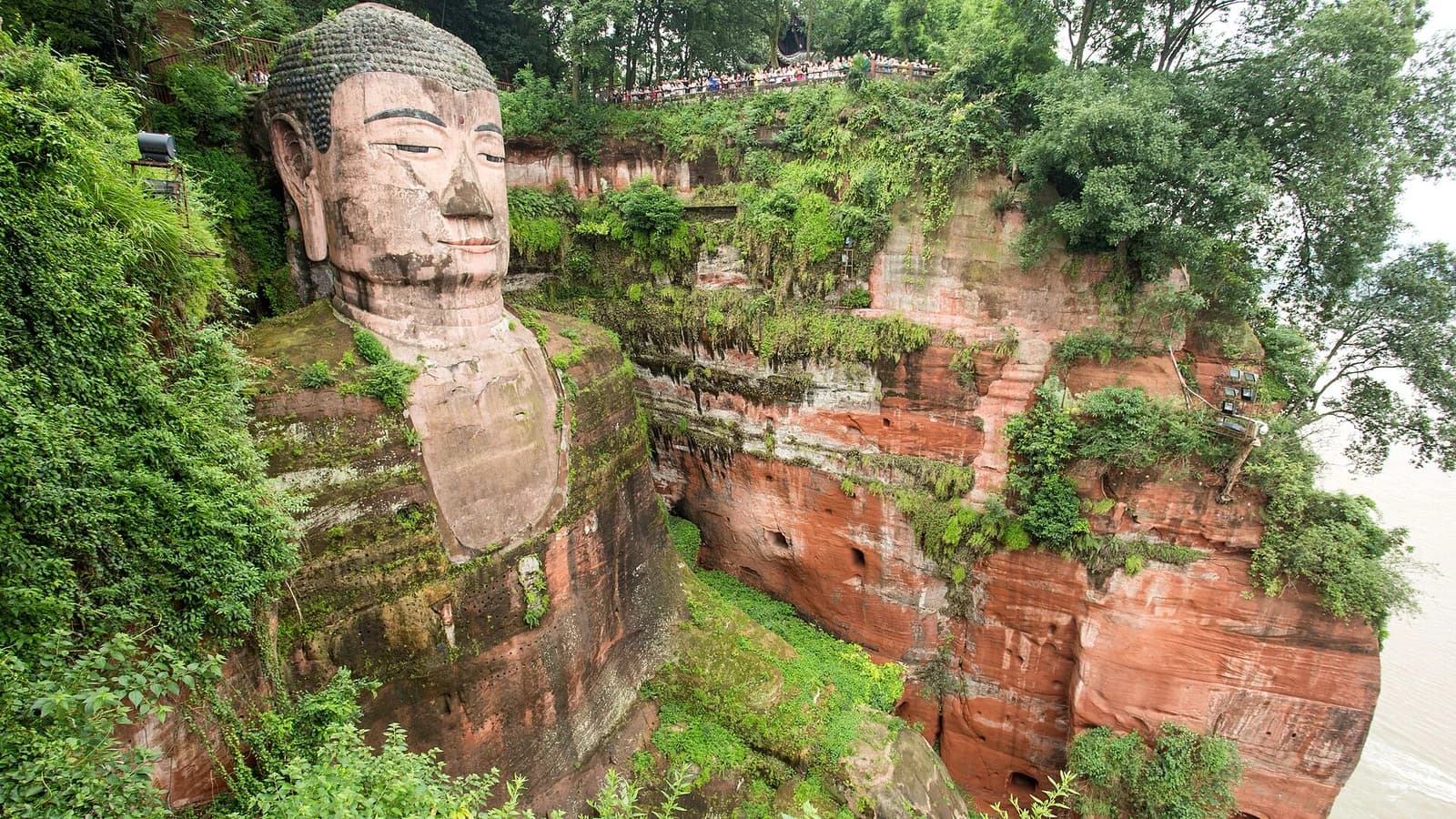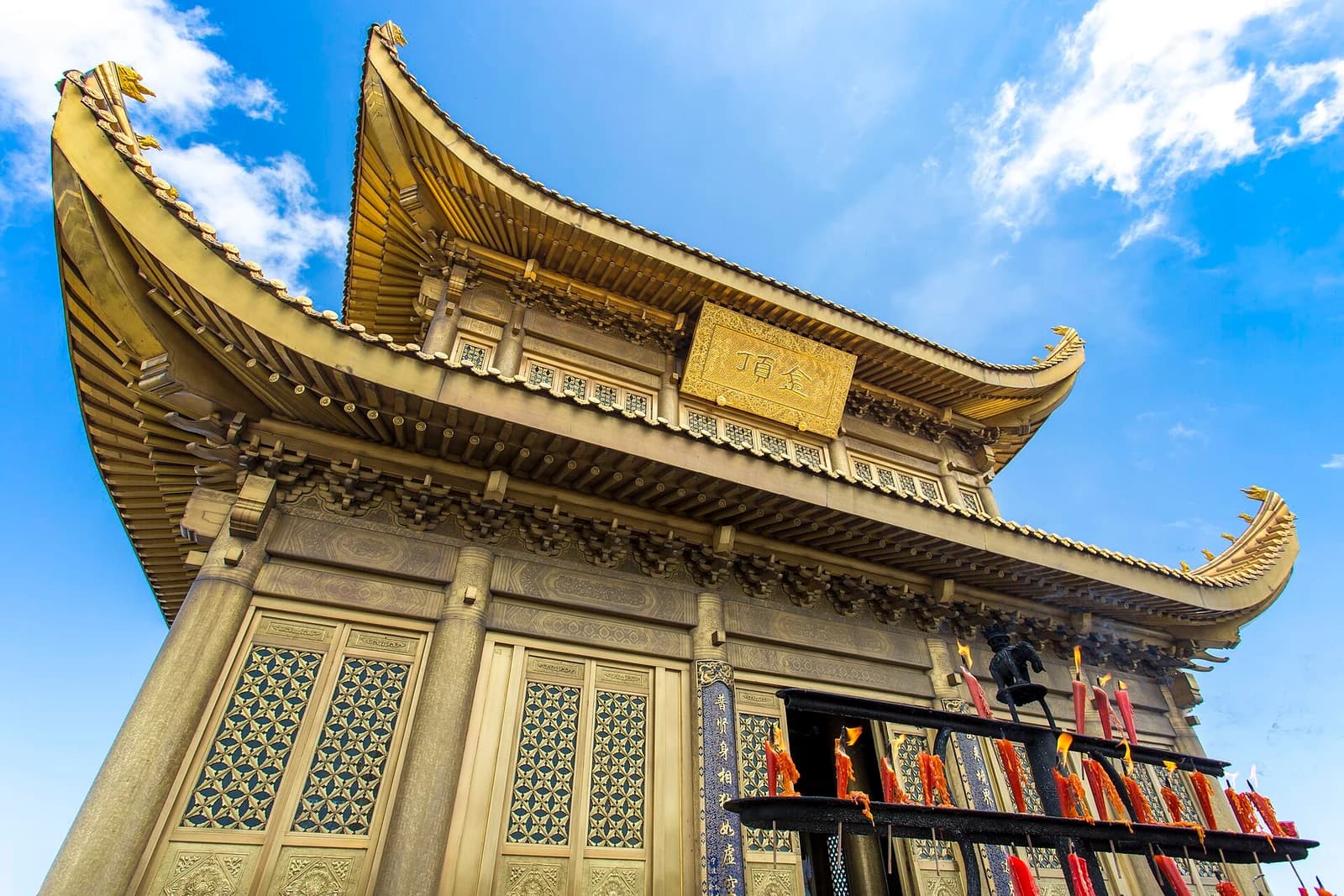
Mount Emei
Mount Emei rewards visitors with three very different ways to experience one great Buddhist and natural landscape. From Baoguo and Huangwan, the mountain rises through streams, forest and temple zones to the high Golden Summit. Choose the version that matches the experience you want:
- Transport-assisted Golden Summit: scenic bus, high-mountain transfer and cableway/walking decisions for the iconic summit.
- Middle-mountain temple and forest walk: a focused Qingyin or Wannian-side day with more landscape immersion.
- Full hiking ascent: a strenuous multi-day mountain route with staged overnights and an official trail plan.
Most first visits should choose one primary product. A summit trip is not an effortless substitute for a hike, and a “short” middle-mountain walk can still consume most of the daylight. Recent visitors consistently report that weather, ice, darkness, queues and overnight logistics—not attraction count—determine whether the day succeeds.
Choose your mountain experience
| Product | Best for | Plan around |
|---|---|---|
| Golden Summit | First-time icon, high-elevation Buddhist landscape and broad views when weather allows | Variable visibility and walking beyond the cableway |
| Middle mountain | Forest, streams, temples and a more grounded walking day | A full daylight block rather than a late summit add-on |
| Full ascent | Strong, experienced hikers who want the mountain transition itself | Multiple hiking stages, weather and confirmed overnight stops |
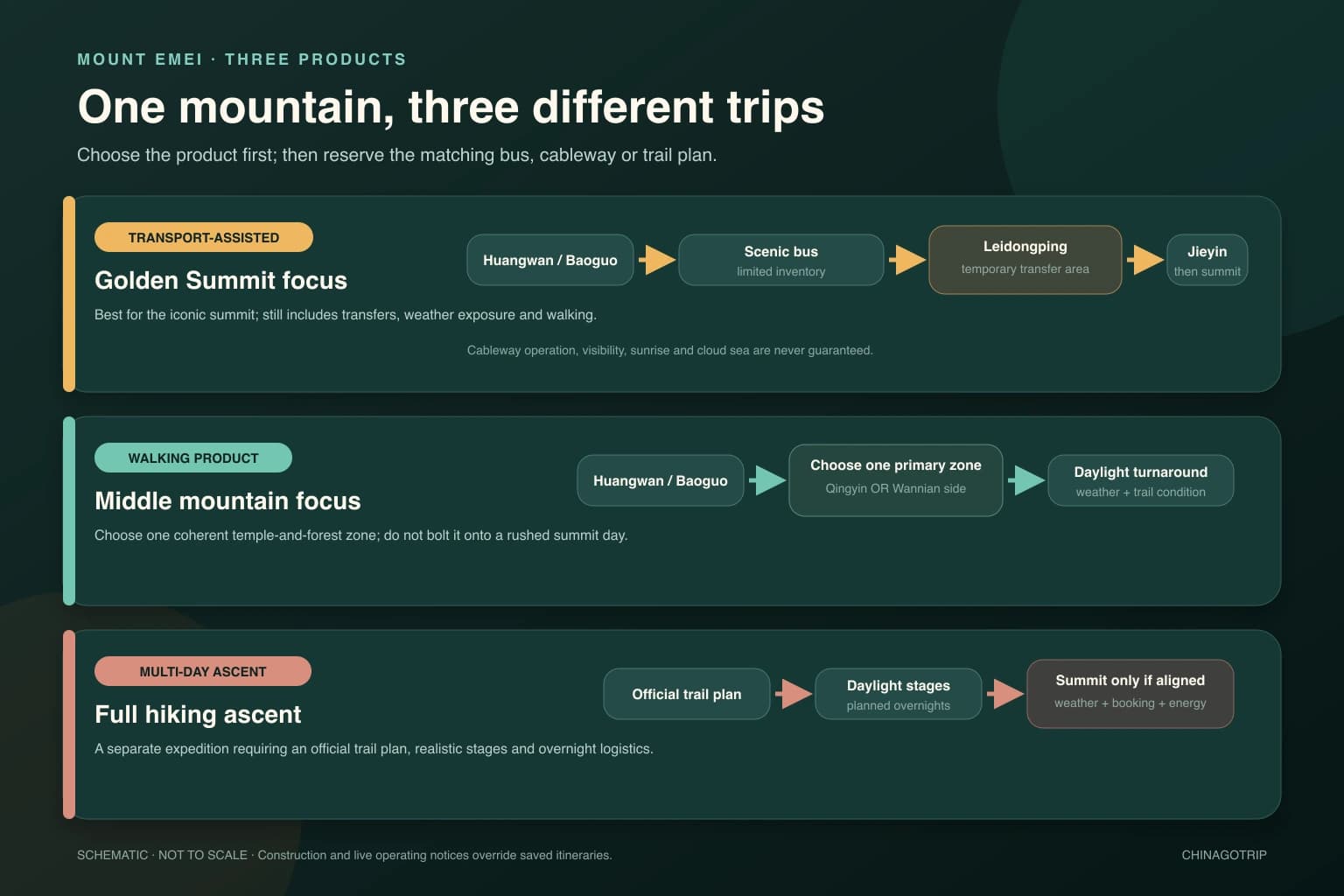
The original diagram below separates the three products without inventing trail geometry or distances.
The 2026–27 construction changes the summit day
The official Golden Summit management notice introduced significant controls from 23 May 2026 while the Leidongping and Golden Summit transport system is upgraded:
- Golden Summit access is capped at 8,000 visitors per day and uses timed reservation.
- High-mountain sightseeing-bus tickets to and from Leidongping have limited inventory.
- Leidongping station and parking are under closed construction; boarding and waiting use a temporary area.
- The old Leidongping station building cannot be used for overnight rest.
- Golden Summit cableway capacity is reduced during the works.
- Completion is expected in 2027, so current notices and on-site directions must override saved route cards.
This means a pre-construction itinerary can be structurally wrong even when its place names remain correct. Reserve the mountain product, high-mountain bus and any cableway in one coherent sequence, and protect a larger return buffer.
Current price baselines
The official Mount Emei 2026 fee schedule, checked on 21 August 2026, lists:
| Item | Peak-season baseline | Low-season baseline |
|---|---|---|
| Scenic-area admission | CNY 160 | CNY 110 |
| Golden Summit cableway, up / down | CNY 65 / 55 | CNY 30 / 20 |
| Wannian cableway, up / down | CNY 65 / 45 | CNY 30 / 20 |
| Baoguo/Huangwan–Leidongping sightseeing bus, return | CNY 90 | Check current product |
| Baoguo/Huangwan–Wuxiangang/Wannian/Linggongli bus, return | CNY 40 | Check current product |
The bus table also contains other zone combinations. Do not add prices from incompatible legs and assume you have built a valid route. Check the exact Mount Emei listing on Trip.com, then compare the named gate, date, bus direction, cableway and passport fields against the current official checkout.
Experience 1: transport-assisted Golden Summit
The workable sequence is Huangwan/Baoguo orientation → matching scenic bus → current Leidongping temporary transfer area → Jieyin Hall/cableway branch → Golden Summit. Each arrow represents a transfer or walk; the cableway does not begin at the railway station or visitor centre.
At the top, read the Golden Summit as a living Buddhist and high-mountain environment rather than a weather vending machine. The Samantabhadra imagery, temples, light, wind and changing visibility shape the experience. Sunrise, cloud sea and a “Buddha's halo” are atmospheric possibilities, never products that a ticket guarantees.
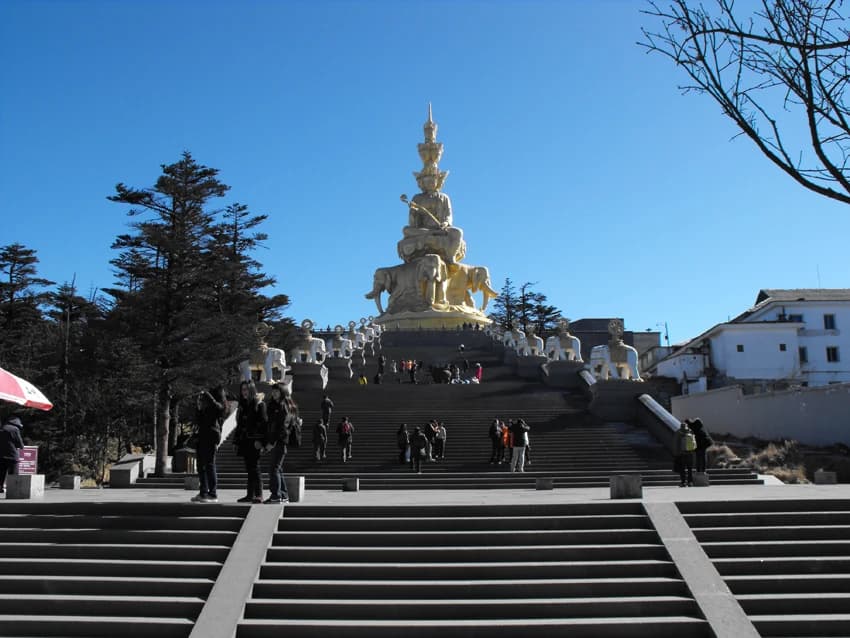
Photo: Martin Wettig · Source · CC BY-SA 3.0
Same-day summit or overnight?
A same-day summit works when you secure an early timed product, accept a transport-heavy day and keep the final train or city transfer conservative. An overnight is useful only when it solves a deliberate sunrise or hiking plan. It still cannot guarantee visibility.
Confirm the exact open lodging, heating, water, luggage access and walking connection. Never plan to sleep in the old Leidongping station building: the current works notice explicitly removes that function.
Experience 2: middle-mountain temples and forest
Choose the middle mountain when the purpose is walking through vegetation, water, bridges and Buddhist sites rather than collecting the summit photograph. Qingyin and the Wannian side are useful anchors, but treat them as route choices rather than two effortless stops to combine automatically.
At Qingyin, the pavilion-and-bridge landscape makes the relationship between water, forest and religious space legible. On the Wannian side, temple history and a cableway option can support a different day. In both cases, use the current scenic bus stop, signed trail and daylight turnaround; do not infer a direct road between two internal map pins.
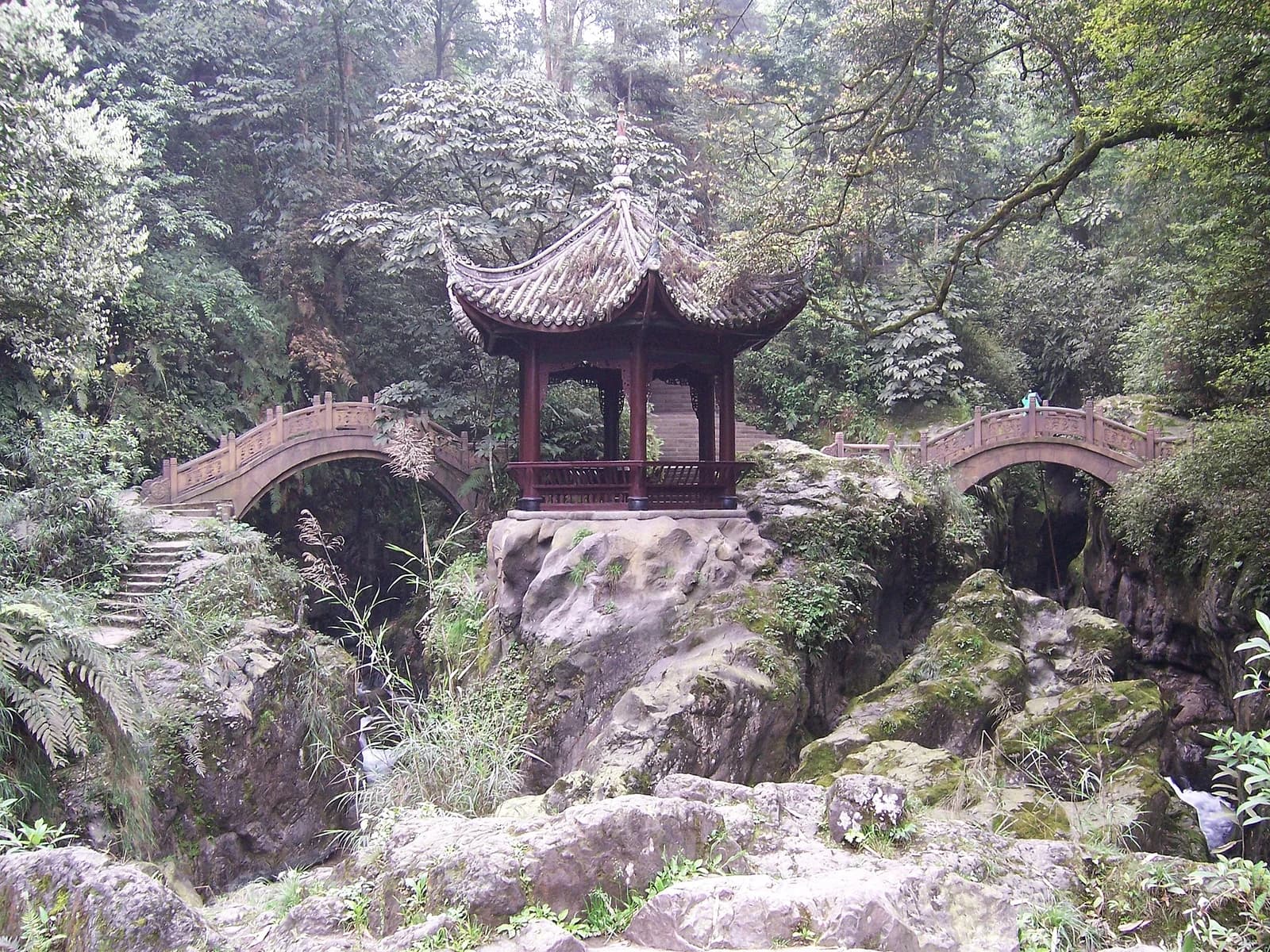
The middle mountain is where elevation becomes an experience rather than a transfer. Paths can be damp, roots and stone can be slippery, and mist changes both scenery and pace. Start early enough to turn around before darkness and keep one primary zone when the forecast or legs are uncertain.
Experience 3: the full hiking ascent
The complete walking ascent is a separate expedition. It needs a current official trail plan, realistic daylight stages, confirmed overnight stops, food and water resupply assumptions, weather contingency and a booked exit. Do not turn one visitor's two-day achievement into a universal schedule.
Only experienced, conditioned hikers should plan it without local support. Build stages from currently open signed trails and staffed zones, not a stylised online map. If a segment closes or the weather deteriorates, shorten the route; a summit reached after the last safe descent is not a successful itinerary.
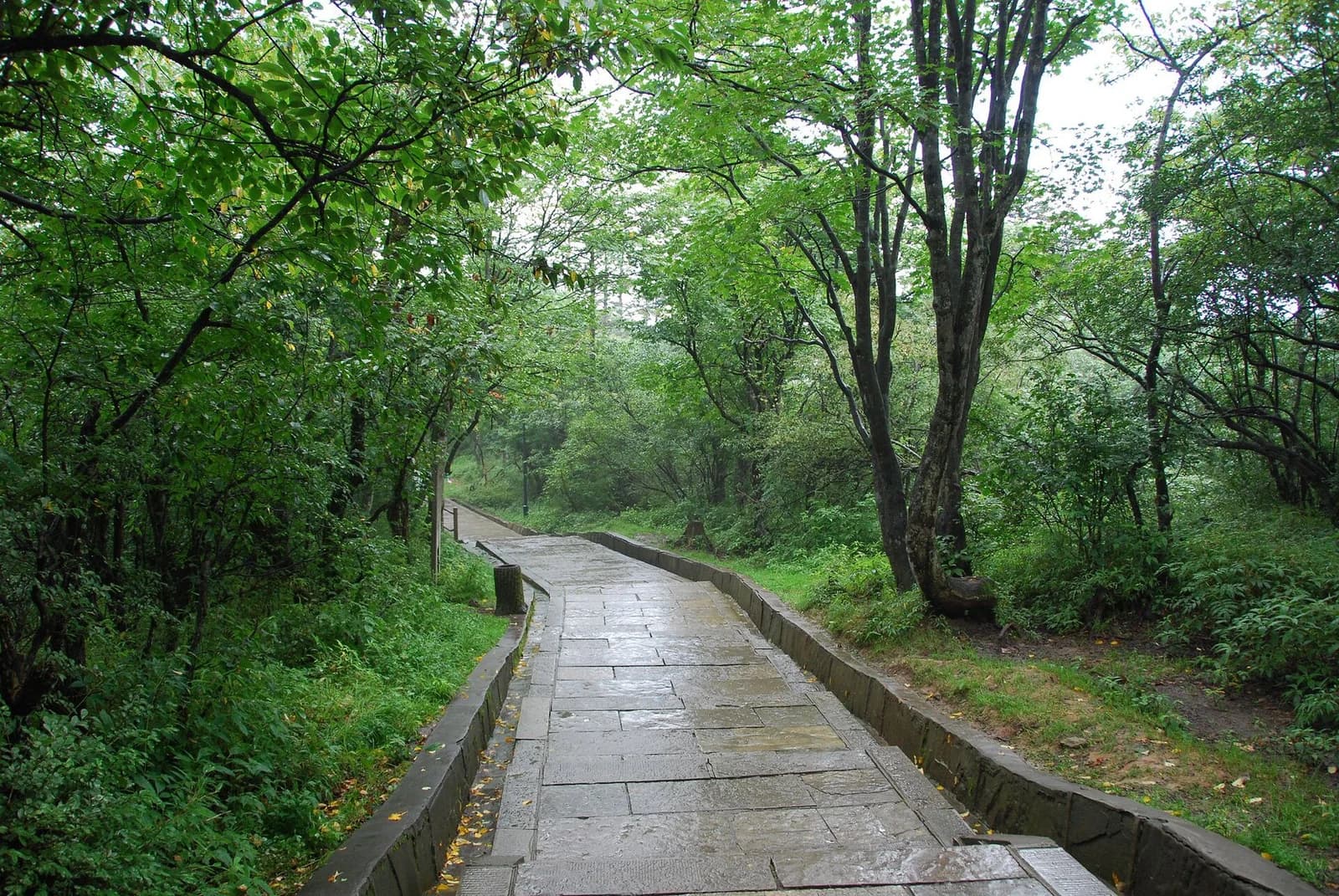
Photo: jetsun · Source · CC BY-SA 3.0
From Emeishan Railway Station
Amap's August 2026 route model found bus 7 from Emeishan Railway Station towards Huangwan in about 36 minutes, including roughly 921 metres of walking. Its car model measured approximately 4.2 km and 10 minutes. These are orientation baselines; traffic, stop changes and scenic-area controls affect the real trip.
The verified Huangwan Visitor Centre coordinate is 103.440170, 29.578258 and Emeishan Railway Station is 103.466479, 29.576403 (longitude first). Use the exact scenic-bus product named in your booking after reaching the orientation area. Amap marked Leidongping parking as suspended during the current works, consistent with the official construction notice; do not navigate a private car there.
Compare live China trains on Trip.com and leave time for security, passport checks and a delayed mountain descent. Avoid the last theoretical return when your route depends on a cableway queue or reduced-capacity bus.
Where to stay
Lower mountain or Emeishan city
This is the normal base for an early scenic bus, a middle-mountain day or an arrival evening. Compare the real transfer to Emeishan Station, Huangwan or Baoguo. “Near Mount Emei” may still mean a long first connection.
High mountain
Use only for a deliberate sunrise or staged hiking plan. Verify the exact operating property, room type, heat, water, food, luggage access and path from your final transport node. Weather can make the overnight worthwhile even without a view—or make the onward plan impossible.
Compare Emeishan accommodation on Trip.com by the first transport node and cancellation conditions, not by a generic summit photograph.
Macaques, weather and temple conduct
- Keep food and plastic bags inside the pack around macaques; do not display, tease or feed them.
- Give animals space and follow staff instructions. Do not attempt a close photograph or retrieve an item through confrontation.
- Wear shoes with reliable grip and carry rain protection plus warmer layers for the high mountain.
- Reduce or abandon the route in lightning, strong wind, ice, heavy rain or poor visibility.
- Keep voices low in temples, dress respectfully and follow photography and incense rules.
- Carry a charged phone and power bank, but let signs and staff override saved screenshots.
Build a mountain day you can enjoy
Before paying, answer: Golden Summit, middle mountain or full ascent; correct lower station; timed admission; matching bus and cableway; live construction constraint; daylight turnaround; overnight purpose; and what you will cut if weather or queues consume the margin.
For most first visits, choose either a focused summit product or a middle-mountain day. Add the other only with a separate day. The mountain is most rewarding when the route explains its elevation, forest and Buddhist landscape—not when every zone is compressed into one ticket basket.