Leshan
Leshan pairs two of Sichuan's great cultural landscapes with a food scene made for tasting in small rounds. At the Leshan Giant Buddha, choose a mountain heritage route for temples and close scale or a river cruise for the complete cliff view. Mount Emei adds forest paths, Buddhist sites and the Golden Summit as a separate mountain day.
For a first visit, one day is enough for the Giant Buddha and a relaxed Leshan meal. Two days can add city time or move you to an Emeishan base. Three days are the first comfortable shape for both the Giant Buddha and one deliberate Mount Emei product.
The three-day first-trip route
Give the Buddha its own heritage visit, then treat Emei Golden Summit and the Qingyin middle-mountain area as different days. Qingyin works best when you want forest paths and have time for the return transport.
Choose the trip shape that gives each highlight room
| Time | What fits without pretending transfers disappear |
|---|---|
| 1 day from Chengdu | Choose the Giant Buddha mountain route or cruise, add one unhurried meal, then return. Combining both Buddha products is possible only when the day's pier, exit and transfer align. |
| 2 days | Day 1 Giant Buddha plus Leshan; day 2 either a middle-mountain Mount Emei walk or a transport-assisted Golden Summit visit. A split base often protects the second morning. |
| 3 days | Day 1 Leshan and the Giant Buddha; day 2 one Mount Emei product; day 3 a second compatible Emei zone or weather buffer. Do not promise both Qingyin and the summit on a rushed single mountain day. |
Recent visitor reports repeatedly support the same planning rule: the Chengdu–Leshan rail day is workable when the list is short, while Mount Emei naturally becomes its own day or overnight. The smoothest plan gives the Buddha, one relaxed food period and the return connection enough room, then treats the Emei summit as a separate commitment.
Choose one base or split the stay
Leshan city: best for the Buddha and food
Use Leshan city when the Giant Buddha is the main purpose or when you want an evening for local food. A practical city stay balances access to Leshan Railway Station, the river-facing old centre and the Buddha's current arrival system. Do not choose a property merely because “Giant Buddha” appears in its name; the north mountain arrival and changing southern pier/exit nodes can require different transfers.
Emeishan or Huangwan/Baoguo: best for an early mountain start
Move towards Emeishan when the next morning is a timed Golden Summit product, a long middle-mountain walk or the beginning of a multi-day ascent. Emeishan Railway Station, Huangwan Visitor Centre and the Baoguo orientation area are separate nodes. The station is convenient for rail; Huangwan/Baoguo is useful for scenic-bus orientation; neither label alone proves an easy walk to the room.
When one base is enough
Keep one Leshan base for a Buddha-only trip. Split the stay when Mount Emei is a real second-day commitment and the luggage move removes a fragile early transfer. Compare Leshan and Emeishan stays on Trip.com by the exact station or visitor-centre connection, not by the broad “Leshan” destination tag.
Read the railway station name before booking
- Leshan Railway Station is the normal rail gateway for the city and Giant Buddha. Amap's August 2026 route model found the K2 bus to the mapped north-arrival stop in about 42 minutes with roughly 427 metres of walking; a car route was about 9.2 km and 28 minutes. These are orientation baselines, not a timetable.
- Emeishan Railway Station is the useful rail gateway for Mount Emei. Amap modelled bus 7 to Huangwan in about 36 minutes with roughly 921 metres of walking, or a 4.2 km car route in about 10 minutes.
- Leshan and Emeishan are different stations. The correct arrival depends on the next product, not which name looks closer on a province map.
Check live China train inventory on Trip.com, leave time for station security and passport checks, and avoid building the return around the last workable train after a mountain or cruise product with live operating risk.
Treat the two World Heritage zones as separate jobs
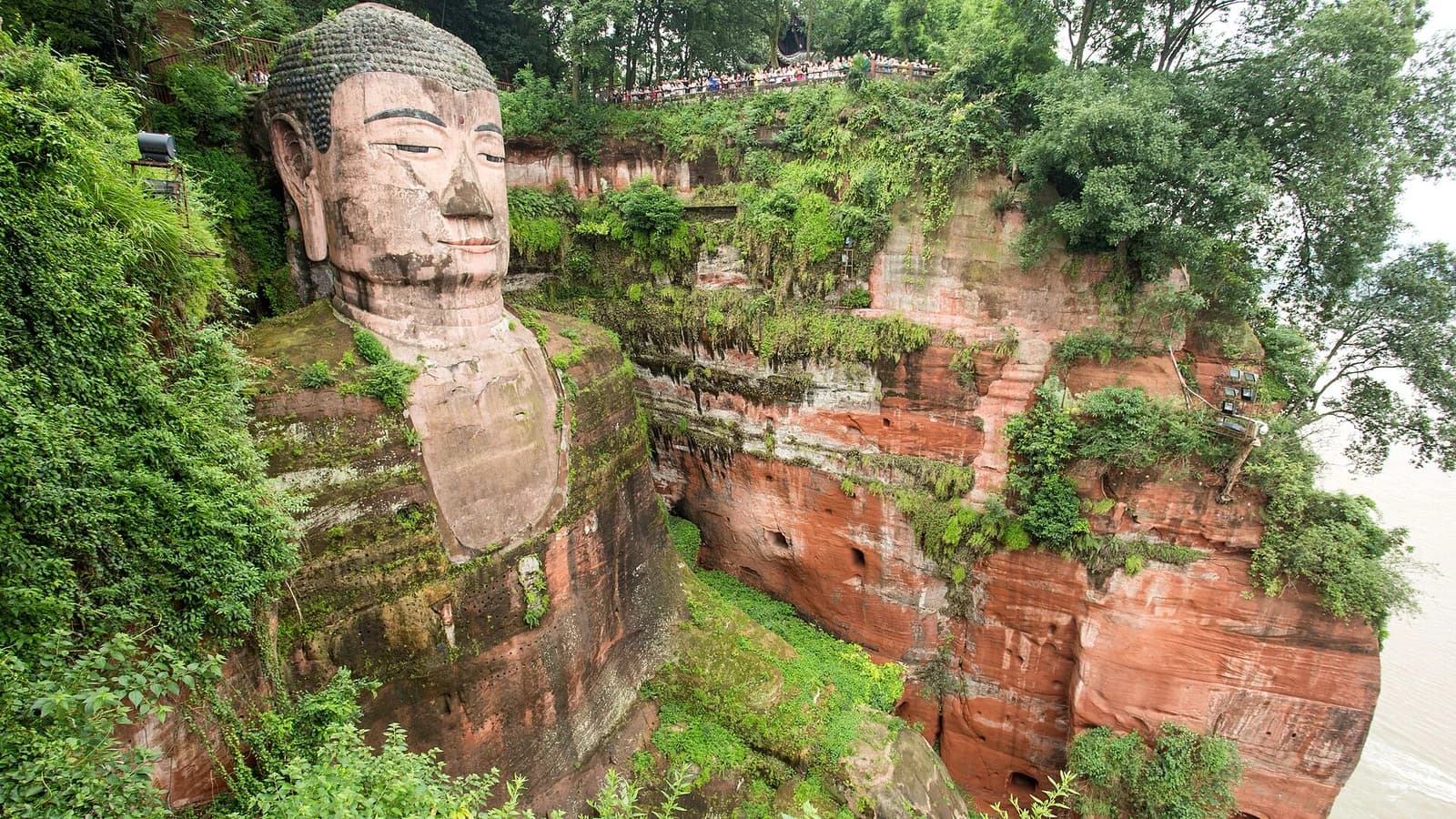
UNESCO inscribed Mount Emei Scenic Area, including Leshan Giant Buddha Scenic Area, in 1996 as one mixed property, but the listing contains two geographically separate zones. The Giant Buddha is a 71-metre eighth-century cliff carving at the confluence of the Minjiang, Dadu and Qingyi rivers. Mount Emei is a much larger Buddhist and natural landscape extending through major elevation and vegetation changes.
That shared World Heritage label is cultural context, not a transfer promise. Choose the Giant Buddha for cliff, river and Tang-period religious landscape; choose Mount Emei for a mountain product that may involve scenic buses, cableways, temples, forest walking and weather exposure.
Taste Leshan in small rounds
Leshan's useful food strategy is to order gradually. Bobo chicken, qiaojiao beef, sweet-skin duck, tofu-based snacks and small bowls or skewers make it easy to taste several things without committing to a single enormous meal. Choose busy places with visible turnover and posted prices, ask about chilli level, and begin with smaller portions before adding more.
Do not cross the city for a shop simply because one post called it essential. A Buddha day already contains transfers and possible queues. Protect one relaxed meal near the route you actually finish, keep tissues and drinking water handy, and treat food as the evening's purpose rather than an obstacle course between famous counters.
What to book first
- Giant Buddha: decide mountain admission, cruise or both; then check the official same-day notice for the foot platform, water conditions, assigned pier and current exit.
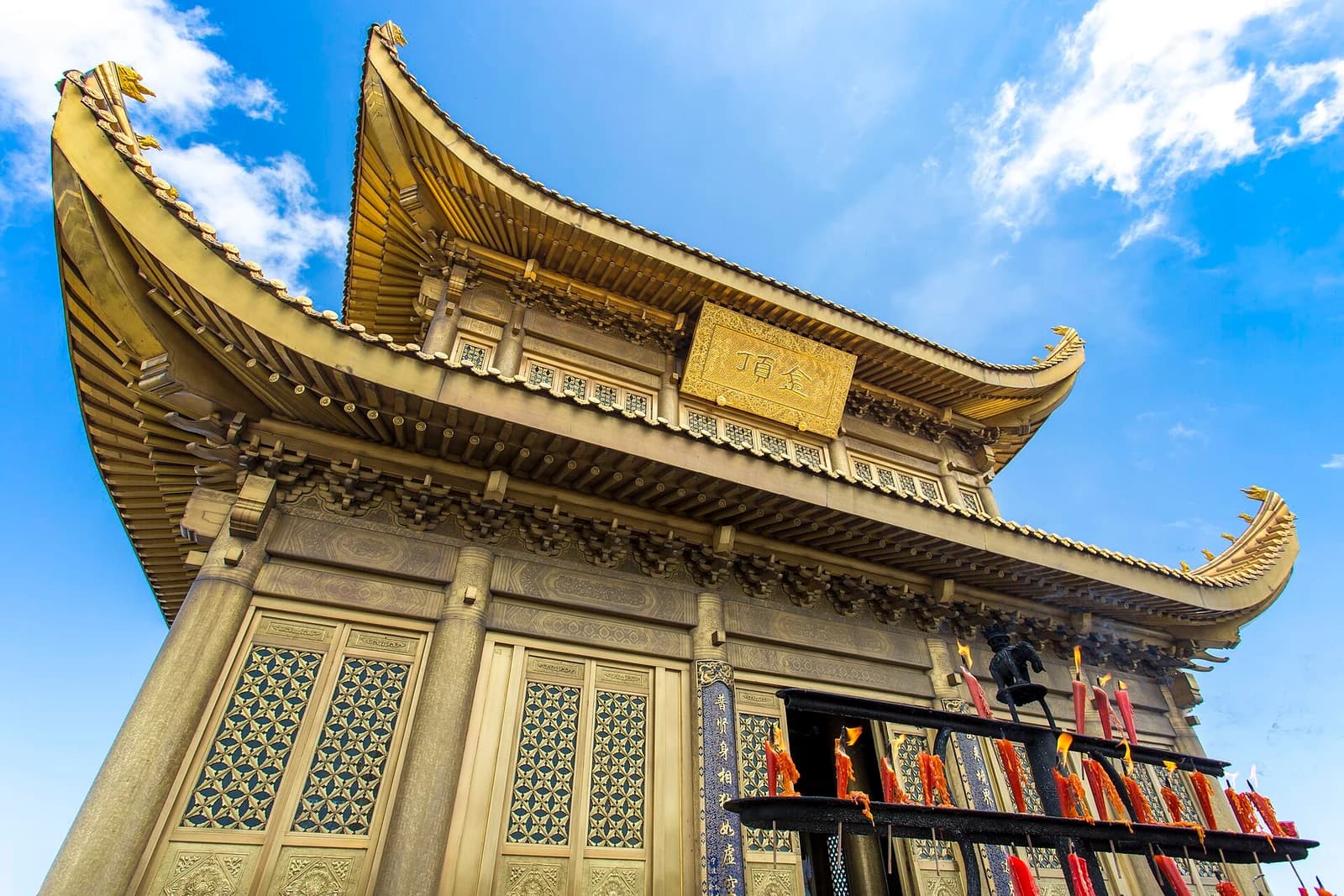
- Mount Emei: choose Golden Summit transport, middle mountain or full ascent before buying buses and cableways. During the 2026–27 high-mountain works, timed entry and reduced capacity materially affect the summit product.
- Rail: reserve the exact Leshan or Emeishan station that matches the day.
- Stay: select the base only after the next morning's first transport node is known.
Build a smooth Leshan–Emei sequence
- Add the second Buddha perspective only when the assigned pier and mountain exit connect without costly backtracking.
- Protect the buffer to your return train, then fit the food crawl around the part of town where the visit ends.
- Give a single Emei day one clear purpose: Golden Summit or middle-mountain forest and temples.
- Pair sunrise with an overnight and treat visibility as a possibility rather than the reason the whole trip succeeds.
- Let live rain, ice, flood, cableway and water-safety notices set the final route even when a ticket is prepaid.
Illustrated guides
A trip that flows
- One day: Giant Buddha plus one food period.
- Two or three days: allocate Mount Emei separately and consider a split base.
- Confirm live pier, gate, bus and cableway details rather than copying screenshots.
- Carry the original passport used for bookings and leave time for staffed handling.
- Keep temple spaces quiet, do not feed macaques and follow signed closures around cliffs and water.