Leiyin Temple in Dunhuang
Leiyin Temple (雷音寺, Léiyīn Sì) is a large Buddhist complex between Dunhuang city and Mingsha Mountain. It is quiet, free according to the current Trip.com listing and recent visitors, and easy to add before a dune evening. Its value is often obscured by a bad claim: the buildings you see are not a 1,700-year-old monastery.
The present temple was created after the religious-activity area was separated from the Mogao heritage zone. An account connected with the Gansu Buddhist Association records an off-site reconstruction beginning in 1989, completion in June 1991, registration in 1992 and another approved expansion in 2009. Older temple names and Buddhist travel traditions belong to a longer Dunhuang history; they do not make today's timber halls ancient fabric.
Best reason to visit: use a calm 75–120 minutes to understand the modern temple, its interpretation of Dunhuang Buddhist history and the scale of the Great Brightness Hall. Skip it if only original ancient architecture will satisfy you, or if it would shorten a timed Mogao Caves visit.
Follow the public four-courtyard axis
The same institutional source describes five courtyards along the central axis. The first four form the public worship area; the fifth is a monastic living and practice area not open to visitors. Respect that boundary even if a gate appears unguarded.
A useful sequence is:
- Mountain gate: read the route and history material as temple interpretation, not archaeological proof. The Xuanzang route panel expresses a Buddhist travel memory; it does not establish that the present hall hosted him.
- Tianwang Hall: slow down and observe the direction of worship before moving through the axis.
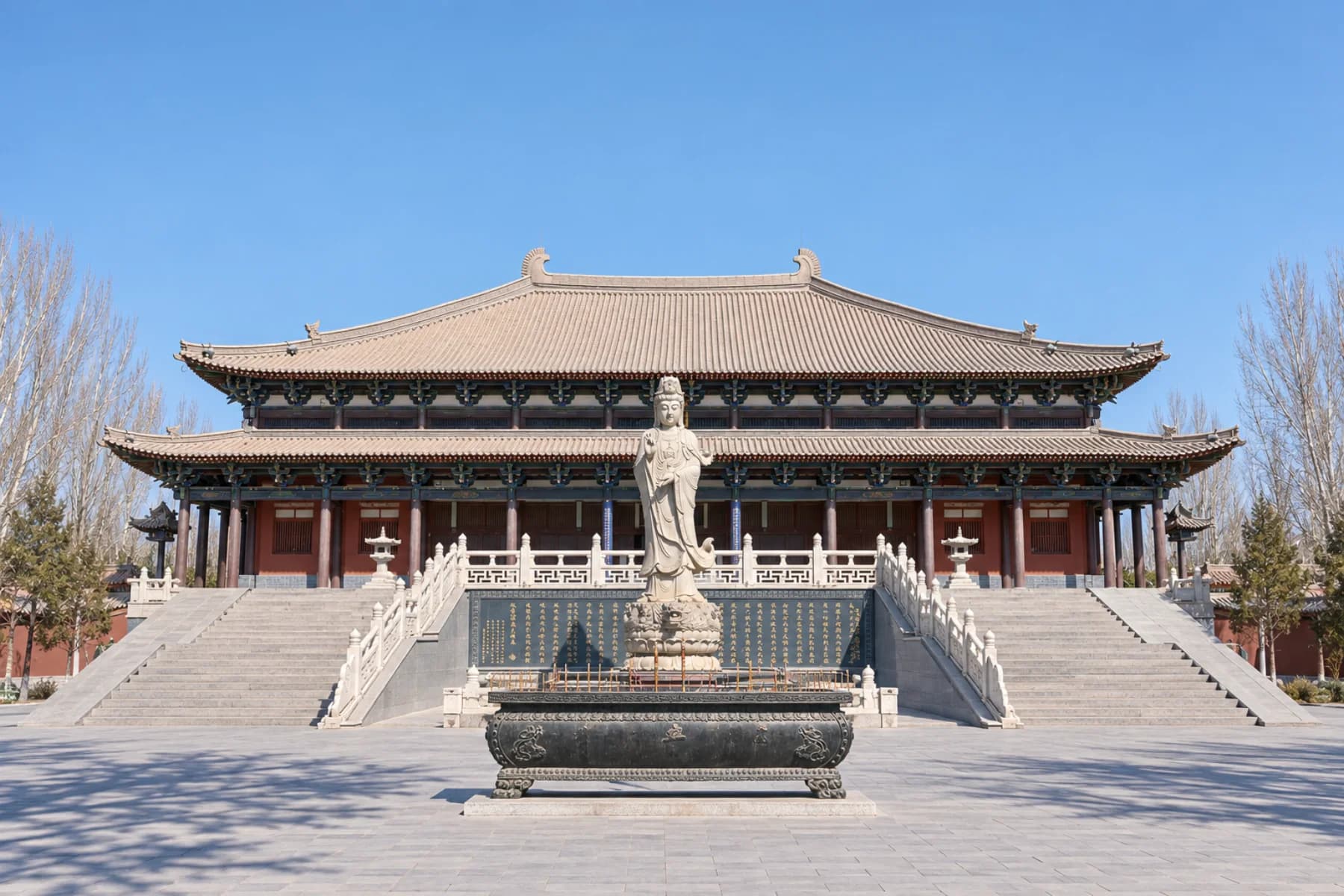
- Main Hall: look at how the new complex uses symmetry, broad courtyards and Tang-inspired roof forms to evoke Dunhuang's visual language.
- Buddhist-history display, if open: recent visitors call this the most useful layer. It outlines Buddhism's movement through Dunhuang and uses reproductions to explain manuscript, image and cave traditions. Treat copied objects as teaching tools, never as substitutes for Mogao originals.
- Great Brightness Hall: finish at the monumental raised hall and standing Guanyin figure. The scale is modern and deliberate. If worship or a ceremony is underway, stay to one side and do not turn it into a photo set.
Most visitors need 75–90 minutes. Allow two hours only if the interpretation space is open and you genuinely want to read it. A recent September visitor spent a little over an hour and felt the vast new complex suited worshippers and learners more than travelers seeking old timber; that is a useful expectation, not a criticism.
Admission is clearer than the closing time
The exact Trip.com place page and several 2025–2026 visitor reports describe free entry without advance booking. Check the current entrance notice before visiting; you should not need a paid admission ticket for an ordinary visit. The listing gives the enquiry number +86 937 888 2057.
Opening-hour claims still conflict across current platforms and travel posts. Do not build a Mingsha sunset plan around the longest advertised time. Arrive by mid-afternoon and confirm at the staffed entrance:
- today's last entry and closing sweep;
- whether the history display and Great Brightness Hall are open;
- whether a passport or simple visitor registration is required;
- whether any explanation service is running and what it costs;
- where public space ends before the fifth courtyard.
Admission, incense, an offering, a donation and a guide are separate decisions. No amount becomes mandatory because a post describes paying it. Use marked donation points, decline pressure calmly and ask what any charge covers before accepting it.
Connect to Mingsha before sunset, not after dark
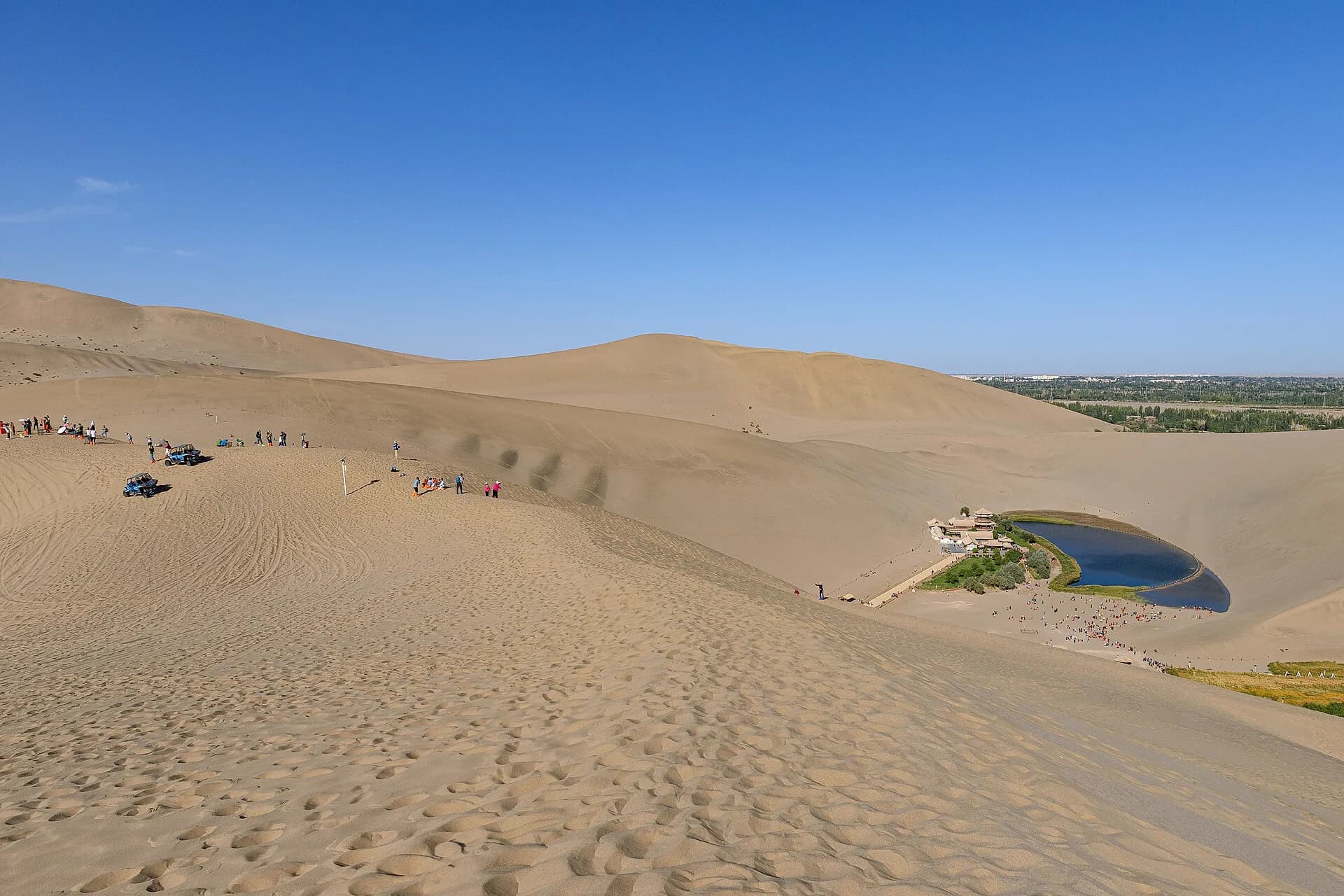
Save the exact Leiyin Temple Amap pin, at 鸣山路28号. The checked route from the temple to the Mingsha Mountain visitor centre was about 0.9 km / 12 minutes on foot, or 1.1 km / 4 minutes by car. Amap also returned Dunhuang bus 3 for this short leg, but walking avoids waiting in mild daylight.
Make Leiyin the first stop. Leave enough daylight to reach the correct Mingsha entrance, complete ticket and identity checks, and follow the Mingsha Mountain and Crescent Lake plan. Do not leave the temple after dark and assume an unlit roadside shortcut or a ride will be available.
From Dunhuang Museum, the checked journey was about 3.4 km / 9 minutes by car. Bus 3 took about 26 minutes with roughly 530 metres of walking. Museum → Leiyin → Mingsha therefore creates a coherent interpretation-to-landscape day, provided every venue's live opening and Mingsha's dated ticket are protected.
Keep story, evidence and devotion separate
Leiyin's name naturally invites Journey to the West comparisons, and visitor posts frequently call it the “real” or “Little” Leiyin Temple. Enjoy the association as literature, but do not present the present site as the proven prototype of the fictional monastery. Likewise, claims that named historical monks stayed exactly here require stronger evidence than a modern panel or reposted caption.
Dress with covered shoulders and knees, keep voices low, step around thresholds, and ask before photographing interiors, religious images, monks or devotees. Do not touch displays, use flash against instructions or enter residential courtyards. If a ceremony begins, the worshippers' use of the space comes first.
Leiyin works best as a modern interpretive pause: learn enough to see Dunhuang's Buddhist landscape more clearly, then carry that context onward without confusing reconstruction, reproduction and original heritage.