Xi'an old-city wall-root walk: a free route below the south wall
This is a street-level walk around the base of Xi'an City Wall, not a walk or bicycle ride on the rampart. The distinction matters. The wall-top attraction has gates, admission, stairs, closing times and separate bicycle rules. This route uses the public square, pedestrian streets, ordinary lanes and Huancheng Park below the wall. You can complete the core circuit without a City Wall ticket.
The route starts at Yongning Gate's South Square, passes through the gate area into Shuyuanmen, continues past Guanzhong Academy and along Sanxue Street to Xi'an Beilin Museum, then turns south at Wenchang Gate. It returns west beneath the wall through Huancheng Park and the Shuncheng lanes before ending at Yongningmen Metro. AMap's five walking legs total about 2.4 km and 34 minutes of pure moving time. For the places to mean anything, allow 2.5–3.5 hours without the museum, or 4.5–6 hours if you enter Beilin.
The route works because it shows the wall from the city it enclosed. You see a ceremonial gate from below, a craft street shaped by calligraphy, a museum built around texts carved in stone, an active neighbourhood lane and the green strip between masonry, moat and ring road. It is also easy to shorten: Wenchang Gate, Beilin and Yongning Gate all give practical exit choices.
Decide which version you are walking
| Version | Start | Best timing | Total time | What you pay for |
|---|---|---|---|---|
| Free afternoon loop | About 2.5–3 hours before sunset | Daylight in Shuyuanmen, warm light in the park, blue hour at Yongning | 2.5–3.5 hours | Nothing on the core route |
| Beilin culture loop | Usually 13:00–14:00, subject to your reserved museum time | Museum first enough to avoid last-entry pressure, then park near sunset | 4.5–6 hours | Beilin ticket only |
| Fast architecture loop | Any comfortable daylight hour | South Square → Shuyuanmen → Wenchang → park return | 90–120 minutes | Nothing |
| Wall-top alternative | Use a confirmed open wall gate | Daylight plus sunset on the rampart | Separate visit | City Wall ticket; bicycle extra if operating |
Do not combine the museum, a full rampart circuit and this wall-root walk in one afternoon. They are three different experiences. If your priority is crenellations, corner towers and riding the 13.74 km rectangle, use the detailed Xi'an City Wall guide. If your priority is calligraphy and sculpture, reserve enough attention for the Beilin Museum guide and treat this walk as its approach and evening exit.
Save these exact AMap pins
Save the Chinese names. Searching only for “South Gate,” “Beilin” or “academy” can return a district, a wall entrance or a place on the wrong side of the gate.
- Yongningmen Metro Station — 永宁门站: the reliable start and final exit.
- Yongning Gate South Square — 永宁门南广场: free public-space opening view.
- Yongning Gate tower — 西安城墙永宁门: use only if you choose the paid wall-top branch.
- Shuyuanmen Pedestrian Street — 书院门步行街: western entrance to the calligraphy street.
- Guanzhong Academy — 关中书院: exterior context; do not assume visitor entry.
- Xi'an Beilin Museum — 西安碑林博物馆: optional, separately ticketed museum.
- Wenchang Gate — 文昌门: the turn from the old-city lanes to the wall-root park.
- Huancheng Park at Wenyi North Road — 环城公园(文艺北路): practical anchor for the westbound below-wall section.
Also save three toilets instead of trusting a generic map icon: the public toilet near Shuyuanmen, the Xianing Xuexiang public toilet near Sanxue Street and the public toilet near the Yongning wall exterior. A mapped facility can be cleaning, closed or hard to see, so use the first convenient open one rather than postponing everything until the finish.
The route at a glance
| Leg | AMap baseline | What happens |
|---|---|---|
| South Square → Shuyuanmen | 0.9 km / 12 min | Read the wall from below, pass through the gate area and enter the old-city street network |
| Shuyuanmen → Beilin | 0.3 km / 5 min | Walk the craft street, see Guanzhong Academy's exterior and continue along Sanxue Street |
| Beilin → Wenchang Gate | 0.2 km / 3 min | Leave the museum area and turn back toward the south wall |
| Wenchang Gate → Huancheng Park | 0.1 km / 2 min | Move from lane-scale architecture to the green wall-root strip |
| Huancheng Park → Yongningmen Metro | 0.9 km / 12 min | Walk west below the wall, finish at the moat and return to Line 2 |
These are navigation baselines, not a promise of an uninterrupted pavement. Signal-controlled crossings, temporary barriers, a closed gate passage or a wrong-level approach can add time. Keep live walking navigation on for the connection around each gate, but follow police, park and construction signs when they differ from the blue line.
When to start for daylight, sunset and blue hour
Use the actual Xi'an sunset time for your date, then count backward. Without the museum, reach South Square about 2.5 to 3 hours before sunset. Spend 35–50 minutes around Yongning and Shuyuanmen, 30–45 minutes on Sanxue Street and near Beilin, then arrive at Wenchang Gate 60–75 minutes before sunset. That puts the wall-root park in lower, warmer light and returns you to Yongning around sunset or early blue hour.
With Beilin, the reservation controls the day. Aim to enter around 13:00–14:00 and spend 90 minutes to 2.5 hours, depending on your interest. Do not book a late slot merely to make the exterior walk line up with sunset. The museum's own published information is inconsistent: its May 2025 full-opening notice states 09:00–18:30 with last entry at 17:00, while a Xi'an culture bureau listing published in May 2026 gives seasonal opening times. The time on your live reservation and any same-day official notice controls.
Season changes the route more than a fixed clock:
- Spring: begin in mid-afternoon. Fresh foliage softens the wall-root park, but wind and dust can lower contrast. Keep a lens cloth and avoid changing camera lenses in gusts.
- Summer: the stone square and open moat edge hold heat. Start later without the museum, use Shuyuanmen's shade first, carry water and let the park absorb the last direct sun. After heavy rain, old paving and painted crossings can be slick.
- Autumn: this is the easiest season for the full slow route. Start about three hours before sunset and protect 30–40 minutes for warm wall detail in the park.
- Winter: sunset comes early and cold wind collects in open spaces. Start earlier, shorten long stationary photo stops and expect darker gate tunnels. Ice is a reason to skip the moat-edge path and use the ordinary pavement.
Blue hour is more reliable than dramatic illumination. Do not build the walk around a promised show or a daily “lights-on” moment. A 2024 official public reply described full Yongning Gate illumination on Fridays, Saturdays and holidays, but operational practice can change. The 2026 wall lantern festival was a temporary event that ended on March 22, 2026. Check the wall's live official channel for your date; otherwise plan for ordinary city lighting and treat anything more as a bonus.
Leg 1: read Yongning Gate from below
Begin at Yongningmen Station and follow the signed exit toward the South Gate square. Elevators and escalators may emerge on different sides of a wide road, so do not choose an exit by number from an old screenshot. Follow current station signs and use a controlled crossing. The first target is the South Square, outside the paid wall attraction.
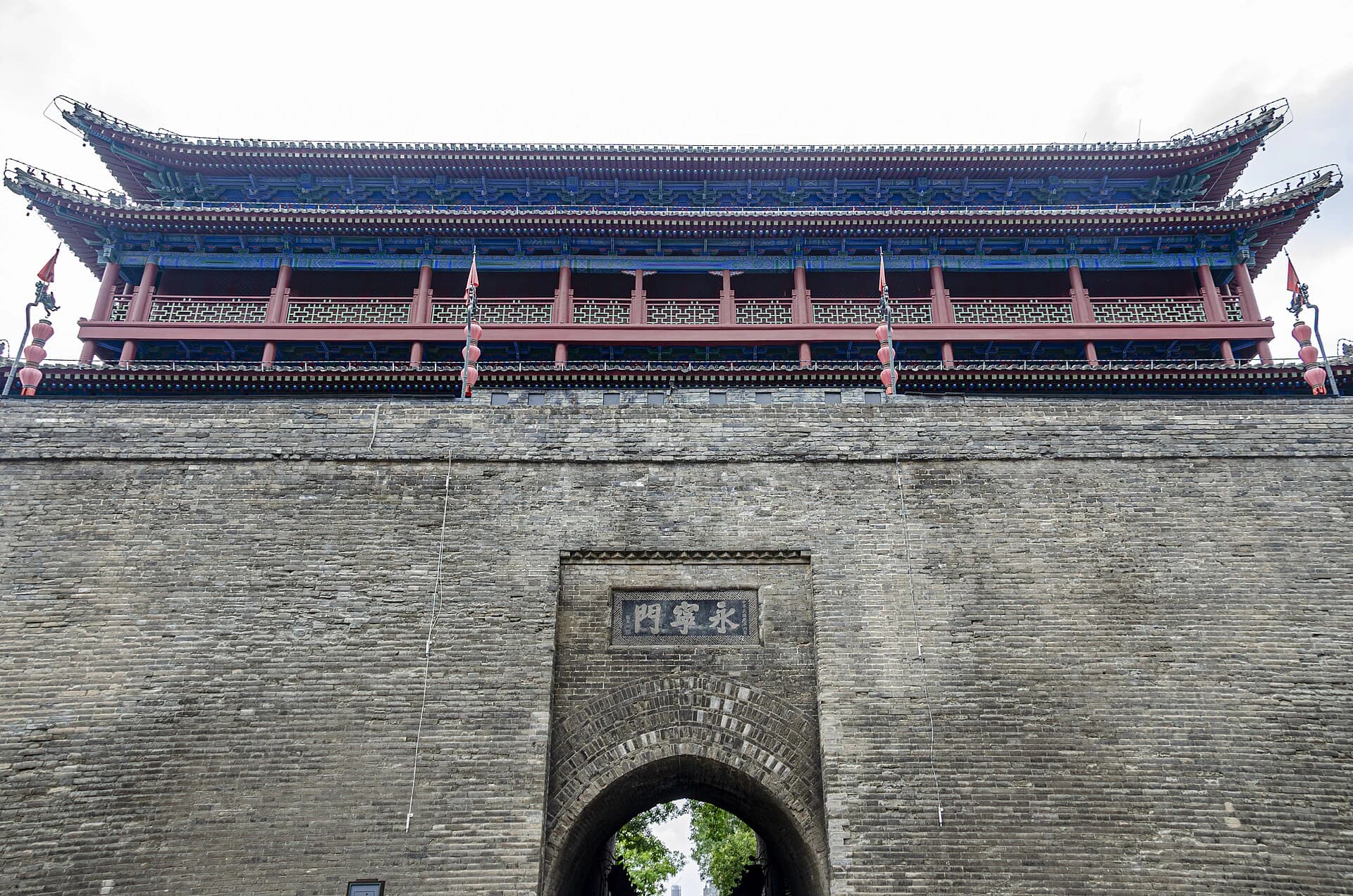
Stand far enough back to see the sequence rather than one roof: moat, wall face, gate opening, tower and the modern city beyond. A gate was a defensive system, not a decorative doorway. Even from the public ground level, you can see how the wall controls movement and how the arch compresses a broad city approach into a narrow passage.
This is also where the free route can accidentally become a paid visit. Ticket windows and access signs lead toward the rampart. Continue only if you intentionally want to enter the wall attraction. The official scenic site currently lists South Gate access from 08:00 to 22:00, and a Qujiang pricing reply confirms a standard adult ticket of CNY 54 and half-price ticket of CNY 27. Live checkout, identification rules, gate status and same-day notices still control. The Trip.com City Wall listing is useful for checking exact dated inventory, but this street loop does not require it.
For the core walk, follow the public pedestrian route through or around the gate into the old city, then turn east toward Shuyuanmen. Do not cross a traffic lane to reach a more centred view. The square and signed pavements give enough space for the photograph without using a median, tunnel carriageway or closed ceremonial area.
Leg 2: Shuyuanmen and the Guanzhong Academy exterior
AMap's baseline from South Square to Shuyuanmen is 0.9 km / about 12 minutes, but allow 25–40 minutes with the gate and street transition. Shuyuanmen (书院门, “Academy Gate”) is more than a souvenir lane. Its visual language comes from calligraphy: brushes, paper, ink, seals, rubbings, framed characters and shop signs. Some stores are serious businesses serving artists; others sell inexpensive decorative objects. Look before assuming every object is old or handmade.
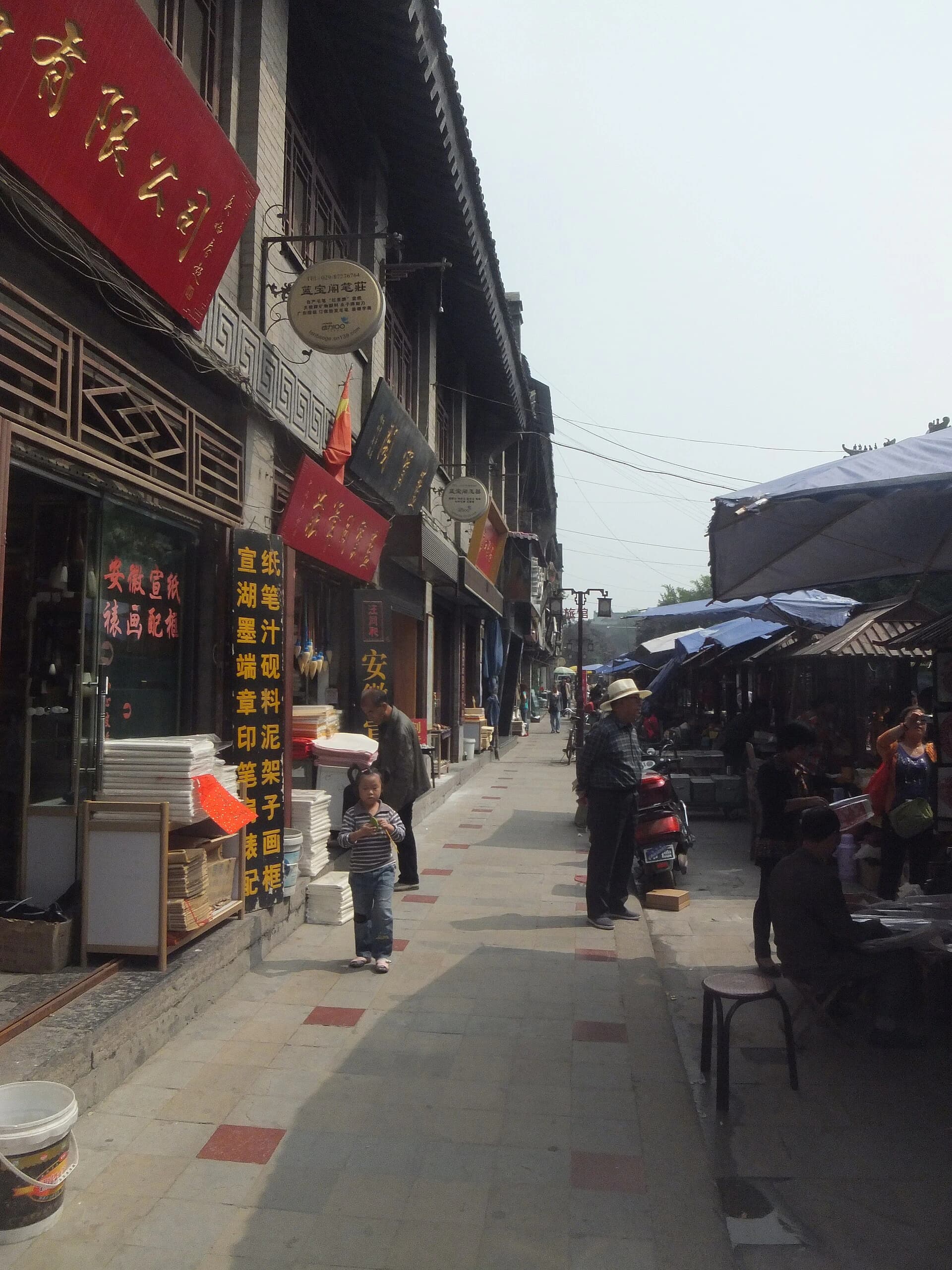
Walk on one side for ten minutes before doubling back for details. This prevents the common stop-start pattern that blocks shop doors. Ask before making a close photograph of a calligrapher, a customer, a price sheet or the inside of a store. A shopfront visible from the public lane is not blanket consent to photograph everyone working behind it. Buy because you want the object, not as a fee for an unrequested portrait.
Guanzhong Academy (关中书院) gives the street its historical anchor. Use the exterior gate and plaque as the dependable stop. The compound has institutional uses and access can change; do not walk through a gate, classroom or courtyard simply because another visitor did. If an entrance is visibly open to visitors, follow the posted boundary and staff instructions. If not, the exterior tells enough of the story: an educational institution helped create the book, ink and calligraphy economy still represented on the street.
This is the best early rest point. Choose tea, a simple drink or a small snack from a visibly open business, then use the mapped toilet near the eastern half of the street. Save a full meal for after the narrow lanes. Greasy takeaway and a camera bag are a poor combination, and aromatic food should not be carried into Beilin Museum.
Leg 3: Sanxue Street and the Beilin decision
Continue east from Shuyuanmen along the public lane toward Sanxue Street (三学街). AMap measures only 0.3 km / about 5 minutes from the Shuyuanmen pin to the museum, but this section deserves 20–35 minutes. The change is subtle: tourist-facing craft shops give way to a quieter mixture of walls, gates, local movement and institutional entrances.
Keep the group compact and leave room for bicycles, deliveries and residents. Do not use a residential doorway as a portrait set, move chairs, lean equipment against old walls or ask people to wait while you repeat a walking shot. In a lived-in old city, the most respectful photograph is often a wider street frame in which people remain small and incidental.
At Xi'an Beilin Museum, make a deliberate choice:
Enter Beilin if inscriptions are central to your day
The museum's May 2025 notice set full admission at CNY 85 and half-price admission at CNY 42 for a two-year implementation period beginning May 12, 2025. It also describes real-name timed booking through the official WeChat service account, website and Alipay channel. Bring the passport or identity document used for the reservation. Compare the dated Trip.com Beilin Museum listing if useful, but the museum's own reservation, document and security rules control.
Allow at least 90 minutes. The museum is not a quick room of stone slabs: the historic Confucian Temple, stele rooms, sculpture and newer northern galleries reward a selective route. Finish before closing pressure forces you through the last rooms, then rejoin this walk outside.
Stay outside if sunset and street texture are the priority
The entrance area and surrounding lane are enough to connect the route's calligraphy theme without buying a ticket. Continue south toward Wenchang Gate. You can return on another morning for a focused museum visit. There is no failure in keeping the free walk free.
Museum toilets are for admitted visitors and cannot be your evening backup. Use the public facility near Sanxue Street before continuing if needed. For food, wait until after Wenchang Gate or the final Yongning exit. A long sit-down meal here usually sacrifices the park's best light.
Leg 4: Wenchang Gate changes the scale
From Beilin to Wenchang Gate, AMap gives 0.2 km / about 3 minutes. Walk it slowly. The lane suddenly meets the mass of the south wall, and the view changes from shopfront scale to fortification scale. Wenchang Gate is also the clearest emergency cut point in the middle of the route: if weather turns, someone is tired or the museum ran late, leave the photo plan and navigate to the nearest operating transit or legal taxi pickup.
Do not assume Wenchang is open for paid wall entry or descent simply because an official notice once listed many access points. A 2025 Qujiang notice described 17 wall gates and the role of Huancheng Park, evidence that the attraction has multiple access options. Temporary events, maintenance and hour-specific controls can still close one. For this route, you do not need to enter the wall at all.
Turn toward the public wall-root park. The AMap anchor for Huancheng Park at Wenyi North Road is only 0.1 km / about 2 minutes from Wenchang Gate, but gate-level crossings and barriers may redirect you. Obey the visible pedestrian route. Never step into the road, climb a slope or pass a fence to preserve an imagined straight line.
Leg 5: walk west beneath the wall to Yongning
Huancheng Park (环城公园) and the Shuncheng edge provide the route's quietest visual contrast. The wall rises on one side; moat, trees, road and ordinary city life occupy the other. Walk west toward Yongning Gate. AMap's final baseline from the park anchor to Yongningmen Metro is 0.9 km / about 12 minutes, but photography and crossings make 35–60 minutes more realistic.
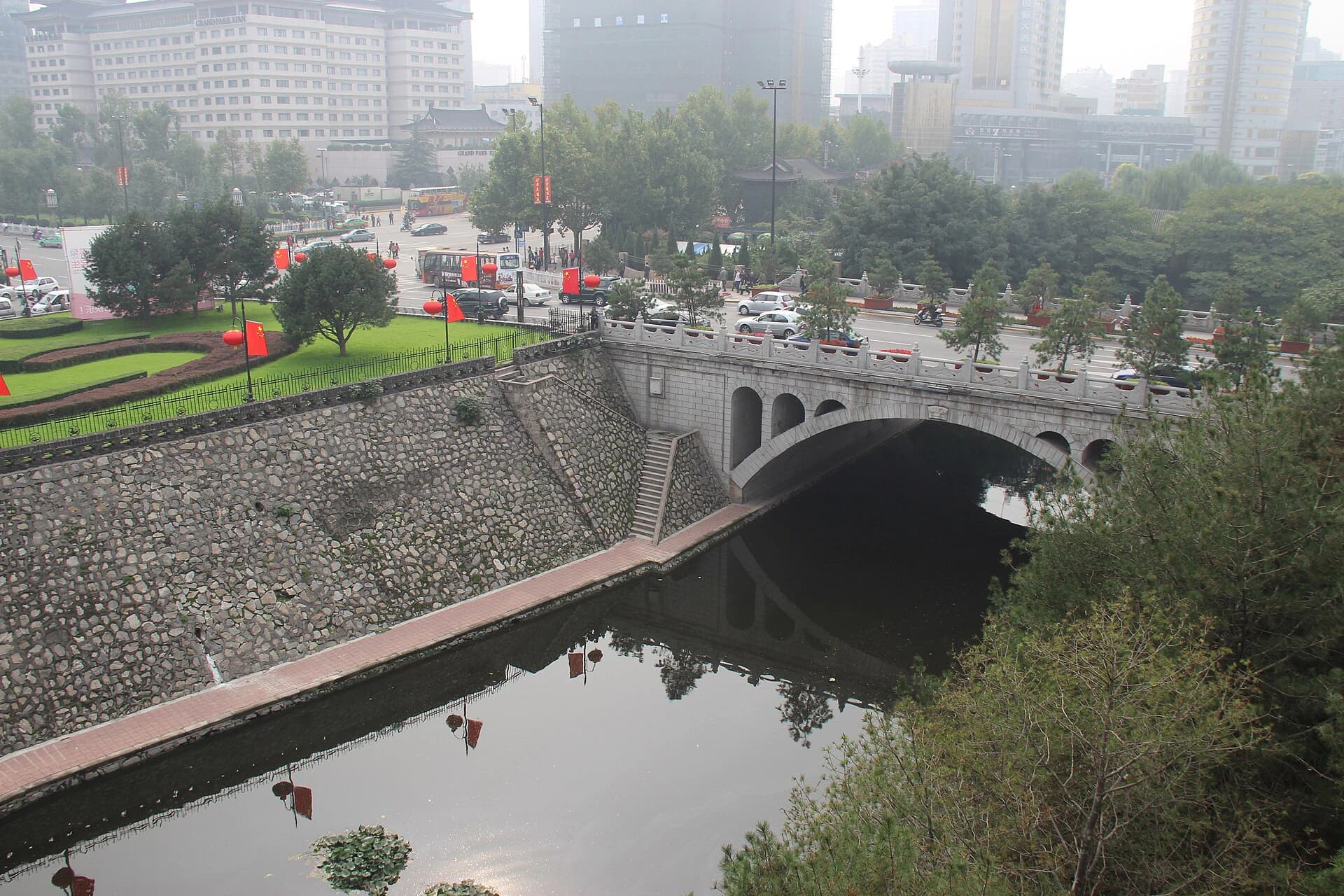
Stay on surfaced public paths. Sections near the wall or water may be fenced, landscaped, wet or temporarily closed. The moat edge is not a tripod platform, and a gap in shrubs is not an invitation to climb closer. If a path narrows, keep moving and make the picture from the next broad area.
The useful photographic sequence is wall face first, park life second and Yongning Gate last. Early in this leg, side light reveals brick colour and repeating buttresses. Closer to Yongning, widen the view to include water, trees and the gate. At blue hour, the sky still separates the tower roof from darkness; later, bright lamps and black sky create harsher contrast.
End on the side of the road that gives the safest approach to Yongningmen Metro. Do not make a final dash across traffic because an entrance is visible. Follow the controlled crossing and current station signs. If the station is crowded after an event, wait in the open square, walk to a clearly legal taxi pickup or continue north only if your next destination is intentional.
Free route, Beilin ticket or City Wall ticket?
| Experience | What you see | Cost baseline | Key constraint |
|---|---|---|---|
| Wall-root loop | Gate exterior, old-city lanes, wall face, moat and park | Free | Public paths can divert around gates or works |
| Beilin Museum | Steles, calligraphy history, sculpture and historic courtyards | CNY 85 full / 42 half in the May 2025 official notice | Timed real-name booking; published hours conflict |
| City Wall top | Rampart width, crenellations, elevated old/new city contrast | CNY 54 full / 27 half in the current official pricing reply | Separate gate hours, stairs, exits and bicycle rules |
Tickets are independent. A wall ticket does not include Beilin; a museum ticket does not put you on the rampart. The free park and streets do not become ticketed simply because they sit beside both attractions.
If you have only one Xi'an afternoon, choose according to attention. Enter Beilin if written history and sculpture matter most. Enter the wall if elevated architecture and a longer exposed walk matter most. Keep the free loop if you want changing neighbourhood scale, low commitment and photography around sunset.
Twelve photographs this route can deliver
Treat these as outcomes rather than boxes to tick. A coherent set of eight is better than twelve rushed frames.
- Yongning Gate in its full setting: use 1× on a phone or 24–35mm on a camera; include square, wall and tower so the gate reads as a system.
- Archway compression: from a legal pedestrian line, centre the arch only when foot traffic opens. Keep moving if stopping would obstruct the passage.
- Old gate and modern street: frame a tower edge against the city beyond to show continuity rather than pretending the old city is a period set.
- Shuyuanmen shopfront rhythm: use 35–50mm or 2×, square the verticals and wait for space between pedestrians.
- Brush, paper and ink detail: ask permission, use window light and focus on one material rather than photographing an entire cluttered counter.
- Guanzhong Academy exterior: include the plaque and a little street context; do not push through a threshold for symmetry.
- Sanxue Street layers: photograph down the lane with a person small in the distance, keeping private doorways incidental.
- Wenchang Gate through trees: use foliage as an edge rather than hiding half the gate behind a branch close to the lens.
- Repeating wall brick: use 2× or 50–85mm to compress buttresses and texture; side light is more useful than maximum saturation.
- Park life at respectful distance: show walking, exercise or rest as part of the city, avoiding identifiable close portraits without consent.
- Moat reflection: lower the phone only from a broad, dry public path; never step onto a bank or over a barrier for a cleaner mirror.
- Blue-hour South Gate: brace against a stable public railing or use two hands, expose for the illuminated tower and keep colour natural.
For moving people in daylight, a camera shutter around 1/250 second keeps an ordinary walking figure clear; use 1/500 second for bicycles. In the park, aperture priority around f/5.6–f/8 gives architecture and context enough depth when light allows. Raise ISO before accepting blur.
On a phone, use 1× as the default. The 0.5× lens helps only inside a tight legal viewpoint or near an arch; it can bend walls and stretch people at the edge. Use 2× for tower layers and brick compression. At night, tap the gate, lower exposure about −0.3 to −0.7 EV, hold for a second after pressing and make several frames. Night mode is useful only if people are not moving through the composition.
Tripods are a poor fit in Shuyuanmen, gate passages and narrow park sections. They turn a working path into a studio and invite collisions. If you carry one, use it only where staff permit and a broad space leaves a complete route around you. Never place feet on tactile paving.
Public-space and privacy boundaries
The route's most photogenic places are also working spaces. Apply a simple rule: architecture from an open public path is generally the safe baseline; a person, shop interior, academy courtyard or residential threshold needs more care.
- Guanzhong Academy: exterior unless live signs and staff visibly allow visitor entry.
- Shuyuanmen shops: ask before close details, portraits, video narration inside or photographing transactions.
- Sanxue Street homes: do not pose in doorways, peer through windows or treat residents as costume background.
- Beilin: follow current museum rules on flash, tripods, bags and gallery photography; never touch stone or attempt a rubbing.
- City Wall and park: barriers, landscaped slopes, maintenance areas and moat banks are boundaries even when another person crosses them.
- Gate passages: keep the walking line open. A symmetrical frame never outranks pedestrian safety.
Children deserve particular restraint. Keep them unidentifiable in wide context unless a guardian clearly agrees. For street performers or working artisans, do not assume a tip purchases unlimited image rights; ask, understand the expected payment and accept refusal immediately.
Food, water, rest and toilets
The route is short enough that you do not need to turn it into a snack crawl. Eat a normal meal before starting, then use Shuyuanmen for tea or a short seated break. Carry water in summer because the South Square and final park segment can be exposed. Do not depend on a viral stall, a specific shop name or a closing time copied months earlier; choose a visibly open place that does not force a detour.
For a full dinner, finish first. South Gate has broad choices, while the Bell Tower area is an easy central continuation by metro or a purposeful walk. The Muslim Quarter deserves its own food plan rather than becoming an automatic appendix to every old-city route. If your day already includes Beilin, a calm noodle meal near the finish is usually more enjoyable than another queue.
Use public toilets when you pass them. The Shuyuanmen and Sanxue-area pins are useful before the park; the Yongning exterior pin is the backup near the finish. Carry tissues and expect a squat-style option. A café purchase does not guarantee a customer toilet, and museum facilities cease to be an option after you leave or after closing.
Benches and low walls are not equally appropriate places to sit. Use signed seating and broad park areas. Do not sit on heritage masonry, a shop threshold or a resident's doorstep. In heat, one ten-minute shaded stop before Wenchang is more effective than repeated unplanned pauses in the open square.
Rain, heat, air quality and seasonal trade-offs
In light rain, Shuyuanmen and the wall's wet brick can photograph beautifully, but polished stone, painted road markings and leaves become slippery. Put the camera away for crossings. Skip the moat reflection if reaching it requires leaving the surfaced path. Beilin can provide a substantial indoor branch only if you already have valid entry; it is not a guaranteed walk-in rain shelter.
In heavy rain or thunder, end at the nearest safe transport point. The gate area, trees and moat are not worth waiting under during lightning. Use Yongningmen Metro for the start side or navigate from Wenchang/Beilin to a legal pickup. Never shelter in a vehicle tunnel or under a temporary structure.
In summer heat, walk the craft lanes first, refill before the park and move the final segment closer to sunset. Pale paving and wall brick radiate heat even after direct sun softens. Wear a hat and carry more water than the distance suggests. If anyone becomes dizzy, stop the route and cool down indoors.
In winter, wind at the moat can make a modest temperature feel severe. Gloves help camera handling; a spare battery matters more than a large lens. Snow and frost simplify the colours but worsen footing, especially near ramps, kerbs and shaded stone.
On a hazy or high-pollution day, work closer. Photograph signs, brick, ink tools and layered arches rather than waiting for a distant skyline. Check the current air-quality reading and reduce prolonged outdoor exertion if official health guidance recommends it.
Accessibility and uneven-surface reality
This route stays at street level, but it is not guaranteed step-free. Old paving, kerbs, tactile strips, narrow shopfront pinch points, gate approaches, park slopes and temporary detours interrupt an otherwise short line. The wall itself may force a longer crossing route than the map suggests. Beilin's historic and new areas also involve substantial walking and surface changes.
Wheelchair users, travellers with walkers and families with strollers should treat each leg independently. At Yongningmen Station, follow current elevator signs rather than an old exit number. At any gate, use the signed accessible crossing even if it adds distance. If the park entrance has steps or a steep ramp, remain on the parallel public pavement and rejoin at a broad access point; the route's story does not depend on one exact path.
The paid wall top requires its own accessibility check. Lifts or accessible entries at one gate do not guarantee an accessible exit at the next. Contact the scenic area using the current details on its official website before buying a one-way plan.
Night exits and useful extensions
The default exit is Yongningmen Metro Station on Line 2. It is the cleanest finish because you return to a major signed transport point rather than searching for a car beside event barriers. Check the final train in the station's live display. Service times change, and a published attraction closing time is not a transit guarantee.
If you are tired at Wenchang Gate, end there. Navigate to the nearest open station or legal taxi pickup based on the live map rather than walking west only to complete the loop. If weather turns near Beilin, the museum entrance is not a ride-hail bay; walk to a road where stopping is permitted.
For an evening extension, continue to the Bell Tower for a central-city night view. Do it after a meal and only if your energy remains good. The Big Wild Goose Pagoda belongs to the southern Qujiang area and is better treated as a separate half-day, not a final walking leg from the wall. For a balanced first visit, place this route within the two-day Xi'an itinerary and give the Terracotta Warriors their own day.
The wall-root walk is successful when the city remains visible. Stay below the rampart, let the lanes lead into the museum district, use Wenchang Gate to change scale and return through the public park as daylight fades. You will understand more of Xi'an's old city than a hurried climb, and you will still have the wall-top experience available for a day when its ticket, weather and time genuinely fit.
Image credits: Yongning Gate by YikyuenG, CC BY-SA 4.0, via Wikimedia Commons. Shuyuanmen photograph by Wolfgang Michel, CC0, via Wikimedia Commons. South Gate moat photograph by Gary Todd, CC0, via Wikimedia Commons.