Mao'er Mountain Yanji
Mao'er Mountain National Forest Park (帽儿山国家森林公园) is Yanji's easiest high viewpoint and its best break from markets, restaurants and photo streets. The official provincial profile places the main summit at 517.2 metres and describes a boardwalk trail system through a protected urban-edge forest. This is not a wilderness expedition, but wet boards, winter ice and a dark descent still matter.
Allow 1.5–2.5 hours at the park, plus transport. Recent visitors report reaching the top in roughly 20–40 minutes, yet that is an individual pace, not a promise. Families, photographers and anyone stopping at viewpoints should budget longer.
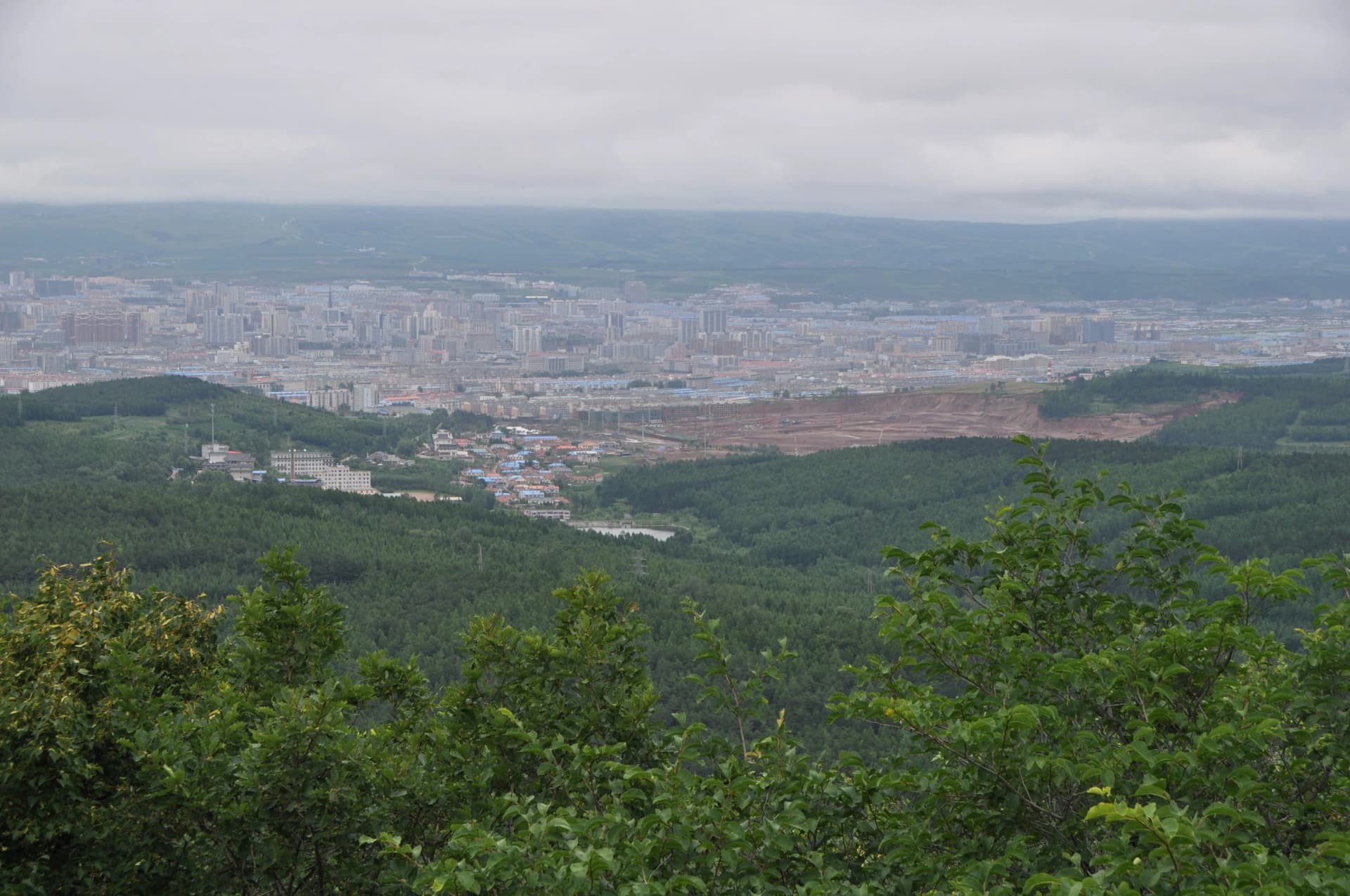
Photo: Yoshi Canopus · Source · CC BY-SA 4.0
Pick the visit that matches the weather
Daylight forest walk
Choose this when visibility is uncertain, the ground is damp or you want a low-pressure outing. Follow the signed main boardwalk, stop at the first useful city viewpoint and continue to the summit only if surfaces and energy are good. Turning back from a lower viewpoint is a complete visit, not a failed climb.
Sunset and city lights
Check the day's sunset time and aim to reach the trailhead 45–60 minutes before sunset, not the summit at sunset. This leaves time for the ascent, viewpoint crowding and changing light. Visitor reports consistently mention wind at the upper platform; summer visitors also report insects.
If you remain until the city lights appear, carry a charged phone and a separate small torch. A phone flashlight is a poor backup on steps when its battery is also needed for navigation and a ride home. Descend as soon as light fades unless the route is clearly illuminated and officially open.
A simple route with no invented ridge traverse
At the entrance, photograph the current trail map and check whether the signed loop is fully open. Use this sequence:
- Main entrance and lower forest boardwalk.
- The first open city-view platform for an effort check.
- Summit observation structure if weather and steps are comfortable.
- Return by the other signed, open side of the loop, or retrace the ascent if staff have closed it.
Some visitors prefer the right-hand ascent because views open earlier, but construction, ice or fire controls can change circulation. Do not leave the maintained route to copy a social-media shortcut. Forest staff actively enforce fire-prevention rules; smoking and open flames do not belong anywhere on the climb.
Admission and same-day operating checks
The forest park is commonly visited as a public city park, but do not build a trip around an assumed permanent fee or schedule. Before leaving, check the current local notice for admission, gate hours, fire-season controls, maintenance and any observation-platform closure. There is no reason to buy a broad tour merely for this compact walk.
After heavy rain, strong wind, snow or freeze-thaw weather, treat the operator's closure or caution as decisive. Clear air matters more than a particular month: a cloudy summer evening can reveal less than a crisp winter afternoon.
Getting there and securing the return
Use 帽儿山国家森林公园 for the entrance in your map. The park lies south of central Yanji, close to the Korean Folk Village. Taxi or ride-hailing is the most predictable approach; buses can be useful in daylight, but routes, last services and exact stops must be checked live.
Sunset creates the main transport trap. Recent visitors have reported buses ending before their descent and ride-hailing cars being scarce at the trailhead. Before climbing:
- save the pickup pin and hotel name offline;
- check the last usable bus rather than the last scheduled departure in the city centre;
- keep a taxi number or second ride app as backup;
- walk only to a better-lit official pickup area, not along an unlit road.
Do not place a train departure immediately after the hike. A short climb does not guarantee a quick vehicle at the bottom.
Effort, accessibility and practical supplies
Expect a sustained incline, boardwalk and many steps. Shoes with grip are more important than hiking boots. Carry water, insect repellent in warm months, a wind layer for the summit and gloves or traction appropriate to winter conditions. Do not feed wildlife or leave food waste in the forest.
The summit route is not step-free. Travellers with limited mobility can use the lower park as a forest break, but should ask staff which viewpoint is reachable without long stair sections. Toilets and vendors are more dependable near developed lower areas than at the top; arrive self-sufficient for a two-hour outing.
Pair the south side without overloading the day
The efficient pairing is Korean Folk Village first and Mao'er Mountain second. Keep the village visit short if sunset is the priority. If a costume session runs late, abandon the climb rather than racing unfamiliar steps in fading light.
Low cloud, rain or ice makes Yanbian Museum the better substitute. The mountain can move to the next clear morning; it does not need to share a day with every market and photo stop in Yanji.