Shiyan and Wudang Mountain
Updated October 29, 2026
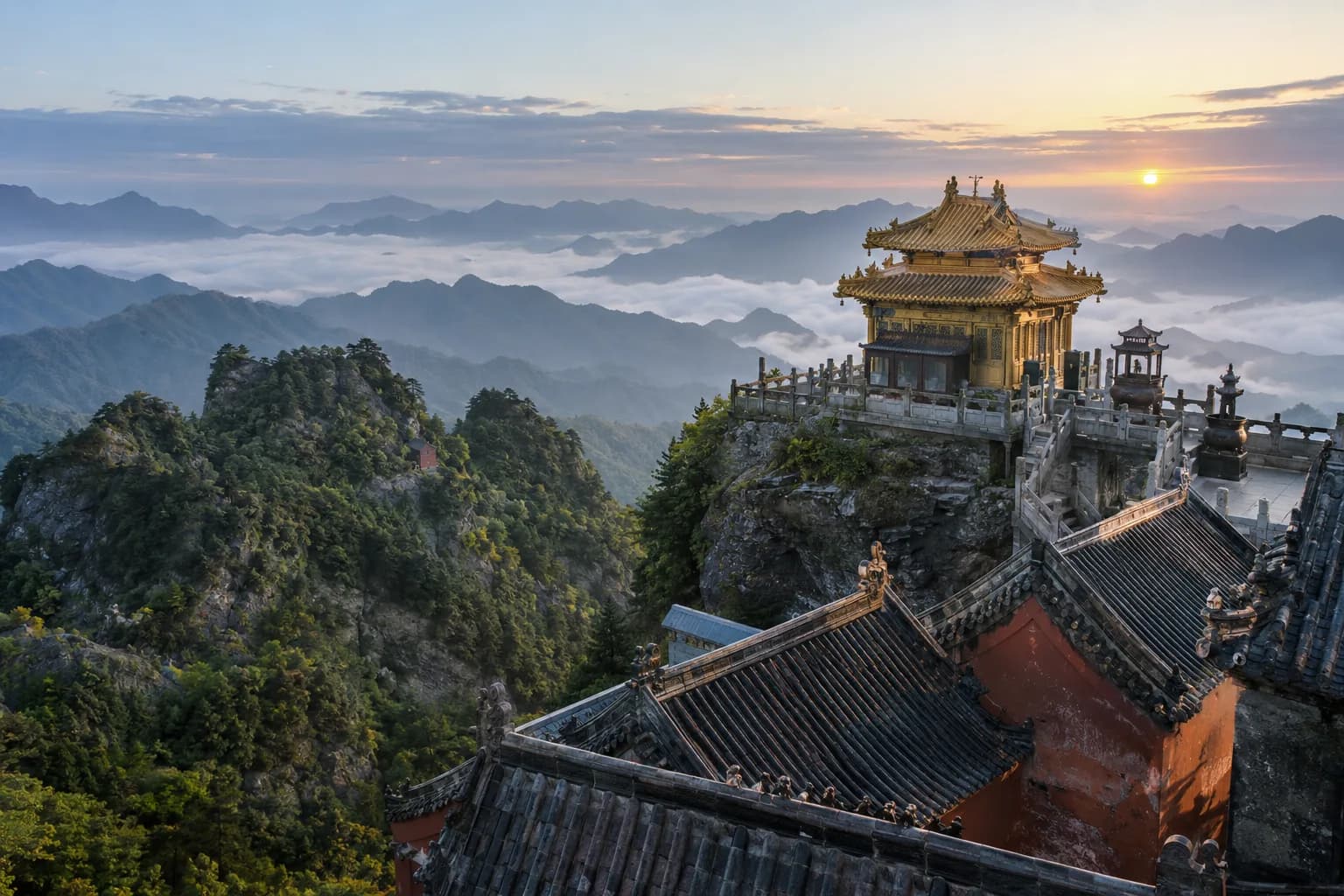
Wudang Mountain (武当山, Wǔdāng Shān) is China's foremost Taoist mountain and the home of Wudang martial arts. In the early 15th century the Yongle Emperor built a chain of imperial palaces and temples along its ridges, and that complex is now a UNESCO World Heritage site. The summit holds the Golden Hall (金殿), a gilded bronze hall cast in 1416, on Tianzhu Peak at 1,612 m. On the way up, Nanyan Palace (南岩宫) clings to a cliff face, and Zixiao Palace (紫霄宫) remains an active temple with morning chanting and a simple vegetarian canteen.
It is a living religious mountain rather than a museum, and that makes it worth two days. The mountain lies in Shiyan (十堰), the regional city in northwest Hubei, and the town of Wudangshan at its foot is reached from Wudangshan West high-speed rail station.
How the mountain fits together
Everything starts at the visitor center at the main gate in Wudangshan town. From there, compulsory scenic buses climb a Y-shaped road network:
- The trunk road climbs past Taizipo (太子坡), with its curving Nine-Bend Yellow River Wall (九曲黄河墙), and Xiaoyaogu (逍遥谷), where wild monkeys gather, to Zixiao Palace.
- From there it splits. One branch goes to Nanyan (南岩) and Wuyaling (乌鸦岭), the start of the old pilgrim stairways (神道) to the summit. The other goes to Qiongtai (琼台), the base of the cableway to the Golden Summit.
You can therefore reach the top in two ways: on foot from Nanyan, 3–3.5 hours of stone stairs, or by a 10-minute cable car from Qiongtai. The best plans use one for going up and the other for coming down, so you never repeat a section.
Tickets and transport costs (2026)
| Item | Price | Notes |
|---|---|---|
| Mountain entry | ¥126 | Real-name; bring your passport |
| Golden Summit + Zixiao Palace | ¥38 combined | Or ¥27 and ¥15 separately |
| Scenic bus | ¥76 | Cut from ¥90 on 5 July 2026, according to visitor and press reports |
| Qiongtai cableway | ¥45 one-way, ¥85 return | Reduced from ¥80/¥150 on 16 July 2026; runs about 08:00–16:30 |
The ticket package lasts several days, so an overnight on the mountain doesn't mean paying twice. Tickets and the cableway are now sold through the Wudangshan Smart Tourism (武当山智慧旅游) mini-program, which replaced the old cableway app in July 2026. On public holidays of three days or more, you must reserve a timed Golden Summit entry before you can buy the cableway ticket. Students and seniors receive reductions on presenting ID; the published rules have differed in detail, so ask at the gate.
Wudang Mountain tickets on Trip.com
Route 1: hike up, ride down (two days, recommended)
This is the classic route, and the one repeat visitors recommend most. You see the main palaces on day one, walk the historic pilgrim path on day two and never backtrack.
Day 1: gate to Nanyan
- Take bus 301 from Wudangshan West station to the visitor center (¥2, 25–30 minutes), collect tickets and pass security.
- Stop at Taizipo (about 40 minutes) for the curving red wall and a hall built on a single pillar supporting twelve beams.
- Stay on the bus to Zixiao Palace (1–1.5 hours). The path drops down to the main hall and climbs back out. If you're there between about 11:30 and 12:30, the temple serves a fixed vegetarian lunch for around ¥15. Arrive early, because dishes run out.
- Continue to Nanyan. From the bus stop it is about 20 minutes on foot to Nanyan Palace and the Dragon Head Incense (龙头香), a carved stone beam jutting out over the drop. In 2026 the palace's main hall was under restoration, but the cliff terraces and the Dragon Head remained open. Incense can no longer be burned there.
- Sleep at Nanyan or Wuyaling. Food is pricier than in town, and one visitor group paid about ¥200 for four dishes at a mountain restaurant.
Day 2: pilgrim stairs to the Golden Summit, cableway down
- After breakfast, start walking from Langmei Shrine (榔梅祠) past Huanglong Cave (黄龙洞) to Chaotian Palace (朝天宫), carrying two bottles of water per person.
- At Chaotian Palace the path forks. The Ming Pilgrim Path (明神道) is steeper and passes the First, Second and Third Heavenly Gates, the most atmospheric section. The Qing Pilgrim Path (清神道) is gentler. Both lead to Taihe Palace (太和宫) below the summit.
- Climb the last stairs to the Golden Hall and its terrace overlooking the ridges.
- Walk 15–20 minutes downhill to the Qiongtai upper cableway station. It is signposted and is not the way you came up. Ride down in about 10 minutes.
- From Qiongtai, take the bus straight back to the visitor center, about 40 minutes.
Keep an eye on the time: the last cableway down has been around 16:30 and the last scenic buses around 17:30. Ask the driver for the last bus from your stop, as times differ between branches.
For sunrise, some hikers sleep at Nanyan, leave Langmei Shrine around 03:30 with headlamps (parts of the path are unlit) and reach the summit for dawn. Low cloud often hides the sunrise, so take it as a night walk with a chance of a view.
Route 2: the low-effort version
If stairs are a problem, reverse the logic and ride up:
- Sleep at Qiongtai and take the first cable car around 07:30. That puts you on the summit before the first buses from the gate have even arrived, the quietest time on the mountain. Spend about an hour around the Golden Hall and Taihe Palace, then ride down by mid-morning.
- Ride the bus to Zixiao Palace for the vegetarian lunch, then Nanyan, whose 20-minute approach path is much easier than the summit stairs. Stop at Taizipo on the way out.
The same order works in one long day from the gate if you start with the first bus. A middle option is to ride up and walk down (about 7 km, around 2 hours), which is easier on the lungs but hard on the knees. Unless you are fit, don't attempt the long climb from Nanyan.
Temple etiquette
Wudang's palaces are working Taoist temples with resident monks and nuns. Dress modestly, keep your voice down in the halls and ask before photographing people or altars. Incense is provided at the halls where offerings are permitted; skip the expensive incense sold by touts at the bus stops. A few sellers approach visitors as "fated ones" and offer protective charms for a "donation" of around ¥99, and a polite no is enough. At Xiaoyaogu, the monkeys snatch food and bags, so don't feed them.
Learning tai chi at Wudang
Wudang's other draw is staying to practice. Dozens of martial arts schools and training camps around the mountain and town take short-stay students. Domestic camps are commonly sold as all-inclusive packages, for example five days and four nights for about ¥2,200 per person including dormitory, meals, lessons and a practice uniform. International schools with English-speaking teachers usually charge more and expect longer stays.
Recent students' advice on choosing a school:
- Ask for photos of the actual rooms, the teacher's background and a written daily timetable. Steer clear of schools that will only say "you'll see when you get here".
- Confirm exactly what is included: beds per room, meals per day, number of uniforms, station pickup and any extra fees.
- Skip schools that promise "quick mastery" or "secret" lineages. Five days is enough to learn a short form, not to master it.
- Pick a quiet location. Camps along the less-visited southern paths make concentration easier than those beside the busy summit corridor.
- Prepare for early mornings. Practice often starts at 06:30, and the first week of stance training leaves almost everyone sore.
If you only want a taste, a few hotels near Qiongtai run short guqin, meditation or incense-seal classes for guests. Ask before booking, because programs change.
Where to stay
| Base | Best for | Trade-off |
|---|---|---|
| Wudangshan town (near the gate) | Cheapest rooms, most restaurants, station access | You need the first bus to get any early start |
| Nanyan / Wuyaling | Hiking up the next morning; quiet evenings | Higher prices, simpler food |
| Qiongtai | First cable car up and easy summit access | Little else around in the evening |
| Inns on the pilgrim paths | Breaking the climb or catching sunrise | Basic rooms; carry only a light bag |
Leave large suitcases at your town hotel or at the station's left-luggage service; the mountain buses and stairways are not built for them. One visitor paid about ¥300 for a clean double with heating at an inn on the Qing path in October 2026.
Compare Wudangshan stays on Trip.com
Getting there
- High-speed rail: Book to Wudangshan West (武当山西站), not Shiyan East, which is the city station much further from the gate. Trains from Wuhan (Hankou) take roughly 2–2.5 hours. Book trains on Trip.com.
- From the station: Take bus 301 to the visitor center for ¥2 (25–30 minutes), or a taxi for about 15 minutes.
- By air: Shiyan Wudangshan Airport has an airport bus to the scenic area of about 40 minutes.
- From Shennongjia: A direct bus has linked Muyu and Wudangshan at 09:10 on alternate days, plus a daily Muyu–Shiyan bus at 08:30, which lets you combine the two without going back to Wuhan.
When to go
April–May and October–November offer the best conditions for climbing stairs, with clear days more likely. From October onward, mountain rain and fog become more frequent; pack a light rain shell and shoes with real grip, since the stone steps get slippery. Summer is hot and humid in town but noticeably cooler on the ridge. In winter, snow and ice can pause the cableway and close steep paths, though the temples in snow are beautiful. Weekends and holidays bring long queues for the cableway and the summit, so a weekday is worth arranging.
Combine with
- Shennongjia: High forest and Dajiuhu, a natural continuation by direct bus.
- Wuhan: The provincial capital and main rail hub.
- Xi'an: The next big historical city to the northwest; check current rail times from Shiyan, since services are being upgraded.